Task 1
•Contractual - A contractual brief is a type of brief or contract where a media company is employed by the
client in order to complete a project within the brief which is set to specific guidelines which the media
company must follow. It will be very important for the media company to follow these guidelines and do
exactly what the client states within the brief, if they fail to do so this can result in a breach of contract and the
company could face legal actions.
A contractual brief is one set out by a company where you will have to work already pre-set guidelines so you
work to an already agreed brief.
•Commission - This brief is where a large media company will employ an other independent media company to
create and produce the product for them, and after the product has been made the larger company may go on
to be use the product for an external client who will pay the independent media company for making the
product and they could even get a cut of the royalties too. The brief is not negotiated between the company
and the client, however is negotiated between the two media companies.
This is like a sub-contractor eg a radio station might employ a an independent company to do them a jingle for
their radio show or even a car company may employ a radio station to create a jingle and will be give almost
complete free artistic license.
•Negotiated - This type of brief will be brought up if the co-operative brief given to the two of more media
companies that are competing the project have any issues between themselves about the brief or anything
they would like to clear up with the client. Through the negotiations the brief can then be changed in order to
suite every party taking part in the production. This could be anything from changing the appearance of the
product to changing the products content as well as keeping it to the guidelines set in the brief.
A negotiated brief is where all parties will sit down and try and discuss the best path to go down when it
comes to the brief so they negotiate too see what everyone can offer and platform ideas.
•Tender - This is where a client will advertise their brief and a production company will bring together a
proposal that they will pitch to the client, there could be multiple pitches to the client from many different
companies, so the client will then get the chance to choose the proposal that they think best suits their brief
and offer the job to that production company.
This is where a company will bring forward a presentation and then present ideas this will probably consist of
mood boards and ideas generation then narrowed down to a few potential options
•Formal - This this where a media company is given a brief by the client which outlines the product which they
are wanting to be made. This brief is very open and only gives enough information to be able to produce the
product, any issues or information that the media company would like to go over can be discussed during the
negotiations with the client. Both the client and the company employed by them will formally agree on the
project and the brief but it cannot always be legally binding.
This is where the media company will be given free rein on the project however it can be negotiated to see
what path the client would like to go down whether it be serious and more relaxed and less formal.
•Co-operative - Within this type of brief there are usually two or more companies that are hired by the client
to work to the brief they have written for the specific project they want to be completed. After both
companies have received the brief they can then proceed to work together to produce the product. If there is
a disagreement or conflict in ideas there can be a negotiated brief in order to resolve these issues.
This is where the company and the client will work together in a cohesive team to try and find the best way of
tackling the brief and then can work back and forth until they come up with the right idea.
•Informal - An informal brief is not documented and is usually of the verbal kind. It is where the client and the
company which they have employed simply discuss the requirements for the product they will be making and
ultimately agrees upon the project.
•Competition - This is where a client can put their brief out so it can be accessed by all of the different
production companies that are participating. It can sometimes been seen as a free competition as each
production company will complete the brief and the client can then judge which company has the best project
and as an award they have it published.
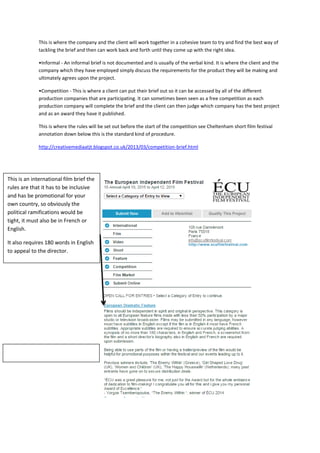
This is where the rules will be set out before the start of the competition see Cheltenham short film festival
annotation down below this is the standard kind of procedure.
http://creativemediaatjt.blogspot.co.uk/2013/03/competition-brief.html
This is an international film brief the
rules are that it has to be inclusive
and has be promotional for your
own country, so obviously the
political ramifications would be
tight, it must also be in French or
English.
It also requires 180 words in English
to appeal to the director.
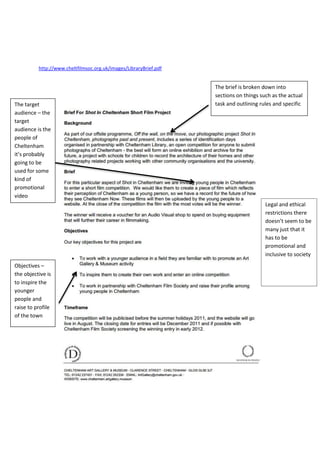
http://www.cheltfilmsoc.org.uk/images/LibraryBrief.pdf
The brief is broken down into
sections on things such as the actual
task and outlining rules and specificThe target
audience – the
target
audience is the
people of
Cheltenham
it’s probably
going to be
used for some
kind of
promotional
video
Objectives –
the objective is
to inspire the
younger
people and
raise to profile
of the town
Legal and ethical
restrictions there
doesn’t seem to be
many just that it
has to be
promotional and
inclusive to society
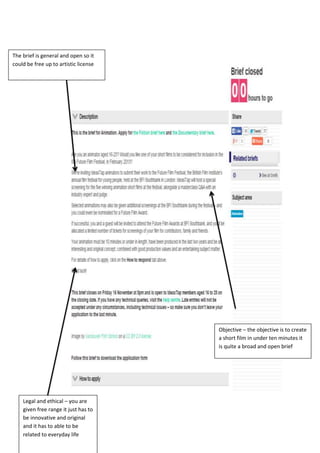
Legal and ethical – you are
given free range it just has to
be innovative and original
and it has to able to be
related to everyday life
Objective – the objective is to create
a short film in under ten minutes it
is quite a broad and open brief
The brief is general and open so it
could be free up to artistic license
Task 1

Task 1

  • 1.
    Task 1 •Contractual -A contractual brief is a type of brief or contract where a media company is employed by the client in order to complete a project within the brief which is set to specific guidelines which the media company must follow. It will be very important for the media company to follow these guidelines and do exactly what the client states within the brief, if they fail to do so this can result in a breach of contract and the company could face legal actions. A contractual brief is one set out by a company where you will have to work already pre-set guidelines so you work to an already agreed brief. •Commission - This brief is where a large media company will employ an other independent media company to create and produce the product for them, and after the product has been made the larger company may go on to be use the product for an external client who will pay the independent media company for making the product and they could even get a cut of the royalties too. The brief is not negotiated between the company and the client, however is negotiated between the two media companies. This is like a sub-contractor eg a radio station might employ a an independent company to do them a jingle for their radio show or even a car company may employ a radio station to create a jingle and will be give almost complete free artistic license. •Negotiated - This type of brief will be brought up if the co-operative brief given to the two of more media companies that are competing the project have any issues between themselves about the brief or anything they would like to clear up with the client. Through the negotiations the brief can then be changed in order to suite every party taking part in the production. This could be anything from changing the appearance of the product to changing the products content as well as keeping it to the guidelines set in the brief. A negotiated brief is where all parties will sit down and try and discuss the best path to go down when it comes to the brief so they negotiate too see what everyone can offer and platform ideas. •Tender - This is where a client will advertise their brief and a production company will bring together a proposal that they will pitch to the client, there could be multiple pitches to the client from many different companies, so the client will then get the chance to choose the proposal that they think best suits their brief and offer the job to that production company. This is where a company will bring forward a presentation and then present ideas this will probably consist of mood boards and ideas generation then narrowed down to a few potential options •Formal - This this where a media company is given a brief by the client which outlines the product which they are wanting to be made. This brief is very open and only gives enough information to be able to produce the product, any issues or information that the media company would like to go over can be discussed during the negotiations with the client. Both the client and the company employed by them will formally agree on the project and the brief but it cannot always be legally binding. This is where the media company will be given free rein on the project however it can be negotiated to see what path the client would like to go down whether it be serious and more relaxed and less formal. •Co-operative - Within this type of brief there are usually two or more companies that are hired by the client to work to the brief they have written for the specific project they want to be completed. After both companies have received the brief they can then proceed to work together to produce the product. If there is a disagreement or conflict in ideas there can be a negotiated brief in order to resolve these issues.
  • 2.
    This is wherethe company and the client will work together in a cohesive team to try and find the best way of tackling the brief and then can work back and forth until they come up with the right idea. •Informal - An informal brief is not documented and is usually of the verbal kind. It is where the client and the company which they have employed simply discuss the requirements for the product they will be making and ultimately agrees upon the project. •Competition - This is where a client can put their brief out so it can be accessed by all of the different production companies that are participating. It can sometimes been seen as a free competition as each production company will complete the brief and the client can then judge which company has the best project and as an award they have it published. This is where the rules will be set out before the start of the competition see Cheltenham short film festival annotation down below this is the standard kind of procedure. http://creativemediaatjt.blogspot.co.uk/2013/03/competition-brief.html This is an international film brief the rules are that it has to be inclusive and has be promotional for your own country, so obviously the political ramifications would be tight, it must also be in French or English. It also requires 180 words in English to appeal to the director.
  • 3.
    http://www.cheltfilmsoc.org.uk/images/LibraryBrief.pdf The brief isbroken down into sections on things such as the actual task and outlining rules and specificThe target audience – the target audience is the people of Cheltenham it’s probably going to be used for some kind of promotional video Objectives – the objective is to inspire the younger people and raise to profile of the town Legal and ethical restrictions there doesn’t seem to be many just that it has to be promotional and inclusive to society
  • 4.
    Legal and ethical– you are given free range it just has to be innovative and original and it has to able to be related to everyday life Objective – the objective is to create a short film in under ten minutes it is quite a broad and open brief The brief is general and open so it could be free up to artistic license