Target Costing
Definition
“Target Costing is defined as a cost management
tool
for reducing the overall cost of a product over its
entire life-cycle with the help of production,
engineering, research and design.”
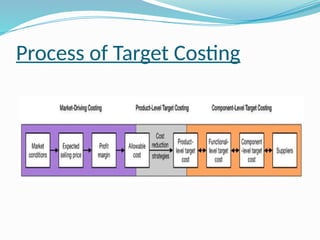
Process of Target Costing
Traditional costing Vs. TC
Traditional costing (Cost-Plus method)
 Market Research (needs and wants)
 Product Design
 Measuring Total cost
 Selling Price = Total cost + Profit %
Drawbacks of Traditional costing
If competitors selling price is equal to your total cost,
then you may bear loss.
Traditional cost-accounting systems have tended to focus
only on the production phase and have not paid enough
attention to the product’s other life-cycle costs like disposal
and recycling cost.
6 Key Principles of Target costing
1. Price-Led costing:
 Look at the market price and than subtract desired
profit and get the expected allowable target cost .
Target Cost = Selling Price – Profit Margin
2. Focus on the Customers:
To be successful at target costing, management must listen
to the company’s customers.
 What products do they want?
 What features are important?
 How much are they willing to pay for a certain level
of product quality?
Principles (continued )
3. Focus on Product Design
Design engineering is a key element in target costing.
This design activity includes specifying
Raw materials and components
Production facilities
Packaging and assembly
4. Focus on Process Design
Every aspect of the production process examined to make
sure that the product is produced as efficiently as possible.
Labour
Technology
Global sourcing in procurement
Principles (Continued)
5. Cross-Functional Teams:
Manufacturing a product at or below its target cost
requires the involvement of people from many different
functions in an organization:
 Market Research and Sales department
 Design engineering and Procurement
 Production engineering and Production scheduling
 Material handling and Cost management
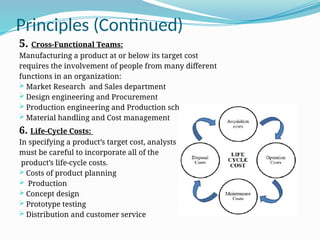
6. Life-Cycle Costs:
In specifying a product’s target cost, analysts
must be careful to incorporate all of the
product’s life-cycle costs.
 Costs of product planning
 Production
 Concept design
 Prototype testing
 Distribution and customer service
Application of TC
More Effective for New Product’s Planning and Designing
stages.
Why TC is effective for new products?
It is noted through studies, 70% to 80% cost is planned and
committed at design stages. If all focus is placed on cost
cutting at design stages then cost is managed according to
the plans efficiently and Effectively.
Mostly Used in;
Manufacturing Companies specially automobile industry
like Honda & Toyota
Healthcare
Construction
Advantages
 Stay competitive
 Ensure success in the market
 Deliver Product’s optimal value (decrease less imp.
Features)
 Reduced development cycle (eliminate unnecessary
steps)
 Maximum Customer satisfaction
 Allow teams to work together for reducing cost
 Provide cost control at all stages of pr0duct like
planning, designing, repairing and disposal/recycling.
Disadvantages
 Time consuming (delay in production)
 Pressure to cut cost may lead to organizational
conflicts. (teams conflicts)
 Too much cost reduction may hamper smooth
functioning of departments.
 Difficult to apply in service industries due to
intangibility and high level of specialties.
THANK YOU

Target_Costing_presentation by kalpana.pptx.pptx

  • 1.
  • 2.
    Definition “Target Costing isdefined as a cost management tool for reducing the overall cost of a product over its entire life-cycle with the help of production, engineering, research and design.”
  • 3.
  • 4.
    Traditional costing Vs.TC Traditional costing (Cost-Plus method)  Market Research (needs and wants)  Product Design  Measuring Total cost  Selling Price = Total cost + Profit % Drawbacks of Traditional costing If competitors selling price is equal to your total cost, then you may bear loss. Traditional cost-accounting systems have tended to focus only on the production phase and have not paid enough attention to the product’s other life-cycle costs like disposal and recycling cost.
  • 5.
    6 Key Principlesof Target costing 1. Price-Led costing:  Look at the market price and than subtract desired profit and get the expected allowable target cost . Target Cost = Selling Price – Profit Margin 2. Focus on the Customers: To be successful at target costing, management must listen to the company’s customers.  What products do they want?  What features are important?  How much are they willing to pay for a certain level of product quality?
  • 6.
    Principles (continued ) 3.Focus on Product Design Design engineering is a key element in target costing. This design activity includes specifying Raw materials and components Production facilities Packaging and assembly 4. Focus on Process Design Every aspect of the production process examined to make sure that the product is produced as efficiently as possible. Labour Technology Global sourcing in procurement
  • 7.
    Principles (Continued) 5. Cross-FunctionalTeams: Manufacturing a product at or below its target cost requires the involvement of people from many different functions in an organization:  Market Research and Sales department  Design engineering and Procurement  Production engineering and Production scheduling  Material handling and Cost management 6. Life-Cycle Costs: In specifying a product’s target cost, analysts must be careful to incorporate all of the product’s life-cycle costs.  Costs of product planning  Production  Concept design  Prototype testing  Distribution and customer service
  • 8.
    Application of TC MoreEffective for New Product’s Planning and Designing stages. Why TC is effective for new products? It is noted through studies, 70% to 80% cost is planned and committed at design stages. If all focus is placed on cost cutting at design stages then cost is managed according to the plans efficiently and Effectively. Mostly Used in; Manufacturing Companies specially automobile industry like Honda & Toyota Healthcare Construction
  • 9.
    Advantages  Stay competitive Ensure success in the market  Deliver Product’s optimal value (decrease less imp. Features)  Reduced development cycle (eliminate unnecessary steps)  Maximum Customer satisfaction  Allow teams to work together for reducing cost  Provide cost control at all stages of pr0duct like planning, designing, repairing and disposal/recycling.
  • 10.
    Disadvantages  Time consuming(delay in production)  Pressure to cut cost may lead to organizational conflicts. (teams conflicts)  Too much cost reduction may hamper smooth functioning of departments.  Difficult to apply in service industries due to intangibility and high level of specialties.
  • 11.