NAME : Nuralia Nadera Binti Mohamad 
UNIT : 1PISMP SAINS 
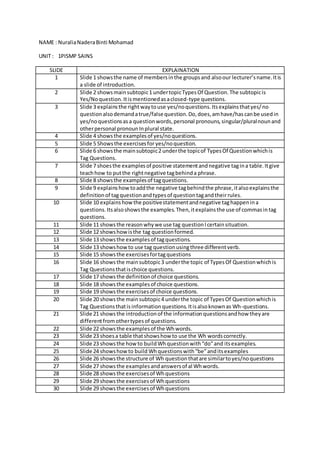
SLIDE EXPLAINATION 
1 Slide 1 shows the name of members in the groups and also our lecturer’s name. It is 
a slide of introduction. 
2 Slide 2 shows main subtopic 1 under topic Types Of Question. The subtopic is 
Yes/No question. It is mentioned as a closed-type questions. 
3 Slide 3 explains the right way to use yes/no questions. Its explains that yes/ no 
question also demand a true/false question. Do, does, am have/has can be used in 
yes/no questions as a question words, personal pronouns, singular/plural noun and 
other personal pronoun In plural state. 
4 Slide 4 shows the examples of yes/no questions. 
5 Slide 5 Shows the exercises for yes/no question. 
6 Slide 6 shows the main subtopic 2 under the topic of Types Of Question which is 
Tag Questions. 
7 Slide 7 shoes the examples of positive statement and negative tag in a table. It give 
teach how to put the right negative tag behind a phrase. 
8 Slide 8 shows the examples of tag questions. 
9 Slide 9 explains how to add the negative tag behind the phrase, it also explains the 
definition of tag question and types of question tag and their rules. 
10 Slide 10 explains how the positive statement and negative tag happen in a 
questions. Its also shows the examples. Then, it explains the use of commas in tag 
questions. 
11 Slide 11 shows the reason why we use tag question I certain situation. 
12 Slide 12 shows how is the tag question formed. 
13 Slide 13 shows the examples of tag questions. 
14 Slide 13 shows how to use tag question using three different verb. 
15 Slide 15 shows the exercises for tag questions 
16 Slide 16 shows the main subtopic 3 under the topic of Types Of Question which is 
Tag Questions that is choice questions. 
17 Slide 17 shows the definition of choice questions. 
18 Slide 18 shows the examples of choice questions. 
19 Slide 19 shows the exercises of choice questions. 
20 Slide 20 shows the main subtopic 4 under the topic of Types Of Question which is 
Tag Questions that is information questions. It is also known as Wh-questions. 
21 Slide 21 shows the introduction of the information questions and how they are 
different from other types of questions. 
22 Slide 22 shows the examples of the Wh words. 
23 Slide 23 shoes a table that shows how to use the Wh words correctly. 
24 Slide 23 shows the how to build Wh question with “do” and its examples. 
25 Slide 24 shows how to build Wh questions with “be” and its examples 
26 Slide 26 shows the structure of Wh question that are similar to yes/no questions 
27 Slide 27 shows the examples and answers of al Wh words. 
28 Slide 28 shows the exercises of Wh questions 
29 Slide 29 shows the exercises of Wh questions 
30 Slide 29 shows the exercises of Wh questions

Tape script Nuralia Nadera

  • 1.
    NAME : NuraliaNadera Binti Mohamad UNIT : 1PISMP SAINS SLIDE EXPLAINATION 1 Slide 1 shows the name of members in the groups and also our lecturer’s name. It is a slide of introduction. 2 Slide 2 shows main subtopic 1 under topic Types Of Question. The subtopic is Yes/No question. It is mentioned as a closed-type questions. 3 Slide 3 explains the right way to use yes/no questions. Its explains that yes/ no question also demand a true/false question. Do, does, am have/has can be used in yes/no questions as a question words, personal pronouns, singular/plural noun and other personal pronoun In plural state. 4 Slide 4 shows the examples of yes/no questions. 5 Slide 5 Shows the exercises for yes/no question. 6 Slide 6 shows the main subtopic 2 under the topic of Types Of Question which is Tag Questions. 7 Slide 7 shoes the examples of positive statement and negative tag in a table. It give teach how to put the right negative tag behind a phrase. 8 Slide 8 shows the examples of tag questions. 9 Slide 9 explains how to add the negative tag behind the phrase, it also explains the definition of tag question and types of question tag and their rules. 10 Slide 10 explains how the positive statement and negative tag happen in a questions. Its also shows the examples. Then, it explains the use of commas in tag questions. 11 Slide 11 shows the reason why we use tag question I certain situation. 12 Slide 12 shows how is the tag question formed. 13 Slide 13 shows the examples of tag questions. 14 Slide 13 shows how to use tag question using three different verb. 15 Slide 15 shows the exercises for tag questions 16 Slide 16 shows the main subtopic 3 under the topic of Types Of Question which is Tag Questions that is choice questions. 17 Slide 17 shows the definition of choice questions. 18 Slide 18 shows the examples of choice questions. 19 Slide 19 shows the exercises of choice questions. 20 Slide 20 shows the main subtopic 4 under the topic of Types Of Question which is Tag Questions that is information questions. It is also known as Wh-questions. 21 Slide 21 shows the introduction of the information questions and how they are different from other types of questions. 22 Slide 22 shows the examples of the Wh words. 23 Slide 23 shoes a table that shows how to use the Wh words correctly. 24 Slide 23 shows the how to build Wh question with “do” and its examples. 25 Slide 24 shows how to build Wh questions with “be” and its examples 26 Slide 26 shows the structure of Wh question that are similar to yes/no questions 27 Slide 27 shows the examples and answers of al Wh words. 28 Slide 28 shows the exercises of Wh questions 29 Slide 29 shows the exercises of Wh questions 30 Slide 29 shows the exercises of Wh questions