Learning as Problem Solving Created by Explorience Explore Learning;  Experience Success
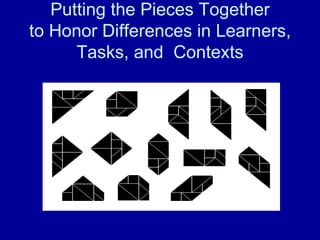
An Analogy Learning is like a problem or a puzzle to be solved.  You need to take all the relevant pieces and arrange them into a coherent picture, a coherent story. So, what are the relevant pieces or skills for solving learning problems? Imagine a set of Tangram pieces each of which represents an essential learning how to learn skill and can open doors to successful learning.
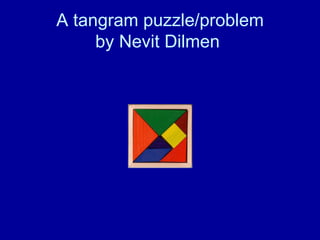
A tangram puzzle/problem by Nevit Dilmen
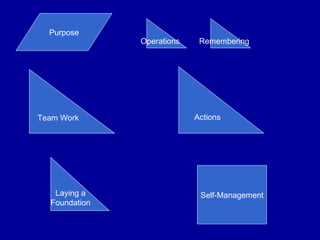
Self-Management Operations Purpose Remembering Laying a Foundation Actions Team Work
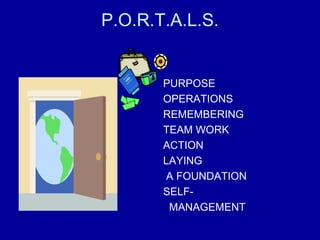
P.O.R.T.A.L.S. PURPOSE OPERATIONS REMEMBERING TEAM WORK ACTION LAYING A FOUNDATION SELF- MANAGEMENT
The pieces of a learning story Purpose (Your goal; the outcome you seek) Operations (How you will achieve the goal through Processing and Transforming Information and Ideas) Remembering (Holding information in Working Memory and Storing and Retrieving it from Long Term Memory) Team Work (Solving problems with help from others) Action (What  you do to demonstrate and disseminate your answer) Laying a Foundation (All problems are about something—the content—the information and ideas) Self-Management (You are in charge!)
Everybody has stories about learning. Each learner’s stories are  different… because learners are  different over time and from one another tasks are different contexts are different! Ev
Putting the Pieces Together to Honor Differences in Learners, Tasks, and  Contexts
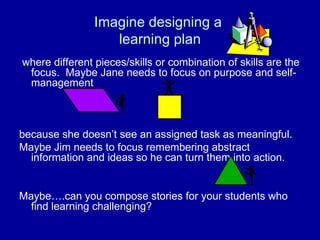
Imagine designing a  learning plan where different pieces/skills or combination of skills are the focus.  Maybe Jane needs to focus on purpose and self-management  because she doesn’t see an assigned task as meaningful. Maybe Jim needs to focus remembering abstract information and ideas so he can turn them into action. Maybe….can you compose stories for your students who find learning challenging?
Creating Your Learning Story * Somebody  (You as a  Self-Managed  learner and your  Teammates  in this particular context) * Wanted   (your  Purpose) ^ Operations  (processing (particularly  Remembering)  and transforming content) that lead to  Action. ^Content--  Lay a Foundation  of information and ideas. * But  (to be a problem, there must be obstacles) * So  (to be a solution, obstacles must be overcome!) Brought to you by:  www.Explorience1.pbworks.com

Tangram analogy

  • 1.
    Learning as ProblemSolving Created by Explorience Explore Learning; Experience Success
  • 2.
    An Analogy Learningis like a problem or a puzzle to be solved. You need to take all the relevant pieces and arrange them into a coherent picture, a coherent story. So, what are the relevant pieces or skills for solving learning problems? Imagine a set of Tangram pieces each of which represents an essential learning how to learn skill and can open doors to successful learning.
  • 3.
    A tangram puzzle/problemby Nevit Dilmen
  • 4.
    Self-Management Operations PurposeRemembering Laying a Foundation Actions Team Work
  • 5.
    P.O.R.T.A.L.S. PURPOSE OPERATIONSREMEMBERING TEAM WORK ACTION LAYING A FOUNDATION SELF- MANAGEMENT
  • 6.
    The pieces ofa learning story Purpose (Your goal; the outcome you seek) Operations (How you will achieve the goal through Processing and Transforming Information and Ideas) Remembering (Holding information in Working Memory and Storing and Retrieving it from Long Term Memory) Team Work (Solving problems with help from others) Action (What you do to demonstrate and disseminate your answer) Laying a Foundation (All problems are about something—the content—the information and ideas) Self-Management (You are in charge!)
  • 7.
    Everybody has storiesabout learning. Each learner’s stories are different… because learners are different over time and from one another tasks are different contexts are different! Ev
  • 8.
    Putting the PiecesTogether to Honor Differences in Learners, Tasks, and Contexts
  • 9.
    Imagine designing a learning plan where different pieces/skills or combination of skills are the focus. Maybe Jane needs to focus on purpose and self-management because she doesn’t see an assigned task as meaningful. Maybe Jim needs to focus remembering abstract information and ideas so he can turn them into action. Maybe….can you compose stories for your students who find learning challenging?
  • 10.
    Creating Your LearningStory * Somebody (You as a Self-Managed learner and your Teammates in this particular context) * Wanted (your Purpose) ^ Operations (processing (particularly Remembering) and transforming content) that lead to Action. ^Content-- Lay a Foundation of information and ideas. * But (to be a problem, there must be obstacles) * So (to be a solution, obstacles must be overcome!) Brought to you by: www.Explorience1.pbworks.com