Reading 1-2-3... GO!
1. Learner
2. 2 to 2 to 2+
3. 3 Dimensions
The
Reading
Pyramid
READING 123… GO!
1. Begin with the Individual Learner
The starting and end point of learning is always the
individual learner/reader.
How well do you know the learner?
What do you know about his/her understanding of
learning? of reading?
What do you know about his/her development?
What do you know about his/her learning history?
What do you know about his/her instruction of
reading?
2. Learning Begins Early and Goes On…
We need to pay attention to learning from 2 months to 2
years to grade 2….and beyond. Learning is a life long
adventure.
Learning to read begins early. Some (including me) say
learning to read and to love reading begins before birth in the
knowledge, and actions, and attitudes of the parents.
There is a wide consensus that learning to read and to love
reading begins very early with oral language. That’s where
we’ll begin.
What happens as children move from home to preschool to
elementary school? Following progress!
Is there a developmental progression from learning to read to
reading to learn?
Oral Language Development
Sounds, Words, Sentences, Discourse
Please link to my blog http://classroomdiscourse.wordpress.com/
“Dialogue about Language, Literacy, and Learning “to open the posts on each
Important element of learning to read and readings to learn.
• Sounds: http://classroomdiscourse.wordpress.com/2014/03/25/oral-
language-development-sounds-sounds-into-words/
•
• Words: http://classroomdiscourse.wordpress.com/2014/03/30/oral-language-
words-part-1-of-5/
•
• Sentences: http://classroomdiscourse.wordpress.com/2014/04/18/oral-
languge-development-sentences/
•
• Discourse: http://classroomdiscourse.wordpress.com/2014/04/29/oral-
language-development-discourse-part-1-of-2/
3. 3 Dimensions
Image a 3D pyramid with context as the base
Learner
Learning
Process
2-2-2+
The Base
Context
Talk
Text
Task
3 Dimensions
Based in Context….(before, during and after reading)
1. Always begin with the individual learner.
2. Address the learning processes: developmental and
instructional.
3. Focus on:
TALK—before, during, and after reading
TEXT—choosing accessible, engaging, and
challenging texts across genre
TASK—the purpose(s) of the reading in light of the
cognitive, linguistic, social and personal
dimensions.
TALK
Before-During-After Reading
Talk about text begins in infancy.
http://classroomdiscourse.wordpress.com/2014/03/
http://dialogic-reading.blogspot.com/2010/09/what-is-dialogic-reading.html
Preschool teachers continue to engage children in talk about books/text.
http://dialogic-reading.blogspot.com/2010/09/books-for-dialogic-reading-with-2-to-
4.html
In the Primary grades the important role of talk continues. See, for example, the work
of G. Wells and Karen Hume (Action Talk and Text) and , Hume; and see the work of
Gallas, Newkirk, Lindfors, and Pinnell in Language Development.
In Grades 2 and beyond…through middle school, high school and college conversation
plays a central role in reading to learn.
http://www.readwritethink.org/classroom-resources/lesson-plans/developing-
students-critical-thinking-326.html
TEXT
Text-Reader Matching: Choosing the Right Texts
for Individual readers
Accessibility Matters
Volume and Variety Matter
Interest and Engagement Matter
Choice Matters
Instruction Matters
TASKS ©
Purposes for reading
Authors, Teachers, and Readers have purposes for
reading—the tasks that readers engage with.
Authors, teachers, and readers may or may not
agree on the tasks.
T: Putting the information/ideas TOGETHER
A: Taking the ideas/information APART
S: SUPPORTING a response/reaction
K: Building KNOWLEDGE
S: SATISFYING interests /curiosity leading to action.
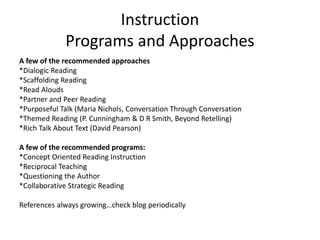
Instruction
Programs and Approaches
A few of the recommended approaches
*Dialogic Reading
*Scaffolding Reading
*Read Alouds
*Partner and Peer Reading
*Purposeful Talk (Maria Nichols, Conversation Through Conversation
*Themed Reading (P. Cunningham & D R Smith, Beyond Retelling)
*Rich Talk About Text (David Pearson)
A few of the recommended programs:
*Concept Oriented Reading Instruction
*Reciprocal Teaching
*Questioning the Author
*Collaborative Strategic Reading
References always growing…check blog periodically
Principles of Instruction
*Zone of Proximal Development (Gradual Release
of Responsibility) Vygotsky
*Learning in/from/for context: Authentic Learning,
Cognitive Apprenticeship, Situated Learning, Whole
Game Learning…..
*Diagnostic Teaching: CAERTONS; CARENOTES (FT)
*MMMM (FT)
*SEAL (FT)
(clip art via Microsoft)

Read 1 2-3 go!

  • 1.
    Reading 1-2-3... GO! 1.Learner 2. 2 to 2 to 2+ 3. 3 Dimensions The Reading Pyramid
  • 2.
  • 3.
    1. Begin withthe Individual Learner The starting and end point of learning is always the individual learner/reader. How well do you know the learner? What do you know about his/her understanding of learning? of reading? What do you know about his/her development? What do you know about his/her learning history? What do you know about his/her instruction of reading?
  • 4.
    2. Learning BeginsEarly and Goes On… We need to pay attention to learning from 2 months to 2 years to grade 2….and beyond. Learning is a life long adventure. Learning to read begins early. Some (including me) say learning to read and to love reading begins before birth in the knowledge, and actions, and attitudes of the parents. There is a wide consensus that learning to read and to love reading begins very early with oral language. That’s where we’ll begin. What happens as children move from home to preschool to elementary school? Following progress! Is there a developmental progression from learning to read to reading to learn?
  • 5.
    Oral Language Development Sounds,Words, Sentences, Discourse Please link to my blog http://classroomdiscourse.wordpress.com/ “Dialogue about Language, Literacy, and Learning “to open the posts on each Important element of learning to read and readings to learn. • Sounds: http://classroomdiscourse.wordpress.com/2014/03/25/oral- language-development-sounds-sounds-into-words/ • • Words: http://classroomdiscourse.wordpress.com/2014/03/30/oral-language- words-part-1-of-5/ • • Sentences: http://classroomdiscourse.wordpress.com/2014/04/18/oral- languge-development-sentences/ • • Discourse: http://classroomdiscourse.wordpress.com/2014/04/29/oral- language-development-discourse-part-1-of-2/
  • 6.
    3. 3 Dimensions Imagea 3D pyramid with context as the base Learner Learning Process 2-2-2+ The Base Context Talk Text Task
  • 7.
    3 Dimensions Based inContext….(before, during and after reading) 1. Always begin with the individual learner. 2. Address the learning processes: developmental and instructional. 3. Focus on: TALK—before, during, and after reading TEXT—choosing accessible, engaging, and challenging texts across genre TASK—the purpose(s) of the reading in light of the cognitive, linguistic, social and personal dimensions.
  • 8.
    TALK Before-During-After Reading Talk abouttext begins in infancy. http://classroomdiscourse.wordpress.com/2014/03/ http://dialogic-reading.blogspot.com/2010/09/what-is-dialogic-reading.html Preschool teachers continue to engage children in talk about books/text. http://dialogic-reading.blogspot.com/2010/09/books-for-dialogic-reading-with-2-to- 4.html In the Primary grades the important role of talk continues. See, for example, the work of G. Wells and Karen Hume (Action Talk and Text) and , Hume; and see the work of Gallas, Newkirk, Lindfors, and Pinnell in Language Development. In Grades 2 and beyond…through middle school, high school and college conversation plays a central role in reading to learn. http://www.readwritethink.org/classroom-resources/lesson-plans/developing- students-critical-thinking-326.html
  • 9.
    TEXT Text-Reader Matching: Choosingthe Right Texts for Individual readers Accessibility Matters Volume and Variety Matter Interest and Engagement Matter Choice Matters Instruction Matters
  • 10.
    TASKS © Purposes forreading Authors, Teachers, and Readers have purposes for reading—the tasks that readers engage with. Authors, teachers, and readers may or may not agree on the tasks. T: Putting the information/ideas TOGETHER A: Taking the ideas/information APART S: SUPPORTING a response/reaction K: Building KNOWLEDGE S: SATISFYING interests /curiosity leading to action.
  • 11.
    Instruction Programs and Approaches Afew of the recommended approaches *Dialogic Reading *Scaffolding Reading *Read Alouds *Partner and Peer Reading *Purposeful Talk (Maria Nichols, Conversation Through Conversation *Themed Reading (P. Cunningham & D R Smith, Beyond Retelling) *Rich Talk About Text (David Pearson) A few of the recommended programs: *Concept Oriented Reading Instruction *Reciprocal Teaching *Questioning the Author *Collaborative Strategic Reading References always growing…check blog periodically
  • 12.
    Principles of Instruction *Zoneof Proximal Development (Gradual Release of Responsibility) Vygotsky *Learning in/from/for context: Authentic Learning, Cognitive Apprenticeship, Situated Learning, Whole Game Learning….. *Diagnostic Teaching: CAERTONS; CARENOTES (FT) *MMMM (FT) *SEAL (FT) (clip art via Microsoft)