AI = Your Data
(And what that means for you
as you build a virtual assistant)
Why do you bother
working on chatbots?
Why do you bother
working on chatbots?
Subtext: I think most conversational
AI projects are bad
What makes a bad
Conversational AI project?
It doesn't help people do
what they need to do.
How do you know what
people need to do?
● You make an educated guess
● You ask them (UX research)
● They tell you (You look at data)
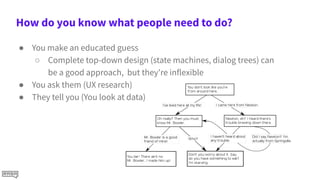
How do you know what people need to do?
● You make an educated guess
○ Complete top-down design (state machines, dialog trees) can
be a good approach, but they're inflexible
● You ask them (UX research)
● They tell you (You look at data)
How do you know what
people need to do?
● You make an educated guess
● ✨You ask them (UX research)✨
○ Not covered today but 100%
do it if you can
● They tell you (You look at data)
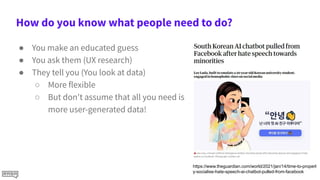
How do you know what people need to do?
● You make an educated guess
● You ask them (UX research)
● They tell you (You look at data)
○ More flexible
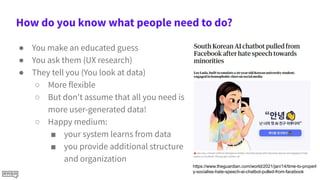
○ But don't assume that all you need is
more user-generated data!
https://www.theguardian.com/world/2021/jan/14/time-to-properl
y-socialise-hate-speech-ai-chatbot-pulled-from-facebook
How do you know what people need to do?
● You make an educated guess
● You ask them (UX research)
● They tell you (You look at data)
○ More flexible
○ But don't assume that all you need is
more user-generated data!
○ Happy medium:
■ your system learns from data
■ you provide additional structure
and organization
https://www.theguardian.com/world/2021/jan/14/time-to-properl
y-socialise-hate-speech-ai-chatbot-pulled-from-facebook
What is “data” in conversational AI?
● The text data use to pretrain any models or
features you're using (e.g. language models,
word embeddings, etc.)
● User-generated text
● Patterns of conversations
● Examples:
○ Customer support logs (assuming data
collection & reuse is covered in your
privacy policy)
Two different assistants can have more
or less the same underlying ML code.
(That’s what makes building a
conversational AI framework possible!)
What makes your assistant work for
you and your users is your data & how
you structure it.
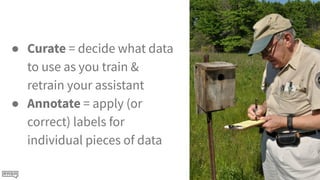
● Curate = decide what data
to use as you train &
retrain your assistant
● Annotate = apply (or
correct) labels for
individual pieces of data
● Intents
○ If you already
have data
○ If you don't
● Stories
● Checking if it works
Intent = something a
user wants to do
Intent = something a
user wants to do
Quick test: is this a VERB
(inform, book_trip, confirm)?
If you have data
● Modified content analysis:
○ Go through data (or sample) by hand and assign each datapoint to a
group
○ If no existing group fits, add a new one
○ At given intervals, go through your groups and combine or seperate
them as needed
○ Start with 2-3 passes through your dataset
● Can't you just automate this?
○ Maaaybe, but I wouldn't recommend it: no guarantee clusters will
map well to user needs
(Even) If you don't have data
● Start with the most common intent
○ Most people want to do the same thing
○ Use the experts in your institution (e.g.
support staff)
● Start with the smallest possible number of
intents (that cover your core use case)
● Everything else goes in an out of scope intent
○ If your assistant can't handle something,
give users an escape hatch right away
● Additional intents will come from user data
Why fewer intents?
● Older style of conversational design:
○ You need an intent for everything your
user might want to do!
● Rasa style CDD:
○ You only need to start with the most
popular, important intents & a way to
handle things outside them
○ Continue to build from there if that’s
what users need
Why fewer intents?
● Human reasons
○ More intents = more training data,
maintenance, documentation
○ More intents = annotation more difficult
● ML reasons
○ Transformer classifiers scale linearly with the
# of classes*
○ Entity extraction (esp. with very lightweight
rule-based systems like Duckling) is often
faster
*Taming pretrained transformers for eXtreme multi-label text classification, Chang et al 2020 @ KDD
Paring down intents book_train:
● One train ticket
● Need to book a train ride
● A rail journey please
book_plane:
● One plane ticket
● Need to book a plane ride
● Don’t use intents as a way to store
information
○ Storing information = slots
● Do a lot of the same tokens show up
in training data for two intents?
Consider if they can be combined
● I would personally start with:
○ max 10 intents
○ min 20 training examples (for
each intent)
make_booking:
● One [train](train) ticket
● Need to book a [train](train) ride
● A [rail](train) journey please
● One [plane](air) ticket
● Need to book a [plane](air) ride
● i'd like to book a trip
● Need a vacation
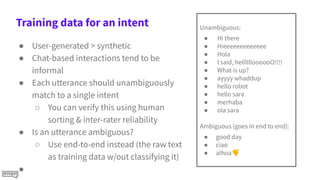
Training data for an intent
● User-generated > synthetic
● Chat-based interactions tend to be
informal
● Each utterance should unambiguously
match to a single intent
○ You can verify this using human
sorting & inter-rater reliability
● Is an utterance ambiguous?
○ Use end-to-end instead (the raw text
as training data w/out classifying it)
●
Unambiguous:
● Hi there
● Hieeeeeeeeeeeee
● Hola
● I said, helllllloooooO!!!!
● What is up?
● ayyyy whaddup
● hello robot
● hello sara
● merhaba
● ola sara
Ambiguous (goes in end to end):
● good day
● ciao
● alhoa🤙
Stories = training data to
decide what your
assistant should do next
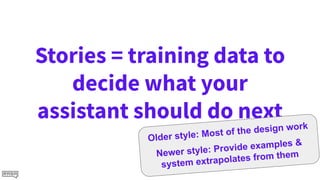
Stories = training data to
decide what your
assistant should do next
Older style: Most of the design work
Newer style: Provide examples &
system extrapolates from them
Stories
● If you have conversational data:
○ If you have conversations, start with the patterns you see in them
○ Find a new intent? Add it to your intents
● Generating your own conversational patterns:
○ It's easiest to use interactive learning to create stories (in
command line or Rasa X)
○ Start with common flows, “happy paths”
○ Then add common errors/digressions
● Once your model is trained:
○ Add user data for more ASAP
Stories
● If you have conversational data:
○ If you have conversations, start with the patterns you see in them
○ Find a new intent? Add it to your intents
● Generating your own conversational patterns:
○ It's easiest to use interactive learning to create stories (in
command line or Rasa X)
○ Start with common flows, “happy paths”
○ Then add common errors/digressions
● Once your model is trained:
○ Add user data for more ASAP
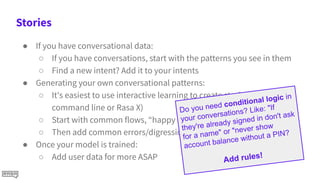
Do you need conditional logic in
your conversations? Like: "If
they're already signed in don't ask
for a name" or "never show
account balance without a PIN?
Add rules!
How do you know if it works?
● Reviewing user conversations!
● Tests
○ Sample conversions that should
always be handled the same
○ Good to shoot for 100% correct
● Validation
○ Checking that your model can guess
correctly at an acceptable rate
○ Be very suspicious of accuracy near
100% 🤔
Takeaways
● Language data is what makes
your Rasa assistant work
● Providing structure for language
data is the first step for building
NLP systems
● Start with the fewest possible,
most popular things
● Get your prototype in front of
users ASAP
Thanks! Questions?
@rctatman

Ai = your data | Rasa Summit 2021

  • 1.
    AI = YourData (And what that means for you as you build a virtual assistant)
  • 2.
    Why do youbother working on chatbots?
  • 3.
    Why do youbother working on chatbots? Subtext: I think most conversational AI projects are bad
  • 4.
    What makes abad Conversational AI project? It doesn't help people do what they need to do.
  • 5.
    How do youknow what people need to do? ● You make an educated guess ● You ask them (UX research) ● They tell you (You look at data)
  • 6.
    How do youknow what people need to do? ● You make an educated guess ○ Complete top-down design (state machines, dialog trees) can be a good approach, but they're inflexible ● You ask them (UX research) ● They tell you (You look at data)
  • 7.
    How do youknow what people need to do? ● You make an educated guess ● ✨You ask them (UX research)✨ ○ Not covered today but 100% do it if you can ● They tell you (You look at data)
  • 8.
    How do youknow what people need to do? ● You make an educated guess ● You ask them (UX research) ● They tell you (You look at data) ○ More flexible ○ But don't assume that all you need is more user-generated data! https://www.theguardian.com/world/2021/jan/14/time-to-properl y-socialise-hate-speech-ai-chatbot-pulled-from-facebook
  • 9.
    How do youknow what people need to do? ● You make an educated guess ● You ask them (UX research) ● They tell you (You look at data) ○ More flexible ○ But don't assume that all you need is more user-generated data! ○ Happy medium: ■ your system learns from data ■ you provide additional structure and organization https://www.theguardian.com/world/2021/jan/14/time-to-properl y-socialise-hate-speech-ai-chatbot-pulled-from-facebook
  • 10.
    What is “data”in conversational AI? ● The text data use to pretrain any models or features you're using (e.g. language models, word embeddings, etc.) ● User-generated text ● Patterns of conversations ● Examples: ○ Customer support logs (assuming data collection & reuse is covered in your privacy policy)
  • 11.
    Two different assistantscan have more or less the same underlying ML code. (That’s what makes building a conversational AI framework possible!) What makes your assistant work for you and your users is your data & how you structure it.
  • 12.
    ● Curate =decide what data to use as you train & retrain your assistant ● Annotate = apply (or correct) labels for individual pieces of data
  • 13.
    ● Intents ○ Ifyou already have data ○ If you don't ● Stories ● Checking if it works
  • 14.
    Intent = somethinga user wants to do
  • 15.
    Intent = somethinga user wants to do Quick test: is this a VERB (inform, book_trip, confirm)?
  • 16.
    If you havedata ● Modified content analysis: ○ Go through data (or sample) by hand and assign each datapoint to a group ○ If no existing group fits, add a new one ○ At given intervals, go through your groups and combine or seperate them as needed ○ Start with 2-3 passes through your dataset ● Can't you just automate this? ○ Maaaybe, but I wouldn't recommend it: no guarantee clusters will map well to user needs
  • 17.
    (Even) If youdon't have data ● Start with the most common intent ○ Most people want to do the same thing ○ Use the experts in your institution (e.g. support staff) ● Start with the smallest possible number of intents (that cover your core use case) ● Everything else goes in an out of scope intent ○ If your assistant can't handle something, give users an escape hatch right away ● Additional intents will come from user data
  • 18.
    Why fewer intents? ●Older style of conversational design: ○ You need an intent for everything your user might want to do! ● Rasa style CDD: ○ You only need to start with the most popular, important intents & a way to handle things outside them ○ Continue to build from there if that’s what users need
  • 19.
    Why fewer intents? ●Human reasons ○ More intents = more training data, maintenance, documentation ○ More intents = annotation more difficult ● ML reasons ○ Transformer classifiers scale linearly with the # of classes* ○ Entity extraction (esp. with very lightweight rule-based systems like Duckling) is often faster *Taming pretrained transformers for eXtreme multi-label text classification, Chang et al 2020 @ KDD
  • 20.
    Paring down intentsbook_train: ● One train ticket ● Need to book a train ride ● A rail journey please book_plane: ● One plane ticket ● Need to book a plane ride ● Don’t use intents as a way to store information ○ Storing information = slots ● Do a lot of the same tokens show up in training data for two intents? Consider if they can be combined ● I would personally start with: ○ max 10 intents ○ min 20 training examples (for each intent) make_booking: ● One [train](train) ticket ● Need to book a [train](train) ride ● A [rail](train) journey please ● One [plane](air) ticket ● Need to book a [plane](air) ride ● i'd like to book a trip ● Need a vacation
  • 21.
    Training data foran intent ● User-generated > synthetic ● Chat-based interactions tend to be informal ● Each utterance should unambiguously match to a single intent ○ You can verify this using human sorting & inter-rater reliability ● Is an utterance ambiguous? ○ Use end-to-end instead (the raw text as training data w/out classifying it) ● Unambiguous: ● Hi there ● Hieeeeeeeeeeeee ● Hola ● I said, helllllloooooO!!!! ● What is up? ● ayyyy whaddup ● hello robot ● hello sara ● merhaba ● ola sara Ambiguous (goes in end to end): ● good day ● ciao ● alhoa🤙
  • 22.
    Stories = trainingdata to decide what your assistant should do next
  • 23.
    Stories = trainingdata to decide what your assistant should do next Older style: Most of the design work Newer style: Provide examples & system extrapolates from them
  • 24.
    Stories ● If youhave conversational data: ○ If you have conversations, start with the patterns you see in them ○ Find a new intent? Add it to your intents ● Generating your own conversational patterns: ○ It's easiest to use interactive learning to create stories (in command line or Rasa X) ○ Start with common flows, “happy paths” ○ Then add common errors/digressions ● Once your model is trained: ○ Add user data for more ASAP
  • 25.
    Stories ● If youhave conversational data: ○ If you have conversations, start with the patterns you see in them ○ Find a new intent? Add it to your intents ● Generating your own conversational patterns: ○ It's easiest to use interactive learning to create stories (in command line or Rasa X) ○ Start with common flows, “happy paths” ○ Then add common errors/digressions ● Once your model is trained: ○ Add user data for more ASAP Do you need conditional logic in your conversations? Like: "If they're already signed in don't ask for a name" or "never show account balance without a PIN? Add rules!
  • 26.
    How do youknow if it works? ● Reviewing user conversations! ● Tests ○ Sample conversions that should always be handled the same ○ Good to shoot for 100% correct ● Validation ○ Checking that your model can guess correctly at an acceptable rate ○ Be very suspicious of accuracy near 100% 🤔
  • 27.
    Takeaways ● Language datais what makes your Rasa assistant work ● Providing structure for language data is the first step for building NLP systems ● Start with the fewest possible, most popular things ● Get your prototype in front of users ASAP
  • 28.