Blogging
A quick guide with particular application for
Junior and Senior High School Social StudiesTeachers
Simple Definitions
A blog is short for the “weblog” or a “web log”.
An online journal or diary, although blogs are
used for much more now, like online journalism.
A blogger is someone who blogs, or writes
content for a blog.
Blogging is the act of writing a post for a
blog.
The Blogosphere is made up of all the places
people go to blog and their interconnections
Anything and
Everything!
What are
blogs about?
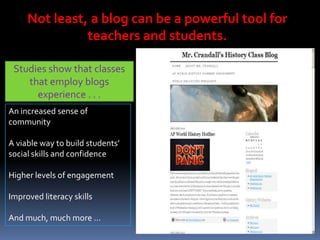
Not least, a blog can be a powerful tool for
teachers and students.
An increased sense of
community
A viable way to build students’
social skills and confidence
Higher levels of engagement
Improved literacy skills
And much, much more …
Studies show that classes
that employ blogs
experience . . .
The basics of
stating a blog in
5 simple steps:
Choose a website1. Wordpress.com
edublogs.org
Blogger.com
These are a few quality free sites!
Click Here
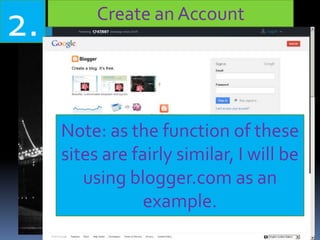
2.
Or here
To use blogger.com, you must
sign up for a Google account
or sign in to your existing
account.
Create an Account
Note: as the function of these
sites are fairly similar, I will be
using blogger.com as an
example.
3. Create your blog
Choose a title
Create a url
Decide on a template
Click on “create blog!”
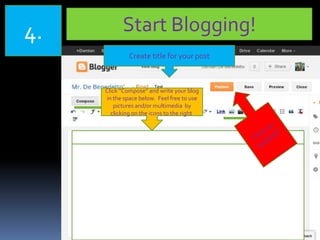
4. Start Blogging!
Click
Here
Start Blogging!4.
Create title for your post
Click “Compose” and write your blog
in the space below. Feel free to use
pictures and/or multimedia by
clicking on the icons to the right.
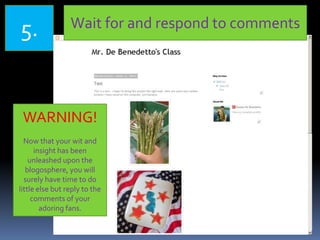
5. Wait for and respond to comments
WARNING!
Now that your wit and
insight has been
unleashed upon the
blogosphere, you will
surely have time to do
little else but reply to the
comments of your
adoring fans.
A blog can be
extremely useful
and powerful tool
for a Social Studies
class!
They are limited
only to the
imagination and
initiative of the
blogger.
Here are three
examples of how blogs
might be used in a
Social Studies class . . .
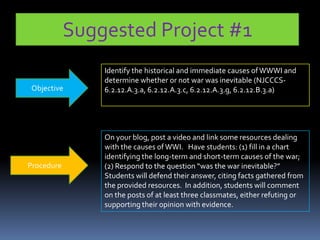
Suggested Project #1
Objective
Identify the historical and immediate causes ofWWWI and
determine whether or not war was inevitable (NJCCCS-
6.2.12.A.3.a, 6.2.12.A.3.c, 6.2.12.A.3.g, 6.2.12.B.3.a)
Procedure
On your blog, post a video and link some resources dealing
with the causes of WWI. Have students: (1) fill in a chart
identifying the long-term and short-term causes of the war;
(2) Respond to the question “was the war inevitable?”
Students will defend their answer, citing facts gathered from
the provided resources. In addition, students will comment
on the posts of at least three classmates, either refuting or
supporting their opinion with evidence.
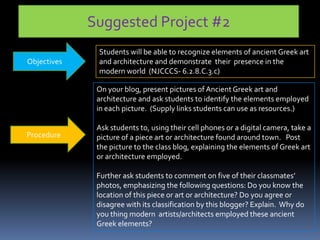
Suggested Project #2
Objectives
Students will be able to recognize elements of ancient Greek art
and architecture and demonstrate their presence in the
modern world (NJCCCS- 6.2.8.C.3.c)
Procedure
On your blog, present pictures of Ancient Greek art and
architecture and ask students to identify the elements employed
in each picture. (Supply links students can use as resources.)
Ask students to, using their cell phones or a digital camera, take a
picture of a piece art or architecture found around town. Post
the picture to the class blog, explaining the elements of Greek art
or architecture employed.
Further ask students to comment on five of their classmates’
photos, emphasizing the following questions: Do you know the
location of this piece or art or architecture? Do you agree or
disagree with its classification by this blogger? Explain. Why do
you thing modern artists/architects employed these ancient
Greek elements?
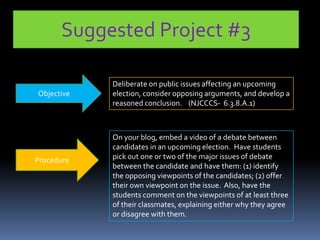
Suggested Project #3
Objective
Deliberate on public issues affecting an upcoming
election, consider opposing arguments, and develop a
reasoned conclusion. (NJCCCS- 6.3.8.A.1)
Procedure
On your blog, embed a video of a debate between
candidates in an upcoming election. Have students
pick out one or two of the major issues of debate
between the candidate and have them: (1) identify
the opposing viewpoints of the candidates; (2) offer
their own viewpoint on the issue. Also, have the
students comment on the viewpoints of at least three
of their classmates, explaining either why they agree
or disagree with them.
For more in-depth information on
blogs, blogging, and the usefulness of blogs
in the classroom, please see the following
helpful links:
http://en.wikipedia.org/wiki/Blog
http://www.teachersfirst.com/content/blog/blo
gbasics.cfm
http://web20intheclassroom.blogspot.com/2008/10/ways-to-
use-blogs-in-your-classroom-and.html
I hope this was
helpful!

Blogging

  • 1.
    Blogging A quick guidewith particular application for Junior and Senior High School Social StudiesTeachers
  • 2.
    Simple Definitions A blogis short for the “weblog” or a “web log”. An online journal or diary, although blogs are used for much more now, like online journalism. A blogger is someone who blogs, or writes content for a blog. Blogging is the act of writing a post for a blog. The Blogosphere is made up of all the places people go to blog and their interconnections
  • 3.
  • 4.
    Not least, ablog can be a powerful tool for teachers and students. An increased sense of community A viable way to build students’ social skills and confidence Higher levels of engagement Improved literacy skills And much, much more … Studies show that classes that employ blogs experience . . .
  • 5.
    The basics of statinga blog in 5 simple steps:
  • 6.
    Choose a website1.Wordpress.com edublogs.org Blogger.com These are a few quality free sites!
  • 7.
    Click Here 2. Or here Touse blogger.com, you must sign up for a Google account or sign in to your existing account. Create an Account Note: as the function of these sites are fairly similar, I will be using blogger.com as an example.
  • 8.
    3. Create yourblog Choose a title Create a url Decide on a template Click on “create blog!”
  • 9.
  • 10.
    Start Blogging!4. Create titlefor your post Click “Compose” and write your blog in the space below. Feel free to use pictures and/or multimedia by clicking on the icons to the right.
  • 11.
    5. Wait forand respond to comments WARNING! Now that your wit and insight has been unleashed upon the blogosphere, you will surely have time to do little else but reply to the comments of your adoring fans.
  • 12.
    A blog canbe extremely useful and powerful tool for a Social Studies class! They are limited only to the imagination and initiative of the blogger. Here are three examples of how blogs might be used in a Social Studies class . . .
  • 13.
    Suggested Project #1 Objective Identifythe historical and immediate causes ofWWWI and determine whether or not war was inevitable (NJCCCS- 6.2.12.A.3.a, 6.2.12.A.3.c, 6.2.12.A.3.g, 6.2.12.B.3.a) Procedure On your blog, post a video and link some resources dealing with the causes of WWI. Have students: (1) fill in a chart identifying the long-term and short-term causes of the war; (2) Respond to the question “was the war inevitable?” Students will defend their answer, citing facts gathered from the provided resources. In addition, students will comment on the posts of at least three classmates, either refuting or supporting their opinion with evidence.
  • 14.
    Suggested Project #2 Objectives Studentswill be able to recognize elements of ancient Greek art and architecture and demonstrate their presence in the modern world (NJCCCS- 6.2.8.C.3.c) Procedure On your blog, present pictures of Ancient Greek art and architecture and ask students to identify the elements employed in each picture. (Supply links students can use as resources.) Ask students to, using their cell phones or a digital camera, take a picture of a piece art or architecture found around town. Post the picture to the class blog, explaining the elements of Greek art or architecture employed. Further ask students to comment on five of their classmates’ photos, emphasizing the following questions: Do you know the location of this piece or art or architecture? Do you agree or disagree with its classification by this blogger? Explain. Why do you thing modern artists/architects employed these ancient Greek elements?
  • 15.
    Suggested Project #3 Objective Deliberateon public issues affecting an upcoming election, consider opposing arguments, and develop a reasoned conclusion. (NJCCCS- 6.3.8.A.1) Procedure On your blog, embed a video of a debate between candidates in an upcoming election. Have students pick out one or two of the major issues of debate between the candidate and have them: (1) identify the opposing viewpoints of the candidates; (2) offer their own viewpoint on the issue. Also, have the students comment on the viewpoints of at least three of their classmates, explaining either why they agree or disagree with them.
  • 16.
    For more in-depthinformation on blogs, blogging, and the usefulness of blogs in the classroom, please see the following helpful links: http://en.wikipedia.org/wiki/Blog http://www.teachersfirst.com/content/blog/blo gbasics.cfm http://web20intheclassroom.blogspot.com/2008/10/ways-to- use-blogs-in-your-classroom-and.html
  • 17.
    I hope thiswas helpful!