Symptoms, host range, taxonomy and
life cycle of Talaromyces
COURSE TEACHER
Dr. PARTHASARATHY S
Asst. Professor (Plant Pathology)
STUDENT
Mr. ROHITH S
ID. NO. 2017021054
COLLEGE OF AGRICULTURAL TECHNOLOGY
(Affiliated to Tamil Nadu Agricultural University, Coimbatore-3)
Kullapuram (Po),ViaVaigai Dam, Theni-625 562
Introduction
 Talaromyces is a genus of ascomycetous fungi of
major importance in natural environment as well as
food and drug production.
 Some members of the genus produce penicillin, a
molecule that is used as an antibiotic, which kills or
stops the growth of certain kinds of bacteria inside
the body. Other species are used in cheese making.
 Penicillium is the anamorphic stage of Talaromyces.
Taxonomy of Talaromyces
Kingdom : Fungi
Phylum : Ascomycota
Subphylum : Pezizomycotina
Class : Eurotiomycetes
Order : Eurotiales
Family : Trichocomaceae
Genus : Talaromyces
Symptoms
 Circular or irregular water soaked lesions formed on
the rind near the stalk end which spreads further and
cover a larger area with mycelia growth.
 Later, due to sporulation the infected fruits are
covered with green/blue moldy growth. Severe
infection leads to rotting of fruits.
 It causes blue mould and green mould disease in post
harvest products.
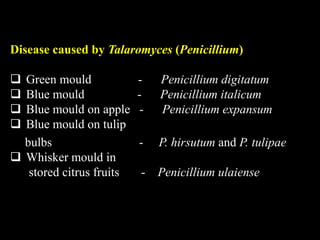
Disease caused by Talaromyces (Penicillium)
 Green mould - Penicillium digitatum
 Blue mould - Penicillium italicum
 Blue mould on apple - Penicillium expansum
 Blue mould on tulip
bulbs - P. hirsutum and P. tulipae
 Whisker mould in
stored citrus fruits - Penicillium ulaiense
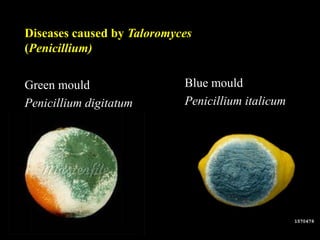
Green mould
Penicillium digitatum
Blue mould
Penicillium italicum
Diseases caused by Taloromyces
(Penicillium)
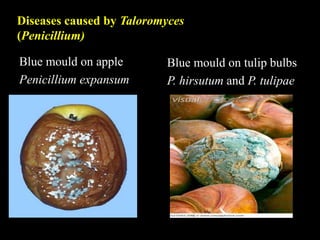
Blue mould on tulip bulbs
P. hirsutum and P. tulipae
Blue mould on apple
Penicillium expansum
Diseases caused by Taloromyces
(Penicillium)
Diseases caused by Taloromyces
(Penicillium)
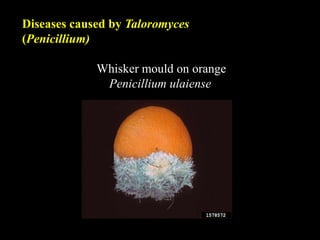
Whisker mould on orange
Penicillium ulaiense
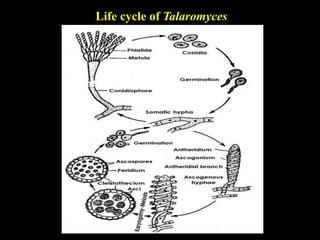
Life cycle of Talaromyces
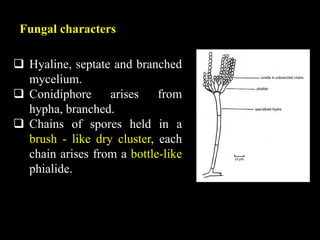
Fungal characters
 Hyaline, septate and branched
mycelium.
 Conidiphore arises from
hypha, branched.
 Chains of spores held in a
brush - like dry cluster, each
chain arises from a bottle-like
phialide.
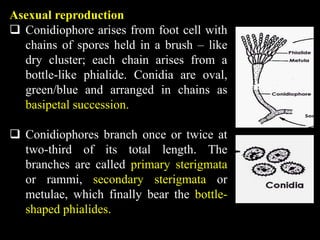
Asexual reproduction
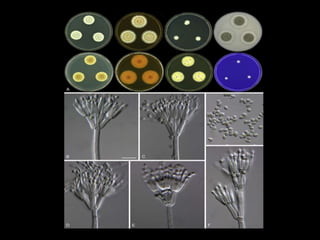
 Conidiophore arises from foot cell with
chains of spores held in a brush – like
dry cluster; each chain arises from a
bottle-like phialide. Conidia are oval,
green/blue and arranged in chains as
basipetal succession.
 Conidiophores branch once or twice at
two-third of its total length. The
branches are called primary sterigmata
or rammi, secondary sterigmata or
metulae, which finally bear the bottle-
shaped phialides.
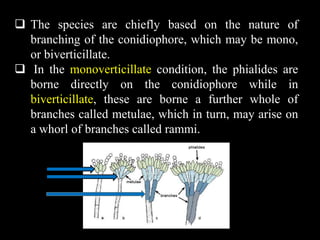
 The species are chiefly based on the nature of
branching of the conidiophore, which may be mono,
or biverticillate.
 In the monoverticillate condition, the phialides are
borne directly on the conidiophore while in
biverticillate, these are borne a further whole of
branches called metulae, which in turn, may arise on
a whorl of branches called rammi.
Sexual reproduction
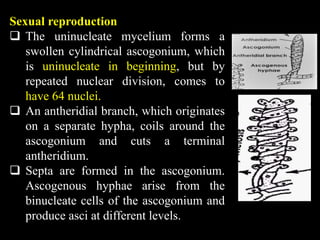
 The uninucleate mycelium forms a
swollen cylindrical ascogonium, which
is uninucleate in beginning, but by
repeated nuclear division, comes to
have 64 nuclei.
 An antheridial branch, which originates
on a separate hypha, coils around the
ascogonium and cuts a terminal
antheridium.
 Septa are formed in the ascogonium.
Ascogenous hyphae arise from the
binucleate cells of the ascogonium and
produce asci at different levels.
 The somatic hyphae, in the meantime, grow and
surround the ascogenous hyphae so as to form a
two layered peridium. Ultimately, this results in the
formation of a cleistothecium.
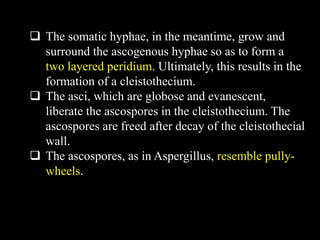
 The asci, which are globose and evanescent,
liberate the ascospores in the cleistothecium. The
ascospores are freed after decay of the cleistothecial
wall.
 The ascospores, as in Aspergillus, resemble pully-
wheels.
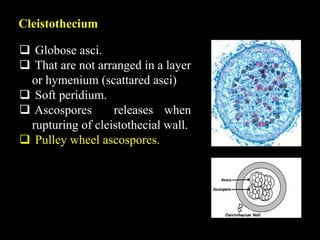
Cleistothecium
 Globose asci.
 That are not arranged in a layer
or hymenium (scattared asci)
 Soft peridium.
 Ascospores releases when
rupturing of cleistothecial wall.
 Pulley wheel ascospores.
REFERENCES
 Alice D, Jeyalakshmi C, Krishnamoorthy A.S and
Karthikeyan M, 2017. Fundamentals of Phyto
Pathology. Sri Sakthi Promotional Litho Process,
Coimbatore.
 Alice D and Jeyalakshmi C, 2014. Plant Pathology.
A.E.Publication, Coimbatore.
 http://www.aspergilluspenicillium.org/talaromyces-
naam
 http://en.m.Wikipedia.org/wiki/Talaromyces
THANK YOU

Talaromyces

  • 1.
    Symptoms, host range,taxonomy and life cycle of Talaromyces COURSE TEACHER Dr. PARTHASARATHY S Asst. Professor (Plant Pathology) STUDENT Mr. ROHITH S ID. NO. 2017021054 COLLEGE OF AGRICULTURAL TECHNOLOGY (Affiliated to Tamil Nadu Agricultural University, Coimbatore-3) Kullapuram (Po),ViaVaigai Dam, Theni-625 562
  • 2.
    Introduction  Talaromyces isa genus of ascomycetous fungi of major importance in natural environment as well as food and drug production.  Some members of the genus produce penicillin, a molecule that is used as an antibiotic, which kills or stops the growth of certain kinds of bacteria inside the body. Other species are used in cheese making.  Penicillium is the anamorphic stage of Talaromyces.
  • 3.
    Taxonomy of Talaromyces Kingdom: Fungi Phylum : Ascomycota Subphylum : Pezizomycotina Class : Eurotiomycetes Order : Eurotiales Family : Trichocomaceae Genus : Talaromyces
  • 4.
    Symptoms  Circular orirregular water soaked lesions formed on the rind near the stalk end which spreads further and cover a larger area with mycelia growth.  Later, due to sporulation the infected fruits are covered with green/blue moldy growth. Severe infection leads to rotting of fruits.  It causes blue mould and green mould disease in post harvest products.
  • 5.
    Disease caused byTalaromyces (Penicillium)  Green mould - Penicillium digitatum  Blue mould - Penicillium italicum  Blue mould on apple - Penicillium expansum  Blue mould on tulip bulbs - P. hirsutum and P. tulipae  Whisker mould in stored citrus fruits - Penicillium ulaiense
  • 6.
    Green mould Penicillium digitatum Bluemould Penicillium italicum Diseases caused by Taloromyces (Penicillium)
  • 7.
    Blue mould ontulip bulbs P. hirsutum and P. tulipae Blue mould on apple Penicillium expansum Diseases caused by Taloromyces (Penicillium)
  • 8.
    Diseases caused byTaloromyces (Penicillium) Whisker mould on orange Penicillium ulaiense
  • 9.
    Life cycle ofTalaromyces
  • 10.
    Fungal characters  Hyaline,septate and branched mycelium.  Conidiphore arises from hypha, branched.  Chains of spores held in a brush - like dry cluster, each chain arises from a bottle-like phialide.
  • 11.
    Asexual reproduction  Conidiophorearises from foot cell with chains of spores held in a brush – like dry cluster; each chain arises from a bottle-like phialide. Conidia are oval, green/blue and arranged in chains as basipetal succession.  Conidiophores branch once or twice at two-third of its total length. The branches are called primary sterigmata or rammi, secondary sterigmata or metulae, which finally bear the bottle- shaped phialides.
  • 12.
     The speciesare chiefly based on the nature of branching of the conidiophore, which may be mono, or biverticillate.  In the monoverticillate condition, the phialides are borne directly on the conidiophore while in biverticillate, these are borne a further whole of branches called metulae, which in turn, may arise on a whorl of branches called rammi.
  • 13.
    Sexual reproduction  Theuninucleate mycelium forms a swollen cylindrical ascogonium, which is uninucleate in beginning, but by repeated nuclear division, comes to have 64 nuclei.  An antheridial branch, which originates on a separate hypha, coils around the ascogonium and cuts a terminal antheridium.  Septa are formed in the ascogonium. Ascogenous hyphae arise from the binucleate cells of the ascogonium and produce asci at different levels.
  • 14.
     The somatichyphae, in the meantime, grow and surround the ascogenous hyphae so as to form a two layered peridium. Ultimately, this results in the formation of a cleistothecium.  The asci, which are globose and evanescent, liberate the ascospores in the cleistothecium. The ascospores are freed after decay of the cleistothecial wall.  The ascospores, as in Aspergillus, resemble pully- wheels.
  • 15.
    Cleistothecium  Globose asci. That are not arranged in a layer or hymenium (scattared asci)  Soft peridium.  Ascospores releases when rupturing of cleistothecial wall.  Pulley wheel ascospores.
  • 17.
    REFERENCES  Alice D,Jeyalakshmi C, Krishnamoorthy A.S and Karthikeyan M, 2017. Fundamentals of Phyto Pathology. Sri Sakthi Promotional Litho Process, Coimbatore.  Alice D and Jeyalakshmi C, 2014. Plant Pathology. A.E.Publication, Coimbatore.  http://www.aspergilluspenicillium.org/talaromyces- naam  http://en.m.Wikipedia.org/wiki/Talaromyces
  • 18.