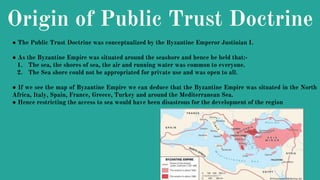
The public trust doctrine asserts that certain natural resources, such as air, water, and forests, are meant for public use and cannot be privately owned. Originating from the teachings of Byzantine Emperor Justinian I and later adopted by English law and the Indian Constitution, it obligates the government to protect these resources for the benefit of all citizens. Landmark Indian Supreme Court cases illustrate the doctrine's application in safeguarding environmental rights and navigating the balance between development and ecological preservation.


![● After Byzantines later on Englishmen also accepted the Public Trust Doctrine.
● Magna Charta in 1215 further strengthened the Public Trust Doctrine by removing the
restrictions to sail in the English Channel which was exclusively available to the English
Royalty.
● In India, Mahatma Gandhi was the staunch supporter of this doctrine.
● And the Indian Constitution has inserted several articles about this.
● The Supreme Court of India has delivered many landmark judgements by using the
principles of Public Trust Doctrine.
● The court took procedural and substantive rights seriously and applied this doctrine for
the protection of Environment.
● The apex court also referred to various articles of the Indian constitution such as Article
48A which made a way through Article 21 by including the right to clean environment
under the right to life and Article 39 [DPSP] which states proper distribution of the
resources.](https://image.slidesharecdn.com/publictrustdoctrine-220605183129-8d53573b/85/Public-Trust-Doctrine-pptx-4-320.jpg)