CREATED BY
SUVENDU SARKAR, PRIYA SINGH,
CHOTAN RAY, TANAZ TABREZ.
1st SEMESTER, CFSM01
• Bert Keely – the dreamer of Tablet PCs.
• First drawing the future of Tablet in the
SGI lab.
• In order to fulfill his dream, he met the
CEOs of Apple and Dell, but all of them
refused Keely.
• Finally, Bill Gates accepted his
suggestion, and soon decided to develop
an OS for his dream.
.
 It is an optimized version of Desktop PC and light
weight Notebook PC.
 An Advanced version of the latest IT- Technology.
 Tablet computer, a kind of mobile computer, usually
having a touchscreen or pen-enabled interface.
 With attached keyboards and screens that turn and
flip
 to cover the keyboards and have the touch-sensitive
 screens face up for pen user interface
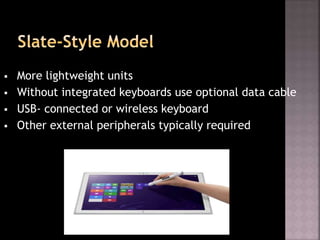
 More lightweight units
 Without integrated keyboards use optional data cable
 USB- connected or wireless keyboard
 Other external peripherals typically required
 High-definition, anti-glare display.
 Back camera and Front facing camera for photograph
and video
 Lower weight and longer battery life than a
comparably- sized laptop
 Wireless local area and internet connectivity (Usually
with Wi-Fi standard and optional mobile broadband)
 Bluetooth is communication with local
devices
 Mobile web browser
 Downloadable Apps such as Games,
Education and Utilities
 Mobile phone functions (Messaging, speaker
phone, address book)
 Video- teleconferencing
• It has all functions that a
computer has.
• Many has calling function.
• Designers efficiently use tablet
PCs to design the creation.
On educational field :-
• it is light , portable and fits on lap.
• The tablet PC is used more organically
• Transparent access to information is a key of educational
goal.
• It helps in designing.
On medical field:-
• The tablet PCs are been increasingly deployed for
therapeutic purposes.
• Tablets Pc’s increasingly popular among physicians,
Access to EMR (Electronic Medical Records) over the
Tablet and wireless LAN.
• The four technologies that is rapidly driving the
development of "personal" medical electronics for
diagnostics, monitoring and therapeutics.
• In Addition to a screen and a pen, you should have
one ”sensing technique”.
• For PDA -> resistive-control panel.
• For Tablet PC -> Electromagnetic Digitizer.
• The sensor – which is embedded behind the display.
• The pen – which contains only the LC-circuit but
no battery.
• Pressure
• Angle
• Eraser-like tip – to simulate the eraser.
• Additional button – to simulate the right button
of the mouse.
Reference
http://www.microsoft.com/windowsxp/tabletpc/defa
ult.mspx
http://msdn.microsoft.com/library/default.asp?url=/li
brary/en-
us/tpcsdk10/lonestar/whitepapers/designguide/tbconi
nkandinking.asp
http://www.wacom.com/tabletpc/index.cfm
http://www.wacom-
components.com/english/tablet_pc.asp
http://www20.tomshardware.com/mobile/20030129/t
ravelmate-01.html
http://www.tabletpctalk.com/
http://my.so-
net.net.tw/ks2568/share_html/album/audio01.htm

Tablet pc