TABLE OF
SPECIFICATION
(TOS)
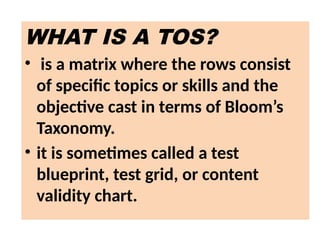
WHAT IS A TOS?
• is a matrix where the rows consist
of specific topics or skills and the
objective cast in terms of Bloom’s
Taxonomy.
• it is sometimes called a test
blueprint, test grid, or content
validity chart.
WHAT IS THE IMPORTANCE
OF T.O.S.?
-to aid the test constructor in developing
a balanced test which emphasizes the
proportion of items to the amount of time
spent in the classroom, activities engaged
in the topics discussed.
-it helps the teacher avoid the tendency to
focus on materials that are easy to
develop as test items.
STEPS IN CONSTRUCTING
T.O.S.
1.Determine the objectives, specific
knowledge and skills to be
evaluated.
2.Find out the number of recitations
spent for each subject matter.
3.Find out the total number of items
desired.
4. Find out the total number of
items for each subject matter.
5.Distribute the number of items
for each subject matter among
the different objectives.
6.Construct the test observing the
principles in the test
construction.
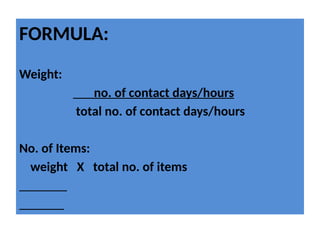
FORMULA:
Weight:
no. of contact days/hours
total no. of contact days/hours
No. of Items:
weight X total no. of items
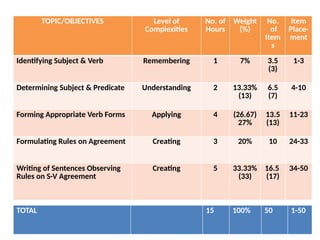
SAMPLE
OF A
ONE-WAY
TOS
TOPIC/OBJECTIVES Level of
Complexities
No. of
Hours
Weight
(%)
No.
of
Item
s
Item
Place-
ment
Identifying Subject & Verb Remembering 1 7% 3.5
(3)
1-3
Determining Subject & Predicate Understanding 2 13.33%
(13)
6.5
(7)
4-10
Forming Appropriate Verb Forms Applying 4 (26.67)
27%
13.5
(13)
11-23
Formulating Rules on Agreement Creating 3 20% 10 24-33
Writing of Sentences Observing
Rules on S-V Agreement
Creating 5 33.33%
(33)
16.5
(17)
34-50
TOTAL 15 100% 50 1-50
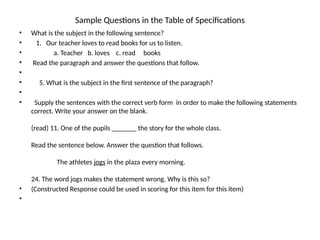
Sample Questions in the Table of Specifications
• What is the subject in the following sentence?
• 1. Our teacher loves to read books for us to listen.
• a. Teacher b. loves c. read books
• Read the paragraph and answer the questions that follow.
•
• 5. What is the subject in the first sentence of the paragraph?
•
• Supply the sentences with the correct verb form in order to make the following statements
correct. Write your answer on the blank.
(read) 11. One of the pupils _______ the story for the whole class.
Read the sentence below. Answer the question that follows.
The athletes jogs in the plaza every morning.
24. The word jogs makes the statement wrong. Why is this so?
• (Constructed Response could be used in scoring for this item for this item)
•
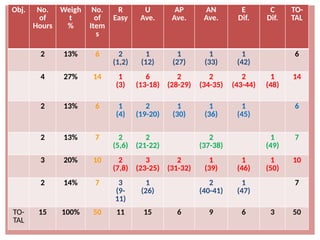
SAMPLE OF A
TWO-WAY
T.O.S
Obj. No.
of
Hours
Weigh
t
%
No.
of
Item
s
R
Easy
U
Ave.
AP
Ave.
AN
Ave.
E
Dif.
C
Dif.
TO-
TAL
2 13% 6 2
(1,2)
1
(12)
1
(27)
1
(33)
1
(42)
6
4 27% 14 1
(3)
6
(13-18)
2
(28-29)
2
(34-35)
2
(43-44)
1
(48)
14
2 13% 6 1
(4)
2
(19-20)
1
(30)
1
(36)
1
(45)
6
2 13% 7 2
(5,6)
2
(21-22)
2
(37-38)
1
(49)
7
3 20% 10 2
(7,8)
3
(23-25)
2
(31-32)
1
(39)
1
(46)
1
(50)
10
2 14% 7 3
(9-
11)
1
(26)
2
(40-41)
1
(47)
7
TO-
TAL
15 100% 50 11 15 6 9 6 3 50
Maraming
salamat po

TABLE-OF-SPECIFICATION.pptx...............

  • 1.
  • 2.
    WHAT IS ATOS? • is a matrix where the rows consist of specific topics or skills and the objective cast in terms of Bloom’s Taxonomy. • it is sometimes called a test blueprint, test grid, or content validity chart.
  • 3.
    WHAT IS THEIMPORTANCE OF T.O.S.? -to aid the test constructor in developing a balanced test which emphasizes the proportion of items to the amount of time spent in the classroom, activities engaged in the topics discussed. -it helps the teacher avoid the tendency to focus on materials that are easy to develop as test items.
  • 4.
    STEPS IN CONSTRUCTING T.O.S. 1.Determinethe objectives, specific knowledge and skills to be evaluated. 2.Find out the number of recitations spent for each subject matter. 3.Find out the total number of items desired.
  • 5.
    4. Find outthe total number of items for each subject matter. 5.Distribute the number of items for each subject matter among the different objectives. 6.Construct the test observing the principles in the test construction.
  • 6.
    FORMULA: Weight: no. of contactdays/hours total no. of contact days/hours No. of Items: weight X total no. of items
  • 7.
  • 8.
    TOPIC/OBJECTIVES Level of Complexities No.of Hours Weight (%) No. of Item s Item Place- ment Identifying Subject & Verb Remembering 1 7% 3.5 (3) 1-3 Determining Subject & Predicate Understanding 2 13.33% (13) 6.5 (7) 4-10 Forming Appropriate Verb Forms Applying 4 (26.67) 27% 13.5 (13) 11-23 Formulating Rules on Agreement Creating 3 20% 10 24-33 Writing of Sentences Observing Rules on S-V Agreement Creating 5 33.33% (33) 16.5 (17) 34-50 TOTAL 15 100% 50 1-50
  • 9.
    Sample Questions inthe Table of Specifications • What is the subject in the following sentence? • 1. Our teacher loves to read books for us to listen. • a. Teacher b. loves c. read books • Read the paragraph and answer the questions that follow. • • 5. What is the subject in the first sentence of the paragraph? • • Supply the sentences with the correct verb form in order to make the following statements correct. Write your answer on the blank. (read) 11. One of the pupils _______ the story for the whole class. Read the sentence below. Answer the question that follows. The athletes jogs in the plaza every morning. 24. The word jogs makes the statement wrong. Why is this so? • (Constructed Response could be used in scoring for this item for this item) •
  • 10.
  • 11.
    Obj. No. of Hours Weigh t % No. of Item s R Easy U Ave. AP Ave. AN Ave. E Dif. C Dif. TO- TAL 2 13%6 2 (1,2) 1 (12) 1 (27) 1 (33) 1 (42) 6 4 27% 14 1 (3) 6 (13-18) 2 (28-29) 2 (34-35) 2 (43-44) 1 (48) 14 2 13% 6 1 (4) 2 (19-20) 1 (30) 1 (36) 1 (45) 6 2 13% 7 2 (5,6) 2 (21-22) 2 (37-38) 1 (49) 7 3 20% 10 2 (7,8) 3 (23-25) 2 (31-32) 1 (39) 1 (46) 1 (50) 10 2 14% 7 3 (9- 11) 1 (26) 2 (40-41) 1 (47) 7 TO- TAL 15 100% 50 11 15 6 9 6 3 50
  • 12.