Coordination
Dr.Syed
Objectives
At the end of this class, you will be able to
•Define coordination
•Explain the factors responsible for coordination
•List out the causes for incoordination.
•Explain the coordination tests.
•Explain the principles of reeducation.
•Describe Frenkel’s exercise.
Coordination
• The correct timing and sequencing of muscle firing
combined with the appropriate intensity of muscular
contraction leading to the effective initiation, guiding
and grading of movement.
• Coordination is the basis of smooth, accurate, efficient
movement and occurs at a conscious or automatic level
Coordination or coordinated movement : is the
ability to execute smooth ,accurate, controlled
motor responses.
• Coordinated movement is characterized by appropriate
speed, distance, direction, timing and muscular tension.
• Involves appropriate synergistic influence, easy reversal
between opposing muscle groups and proximal fixation
to allow distal motion or to maintain posture.
Contd..
• Co-ordinated movement is smooth, accurate and
purposeful brought about by the integrated action of
many muscles, superimposed upon a basis of efficient
postural activity.
Action of Muscles
• Muscle group – agonists, antagonist, synergists and
fixators.
• Agonist – produce movement by contracting
• Antagonist - relaxation ands control the movement without
impending.
• Synergists – alter direction of pull, stabilize.
• Fixators – fix the bone of origin or insertion.
Nervous control
• Motor pathways – Afferent impulse from muscle or stimulus.
• Cerebral cortex – Planning the pattern of movement based
on previous memories and present impulses. Sends in the
form of efferent.
• Cerebellum – receiving station from afferent and efferent.
Also receives proprioceptive and kinesthetic sensation. Does
the minor alteration and correction.
Inco-ordination
• Jerky, arhythmic or inaccurate movement.
• Interference with the function of any one of the factors.
Causes
• Weakness or flaccidity of a particular muscle group. Eg:
LMN.
• Spasticity of muscle group. Eg: UMN
• Cerebellar lesion (ataxia)- (without order) – swaying,
irregular or tremor.
• Loss of kinaesthetic sensation (sensory ataxia) – Tabes
Dorsalis.
Coordination deficits are common in:
• Traumatic brain injury
• Parkinsonism
• Multiple sclerosis
• Cerebral palsy
• Cerebellar tumors
• Vestibular pathology
Assessment
• Level or skill in activity
• The occurrence of extraneous movements,
oscillation ,swaying or unsteadiness.
• Number of extremity involved
• Distribution of coordination impairment
(proximal or distal)
• Situation that alters the coordination deficit
• Amount of time required to perform an activity
• Level of safety
• History of any fall
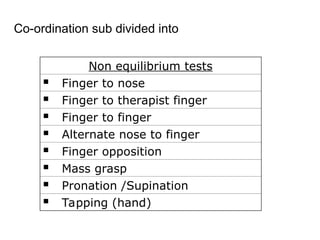
Co-ordination sub divided into
Non equilibrium tests
 Finger to nose
 Finger to therapist finger
 Finger to finger
 Alternate nose to finger
 Finger opposition
 Mass grasp
 Pronation /Supination
 Tapping (hand)
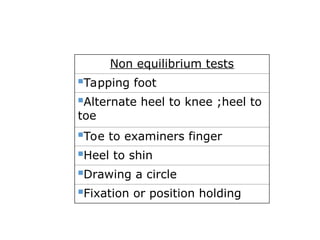
Non equilibrium tests
Tapping foot
Alternate heel to knee ;heel to
toe
Toe to examiners finger
Heel to shin
Drawing a circle
Fixation or position holding
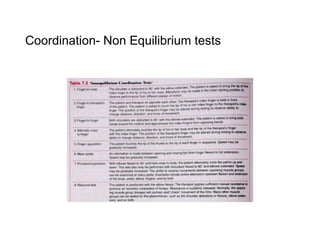
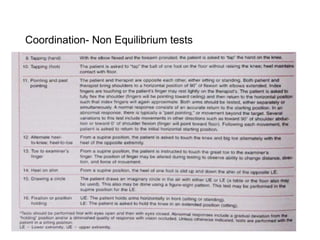
Coordination- Non Equilibrium tests
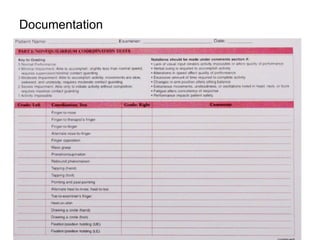
Documentation
Re - Education
• Use of alternative nervous pathways – If pathways are
blocked – use alternate or stimulate inactive pathways.
Initially difficult then progressively easier.
• Condition of the muscle – prepare the muscle to
receive the coordinating impulses so that their reaction
is as normal as possible.
Weak – strengthen, spastic – stretch.
Principles of reeducation
1. Weakness or flaccidity
•Naturally incoordination is avoided by alternate pattern
of movement – trick movement.
•Treatment:
•Improve the muscle power and tone.
•Eg: Slow reversals technique, strength training,
facilitating technique.
Contd..
2. Spasticity of Muscles
•Modifies their reaction as they cannot or can only do
with much difficulty. Rhythm is lost.
•Treatment:
•To promote relaxation, to train rhythm and reduce tone.
•Eg: relaxation and stretch
Contd..
3. Cerebellar Ataxia
•Loss of coordinating impulses from cerebellum. Lack of
sensory pathway.
•Treatment: make use of available pathway.
Contd..
4. Loss of Kinaesthetic Sense
•Loss of Kinaesthetic sensation.
•Treatment:
• stimulate alternate and use of available pathway.
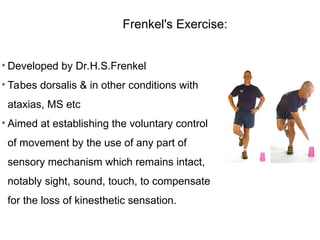
• Developed by Dr.H.S.Frenkel
• Tabes dorsalis & in other conditions with
ataxias, MS etc
• Aimed at establishing the voluntary control
of movement by the use of any part of
sensory mechanism which remains intact,
notably sight, sound, touch, to compensate
for the loss of kinesthetic sensation.
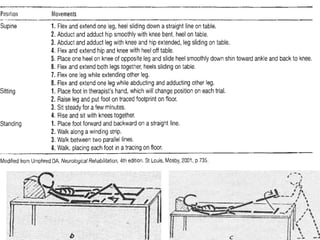
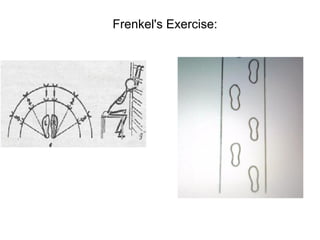
Frenkel's Exercise:
• The essentials of Frenkel's exercise being:
• Concentration of Attention
• Precision
• Repetition
• The ultimate aim is to establish the control of movement so
that patient is able and confident in his ability to carry out
these activities which are essential for independence in
every day life.
Frenkel's Exercise:
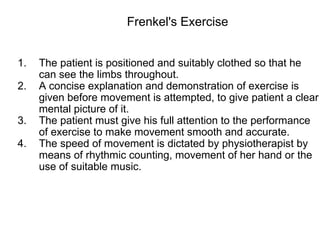
1. The patient is positioned and suitably clothed so that he
can see the limbs throughout.
2. A concise explanation and demonstration of exercise is
given before movement is attempted, to give patient a clear
mental picture of it.
3. The patient must give his full attention to the performance
of exercise to make movement smooth and accurate.
4. The speed of movement is dictated by physiotherapist by
means of rhythmic counting, movement of her hand or the
use of suitable music.
Frenkel's Exercise
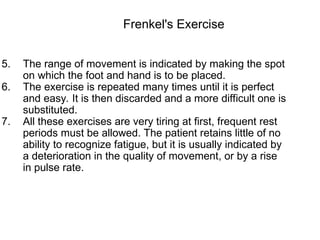
5. The range of movement is indicated by making the spot
on which the foot and hand is to be placed.
6. The exercise is repeated many times until it is perfect
and easy. It is then discarded and a more difficult one is
substituted.
7. All these exercises are very tiring at first, frequent rest
periods must be allowed. The patient retains little of no
ability to recognize fatigue, but it is usually indicated by
a deterioration in the quality of movement, or by a rise
in pulse rate.
Frenkel's Exercise
Progression
• Altering speed, range and complexity of the exercises.
Frenkel's Exercise:

Coordination Exercises for Physiotherapists.ppt

  • 1.
  • 2.
    Objectives At the endof this class, you will be able to •Define coordination •Explain the factors responsible for coordination •List out the causes for incoordination. •Explain the coordination tests. •Explain the principles of reeducation. •Describe Frenkel’s exercise.
  • 3.
    Coordination • The correcttiming and sequencing of muscle firing combined with the appropriate intensity of muscular contraction leading to the effective initiation, guiding and grading of movement. • Coordination is the basis of smooth, accurate, efficient movement and occurs at a conscious or automatic level
  • 4.
    Coordination or coordinatedmovement : is the ability to execute smooth ,accurate, controlled motor responses. • Coordinated movement is characterized by appropriate speed, distance, direction, timing and muscular tension. • Involves appropriate synergistic influence, easy reversal between opposing muscle groups and proximal fixation to allow distal motion or to maintain posture.
  • 5.
    Contd.. • Co-ordinated movementis smooth, accurate and purposeful brought about by the integrated action of many muscles, superimposed upon a basis of efficient postural activity.
  • 6.
    Action of Muscles •Muscle group – agonists, antagonist, synergists and fixators. • Agonist – produce movement by contracting • Antagonist - relaxation ands control the movement without impending. • Synergists – alter direction of pull, stabilize. • Fixators – fix the bone of origin or insertion.
  • 7.
    Nervous control • Motorpathways – Afferent impulse from muscle or stimulus. • Cerebral cortex – Planning the pattern of movement based on previous memories and present impulses. Sends in the form of efferent. • Cerebellum – receiving station from afferent and efferent. Also receives proprioceptive and kinesthetic sensation. Does the minor alteration and correction.
  • 8.
    Inco-ordination • Jerky, arhythmicor inaccurate movement. • Interference with the function of any one of the factors.
  • 9.
    Causes • Weakness orflaccidity of a particular muscle group. Eg: LMN. • Spasticity of muscle group. Eg: UMN • Cerebellar lesion (ataxia)- (without order) – swaying, irregular or tremor. • Loss of kinaesthetic sensation (sensory ataxia) – Tabes Dorsalis.
  • 10.
    Coordination deficits arecommon in: • Traumatic brain injury • Parkinsonism • Multiple sclerosis • Cerebral palsy • Cerebellar tumors • Vestibular pathology
  • 11.
    Assessment • Level orskill in activity • The occurrence of extraneous movements, oscillation ,swaying or unsteadiness. • Number of extremity involved • Distribution of coordination impairment (proximal or distal)
  • 12.
    • Situation thatalters the coordination deficit • Amount of time required to perform an activity • Level of safety • History of any fall
  • 13.
    Co-ordination sub dividedinto Non equilibrium tests  Finger to nose  Finger to therapist finger  Finger to finger  Alternate nose to finger  Finger opposition  Mass grasp  Pronation /Supination  Tapping (hand)
  • 14.
    Non equilibrium tests Tappingfoot Alternate heel to knee ;heel to toe Toe to examiners finger Heel to shin Drawing a circle Fixation or position holding
  • 15.
  • 16.
  • 17.
  • 18.
    Re - Education •Use of alternative nervous pathways – If pathways are blocked – use alternate or stimulate inactive pathways. Initially difficult then progressively easier. • Condition of the muscle – prepare the muscle to receive the coordinating impulses so that their reaction is as normal as possible. Weak – strengthen, spastic – stretch.
  • 19.
    Principles of reeducation 1.Weakness or flaccidity •Naturally incoordination is avoided by alternate pattern of movement – trick movement. •Treatment: •Improve the muscle power and tone. •Eg: Slow reversals technique, strength training, facilitating technique.
  • 20.
    Contd.. 2. Spasticity ofMuscles •Modifies their reaction as they cannot or can only do with much difficulty. Rhythm is lost. •Treatment: •To promote relaxation, to train rhythm and reduce tone. •Eg: relaxation and stretch
  • 21.
    Contd.. 3. Cerebellar Ataxia •Lossof coordinating impulses from cerebellum. Lack of sensory pathway. •Treatment: make use of available pathway.
  • 22.
    Contd.. 4. Loss ofKinaesthetic Sense •Loss of Kinaesthetic sensation. •Treatment: • stimulate alternate and use of available pathway.
  • 23.
    • Developed byDr.H.S.Frenkel • Tabes dorsalis & in other conditions with ataxias, MS etc • Aimed at establishing the voluntary control of movement by the use of any part of sensory mechanism which remains intact, notably sight, sound, touch, to compensate for the loss of kinesthetic sensation. Frenkel's Exercise:
  • 24.
    • The essentialsof Frenkel's exercise being: • Concentration of Attention • Precision • Repetition • The ultimate aim is to establish the control of movement so that patient is able and confident in his ability to carry out these activities which are essential for independence in every day life. Frenkel's Exercise:
  • 25.
    1. The patientis positioned and suitably clothed so that he can see the limbs throughout. 2. A concise explanation and demonstration of exercise is given before movement is attempted, to give patient a clear mental picture of it. 3. The patient must give his full attention to the performance of exercise to make movement smooth and accurate. 4. The speed of movement is dictated by physiotherapist by means of rhythmic counting, movement of her hand or the use of suitable music. Frenkel's Exercise
  • 26.
    5. The rangeof movement is indicated by making the spot on which the foot and hand is to be placed. 6. The exercise is repeated many times until it is perfect and easy. It is then discarded and a more difficult one is substituted. 7. All these exercises are very tiring at first, frequent rest periods must be allowed. The patient retains little of no ability to recognize fatigue, but it is usually indicated by a deterioration in the quality of movement, or by a rise in pulse rate. Frenkel's Exercise
  • 27.
    Progression • Altering speed,range and complexity of the exercises.
  • 29.