WHITEPAPER
Next Generation Financial
Risk Monitoring
Assessing the systemic risk of a
multi-trillion dollar financial economy
“ Yes, there is the occasional corporate fraud
or misaligned incentives, but those are
aberrations rather than a systemic problem.
So I think this view, that you couldn’t have a
large systemic problem,this was the problem.”
Raghuram Rajan | Former Chief Economist and Director of Research at IMF who
predicted the 2008 U.S. recession in 2005. He is a Distinguished Professor at
Chicago Booth, now Governor of the Reserve Bank of India, and author of the
Financial Time Book of the Year Fault Lines: How hidden fractures still threaten
the world economy.
Datashop | Next Generation Financial Risk Monitoring
Acknowledgements
Innovaccer would like to acknowledge and thank Dr. Sanjiv Das for collaborating and supporting
analytical modules of Datashop Alchemy. Dr. Das, a William and Janice Terry Professor of
Finance at Santa Clara University’s Leavey School of Business and an expert in risk and
networks, presented a new measure of systemic risk that accounts for both the interconnectedness
of financial institutions and their relative levels of financial solvency. This work is at the heart
of Datashop Alchemy framework to evaluate systemic risk and fragility scores of the
interconnected financial networks.
Innovaccer also extends thanks and appreciation to CAFRAL (Research Wing of RBI) and
especially to Dr. NR Prabhala, Chief Mentor and Head of Research at CAFRAL and Associate
Professor at the Robert H. Smith School of Business at University of Maryland, for their
continuous support and feedback during the development of Datashop Alchemy.
3
Datashop | Next Generation Financial Risk Monitoring
Introduction
The 2008 global financial crisis raised profound questions regarding the stability of the
global financial system. It proved that in an interconnected world, what was initially a liquidity
crisis can very quickly turn into a solvency crisis for financial institutions, a balance of payment
crisis for countries, and a full-blown confidence crisis for the entire world.
Finance and economic researchers emerged from these crises to address global stability
using a unified approach of interconnectedness to capture what is denotedas systemic risk. There
is no widely accepted, comprehensive definition of systemic risk. In a general sense, it refers to the
risk of failure of an entire system, be it financial, manufacturing, retail, or otherwise.
This white paper exploresmeasures of interconnectedness in a financial system and
discusses approaches to regulating its movements. We also showcase a novel framework for
network-based systemic risk measurement and management. Innovaccer’s Datashop Technology
through its Big Data framework of unified data management, analysis, and dashboarding modules
enables organizations to deploy systemic risk frameworks within weeks and assess the
interconnected risk on a daily basis.
4
Datashop | Next Generation Financial Risk Monitoring
What is Systemic Risk?
There is no widely accepted, comprehensive definition of systemic risk. In a general sense,
it refers to the risk of failure of an entire system, be it financial, manufacturing, retail, or
otherwise. A G-10 report on Financial Sector Consolidation (2001) defines Systemic Risk as
follows:
“Systemic financial risk is the risk that an event will trigger a loss of
economic value or confidence in, and attendant increases in uncertainty
about, a substantial portion of the financial system that is serious enough to
quite probably have significant adverse effects on the real economy.
Systemic risk events can be sudden and unexpected, or the likelihood of their
occurrence can build up through time in the absence of appropriate policy
responses. The adverse real economic effects from systemic problems are
generally seen as arising from disruptions to the payment system, to credit
flows, and from the destruction of asset values.”
Systemic risk represents the potential for interconnected entities to collapse, affecting every
market, trade, or economy they touch, thereby becoming a global crisis in any industry. The G-20
Brisbane summit report (2014) (from KPMG) also shows systemic risk as one of the four core
areas of financial regulatory reform and summit priorities.
5
Datashop | Next Generation Financial Risk Monitoring
Why are actors in an economy interconnected?
Firms in an economy are connected because of common economic factors. These factors
may be (a) economy-wide, (b) industry-wide, and (c) within industry, small group specific. A
factor analysis of firm returns will reveal how many common factors exist that supportthe
interconnectedness of firms. In credit risk modeling, the presence of common factors has been
empirically established by Longstaff and Rajan (2008).1 The existence of such factors has been
well-established for publicly traded firms and is in fact used widely in the asset management
industry, as seen in the Fama-French four-factor model.2
In financial systems, entities are perforce connected as speculation and
risk-sharing requires trading and this connects agents to each other.
As the number of products and risks grows, the intricacy of connections grows as well.
As risks grow, more trading is needed, and network connections grow rapidly. The network
grows as an antidote to itself! More sharing of risks naturally creates more systemic risk.
The historical evolution of socialsystems (which includes financial networks) has been
characterized by increasing connectedness, arising from the Law of Preferential Attachment,
originally developed in Barabasi and Albert (1999).3 In this theory, influential nodes in
a network grow in influence, as new nodes that enter a network attach to these nodes,
leading to a concentration of influence. In the context of financial networks, large trading
intermediaries become increasingly central and important in the network, fostering rapid
transmission of economic contagion when a crisis occurs.
1
Longstaff, Francis A. and Arvind Rajan. “An Empirical Analysis of the Pricing of Collateralized Debt
Obligations.”
Journal of Finance 63, 2 (April 2008):529-63.
2
See: https://en.wikipedia.org/wiki/Carhart_four-factor_model. The data for this model is widely available at:
http://mba.tuck.dartmouth.edu/pages/faculty/ken.french/data_library.html.
3
Barabási, A.-L.; R. Albert (1999). “Emergence of scaling in random networks”. Science 286 (5439): 509–512.
6
Datashop | Next Generation Financial Risk Monitoring
How is Systemic Risk Evaluated?
Post-2008research on financial stability is centered around the evaluation of
interconnectedness of actors in an economy. Acemoglu et al. (2013) argued that more
interconnected networks do not mean a more stable economy, in fact they show a negative impact
on financial stability in certain circumstances.4
Hansen (2012) presents variousapproaches to measuring systemic risk such as
tail measures, contingent claims analysis, network models, and dynamic, stochastic macroeconomic
models.5 In a recent development by Billio et al. (2012), econometric measures of connectedness
based on component analysis and Granger causality networks promises to capture the intricate web
of pairwise statistical relations among individual firms in the finance and insurance industries.6
Das (2014)7 developed a new measure of systemic risk that accounts for
both, the interconnectedness of financial institutions and also their relative
levels of financial solvency.
Interconnectedness in the Das model may be developed in a myriad of ways, from using
interbank lending networks8 to using Granger causality methods developed in Billio et al.
(2012). The financial health of each bank may be derived from a credit scoring model and
is signified with a credit rating level, where higher values denote worse credit. Using these
inputs (the network matrix and credit vector), the metric produces a single composite
number for systemic risk that can be tracked over time. In the Das (2014) measure, an
increase in connectedness or a worsening in credit ratings results in an increase in systemic
risk.
4
Acemoglu, Daron, Asuman Ozdaglar, and Alireza Tahbaz-Salehi. “Systemic risk and stability in financial
networks.” American Economic Review 105(2), (2015): 564-608.
5
Hansen, Lars Peter. Challenges in identifying and measuring systemic risk. No. w18505. National Bureau of
Economic Research, 2012.
6
Billio, Monica, et al. “Econometric measures of connectedness and systemic risk in the finance and insurance
sectors.” Journal of Financial Economics 104(3), (2012): 535-559.
7
Das, Sanjiv (2014). “Matrix Math: Network-Based Measures of Systemic Risk”, Working paper, Santa
Clara
Uiversity.
8
See Douglas Burdick, Sanjiv R. Das, Mauricio A. Hernandez, Howard Ho, Georgia Koutrika,
Rajasekar Krishnamurthy, Lucian Popa,Ioana Stanoi, Shivakumar Vaithyanathan, (2012). “Extracting,
Linking and Integrating Data from Public Sources: A Financial Case Study,” IEEE Data Engineering
Bulletin, 3(3),
60-67.
7
Datashop | Next Generation Financial Risk Monitoring
The Das (2014) metric also offers some interesting analyses as a byproduct. First, the single
value for the financial system can be broken down into values for each bank’s contribution
to total risk, so as to determine the relative share of each bank in system-wide risk. Second,
we may also compute the increase in system-wide risk if any one bank drops in credit
quality. Third, we are able to undertake what-if scenario analyses to assess the impact of
increasing connectedness in the system. Fourth, we can determine best ways in which to
reduce systemic risk by better risk management at banks or through a reconfiguration of the
network. Several other analyses are also possible, supported by high-quality visualizations
of the financial system.
Evaluating systemic risk builds a hedge of protection around a financial system by providing
a vantage point to see the big picture of interconnectedness, individual banks from many
angles, and outcome predictions of specific scenarios.
8
Datashop | Next Generation Financial Risk Monitoring
Why should your business
monitor systemic risk?
Systemic risk is not limited to the financial sector. Parallels can be drawn to any
industry where there is a high degree of interconnectedness and need to monitor
interactions between players in the system. This can help organizations understand the
interconnectedness of themselves with other competitors and between competitors.
Central Banks
A central bank’s mandate is to regulate the financial economy of itsrespective country. Acharya et
al. (2010) suggests that systemic risk can be regulated by measuring each financial institution’s
individual contribution.9 They conclude in their paper that financial regulation be focused on
limiting systemic risk, that is, the risk of a crisis in the financial sector and its spillover into
the economy at large.
Measuring and monitoring systemic risk, interconnectedness of financial institutions and
individual institution’s contributions to the risk is useful to regulate the financial economy in
order to prevent a systemic and irreversible shock to the world’s economy.
Financial Institutions
For financial institutions, the reverse is true, i.e., an awareness of how systemic risk impacts
their firms is useful. By correlating the time series of systemic risk with individual firm’s
performance indicators, a single financial institution will be able to better ensure that it is
not overexposed to systemic risk.
Industries
In retail, the viability of your business depends not only on your customers and your competitors,
but on every entity that has a hand in getting your product from an idea in your mind to your
customers hands, from vendors to manufacturers to shipping companies. Interconnected players in
any industry pose complicated and shifting systemic risk. Being able to accurately determine your
risk profile versus those of competitors is essential for risk assessment and risk mitigation planning.
9
http://pages.stern.nyu.edu/~sternfin/vacharya/public_html/MeasuringSystemicRisk_final.pdf
9
Datashop | Next Generation Financial Risk Monitoring
Datashop Alchemy
Datashop Alchemy is a decision science framework that enables companies to understand
and manage their systemic risk profile. This framework automatically pulls data from multiple data
streams, computes multiple metrics including systemic risk scores, fragility scores, and individual
risk scores on a daily basis and visualizes all of this via an interactive dashboard.
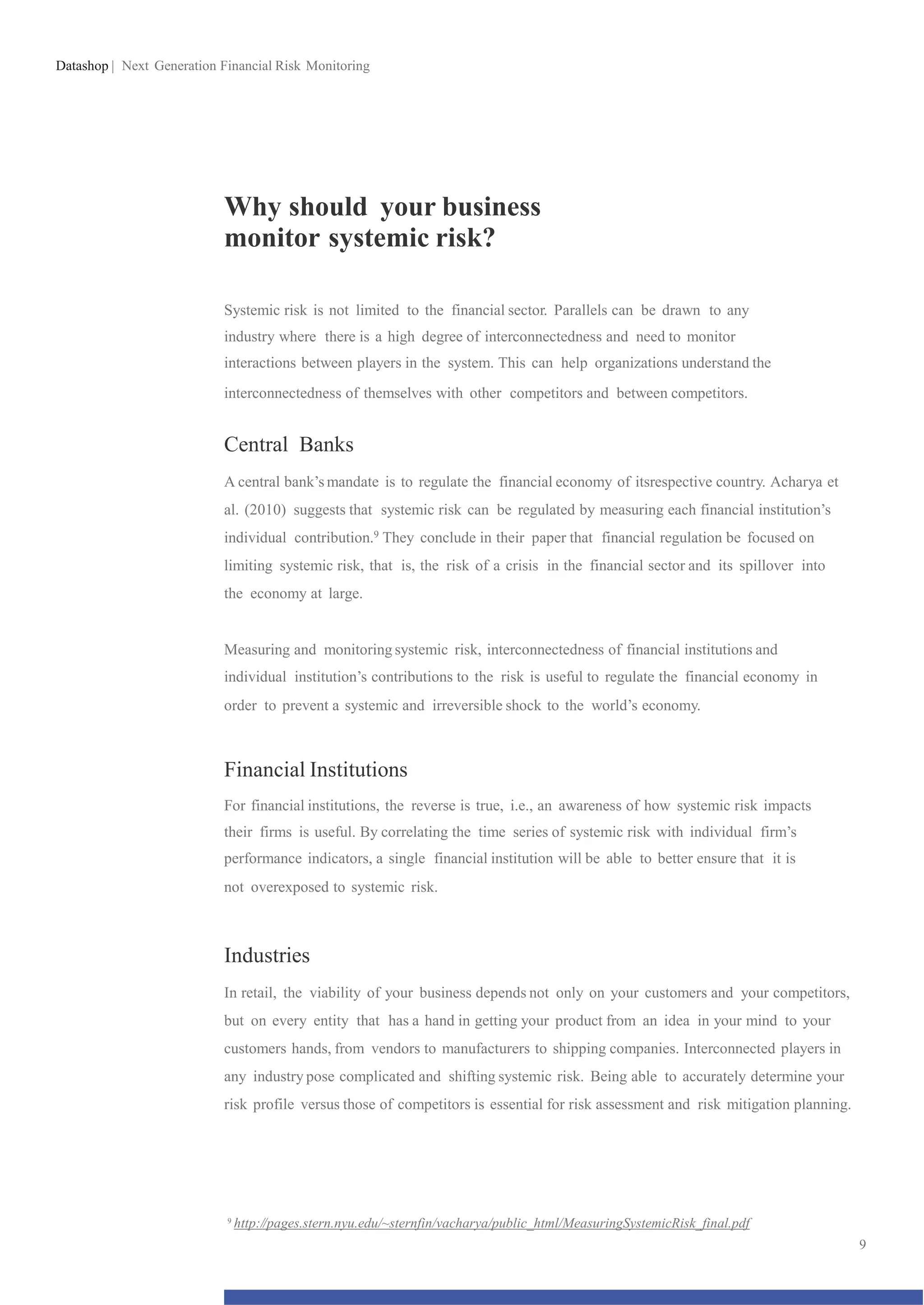
Interconnectedness of Banks
Illustrativenetwork graph of banks representing
which banks are interconnected based on their
equity and credit ratings’ Granger causality. Bubble
size represents the number of inter-connections and
a bank more central in the graph is more connected
to other banks.
10
Datashop | Next Generation Financial Risk Monitoring
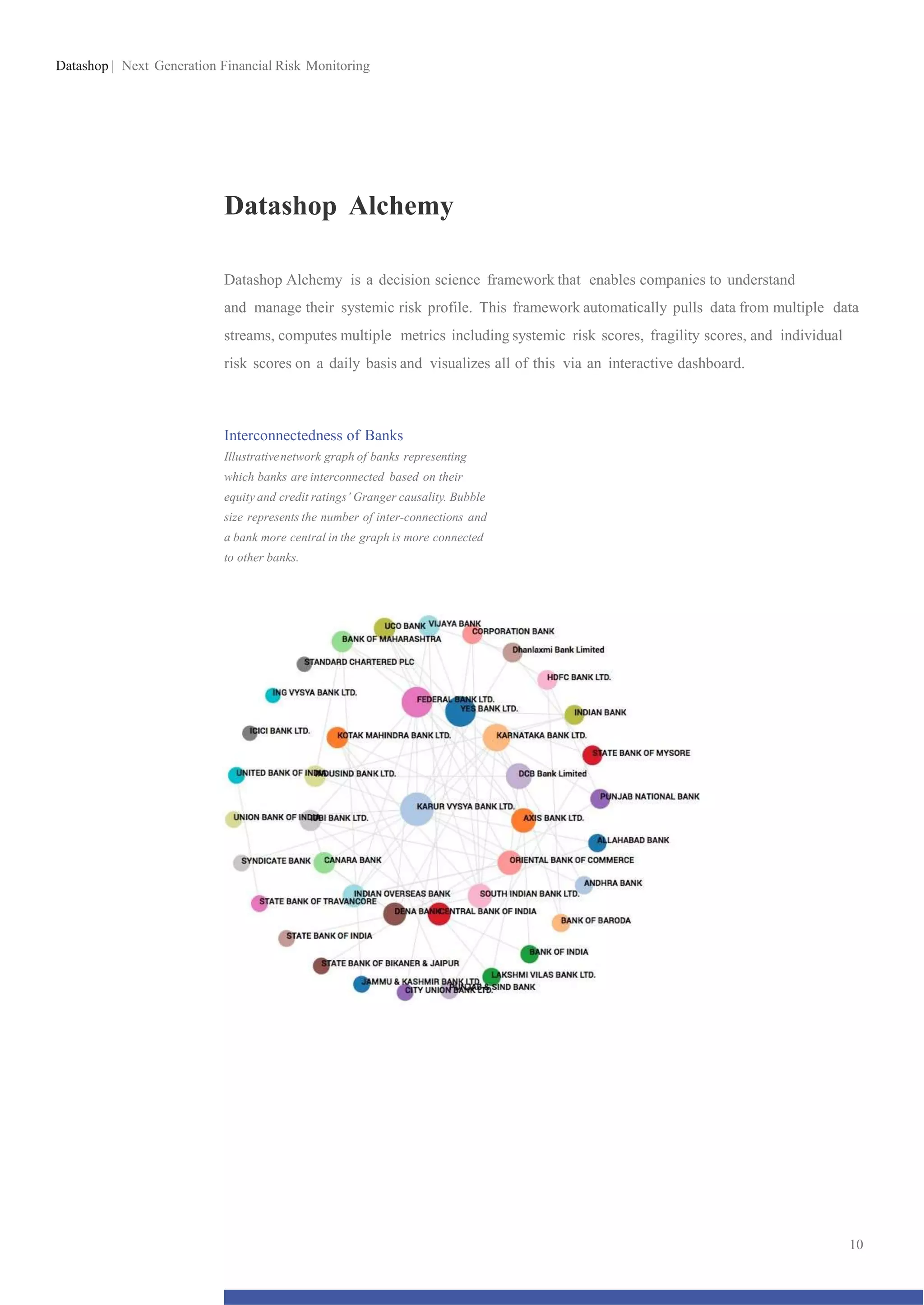
Systemic Risk and Fragility Scores
Time-Series graph of daily systemic risk and fragility
scores of a financial economy of a country. Volatility
in time-series data of systemic risk or fragility scores
gives rich information on instabilityin the market.
The benefits of this framework are:
Academically proven systemic risk algorithms
The Das (2014) metric is derived from 15 years of work on systemic risk. The academic
community validated the metric, which is at the heart of Datashop Alchemy to compute
systemic risk scores. This measure is robust enough to even evaluate an increase in
systemic risk if one bank drops in credit quality.
Scalability
The framework is scalable to store and manage large data-sets to easily accommodate 50+ years of
data and more than 5,000 actors. Using a NoSQL database along with a scalable architecture of R
+ Spark, systemic risk score evaluations can be fired up on multiple virtual machines
simultaneously to provide near real-time scores and metrics.
Flexibility
The modular architecture of Datashop Alchemy allows for adding functionality or data
visualizations on the web dashboard or streaming other sources of data with ease, without
touching any other modules irrelevant to the additions. Access control management
and role-based access to different views provides more power to the administrator in
disseminating the web dashboard across peoplein the organization.
11
Datashop | Next Generation Financial Risk Monitoring
Easy to Setup
Data streams plug in to this framework automatically using data connectors. To configure Datashop
Alchemy, one must simply choose the data-streams activate and filter parameters of obtaining the
streams including geographic region, time frame, industry, frequency schedule of data streaming,
and frequency schedule of risk evaluations. Administrators at the organization can then set up
accounts and role-based access levels for users to start accessing the web dashboard.
Protection
Interactive dashboards provide key insights and risk scores to drive vital and time-sensitive
decisions that will ultimately protect the entire system. Datashop Alchemy builds a vantage point
for the administrator to understand the big picture of the organization.
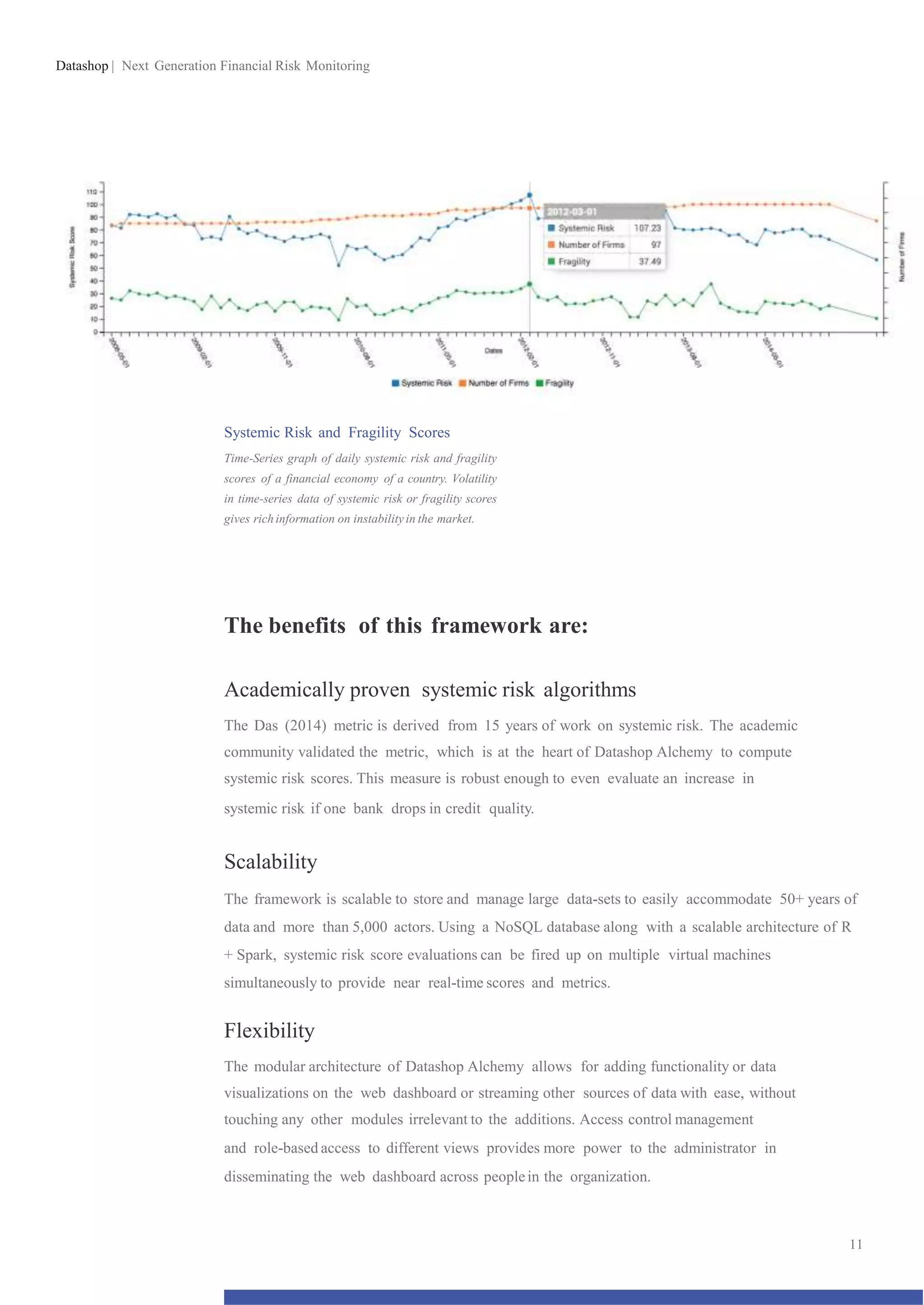
Architecture Diagram of
Datashop Alchemy
Datashop Alchemy is capable of streaming in any
data from stock markets, credit ratings, and inter
institution lending data using its data connectors
and execute systemic risk models on a scalable R
+ Spark architecture for providing near real-
time
systemic risk measures on a web dashboard. 12
Datashop | Next Generation Financial Risk Monitoring
Case Studies
The Datashop Alchemy framework has supported worldwide organizations, helping to
secure trillions of dollars in our interconnected, global economy. In the business of risk
management, no news is good news. To prevent the next financial crisis or economic
collapse, Datashop Alchemy quietly plugs away, providing financial leaders with vital
information that drives key decisions to strengthen and grow their organizations, keeping
risks at bay and squelching threats.
Central Bank
Innovaccer deployed the Datashop Alchemy framework at a central bank of a multi-trillion dollar
national economy to examine systemic risk scores of more than a 1,000financial institutions using
stock market and credit rating data.
The central bank uses this score on a daily basis and has preventative measures in place
determined by fluctuations calculated by Datashop Alchemy.
Oil and Gas
In the Oil and Gas industry, market players’ equity market and credit ratings are not the only
variables affecting systemic risk but also currency and energy prices. These two additional data
streams were added to the framework with a slight customization to the algorithm to incorporate
two new indices.
An Oil and Gas major player was able to examine external market risks all at
once, including competitor’s equities and credit ratings, currency, and energy price
fluctuations.
13
Datashop | Next Generation Financial Risk Monitoring
About Innovaccer
At Innovaccer, we create products that transform the way organizations use data. Our
products and services are deployed at critical government, commercial, and non-profit institutions
around the world to solve sophisticated and world-changing problems. Simply put, we accelerate
innovationthrough the power of data science.
© Innovaccer Inc 2015
Innovaccer, Innovaccer Inc, and Innovaccer Datashop are trademarks of Innovaccer Inc. All other
company and product names may be trademarks with which they are associated with. Datashop
Alchemy is a proprietary technology and Intellectual Property of Innovaccer.
For feedback, requests, or other questions, feel free to reach out:
info@innovaccer.com
Innovaccer, Inc.
Stanford Financial Square,
2600 El Camino Real, Suite 415
Palo Alto, CA 94306
United States
+1 714 729 4038

Datashop Alchemy

  • 1.
    WHITEPAPER Next Generation Financial RiskMonitoring Assessing the systemic risk of a multi-trillion dollar financial economy
  • 2.
    “ Yes, thereis the occasional corporate fraud or misaligned incentives, but those are aberrations rather than a systemic problem. So I think this view, that you couldn’t have a large systemic problem,this was the problem.” Raghuram Rajan | Former Chief Economist and Director of Research at IMF who predicted the 2008 U.S. recession in 2005. He is a Distinguished Professor at Chicago Booth, now Governor of the Reserve Bank of India, and author of the Financial Time Book of the Year Fault Lines: How hidden fractures still threaten the world economy.
  • 3.
    Datashop | NextGeneration Financial Risk Monitoring Acknowledgements Innovaccer would like to acknowledge and thank Dr. Sanjiv Das for collaborating and supporting analytical modules of Datashop Alchemy. Dr. Das, a William and Janice Terry Professor of Finance at Santa Clara University’s Leavey School of Business and an expert in risk and networks, presented a new measure of systemic risk that accounts for both the interconnectedness of financial institutions and their relative levels of financial solvency. This work is at the heart of Datashop Alchemy framework to evaluate systemic risk and fragility scores of the interconnected financial networks. Innovaccer also extends thanks and appreciation to CAFRAL (Research Wing of RBI) and especially to Dr. NR Prabhala, Chief Mentor and Head of Research at CAFRAL and Associate Professor at the Robert H. Smith School of Business at University of Maryland, for their continuous support and feedback during the development of Datashop Alchemy. 3
  • 4.
    Datashop | NextGeneration Financial Risk Monitoring Introduction The 2008 global financial crisis raised profound questions regarding the stability of the global financial system. It proved that in an interconnected world, what was initially a liquidity crisis can very quickly turn into a solvency crisis for financial institutions, a balance of payment crisis for countries, and a full-blown confidence crisis for the entire world. Finance and economic researchers emerged from these crises to address global stability using a unified approach of interconnectedness to capture what is denotedas systemic risk. There is no widely accepted, comprehensive definition of systemic risk. In a general sense, it refers to the risk of failure of an entire system, be it financial, manufacturing, retail, or otherwise. This white paper exploresmeasures of interconnectedness in a financial system and discusses approaches to regulating its movements. We also showcase a novel framework for network-based systemic risk measurement and management. Innovaccer’s Datashop Technology through its Big Data framework of unified data management, analysis, and dashboarding modules enables organizations to deploy systemic risk frameworks within weeks and assess the interconnected risk on a daily basis. 4
  • 5.
    Datashop | NextGeneration Financial Risk Monitoring What is Systemic Risk? There is no widely accepted, comprehensive definition of systemic risk. In a general sense, it refers to the risk of failure of an entire system, be it financial, manufacturing, retail, or otherwise. A G-10 report on Financial Sector Consolidation (2001) defines Systemic Risk as follows: “Systemic financial risk is the risk that an event will trigger a loss of economic value or confidence in, and attendant increases in uncertainty about, a substantial portion of the financial system that is serious enough to quite probably have significant adverse effects on the real economy. Systemic risk events can be sudden and unexpected, or the likelihood of their occurrence can build up through time in the absence of appropriate policy responses. The adverse real economic effects from systemic problems are generally seen as arising from disruptions to the payment system, to credit flows, and from the destruction of asset values.” Systemic risk represents the potential for interconnected entities to collapse, affecting every market, trade, or economy they touch, thereby becoming a global crisis in any industry. The G-20 Brisbane summit report (2014) (from KPMG) also shows systemic risk as one of the four core areas of financial regulatory reform and summit priorities. 5
  • 6.
    Datashop | NextGeneration Financial Risk Monitoring Why are actors in an economy interconnected? Firms in an economy are connected because of common economic factors. These factors may be (a) economy-wide, (b) industry-wide, and (c) within industry, small group specific. A factor analysis of firm returns will reveal how many common factors exist that supportthe interconnectedness of firms. In credit risk modeling, the presence of common factors has been empirically established by Longstaff and Rajan (2008).1 The existence of such factors has been well-established for publicly traded firms and is in fact used widely in the asset management industry, as seen in the Fama-French four-factor model.2 In financial systems, entities are perforce connected as speculation and risk-sharing requires trading and this connects agents to each other. As the number of products and risks grows, the intricacy of connections grows as well. As risks grow, more trading is needed, and network connections grow rapidly. The network grows as an antidote to itself! More sharing of risks naturally creates more systemic risk. The historical evolution of socialsystems (which includes financial networks) has been characterized by increasing connectedness, arising from the Law of Preferential Attachment, originally developed in Barabasi and Albert (1999).3 In this theory, influential nodes in a network grow in influence, as new nodes that enter a network attach to these nodes, leading to a concentration of influence. In the context of financial networks, large trading intermediaries become increasingly central and important in the network, fostering rapid transmission of economic contagion when a crisis occurs. 1 Longstaff, Francis A. and Arvind Rajan. “An Empirical Analysis of the Pricing of Collateralized Debt Obligations.” Journal of Finance 63, 2 (April 2008):529-63. 2 See: https://en.wikipedia.org/wiki/Carhart_four-factor_model. The data for this model is widely available at: http://mba.tuck.dartmouth.edu/pages/faculty/ken.french/data_library.html. 3 Barabási, A.-L.; R. Albert (1999). “Emergence of scaling in random networks”. Science 286 (5439): 509–512. 6
  • 7.
    Datashop | NextGeneration Financial Risk Monitoring How is Systemic Risk Evaluated? Post-2008research on financial stability is centered around the evaluation of interconnectedness of actors in an economy. Acemoglu et al. (2013) argued that more interconnected networks do not mean a more stable economy, in fact they show a negative impact on financial stability in certain circumstances.4 Hansen (2012) presents variousapproaches to measuring systemic risk such as tail measures, contingent claims analysis, network models, and dynamic, stochastic macroeconomic models.5 In a recent development by Billio et al. (2012), econometric measures of connectedness based on component analysis and Granger causality networks promises to capture the intricate web of pairwise statistical relations among individual firms in the finance and insurance industries.6 Das (2014)7 developed a new measure of systemic risk that accounts for both, the interconnectedness of financial institutions and also their relative levels of financial solvency. Interconnectedness in the Das model may be developed in a myriad of ways, from using interbank lending networks8 to using Granger causality methods developed in Billio et al. (2012). The financial health of each bank may be derived from a credit scoring model and is signified with a credit rating level, where higher values denote worse credit. Using these inputs (the network matrix and credit vector), the metric produces a single composite number for systemic risk that can be tracked over time. In the Das (2014) measure, an increase in connectedness or a worsening in credit ratings results in an increase in systemic risk. 4 Acemoglu, Daron, Asuman Ozdaglar, and Alireza Tahbaz-Salehi. “Systemic risk and stability in financial networks.” American Economic Review 105(2), (2015): 564-608. 5 Hansen, Lars Peter. Challenges in identifying and measuring systemic risk. No. w18505. National Bureau of Economic Research, 2012. 6 Billio, Monica, et al. “Econometric measures of connectedness and systemic risk in the finance and insurance sectors.” Journal of Financial Economics 104(3), (2012): 535-559. 7 Das, Sanjiv (2014). “Matrix Math: Network-Based Measures of Systemic Risk”, Working paper, Santa Clara Uiversity. 8 See Douglas Burdick, Sanjiv R. Das, Mauricio A. Hernandez, Howard Ho, Georgia Koutrika, Rajasekar Krishnamurthy, Lucian Popa,Ioana Stanoi, Shivakumar Vaithyanathan, (2012). “Extracting, Linking and Integrating Data from Public Sources: A Financial Case Study,” IEEE Data Engineering Bulletin, 3(3), 60-67. 7
  • 8.
    Datashop | NextGeneration Financial Risk Monitoring The Das (2014) metric also offers some interesting analyses as a byproduct. First, the single value for the financial system can be broken down into values for each bank’s contribution to total risk, so as to determine the relative share of each bank in system-wide risk. Second, we may also compute the increase in system-wide risk if any one bank drops in credit quality. Third, we are able to undertake what-if scenario analyses to assess the impact of increasing connectedness in the system. Fourth, we can determine best ways in which to reduce systemic risk by better risk management at banks or through a reconfiguration of the network. Several other analyses are also possible, supported by high-quality visualizations of the financial system. Evaluating systemic risk builds a hedge of protection around a financial system by providing a vantage point to see the big picture of interconnectedness, individual banks from many angles, and outcome predictions of specific scenarios. 8
  • 9.
    Datashop | NextGeneration Financial Risk Monitoring Why should your business monitor systemic risk? Systemic risk is not limited to the financial sector. Parallels can be drawn to any industry where there is a high degree of interconnectedness and need to monitor interactions between players in the system. This can help organizations understand the interconnectedness of themselves with other competitors and between competitors. Central Banks A central bank’s mandate is to regulate the financial economy of itsrespective country. Acharya et al. (2010) suggests that systemic risk can be regulated by measuring each financial institution’s individual contribution.9 They conclude in their paper that financial regulation be focused on limiting systemic risk, that is, the risk of a crisis in the financial sector and its spillover into the economy at large. Measuring and monitoring systemic risk, interconnectedness of financial institutions and individual institution’s contributions to the risk is useful to regulate the financial economy in order to prevent a systemic and irreversible shock to the world’s economy. Financial Institutions For financial institutions, the reverse is true, i.e., an awareness of how systemic risk impacts their firms is useful. By correlating the time series of systemic risk with individual firm’s performance indicators, a single financial institution will be able to better ensure that it is not overexposed to systemic risk. Industries In retail, the viability of your business depends not only on your customers and your competitors, but on every entity that has a hand in getting your product from an idea in your mind to your customers hands, from vendors to manufacturers to shipping companies. Interconnected players in any industry pose complicated and shifting systemic risk. Being able to accurately determine your risk profile versus those of competitors is essential for risk assessment and risk mitigation planning. 9 http://pages.stern.nyu.edu/~sternfin/vacharya/public_html/MeasuringSystemicRisk_final.pdf 9
  • 10.
    Datashop | NextGeneration Financial Risk Monitoring Datashop Alchemy Datashop Alchemy is a decision science framework that enables companies to understand and manage their systemic risk profile. This framework automatically pulls data from multiple data streams, computes multiple metrics including systemic risk scores, fragility scores, and individual risk scores on a daily basis and visualizes all of this via an interactive dashboard. Interconnectedness of Banks Illustrativenetwork graph of banks representing which banks are interconnected based on their equity and credit ratings’ Granger causality. Bubble size represents the number of inter-connections and a bank more central in the graph is more connected to other banks. 10
  • 11.
    Datashop | NextGeneration Financial Risk Monitoring Systemic Risk and Fragility Scores Time-Series graph of daily systemic risk and fragility scores of a financial economy of a country. Volatility in time-series data of systemic risk or fragility scores gives rich information on instabilityin the market. The benefits of this framework are: Academically proven systemic risk algorithms The Das (2014) metric is derived from 15 years of work on systemic risk. The academic community validated the metric, which is at the heart of Datashop Alchemy to compute systemic risk scores. This measure is robust enough to even evaluate an increase in systemic risk if one bank drops in credit quality. Scalability The framework is scalable to store and manage large data-sets to easily accommodate 50+ years of data and more than 5,000 actors. Using a NoSQL database along with a scalable architecture of R + Spark, systemic risk score evaluations can be fired up on multiple virtual machines simultaneously to provide near real-time scores and metrics. Flexibility The modular architecture of Datashop Alchemy allows for adding functionality or data visualizations on the web dashboard or streaming other sources of data with ease, without touching any other modules irrelevant to the additions. Access control management and role-based access to different views provides more power to the administrator in disseminating the web dashboard across peoplein the organization. 11
  • 12.
    Datashop | NextGeneration Financial Risk Monitoring Easy to Setup Data streams plug in to this framework automatically using data connectors. To configure Datashop Alchemy, one must simply choose the data-streams activate and filter parameters of obtaining the streams including geographic region, time frame, industry, frequency schedule of data streaming, and frequency schedule of risk evaluations. Administrators at the organization can then set up accounts and role-based access levels for users to start accessing the web dashboard. Protection Interactive dashboards provide key insights and risk scores to drive vital and time-sensitive decisions that will ultimately protect the entire system. Datashop Alchemy builds a vantage point for the administrator to understand the big picture of the organization. Architecture Diagram of Datashop Alchemy Datashop Alchemy is capable of streaming in any data from stock markets, credit ratings, and inter institution lending data using its data connectors and execute systemic risk models on a scalable R + Spark architecture for providing near real- time systemic risk measures on a web dashboard. 12
  • 13.
    Datashop | NextGeneration Financial Risk Monitoring Case Studies The Datashop Alchemy framework has supported worldwide organizations, helping to secure trillions of dollars in our interconnected, global economy. In the business of risk management, no news is good news. To prevent the next financial crisis or economic collapse, Datashop Alchemy quietly plugs away, providing financial leaders with vital information that drives key decisions to strengthen and grow their organizations, keeping risks at bay and squelching threats. Central Bank Innovaccer deployed the Datashop Alchemy framework at a central bank of a multi-trillion dollar national economy to examine systemic risk scores of more than a 1,000financial institutions using stock market and credit rating data. The central bank uses this score on a daily basis and has preventative measures in place determined by fluctuations calculated by Datashop Alchemy. Oil and Gas In the Oil and Gas industry, market players’ equity market and credit ratings are not the only variables affecting systemic risk but also currency and energy prices. These two additional data streams were added to the framework with a slight customization to the algorithm to incorporate two new indices. An Oil and Gas major player was able to examine external market risks all at once, including competitor’s equities and credit ratings, currency, and energy price fluctuations. 13
  • 14.
    Datashop | NextGeneration Financial Risk Monitoring About Innovaccer At Innovaccer, we create products that transform the way organizations use data. Our products and services are deployed at critical government, commercial, and non-profit institutions around the world to solve sophisticated and world-changing problems. Simply put, we accelerate innovationthrough the power of data science. © Innovaccer Inc 2015 Innovaccer, Innovaccer Inc, and Innovaccer Datashop are trademarks of Innovaccer Inc. All other company and product names may be trademarks with which they are associated with. Datashop Alchemy is a proprietary technology and Intellectual Property of Innovaccer. For feedback, requests, or other questions, feel free to reach out: info@innovaccer.com Innovaccer, Inc. Stanford Financial Square, 2600 El Camino Real, Suite 415 Palo Alto, CA 94306 United States +1 714 729 4038