A Systematic Approach to Monitoring and
Evaluating Integrated Health Interventions in
   the Era of the Global Health Initiative


         Heidi Reynolds, MPH, Ph.D. and
           Elizabeth Sutherland, Ph.D.
Rationale
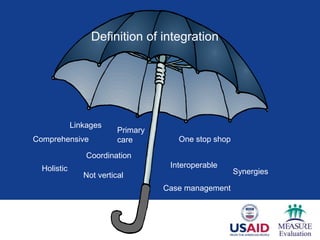
Definition of integration


             Linkages
                          Primary
Comprehensive             care         One stop shop

                 Coordination
  Holistic                           Interoperable
                Not vertical                           Synergies

                                    Case management
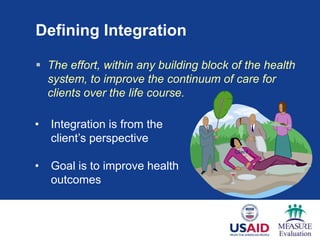
Defining Integration

 The effort, within any building block of the health
  system, to improve the continuum of care for
  clients over the life course.

•   Integration is from the
    client’s perspective
                                        Client

•   Goal is to improve health
    outcomes
Health System Building Blocks
  and Integration
   Health financing
       Direct funding by external donors -> General health care
        budget
   Leadership and governance
       Disease policies -> integrated health policies
       Decisions made without -> with consideration of general
        health care activities
   Health services
       Single purpose ->multi-purpose service


Atun et al 2009;
Mitchell et al 2004
Health System Building Blocks
  and Integration (con’t)
   Work-force
       Providers and supervisors with specialized -> generalized
        knowledge
   Medical products, vaccines and technologies
       Vertical -> general systems
   Health information systems
       Single purpose reporting ->patient centered system


Atun et al 2009; Mitchell 2004
Health Systems and Integration

 Health systems do not need to be integrated to
  result in integrated care
 Health systems do need to be strong
 Whether and how health systems will be
  integrated is context specific
So now what?

 How do we operationalize integration in a
  systematic fashion?
 How do we monitor and evaluate integrated
  interventions?
 How do we use the data to adapt program
  response and inform the global evidence base
  for integration?
No Need to Panic!
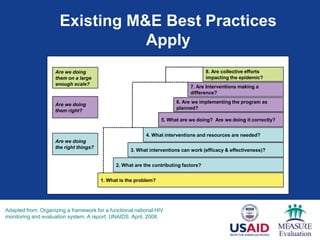
Existing M&E Best Practices
                                 Apply
                    Are we doing                                                      8. Are collective efforts
                    them on a large                                                   impacting the epidemic?
                    enough scale?
                                                                              7. Are Interventions making a
                                                                              difference?
                                                                        6. Are we implementing the program as
                    Are we doing
                                                                        planned?
                    them right?
                                                                  5. What are we doing? Are we doing it correctly?


                                                           4. What interventions and resources are needed?
                    Are we doing
                    the right things?
                                                    3. What interventions can work (efficacy & effectiveness)?


                                              2. What are the contributing factors?


                                        1. What is the problem?


Adapted from: Organizing a framework for a functional national HIV
monitoring and evaluation system. A report. UNAIDS. April, 2008.
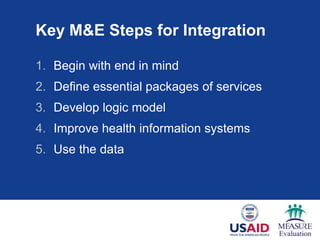
Key M&E Steps for Integration

1. Begin with end in mind
2. Define essential packages of services
3. Develop logic model
4. Improve health information systems
5. Use the data
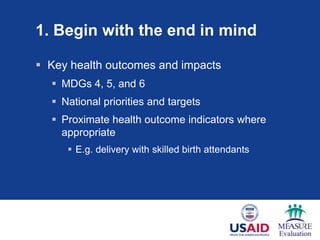
1. Begin with the end in mind

 Key health outcomes and impacts
   MDGs 4, 5, and 6
   National priorities and targets
   Proximate health outcome indicators where
    appropriate
      E.g. delivery with skilled birth attendants
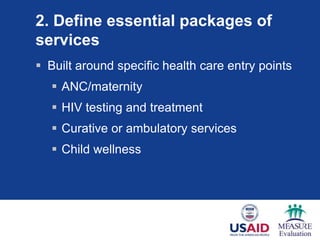
2. Define essential packages of
services
 Built around specific health care entry points
   ANC/maternity
   HIV testing and treatment
   Curative or ambulatory services
   Child wellness
2. Essential packages of services
(con’t)

 Precedent setting examples of such
  packages exist
 ANC
     Women presenting in pregnancy
     WHO package includes range of services
           HIV testing and screening for other STIs
           Blood pressure and anemia screens
           Tetanus toxoid injection and malaria prophylaxis
2. Essential packages of services
(con’t)

   Need international guidance on service
    packages
      Choice of package determined by health
       needs
      Tailored for country-specific priorities and
       epidemiology
      Service delivery guidelines for different
       service delivery levels
3. Develop logic models

 Defines how and where integration occurs at each
  level of intervention
    Inputs, processes, outcomes, impacts
    National, district hospital, health facility, community
    Health system building blocks
 Promotes stakeholder buy in at national-level
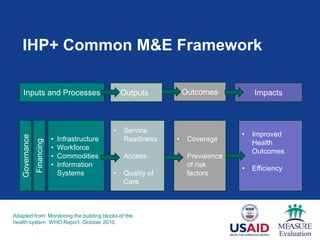
IHP+ Common M&E Framework

    Inputs and Processes                              Outputs          Outcomes          Impacts


                                                  •   Service
                                                                                     •   Improved
    Governance


                             •   Infrastructure       Readiness    •    Coverage
                 Financing


                                                                                         Health
                             •   Workforce
                                                                                         Outcomes
                             •   Commodities      •   Access       •    Prevalence
                             •   Information                            of risk
                                                                                     •   Efficiency
                                 Systems          •   Quality of        factors
                                                      Care


Adapted from: Monitoring the building blocks of the
health system. WHO Report. October 2010.
4. Improve health information
systems
 Support provider access to client health
  information
    Electronic medical records
    3 interlinked patient monitoring systems
    ANC client cards
 Strong linked/interoperable routine health
  information systems still needed
    Track progress in service delivery
4. Health information systems (con’t)

 Indicators
     Derived from logic model
     Access, readiness, coverage, health outcomes
 New indicators are needed
         Quality
         Met needs and prevention
         Referral
4. Health information systems (con’t)

 Consistent with efforts to strengthen the
  broader M&E system
     IHP+, CHeSS, evaluation platform, etc.
 Map data needs (from indicators in logic model)
  to existing survey data, surveillance, RHIS, etc.
 Determine what new data collection efforts are
  necessary
5. Use the data

 Inform program decision making
 Refine logic model inputs, processes, indicators
 Strengthen the evidence base of what works
Research and Evaluation Agenda
Current state of the evidence

 Some improved client-level outcomes noted
    increased uptake of services
    increased client satisfaction
 Pilot tests
    Little info on how to implement/effectiveness at
     scale
 Value added
    Little/no info on relative value of integration
Research agenda
 Conduct outcome and impact evaluations
    At scale/going to scale
    Across several models and countries
 Evaluate essential packages of services
    What should they contain?
    What is the effectiveness of package in improving key health
     outcomes?
 Evaluate effectiveness of improved patient monitoring tools on
    Continuum of care
    Provider access to client health info
Research agenda

 Evaluate effective capacity building approaches to
  intervention
    For building human resources to provide
     integration
 Evaluate effectiveness of referral mechanisms
 Conduct case studies of integrated interventions to
  inform impact evaluations
Conclusions

 Integration is fundamentally client-centered
 Interventions should improve continuum of care
 Approach assumes integration will be country led
    Context specific and tailored to epidemiology
 Experience needed to understand how to adapt
  approach to reality of country setting
 Role for international community to guide and
  help build evidence base
Conclusions

 Health system needs to be strong but not
  necessarily integrated
 Integrated interventions take place within health
  system building blocks
 Intersects with innovative National Evaluation
  Platform design, IHP+ initiative, HSS questions,
  and the CHeSS initiative
 Leadership is needed from GHI on expectations
  for implementing the integration principle
MEASURE Evaluation is a MEASURE project funded by the
U.S. Agency for International Development and implemented by
the Carolina Population Center at the University of North Carolina
at Chapel Hill in partnership with Futures Group International,
ICF Macro, John Snow, Inc., Management Sciences for Health,
and Tulane University. Views expressed in this presentation do not
necessarily reflect the views of USAID or the U.S. Government.
MEASURE Evaluation is the USAID Global Health Bureau's
primary vehicle for supporting improvements in monitoring and
evaluation in population, health and nutrition worldwide.

A Systematic Approach to Monitoring and Evaluating Integrated Health Interventions in the Era of the Global Health Initiative

  • 1.
    A Systematic Approachto Monitoring and Evaluating Integrated Health Interventions in the Era of the Global Health Initiative Heidi Reynolds, MPH, Ph.D. and Elizabeth Sutherland, Ph.D.
  • 2.
  • 3.
    Definition of integration Linkages Primary Comprehensive care One stop shop Coordination Holistic Interoperable Not vertical Synergies Case management
  • 4.
    Defining Integration  Theeffort, within any building block of the health system, to improve the continuum of care for clients over the life course. • Integration is from the client’s perspective Client • Goal is to improve health outcomes
  • 5.
    Health System BuildingBlocks and Integration  Health financing  Direct funding by external donors -> General health care budget  Leadership and governance  Disease policies -> integrated health policies  Decisions made without -> with consideration of general health care activities  Health services  Single purpose ->multi-purpose service Atun et al 2009; Mitchell et al 2004
  • 6.
    Health System BuildingBlocks and Integration (con’t)  Work-force  Providers and supervisors with specialized -> generalized knowledge  Medical products, vaccines and technologies  Vertical -> general systems  Health information systems  Single purpose reporting ->patient centered system Atun et al 2009; Mitchell 2004
  • 7.
    Health Systems andIntegration  Health systems do not need to be integrated to result in integrated care  Health systems do need to be strong  Whether and how health systems will be integrated is context specific
  • 8.
    So now what? How do we operationalize integration in a systematic fashion?  How do we monitor and evaluate integrated interventions?  How do we use the data to adapt program response and inform the global evidence base for integration?
  • 9.
    No Need toPanic!
  • 10.
    Existing M&E BestPractices Apply Are we doing 8. Are collective efforts them on a large impacting the epidemic? enough scale? 7. Are Interventions making a difference? 6. Are we implementing the program as Are we doing planned? them right? 5. What are we doing? Are we doing it correctly? 4. What interventions and resources are needed? Are we doing the right things? 3. What interventions can work (efficacy & effectiveness)? 2. What are the contributing factors? 1. What is the problem? Adapted from: Organizing a framework for a functional national HIV monitoring and evaluation system. A report. UNAIDS. April, 2008.
  • 11.
    Key M&E Stepsfor Integration 1. Begin with end in mind 2. Define essential packages of services 3. Develop logic model 4. Improve health information systems 5. Use the data
  • 12.
    1. Begin withthe end in mind  Key health outcomes and impacts  MDGs 4, 5, and 6  National priorities and targets  Proximate health outcome indicators where appropriate  E.g. delivery with skilled birth attendants
  • 13.
    2. Define essentialpackages of services  Built around specific health care entry points  ANC/maternity  HIV testing and treatment  Curative or ambulatory services  Child wellness
  • 14.
    2. Essential packagesof services (con’t)  Precedent setting examples of such packages exist  ANC  Women presenting in pregnancy  WHO package includes range of services  HIV testing and screening for other STIs  Blood pressure and anemia screens  Tetanus toxoid injection and malaria prophylaxis
  • 15.
    2. Essential packagesof services (con’t)  Need international guidance on service packages  Choice of package determined by health needs  Tailored for country-specific priorities and epidemiology  Service delivery guidelines for different service delivery levels
  • 16.
    3. Develop logicmodels  Defines how and where integration occurs at each level of intervention  Inputs, processes, outcomes, impacts  National, district hospital, health facility, community  Health system building blocks  Promotes stakeholder buy in at national-level
  • 17.
    IHP+ Common M&EFramework Inputs and Processes Outputs Outcomes Impacts • Service • Improved Governance • Infrastructure Readiness • Coverage Financing Health • Workforce Outcomes • Commodities • Access • Prevalence • Information of risk • Efficiency Systems • Quality of factors Care Adapted from: Monitoring the building blocks of the health system. WHO Report. October 2010.
  • 18.
    4. Improve healthinformation systems  Support provider access to client health information  Electronic medical records  3 interlinked patient monitoring systems  ANC client cards  Strong linked/interoperable routine health information systems still needed  Track progress in service delivery
  • 19.
    4. Health informationsystems (con’t)  Indicators  Derived from logic model  Access, readiness, coverage, health outcomes  New indicators are needed  Quality  Met needs and prevention  Referral
  • 20.
    4. Health informationsystems (con’t)  Consistent with efforts to strengthen the broader M&E system  IHP+, CHeSS, evaluation platform, etc.  Map data needs (from indicators in logic model) to existing survey data, surveillance, RHIS, etc.  Determine what new data collection efforts are necessary
  • 21.
    5. Use thedata  Inform program decision making  Refine logic model inputs, processes, indicators  Strengthen the evidence base of what works
  • 22.
  • 23.
    Current state ofthe evidence  Some improved client-level outcomes noted  increased uptake of services  increased client satisfaction  Pilot tests  Little info on how to implement/effectiveness at scale  Value added  Little/no info on relative value of integration
  • 24.
    Research agenda  Conductoutcome and impact evaluations  At scale/going to scale  Across several models and countries  Evaluate essential packages of services  What should they contain?  What is the effectiveness of package in improving key health outcomes?  Evaluate effectiveness of improved patient monitoring tools on  Continuum of care  Provider access to client health info
  • 25.
    Research agenda  Evaluateeffective capacity building approaches to intervention  For building human resources to provide integration  Evaluate effectiveness of referral mechanisms  Conduct case studies of integrated interventions to inform impact evaluations
  • 26.
    Conclusions  Integration isfundamentally client-centered  Interventions should improve continuum of care  Approach assumes integration will be country led  Context specific and tailored to epidemiology  Experience needed to understand how to adapt approach to reality of country setting  Role for international community to guide and help build evidence base
  • 27.
    Conclusions  Health systemneeds to be strong but not necessarily integrated  Integrated interventions take place within health system building blocks  Intersects with innovative National Evaluation Platform design, IHP+ initiative, HSS questions, and the CHeSS initiative  Leadership is needed from GHI on expectations for implementing the integration principle
  • 28.
    MEASURE Evaluation isa MEASURE project funded by the U.S. Agency for International Development and implemented by the Carolina Population Center at the University of North Carolina at Chapel Hill in partnership with Futures Group International, ICF Macro, John Snow, Inc., Management Sciences for Health, and Tulane University. Views expressed in this presentation do not necessarily reflect the views of USAID or the U.S. Government. MEASURE Evaluation is the USAID Global Health Bureau's primary vehicle for supporting improvements in monitoring and evaluation in population, health and nutrition worldwide.

Editor's Notes

  • #4 The definition of integration, what we mean by integration, bogs down the dialogueIt is really an umbrella term for many concepts and operationalizations
  • #5 Many definitionsDefinition must supersede specific disease areas or health outcomesClient at center as opposed to program or donor prioritiesClient has easy access, perceives seamless care, her/his needs are met
  • #6 Interventions to improve the continuum of care take place within the health system building blocks, but the health system building blocks do not themselves have to be integrated to improve the continuum of care for the client(Building blocks from WHO, definitions of integration within building blocks mixed from Atun and Mitchell, and this may not be exhaustive and certainly is not definitive)
  • #9 We propose a systematic approach that will inform operationalization, M&E, and data for decision making.
  • #11 Many frameworks exist, this is one (MDG 6)and there are others (e.g. Bryce MCH approach to evaluate the scale up for MDGs 4 and 5) These present a series of important questions to be asked when addressing M&E. Namely, we must id the problem, plan the response to the problem, monitor implementation of the response, collect and analyze data that will allow us to revise the response as needed and assess the effectiveness of the response.This is a dynamic process and not just a matter of reporting on indicators and putting together a report.
  • #12 How would we approach this process for integration? There are several key principles for applying these types of frameworks/processes to integration. This outlines some practical steps that must be taken to appropriately operationalize M&E for integration. Highlight three principles to discuss in greater depth.
  • #13 Roles of international and national public health community in each of these.
  • #14 Some useful packages already created (e.g. ANC and to some extent HIV) but others still needed. Not all packages can be implemented in all countries immediately. Priorities determined by country level health needs as evidenced by national plans and targets.
  • #15 Lack evidence for some may have to rely on expert opinion while evidence is generated for specific packages
  • #17 Logic model provides a template for integration and coordination. This is a planning document that allows for each stage of implementation (inputs and processes to be planned in terms of coordination/integration roles and responsibilities). This is where the integrated interventions are planned for, with the aim of improving the continuum of care for clientsLogic models describe plausible pathways for causal effects. They are informed by theory and evidence. They lay out a logical expected pathway for activities to influence intermediate outcomes and collectively work toward expected impact.
  • #18 Common framework adapted to show how the logic model can show the elements of the health care system working together to influence service delivery/care and ultimate health impacts.
  • #19 Information that allows providers to follow clients health information over time will be important in the case of screening and referrals.
  • #25 Outcome/impact evaluateions are needed to generate evidence for decision making for program management and scaleup and also for global adaptation and adoption. To understand the benefit of investment in integration must also understand cost effectiveness and Must also understand the ideal interventions within each health building block to maximize the benefits of integration interventions for health
  • #26 (Re: last bullet: Case studies of on-going integration efforts can help understand what changes have been made to the health system building blocks, uncover other’s ideas about plausible pathways for effects of integrated interventions on client outcomes, build the “integration theory”, tap into the measures they are testing. This information can broadly inform interventions and determine impact evaluation priorities and designs)