System Thinking
System Fundamentals
Types of Systems
Session Outcome
▪ Describe the various system types
Type 1 - Systems
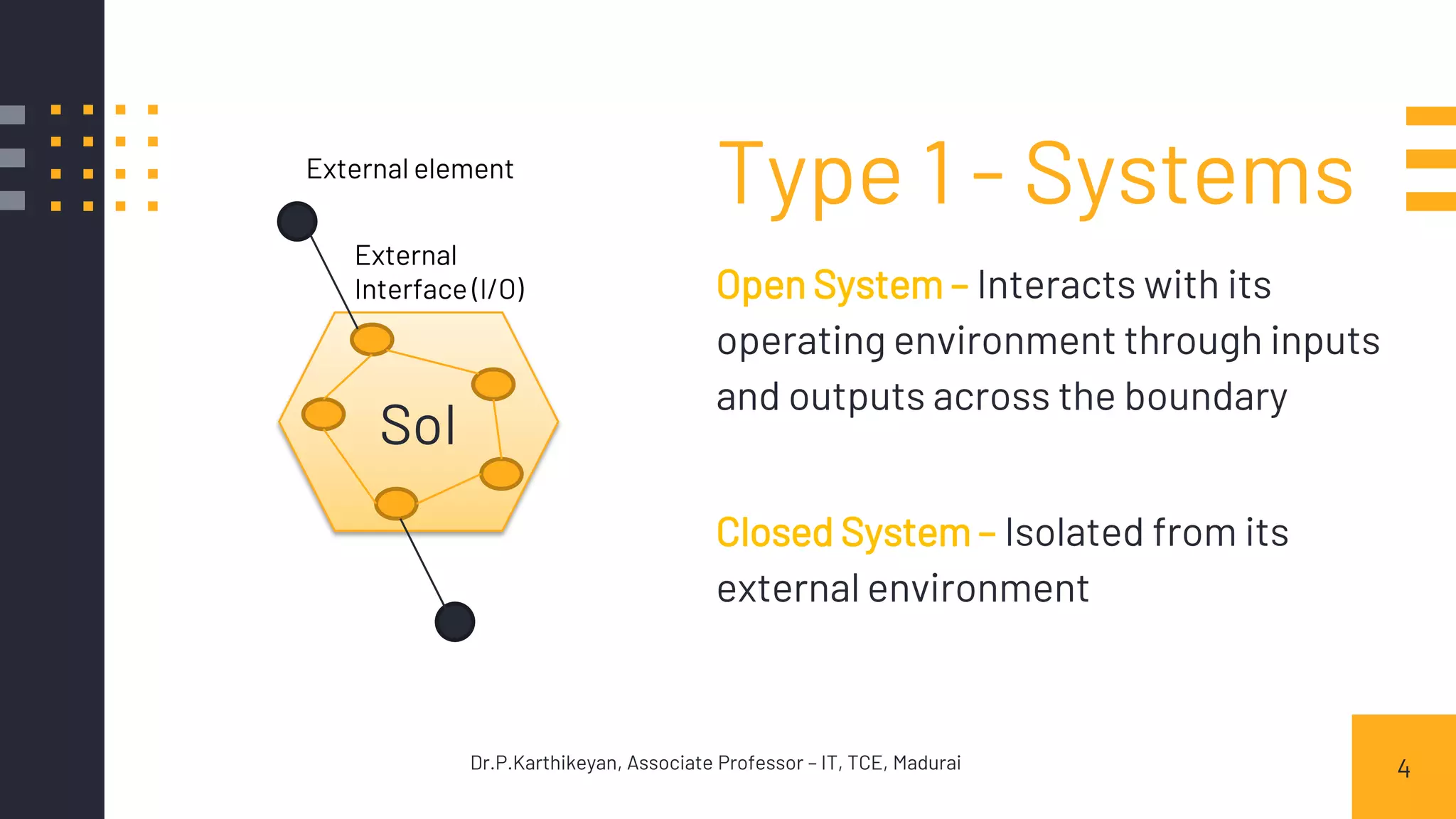
Open System – Interacts with its
operating environment through inputs
and outputs across the boundary
Closed System – Isolated from its
external environment
4Dr.P.Karthikeyan, Associate Professor – IT, TCE, Madurai
SoI
External element
External
Interface (I/O)
Type 2 - Systems
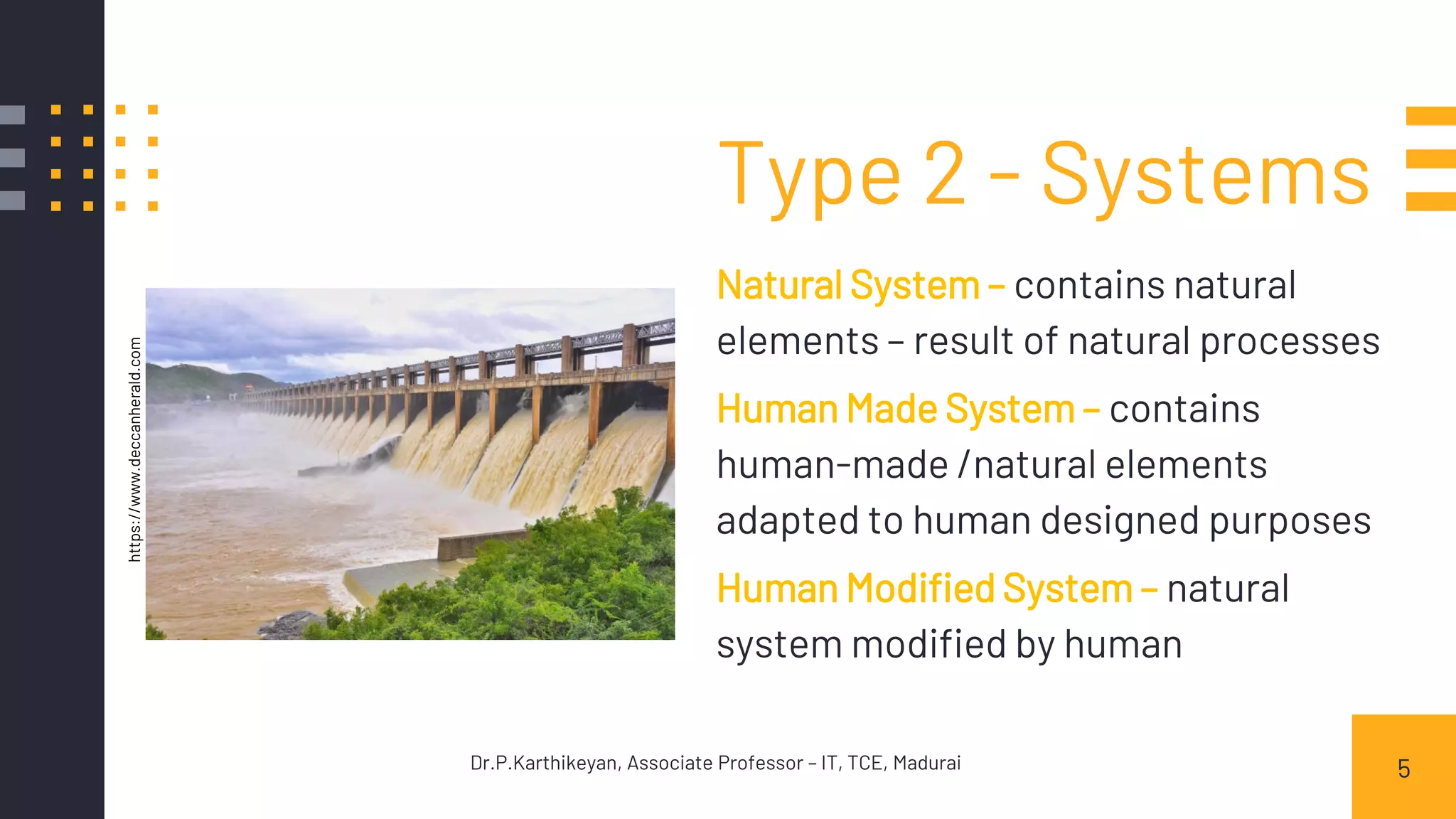
Natural System – contains natural
elements – result of natural processes
Human Made System – contains
human-made /natural elements
adapted to human designed purposes
Human Modified System – natural
system modified by human
5Dr.P.Karthikeyan, Associate Professor – IT, TCE, Madurai
https://www.deccanherald.com
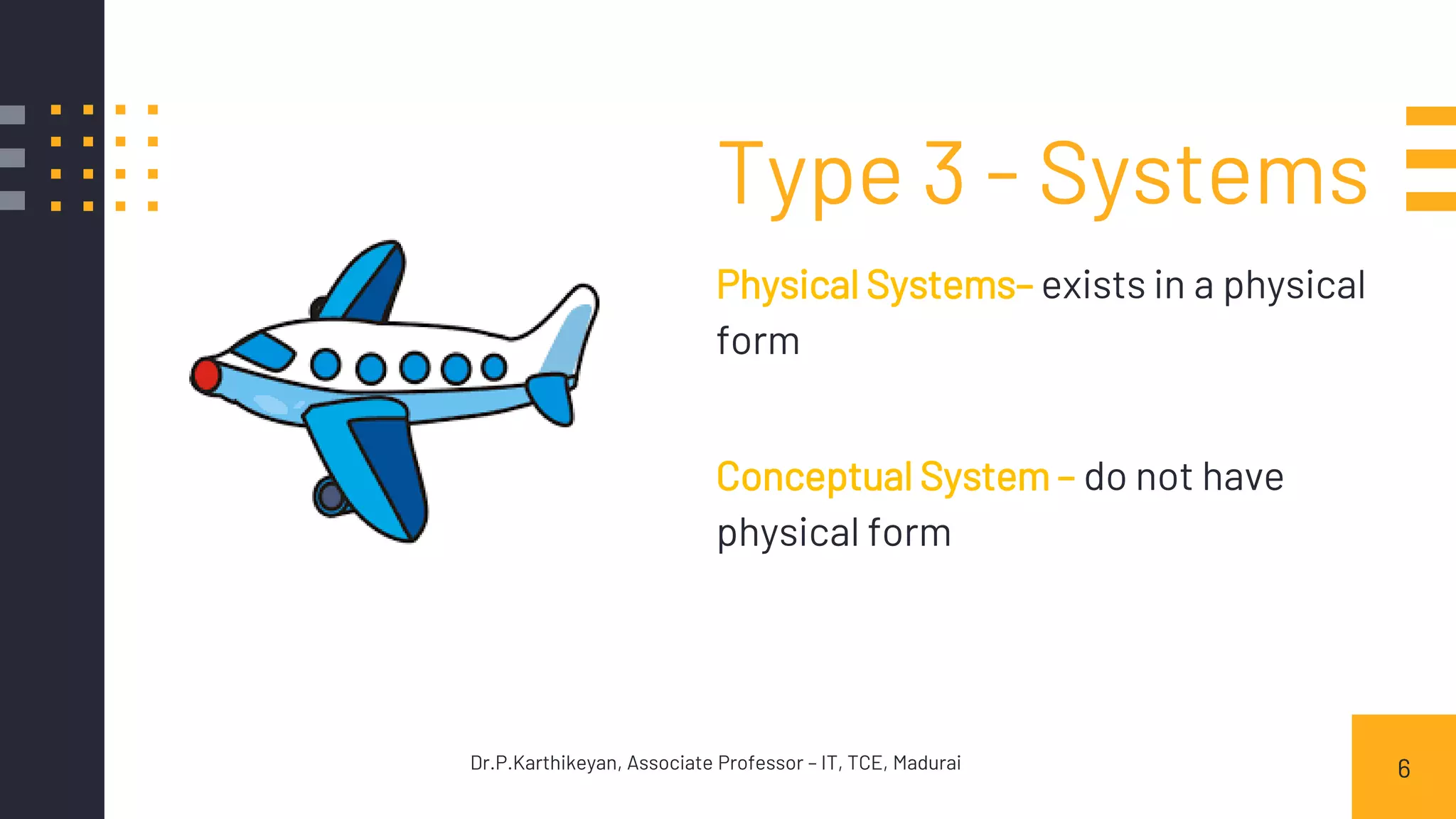
Type 3 - Systems
Physical Systems– exists in a physical
form
Conceptual System – do not have
physical form
6Dr.P.Karthikeyan, Associate Professor – IT, TCE, Madurai
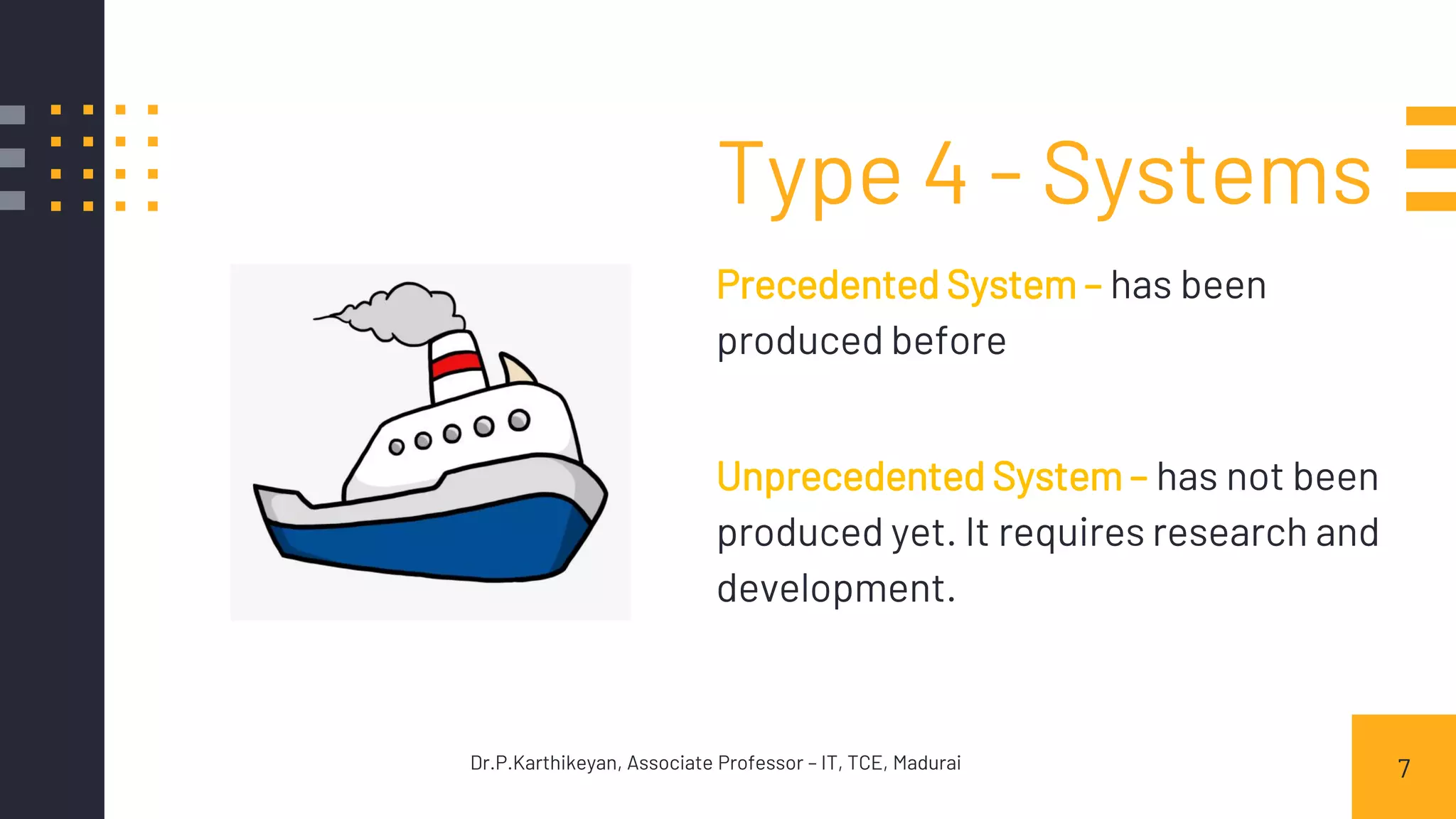
Type 4 - Systems
Precedented System – has been
produced before
Unprecedented System – has not been
produced yet. It requires research and
development.
7Dr.P.Karthikeyan, Associate Professor – IT, TCE, Madurai
“ Systems engineering is
applied to open,
physical systems that are
human-made/modified
from largely
precedented elements
8Dr.P.Karthikeyan, Associate Professor – IT, TCE, Madurai
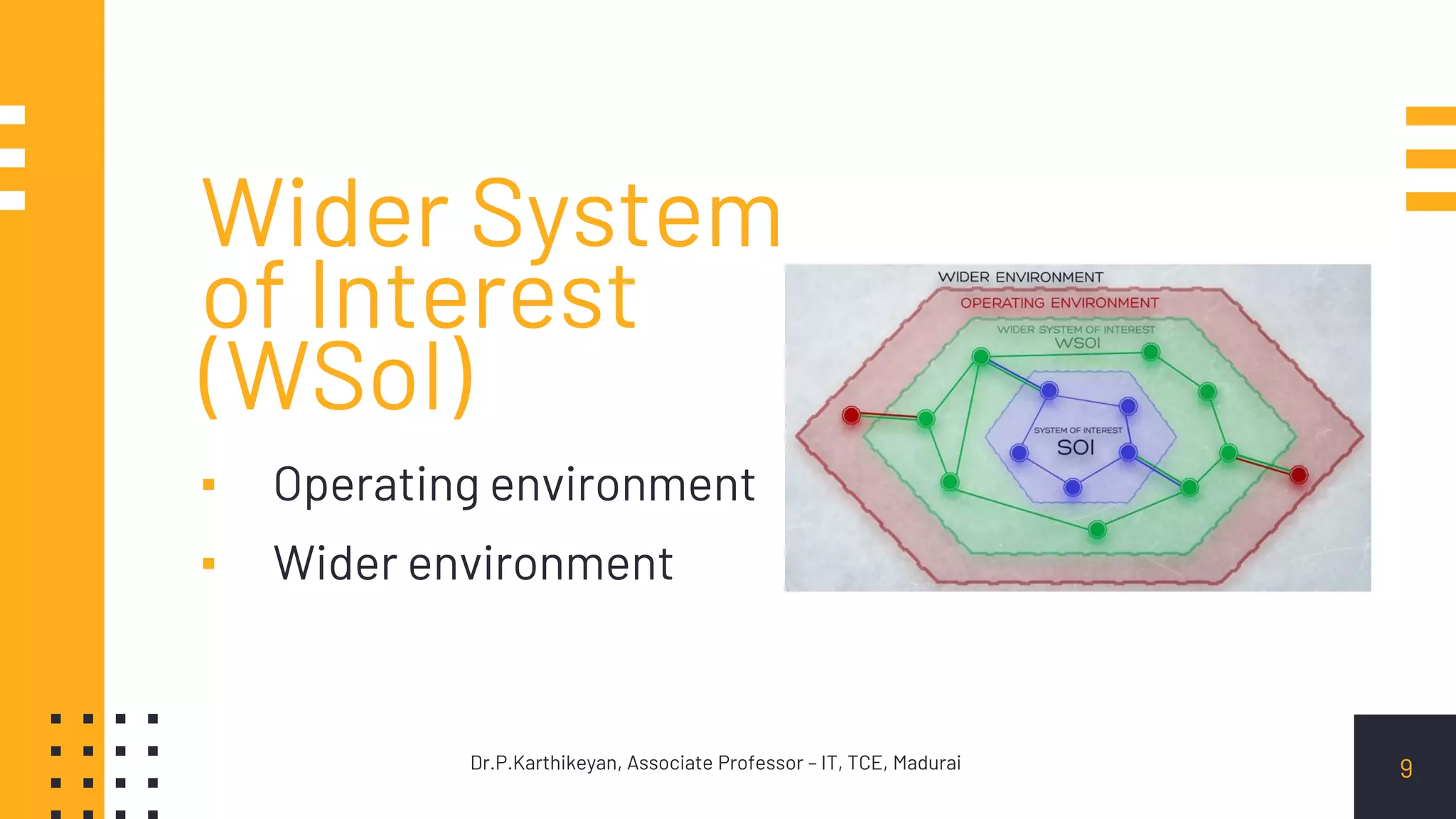
Wider System
of Interest
(WSoI)
▪ Operating environment
▪ Wider environment
9Dr.P.Karthikeyan, Associate Professor – IT, TCE, Madurai
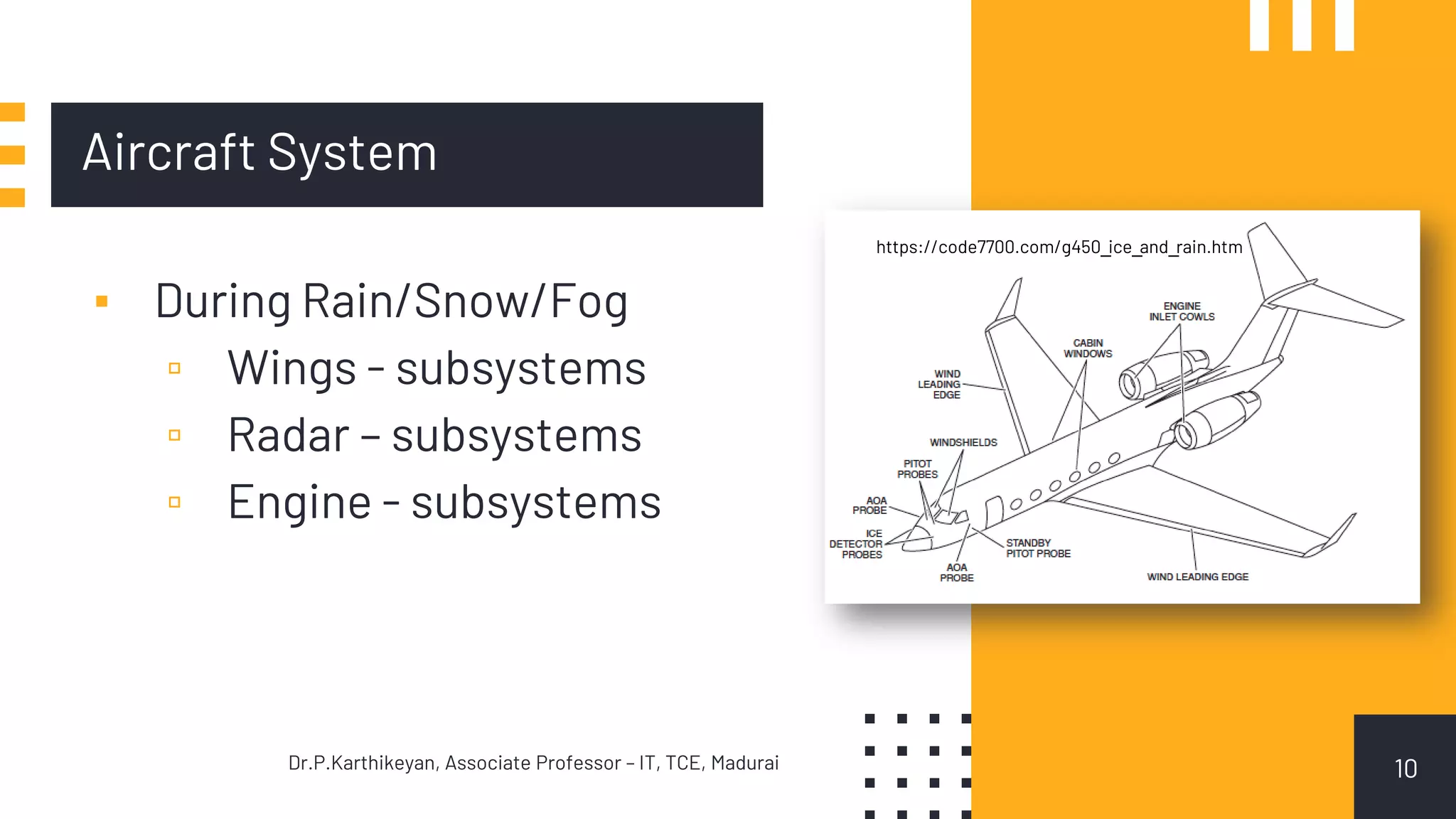
Aircraft System
10
▪ During Rain/Snow/Fog
▫ Wings - subsystems
▫ Radar – subsystems
▫ Engine - subsystems
Dr.P.Karthikeyan, Associate Professor – IT, TCE, Madurai
https://code7700.com/g450_ice_and_rain.htm
System as a Product
In a physical sense, the term “System” considered as
“Product”
The outcome of a system may be a product or system
delivers product.
11Dr.P.Karthikeyan, Associate Professor – IT, TCE, Madurai
Few System Products
12Dr.P.Karthikeyan, Associate Professor – IT, TCE, Madurai
 Development product
 Test product
 Training product
 Disposal product
 Support product
System – Operational Capability
Systems are much
more than an
aggregation of
Hardware and
Software products
Also include
Organisation,
personnel, collective
training systems,
facilities, data,
support, operating
procedures and
policies
13Dr.P.Karthikeyan, Associate Professor – IT, TCE, Madurai
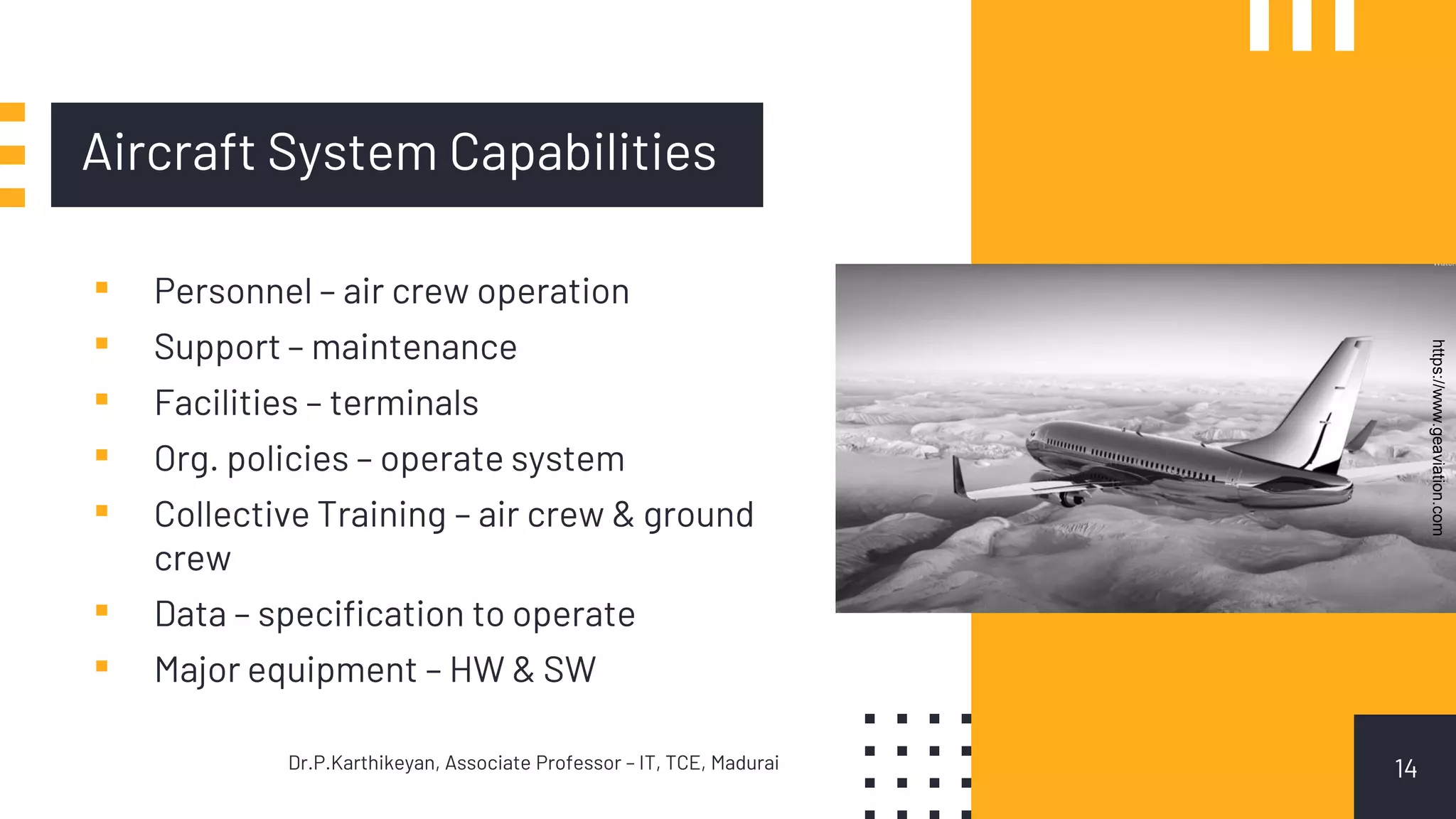
Aircraft System Capabilities
14
▪ Personnel – air crew operation
▪ Support – maintenance
▪ Facilities – terminals
▪ Org. policies – operate system
▪ Collective Training – air crew & ground
crew
▪ Data – specification to operate
▪ Major equipment – HW & SW
Dr.P.Karthikeyan, Associate Professor – IT, TCE, Madurai
https://www.geaviation.com
System – Descriptions
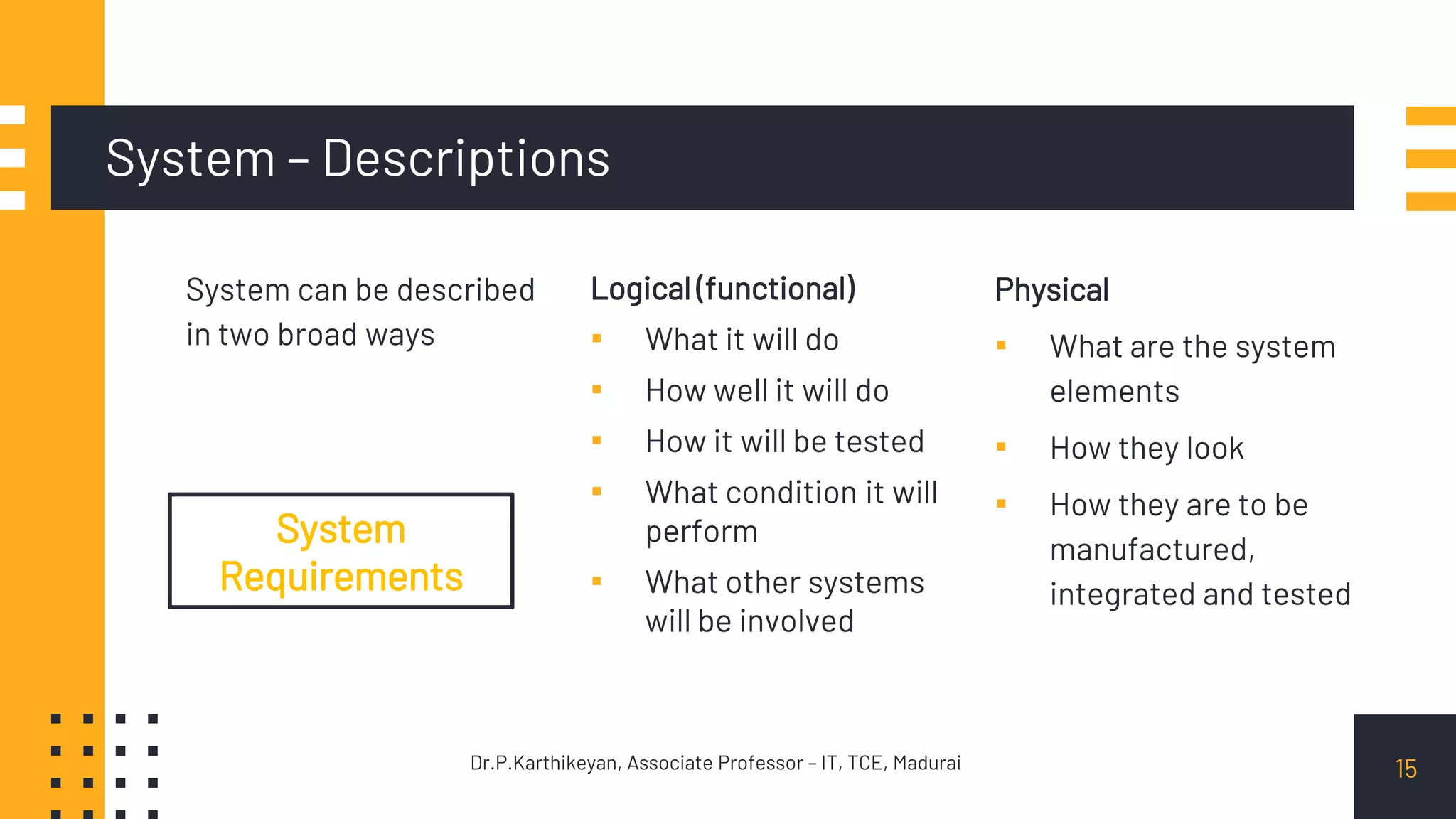
System can be described
in two broad ways
Logical (functional)
▪ What it will do
▪ How well it will do
▪ How it will be tested
▪ What condition it will
perform
▪ What other systems
will be involved
Physical
▪ What are the system
elements
▪ How they look
▪ How they are to be
manufactured,
integrated and tested
15Dr.P.Karthikeyan, Associate Professor – IT, TCE, Madurai
System
Requirements
System – Architecture
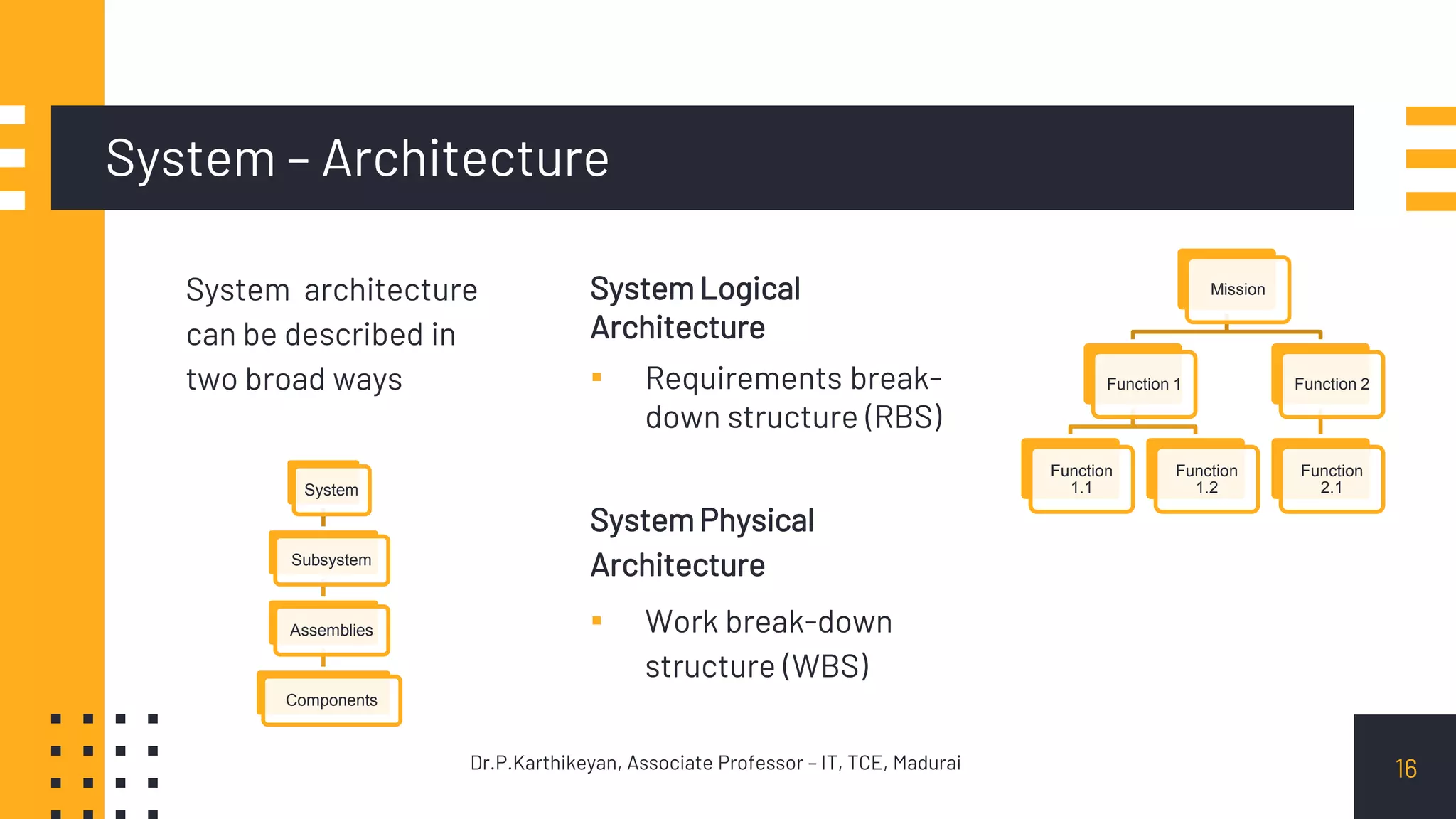
System architecture
can be described in
two broad ways
SystemLogical
Architecture
▪ Requirements break-
down structure (RBS)
SystemPhysical
Architecture
▪ Work break-down
structure (WBS)
16Dr.P.Karthikeyan, Associate Professor – IT, TCE, Madurai
System
Subsystem
Assemblies
Components
Mission
Function 1
Function
1.1
Function
1.2
Function 2
Function
2.1
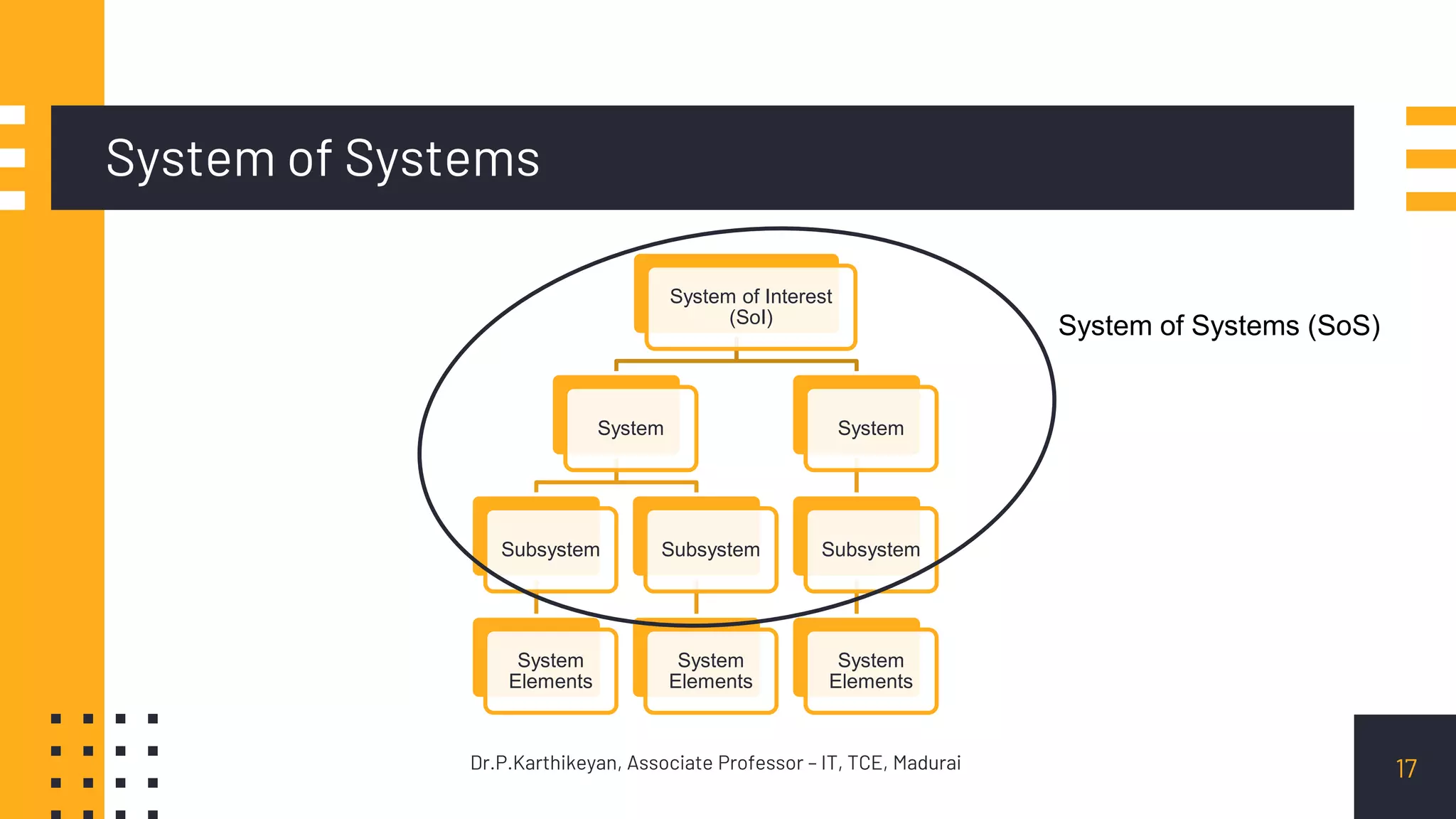
System of Systems
17Dr.P.Karthikeyan, Associate Professor – IT, TCE, Madurai
System of Interest
(SoI)
System
Subsystem
System
Elements
Subsystem
System
Elements
System
Subsystem
System
Elements
System of Systems (SoS)
18
Thanks!

System types

  • 1.
  • 2.
  • 3.
    Session Outcome ▪ Describethe various system types
  • 4.
    Type 1 -Systems Open System – Interacts with its operating environment through inputs and outputs across the boundary Closed System – Isolated from its external environment 4Dr.P.Karthikeyan, Associate Professor – IT, TCE, Madurai SoI External element External Interface (I/O)
  • 5.
    Type 2 -Systems Natural System – contains natural elements – result of natural processes Human Made System – contains human-made /natural elements adapted to human designed purposes Human Modified System – natural system modified by human 5Dr.P.Karthikeyan, Associate Professor – IT, TCE, Madurai https://www.deccanherald.com
  • 6.
    Type 3 -Systems Physical Systems– exists in a physical form Conceptual System – do not have physical form 6Dr.P.Karthikeyan, Associate Professor – IT, TCE, Madurai
  • 7.
    Type 4 -Systems Precedented System – has been produced before Unprecedented System – has not been produced yet. It requires research and development. 7Dr.P.Karthikeyan, Associate Professor – IT, TCE, Madurai
  • 8.
    “ Systems engineeringis applied to open, physical systems that are human-made/modified from largely precedented elements 8Dr.P.Karthikeyan, Associate Professor – IT, TCE, Madurai
  • 9.
    Wider System of Interest (WSoI) ▪Operating environment ▪ Wider environment 9Dr.P.Karthikeyan, Associate Professor – IT, TCE, Madurai
  • 10.
    Aircraft System 10 ▪ DuringRain/Snow/Fog ▫ Wings - subsystems ▫ Radar – subsystems ▫ Engine - subsystems Dr.P.Karthikeyan, Associate Professor – IT, TCE, Madurai https://code7700.com/g450_ice_and_rain.htm
  • 11.
    System as aProduct In a physical sense, the term “System” considered as “Product” The outcome of a system may be a product or system delivers product. 11Dr.P.Karthikeyan, Associate Professor – IT, TCE, Madurai
  • 12.
    Few System Products 12Dr.P.Karthikeyan,Associate Professor – IT, TCE, Madurai  Development product  Test product  Training product  Disposal product  Support product
  • 13.
    System – OperationalCapability Systems are much more than an aggregation of Hardware and Software products Also include Organisation, personnel, collective training systems, facilities, data, support, operating procedures and policies 13Dr.P.Karthikeyan, Associate Professor – IT, TCE, Madurai
  • 14.
    Aircraft System Capabilities 14 ▪Personnel – air crew operation ▪ Support – maintenance ▪ Facilities – terminals ▪ Org. policies – operate system ▪ Collective Training – air crew & ground crew ▪ Data – specification to operate ▪ Major equipment – HW & SW Dr.P.Karthikeyan, Associate Professor – IT, TCE, Madurai https://www.geaviation.com
  • 15.
    System – Descriptions Systemcan be described in two broad ways Logical (functional) ▪ What it will do ▪ How well it will do ▪ How it will be tested ▪ What condition it will perform ▪ What other systems will be involved Physical ▪ What are the system elements ▪ How they look ▪ How they are to be manufactured, integrated and tested 15Dr.P.Karthikeyan, Associate Professor – IT, TCE, Madurai System Requirements
  • 16.
    System – Architecture Systemarchitecture can be described in two broad ways SystemLogical Architecture ▪ Requirements break- down structure (RBS) SystemPhysical Architecture ▪ Work break-down structure (WBS) 16Dr.P.Karthikeyan, Associate Professor – IT, TCE, Madurai System Subsystem Assemblies Components Mission Function 1 Function 1.1 Function 1.2 Function 2 Function 2.1
  • 17.
    System of Systems 17Dr.P.Karthikeyan,Associate Professor – IT, TCE, Madurai System of Interest (SoI) System Subsystem System Elements Subsystem System Elements System Subsystem System Elements System of Systems (SoS)
  • 18.