SYNTAX - part 1
Prácticas Discursivas de la Comunicación Escrita 1
1°2°
ISFD 41
Prof. Stella Maris Saubidet Oyhamburu
Short story: “Guess who’s coming to dinner?”
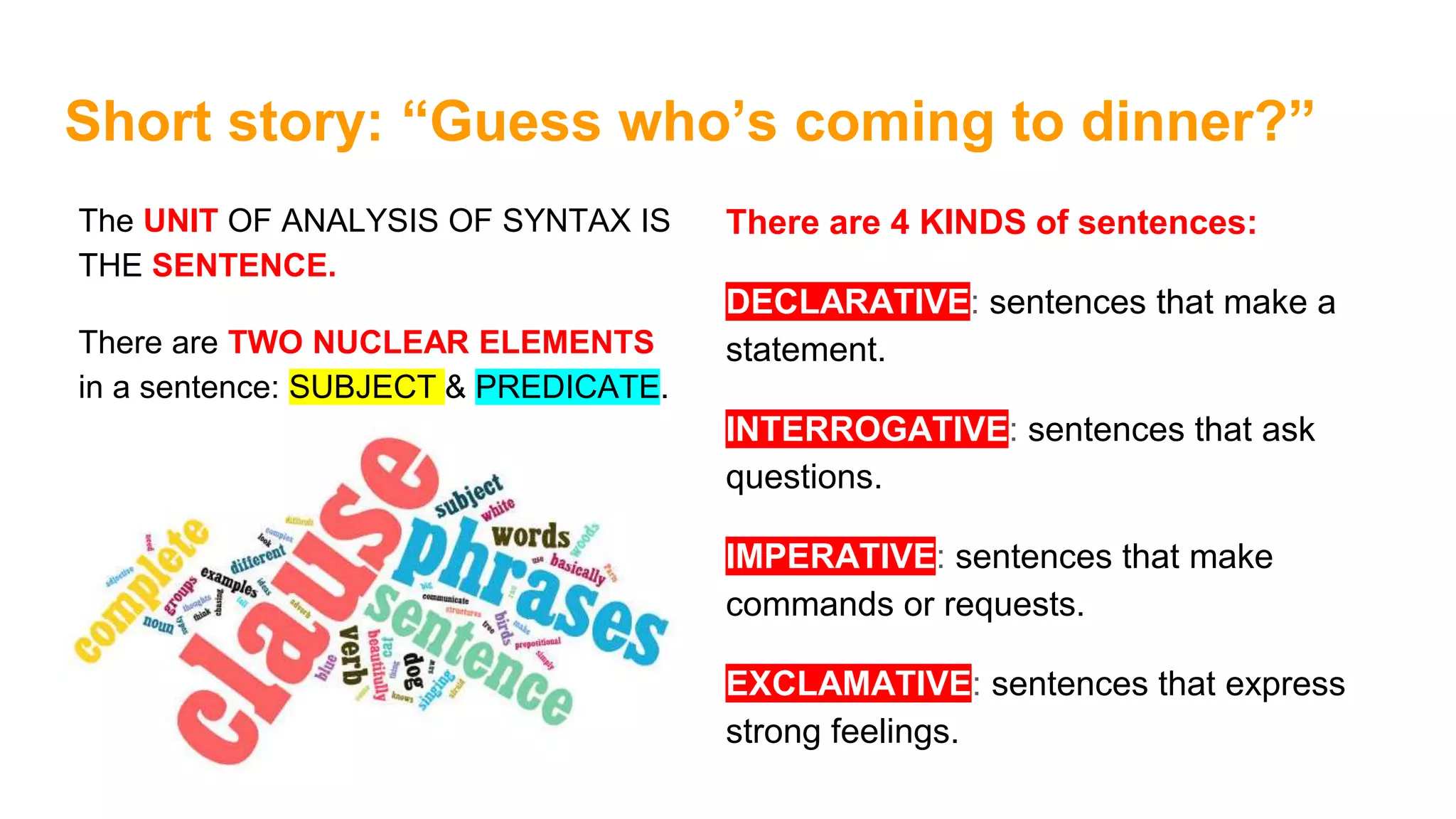
The UNIT OF ANALYSIS OF SYNTAX IS
THE SENTENCE.
There are TWO NUCLEAR ELEMENTS
in a sentence: SUBJECT & PREDICATE.
There are 4 KINDS of sentences:
DECLARATIVE: sentences that make a
statement.
INTERROGATIVE: sentences that ask
questions.
IMPERATIVE: sentences that make
commands or requests.
EXCLAMATIVE: sentences that express
strong feelings.
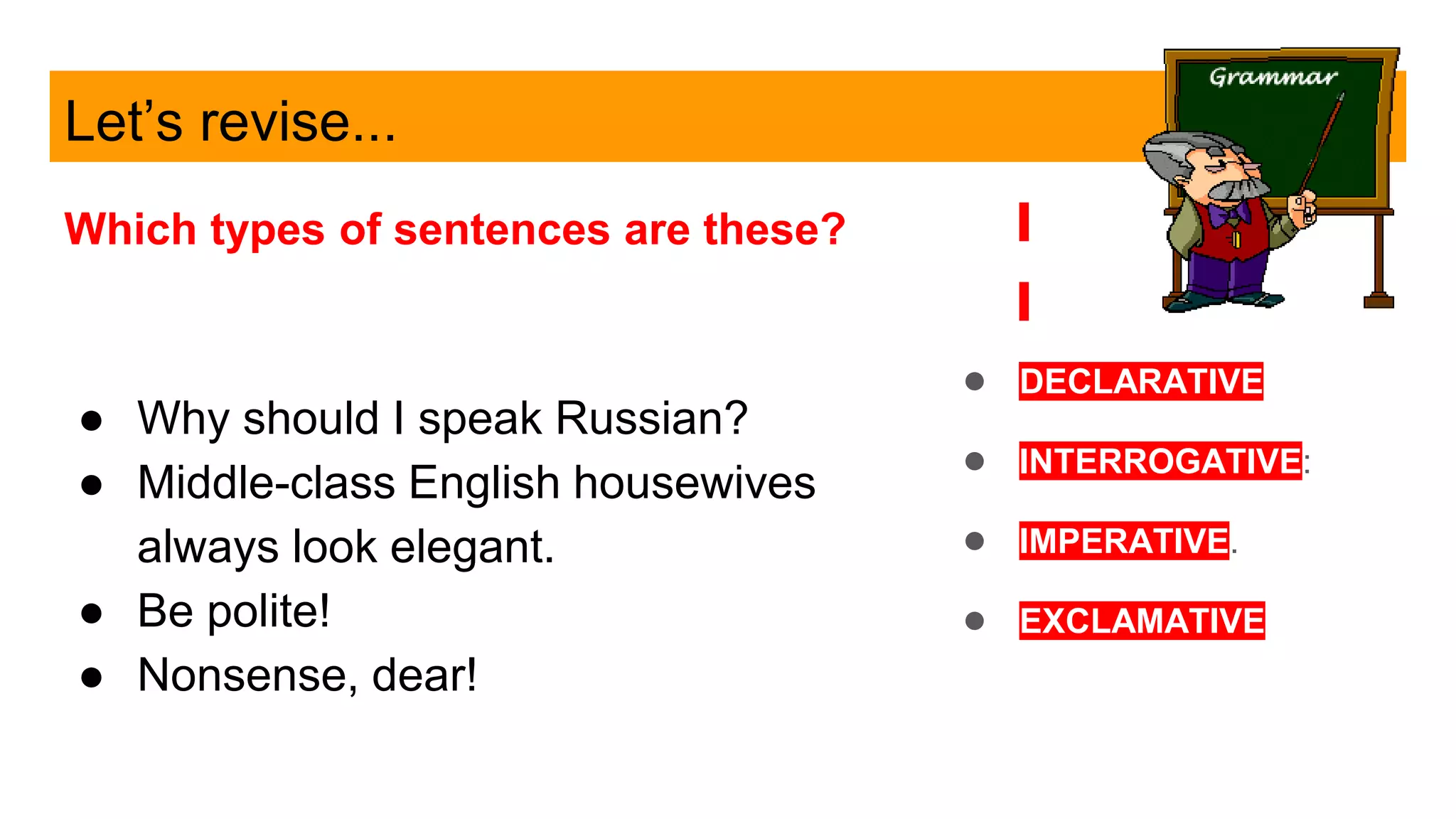
Let’s revise...
Which types of sentences are these?
● Why should I speak Russian?
● Middle-class English housewives
always look elegant.
● Be polite!
● Nonsense, dear!
● DECLARATIVE
● INTERROGATIVE:
● IMPERATIVE.
● EXCLAMATIVE
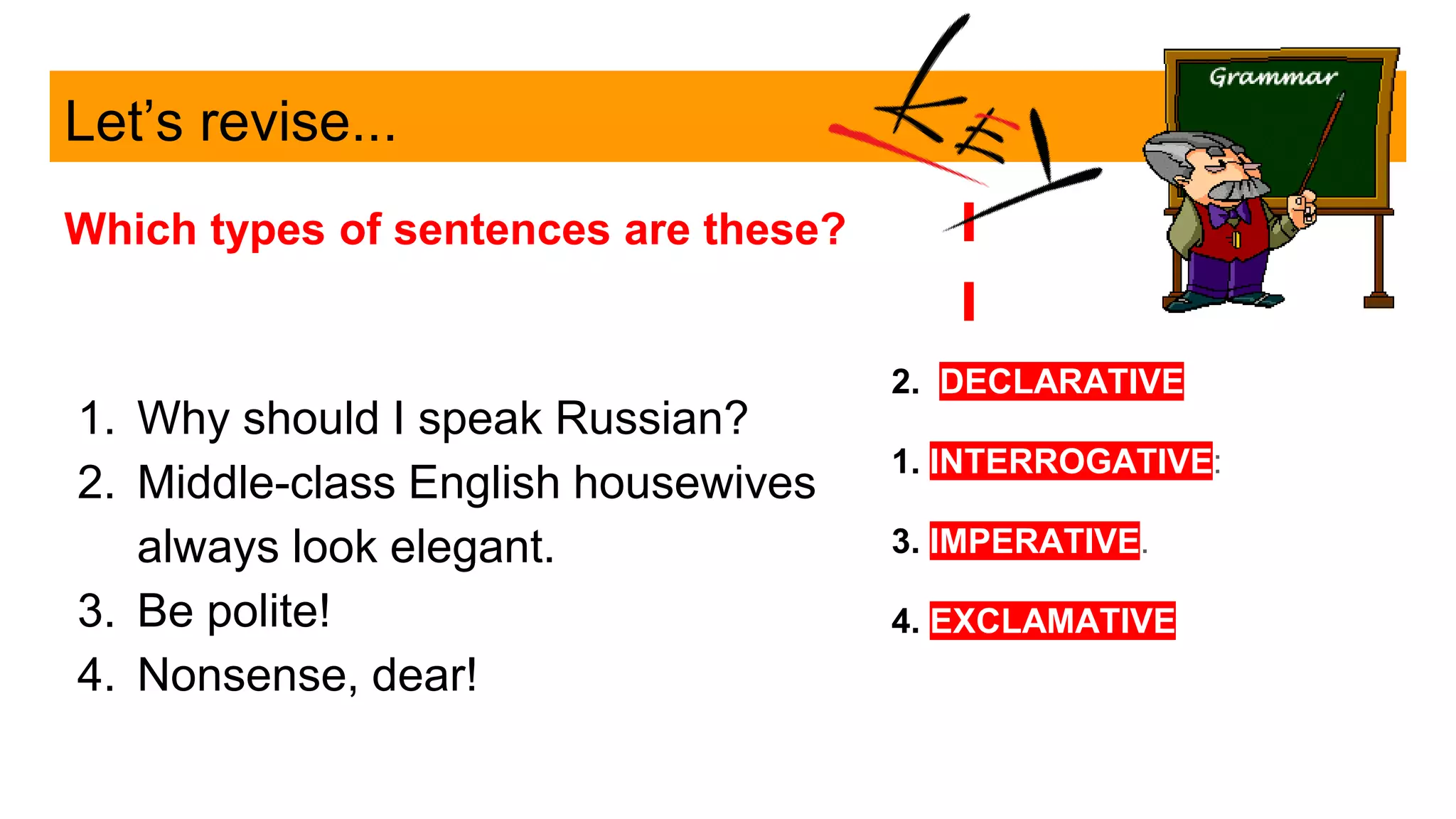
Let’s revise...
Which types of sentences are these?
1. Why should I speak Russian?
2. Middle-class English housewives
always look elegant.
3. Be polite!
4. Nonsense, dear!
2. DECLARATIVE
1. INTERROGATIVE:
3. IMPERATIVE.
4. EXCLAMATIVE
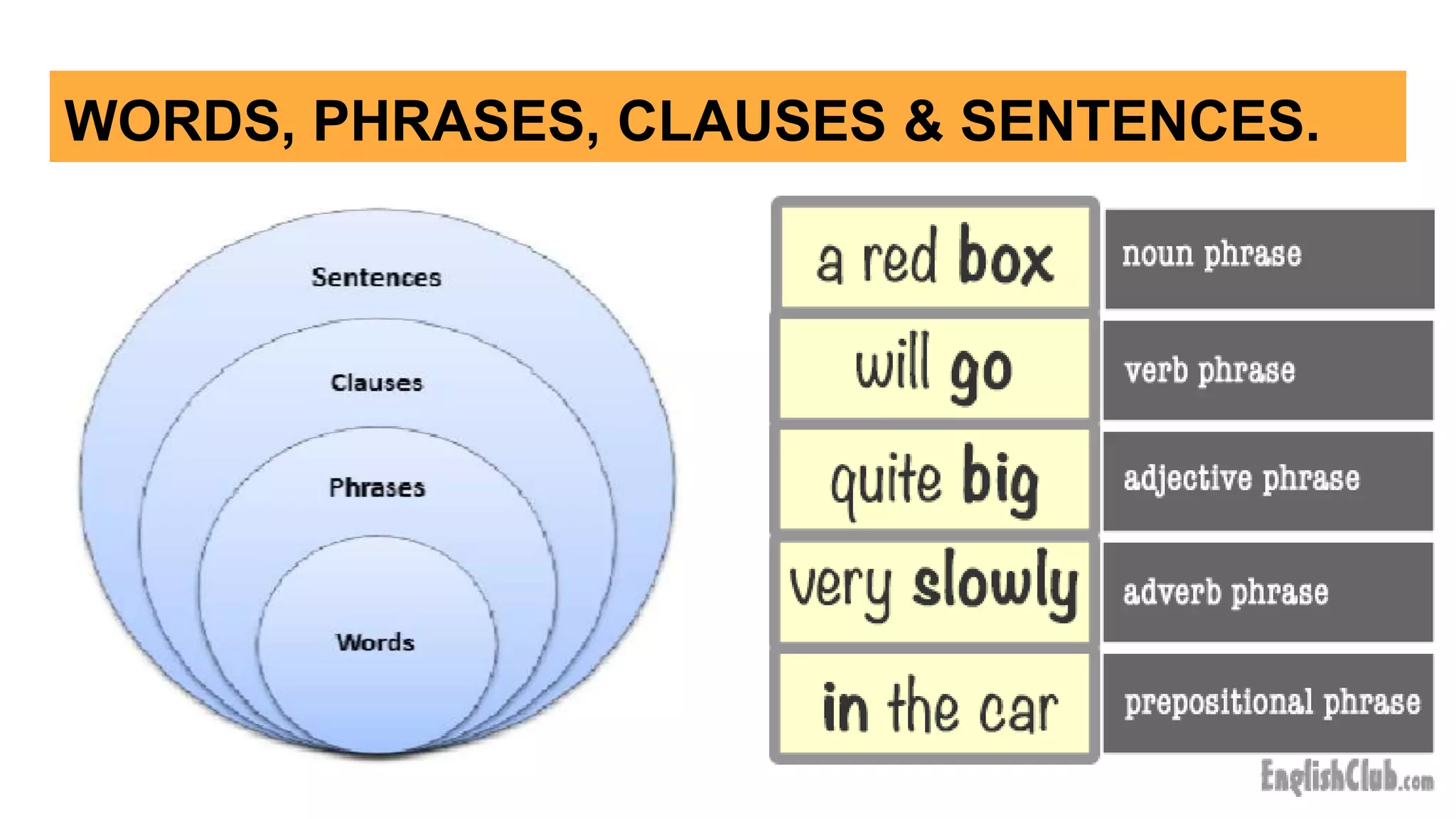
WORDS, PHRASES, CLAUSES & SENTENCES.
Let’s revise...
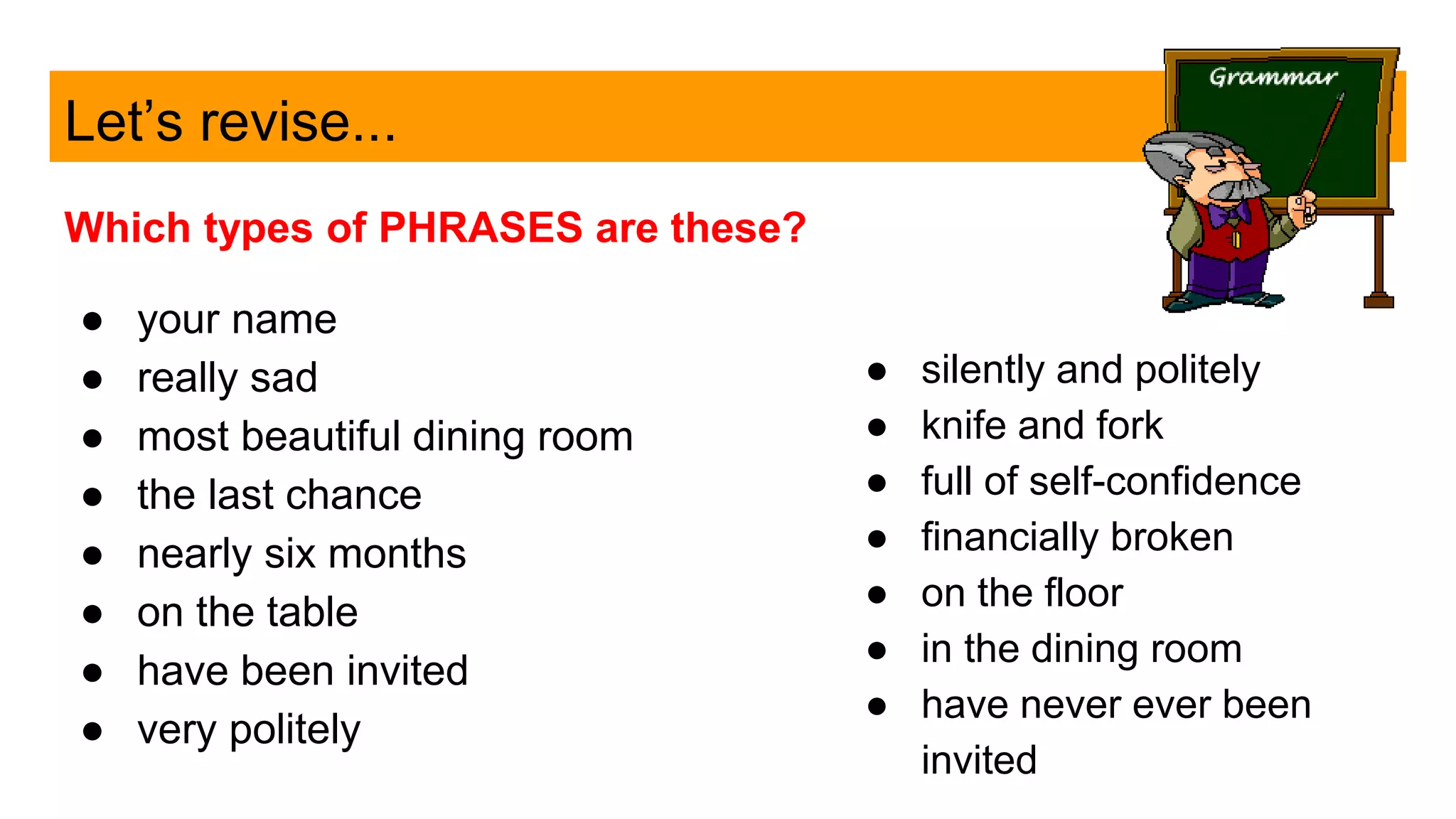
Which types of PHRASES are these?
● your name
● really sad
● most beautiful dining room
● the last chance
● nearly six months
● on the table
● have been invited
● very politely
● silently and politely
● knife and fork
● full of self-confidence
● financially broken
● on the floor
● in the dining room
● have never ever been
invited
Let’s revise...
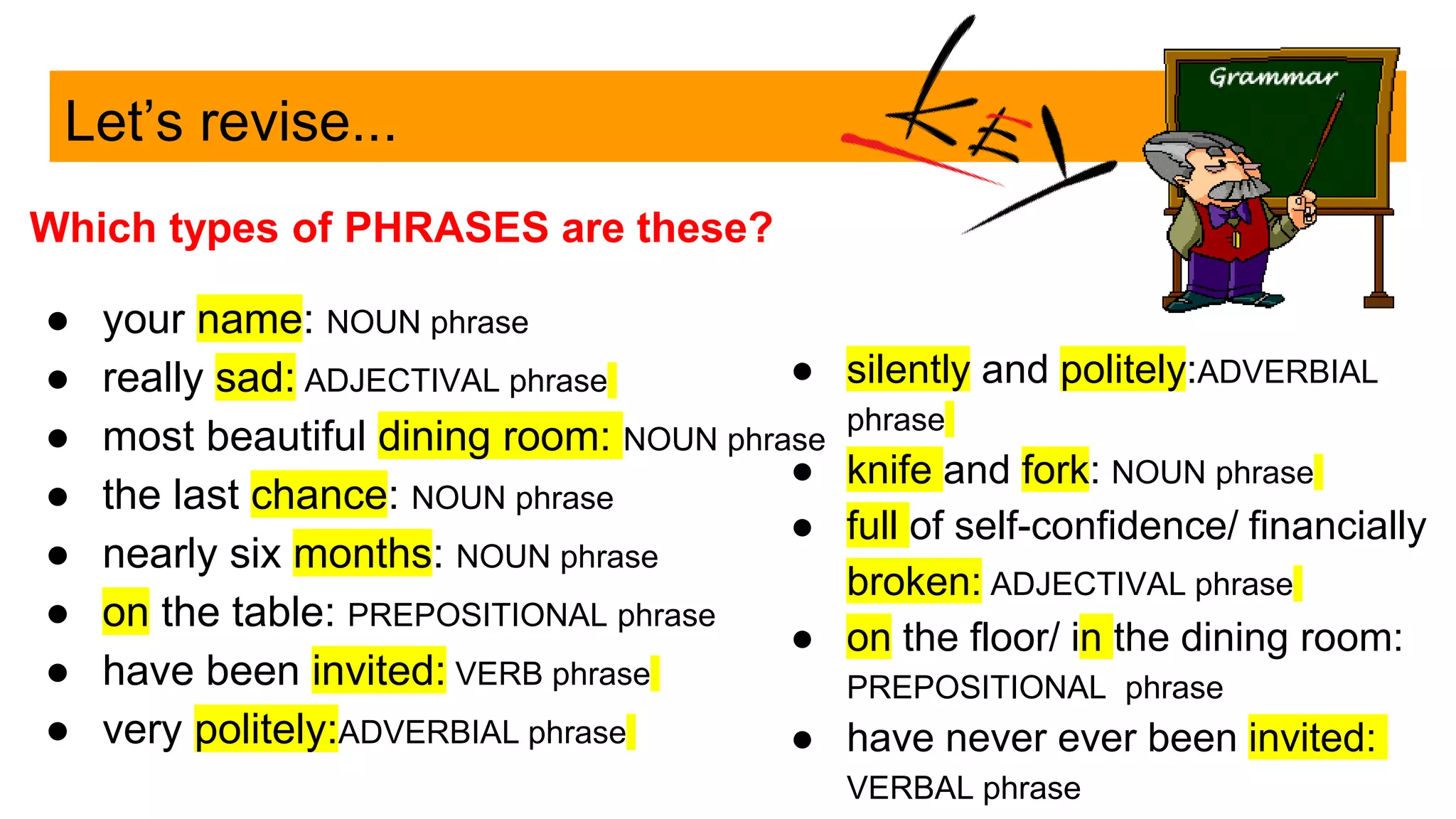
Which types of PHRASES are these?
● your name: NOUN phrase
● really sad: ADJECTIVAL phrase
● most beautiful dining room: NOUN phrase
● the last chance: NOUN phrase
● nearly six months: NOUN phrase
● on the table: PREPOSITIONAL phrase
● have been invited: VERB phrase
● very politely:ADVERBIAL phrase
● silently and politely:ADVERBIAL
phrase
● knife and fork: NOUN phrase
● full of self-confidence/ financially
broken: ADJECTIVAL phrase
● on the floor/ in the dining room:
PREPOSITIONAL phrase
● have never ever been invited:
VERBAL phrase
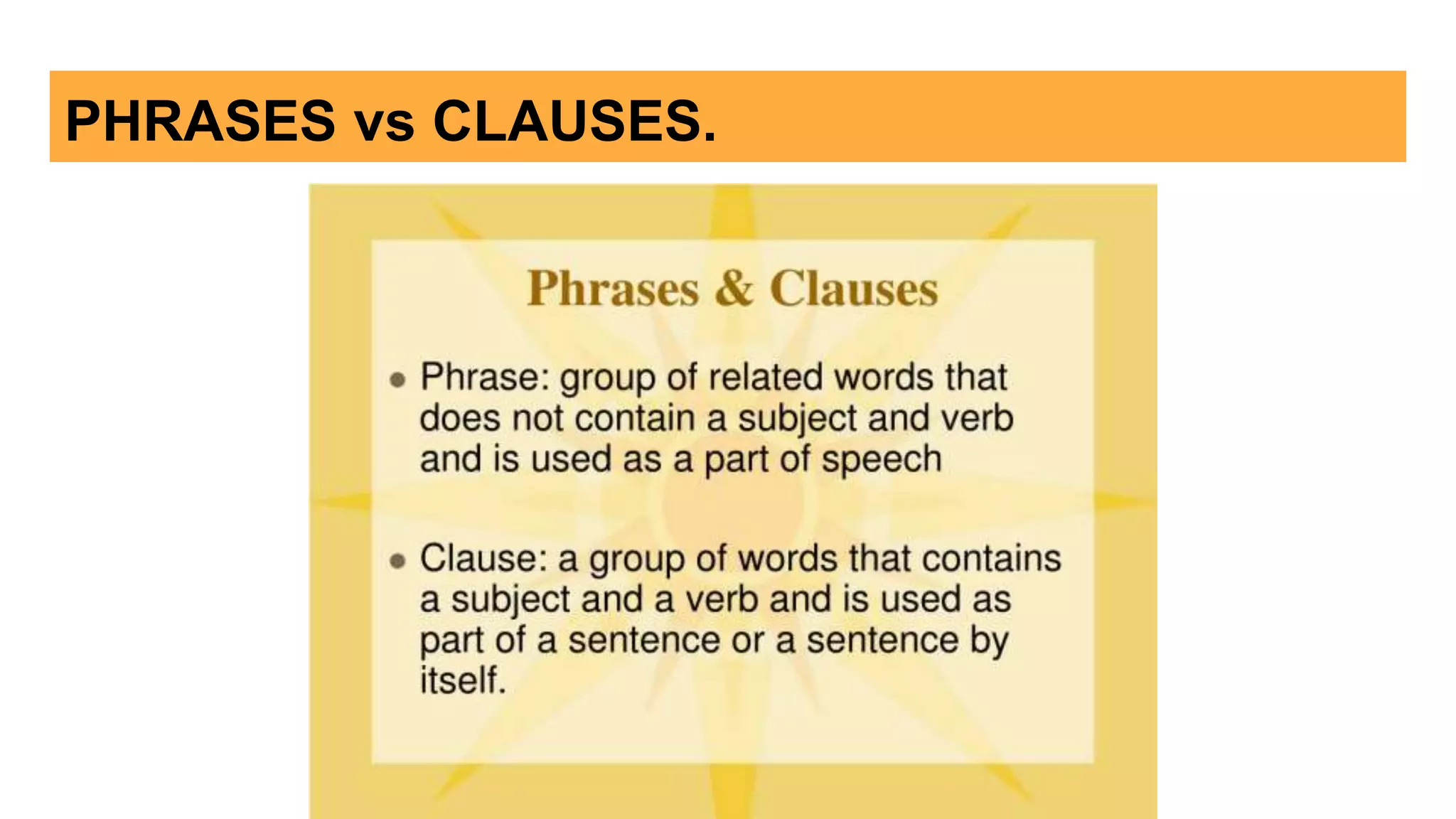
PHRASES vs CLAUSES.
a
Let’s revise...
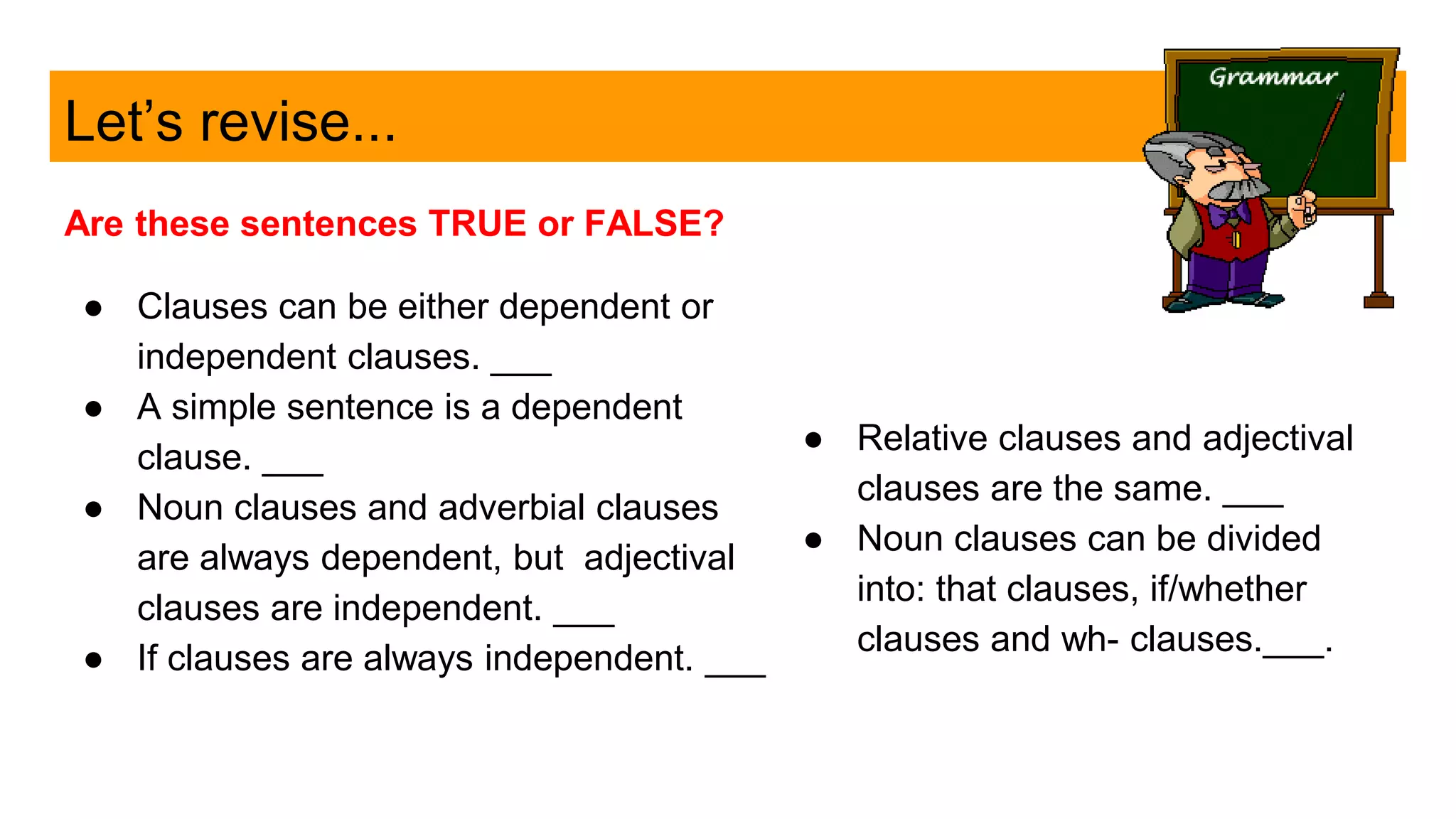
Are these sentences TRUE or FALSE?
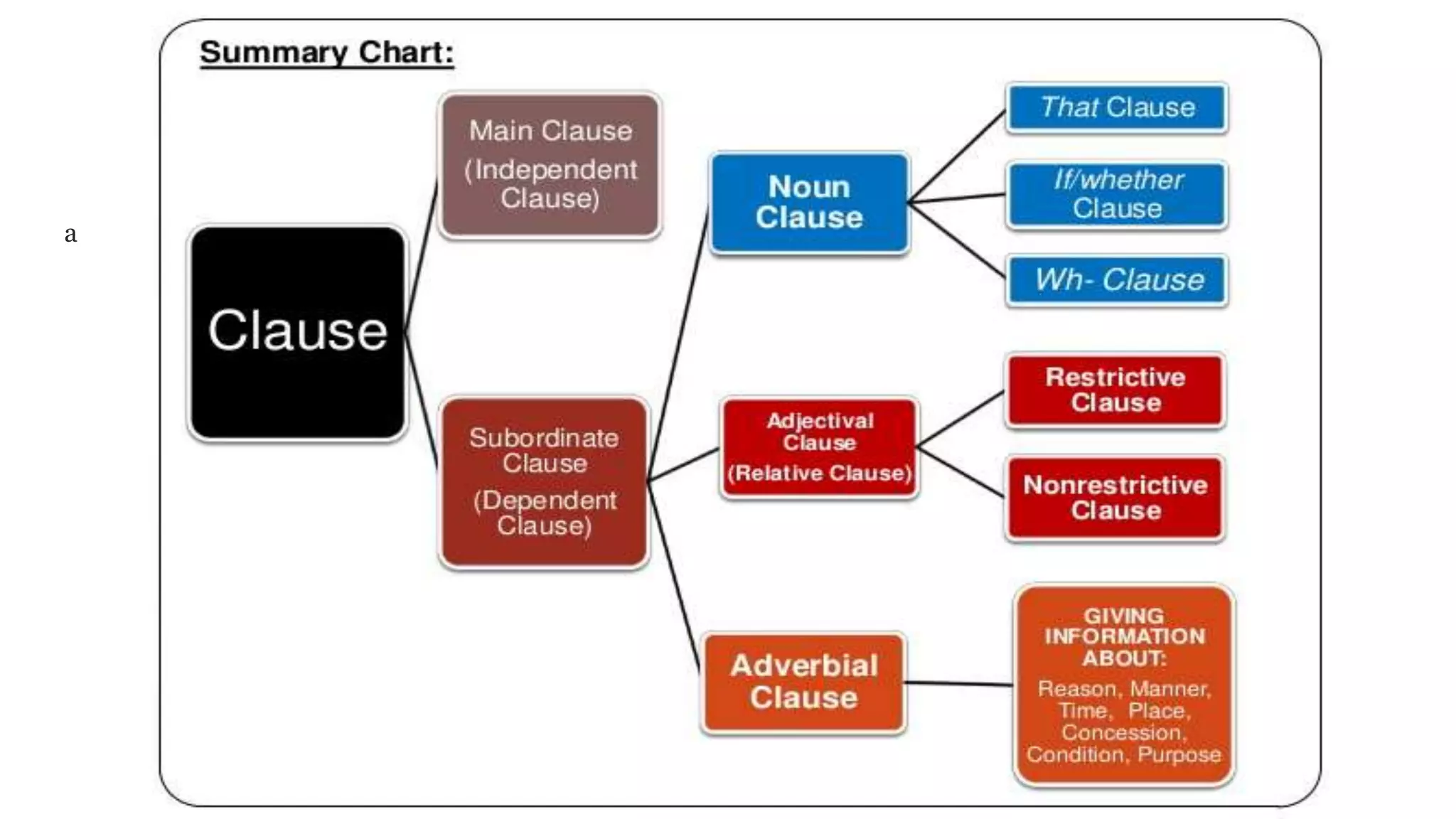
● Clauses can be either dependent or
independent clauses. ___
● A simple sentence is a dependent
clause. ___
● Noun clauses and adverbial clauses
are always dependent, but adjectival
clauses are independent. ___
● If clauses are always independent. ___
● Relative clauses and adjectival
clauses are the same. ___
● Noun clauses can be divided
into: that clauses, if/whether
clauses and wh- clauses.___.
Let’s revise...
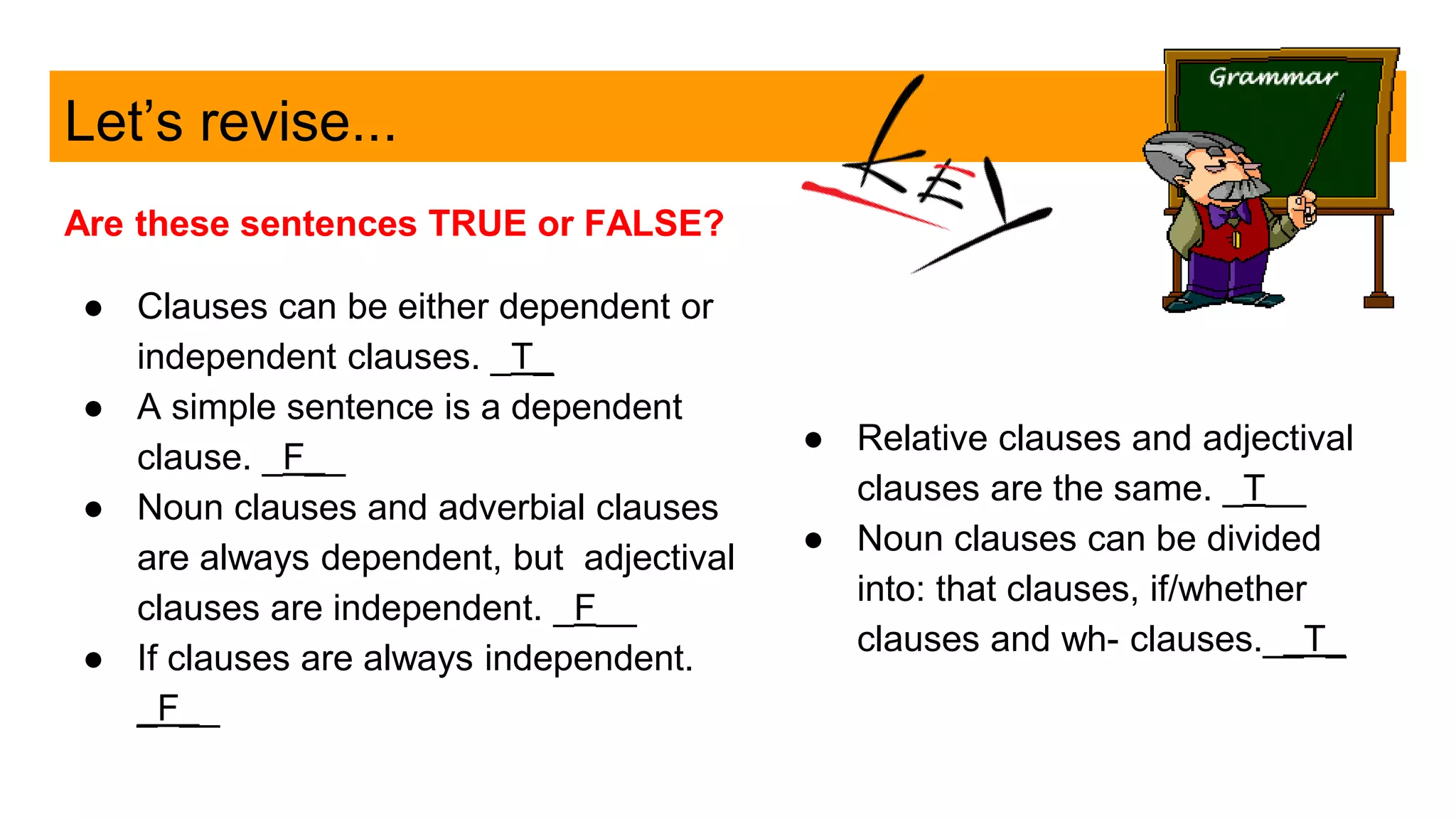
Are these sentences TRUE or FALSE?
● Clauses can be either dependent or
independent clauses. _T_
● A simple sentence is a dependent
clause. _F__
● Noun clauses and adverbial clauses
are always dependent, but adjectival
clauses are independent. _F__
● If clauses are always independent.
_F__
● Relative clauses and adjectival
clauses are the same. _T__
● Noun clauses can be divided
into: that clauses, if/whether
clauses and wh- clauses.__T_
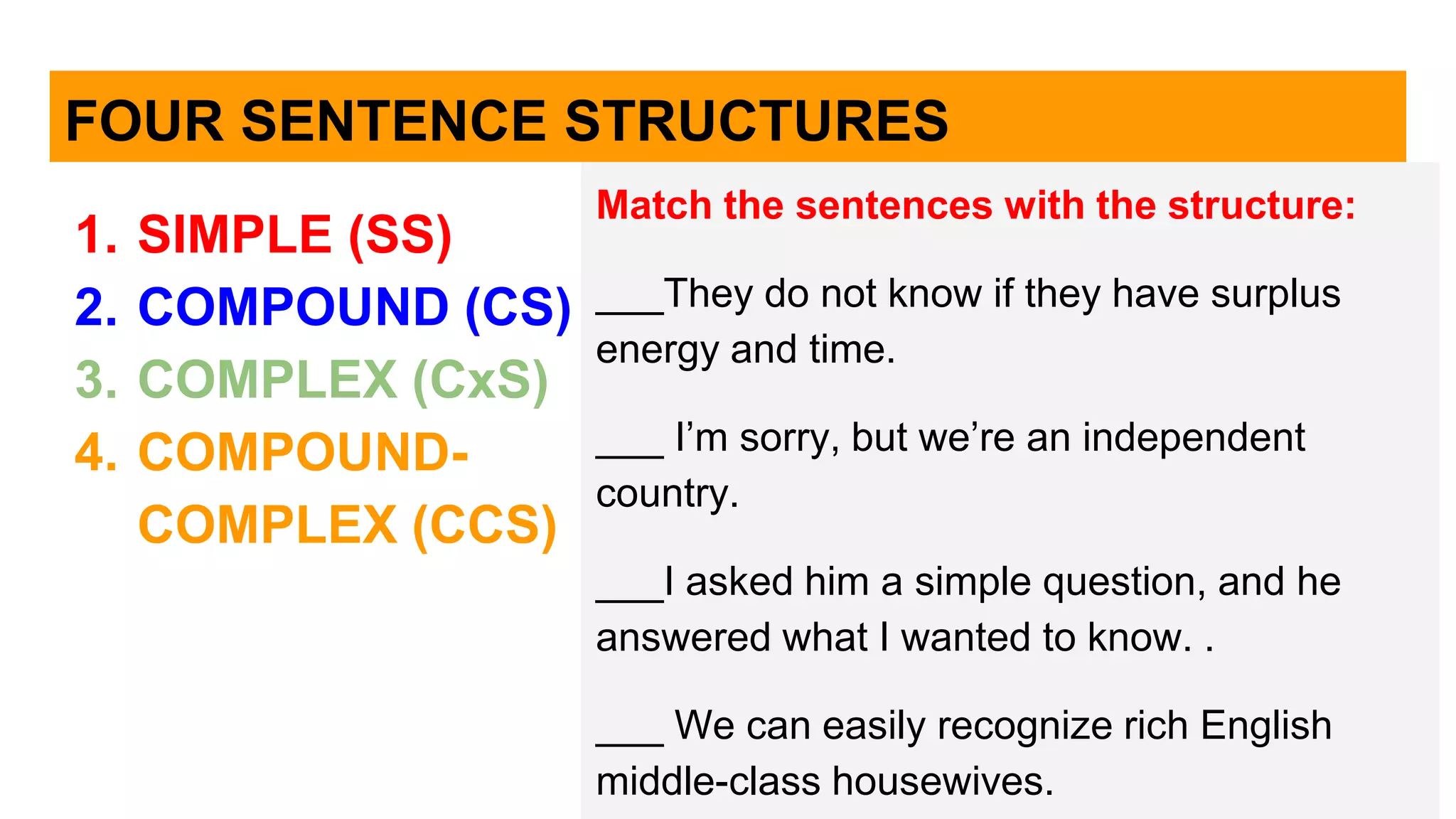
FOUR SENTENCE STRUCTURES
1. SIMPLE (SS)
2. COMPOUND (CS)
3. COMPLEX (CxS)
4. COMPOUND-
COMPLEX (CCS)
Match the sentences with the structure:
___They do not know if they have surplus
energy and time.
___ I’m sorry, but we’re an independent
country.
___I asked him a simple question, and he
answered what I wanted to know. .
___ We can easily recognize rich English
middle-class housewives.
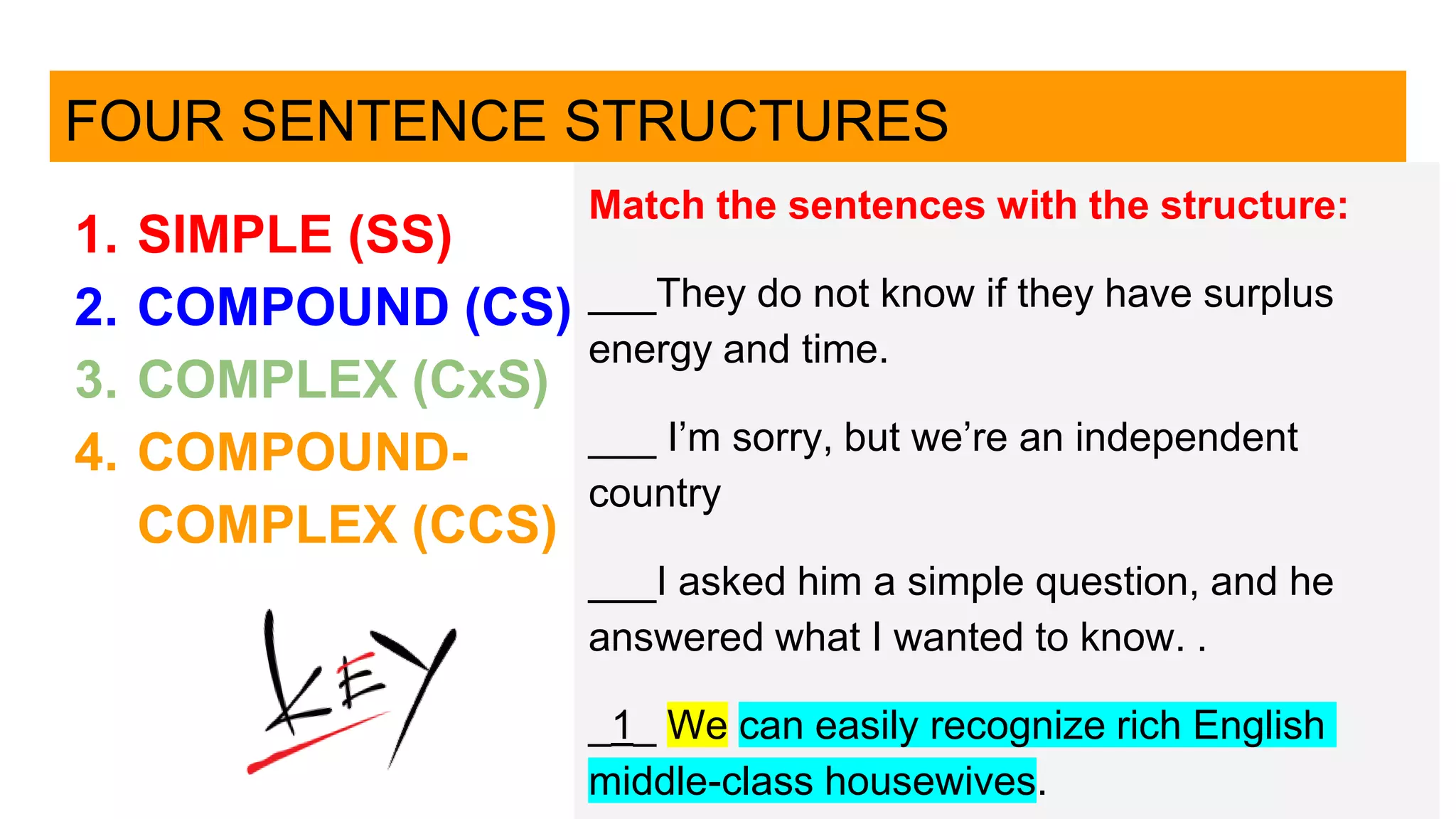
FOUR SENTENCE STRUCTURES
1. SIMPLE (SS)
2. COMPOUND (CS)
3. COMPLEX (CxS)
4. COMPOUND-
COMPLEX (CCS)
Match the sentences with the structure:
___They do not know if they have surplus
energy and time.
___ I’m sorry, but we’re an independent
country
___I asked him a simple question, and he
answered what I wanted to know. .
_1_ We can easily recognize rich English
middle-class housewives.
FOUR SENTENCE STRUCTURES
1. SIMPLE (SS)
2. COMPOUND (CS)
3. COMPLEX (CxS)
4. COMPOUND-
COMPLEX (CCS)
Match the sentences with the structure:
___They do not know if they have surplus
energy and time.
_2_ [I’m sorry], but [we’re an independent
country.]BUT= coordinating conjunction.
__I asked him a simple question, and he
answered what I wanted to know. .
___ We can easily recognize rich English
middle-class housewives.
FOUR SENTENCE STRUCTURES
1. SIMPLE (SS)
2. COMPOUND (CS)
3. COMPLEX (CxS)
4. COMPOUND-
COMPLEX (CCS)
Match the sentences with the structure:
_3_[They do not know [if they have surplus
energy and time].] >>> [if they have surplus
energy.] IF= SUBordinating conjunction. [.... [...] ]
__ I’m sorry, but we’re an independent country
___I asked him a simple question, and he
answered what I wanted to know. .
___ We can easily recognize rich English middle-
class housewives.
FOUR SENTENCE STRUCTURES
1. SIMPLE (SS)
2. COMPOUND (CS)
3. COMPLEX (CxS)
4. COMPOUND-
COMPLEX (CCS)
Match the sentences with the corresponding
structure:
___They do not know if they have surplus
energy and time.
___ I’m sorry, but we’re an independent country
_4_[[I asked him a simple question], and [he
answered [what I wanted to know].] .[ what I
wanted to know.]
Let’s revise...
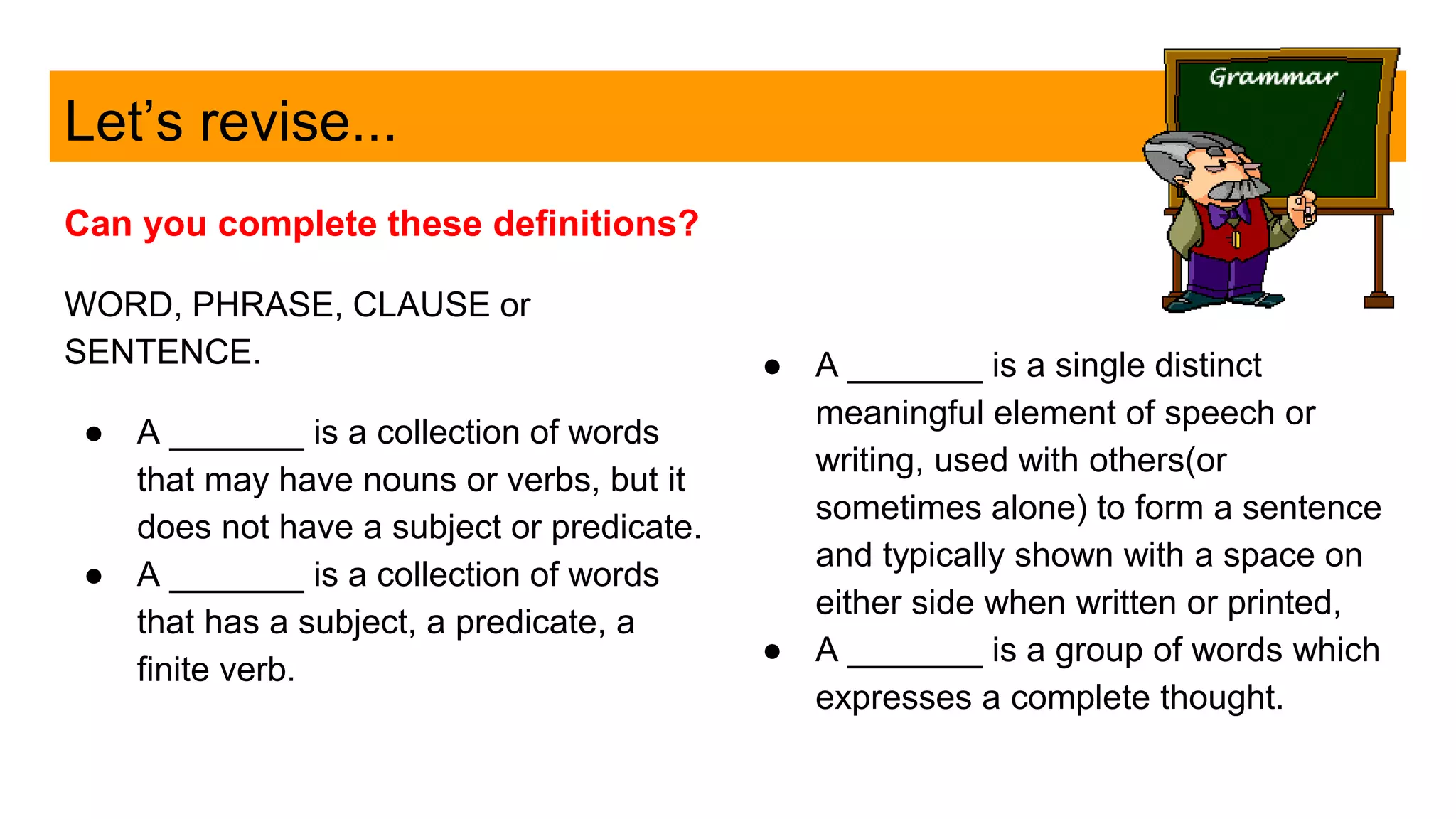
Can you complete these definitions?
WORD, PHRASE, CLAUSE or
SENTENCE.
● A _______ is a collection of words
that may have nouns or verbs, but it
does not have a subject or predicate.
● A _______ is a collection of words
that has a subject, a predicate, a
finite verb.
● A _______ is a single distinct
meaningful element of speech or
writing, used with others(or
sometimes alone) to form a sentence
and typically shown with a space on
either side when written or printed,
● A _______ is a group of words which
expresses a complete thought.
Let’s revise...
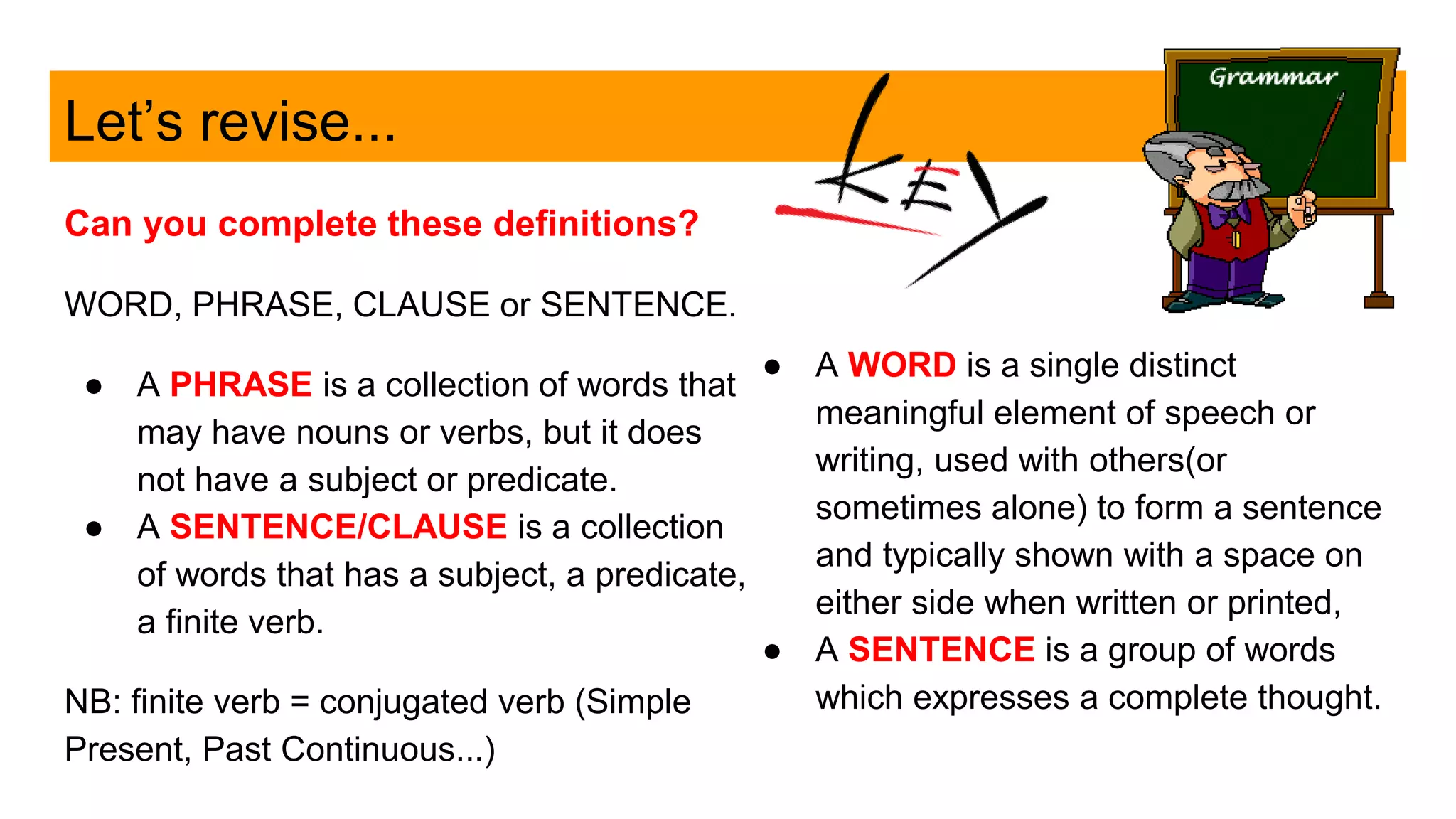
Can you complete these definitions?
WORD, PHRASE, CLAUSE or SENTENCE.
● A PHRASE is a collection of words that
may have nouns or verbs, but it does
not have a subject or predicate.
● A SENTENCE/CLAUSE is a collection
of words that has a subject, a predicate,
a finite verb.
NB: finite verb = conjugated verb (Simple
Present, Past Continuous...)
● A WORD is a single distinct
meaningful element of speech or
writing, used with others(or
sometimes alone) to form a sentence
and typically shown with a space on
either side when written or printed,
● A SENTENCE is a group of words
which expresses a complete thought.
Syntax - part 1

Syntax - part 1

  • 1.
    SYNTAX - part1 Prácticas Discursivas de la Comunicación Escrita 1 1°2° ISFD 41 Prof. Stella Maris Saubidet Oyhamburu
  • 4.
    Short story: “Guesswho’s coming to dinner?” The UNIT OF ANALYSIS OF SYNTAX IS THE SENTENCE. There are TWO NUCLEAR ELEMENTS in a sentence: SUBJECT & PREDICATE. There are 4 KINDS of sentences: DECLARATIVE: sentences that make a statement. INTERROGATIVE: sentences that ask questions. IMPERATIVE: sentences that make commands or requests. EXCLAMATIVE: sentences that express strong feelings.
  • 5.
    Let’s revise... Which typesof sentences are these? ● Why should I speak Russian? ● Middle-class English housewives always look elegant. ● Be polite! ● Nonsense, dear! ● DECLARATIVE ● INTERROGATIVE: ● IMPERATIVE. ● EXCLAMATIVE
  • 6.
    Let’s revise... Which typesof sentences are these? 1. Why should I speak Russian? 2. Middle-class English housewives always look elegant. 3. Be polite! 4. Nonsense, dear! 2. DECLARATIVE 1. INTERROGATIVE: 3. IMPERATIVE. 4. EXCLAMATIVE
  • 8.
  • 9.
    Let’s revise... Which typesof PHRASES are these? ● your name ● really sad ● most beautiful dining room ● the last chance ● nearly six months ● on the table ● have been invited ● very politely ● silently and politely ● knife and fork ● full of self-confidence ● financially broken ● on the floor ● in the dining room ● have never ever been invited
  • 10.
    Let’s revise... Which typesof PHRASES are these? ● your name: NOUN phrase ● really sad: ADJECTIVAL phrase ● most beautiful dining room: NOUN phrase ● the last chance: NOUN phrase ● nearly six months: NOUN phrase ● on the table: PREPOSITIONAL phrase ● have been invited: VERB phrase ● very politely:ADVERBIAL phrase ● silently and politely:ADVERBIAL phrase ● knife and fork: NOUN phrase ● full of self-confidence/ financially broken: ADJECTIVAL phrase ● on the floor/ in the dining room: PREPOSITIONAL phrase ● have never ever been invited: VERBAL phrase
  • 11.
  • 12.
  • 13.
    Let’s revise... Are thesesentences TRUE or FALSE? ● Clauses can be either dependent or independent clauses. ___ ● A simple sentence is a dependent clause. ___ ● Noun clauses and adverbial clauses are always dependent, but adjectival clauses are independent. ___ ● If clauses are always independent. ___ ● Relative clauses and adjectival clauses are the same. ___ ● Noun clauses can be divided into: that clauses, if/whether clauses and wh- clauses.___.
  • 14.
    Let’s revise... Are thesesentences TRUE or FALSE? ● Clauses can be either dependent or independent clauses. _T_ ● A simple sentence is a dependent clause. _F__ ● Noun clauses and adverbial clauses are always dependent, but adjectival clauses are independent. _F__ ● If clauses are always independent. _F__ ● Relative clauses and adjectival clauses are the same. _T__ ● Noun clauses can be divided into: that clauses, if/whether clauses and wh- clauses.__T_
  • 15.
    FOUR SENTENCE STRUCTURES 1.SIMPLE (SS) 2. COMPOUND (CS) 3. COMPLEX (CxS) 4. COMPOUND- COMPLEX (CCS) Match the sentences with the structure: ___They do not know if they have surplus energy and time. ___ I’m sorry, but we’re an independent country. ___I asked him a simple question, and he answered what I wanted to know. . ___ We can easily recognize rich English middle-class housewives.
  • 16.
    FOUR SENTENCE STRUCTURES 1.SIMPLE (SS) 2. COMPOUND (CS) 3. COMPLEX (CxS) 4. COMPOUND- COMPLEX (CCS) Match the sentences with the structure: ___They do not know if they have surplus energy and time. ___ I’m sorry, but we’re an independent country ___I asked him a simple question, and he answered what I wanted to know. . _1_ We can easily recognize rich English middle-class housewives.
  • 17.
    FOUR SENTENCE STRUCTURES 1.SIMPLE (SS) 2. COMPOUND (CS) 3. COMPLEX (CxS) 4. COMPOUND- COMPLEX (CCS) Match the sentences with the structure: ___They do not know if they have surplus energy and time. _2_ [I’m sorry], but [we’re an independent country.]BUT= coordinating conjunction. __I asked him a simple question, and he answered what I wanted to know. . ___ We can easily recognize rich English middle-class housewives.
  • 18.
    FOUR SENTENCE STRUCTURES 1.SIMPLE (SS) 2. COMPOUND (CS) 3. COMPLEX (CxS) 4. COMPOUND- COMPLEX (CCS) Match the sentences with the structure: _3_[They do not know [if they have surplus energy and time].] >>> [if they have surplus energy.] IF= SUBordinating conjunction. [.... [...] ] __ I’m sorry, but we’re an independent country ___I asked him a simple question, and he answered what I wanted to know. . ___ We can easily recognize rich English middle- class housewives.
  • 19.
    FOUR SENTENCE STRUCTURES 1.SIMPLE (SS) 2. COMPOUND (CS) 3. COMPLEX (CxS) 4. COMPOUND- COMPLEX (CCS) Match the sentences with the corresponding structure: ___They do not know if they have surplus energy and time. ___ I’m sorry, but we’re an independent country _4_[[I asked him a simple question], and [he answered [what I wanted to know].] .[ what I wanted to know.]
  • 20.
    Let’s revise... Can youcomplete these definitions? WORD, PHRASE, CLAUSE or SENTENCE. ● A _______ is a collection of words that may have nouns or verbs, but it does not have a subject or predicate. ● A _______ is a collection of words that has a subject, a predicate, a finite verb. ● A _______ is a single distinct meaningful element of speech or writing, used with others(or sometimes alone) to form a sentence and typically shown with a space on either side when written or printed, ● A _______ is a group of words which expresses a complete thought.
  • 21.
    Let’s revise... Can youcomplete these definitions? WORD, PHRASE, CLAUSE or SENTENCE. ● A PHRASE is a collection of words that may have nouns or verbs, but it does not have a subject or predicate. ● A SENTENCE/CLAUSE is a collection of words that has a subject, a predicate, a finite verb. NB: finite verb = conjugated verb (Simple Present, Past Continuous...) ● A WORD is a single distinct meaningful element of speech or writing, used with others(or sometimes alone) to form a sentence and typically shown with a space on either side when written or printed, ● A SENTENCE is a group of words which expresses a complete thought.