BACHELOR OF EARLYCHILDHOOD EDUCATION (BECEd)
PROGRAMOUTCOMES AND
PERFORMANCE INDICATORS
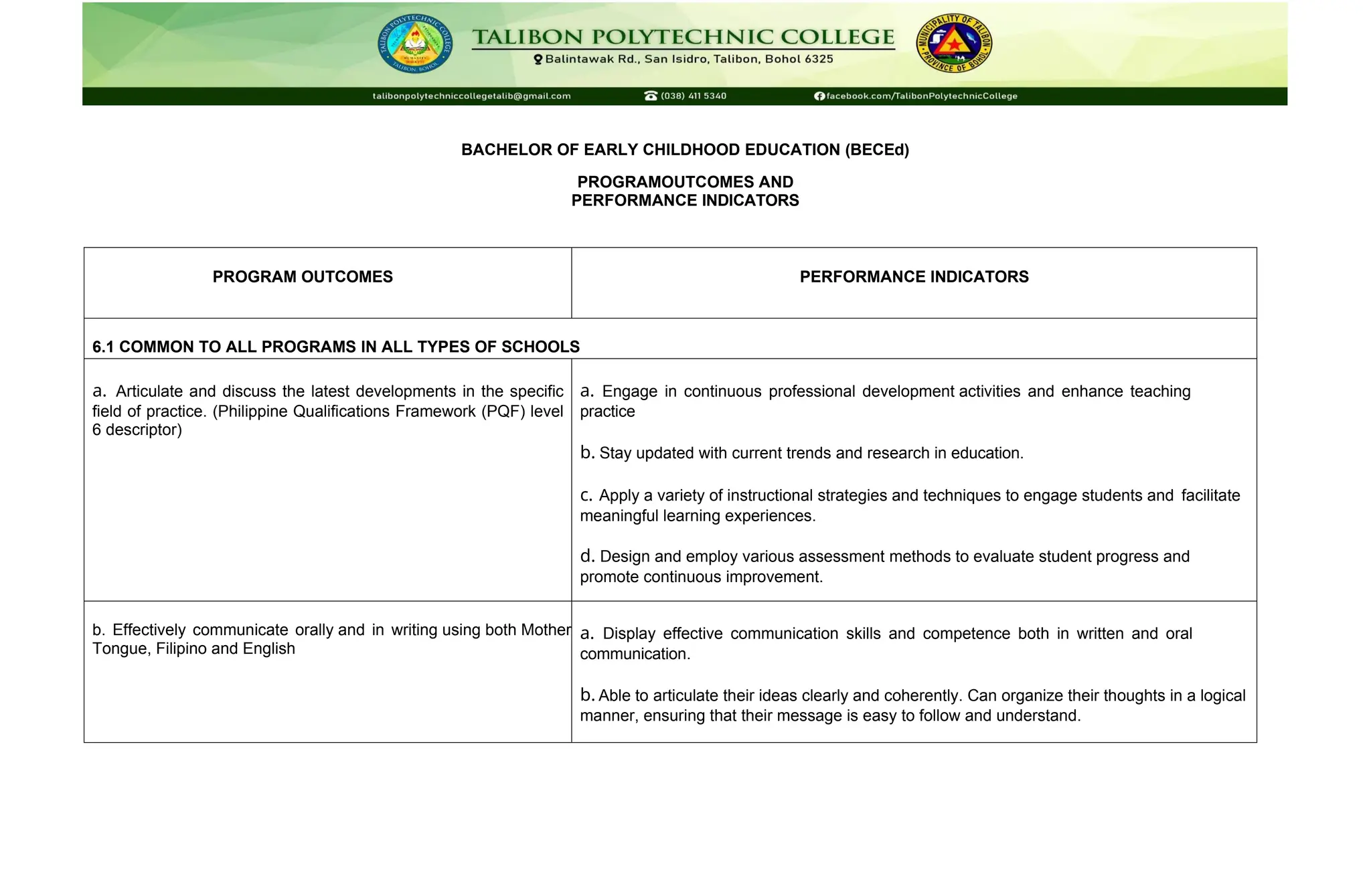
PROGRAM OUTCOMES PERFORMANCE INDICATORS
6.1 COMMON TO ALL PROGRAMS IN ALL TYPES OF SCHOOLS
a. Articulate and discuss the latest developments in the specific
field of practice. (Philippine Qualifications Framework (PQF) level
6 descriptor)
a. Engage in continuous professional development activities and enhance teaching
practice
b. Stay updated with current trends and research in education.
c. Apply a variety of instructional strategies and techniques to engage students and facilitate
meaningful learning experiences.
d. Design and employ various assessment methods to evaluate student progress and
promote continuous improvement.
b. Effectively communicate orally and in writing using both Mother
Tongue, Filipino and English
a. Display effective communication skills and competence both in written and oral
communication.
b. Able to articulate their ideas clearly and coherently. Can organize their thoughts in a logical
manner, ensuring that their message is easy to follow and understand.
2.
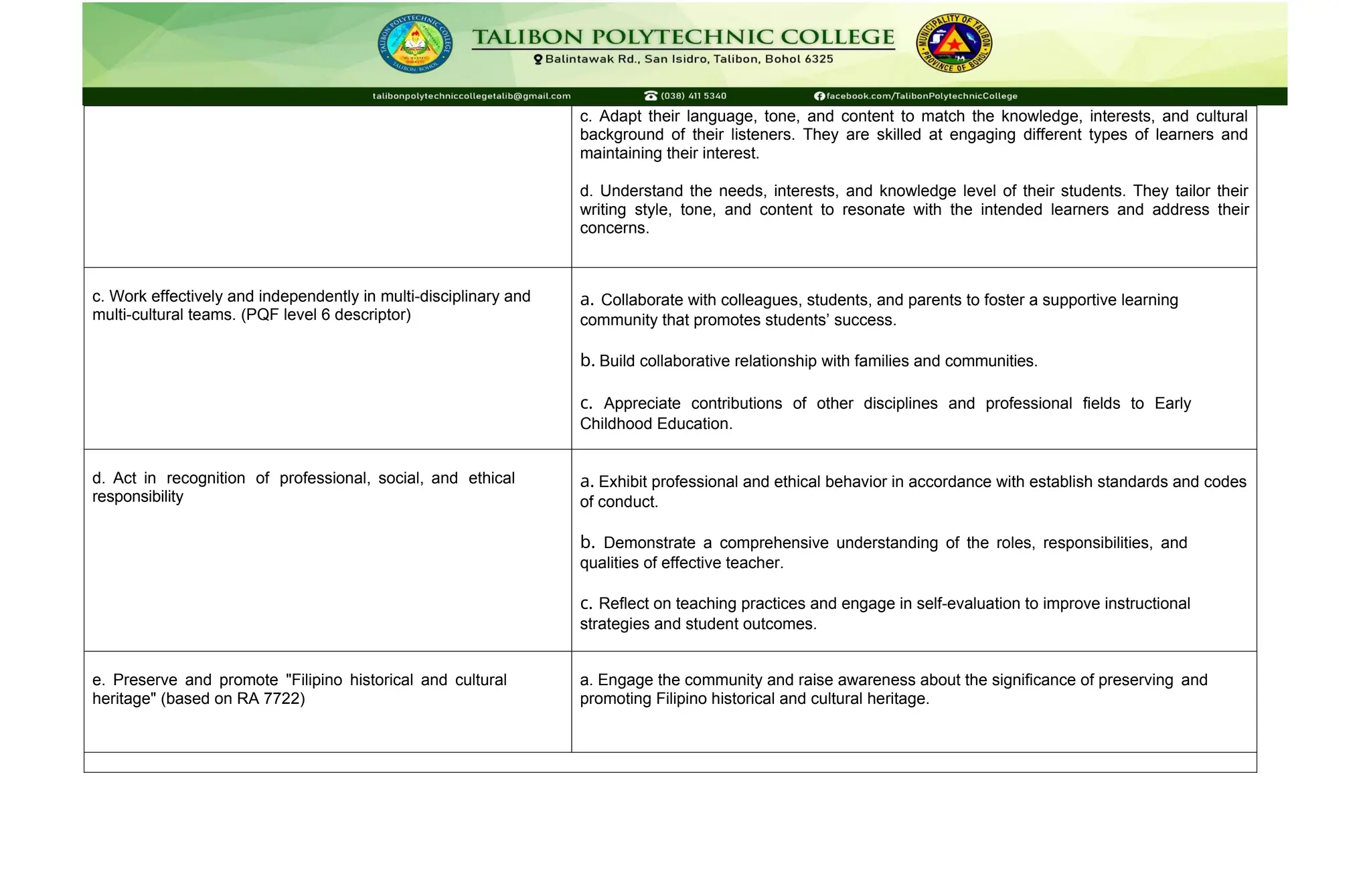
c. Adapt theirlanguage, tone, and content to match the knowledge, interests, and cultural
background of their listeners. They are skilled at engaging different types of learners and
maintaining their interest.
d. Understand the needs, interests, and knowledge level of their students. They tailor their
writing style, tone, and content to resonate with the intended learners and address their
concerns.
c. Work effectively and independently in multi-disciplinary and
multi-cultural teams. (PQF level 6 descriptor)
a. Collaborate with colleagues, students, and parents to foster a supportive learning
community that promotes students’ success.
b. Build collaborative relationship with families and communities.
c. Appreciate contributions of other disciplines and professional fields to Early
Childhood Education.
d. Act in recognition of professional, social, and ethical
responsibility
a. Exhibit professional and ethical behavior in accordance with establish standards and codes
of conduct.
b. Demonstrate a comprehensive understanding of the roles, responsibilities, and
qualities of effective teacher.
c. Reflect on teaching practices and engage in self-evaluation to improve instructional
strategies and student outcomes.
e. Preserve and promote "Filipino historical and cultural
heritage" (based on RA 7722)
a. Engage the community and raise awareness about the significance of preserving and
promoting Filipino historical and cultural heritage.
3.
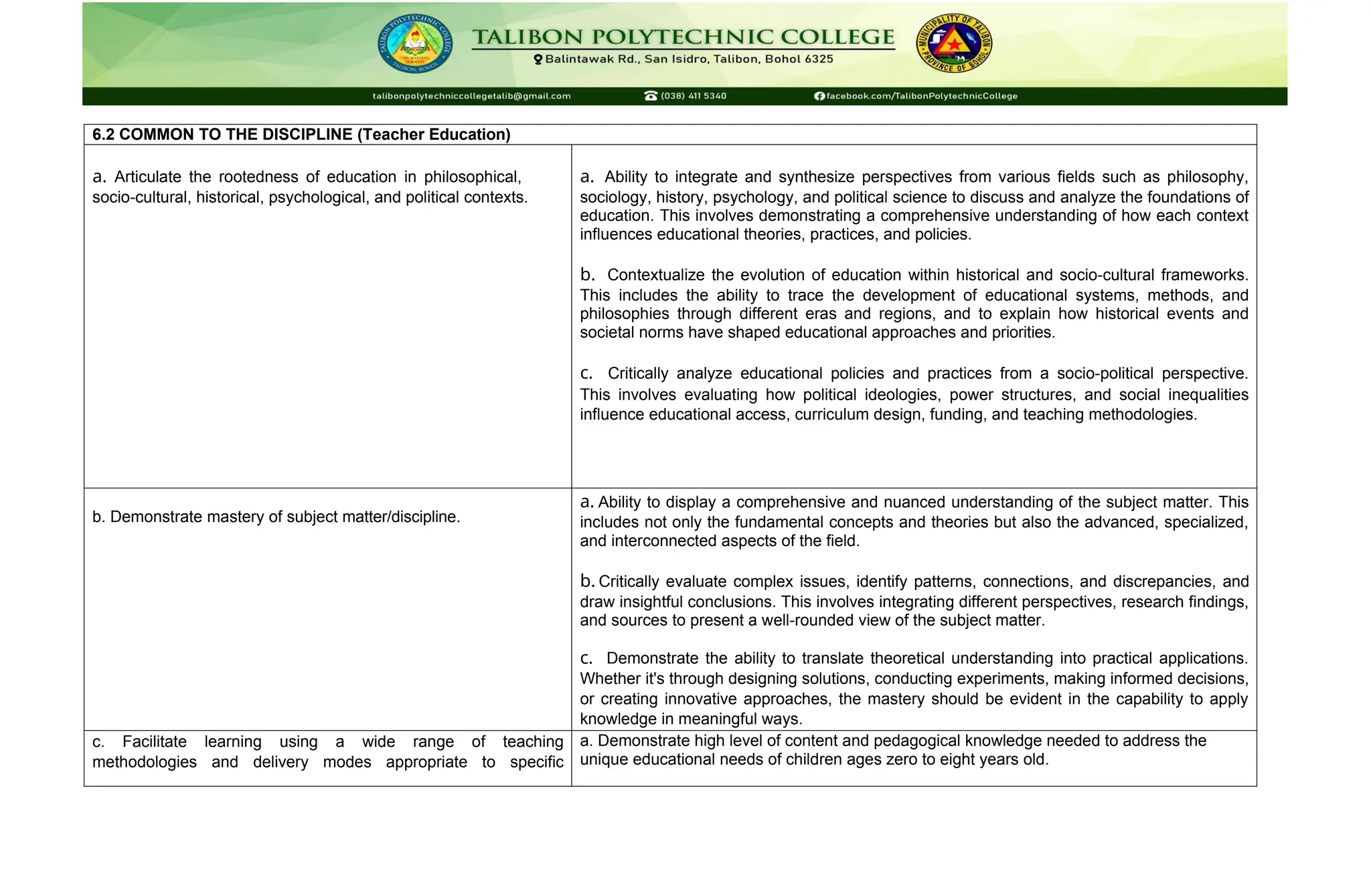
6.2 COMMON TOTHE DISCIPLINE (Teacher Education)
a. Articulate the rootedness of education in philosophical,
socio-cultural, historical, psychological, and political contexts.
a. Ability to integrate and synthesize perspectives from various fields such as philosophy,
sociology, history, psychology, and political science to discuss and analyze the foundations of
education. This involves demonstrating a comprehensive understanding of how each context
influences educational theories, practices, and policies.
b. Contextualize the evolution of education within historical and socio-cultural frameworks.
This includes the ability to trace the development of educational systems, methods, and
philosophies through different eras and regions, and to explain how historical events and
societal norms have shaped educational approaches and priorities.
c. Critically analyze educational policies and practices from a socio-political perspective.
This involves evaluating how political ideologies, power structures, and social inequalities
influence educational access, curriculum design, funding, and teaching methodologies.
b. Demonstrate mastery of subject matter/discipline.
a. Ability to display a comprehensive and nuanced understanding of the subject matter. This
includes not only the fundamental concepts and theories but also the advanced, specialized,
and interconnected aspects of the field.
b. Critically evaluate complex issues, identify patterns, connections, and discrepancies, and
draw insightful conclusions. This involves integrating different perspectives, research findings,
and sources to present a well-rounded view of the subject matter.
c. Demonstrate the ability to translate theoretical understanding into practical applications.
Whether it's through designing solutions, conducting experiments, making informed decisions,
or creating innovative approaches, the mastery should be evident in the capability to apply
knowledge in meaningful ways.
c. Facilitate learning using a wide range of teaching
methodologies and delivery modes appropriate to specific
a. Demonstrate high level of content and pedagogical knowledge needed to address the
unique educational needs of children ages zero to eight years old.
4.
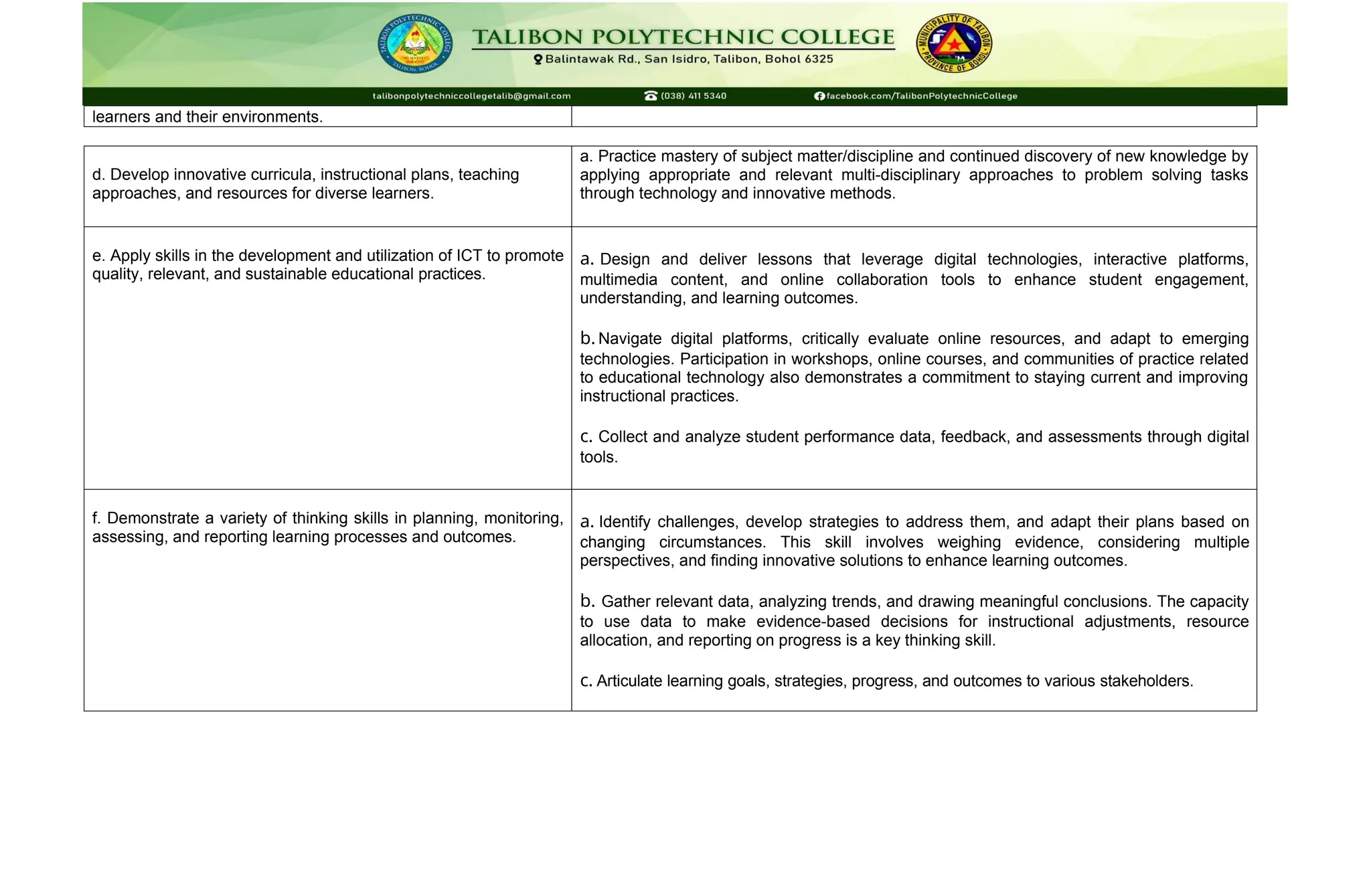
learners and theirenvironments.
d. Develop innovative curricula, instructional plans, teaching
approaches, and resources for diverse learners.
a. Practice mastery of subject matter/discipline and continued discovery of new knowledge by
applying appropriate and relevant multi-disciplinary approaches to problem solving tasks
through technology and innovative methods.
e. Apply skills in the development and utilization of ICT to promote
quality, relevant, and sustainable educational practices.
a. Design and deliver lessons that leverage digital technologies, interactive platforms,
multimedia content, and online collaboration tools to enhance student engagement,
understanding, and learning outcomes.
b. Navigate digital platforms, critically evaluate online resources, and adapt to emerging
technologies. Participation in workshops, online courses, and communities of practice related
to educational technology also demonstrates a commitment to staying current and improving
instructional practices.
c. Collect and analyze student performance data, feedback, and assessments through digital
tools.
f. Demonstrate a variety of thinking skills in planning, monitoring,
assessing, and reporting learning processes and outcomes.
a. Identify challenges, develop strategies to address them, and adapt their plans based on
changing circumstances. This skill involves weighing evidence, considering multiple
perspectives, and finding innovative solutions to enhance learning outcomes.
b. Gather relevant data, analyzing trends, and drawing meaningful conclusions. The capacity
to use data to make evidence-based decisions for instructional adjustments, resource
allocation, and reporting on progress is a key thinking skill.
c. Articulate learning goals, strategies, progress, and outcomes to various stakeholders.
5.
g. Practice professionaland ethical teaching standards
sensitive to the changing local, national, and global realities.
a. Act in recognition of professional, social, and ethical through establishing a smooth
interpersonal relationship with others by taking responsibility and accountability for
actions, a positive attitude towards learning and the concern for the preservation and
protection of the environment.
h. Pursue lifelong learning for personal and professional growth
through varied experiential and field-based opportunities.
a. Manifest life-long commitment to improve practice through active participation in
professional networks, engagement in research and extension, and post-graduate studies.
b. Demonstrate a willingness to explore different subjects and disciplines showcases a
commitment to continuous learning and intellectual curiosity.
c. Document reflections, insights, and lessons learned from each experiential opportunity.
6.3 SPECIFIC TO EARLY CHILDHOOD EDUCATION
a. Demonstrate an advanced level of expertise in both subject
matter and teaching methods
a. Evaluate individuals' performance on assessments related to the program's content and
pedagogical methods. High scores indicate a strong grasp of the material and effective
teaching strategies.
b. Review and assess individuals' lesson plans, thorough content coverage and effective
pedagogical approaches, such as differentiated instruction, active learning, or technology
integration.
c. Evaluate students’ ability to communicate content effectively, engage students, and
manage the learning environment
d. Content knowledge assessments to gauge individuals' mastery of the subject matter they
6.
are teaching, thatmay include subject-specific exams or projects.
b. Display a deep understanding and respect for diversity. a. Evaluate the inclusivity of the classroom or learning environment, considering factors such
as seating arrangements, diverse representation in teaching materials, and respect for
various perspectives.
7.
b. Assess whethercourse materials and content reflect diverse voices, cultures, and
experiences, ensuring that multiple perspectives are included in the learning experience.
c. Observe and assess the use of inclusive and culturally sensitive language in
communication, lectures, and materials.
d. Evaluate efforts to address equity issues within the program, such as initiatives to reduce
achievement gaps or provide support to underrepresented groups.
e. Measure the development and implementation of diversity-related initiatives or policies
within the program or institution.
c. Exhibit effective collaboration skills a. Assess an individual's performance in team-based projects or assignments.
b. Evaluate an individual's performance in group presentations or discussions.
c. Assess an individual's ability to handle conflicts within a team. Effective conflict resolution,
such as addressing disagreements constructively and seeking compromise, is a key aspect of
collaboration.
d. Evaluate an individual's contributions to meetings, including their preparedness,
engagement, and ability to stay on topic and help the team make decisions.
e. Recognize individuals who demonstrate leadership skills within collaborative teams, such
as facilitating discussions or guiding group decision-making.
d. Showcase creative and innovative thinking a. Evaluate an individual's ability to approach problems or issues in novel and creative ways,
including their capacity to identify alternative solutions.
b. Measure participation in innovation competitions or challenges and assess an
individual's performance, awards, or recognition received.
c. Assess the use of innovative teaching methods or approaches in an educational
context, demonstrating a commitment to fostering innovation in learning.
8.
d. Develop metricsto track the number of innovative ideas generated, the success rate of
implementation, and the degree of novelty and impact.
e. Possess critical thinking and problems solving abilities. a. Evaluate an individual's critical reading skills by assessing their ability to analyze and
critique written or multimedia content for accuracy, bias, and credibility.
b. Assess an individual's ability to communicate their problem-solving processes and findings
effectively through presentations or reports.
c. Acquire research skills, including the ability to design and conduct research, analyze data,
and draw meaningful conclusions.
f. Champions the rights of children, equality, community,
national values, and democratic principles
a. Develop curricula that incorporate lessons on children's rights, equality, community
engagement, nationalism, and democratic ideas at the early childhood level.
b. Use of teaching materials and resources that emphasize values, such as age- appropriate
books, videos, and activities that promote children's understanding of these concepts.
c. Review lesson plans to determine how well they incorporate discussions and activities
related to children's rights, equality, community involvement, nationalism, and democratic
principles.
d. Evaluate an individual's ability to teach and model conflict resolution skills among young
children, emphasizing peaceful and democratic approaches.
e. Evaluate students' ability to guide young children in creating projects or presentations that
highlight these values and ideas.
f. Initiate or guide children to initiate projects themselves that reflect their understanding and
commitment to these values.
g. Engage in continuous lifelong learning a. Apply new knowledge and skills gained through lifelong learning in their work with young
children and families.
10.
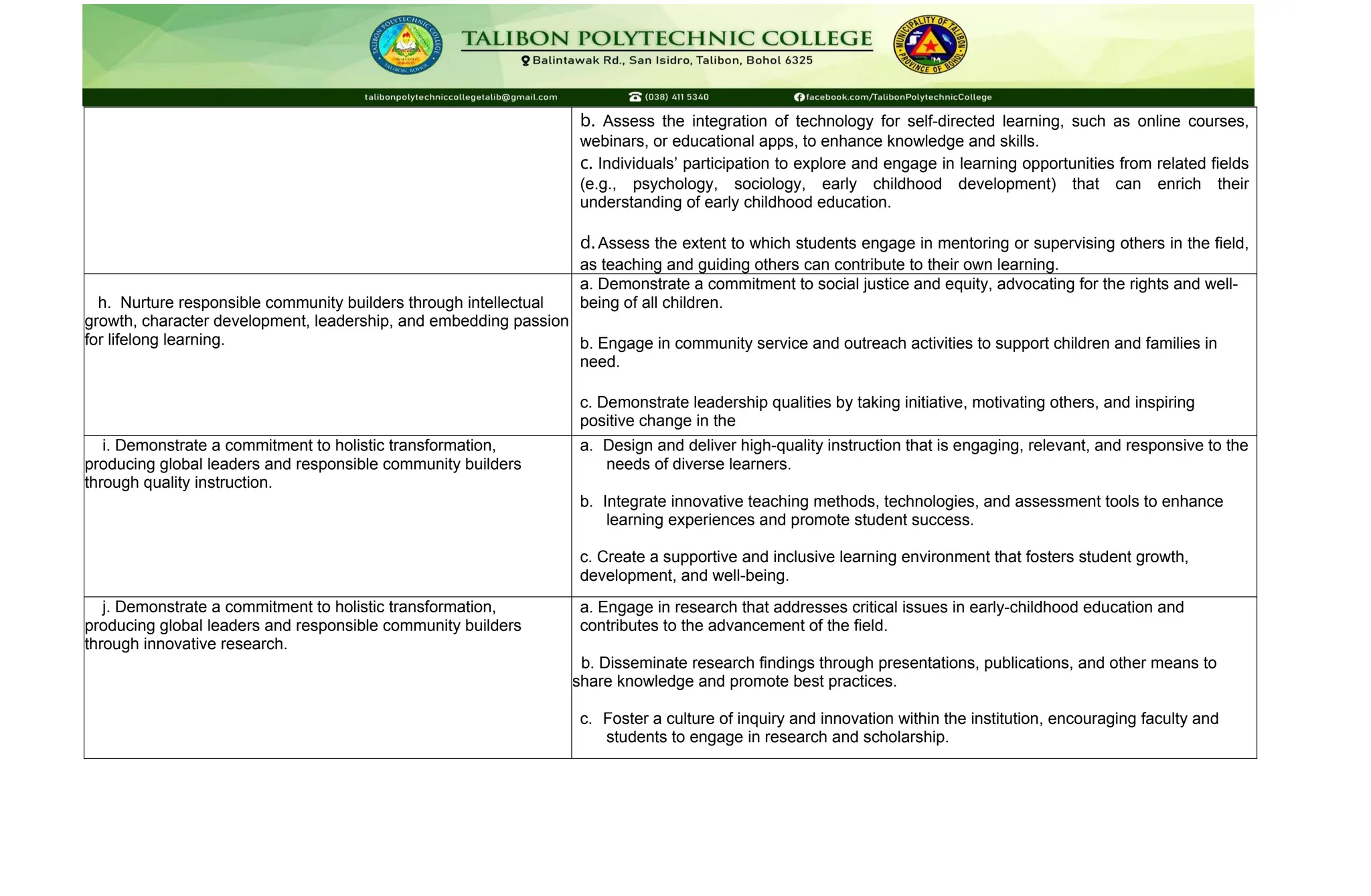
b. Assess theintegration of technology for self-directed learning, such as online courses,
webinars, or educational apps, to enhance knowledge and skills.
c. Individuals’ participation to explore and engage in learning opportunities from related fields
(e.g., psychology, sociology, early childhood development) that can enrich their
understanding of early childhood education.
d.Assess the extent to which students engage in mentoring or supervising others in the field,
as teaching and guiding others can contribute to their own learning.
h. Nurture responsible community builders through intellectual
growth, character development, leadership, and embedding passion
for lifelong learning.
a. Demonstrate a commitment to social justice and equity, advocating for the rights and well-
being of all children.
b. Engage in community service and outreach activities to support children and families in
need.
c. Demonstrate leadership qualities by taking initiative, motivating others, and inspiring
positive change in the
i. Demonstrate a commitment to holistic transformation,
producing global leaders and responsible community builders
through quality instruction.
a. Design and deliver high-quality instruction that is engaging, relevant, and responsive to the
needs of diverse learners.
b. Integrate innovative teaching methods, technologies, and assessment tools to enhance
learning experiences and promote student success.
c. Create a supportive and inclusive learning environment that fosters student growth,
development, and well-being.
j. Demonstrate a commitment to holistic transformation,
producing global leaders and responsible community builders
through innovative research.
a. Engage in research that addresses critical issues in early-childhood education and
contributes to the advancement of the field.
b. Disseminate research findings through presentations, publications, and other means to
share knowledge and promote best practices.
c. Foster a culture of inquiry and innovation within the institution, encouraging faculty and
students to engage in research and scholarship.