The Sydney
Harbour Bridge
Anushka Bhargava
TY B2
309207
Building Material Topic : Steel structure Example
JNEC
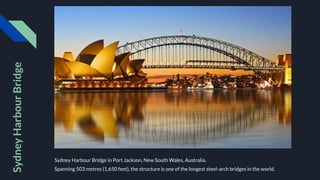
Sydney Harbour Bridge in Port Jackson, New South Wales, Australia.
Spanning 503 metres (1,650 feet), the structure is one of the longest steel-arch bridges in the world.
Sydney
Harbour
Bridge
LOCATION : Sydney, New South Wales, AUSTRALIA
ARCHITECT : Dorman Long
TYPE OF STRUCTURE : Typical arch bridge
BUILT UP YEAR : July, 1923
Sydney
Harbour
Bridge
ABOUT THE STRUCTURE
MATERIAL :
● The total weight of the steelwork of bridge,including the
arch and approach spans,is52,800 tonnes with the arch
itself weighing 39,000 tonnes.
● About 79%of the steel,specifically those technical sections
consulting the arch,was imported pre-formed from
England,with the rest being source from Newcastle.
PURPOSE :
● Due to economic, political and designs election factors,it
took about 100 years for the idea to be converted into
reality.
● The purpose of the bridge was to connect the people who
lived on both sides of the Sydney Harbour
Sydney
Harbour
Bridge
DESCRIPTION
● Sydney Harbour Bridge, steel-arch bridge across Sydney
Harbour (Port Jackson), Australia.
● The bridge, opened in 1932, serves as the primary
transportation link between Sydney and its suburbs on the
northern side of the harbour.
● It spans about 500 metres (1,650 feet), making it one of the
longest steel-arch bridges in the world. Along its length, it
features four railroad tracks, a highway, and two pedestrian
walkways.
Sydney
Harbour
Bridge
● In 1912 John Bradfield, a civil engineer with the New South Wales
Department of Public Works, presented plans to Australia’s
parliament for the construction of a bridge over Sydney Harbour,
with options for either a suspension bridge or a cantilever bridge
design.
● He envisioned the structure as part of an electric railway system
for Sydney and its suburbs. The year after Bradfield submitted his
plans, his cantilever design was accepted, and he was appointed to
lead the project.
● Work on the bridge was delayed by World War I, however, and it
was not until 1922, with the passage of the Sydney Harbour
Bridge Act, that funding for the project became available.
● By that time too, progress in steelmaking had made possible the
construction of an arch bridge.
Sydney
Harbour
Bridge
● The building contract was awarded to the English enterprise Dorman
Long & Co., which hired Sir Ralph Freeman to perform detailed design
work.
● The final, approved plan called for a steel-arch bridge linking Dawes
Point on the south with Milsons Point on the north.
● An arch bridge was chosen because it was less expensive than a
cantilever design and capable of handling heavier loads.
● Construction began in 1924 under Bradfield’s supervision.
● The deep waters of Sydney Harbour made temporary supports
impractical, so the steel arch was assembled by building out from
each bank.
● The two sides met in the middle in 1930, and the bridge was officially
opened with an elaborate ceremony on March 19, 1932.
Sydney
Harbour
Bridge
Sydney
Harbour
Bridge
SOME AMAZING FACTS
ABOUT SYDNEY BRIDGE
The Sydney Harbour Bridge is an instantly recognisable symbol of Australia,
affectionately known as the ‘Coathanger’ by locals.
Here’s the list of interesting facts about Sydney Harbour Bridge.
● The construction of Sydney Harbour Bridge began on 28 July 1923,
using the labour of 1,400 workers and was completed eight years later.
● Approximately six million hand driven rivets and 53,000 tonnes of steel
were used in the construction, and 272,000 litres of paint were used.
● As the bridge took so long to paint, at one point the team commissioned
to paint it were virtually permanently employed as once the last coat of
paint was finished, it was time to paint the next one.
● The bridge plays a part in some of the best annual events in Sydney most
notably as the focal point of the New Year’s Eve fireworks spectacular.
Sydney
Harbour
Bridge
● At the stroke of midnight, specially placed firing points along the
bridge shoot thousands of fireworks into the sky.
● It’s also an integral part of Vivid Sydney a yearly festival of lights,
music and the arts.
● Today, it costs approximately $4, but to speed up travel times and
avoid congestion, there are no toll booths on the bridge; instead
there is an electronic tag system with automatic number plate
recognition.
● Opened to the public in 1998, BridgeClimb has allowed more than 3
million people to scale the bridge and enjoy an unforgettable
experience.
Sydney
Harbour
Bridge
● The four huge granite-faced pylons found at either end of the
Sydney Harbour Bridge play no part in supporting the bridge
whatsoever, and are there for purely aesthetic reasons.
● The bridge has eight traffic lanes and two railway lines.
● There is a pedestrian walkway on the eastern side of the bridge
and a cycleway on the western side, making the Sydney
Harbour Bridge surely one of the most scenic commuter
routes in the world.
● The arch of the bridge can rise or fall by as much as 18
centimetres (7 inches) due to heating and cooling caused by
varying temperatures.
Sydney
Harbour
Bridge
THANK YOU!

SYDNEY HARBOUR BRIDGE

  • 1.
    The Sydney Harbour Bridge AnushkaBhargava TY B2 309207 Building Material Topic : Steel structure Example JNEC
  • 2.
    Sydney Harbour Bridgein Port Jackson, New South Wales, Australia. Spanning 503 metres (1,650 feet), the structure is one of the longest steel-arch bridges in the world. Sydney Harbour Bridge
  • 3.
    LOCATION : Sydney,New South Wales, AUSTRALIA ARCHITECT : Dorman Long TYPE OF STRUCTURE : Typical arch bridge BUILT UP YEAR : July, 1923 Sydney Harbour Bridge ABOUT THE STRUCTURE
  • 4.
    MATERIAL : ● Thetotal weight of the steelwork of bridge,including the arch and approach spans,is52,800 tonnes with the arch itself weighing 39,000 tonnes. ● About 79%of the steel,specifically those technical sections consulting the arch,was imported pre-formed from England,with the rest being source from Newcastle. PURPOSE : ● Due to economic, political and designs election factors,it took about 100 years for the idea to be converted into reality. ● The purpose of the bridge was to connect the people who lived on both sides of the Sydney Harbour Sydney Harbour Bridge
  • 5.
  • 6.
    ● Sydney HarbourBridge, steel-arch bridge across Sydney Harbour (Port Jackson), Australia. ● The bridge, opened in 1932, serves as the primary transportation link between Sydney and its suburbs on the northern side of the harbour. ● It spans about 500 metres (1,650 feet), making it one of the longest steel-arch bridges in the world. Along its length, it features four railroad tracks, a highway, and two pedestrian walkways. Sydney Harbour Bridge
  • 7.
    ● In 1912John Bradfield, a civil engineer with the New South Wales Department of Public Works, presented plans to Australia’s parliament for the construction of a bridge over Sydney Harbour, with options for either a suspension bridge or a cantilever bridge design. ● He envisioned the structure as part of an electric railway system for Sydney and its suburbs. The year after Bradfield submitted his plans, his cantilever design was accepted, and he was appointed to lead the project. ● Work on the bridge was delayed by World War I, however, and it was not until 1922, with the passage of the Sydney Harbour Bridge Act, that funding for the project became available. ● By that time too, progress in steelmaking had made possible the construction of an arch bridge. Sydney Harbour Bridge
  • 8.
    ● The buildingcontract was awarded to the English enterprise Dorman Long & Co., which hired Sir Ralph Freeman to perform detailed design work. ● The final, approved plan called for a steel-arch bridge linking Dawes Point on the south with Milsons Point on the north. ● An arch bridge was chosen because it was less expensive than a cantilever design and capable of handling heavier loads. ● Construction began in 1924 under Bradfield’s supervision. ● The deep waters of Sydney Harbour made temporary supports impractical, so the steel arch was assembled by building out from each bank. ● The two sides met in the middle in 1930, and the bridge was officially opened with an elaborate ceremony on March 19, 1932. Sydney Harbour Bridge
  • 9.
  • 10.
    The Sydney HarbourBridge is an instantly recognisable symbol of Australia, affectionately known as the ‘Coathanger’ by locals. Here’s the list of interesting facts about Sydney Harbour Bridge. ● The construction of Sydney Harbour Bridge began on 28 July 1923, using the labour of 1,400 workers and was completed eight years later. ● Approximately six million hand driven rivets and 53,000 tonnes of steel were used in the construction, and 272,000 litres of paint were used. ● As the bridge took so long to paint, at one point the team commissioned to paint it were virtually permanently employed as once the last coat of paint was finished, it was time to paint the next one. ● The bridge plays a part in some of the best annual events in Sydney most notably as the focal point of the New Year’s Eve fireworks spectacular. Sydney Harbour Bridge
  • 11.
    ● At thestroke of midnight, specially placed firing points along the bridge shoot thousands of fireworks into the sky. ● It’s also an integral part of Vivid Sydney a yearly festival of lights, music and the arts. ● Today, it costs approximately $4, but to speed up travel times and avoid congestion, there are no toll booths on the bridge; instead there is an electronic tag system with automatic number plate recognition. ● Opened to the public in 1998, BridgeClimb has allowed more than 3 million people to scale the bridge and enjoy an unforgettable experience. Sydney Harbour Bridge
  • 12.
    ● The fourhuge granite-faced pylons found at either end of the Sydney Harbour Bridge play no part in supporting the bridge whatsoever, and are there for purely aesthetic reasons. ● The bridge has eight traffic lanes and two railway lines. ● There is a pedestrian walkway on the eastern side of the bridge and a cycleway on the western side, making the Sydney Harbour Bridge surely one of the most scenic commuter routes in the world. ● The arch of the bridge can rise or fall by as much as 18 centimetres (7 inches) due to heating and cooling caused by varying temperatures. Sydney Harbour Bridge
  • 13.