ANUSHKA BHARGAVA
209207
SY B2
JNEC
BUILDING
MATERIALS
NOTES
CA-2
Detailed Notes
Of Applied
Finishes
01
A.
Application Of
Paint On Wall
04
Constituents
Of Paints
02
Detailed Notes
On Types Of
Paints
01
B.
Application Of
Wall Putty
05
Defects In
Paint
03
CONTENTS
OF
ASSIGNMENT
Q.1. (A) Applied Finishes
(I) Plaster Of Paris
(II) Gypsum Plaster
(III) Wall Putty
I) PLASTER OF PARIS
•When finely ground , gypsum rock is heated to a temperature between
100’C and 140’C , three-fourth of the combined water passes of as
steam .
•The remaining product is known as ‘Plaster of Paris’ of pure gypsum
has been used and ‘Hard wall plaster’ if the gypsum rock containing
impurities .
A. Properties
(a) It is a white powder. When mixed with water (1/3 of its mass ), it
evolves heat and quickly sets to a hard porous mass within 5 to 15
minutes.
(b) During settling, a slight expansion (about 1%) on volume occurs so
that it6 fills the mould completely and takes a sharp impression.
B. Preparation
a) Plaster of Paris is prepared by heating calcium sulfate dihydrate,
or gypsum, to 120–180 °C (248–356 °F).
b) With an additive to retard the set, it is called wall, or hard wall,
plaster, which can provide passive fire protection for interior
surfaces.
C. Uses
(a) Plaster of Paris is used for cost ornamental plaster work and it is
very valuable for this purpose.
(b) It produces hard surfaces, sharp contours and is sufficiently
strong
D. Method of application
(a) When water is added to Plaster of Paris , it hardens.
II ) GYPSUM PLASTER
• It is a combination of calcium sulphate with water of
crystallization (I.E. Chemically, caso4.2H2O) and it is white
color substance found in the form of rock in nature.
• Gypsum containing up to 70% of caso42h20 can be used as
a building material.
• It is mainly used in the manufacture of cement to increase in
setting time.
Gypsum anhydrite-
• If we heat gypsum rock further up to a temperature of about
200 degree celsius.
• The entire water of crystallization is driven off and the
resultant product is known as gypsum anhydrite.
For Hard Plastic
• This hard burnt plaster takes too much time in setting and to
accelerate it.
• Certain substances i.e. Accelerators such as alum potassium
sulfate raw gypsum extra are added to it.
Gypsum Miscellaneous Product
• Blocks and tiles made from wall plaster which are light easy in
shaping strong water the distance are becoming very popular for
floor in interior construction.
• This wall plaster mixed with fine cinders or wood chips and
sufficient water has been used in making floors .However they
have not been stronger and more fire resistant than concrete
floors.
Advantages
• The application of gypsum plaster is a time-saving process, hence cost of the
project is reduced.
• Quantum of wastage during application is negligible.
• It is easily workable for an excellent finish.
• Gypsum plaster does not require curing which saves both water and time
during construction.
• Gypsum exhibits bonding properties. Hence only a single coat on RCC
ceilings, internal bare-brick walls, AAC blocks and concrete columns would be
sufficient.
• The space looks large and beautiful as gypsum plaster is pure white in color.
• Gypsum plaster is pre-mixed material and available in easy to handle packs.
• It gives a smooth finish to the surface to receive all type of paints.
• Various surface textures and surface hardness can be obtained.
• Gypsum plaster is not affected by insects and does not favour growth of
fungus.
Uses of Gypsum
• Gypsum uses include: manufacture of wallboard, cement, plaster
of Paris, soil conditioning, a hardening retarder in Portland
cement.
• Varieties of gypsum known as "satin spar" and "alabaster" are
used for a variety of ornamental purposes; however, their low
hardness limits their durability.
Types of gypsum plasters are
categorized as
1. Casting Gypsum Plaster
2. Undercoat Gypsum Plaster
3. Finish Gypsum Plaster
4. One Coat Gypsum Plaster
5. Machine applied Gypsum Plaster
Properties
-Gypsum is a very brittle material
-The strength of gypsum depends on the porosity of both material
-Tone is always mixed at lower wbp ratio it is less Porous much
stronger and harder.
-Solubility increases with the temperature of the water.
Stone is less fragile but must be treated with care of fracture is to
be avoided.
-Dimensional stability of gypsum is good.
(III) WALL PUTTY
• In general, wall putty is nothing but the materials with high
plasticity which are similar in the texture of clay or dough.
• It provides a protective smooth base for paint application.
• It also acts as a sealer or filler as you can fill cracks or any
patches on the wall.
• It allows all types of colors to be applied over the walls.
• Putty comes in different colors and consistency.
• The good thing about wall putty is that it can be easily used
on both exterior as well as interior surface whether it is old or
new.
• Even after applying expensive paint, your wall may look
uneven.
• This uneven surface needs to be filled with putty.
• Following problems or defects can be hidden using wall
putty:
i. Hair cracks and pin holes on walls
ii. Dampness on wall
iii. Uneven and rough cement plaster on the wall
iv. Cracking due to the ageing of walls
v. Discolored patches
vi. Effloresces on walls
vii. Peeling of old paint
Procedure for Applying Putty on Wall
Follow the steps below for applying putty on wall:
• Before you start applying putty on wall, make sure the
surface is clean and dry. The surface should be free from
dust, loose particles, or any other contamination. Remove
this loose particle using sandpaper or wire brush.
• Mix the wall putty in a pan and add water as per
manufacturer’s instructions. Stir continuously by hand or an
electric putty mixer for about 10-15 minutes till it gets a
creamy, paste-like consistency.
Procedure for Applying Putty on Wall
Application
• Apply one coat of primer before applying putty on wall. Then apply
the first coat of putty from bottom to top manner with the help of
putty knife or spatula.
• Allow it to dry for a minimum 6 to 8 hours.
• After the first cost of putty get dried, apply a second coat of putty
and dry it for hours.
• Once the putty dries completely, remove unevenness with the help
of sandpaper.
Types of Wall Putty
• There are various types of wall putty available in the market based on
different purposes such as for interior and exterior walls.
• Basically, wall putty is differentiated into two types:
1. White Cement Putty
2. Acrylic Putty
Q.1. (B) Paints
(I) Cement Paints And White Washing
(II) Distempers
(III) Emulsion Paints
(IV) Plastic And Luster Paints
(V) Varnishes And Polishes
(VI)
a) Bituminous Paints,
b) Water Proofing Paints,
c) Anti Corrosive Paints
1) CEMENT PAINT & WHITE WASHING
1 (A) CEMENT PAINT
• This consists of boiled linseed oil to which dry good cement (65
to 70% Portland, white or colored cement) has been mixed or
stirred to an amount that a paint of workable consistency is
obtained. The cement paint is available in powder form in a
variety of shades.
• This paint has the following qualities:
(i) It possesses better water-proofing qualities.
(ii) It possesses good strength, hardness, density and durability.
These qualities are impacted by cement.
(iii) It exhibits excellent decorative appearance.
• This quality is impacted by the use of coloring pigment,
inert filter, lime and other constituents added in small
percentage.
• In light of these qualities, cement paints are being
extensively used for painting plastered brickwork, stone
masonry and concrete for both external and internal
works.
• These are also used for painting corrugated iron sheets.
• Cement paints are becoming very popular as a lasting
finish (minimum 5 to years without needing a renewal for
walls and ceilings in residences, offices, public buildings,
cinema halls, hotels, factories, work-shops, warehouses,
etc.
1 (B) WHITE WASHING
• White washing in this process mixture of pure fat
slaked lime in sufficient quantity of water is first
prepared.
• It is then screened through coarse cloth and a
mixture of boiled gum with rice in certain
proportions is added to it.
• The solution so formed called white wash, is then
applied by brushes to a specified number of coats
usually three.
2) DISTEMPER
• 'DISTEMPERS 'are considered to be water-paints, consisting of whiting
i.e.,(powdered chalk), glue or casein as a binder, and suitable proportion of
fast coloring pigments (if desired).
• These distempers from a cheap, durable and easily applied decoration for
internal use on plastered, cement.
• 'DISTEMPERING ' is the process of applying distempers over the various
surfaces more easily and with lesser coat than paints and varnishes to
safeguard them against weather effects and improve their appearance .
• The study of distempers and distempering can be divided into the following
heads :
1. Distempers and there compositions
2. Properties of distempers
Distempers and their compositions
• A distemper is composed of base (Whiting or chalk) ,glue (binder) , water
(carrier or thinner), and a coloring pigment.
• Distempers are available in the market in a variety of shades under
different trade names.
• They may either in powder form or paste form.
• These distempers are required to be mixed with hot water before use.
• The various forms of distempers are:
White distempers
• They are made by mixing only whiting (i.e., powdered chalk) and glue size.
Colored distempers
• They are prepared by mixing the desired coloring pigment to the whiting
before mixing it with the glue size.
Oil Bound Distempers
• There is a variety of oil paints in which the drying oil is so treated that
it mixes with water.
• Such distempers are diluted or thinned with water when required.
These distempers, on drying, from a durable and washable coating.
Casein Paints
• This paints are prepared by mixing a finely ground casein( casein is
extracted from milk curds and acts as a binder) with a white base
usually slaked lime.
• Due to high opacity , this paints are used on plastered surfaces,
stucco fibered board, cement blocks etc.
Properties Of Distempers
Distempers exhibit the following properties or qualities :
• Distempers may be in the form of oil bound washable paints,
washable oil free distempers, non washable distempers or
emulsion paints (i.e., glue or casein as emulsifying agents)
• They are cheaper than paints and varnishes, but comparable
with the cost of white- wash in the long run .
3) EMULSION PAINT (or Stucco, Bricks &
Masonry Paint).
• This paint consists of a vehicle such as polyvinyl acetate, synthetic resins
usually chlorinated rubber etc., as the main constituent.
• This vehicle imparts an excellent quality of alkali-resistance to the paint. In
addition to this, emulsion paint has the qualities of quick drying, good
work-ability and high durability.
• This paint is recommended for use on stucco bricks and masonry surfaces
which contain free alkali.
• The surfaces to be painted should first be washed with zinc sulphate
solution so as to reduce the alkalinity.8. Enamel Paint. This paint consist of
metallic
4. PLASTIC AND LUSTER PAINTS
• Plastic emulsion paint is water based wall paint. It is
based on acrylic and provide a smooth matt finish to
the walls.
• These paints have gained popularity because of their
ease of application, quick drying properties,
non-objectionable odour and good washability.
• The specification for Plastic Emulsion Paint shall
conform to IS 15489: 2004 as given below.
4. (A)PLASTIC PAINTS
Types
Plastic emulsion paint shall be of two types:
• Type 1 for interior use, and
• Type 2 for exterior use.
Class
1. There shall be following four classes of products:
2. Matt finish,
3. Egg shell/satin finish,
4. Semi-glossy finish, and
5. Glossy finish.
Benefits of Plastic Based Paint
• These latex paints take advantage of various properties of plastics.
• These plastic based paints are quick to cure, durable and washable.
• They often cover in one coat and clean up with water for minimal fuss.
4. (B) LUSTRE PAINTS
4. PLASTIC AND LUSTER PAINTS
• Luster paints are of a unique formulation so that when compared to
ordinary paints they are more durable.
• The special formula makes them highly durable.
• Luster paints enhance the interiors due to the shimmering effect they
make on the walls.
• These paints provide a smooth finish to the walls and they make it very
easy to clean the walls.
• Any surface that is painted with Luster Paints is assured complete
protection from fungal growth. Due to the anti-fungal property of this type
of paints, there will not be the formation of dark spots on the walls.
• Luster paints make cleaning of walls very easy by effective
prevention of stains penetration.
• They protect the walls from all types of stains.
• Since luster paints are specially formulated, they last for longer
periods when compared to the regular emulsions.
• The shade on the wall remains the same for years thanks to the
anti-yellowing property of lustre paints.
5) VARNISHES &
POLISHES
5. (A) VARNISHES
• Varnish is a solution of a resinous substance (like amber, copal,
common resin shellac, etc.)
• In either oil , turpentine or alcohol.
• However, a drier may be added to this solution for accelerating the
process of drying .
• The varnish solution in drying or evaporation from leaves a hard,
transparent and glossy film of resin on the varnished surface.
• 'Varnishing' is the process of applying varnish to the wooden
surface (unpainted) and also to the painted surfaces in order to
improve their appearance and protect them from atmospheric
actions.
The study of varnishes and varnishing can be divided into the following heads :
1.Objects varnishing.
2. Characteristic of a good varnish
3. Ingredients of a varnish
4. Types of varnish
5. Process of varnishing or application of varnish
6. Polishes and polishing
1. Objects Of Varnishing
The various objects of varnishing a surface are as follows :
i. To intensify and brighten the ornamental appearance of the grains of the
unpainted wood surfaces.
ii. To protect the structural wooden surfaces (unpainted),like doors, windows,
floors, roof trusses, etc. from atmospheric action.
iii. To give brilliancy to the painted surfaces and also to papered walls.
iv. To protect the painted surface from atmospheric actions in order to increase
the durability of the paint film.
2. Characteristics Of A Good Varnish
A good varnish should have the following characteristics or qualities
i. It should dry rapidly or quickly.
ii. On drying, it should form a protective film which should be hard,
tough resistant to wear and durable.
iii. It should exhibits a glossy surface
iv. The finished or varnished surface should be uniform in nature
and pleasing in appearance.
v. The color of the varnish should not fade or change when surface
is exposed to atmospheric actions.
vi. It should not crack on drying and should have sufficient elasticity.
5) VARNISHES & POLISHES
5. (B) POLISHES
• ‘’Polishes’’ are nothing but thin varnishes which are solutions of shellac in
spirit and are lightly rubbed as in case of brush polish.
• The various types of polishes are described below :
(a) French polish.
• This is a high class varnish, and is made by dissolving 0.15 kg or black or
light brown shellac in one liter of methylated spirit without heat.
• The polish colored can be obtained by adding suitable coloring pigments.
• This polish dries out within few minutes gives a fine glossy surface.
• It is mostly used on superior wood- work, handrails, furniture, etc.
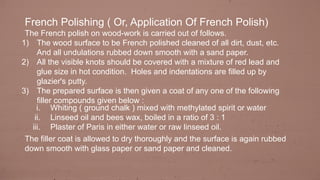
French Polishing ( Or, Application Of French Polish)
The French polish on wood-work is carried out of follows.
1) The wood surface to be French polished cleaned of all dirt, dust, etc.
And all undulations rubbed down smooth with a sand paper.
2) All the visible knots should be covered with a mixture of red lead and
glue size in hot condition. Holes and indentations are filled up by
glazier's putty.
3) The prepared surface is then given a coat of any one of the following
filler compounds given below :
The filler coat is allowed to dry thoroughly and the surface is again rubbed
down smooth with glass paper or sand paper and cleaned.
i. Whiting ( ground chalk ) mixed with methylated spirit or water
ii. Linseed oil and bees wax, boiled in a ratio of 3 : 1
iii. Plaster of Paris in either water or raw linseed oil.
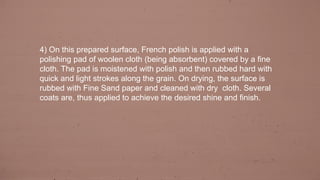
4) On this prepared surface, French polish is applied with a
polishing pad of woolen cloth (being absorbent) covered by a fine
cloth. The pad is moistened with polish and then rubbed hard with
quick and light strokes along the grain. On drying, the surface is
rubbed with Fine Sand paper and cleaned with dry cloth. Several
coats are, thus applied to achieve the desired shine and finish.
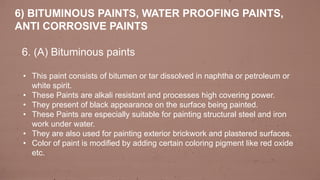
6. (A) Bituminous paints
• This paint consists of bitumen or tar dissolved in naphtha or petroleum or
white spirit.
• These Paints are alkali resistant and processes high covering power.
• They present of black appearance on the surface being painted.
• These Paints are especially suitable for painting structural steel and iron
work under water.
• They are also used for painting exterior brickwork and plastered surfaces.
• Color of paint is modified by adding certain coloring pigment like red oxide
etc.
6) BITUMINOUS PAINTS, WATER PROOFING PAINTS,
ANTI CORROSIVE PAINTS
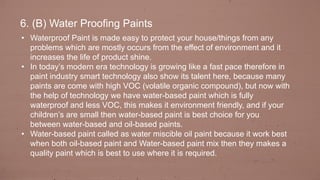
6. (B) Water Proofing Paints
• Waterproof Paint is made easy to protect your house/things from any
problems which are mostly occurs from the effect of environment and it
increases the life of product shine.
• In today’s modern era technology is growing like a fast pace therefore in
paint industry smart technology also show its talent here, because many
paints are come with high VOC (volatile organic compound), but now with
the help of technology we have water-based paint which is fully
waterproof and less VOC, this makes it environment friendly, and if your
children’s are small then water-based paint is best choice for you
between water-based and oil-based paints.
• Water-based paint called as water miscible oil paint because it work best
when both oil-based paint and Water-based paint mix then they makes a
quality paint which is best to use where it is required.
Types of Waterproof paint:
1. Masonry Paint
• Masonry Paint made from ceramic and latex.
• It is mostly used for concrete/cinder blocks, bricks, cement, stones and also things like
Hardie board. Used for absorbing water and other liquids, surfaces easily clean with soap
and water.
• This paint is made for exterior use if you think that you want to use this inside your house
than at once you read its cons or asked to an expert.
2. Epoxy Paint
• This paint is made from epoxy-based resin also known as polyoxides.
• Epoxy Paint is used in majority form for industries such as for commercial, industrial,
construction, agricultural and for electronics. Epoxy Paint is 5 time thicker than other floor
paints, benefits that it is permanent adhesion, durable, waterproof, easy clean up,
long-lasting, and resistant (acid, rust, chemicals, heat).
• Epoxy Coating is must used in swimming pool.
• Epoxy Paint takes longer time for dry on high humidity and in cool temperature.
3. Acrolein Elasticized Paint
• This paint used on surfaces which are made from
concrete.
• It protects from growth of mould, bacteria, mildew which
comes in presence with the cause of moisture.
• It is used on concrete surfaces, cinder block surfaces
and stone surfaces.
Advantages Of Waterproofing Cement Paint
• It does not let walls affected of mold or mildew. It means your house will
have ideal structural integrity and health.
• Moreover, you would not have to worry about maintenance costs. Your
walls will keep looking amazingly good quite longer.
• Waterproof Cement Paint means you will have to do less work while
cleaning up after rain or heavy rainstorm.
Disadvantages of Waterproofing Cement Paint
• However, there are no such prominent disadvantages of waterproofing
cement paint. Talking about the general ones, it could have limited
shades.
• It would be needed a lot water while being done on your home. It
needs to get used within two hours only otherwise it would get dry up
and will be formed a bit hard.
6. (C)Anti corrosive paint
• This Paints mainly consists of, a strong drier and a coloring
pigment mixed with very fine sand.
• This paint is cheaper than white lead.
• It lasts for a long period and give black appearance to the
surface Bing painted.
• 20 Paints generally used for external work.
• This is used for protect and preserve the Steel work against the
adverse effects of weather, fumes, acidic, corrosive chemicals
etc.
Q.2. Detail Notes On
Constituents Of Paints
Ingredients Of A Paint
A paint essentially consist of the following
ingredients-
1) A Base
2) A Vehicle Or Carrier
3) A Drier
4) A Colouring Pigment And
5) A Solvent
1) Bases
• A base is a solid substance in fine state of division and it forms the
bulk of paint .
• It determines the character of the paint and imparts durability to the
surface which is painted.
2) Vehicles
• The vehicles are the liquid substances which hold the ingredients of
a paint in liquid suspension .
They are required mainly for two reasons-
(i) to make it possible to spread the paint evenly on the surface, and
(ii) to provide a binder for the ingredients of a paint so that they may
stick or adhere to the surface.
3) Driers
• A 'Drier is a substance which act as a catalyst and accelerates the process of
drying of a paint film.
• A drier absorbs the oxygen from the atmosphere and become a higher oxide.
• This drier which gets hardened.
• Thus, the only function of driers is catalytic.
• However, the driers adversely affect the color and elasticity of the paints.
• They are, therefore, not used in preparing the paint for the final or finishing coat
otherwise they will lead to flaking of the paint.
Driers are classified into 2 types:
i. Oil driers( or soluble driers). These are the driers which are dissolved in
linseed oil or some other good oil. These are available in powdered form, e.g
litharge, magnesium dioxide, magnesium borate, etc.
ii. Paste driers: These driers are first mixed with inert fillers, such as barytes,
whiting, silica, etc. And then ground in linseed oil or some other good oil, e.g.
cobalt or vanadium compounds.
• Out of other driers, Litharge is the most common used
drier Red lead and sulphate of magnesium can also be
used as driers.
• It should be noted that drier more than 10% by volume of
the paint should not be added and moreover, only one kind
of drier and that too just before using the paint, should be
added if necessary.
4) Solvents and Thinners
• "solvent" and "Thinner" is a liquid which is mixed into paint to
make the paint thinner or desired consistency so that it can be oily
applied on the surface.
• The following function in a paint:
(i)It help the paint in penetrating through the pores surfaces being
thinner at the time of application.
(ii) After applying the paint the solvent evaporates and the resulting
surface is more even and smooth.
(iii) It facilitates brushing and improve spreading power of the paint.
• Thinners commonly used are the following:
(a) For oil paint : (i)Turpentine (ii) white spirit, and (iii) Naphtha.
(b) For spirit lacquers: Alcohol
(c) For cellulose paint: Ethyl amyl acetate
(d) For distempers: water
• 'Turpentine', is the most common thinner used in oil paints.
• Turpentine is a spirit obtained by distilling balsam, which is the
resin or gum obtained from pine trees. Turpentine is an
inflammable, volatile and colorless liquid with pungent smell.
• Turpentine is generally affected by whether and hence should
only be used in interior work and in making varnishes.
• If at all it is required to be used for external work, then
minimum quantity, which is just enough to make the paint
workable, should be used.
• Turpentine can also be used to produce dull surface when
required.
• 'Benzine and Naphitha' are thinners which are cheaper and are
sometimes used as substitutes for turpentine.
5) Coloring pigments or strainers
• As the name implies, it is a coloring pigment which is added to
the paint, when the colored desired for the paint is different
from the base of the paint generally for white, black and very
dark colored shade, the base itself is chosen of the same color.
• In case of light pant shade.
• The coloring pigment is added to the white paint.
• The coloring pigment is generally used are given below.
• The desired shade of the paint may be obtained by using single
or combination of coloring pigments or strainers.
(i) Black pigment: Lamp black, carbon black, bone black and
graphite.
(ii) Brown pigment: Burnt umber, Rain umber, Burnt sienna, and
Vandyke Brown.
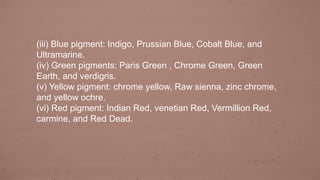
(iii) Blue pigment: Indigo, Prussian Blue, Cobalt Blue, and
Ultramarine.
(iv) Green pigments: Paris Green , Chrome Green, Green
Earth, and verdigris.
(v) Yellow pigment: chrome yellow, Raw sienna, zinc chrome,
and yellow ochre.
(vi) Red pigment: Indian Red, venetian Red, Vermillion Red,
carmine, and Red Dead.
Q.3. Detail Note On Defects In
Paints
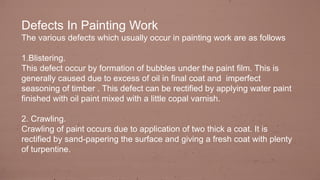
Defects In Painting Work
The various defects which usually occur in painting work are as follows
1.Blistering.
This defect occur by formation of bubbles under the paint film. This is
generally caused due to excess of oil in final coat and imperfect
seasoning of timber . This defect can be rectified by applying water paint
finished with oil paint mixed with a little copal varnish.
2. Crawling.
Crawling of paint occurs due to application of two thick a coat. It is
rectified by sand-papering the surface and giving a fresh coat with plenty
of turpentine.
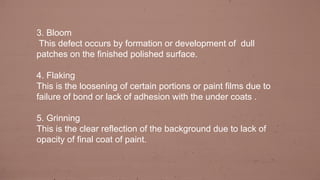
3. Bloom
This defect occurs by formation or development of dull
patches on the finished polished surface.
4. Flaking
This is the loosening of certain portions or paint films due to
failure of bond or lack of adhesion with the under coats .
5. Grinning
This is the clear reflection of the background due to lack of
opacity of final coat of paint.
6. Fading
This is the loss of paint color gradually due to the effect of
sunlight on pigments of paints
7. Flashing
This is the appearance or reflection of glossy patches on the
painted surface due to either poor workmanship or cheap
paint used or due to weather effect.
8. Saponification
This is the formation of soap patches on the painted surface
due to chemical action of alkalis.
Q.4. Explain Step By
Step Procedure Of
Application Of Paints
On Wall.
1. Painting Of New Work
• Normally 4 coats of paint are required for satisfactory painting
of new food-work in superior works, 5 or 6 coats can be
applied, whereas in interior work 2 to 3 coats are considered
sufficient.
• The process of painting on new wood work is carried out in the
following stages :
Stage-1 : Preparation of surface.,
Stage-2 : Knotting or killings nots.,
Stage-3 : Priming or first coat.,
Stage-4 : Stopping,
Stage-5 : Under coats (or second and succeeding coats)
Stage-6 : Finishing and flatting coat.
A. Preparation of surface
• The Surface preparation is important to preserve the properties
and life of the paint.
• Hence, the wood-work should be properly seasoned or dried
before painting.
• ( Wood should not contain more than 15% moisture at the time
of painting ).
• The surface should be cleaned of any dust, dirt, etc. And made
smooth.
• All the heads of nails should be punched to a dept of 3 mm
below the surface.
• The grease, if present of the surface, should be removed by
rubbing with a find grade sand paper or glass paper.
B. Knotting of killings Knots.
• In this, the surface is knotted.
• The knotting is the process of covering or killing of all nots of wood-work with
a substance through which the resin cannot come out or exude.
• Knotting is essential because the resin coming out od nots damages the paint
film by way of cracking, peeling or brown discoloration.
• The following three method of knotting are generally adopted :
1. Ordinary or size knotting
• This consists in sealing the knots by applying two coats.
• The first coat consisting of red lead ground in water and mixed with strong
glue size, is applied in hot condition on the knots.
• Soon after the drying of first coat (drying time, usually 10 minutes), the
second coat, consisting of red lead ground in oil which is thinned by boiled oil
and turpentine, is applied.
2. Patent knotting
• This consists is sealing the knots by applying two coats of
varnish of the knots.
• The varnish is made by dissolving shellac in methylated spirits
of naphtha
3. Lime knotting
• This consist of covering the knots with hot lime for about 24
hours.
• After this period, the lime is scrapped from the surface and the
knots are treated with ordinary of size method of knotting.
C. Priming Of First Coat
• After knotting the priming of first coat of paint is applied to fill the pores
of wood or any minute inequalities on the surface to be painted.
• It also prepare a smooth base for the subsequent coats of paints
accelerates there drying.
• Selection of primers depends upon several factors, viz,. Nature and time
of surface , nature of materials, degree of exposure number of coats,
etc.
• Generally, the ingredient of the priming coat are kept same as for
subsequent coat but with varying proportions.
• The priming coat is usually applied before fixing the wood work position.
• The paint of priming or first coat may have the following composition for
interior exterior or ordinary works.
D. Stopping
• Stopping consists of rubbing down the primed dry surface with
either pumice stone or glass paper or both, and then filling up
all the cracks, nail holes, dents, open joints etc., with putty.
• Ordinary Putty is made by mixing whiting(or powdered chalk)
with linseed oil to a workable consistency.
• For high class interior work ,hard stopping consisting of an
admixture of 1/3 white lead and 2/3 ordinary putty, is used for
filling up the cracks and other such defects, instead of ordinary
putty.
E. Under-Coats (or second & succeeding coats)
• After drying of the priming coat, second coat of the desired color is
laid on in exactly the same manner as the first coat.
• On drying, the surface of the second coat is rubbed down with
pumice stone or glass paper.
• All other succeeding coats except the finishing coat are follow in a
similar manner.
• These under- coats afford an even, smooth and hard foundation to
the finishing coat .
F. Finishing or Flatting coat
After completely drying of the under coat, finishing coat is applied
very carefully so as to present a perfectly smooth and even surface,
without any brush marks on it .
Q.5. Explain Procedure Of
Application Of Wall Putty
& Gypsum Wall Punning
Application Of Wall Putty
• The application of wall putty can be done on exterior
or interior walls.
• Accordingly, decide which kind of wall putty do your
walls need.
• Always add water slowly to the wall putty mix,
ensuring the preparation of a smooth paste.
• Make use of a mechanical stirrer to blend the mixture.
Use the putty mixture within 2-3 hours of preparation.
Prepare the putty mix in small quantities to prevent
wastage of the putty mix.
• Before applying putty, make sure that the surface of the wall is
free from unwanted particles like dust, dirt, grease, molds, etc.
• Use sandpaper or a clean towel to carry out this step. Use
sandpaper for removing unwanted particles from oil-painted walls.
• Use a screwdriver to dig out all the cracks and dents in the wall.
• Apply wall putty only on a pre-wet surface.
• This step allows the putty to create a strong bond with the wall
substrates.
• Use wall putty on a plastered wall with the help of tools like a
putty knife and a firm brush.
• After the application of putty, smoothen the dry surface with
sandpaper.
• The materials used in the two stage finish i.e. plaster and POP are
cement, sand, water and POP/ putty, where as in gypsum plaster,
gypsum and water is required for plastering.
• Gypsum is mixed with water and applied on the wall within level strips
and finished to a smooth surface with steel trowels/ steel float and
ensures line and level leaving no undulation in the surface completely
made good.
• The finished surface should be smooth, true to plane, slopes or curves.
• After drying the surface should be sand papered to give smooth surface.
• In this way there is saving in time for curing cement sand plaster and time
for leveling coat of POP.
• Cement should not be mixed with Gypsum plaster.
Application Of Gypsum Wall Punning
Advantages
• Gypsum plaster is directly applied on brick, block or RCC, no separate finishing
product required.
• It requires no curing, therefore ready to paint.
• Gypsum plaster saves time during construction and ensures timely possession of
homes/ building.
• Gypsum plaster expands slightly on setting and is not, therefore likely to cause
cracking of surface.
• On drying out it forms a sufficient dense surface to resist normal knocks.
• Gypsum plaster is comparatively easy to spread and level.
• Gypsum plasters have no appreciable chemical action on paint.
• Gypsum plaster spread and finished to a minimum thickness increasing carpet area.
• Gypsum plaster is perfectly lined, leveled, sharp corner and smooth surface.
• Saving on electricity used for air conditioning as gypsum has very low thermal
conductivity.
• It is more durable and green material.
• Gypsum plaster light in weight, therefore reduces the load on structure.
• More cleanliness on site because it is bag packed product and no curing is required.
THANKS
REMARKS:
IMPROVEMENTS:

BUILDING MATERIALS NOTES

  • 1.
  • 2.
    Detailed Notes Of Applied Finishes 01 A. ApplicationOf Paint On Wall 04 Constituents Of Paints 02 Detailed Notes On Types Of Paints 01 B. Application Of Wall Putty 05 Defects In Paint 03 CONTENTS OF ASSIGNMENT
  • 3.
    Q.1. (A) AppliedFinishes (I) Plaster Of Paris (II) Gypsum Plaster (III) Wall Putty
  • 4.
    I) PLASTER OFPARIS •When finely ground , gypsum rock is heated to a temperature between 100’C and 140’C , three-fourth of the combined water passes of as steam . •The remaining product is known as ‘Plaster of Paris’ of pure gypsum has been used and ‘Hard wall plaster’ if the gypsum rock containing impurities . A. Properties (a) It is a white powder. When mixed with water (1/3 of its mass ), it evolves heat and quickly sets to a hard porous mass within 5 to 15 minutes. (b) During settling, a slight expansion (about 1%) on volume occurs so that it6 fills the mould completely and takes a sharp impression.
  • 5.
    B. Preparation a) Plasterof Paris is prepared by heating calcium sulfate dihydrate, or gypsum, to 120–180 °C (248–356 °F). b) With an additive to retard the set, it is called wall, or hard wall, plaster, which can provide passive fire protection for interior surfaces. C. Uses (a) Plaster of Paris is used for cost ornamental plaster work and it is very valuable for this purpose. (b) It produces hard surfaces, sharp contours and is sufficiently strong D. Method of application (a) When water is added to Plaster of Paris , it hardens.
  • 6.
    II ) GYPSUMPLASTER • It is a combination of calcium sulphate with water of crystallization (I.E. Chemically, caso4.2H2O) and it is white color substance found in the form of rock in nature. • Gypsum containing up to 70% of caso42h20 can be used as a building material. • It is mainly used in the manufacture of cement to increase in setting time. Gypsum anhydrite- • If we heat gypsum rock further up to a temperature of about 200 degree celsius. • The entire water of crystallization is driven off and the resultant product is known as gypsum anhydrite.
  • 7.
    For Hard Plastic •This hard burnt plaster takes too much time in setting and to accelerate it. • Certain substances i.e. Accelerators such as alum potassium sulfate raw gypsum extra are added to it. Gypsum Miscellaneous Product • Blocks and tiles made from wall plaster which are light easy in shaping strong water the distance are becoming very popular for floor in interior construction. • This wall plaster mixed with fine cinders or wood chips and sufficient water has been used in making floors .However they have not been stronger and more fire resistant than concrete floors.
  • 8.
    Advantages • The applicationof gypsum plaster is a time-saving process, hence cost of the project is reduced. • Quantum of wastage during application is negligible. • It is easily workable for an excellent finish. • Gypsum plaster does not require curing which saves both water and time during construction. • Gypsum exhibits bonding properties. Hence only a single coat on RCC ceilings, internal bare-brick walls, AAC blocks and concrete columns would be sufficient. • The space looks large and beautiful as gypsum plaster is pure white in color. • Gypsum plaster is pre-mixed material and available in easy to handle packs. • It gives a smooth finish to the surface to receive all type of paints. • Various surface textures and surface hardness can be obtained. • Gypsum plaster is not affected by insects and does not favour growth of fungus.
  • 9.
    Uses of Gypsum •Gypsum uses include: manufacture of wallboard, cement, plaster of Paris, soil conditioning, a hardening retarder in Portland cement. • Varieties of gypsum known as "satin spar" and "alabaster" are used for a variety of ornamental purposes; however, their low hardness limits their durability. Types of gypsum plasters are categorized as 1. Casting Gypsum Plaster 2. Undercoat Gypsum Plaster 3. Finish Gypsum Plaster 4. One Coat Gypsum Plaster 5. Machine applied Gypsum Plaster
  • 10.
    Properties -Gypsum is avery brittle material -The strength of gypsum depends on the porosity of both material -Tone is always mixed at lower wbp ratio it is less Porous much stronger and harder. -Solubility increases with the temperature of the water. Stone is less fragile but must be treated with care of fracture is to be avoided. -Dimensional stability of gypsum is good.
  • 11.
    (III) WALL PUTTY •In general, wall putty is nothing but the materials with high plasticity which are similar in the texture of clay or dough. • It provides a protective smooth base for paint application. • It also acts as a sealer or filler as you can fill cracks or any patches on the wall. • It allows all types of colors to be applied over the walls. • Putty comes in different colors and consistency. • The good thing about wall putty is that it can be easily used on both exterior as well as interior surface whether it is old or new.
  • 12.
    • Even afterapplying expensive paint, your wall may look uneven. • This uneven surface needs to be filled with putty. • Following problems or defects can be hidden using wall putty: i. Hair cracks and pin holes on walls ii. Dampness on wall iii. Uneven and rough cement plaster on the wall iv. Cracking due to the ageing of walls v. Discolored patches vi. Effloresces on walls vii. Peeling of old paint
  • 13.
    Procedure for ApplyingPutty on Wall Follow the steps below for applying putty on wall: • Before you start applying putty on wall, make sure the surface is clean and dry. The surface should be free from dust, loose particles, or any other contamination. Remove this loose particle using sandpaper or wire brush. • Mix the wall putty in a pan and add water as per manufacturer’s instructions. Stir continuously by hand or an electric putty mixer for about 10-15 minutes till it gets a creamy, paste-like consistency. Procedure for Applying Putty on Wall
  • 14.
    Application • Apply onecoat of primer before applying putty on wall. Then apply the first coat of putty from bottom to top manner with the help of putty knife or spatula. • Allow it to dry for a minimum 6 to 8 hours. • After the first cost of putty get dried, apply a second coat of putty and dry it for hours. • Once the putty dries completely, remove unevenness with the help of sandpaper. Types of Wall Putty • There are various types of wall putty available in the market based on different purposes such as for interior and exterior walls. • Basically, wall putty is differentiated into two types: 1. White Cement Putty 2. Acrylic Putty
  • 15.
    Q.1. (B) Paints (I)Cement Paints And White Washing (II) Distempers (III) Emulsion Paints (IV) Plastic And Luster Paints (V) Varnishes And Polishes (VI) a) Bituminous Paints, b) Water Proofing Paints, c) Anti Corrosive Paints
  • 16.
    1) CEMENT PAINT& WHITE WASHING 1 (A) CEMENT PAINT • This consists of boiled linseed oil to which dry good cement (65 to 70% Portland, white or colored cement) has been mixed or stirred to an amount that a paint of workable consistency is obtained. The cement paint is available in powder form in a variety of shades. • This paint has the following qualities: (i) It possesses better water-proofing qualities. (ii) It possesses good strength, hardness, density and durability. These qualities are impacted by cement. (iii) It exhibits excellent decorative appearance.
  • 17.
    • This qualityis impacted by the use of coloring pigment, inert filter, lime and other constituents added in small percentage. • In light of these qualities, cement paints are being extensively used for painting plastered brickwork, stone masonry and concrete for both external and internal works. • These are also used for painting corrugated iron sheets. • Cement paints are becoming very popular as a lasting finish (minimum 5 to years without needing a renewal for walls and ceilings in residences, offices, public buildings, cinema halls, hotels, factories, work-shops, warehouses, etc.
  • 18.
    1 (B) WHITEWASHING • White washing in this process mixture of pure fat slaked lime in sufficient quantity of water is first prepared. • It is then screened through coarse cloth and a mixture of boiled gum with rice in certain proportions is added to it. • The solution so formed called white wash, is then applied by brushes to a specified number of coats usually three.
  • 19.
    2) DISTEMPER • 'DISTEMPERS'are considered to be water-paints, consisting of whiting i.e.,(powdered chalk), glue or casein as a binder, and suitable proportion of fast coloring pigments (if desired). • These distempers from a cheap, durable and easily applied decoration for internal use on plastered, cement. • 'DISTEMPERING ' is the process of applying distempers over the various surfaces more easily and with lesser coat than paints and varnishes to safeguard them against weather effects and improve their appearance . • The study of distempers and distempering can be divided into the following heads : 1. Distempers and there compositions 2. Properties of distempers
  • 20.
    Distempers and theircompositions • A distemper is composed of base (Whiting or chalk) ,glue (binder) , water (carrier or thinner), and a coloring pigment. • Distempers are available in the market in a variety of shades under different trade names. • They may either in powder form or paste form. • These distempers are required to be mixed with hot water before use. • The various forms of distempers are: White distempers • They are made by mixing only whiting (i.e., powdered chalk) and glue size. Colored distempers • They are prepared by mixing the desired coloring pigment to the whiting before mixing it with the glue size.
  • 21.
    Oil Bound Distempers •There is a variety of oil paints in which the drying oil is so treated that it mixes with water. • Such distempers are diluted or thinned with water when required. These distempers, on drying, from a durable and washable coating. Casein Paints • This paints are prepared by mixing a finely ground casein( casein is extracted from milk curds and acts as a binder) with a white base usually slaked lime. • Due to high opacity , this paints are used on plastered surfaces, stucco fibered board, cement blocks etc.
  • 22.
    Properties Of Distempers Distempersexhibit the following properties or qualities : • Distempers may be in the form of oil bound washable paints, washable oil free distempers, non washable distempers or emulsion paints (i.e., glue or casein as emulsifying agents) • They are cheaper than paints and varnishes, but comparable with the cost of white- wash in the long run .
  • 23.
    3) EMULSION PAINT(or Stucco, Bricks & Masonry Paint). • This paint consists of a vehicle such as polyvinyl acetate, synthetic resins usually chlorinated rubber etc., as the main constituent. • This vehicle imparts an excellent quality of alkali-resistance to the paint. In addition to this, emulsion paint has the qualities of quick drying, good work-ability and high durability. • This paint is recommended for use on stucco bricks and masonry surfaces which contain free alkali. • The surfaces to be painted should first be washed with zinc sulphate solution so as to reduce the alkalinity.8. Enamel Paint. This paint consist of metallic
  • 24.
    4. PLASTIC ANDLUSTER PAINTS • Plastic emulsion paint is water based wall paint. It is based on acrylic and provide a smooth matt finish to the walls. • These paints have gained popularity because of their ease of application, quick drying properties, non-objectionable odour and good washability. • The specification for Plastic Emulsion Paint shall conform to IS 15489: 2004 as given below. 4. (A)PLASTIC PAINTS
  • 25.
    Types Plastic emulsion paintshall be of two types: • Type 1 for interior use, and • Type 2 for exterior use. Class 1. There shall be following four classes of products: 2. Matt finish, 3. Egg shell/satin finish, 4. Semi-glossy finish, and 5. Glossy finish. Benefits of Plastic Based Paint • These latex paints take advantage of various properties of plastics. • These plastic based paints are quick to cure, durable and washable. • They often cover in one coat and clean up with water for minimal fuss.
  • 26.
    4. (B) LUSTREPAINTS 4. PLASTIC AND LUSTER PAINTS • Luster paints are of a unique formulation so that when compared to ordinary paints they are more durable. • The special formula makes them highly durable. • Luster paints enhance the interiors due to the shimmering effect they make on the walls. • These paints provide a smooth finish to the walls and they make it very easy to clean the walls. • Any surface that is painted with Luster Paints is assured complete protection from fungal growth. Due to the anti-fungal property of this type of paints, there will not be the formation of dark spots on the walls.
  • 27.
    • Luster paintsmake cleaning of walls very easy by effective prevention of stains penetration. • They protect the walls from all types of stains. • Since luster paints are specially formulated, they last for longer periods when compared to the regular emulsions. • The shade on the wall remains the same for years thanks to the anti-yellowing property of lustre paints.
  • 28.
    5) VARNISHES & POLISHES 5.(A) VARNISHES • Varnish is a solution of a resinous substance (like amber, copal, common resin shellac, etc.) • In either oil , turpentine or alcohol. • However, a drier may be added to this solution for accelerating the process of drying . • The varnish solution in drying or evaporation from leaves a hard, transparent and glossy film of resin on the varnished surface. • 'Varnishing' is the process of applying varnish to the wooden surface (unpainted) and also to the painted surfaces in order to improve their appearance and protect them from atmospheric actions.
  • 29.
    The study ofvarnishes and varnishing can be divided into the following heads : 1.Objects varnishing. 2. Characteristic of a good varnish 3. Ingredients of a varnish 4. Types of varnish 5. Process of varnishing or application of varnish 6. Polishes and polishing 1. Objects Of Varnishing The various objects of varnishing a surface are as follows : i. To intensify and brighten the ornamental appearance of the grains of the unpainted wood surfaces. ii. To protect the structural wooden surfaces (unpainted),like doors, windows, floors, roof trusses, etc. from atmospheric action. iii. To give brilliancy to the painted surfaces and also to papered walls. iv. To protect the painted surface from atmospheric actions in order to increase the durability of the paint film.
  • 30.
    2. Characteristics OfA Good Varnish A good varnish should have the following characteristics or qualities i. It should dry rapidly or quickly. ii. On drying, it should form a protective film which should be hard, tough resistant to wear and durable. iii. It should exhibits a glossy surface iv. The finished or varnished surface should be uniform in nature and pleasing in appearance. v. The color of the varnish should not fade or change when surface is exposed to atmospheric actions. vi. It should not crack on drying and should have sufficient elasticity.
  • 31.
    5) VARNISHES &POLISHES 5. (B) POLISHES • ‘’Polishes’’ are nothing but thin varnishes which are solutions of shellac in spirit and are lightly rubbed as in case of brush polish. • The various types of polishes are described below : (a) French polish. • This is a high class varnish, and is made by dissolving 0.15 kg or black or light brown shellac in one liter of methylated spirit without heat. • The polish colored can be obtained by adding suitable coloring pigments. • This polish dries out within few minutes gives a fine glossy surface. • It is mostly used on superior wood- work, handrails, furniture, etc.
  • 32.
    French Polishing (Or, Application Of French Polish) The French polish on wood-work is carried out of follows. 1) The wood surface to be French polished cleaned of all dirt, dust, etc. And all undulations rubbed down smooth with a sand paper. 2) All the visible knots should be covered with a mixture of red lead and glue size in hot condition. Holes and indentations are filled up by glazier's putty. 3) The prepared surface is then given a coat of any one of the following filler compounds given below : The filler coat is allowed to dry thoroughly and the surface is again rubbed down smooth with glass paper or sand paper and cleaned. i. Whiting ( ground chalk ) mixed with methylated spirit or water ii. Linseed oil and bees wax, boiled in a ratio of 3 : 1 iii. Plaster of Paris in either water or raw linseed oil.
  • 33.
    4) On thisprepared surface, French polish is applied with a polishing pad of woolen cloth (being absorbent) covered by a fine cloth. The pad is moistened with polish and then rubbed hard with quick and light strokes along the grain. On drying, the surface is rubbed with Fine Sand paper and cleaned with dry cloth. Several coats are, thus applied to achieve the desired shine and finish.
  • 34.
    6. (A) Bituminouspaints • This paint consists of bitumen or tar dissolved in naphtha or petroleum or white spirit. • These Paints are alkali resistant and processes high covering power. • They present of black appearance on the surface being painted. • These Paints are especially suitable for painting structural steel and iron work under water. • They are also used for painting exterior brickwork and plastered surfaces. • Color of paint is modified by adding certain coloring pigment like red oxide etc. 6) BITUMINOUS PAINTS, WATER PROOFING PAINTS, ANTI CORROSIVE PAINTS
  • 35.
    6. (B) WaterProofing Paints • Waterproof Paint is made easy to protect your house/things from any problems which are mostly occurs from the effect of environment and it increases the life of product shine. • In today’s modern era technology is growing like a fast pace therefore in paint industry smart technology also show its talent here, because many paints are come with high VOC (volatile organic compound), but now with the help of technology we have water-based paint which is fully waterproof and less VOC, this makes it environment friendly, and if your children’s are small then water-based paint is best choice for you between water-based and oil-based paints. • Water-based paint called as water miscible oil paint because it work best when both oil-based paint and Water-based paint mix then they makes a quality paint which is best to use where it is required.
  • 36.
    Types of Waterproofpaint: 1. Masonry Paint • Masonry Paint made from ceramic and latex. • It is mostly used for concrete/cinder blocks, bricks, cement, stones and also things like Hardie board. Used for absorbing water and other liquids, surfaces easily clean with soap and water. • This paint is made for exterior use if you think that you want to use this inside your house than at once you read its cons or asked to an expert. 2. Epoxy Paint • This paint is made from epoxy-based resin also known as polyoxides. • Epoxy Paint is used in majority form for industries such as for commercial, industrial, construction, agricultural and for electronics. Epoxy Paint is 5 time thicker than other floor paints, benefits that it is permanent adhesion, durable, waterproof, easy clean up, long-lasting, and resistant (acid, rust, chemicals, heat). • Epoxy Coating is must used in swimming pool. • Epoxy Paint takes longer time for dry on high humidity and in cool temperature.
  • 37.
    3. Acrolein ElasticizedPaint • This paint used on surfaces which are made from concrete. • It protects from growth of mould, bacteria, mildew which comes in presence with the cause of moisture. • It is used on concrete surfaces, cinder block surfaces and stone surfaces.
  • 38.
    Advantages Of WaterproofingCement Paint • It does not let walls affected of mold or mildew. It means your house will have ideal structural integrity and health. • Moreover, you would not have to worry about maintenance costs. Your walls will keep looking amazingly good quite longer. • Waterproof Cement Paint means you will have to do less work while cleaning up after rain or heavy rainstorm. Disadvantages of Waterproofing Cement Paint • However, there are no such prominent disadvantages of waterproofing cement paint. Talking about the general ones, it could have limited shades. • It would be needed a lot water while being done on your home. It needs to get used within two hours only otherwise it would get dry up and will be formed a bit hard.
  • 39.
    6. (C)Anti corrosivepaint • This Paints mainly consists of, a strong drier and a coloring pigment mixed with very fine sand. • This paint is cheaper than white lead. • It lasts for a long period and give black appearance to the surface Bing painted. • 20 Paints generally used for external work. • This is used for protect and preserve the Steel work against the adverse effects of weather, fumes, acidic, corrosive chemicals etc.
  • 40.
    Q.2. Detail NotesOn Constituents Of Paints
  • 41.
    Ingredients Of APaint A paint essentially consist of the following ingredients- 1) A Base 2) A Vehicle Or Carrier 3) A Drier 4) A Colouring Pigment And 5) A Solvent
  • 42.
    1) Bases • Abase is a solid substance in fine state of division and it forms the bulk of paint . • It determines the character of the paint and imparts durability to the surface which is painted. 2) Vehicles • The vehicles are the liquid substances which hold the ingredients of a paint in liquid suspension . They are required mainly for two reasons- (i) to make it possible to spread the paint evenly on the surface, and (ii) to provide a binder for the ingredients of a paint so that they may stick or adhere to the surface.
  • 43.
    3) Driers • A'Drier is a substance which act as a catalyst and accelerates the process of drying of a paint film. • A drier absorbs the oxygen from the atmosphere and become a higher oxide. • This drier which gets hardened. • Thus, the only function of driers is catalytic. • However, the driers adversely affect the color and elasticity of the paints. • They are, therefore, not used in preparing the paint for the final or finishing coat otherwise they will lead to flaking of the paint. Driers are classified into 2 types: i. Oil driers( or soluble driers). These are the driers which are dissolved in linseed oil or some other good oil. These are available in powdered form, e.g litharge, magnesium dioxide, magnesium borate, etc. ii. Paste driers: These driers are first mixed with inert fillers, such as barytes, whiting, silica, etc. And then ground in linseed oil or some other good oil, e.g. cobalt or vanadium compounds.
  • 44.
    • Out ofother driers, Litharge is the most common used drier Red lead and sulphate of magnesium can also be used as driers. • It should be noted that drier more than 10% by volume of the paint should not be added and moreover, only one kind of drier and that too just before using the paint, should be added if necessary.
  • 45.
    4) Solvents andThinners • "solvent" and "Thinner" is a liquid which is mixed into paint to make the paint thinner or desired consistency so that it can be oily applied on the surface. • The following function in a paint: (i)It help the paint in penetrating through the pores surfaces being thinner at the time of application. (ii) After applying the paint the solvent evaporates and the resulting surface is more even and smooth. (iii) It facilitates brushing and improve spreading power of the paint. • Thinners commonly used are the following: (a) For oil paint : (i)Turpentine (ii) white spirit, and (iii) Naphtha. (b) For spirit lacquers: Alcohol (c) For cellulose paint: Ethyl amyl acetate (d) For distempers: water
  • 46.
    • 'Turpentine', isthe most common thinner used in oil paints. • Turpentine is a spirit obtained by distilling balsam, which is the resin or gum obtained from pine trees. Turpentine is an inflammable, volatile and colorless liquid with pungent smell. • Turpentine is generally affected by whether and hence should only be used in interior work and in making varnishes. • If at all it is required to be used for external work, then minimum quantity, which is just enough to make the paint workable, should be used. • Turpentine can also be used to produce dull surface when required. • 'Benzine and Naphitha' are thinners which are cheaper and are sometimes used as substitutes for turpentine.
  • 47.
    5) Coloring pigmentsor strainers • As the name implies, it is a coloring pigment which is added to the paint, when the colored desired for the paint is different from the base of the paint generally for white, black and very dark colored shade, the base itself is chosen of the same color. • In case of light pant shade. • The coloring pigment is added to the white paint. • The coloring pigment is generally used are given below. • The desired shade of the paint may be obtained by using single or combination of coloring pigments or strainers. (i) Black pigment: Lamp black, carbon black, bone black and graphite. (ii) Brown pigment: Burnt umber, Rain umber, Burnt sienna, and Vandyke Brown.
  • 48.
    (iii) Blue pigment:Indigo, Prussian Blue, Cobalt Blue, and Ultramarine. (iv) Green pigments: Paris Green , Chrome Green, Green Earth, and verdigris. (v) Yellow pigment: chrome yellow, Raw sienna, zinc chrome, and yellow ochre. (vi) Red pigment: Indian Red, venetian Red, Vermillion Red, carmine, and Red Dead.
  • 49.
    Q.3. Detail NoteOn Defects In Paints
  • 50.
    Defects In PaintingWork The various defects which usually occur in painting work are as follows 1.Blistering. This defect occur by formation of bubbles under the paint film. This is generally caused due to excess of oil in final coat and imperfect seasoning of timber . This defect can be rectified by applying water paint finished with oil paint mixed with a little copal varnish. 2. Crawling. Crawling of paint occurs due to application of two thick a coat. It is rectified by sand-papering the surface and giving a fresh coat with plenty of turpentine.
  • 51.
    3. Bloom This defectoccurs by formation or development of dull patches on the finished polished surface. 4. Flaking This is the loosening of certain portions or paint films due to failure of bond or lack of adhesion with the under coats . 5. Grinning This is the clear reflection of the background due to lack of opacity of final coat of paint.
  • 52.
    6. Fading This isthe loss of paint color gradually due to the effect of sunlight on pigments of paints 7. Flashing This is the appearance or reflection of glossy patches on the painted surface due to either poor workmanship or cheap paint used or due to weather effect. 8. Saponification This is the formation of soap patches on the painted surface due to chemical action of alkalis.
  • 53.
    Q.4. Explain StepBy Step Procedure Of Application Of Paints On Wall.
  • 54.
    1. Painting OfNew Work • Normally 4 coats of paint are required for satisfactory painting of new food-work in superior works, 5 or 6 coats can be applied, whereas in interior work 2 to 3 coats are considered sufficient. • The process of painting on new wood work is carried out in the following stages : Stage-1 : Preparation of surface., Stage-2 : Knotting or killings nots., Stage-3 : Priming or first coat., Stage-4 : Stopping, Stage-5 : Under coats (or second and succeeding coats) Stage-6 : Finishing and flatting coat.
  • 55.
    A. Preparation ofsurface • The Surface preparation is important to preserve the properties and life of the paint. • Hence, the wood-work should be properly seasoned or dried before painting. • ( Wood should not contain more than 15% moisture at the time of painting ). • The surface should be cleaned of any dust, dirt, etc. And made smooth. • All the heads of nails should be punched to a dept of 3 mm below the surface. • The grease, if present of the surface, should be removed by rubbing with a find grade sand paper or glass paper.
  • 56.
    B. Knotting ofkillings Knots. • In this, the surface is knotted. • The knotting is the process of covering or killing of all nots of wood-work with a substance through which the resin cannot come out or exude. • Knotting is essential because the resin coming out od nots damages the paint film by way of cracking, peeling or brown discoloration. • The following three method of knotting are generally adopted : 1. Ordinary or size knotting • This consists in sealing the knots by applying two coats. • The first coat consisting of red lead ground in water and mixed with strong glue size, is applied in hot condition on the knots. • Soon after the drying of first coat (drying time, usually 10 minutes), the second coat, consisting of red lead ground in oil which is thinned by boiled oil and turpentine, is applied.
  • 57.
    2. Patent knotting •This consists is sealing the knots by applying two coats of varnish of the knots. • The varnish is made by dissolving shellac in methylated spirits of naphtha 3. Lime knotting • This consist of covering the knots with hot lime for about 24 hours. • After this period, the lime is scrapped from the surface and the knots are treated with ordinary of size method of knotting.
  • 58.
    C. Priming OfFirst Coat • After knotting the priming of first coat of paint is applied to fill the pores of wood or any minute inequalities on the surface to be painted. • It also prepare a smooth base for the subsequent coats of paints accelerates there drying. • Selection of primers depends upon several factors, viz,. Nature and time of surface , nature of materials, degree of exposure number of coats, etc. • Generally, the ingredient of the priming coat are kept same as for subsequent coat but with varying proportions. • The priming coat is usually applied before fixing the wood work position. • The paint of priming or first coat may have the following composition for interior exterior or ordinary works.
  • 59.
    D. Stopping • Stoppingconsists of rubbing down the primed dry surface with either pumice stone or glass paper or both, and then filling up all the cracks, nail holes, dents, open joints etc., with putty. • Ordinary Putty is made by mixing whiting(or powdered chalk) with linseed oil to a workable consistency. • For high class interior work ,hard stopping consisting of an admixture of 1/3 white lead and 2/3 ordinary putty, is used for filling up the cracks and other such defects, instead of ordinary putty.
  • 60.
    E. Under-Coats (orsecond & succeeding coats) • After drying of the priming coat, second coat of the desired color is laid on in exactly the same manner as the first coat. • On drying, the surface of the second coat is rubbed down with pumice stone or glass paper. • All other succeeding coats except the finishing coat are follow in a similar manner. • These under- coats afford an even, smooth and hard foundation to the finishing coat . F. Finishing or Flatting coat After completely drying of the under coat, finishing coat is applied very carefully so as to present a perfectly smooth and even surface, without any brush marks on it .
  • 61.
    Q.5. Explain ProcedureOf Application Of Wall Putty & Gypsum Wall Punning
  • 62.
    Application Of WallPutty • The application of wall putty can be done on exterior or interior walls. • Accordingly, decide which kind of wall putty do your walls need. • Always add water slowly to the wall putty mix, ensuring the preparation of a smooth paste. • Make use of a mechanical stirrer to blend the mixture. Use the putty mixture within 2-3 hours of preparation. Prepare the putty mix in small quantities to prevent wastage of the putty mix.
  • 63.
    • Before applyingputty, make sure that the surface of the wall is free from unwanted particles like dust, dirt, grease, molds, etc. • Use sandpaper or a clean towel to carry out this step. Use sandpaper for removing unwanted particles from oil-painted walls. • Use a screwdriver to dig out all the cracks and dents in the wall. • Apply wall putty only on a pre-wet surface. • This step allows the putty to create a strong bond with the wall substrates. • Use wall putty on a plastered wall with the help of tools like a putty knife and a firm brush. • After the application of putty, smoothen the dry surface with sandpaper.
  • 64.
    • The materialsused in the two stage finish i.e. plaster and POP are cement, sand, water and POP/ putty, where as in gypsum plaster, gypsum and water is required for plastering. • Gypsum is mixed with water and applied on the wall within level strips and finished to a smooth surface with steel trowels/ steel float and ensures line and level leaving no undulation in the surface completely made good. • The finished surface should be smooth, true to plane, slopes or curves. • After drying the surface should be sand papered to give smooth surface. • In this way there is saving in time for curing cement sand plaster and time for leveling coat of POP. • Cement should not be mixed with Gypsum plaster. Application Of Gypsum Wall Punning
  • 65.
    Advantages • Gypsum plasteris directly applied on brick, block or RCC, no separate finishing product required. • It requires no curing, therefore ready to paint. • Gypsum plaster saves time during construction and ensures timely possession of homes/ building. • Gypsum plaster expands slightly on setting and is not, therefore likely to cause cracking of surface. • On drying out it forms a sufficient dense surface to resist normal knocks. • Gypsum plaster is comparatively easy to spread and level. • Gypsum plasters have no appreciable chemical action on paint. • Gypsum plaster spread and finished to a minimum thickness increasing carpet area. • Gypsum plaster is perfectly lined, leveled, sharp corner and smooth surface. • Saving on electricity used for air conditioning as gypsum has very low thermal conductivity. • It is more durable and green material. • Gypsum plaster light in weight, therefore reduces the load on structure. • More cleanliness on site because it is bag packed product and no curing is required.
  • 66.