Overview of APM
Competence Framework
2nd edition and Project
Professional Qualification
APM South Wales and West of England
Branch Meeting
10th May 2016
Colin MacKenzie
1
Who am I?
2
What I’m going to talk about
 Overview of project landscape
 Provide a high level overview of the APM Competence framework 2nd
edition
 Summarise the benefits it can provide to organisations and individuals
 Give you an insight into our new Project Professional Qualification and
how this is aligned to the competence framework
 Questions
3
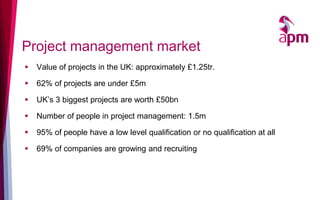
Project management market
 Value of projects in the UK: approximately £1.25tr.
 62% of projects are under £5m
 UK’s 3 biggest projects are worth £50bn
 Number of people in project management: 1.5m
 95% of people have a low level qualification or no qualification at all
 69% of companies are growing and recruiting
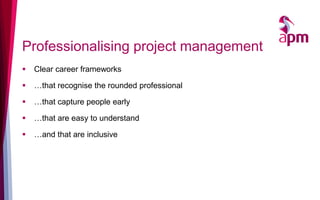
Professionalising project management
 Clear career frameworks
 …that recognise the rounded professional
 …that capture people early
 …that are easy to understand
 …and that are inclusive
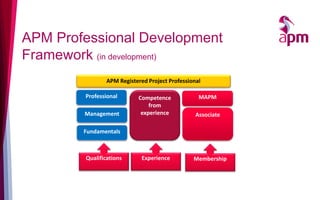
APM Professional Development
Framework (in development)
Fundamentals
Management
Professional MAPM
Associate
Competence
from
experience
APM Registered Project Professional
Qualifications MembershipExperience
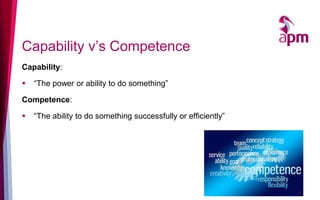
Capability v’s Competence
Capability:
 “The power or ability to do something”
Competence:
 “The ability to do something successfully or efficiently”
7
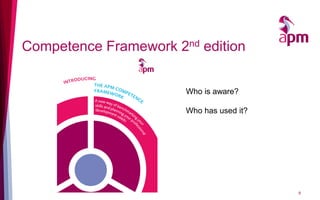
Competence Framework 2nd edition
8
Who is aware?
Who has used it?
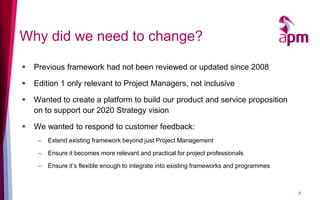
Why did we need to change?
 Previous framework had not been reviewed or updated since 2008
 Edition 1 only relevant to Project Managers, not inclusive
 Wanted to create a platform to build our product and service proposition
on to support our 2020 Strategy vision
 We wanted to respond to customer feedback:
– Extend existing framework beyond just Project Management
– Ensure it becomes more relevant and practical for project professionals
– Ensure it’s flexible enough to integrate into existing frameworks and programmes
9
What’s different?
 Streamlined and easier to use
– Number of competences reduced from 47 to 27
– Mapped new competence to old ones
 Addresses both application and knowledge of each competence
 Relevant for Project, Programme and Portfolio Managers and PMO roles
 14 new role profiles
 New ratings scale
 New complexity guidance
10
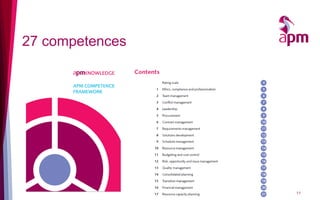
27 competences
11
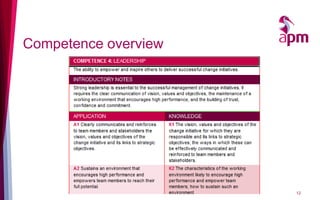
Competence overview
12
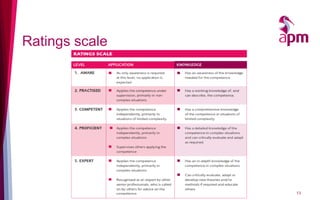
Ratings scale
13
How should you use it?
 Review the competences and decide which are relevant to your role
 Read the performance indicators for both application and knowledge
then score these holistically
 Ask someone else to validate your scores
 Measure yourself against a specific role profile
 Use the gaps highlighted to develop and build into your PDP and CPD
plan
14
Key benefits
 Role profiles give you the professional body view of competence and provide a
trusted benchmark
 Enables you to make (consistent) comparisons across your PM community
 Identifies the differences between professional body benchmark and actual skills
within your organisation
 Identify skills gaps and can be used to support professional development plans
 Facilitates movement between the four project professional disciplines
 Modern Framework that can be used as it is or integrated into an existing
framework
15
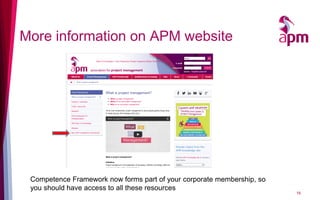
More information on APM website
Competence Framework now forms part of your corporate membership, so
you should have access to all these resources
16
In summary….
 It’s integral to and underpins everything we do at APM
– Basis of all of our new product development
 It enables organisations to assess their capacity and capabilities
across the breadth of their different functions
– Enables senior management teams to plan the skills development and
knowledge acquisition strategies in a common way for all delivery teams.
 It enables individual project professionals to assess the knowledge
and experiences that they have against the knowledge and
experience they require to progress their career
– Identifies the study pathway that will best suit their individual requirements.
17
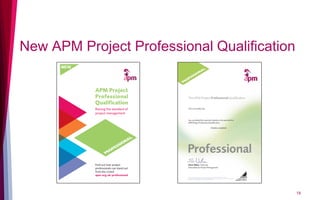
New APM Project Professional Qualification
18
Introduction to new PPQ qualification
 Launched on 21st April at the APM conference
 It’s a developmental qualification that sits on the route to RPP
– Natural progression from Project Management Qualification
 It’s not a direct replacement for the existing Practitioner Qualification,
but it sits in the same space
– The PQ is a retrospective assessment whereas the PPQ takes a
progressive/developmental approach
19
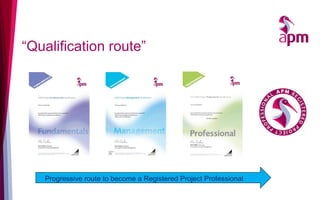
“Qualification route”
Progressive route to become a Registered Project Professional
Qualification overview
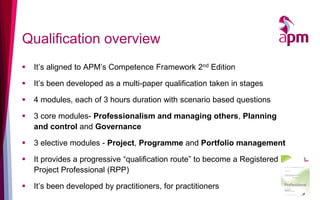
 It’s aligned to APM’s Competence Framework 2nd Edition
 It’s been developed as a multi-paper qualification taken in stages
 4 modules, each of 3 hours duration with scenario based questions
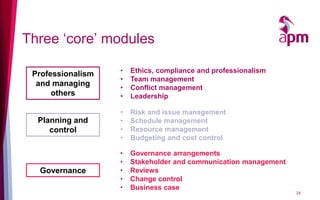
 3 core modules- Professionalism and managing others, Planning
and control and Governance
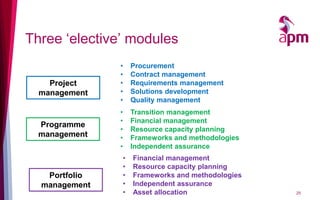
 3 elective modules - Project, Programme and Portfolio management
 It provides a progressive “qualification route” to become a Registered
Project Professional (RPP)
 It’s been developed by practitioners, for practitioners
21
Who should consider this qualification?
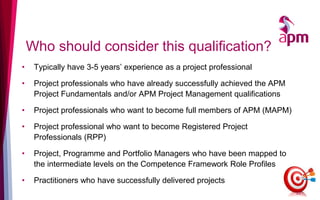
• Typically have 3-5 years’ experience as a project professional
• Project professionals who have already successfully achieved the APM
Project Fundamentals and/or APM Project Management qualifications
• Project professionals who want to become full members of APM (MAPM)
• Project professional who want to become Registered Project
Professionals (RPP)
• Project, Programme and Portfolio Managers who have been mapped to
the intermediate levels on the Competence Framework Role Profiles
• Practitioners who have successfully delivered projects
22
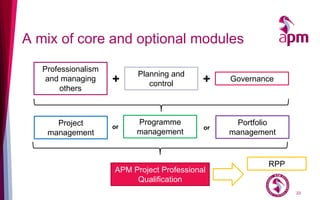
A mix of core and optional modules
Professionalism
and managing
others
Planning and
control
Governance+ +
Project
management
Programme
management
Portfolio
management
or or
APM Project Professional
Qualification
RPP
23
Three ‘core’ modules
Professionalism
and managing
others
Planning and
control
Governance
• Ethics, compliance and professionalism
• Team management
• Conflict management
• Leadership
• Risk and issue management
• Schedule management
• Resource management
• Budgeting and cost control
• Governance arrangements
• Stakeholder and communication management
• Reviews
• Change control
• Business case
24
Three ‘elective’ modules
Project
management
Programme
management
Portfolio
management
• Procurement
• Contract management
• Requirements management
• Solutions development
• Quality management
• Transition management
• Financial management
• Resource capacity planning
• Frameworks and methodologies
• Independent assurance
• Financial management
• Resource capacity planning
• Frameworks and methodologies
• Independent assurance
• Asset allocation 25
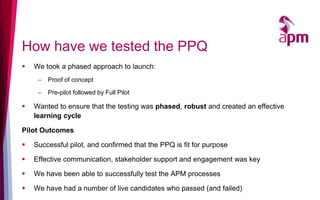
How have we tested the PPQ
 We took a phased approach to launch:
– Proof of concept
– Pre-pilot followed by Full Pilot
 Wanted to ensure that the testing was phased, robust and created an effective
learning cycle
Pilot Outcomes
 Successful pilot, and confirmed that the PPQ is fit for purpose
 Effective communication, stakeholder support and engagement was key
 We have been able to successfully test the APM processes
 We have had a number of live candidates who passed (and failed)
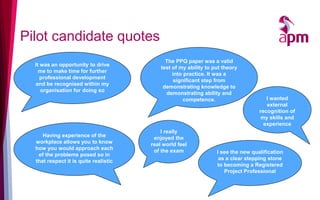
Pilot candidate quotes
It was an opportunity to drive
me to make time for further
professional development
and be recognised within my
organisation for doing so
Having experience of the
workplace allows you to know
how you would approach each
of the problems posed so in
that respect it is quite realistic
I see the new qualification
as a clear stepping stone
to becoming a Registered
Project Professional
I wanted
external
recognition of
my skills and
experience
I really
enjoyed the
real world feel
of the exam
The PPQ paper was a valid
test of my ability to put theory
into practice. It was a
significant step from
demonstrating knowledge to
demonstrating ability and
competence.
Benefits
 Relevant to all project professionals, making it more inclusive
 Enables organisations to develop the right skills for the right roles to
improve project success
 Enables organisations to demonstrate their commitment to developing
talent across their whole project community
 Provides individuals with structured personal development solutions
 Enables individuals to engage more effectively with peers and clients
 Increases individuals employability
28
And finally, what’s to come….?
 Qualifications campaign, to ensure the refreshed qualification
names are effectively communicated: planned for Q3/4 2016
 Launch of new website and CRM: Q3 2016
– Improved on-site search and discoverability
– Improved transactional activity
– New modern look and feel accessible across multiple devices and platforms
 Review of RPP
29
Questions
colin.mackenzie@apm.org.uk
30

Swwe presentation 100516

  • 1.
    Overview of APM CompetenceFramework 2nd edition and Project Professional Qualification APM South Wales and West of England Branch Meeting 10th May 2016 Colin MacKenzie 1
  • 2.
  • 3.
    What I’m goingto talk about  Overview of project landscape  Provide a high level overview of the APM Competence framework 2nd edition  Summarise the benefits it can provide to organisations and individuals  Give you an insight into our new Project Professional Qualification and how this is aligned to the competence framework  Questions 3
  • 4.
    Project management market Value of projects in the UK: approximately £1.25tr.  62% of projects are under £5m  UK’s 3 biggest projects are worth £50bn  Number of people in project management: 1.5m  95% of people have a low level qualification or no qualification at all  69% of companies are growing and recruiting
  • 5.
    Professionalising project management Clear career frameworks  …that recognise the rounded professional  …that capture people early  …that are easy to understand  …and that are inclusive
  • 6.
    APM Professional Development Framework(in development) Fundamentals Management Professional MAPM Associate Competence from experience APM Registered Project Professional Qualifications MembershipExperience
  • 7.
    Capability v’s Competence Capability: “The power or ability to do something” Competence:  “The ability to do something successfully or efficiently” 7
  • 8.
    Competence Framework 2ndedition 8 Who is aware? Who has used it?
  • 9.
    Why did weneed to change?  Previous framework had not been reviewed or updated since 2008  Edition 1 only relevant to Project Managers, not inclusive  Wanted to create a platform to build our product and service proposition on to support our 2020 Strategy vision  We wanted to respond to customer feedback: – Extend existing framework beyond just Project Management – Ensure it becomes more relevant and practical for project professionals – Ensure it’s flexible enough to integrate into existing frameworks and programmes 9
  • 10.
    What’s different?  Streamlinedand easier to use – Number of competences reduced from 47 to 27 – Mapped new competence to old ones  Addresses both application and knowledge of each competence  Relevant for Project, Programme and Portfolio Managers and PMO roles  14 new role profiles  New ratings scale  New complexity guidance 10
  • 11.
  • 12.
  • 13.
  • 14.
    How should youuse it?  Review the competences and decide which are relevant to your role  Read the performance indicators for both application and knowledge then score these holistically  Ask someone else to validate your scores  Measure yourself against a specific role profile  Use the gaps highlighted to develop and build into your PDP and CPD plan 14
  • 15.
    Key benefits  Roleprofiles give you the professional body view of competence and provide a trusted benchmark  Enables you to make (consistent) comparisons across your PM community  Identifies the differences between professional body benchmark and actual skills within your organisation  Identify skills gaps and can be used to support professional development plans  Facilitates movement between the four project professional disciplines  Modern Framework that can be used as it is or integrated into an existing framework 15
  • 16.
    More information onAPM website Competence Framework now forms part of your corporate membership, so you should have access to all these resources 16
  • 17.
    In summary….  It’sintegral to and underpins everything we do at APM – Basis of all of our new product development  It enables organisations to assess their capacity and capabilities across the breadth of their different functions – Enables senior management teams to plan the skills development and knowledge acquisition strategies in a common way for all delivery teams.  It enables individual project professionals to assess the knowledge and experiences that they have against the knowledge and experience they require to progress their career – Identifies the study pathway that will best suit their individual requirements. 17
  • 18.
    New APM ProjectProfessional Qualification 18
  • 19.
    Introduction to newPPQ qualification  Launched on 21st April at the APM conference  It’s a developmental qualification that sits on the route to RPP – Natural progression from Project Management Qualification  It’s not a direct replacement for the existing Practitioner Qualification, but it sits in the same space – The PQ is a retrospective assessment whereas the PPQ takes a progressive/developmental approach 19
  • 20.
    “Qualification route” Progressive routeto become a Registered Project Professional
  • 21.
    Qualification overview  It’saligned to APM’s Competence Framework 2nd Edition  It’s been developed as a multi-paper qualification taken in stages  4 modules, each of 3 hours duration with scenario based questions  3 core modules- Professionalism and managing others, Planning and control and Governance  3 elective modules - Project, Programme and Portfolio management  It provides a progressive “qualification route” to become a Registered Project Professional (RPP)  It’s been developed by practitioners, for practitioners 21
  • 22.
    Who should considerthis qualification? • Typically have 3-5 years’ experience as a project professional • Project professionals who have already successfully achieved the APM Project Fundamentals and/or APM Project Management qualifications • Project professionals who want to become full members of APM (MAPM) • Project professional who want to become Registered Project Professionals (RPP) • Project, Programme and Portfolio Managers who have been mapped to the intermediate levels on the Competence Framework Role Profiles • Practitioners who have successfully delivered projects 22
  • 23.
    A mix ofcore and optional modules Professionalism and managing others Planning and control Governance+ + Project management Programme management Portfolio management or or APM Project Professional Qualification RPP 23
  • 24.
    Three ‘core’ modules Professionalism andmanaging others Planning and control Governance • Ethics, compliance and professionalism • Team management • Conflict management • Leadership • Risk and issue management • Schedule management • Resource management • Budgeting and cost control • Governance arrangements • Stakeholder and communication management • Reviews • Change control • Business case 24
  • 25.
    Three ‘elective’ modules Project management Programme management Portfolio management •Procurement • Contract management • Requirements management • Solutions development • Quality management • Transition management • Financial management • Resource capacity planning • Frameworks and methodologies • Independent assurance • Financial management • Resource capacity planning • Frameworks and methodologies • Independent assurance • Asset allocation 25
  • 26.
    How have wetested the PPQ  We took a phased approach to launch: – Proof of concept – Pre-pilot followed by Full Pilot  Wanted to ensure that the testing was phased, robust and created an effective learning cycle Pilot Outcomes  Successful pilot, and confirmed that the PPQ is fit for purpose  Effective communication, stakeholder support and engagement was key  We have been able to successfully test the APM processes  We have had a number of live candidates who passed (and failed)
  • 27.
    Pilot candidate quotes Itwas an opportunity to drive me to make time for further professional development and be recognised within my organisation for doing so Having experience of the workplace allows you to know how you would approach each of the problems posed so in that respect it is quite realistic I see the new qualification as a clear stepping stone to becoming a Registered Project Professional I wanted external recognition of my skills and experience I really enjoyed the real world feel of the exam The PPQ paper was a valid test of my ability to put theory into practice. It was a significant step from demonstrating knowledge to demonstrating ability and competence.
  • 28.
    Benefits  Relevant toall project professionals, making it more inclusive  Enables organisations to develop the right skills for the right roles to improve project success  Enables organisations to demonstrate their commitment to developing talent across their whole project community  Provides individuals with structured personal development solutions  Enables individuals to engage more effectively with peers and clients  Increases individuals employability 28
  • 29.
    And finally, what’sto come….?  Qualifications campaign, to ensure the refreshed qualification names are effectively communicated: planned for Q3/4 2016  Launch of new website and CRM: Q3 2016 – Improved on-site search and discoverability – Improved transactional activity – New modern look and feel accessible across multiple devices and platforms  Review of RPP 29
  • 30.