Pathways to
become a
Chartered Project
Professional (ChPP)
Austin Witney
Agenda
1. What is Chartered and why is it so important
2. What it means for you and the profession
3. How it fits with APM Qualifications, Membership and RPP
(Registered Project Professional)
4. How to check if you are ready, what is being assessed and
what support is available
5. Routes to achieving Chartered Project Professional (ChPP)
6. Other Information and current statistics
7. Questions
 A professional benchmark that demonstrates attainment of
a defined level of technical knowledge, professional
practice and ethical behaviour
 Basis of assessment for applicants to obtain ChPP status
and join Register of ChPPs
What is the chartered standard?
Why is Chartered so important?
 Recognisable mark of standards for the profession
 Raise profile and value of PM as a first choice profession
 Develops a group of assured professionals to lead delivery
of projects
 Creation of a Register for Chartered Project Professionals
and raise the standard of project, programme and portfolio
delivery
 It will help address the shortage of qualified/assured
project professionals
Benefits: individuals
 Personal recognition from peers in project management and other
professions
 Enhanced CV to stand out from the crowd
 A framework for career development
 International recognition
 Assures clients of high standards and ethical practice
 Use of the post nominal ChPP & entry onto the ChPP Register
 Increased understanding, helping project professionals to work
more effectively
Benefits: for the profession and the
public
 Enhanced status of project management as a unique discipline
 Raised standards of practice & improved project outcomes
 Better public understanding and confidence in project
management
 Assurance and confidence for customers buying services
 Opening the door to collaboration with other professions
Where chartered fits in the APM picture
Typical years of
experience
APM Qualifications/Standards APM Membership Grades
7+ years RPP|ChPP
Fellow (FAPM)
Full (MAPM)
5-7 years APM PPQ
2-4 years APM PMQ
Associate/
Student
0-2 years APM PFQ
How to check if you are ready for
chartered
 You are professionally active with a proven track record of delivering projects,
programmes, portfolios or a key control or enabling function.
 These projects, programmes or portfolios exhibit characteristics of complexity.
 You have the required breadth of project experience to meet the requirements
of ten mandatory and two elective competences.
 You have an advanced technical knowledge and are able to confidently evaluate
and analyse theory of current practices and methods.
 You are committed to continuing professional development and an ethical way
of working.
What is being assessed?
Technical knowledge
Advanced technical knowledge and understanding of how to deliver
projects, programmes or portfolios, taking into account many
interacting factors and different approaches that could be taken.
What is being assessed?
Professional practice
Application of technical knowledge to deliver projects, programmes
or portfolios that involved:
 Uncertainty or conflicting objectives
 High levels of unpredictability or risk
 Multiple work packages, projects or programmes
 Multiple interdependent stakeholders, possibly with competing
interests.
What is being assessed?
CPD and Ethics
Applications must commit to professional ethics and show continued
professional development (CPD) – min 35 hours in the preceding 12
months (uphold 35+ hrs each year)
ChPP – What's available & guidance
 The ChPP standard
– Eligibility criteria
– Routes of entry
– Mandatory and Options Competences
 Application Guidance
– Understand what being chartered means for you
– Decide if becoming chartered is right for you now or
at a later date
– Prepare your application
 FAQ and online Clinics
https://www.apm.org.uk/chartered-standard/
Routes to Chartership
Route 1 : for those who have a recognised
assessment for technical knowledge. (£710 split £390 +
£320*)
Route 2: for those who have a recognised assessment
for technical knowledge and professional practice. (£245*)
Route 3: an experiential route for those who do not
have a recognised assessment but do meet the eligibility
criteria. (£1110 split £610 + £500*)
* Prices exclude VAT
Recognised assessments
 A recognised assessment is awarded to an organisation
who can show a particular development programme or
qualification meets either the technical knowledge or
the technical knowledge and professional practice
criteria
 The list will grow as providers apply to have their courses
and qualifications recognised
 We expect over time a growing number of Corporates
also will join the list as they gain recognition or align
their internal development programmes
Route 1
For those who have a recognised assessment for technical knowledge
STAGE ONE – WRITTEN SUBMISSION
Assessment of technical knowledge is via the recognised
assessment that is held.
Assessment of professional practice is via written submission
and interview.
Declaration of up-to-date CPD.
STAGE TWO - INTERVIEW
Up to one hour face-to-face interview to cover:
 Professional practice: validates written submission.
 Ethics.
Route 2
For those who have a recognised assessment for technical knowledge and
professional practice
STAGE ONE – WRITTEN SUBMISSION
Assessment of technical knowledge is via the recognised
assessment that is held.
Assessment of professional practice is via the recognised
assessment that is held.
Upload of CPD logo to declare 35 hours.
STAGE TWO - INTERVIEW
Up to 30 minute phone interview to cover:
 CPD: discussion of competence related to CPD.
 Ethics.
Route 3
An experiential route for those who do not have a recognised assessment but do
meet the eligibility criteria
STAGE ONE – WRITTEN SUBMISSION
Assessment of technical knowledge is via an extended
interview.
Assessment of professional practice is via written submission
and interview.
Declaration of up-to-date CPD.
STAGE TWO - INTERVIEW
Up to two hour face-to-face interview to cover:
 Professional practice: validates written submission.
 Technical knowledge: questioning to assess breadth of
knowledge.
 Ethics.
How to become chartered: the process
 Read the guidance notes carefully before you start
 Complete and submit the online application
 Written submission assessed
 Interview booked
 Outcome of the assessment goes before a panel
 Notice of award issued and name added to the
Chartered Register
ChPP - Setting the Standard
 892 CHPPs on the Register since commencement in May 2018
 1199 applications to date (10/10/19)
 1838 applications started but not yet submitted (10/10/19)
 Youngest 26, oldest 71
 43 International
 Male/Female: 85%/15%
 Maintaining rigour of assessment
 Audit of CPD
 Over 5,000 PM apprenticeships and 100 degree level apprenticeships
ChPP - Setting the Standard
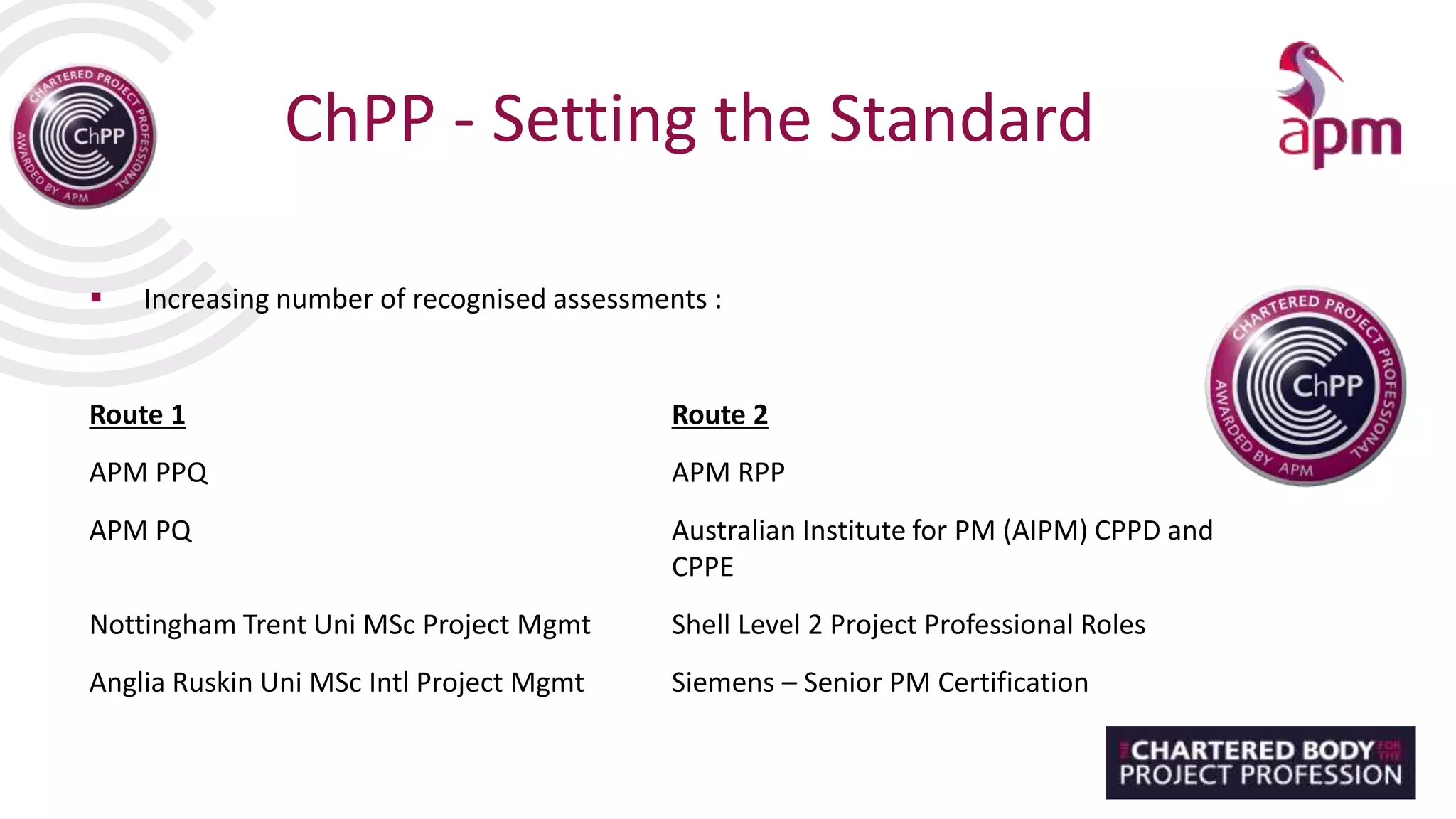
 Increasing number of recognised assessments :
Route 1 Route 2
APM PPQ APM RPP
APM PQ Australian Institute for PM (AIPM) CPPD and
CPPE
Nottingham Trent Uni MSc Project Mgmt Shell Level 2 Project Professional Roles
Anglia Ruskin Uni MSc Intl Project Mgmt Siemens – Senior PM Certification
Submission and results dates 2019
*Successful applicants notified via email from the chartered team and will be added to the
public register on the APM website if they have opted to do so.
Submission Date Result Date
4th October 2019 4th December 2019
13th December 2019 4th March 2020
10th January 2020 25th March 2020
6th March 2020 27th May 2020
29th May 2020 5th August 2020
Alex Garrard ChPP
23© PA Knowledge Limited | PA Confidential – Internal use only
Chartered programme leader working for PA
Consulting. I work mainly in the defence sector. I
help clients to lead, define and deliver complex IT
programmes and business transformations.
Over the last five years I have worked as:
• Operational Service Management programme
manager for the Ministry of Defence’s (MOD)
internal IT provider
• Rotary sub-portfolio assurer for the MOD’s
Army Headquarters
• Cyber programme manager for a defence
manufacturer
• Engineering sub-PgMO lead in the Home Office
Hello, I am a…
All about I & my;
never we & our
24© PA Knowledge Limited | PA Confidential – Internal use only
• My company paid…
• I went through the process as part of a team
• I had support from an external training organisation (helpful but not
essential)
• I followed the simple and clear guidance provided by the APM
• I took it seriously and spread the work out over time
• One day to prepare the portfolio (10 hrs)
• One day to prepare for and attend the interview (10 hrs excl. travel)
• I took a structured approach
My experience of Route 3 Work with a
buddy
Think GCSE
answers
25© PA Knowledge Limited | PA Confidential – Internal use only
• Step 1: I mapped my last 5 years worth of experience against:
• the levels of complexity
• uncertain or conflicting objectives
• high levels of uncertainty or risk
• multiple work packages, projects or programmes
• multiple interdependent stakeholders
• the competences
• Step 2: I identified one [project] overview that covered the:
• 10 mandatory competences
• 2 elective competencies
It was not hard to build my portfolio (1/2)
Don’t
overcomplicate it
26© PA Knowledge Limited | PA Confidential – Internal use only
• Step 3: I wrote my 500 word [project] overview using the STAR method.
This included stating
• my role
• the dates of the work
• the levels of complexity
• Step 4: Using the STAR method, relating to the relevant [project] overview
and including at least 5 of the professional practice competence criteria,
write your 12 x 250 word competence statements
• Step 5: Check your work, search for and replace ‘we’ (and similar terms)
then cut the word-count
It was not hard to build my portfolio (2/2)
The APM count
words differently
27© PA Knowledge Limited | PA Confidential – Internal use only
1. In introduced myself – a chance to build rapport
2. I answered a series of questions based on the competences in
my portfolio assessed against both sets of competence
criteria:
• Half of each question focused on my portfolio using the
professional practice criteria
• The other half tested my understanding of the competence
using the technical knowledge criteria
3. I answered an ethics question
4. I told them about my work outside my portfolio
I had been doing the job for over five years… the
interview was more fun than taxing
I learned about my
interviewers using
LinkedIn
28© PA Knowledge Limited | PA Confidential – Internal use only
• I reviewed my portfolio – I knew what I wrote
• I discussed EVM in my portfolio – I rehearsed the formulas
• I mapped my knowledge against my 12 technical knowledge
competences and then filled in the blanks
• APM BoK
• Google
• YouTube
• (PA Academy and PA IMP service Operating guides)
• I understood the APM Code of Professional Conduct
I focused on gaps in my knowledge when preparing for
my interview
I treated it like an
interview and
prepared
29© PA Knowledge Limited | PA Confidential – Internal use only
It has improved my network
• I am speaking here today
• I am supporting my clients in their route 3 ChPP
• I am being introduced to potential clients thinking about ChPP
It has strengthened my brand (CV)
• It silenced the competition within my client
• It helped with a promotion – the qualification rounded out my
promotion case
• It elevated me in the eyes of my peers
How becoming a Chartered Project Professional has
helped me

Pathways to become a Chartered Project Professional

  • 1.
    Pathways to become a CharteredProject Professional (ChPP) Austin Witney
  • 2.
    Agenda 1. What isChartered and why is it so important 2. What it means for you and the profession 3. How it fits with APM Qualifications, Membership and RPP (Registered Project Professional) 4. How to check if you are ready, what is being assessed and what support is available 5. Routes to achieving Chartered Project Professional (ChPP) 6. Other Information and current statistics 7. Questions
  • 3.
     A professionalbenchmark that demonstrates attainment of a defined level of technical knowledge, professional practice and ethical behaviour  Basis of assessment for applicants to obtain ChPP status and join Register of ChPPs What is the chartered standard?
  • 4.
    Why is Charteredso important?  Recognisable mark of standards for the profession  Raise profile and value of PM as a first choice profession  Develops a group of assured professionals to lead delivery of projects  Creation of a Register for Chartered Project Professionals and raise the standard of project, programme and portfolio delivery  It will help address the shortage of qualified/assured project professionals
  • 5.
    Benefits: individuals  Personalrecognition from peers in project management and other professions  Enhanced CV to stand out from the crowd  A framework for career development  International recognition  Assures clients of high standards and ethical practice  Use of the post nominal ChPP & entry onto the ChPP Register  Increased understanding, helping project professionals to work more effectively
  • 6.
    Benefits: for theprofession and the public  Enhanced status of project management as a unique discipline  Raised standards of practice & improved project outcomes  Better public understanding and confidence in project management  Assurance and confidence for customers buying services  Opening the door to collaboration with other professions
  • 7.
    Where chartered fitsin the APM picture Typical years of experience APM Qualifications/Standards APM Membership Grades 7+ years RPP|ChPP Fellow (FAPM) Full (MAPM) 5-7 years APM PPQ 2-4 years APM PMQ Associate/ Student 0-2 years APM PFQ
  • 8.
    How to checkif you are ready for chartered  You are professionally active with a proven track record of delivering projects, programmes, portfolios or a key control or enabling function.  These projects, programmes or portfolios exhibit characteristics of complexity.  You have the required breadth of project experience to meet the requirements of ten mandatory and two elective competences.  You have an advanced technical knowledge and are able to confidently evaluate and analyse theory of current practices and methods.  You are committed to continuing professional development and an ethical way of working.
  • 9.
    What is beingassessed? Technical knowledge Advanced technical knowledge and understanding of how to deliver projects, programmes or portfolios, taking into account many interacting factors and different approaches that could be taken.
  • 10.
    What is beingassessed? Professional practice Application of technical knowledge to deliver projects, programmes or portfolios that involved:  Uncertainty or conflicting objectives  High levels of unpredictability or risk  Multiple work packages, projects or programmes  Multiple interdependent stakeholders, possibly with competing interests.
  • 11.
    What is beingassessed? CPD and Ethics Applications must commit to professional ethics and show continued professional development (CPD) – min 35 hours in the preceding 12 months (uphold 35+ hrs each year)
  • 12.
    ChPP – What'savailable & guidance  The ChPP standard – Eligibility criteria – Routes of entry – Mandatory and Options Competences  Application Guidance – Understand what being chartered means for you – Decide if becoming chartered is right for you now or at a later date – Prepare your application  FAQ and online Clinics https://www.apm.org.uk/chartered-standard/
  • 13.
    Routes to Chartership Route1 : for those who have a recognised assessment for technical knowledge. (£710 split £390 + £320*) Route 2: for those who have a recognised assessment for technical knowledge and professional practice. (£245*) Route 3: an experiential route for those who do not have a recognised assessment but do meet the eligibility criteria. (£1110 split £610 + £500*) * Prices exclude VAT
  • 14.
    Recognised assessments  Arecognised assessment is awarded to an organisation who can show a particular development programme or qualification meets either the technical knowledge or the technical knowledge and professional practice criteria  The list will grow as providers apply to have their courses and qualifications recognised  We expect over time a growing number of Corporates also will join the list as they gain recognition or align their internal development programmes
  • 15.
    Route 1 For thosewho have a recognised assessment for technical knowledge STAGE ONE – WRITTEN SUBMISSION Assessment of technical knowledge is via the recognised assessment that is held. Assessment of professional practice is via written submission and interview. Declaration of up-to-date CPD. STAGE TWO - INTERVIEW Up to one hour face-to-face interview to cover:  Professional practice: validates written submission.  Ethics.
  • 16.
    Route 2 For thosewho have a recognised assessment for technical knowledge and professional practice STAGE ONE – WRITTEN SUBMISSION Assessment of technical knowledge is via the recognised assessment that is held. Assessment of professional practice is via the recognised assessment that is held. Upload of CPD logo to declare 35 hours. STAGE TWO - INTERVIEW Up to 30 minute phone interview to cover:  CPD: discussion of competence related to CPD.  Ethics.
  • 17.
    Route 3 An experientialroute for those who do not have a recognised assessment but do meet the eligibility criteria STAGE ONE – WRITTEN SUBMISSION Assessment of technical knowledge is via an extended interview. Assessment of professional practice is via written submission and interview. Declaration of up-to-date CPD. STAGE TWO - INTERVIEW Up to two hour face-to-face interview to cover:  Professional practice: validates written submission.  Technical knowledge: questioning to assess breadth of knowledge.  Ethics.
  • 18.
    How to becomechartered: the process  Read the guidance notes carefully before you start  Complete and submit the online application  Written submission assessed  Interview booked  Outcome of the assessment goes before a panel  Notice of award issued and name added to the Chartered Register
  • 19.
    ChPP - Settingthe Standard  892 CHPPs on the Register since commencement in May 2018  1199 applications to date (10/10/19)  1838 applications started but not yet submitted (10/10/19)  Youngest 26, oldest 71  43 International  Male/Female: 85%/15%  Maintaining rigour of assessment  Audit of CPD  Over 5,000 PM apprenticeships and 100 degree level apprenticeships
  • 20.
    ChPP - Settingthe Standard  Increasing number of recognised assessments : Route 1 Route 2 APM PPQ APM RPP APM PQ Australian Institute for PM (AIPM) CPPD and CPPE Nottingham Trent Uni MSc Project Mgmt Shell Level 2 Project Professional Roles Anglia Ruskin Uni MSc Intl Project Mgmt Siemens – Senior PM Certification
  • 21.
    Submission and resultsdates 2019 *Successful applicants notified via email from the chartered team and will be added to the public register on the APM website if they have opted to do so. Submission Date Result Date 4th October 2019 4th December 2019 13th December 2019 4th March 2020 10th January 2020 25th March 2020 6th March 2020 27th May 2020 29th May 2020 5th August 2020
  • 22.
  • 23.
    23© PA KnowledgeLimited | PA Confidential – Internal use only Chartered programme leader working for PA Consulting. I work mainly in the defence sector. I help clients to lead, define and deliver complex IT programmes and business transformations. Over the last five years I have worked as: • Operational Service Management programme manager for the Ministry of Defence’s (MOD) internal IT provider • Rotary sub-portfolio assurer for the MOD’s Army Headquarters • Cyber programme manager for a defence manufacturer • Engineering sub-PgMO lead in the Home Office Hello, I am a… All about I & my; never we & our
  • 24.
    24© PA KnowledgeLimited | PA Confidential – Internal use only • My company paid… • I went through the process as part of a team • I had support from an external training organisation (helpful but not essential) • I followed the simple and clear guidance provided by the APM • I took it seriously and spread the work out over time • One day to prepare the portfolio (10 hrs) • One day to prepare for and attend the interview (10 hrs excl. travel) • I took a structured approach My experience of Route 3 Work with a buddy Think GCSE answers
  • 25.
    25© PA KnowledgeLimited | PA Confidential – Internal use only • Step 1: I mapped my last 5 years worth of experience against: • the levels of complexity • uncertain or conflicting objectives • high levels of uncertainty or risk • multiple work packages, projects or programmes • multiple interdependent stakeholders • the competences • Step 2: I identified one [project] overview that covered the: • 10 mandatory competences • 2 elective competencies It was not hard to build my portfolio (1/2) Don’t overcomplicate it
  • 26.
    26© PA KnowledgeLimited | PA Confidential – Internal use only • Step 3: I wrote my 500 word [project] overview using the STAR method. This included stating • my role • the dates of the work • the levels of complexity • Step 4: Using the STAR method, relating to the relevant [project] overview and including at least 5 of the professional practice competence criteria, write your 12 x 250 word competence statements • Step 5: Check your work, search for and replace ‘we’ (and similar terms) then cut the word-count It was not hard to build my portfolio (2/2) The APM count words differently
  • 27.
    27© PA KnowledgeLimited | PA Confidential – Internal use only 1. In introduced myself – a chance to build rapport 2. I answered a series of questions based on the competences in my portfolio assessed against both sets of competence criteria: • Half of each question focused on my portfolio using the professional practice criteria • The other half tested my understanding of the competence using the technical knowledge criteria 3. I answered an ethics question 4. I told them about my work outside my portfolio I had been doing the job for over five years… the interview was more fun than taxing I learned about my interviewers using LinkedIn
  • 28.
    28© PA KnowledgeLimited | PA Confidential – Internal use only • I reviewed my portfolio – I knew what I wrote • I discussed EVM in my portfolio – I rehearsed the formulas • I mapped my knowledge against my 12 technical knowledge competences and then filled in the blanks • APM BoK • Google • YouTube • (PA Academy and PA IMP service Operating guides) • I understood the APM Code of Professional Conduct I focused on gaps in my knowledge when preparing for my interview I treated it like an interview and prepared
  • 29.
    29© PA KnowledgeLimited | PA Confidential – Internal use only It has improved my network • I am speaking here today • I am supporting my clients in their route 3 ChPP • I am being introduced to potential clients thinking about ChPP It has strengthened my brand (CV) • It silenced the competition within my client • It helped with a promotion – the qualification rounded out my promotion case • It elevated me in the eyes of my peers How becoming a Chartered Project Professional has helped me

Editor's Notes

  • #6 Speaker notes Remind audience that where they “project manager” this includes programme and portfolio management plus support and enabling functions such as PMO.
  • #8  Membership Under the requirements of the Royal Charter applying for chartered status is open to all project professionals. The Chartered Project Professional (ChPP) standard has different requirements from membership of APM so there is no direct link. Being a member of APM holds significant value in itself. It offers opportunities to attend our knowledge and networking events, become a part of our extensive volunteer community and access member-only resources. Membership also provides access to CPD opportunities which will help to support fulfilment of CPD requirements for maintaining ChPP. You might also wish to consider becoming a Fellow of APM which offer recognition by your peers of a significant contribution to the development of the art and science of project management. APM Fellows are entitled to use the post-nominals (FAPM). RPP If you already hold the RPP standard you may be eligible for the Route 2 option for applying for the chartered standard. This process for APM Registered Project Professionals is very straightforward.  As an RPP you are deemed to have already demonstrated your technical knowledge and professional practice so the chartered process simply asks for evidence of CPD and commitment to ethical and professional behaviour, plus validation of the application through a 30 minute phone interview. We hope that RPPs will be keen to become ChPP in line with the process which is compliant with APM’s Royal Charter. Fellowship Fellowship provides recognition for senior individuals who have made a significant contribution to the profession. Fellows can make use of the highly regarded FAPM post-nominals and gain access to APM’s network of other influential figures in the profession. ChPP is aimed at a broader range of candidates, including those early in their career as a project professional, and focuses on effective practice, i.e. delivery of projects, programmes or portfolios.
  • #10 Technical knowledge can be thought about as theory
  • #11 Professional practice can be thought about as experience.
  • #19 Advise that a hard copy form is also available Also, they will need two proposers who may be contacted by APM
  • #20 Charter just over 1 year – thank you to all who have helped make it such a successful first year What have we learnt? Employers and government are fully embracing the standard Nature of those applying already changing 20% failure rate – seems about right – checking guidance, support or just – support service make sure really know what they say they know More women need to be encouraged to apply – falling not increasing Age and sector diversification is good Rigour and standardization is critical - assessors to ensure this Maintain the value of the standard expectation and audit of CPD need to be thorough and rigorous Recognised assessments include first MsC Project Management for Nottingham Trent uni for route 1 Route 2 includes the AIPM and Shell internal scheme with more employers potentially looking into this. Now Siemens
  • #21 Charter just over 1 year – thank you to all who have helped make it such a successful first year What have we learnt? Employers and government are fully embracing the standard Nature of those applying already changing 20% failure rate – seems about right – checking guidance, support or just – support service make sure really know what they say they know More women need to be encouraged to apply – falling not increasing Age and sector diversification is good Rigour and standardization is critical - assessors to ensure this Maintain the value of the standard expectation and audit of CPD need to be thorough and rigorous Recognised assessments include first MsC Project Management for Nottingham Trent uni for route 1 Route 2 includes the AIPM and Shell internal scheme with more employers potentially looking into this. Now Siemens
  • #26  (uncertain or conflicting objectives, high levels of uncertainty or risk, multiple work packages, projects or programmes, multiple interdependent stakeholders)
  • #27  (uncertain or conflicting objectives, high levels of uncertainty or risk, multiple work packages, projects or programmes, multiple interdependent stakeholders)