SWON Alliance
Cross council AMR collaborative
SWON: Multi-institutional
Multi-disciplinary team
• Sheffield, Southampton, Warwick, Oxford, Newcastle
• Complementary aspects of biochemistry, genetics,
physiology and molecular modeling in the area of PG
metabolism, structure and architecture, plus
innovative lead molecules from Oxford
• Working with industry
Target organisms
• E. coli; resistance to penicillin by the acquisition of β-
lactamases and changes to membrane permeability/
efflux.
• S. aureus; resistance to methicillin by the acquisition of
the low affinity PBP2A.
• S. pneumoniae; penicillin resistance through horizontal
gene transfer to develop low affinity forms of PBPs 1A,
2X and 2B.
Objectives
1. Determine the fundamental mechanism of
peptidoglycan assembly
2. Determine how PBP activity is controlled at the
molecular and cellular level.
3. Determine how β-lactams impact upon the cell wall
biosynthesis machinery and discover non-lactam inhibitors
to underpin new chemotherapeutic regimes targeting
PBPs.
Technologies
• Sheffield – super high resolution imaging
• Southampton – molecular modeling
• Warwick – reagent synthesis for assay
development (research and industry),
fundamental biochemistry, structural biology
• Oxford – chemical synthesis, assay development
• Newcastle – molecular microbiology,
biochemistry (protein protein interactions in vivo
and in vitro), structural biology
1.1. How do PBPs interact with their substrates?
• This question has been unanswered for the past 70
years because of the lack of a quantitative assay for
TP activity.
1.2. How are TG and TP activities co-ordinated?
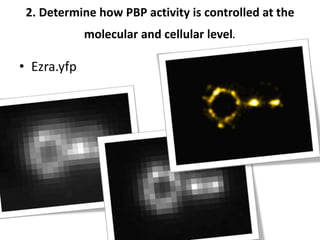
2. Determine how PBP activity is controlled at the
molecular and cellular level.
• Ezra.yfp
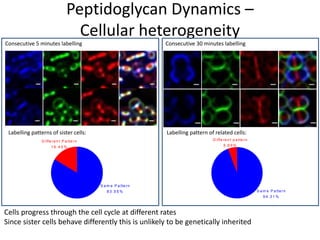
Peptidoglycan Dynamics –
Cellular heterogeneity
Consecutive 5 minutes labelling
Labelling patterns of sister cells: Labelling pattern of related cells:
Consecutive 30 minutes labelling
Cells progress through the cell cycle at different rates
Since sister cells behave differently this is unlikely to be genetically inherited
T o ta l= 2 3 1
D iffe re n t P a tte rn
1 6 .4 5 %
S a m e P a tte rn
8 3 .5 5 %
T o ta l= 7 2 0
D iffe re n t p a tte rn
5 .6 9 %
S a m e P a tte rn
9 4 .3 1 %
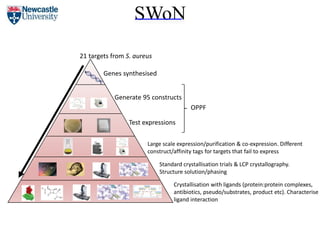
SWoN
21 targets from S. aureus
Generate 95 constructs
Genes synthesised
Test expressions
OPPF
Large scale expression/purification & co-expression. Different
construct/affinity tags for targets that fail to express
Standard crystallisation trials & LCP crystallography.
Structure solution/phasing
Crystallisation with ligands (protein:protein complexes,
antibiotics, pseudo/substrates, product etc). Characterise
ligand interaction
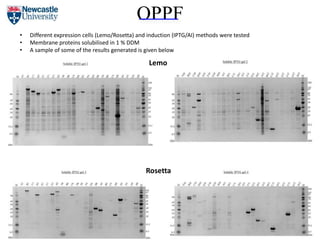
OPPF
Lemo
Rosetta
• Different expression cells (Lemo/Rosetta) and induction (IPTG/AI) methods were tested
• Membrane proteins solubilised in 1 % DDM
• A sample of some of the results generated is given below
3. Investigating new ways of inhibiting PBPs and b-lactamases
-HTS for MBLs and SBLs, PBPs
-Crystallography (VIM-2, IMP-1, BcII, SPM-1, NDM-1,-4-5;
PBP-3...)
-NMR, SPR new binding assays
-MS, Tm shift, CD, SF, etc
-Counter screen ...
PBPs: PBP-2a, -3, -4, -5, -6
SBLs: TEM-1, AmpC, CTX-10, CTX-15, etc.
MBLs: (B1) VIM-1, VIM-2, SPM-1, IMP-1, BcII, NDM-1 to -8;
(B2) CphA, Imi-S;
(B3) Fez-1, L-1, AIM-1, etc...
-Several human metallo-enzymes, including human-metallo-
β-lactamases (e.g. SNM1A and B, ETHE1, etc.)
N
O
O
HO2C
MeCOHN
O O
Lactivicn
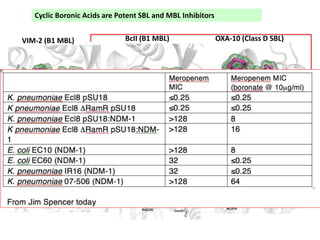
VIM-2 (B1 MBL) BcII (B1 MBL) OXA-10 (Class D SBL)
Cyclic Boronic Acids are Potent SBL and MBL Inhibitors

SWON Alliance Cross Council AMR Collaborative

  • 1.
    SWON Alliance Cross councilAMR collaborative
  • 2.
    SWON: Multi-institutional Multi-disciplinary team •Sheffield, Southampton, Warwick, Oxford, Newcastle • Complementary aspects of biochemistry, genetics, physiology and molecular modeling in the area of PG metabolism, structure and architecture, plus innovative lead molecules from Oxford • Working with industry
  • 3.
    Target organisms • E.coli; resistance to penicillin by the acquisition of β- lactamases and changes to membrane permeability/ efflux. • S. aureus; resistance to methicillin by the acquisition of the low affinity PBP2A. • S. pneumoniae; penicillin resistance through horizontal gene transfer to develop low affinity forms of PBPs 1A, 2X and 2B.
  • 4.
    Objectives 1. Determine thefundamental mechanism of peptidoglycan assembly 2. Determine how PBP activity is controlled at the molecular and cellular level. 3. Determine how β-lactams impact upon the cell wall biosynthesis machinery and discover non-lactam inhibitors to underpin new chemotherapeutic regimes targeting PBPs.
  • 5.
    Technologies • Sheffield –super high resolution imaging • Southampton – molecular modeling • Warwick – reagent synthesis for assay development (research and industry), fundamental biochemistry, structural biology • Oxford – chemical synthesis, assay development • Newcastle – molecular microbiology, biochemistry (protein protein interactions in vivo and in vitro), structural biology
  • 6.
    1.1. How doPBPs interact with their substrates? • This question has been unanswered for the past 70 years because of the lack of a quantitative assay for TP activity. 1.2. How are TG and TP activities co-ordinated?
  • 7.
    2. Determine howPBP activity is controlled at the molecular and cellular level. • Ezra.yfp
  • 8.
    Peptidoglycan Dynamics – Cellularheterogeneity Consecutive 5 minutes labelling Labelling patterns of sister cells: Labelling pattern of related cells: Consecutive 30 minutes labelling Cells progress through the cell cycle at different rates Since sister cells behave differently this is unlikely to be genetically inherited T o ta l= 2 3 1 D iffe re n t P a tte rn 1 6 .4 5 % S a m e P a tte rn 8 3 .5 5 % T o ta l= 7 2 0 D iffe re n t p a tte rn 5 .6 9 % S a m e P a tte rn 9 4 .3 1 %
  • 9.
    SWoN 21 targets fromS. aureus Generate 95 constructs Genes synthesised Test expressions OPPF Large scale expression/purification & co-expression. Different construct/affinity tags for targets that fail to express Standard crystallisation trials & LCP crystallography. Structure solution/phasing Crystallisation with ligands (protein:protein complexes, antibiotics, pseudo/substrates, product etc). Characterise ligand interaction
  • 10.
    OPPF Lemo Rosetta • Different expressioncells (Lemo/Rosetta) and induction (IPTG/AI) methods were tested • Membrane proteins solubilised in 1 % DDM • A sample of some of the results generated is given below
  • 11.
    3. Investigating newways of inhibiting PBPs and b-lactamases -HTS for MBLs and SBLs, PBPs -Crystallography (VIM-2, IMP-1, BcII, SPM-1, NDM-1,-4-5; PBP-3...) -NMR, SPR new binding assays -MS, Tm shift, CD, SF, etc -Counter screen ... PBPs: PBP-2a, -3, -4, -5, -6 SBLs: TEM-1, AmpC, CTX-10, CTX-15, etc. MBLs: (B1) VIM-1, VIM-2, SPM-1, IMP-1, BcII, NDM-1 to -8; (B2) CphA, Imi-S; (B3) Fez-1, L-1, AIM-1, etc... -Several human metallo-enzymes, including human-metallo- β-lactamases (e.g. SNM1A and B, ETHE1, etc.) N O O HO2C MeCOHN O O Lactivicn
  • 12.
    VIM-2 (B1 MBL)BcII (B1 MBL) OXA-10 (Class D SBL) Cyclic Boronic Acids are Potent SBL and MBL Inhibitors