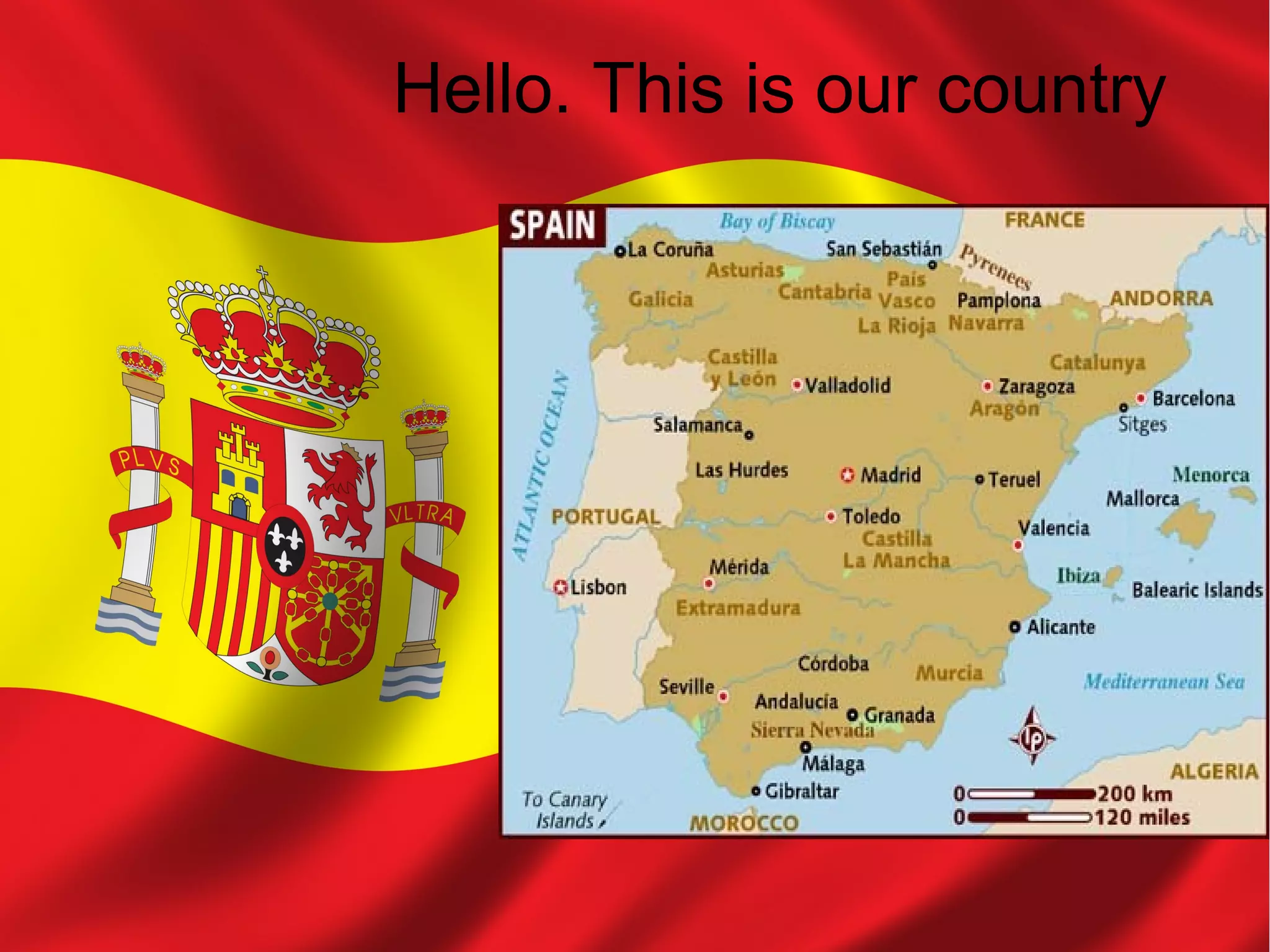
Hello. This is our country
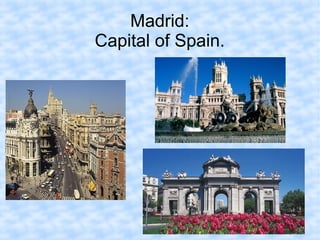
Madrid:
Capital of Spain.
The history of Madrid (Spain) is marked by the
establishment there of the royal court (June 1561)
and the consolidation of the country, with the
capital Madrid this.
However, before this the area of the present town
was already populated with the establishment of
more or less relevant communities. The
emergence of Madrid in history dating from the
ninth century, a century in which the Emir
Mohamed I (852-886) raises a fortress on the site
currently occupied by the Royal Palace.
Other important cities
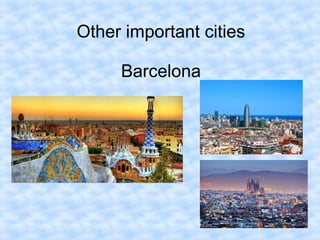
Barcelona
Barcelona's history spans over 4,000 years, from the late Neolithic, with the first
remains found in the territory of the city until today.
The substrate of its inhabitants brings together the Iberian peoples (layetanos),
Carthaginians, Romans, Jews, Visigoths, Muslims and Christians.
Although the remains of Iberian and Carthaginian settlements, the real birth of
the city took place in Roman times, whose first splendor will evolve to become
one of the main ports of the western Mediterranean, in the Middle Ages reaching
primacy over the other Catalan counties and becoming one of the most
important cities of the Crown of Aragon.
After the union of Castile and Aragon Barcelona it has always enjoyed a position
of great importance in the political, social and economic development of Spain.
Today, events like the Olympic Games 1992 and the Universal Forum of
Cultures Barcelona have placed as a globally recognized and praised city,
important tourist and cultural center as well as a financial center and renowned
congreses.
Valencia
The History of the City of Valencia extends from the time before the formal foundation of
the city when the region was inhabited by Roman peoples until today.
Thanks to the fertile lands on which it is based, around Valencia (Spain) were already an
area of high human density before its founding in the second century BC by the Romans.
Since then, the city has become one of the largest towns in the Iberian Peninsula
Sevilla
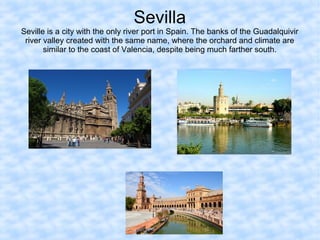
Seville is a city with the only river port in Spain. The banks of the Guadalquivir
river valley created with the same name, where the orchard and climate are
similar to the coast of Valencia, despite being much farther south.
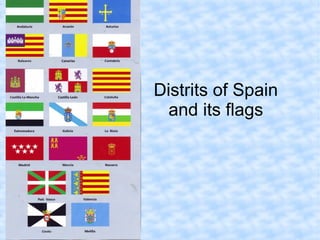
Distrits of Spain
and its flags
Languajes, flags and distrits
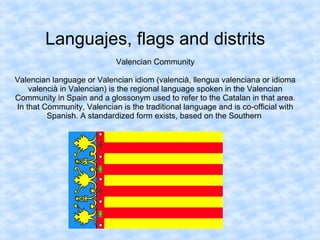
Valencian Community
Valencian language or Valencian idiom (valencià, llengua valenciana or idioma
valencià in Valencian) is the regional language spoken in the Valencian
Community in Spain and a glossonym used to refer to the Catalan in that area.
In that Community, Valencian is the traditional language and is co-official with
Spanish. A standardized form exists, based on the Southern
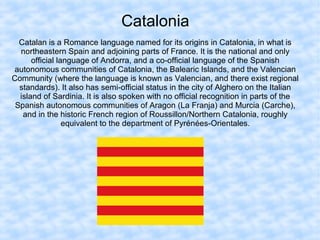
Catalonia
Catalan is a Romance language named for its origins in Catalonia, in what is
northeastern Spain and adjoining parts of France. It is the national and only
official language of Andorra, and a co-official language of the Spanish
autonomous communities of Catalonia, the Balearic Islands, and the Valencian
Community (where the language is known as Valencian, and there exist regional
standards). It also has semi-official status in the city of Alghero on the Italian
island of Sardinia. It is also spoken with no official recognition in parts of the
Spanish autonomous communities of Aragon (La Franja) and Murcia (Carche),
and in the historic French region of Roussillon/Northern Catalonia, roughly
equivalent to the department of Pyrénées-Orientales.
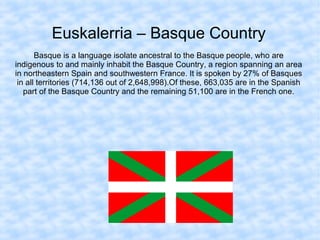
Euskalerria – Basque Country
Basque is a language isolate ancestral to the Basque people, who are
indigenous to and mainly inhabit the Basque Country, a region spanning an area
in northeastern Spain and southwestern France. It is spoken by 27% of Basques
in all territories (714,136 out of 2,648,998).Of these, 663,035 are in the Spanish
part of the Basque Country and the remaining 51,100 are in the French one.
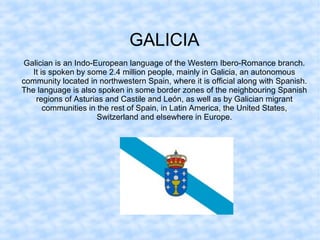
GALICIA
Galician is an Indo-European language of the Western Ibero-Romance branch.
It is spoken by some 2.4 million people, mainly in Galicia, an autonomous
community located in northwestern Spain, where it is official along with Spanish.
The language is also spoken in some border zones of the neighbouring Spanish
regions of Asturias and Castile and León, as well as by Galician migrant
communities in the rest of Spain, in Latin America, the United States,
Switzerland and elsewhere in Europe.
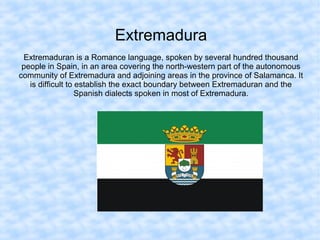
Extremadura
Extremaduran is a Romance language, spoken by several hundred thousand
people in Spain, in an area covering the north-western part of the autonomous
community of Extremadura and adjoining areas in the province of Salamanca. It
is difficult to establish the exact boundary between Extremaduran and the
Spanish dialects spoken in most of Extremadura.
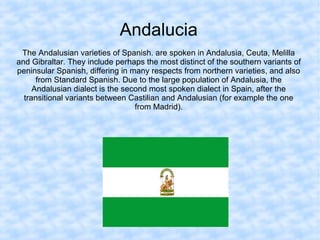
Andalucia
The Andalusian varieties of Spanish. are spoken in Andalusia, Ceuta, Melilla
and Gibraltar. They include perhaps the most distinct of the southern variants of
peninsular Spanish, differing in many respects from northern varieties, and also
from Standard Spanish. Due to the large population of Andalusia, the
Andalusian dialect is the second most spoken dialect in Spain, after the
transitional variants between Castilian and Andalusian (for example the one
from Madrid).
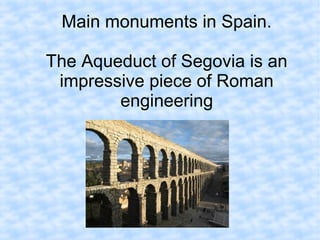
Main monuments in Spain.
The Aqueduct of Segovia is an
impressive piece of Roman
engineering
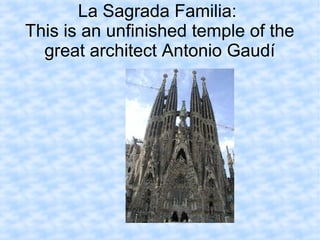
La Sagrada Familia:
This is an unfinished temple of the
great architect Antonio Gaudí
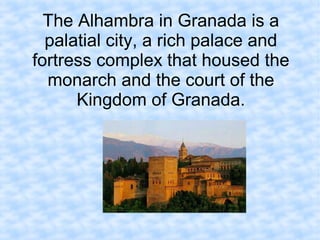
The Alhambra in Granada is a
palatial city, a rich palace and
fortress complex that housed the
monarch and the court of the
Kingdom of Granada.
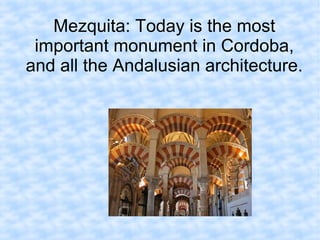
Mezquita: Today is the most
important monument in Cordoba,
and all the Andalusian architecture.
Significant People
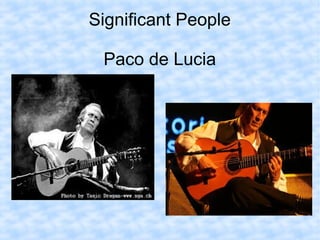
Paco de Lucia
Paco de Lucia: Full name: Francisco Sanchez Gomez
Born : December 21, 1947 and Death: February 25, 2014
Paco de Lucia, was a Spanish composer and guitarist flamenco. Younger
brother Dynasty "The Lucy" , with Ramón de Algeciras and Pepe de Lucía ,
received like these hand musical education from his father Antonio Sánchez
Pecino guitarist too. In a family atmosphere
World flamenco , Paco de Lucia soon made contact with some of the major
figures of flamenco , one of his main influences Niño Ricardo and Sabicas.
Following the disclosure of the Spanish flamenco in the International
Competition of Flamenco Art in Jerez de la Frontera , 1962 , I recorded his first
nightclubs with his brother Pepe As part of the set of Los Chiquitos de Algeciras.
In the following years he worked in touch with Fosforito and El Lebrijano singers
and since 1969 with Camaron de la Isla .
He received , among other awards , two Grammys Latinos albums good cositas
(2004) and Live Concerts Spain (2010 ), 9 the National Prize of Guitar Flamenco
Art , the Gold Medal for Merit in Fine Arts (1992 ) , beloved Son of the province
of Cádiz (1997 ) , Son of Algeciras (1998 ) , the Silver Medal of Andalusia, the
honorary distinction of Music Awards (2002 ) , Prince of Asturias Award for the
Arts ( 2004 ), Doctor Honoris Causa by the University of Cadiz (2009 ) and the
Berklee College of Music (2010)
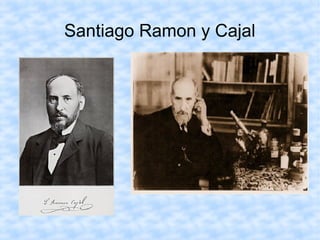
Santiago Ramon y Cajal
Birthdate: May 1, 1852
Death: October 17, 1934
Santiago Ramon y Cajal (Petilla of Aragon, Navarra, May 1, 1852-Madrid,
October 17, 1934) was a Spanish doctor, specializing in histology and
pathology. He shared the Nobel Prize in Medicine in 1906 for his research on
the mechanisms that govern the morphology and connective processes of nerve
cells, a revolutionary new theory that came to be called the "neuron doctrine"
based on the tissue cerebral comprises individual cells. Humanist, besides
scientist, is considered head of the Generation of Elders.
He studied medicine in Zaragoza, where all his family moved in 1870. Cajal
focused on his studies successfully and, after graduating in medicine in June
1873, at age 21, he was called up in the call Quinta de Castelar, conscription
ordered by the famous politician, the then president at the time of the short-lived
First Republic
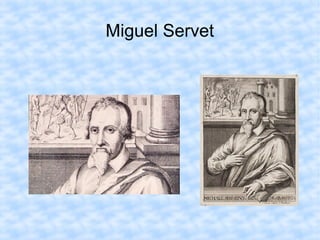
Miguel Servet
Full name: Miguel de Villanueva
Birthdate: September 29, 1509
Death: October 27, 1553
Miguel Servet, also called Miguel de Villanueva, Michel de Villeneuve or, in Latin,
Michael Servetus (his real name was Michael Servetus and Conesa, alias
"Reverse") (Villanueva of Sigena, Huesca, Aragón1 probably the September 29,
1509 or 15112 - Geneva, October 27, 1553) was a Spanish theologian and
scientist. His interests encompassed many sciences: astronomy, meteorology,
geography, law, theology, physics and the study of the Bible, mathematics,
anatomy and medicine. Much of his fame and subsequent recognition is due to
his work on the pulmonary circulation described in his Christianismi Restitutio.
He participated in the Protestant Reformation and developed a Christology
contrary to Trinidad. Repudiated by both Catholics and Protestants, he was
arrested in Geneva on trial and condemned to die at the stake by order of the
City Council and Reformed churches cantons when it dominated the influence of
John Calvin.
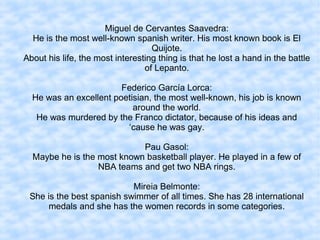
Miguel de Cervantes Saavedra:
He is the most well-known spanish writer. His most known book is El
Quijote.
About his life, the most interesting thing is that he lost a hand in the battle
of Lepanto.
Federico García Lorca:
He was an excellent poetisian, the most well-known, his job is known
around the world.
He was murdered by the Franco dictator, because of his ideas and
‘cause he was gay.
Pau Gasol:
Maybe he is the most known basketball player. He played in a few of
NBA teams and get two NBA rings.
Mireia Belmonte:
She is the best spanish swimmer of all times. She has 28 international
medals and she has the women records in some categories.
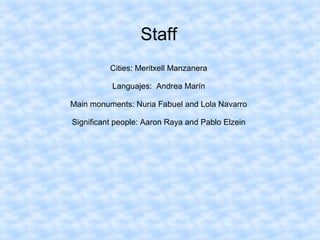
Staff
Cities: Meritxell Manzanera
Languajes: Andrea Marín
Main monuments: Nuria Fabuel and Lola Navarro
Significant people: Aaron Raya and Pablo Elzein

SPAIN: this is my country

  • 1.
    Hello. This isour country
  • 2.
  • 3.
    The history ofMadrid (Spain) is marked by the establishment there of the royal court (June 1561) and the consolidation of the country, with the capital Madrid this. However, before this the area of the present town was already populated with the establishment of more or less relevant communities. The emergence of Madrid in history dating from the ninth century, a century in which the Emir Mohamed I (852-886) raises a fortress on the site currently occupied by the Royal Palace.
  • 4.
  • 5.
    Barcelona's history spansover 4,000 years, from the late Neolithic, with the first remains found in the territory of the city until today. The substrate of its inhabitants brings together the Iberian peoples (layetanos), Carthaginians, Romans, Jews, Visigoths, Muslims and Christians. Although the remains of Iberian and Carthaginian settlements, the real birth of the city took place in Roman times, whose first splendor will evolve to become one of the main ports of the western Mediterranean, in the Middle Ages reaching primacy over the other Catalan counties and becoming one of the most important cities of the Crown of Aragon. After the union of Castile and Aragon Barcelona it has always enjoyed a position of great importance in the political, social and economic development of Spain. Today, events like the Olympic Games 1992 and the Universal Forum of Cultures Barcelona have placed as a globally recognized and praised city, important tourist and cultural center as well as a financial center and renowned congreses.
  • 6.
    Valencia The History ofthe City of Valencia extends from the time before the formal foundation of the city when the region was inhabited by Roman peoples until today. Thanks to the fertile lands on which it is based, around Valencia (Spain) were already an area of high human density before its founding in the second century BC by the Romans. Since then, the city has become one of the largest towns in the Iberian Peninsula
  • 7.
    Sevilla Seville is acity with the only river port in Spain. The banks of the Guadalquivir river valley created with the same name, where the orchard and climate are similar to the coast of Valencia, despite being much farther south.
  • 8.
  • 9.
    Languajes, flags anddistrits Valencian Community Valencian language or Valencian idiom (valencià, llengua valenciana or idioma valencià in Valencian) is the regional language spoken in the Valencian Community in Spain and a glossonym used to refer to the Catalan in that area. In that Community, Valencian is the traditional language and is co-official with Spanish. A standardized form exists, based on the Southern
  • 10.
    Catalonia Catalan is aRomance language named for its origins in Catalonia, in what is northeastern Spain and adjoining parts of France. It is the national and only official language of Andorra, and a co-official language of the Spanish autonomous communities of Catalonia, the Balearic Islands, and the Valencian Community (where the language is known as Valencian, and there exist regional standards). It also has semi-official status in the city of Alghero on the Italian island of Sardinia. It is also spoken with no official recognition in parts of the Spanish autonomous communities of Aragon (La Franja) and Murcia (Carche), and in the historic French region of Roussillon/Northern Catalonia, roughly equivalent to the department of Pyrénées-Orientales.
  • 11.
    Euskalerria – BasqueCountry Basque is a language isolate ancestral to the Basque people, who are indigenous to and mainly inhabit the Basque Country, a region spanning an area in northeastern Spain and southwestern France. It is spoken by 27% of Basques in all territories (714,136 out of 2,648,998).Of these, 663,035 are in the Spanish part of the Basque Country and the remaining 51,100 are in the French one.
  • 12.
    GALICIA Galician is anIndo-European language of the Western Ibero-Romance branch. It is spoken by some 2.4 million people, mainly in Galicia, an autonomous community located in northwestern Spain, where it is official along with Spanish. The language is also spoken in some border zones of the neighbouring Spanish regions of Asturias and Castile and León, as well as by Galician migrant communities in the rest of Spain, in Latin America, the United States, Switzerland and elsewhere in Europe.
  • 13.
    Extremadura Extremaduran is aRomance language, spoken by several hundred thousand people in Spain, in an area covering the north-western part of the autonomous community of Extremadura and adjoining areas in the province of Salamanca. It is difficult to establish the exact boundary between Extremaduran and the Spanish dialects spoken in most of Extremadura.
  • 14.
    Andalucia The Andalusian varietiesof Spanish. are spoken in Andalusia, Ceuta, Melilla and Gibraltar. They include perhaps the most distinct of the southern variants of peninsular Spanish, differing in many respects from northern varieties, and also from Standard Spanish. Due to the large population of Andalusia, the Andalusian dialect is the second most spoken dialect in Spain, after the transitional variants between Castilian and Andalusian (for example the one from Madrid).
  • 15.
    Main monuments inSpain. The Aqueduct of Segovia is an impressive piece of Roman engineering
  • 16.
    La Sagrada Familia: Thisis an unfinished temple of the great architect Antonio Gaudí
  • 17.
    The Alhambra inGranada is a palatial city, a rich palace and fortress complex that housed the monarch and the court of the Kingdom of Granada.
  • 18.
    Mezquita: Today isthe most important monument in Cordoba, and all the Andalusian architecture.
  • 19.
  • 20.
    Paco de Lucia:Full name: Francisco Sanchez Gomez Born : December 21, 1947 and Death: February 25, 2014 Paco de Lucia, was a Spanish composer and guitarist flamenco. Younger brother Dynasty "The Lucy" , with Ramón de Algeciras and Pepe de Lucía , received like these hand musical education from his father Antonio Sánchez Pecino guitarist too. In a family atmosphere World flamenco , Paco de Lucia soon made contact with some of the major figures of flamenco , one of his main influences Niño Ricardo and Sabicas. Following the disclosure of the Spanish flamenco in the International Competition of Flamenco Art in Jerez de la Frontera , 1962 , I recorded his first nightclubs with his brother Pepe As part of the set of Los Chiquitos de Algeciras. In the following years he worked in touch with Fosforito and El Lebrijano singers and since 1969 with Camaron de la Isla . He received , among other awards , two Grammys Latinos albums good cositas (2004) and Live Concerts Spain (2010 ), 9 the National Prize of Guitar Flamenco Art , the Gold Medal for Merit in Fine Arts (1992 ) , beloved Son of the province of Cádiz (1997 ) , Son of Algeciras (1998 ) , the Silver Medal of Andalusia, the honorary distinction of Music Awards (2002 ) , Prince of Asturias Award for the Arts ( 2004 ), Doctor Honoris Causa by the University of Cadiz (2009 ) and the Berklee College of Music (2010)
  • 21.
  • 22.
    Birthdate: May 1,1852 Death: October 17, 1934 Santiago Ramon y Cajal (Petilla of Aragon, Navarra, May 1, 1852-Madrid, October 17, 1934) was a Spanish doctor, specializing in histology and pathology. He shared the Nobel Prize in Medicine in 1906 for his research on the mechanisms that govern the morphology and connective processes of nerve cells, a revolutionary new theory that came to be called the "neuron doctrine" based on the tissue cerebral comprises individual cells. Humanist, besides scientist, is considered head of the Generation of Elders. He studied medicine in Zaragoza, where all his family moved in 1870. Cajal focused on his studies successfully and, after graduating in medicine in June 1873, at age 21, he was called up in the call Quinta de Castelar, conscription ordered by the famous politician, the then president at the time of the short-lived First Republic
  • 23.
  • 24.
    Full name: Miguelde Villanueva Birthdate: September 29, 1509 Death: October 27, 1553 Miguel Servet, also called Miguel de Villanueva, Michel de Villeneuve or, in Latin, Michael Servetus (his real name was Michael Servetus and Conesa, alias "Reverse") (Villanueva of Sigena, Huesca, Aragón1 probably the September 29, 1509 or 15112 - Geneva, October 27, 1553) was a Spanish theologian and scientist. His interests encompassed many sciences: astronomy, meteorology, geography, law, theology, physics and the study of the Bible, mathematics, anatomy and medicine. Much of his fame and subsequent recognition is due to his work on the pulmonary circulation described in his Christianismi Restitutio. He participated in the Protestant Reformation and developed a Christology contrary to Trinidad. Repudiated by both Catholics and Protestants, he was arrested in Geneva on trial and condemned to die at the stake by order of the City Council and Reformed churches cantons when it dominated the influence of John Calvin.
  • 25.
    Miguel de CervantesSaavedra: He is the most well-known spanish writer. His most known book is El Quijote. About his life, the most interesting thing is that he lost a hand in the battle of Lepanto. Federico García Lorca: He was an excellent poetisian, the most well-known, his job is known around the world. He was murdered by the Franco dictator, because of his ideas and ‘cause he was gay. Pau Gasol: Maybe he is the most known basketball player. He played in a few of NBA teams and get two NBA rings. Mireia Belmonte: She is the best spanish swimmer of all times. She has 28 international medals and she has the women records in some categories.
  • 26.
    Staff Cities: Meritxell Manzanera Languajes:Andrea Marín Main monuments: Nuria Fabuel and Lola Navarro Significant people: Aaron Raya and Pablo Elzein