by Lynsey Wilkie & Andrew Backes Bonjour!
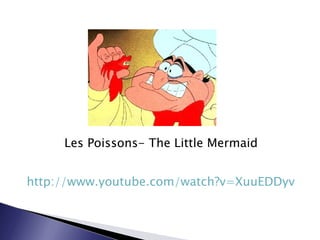
Les Poissons- The Little Mermaid http://www.youtube.com/watch?v=XuuEDDyvzuE
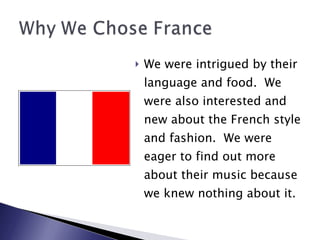
We were intrigued by their language and food.  We were also interested and new about the French style and fashion.  We were eager to find out more about their music because we knew nothing about it.
France, and in particular Paris, has played an important role as a center of high culture and of decorative arts since the seventeenth century, first in Europe, and from the nineteenth century on, worldwide.  From the late nineteenth century, France has also played an important role in modern art, cinema, fashion and cuisine.
French  is a Romance language globally spoken by about 77 million people as a first language (mother tongue),  By 190 million as a second language, and by about another 200 million people as an acquired foreign language, with significant speakers in 57 countries.  Most native speakers of the language live in France, where the language originated. The rest live essentially in Canada. http://www.youtube.com/watch?v=i0C14Qv2Zl4
France is a secular country where freedom of thought and of religion is preserved, by virtue of the 1789 Declaration of the Rights of Man and of the Citizen.  The Republic is based on the principle of  laïcité , that is of freedom of religion.  A January 2007 poll found that 51% of the French population describe themselves as Catholics—and only half of those said they believed in God--, 31% as atheists, 4% as Muslims, 3% as Protestants and 1% as Jews.
Growing out of the values of the Catholic church and rural communities, the basic unit of French society was traditionally held to be the family.  Over the twentieth century, the "traditional" family structure in France has evolved from extended families to, after World War II, nuclear families.  Since the 1960s, marriages have decreased and divorces have increased in France, and divorce law and legal family status have evolved to reflect these social changes.
Voted by the French Parliament in November 1999 following some controversy, the  pacte civil de solidarité  ("civil pact of solidarity") commonly known as a  PACS , is a form of civil union between two adults (same-sex or opposite-sex) for organizing their joint life.  It brings rights and responsibilities, but less so than marriage. From a legal standpoint, a PACS is a "contract" drawn up between the two individuals, which is stamped and registered by the clerk of the court.  Individuals who have registered a PACS are still considered "single" with regard to family status for some purposes, while they are increasingly considered in the same way as married couples are for other purposes.
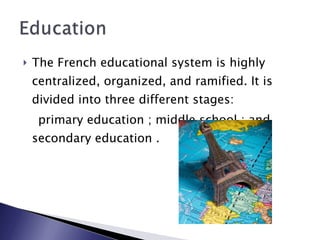
The French educational system is highly centralized, organized, and ramified. It is divided into three different stages: primary education ; middle school ; and secondary education .
Primary and secondary education is predominantly public, while higher education has both public and private elements. At the end of secondary education, students take the baccalauréat exam, which allows them to pursue higher education. The baccalauréat pass rate in 1999 was 78.3%. In 1999–2000, educational spending amounted to 7% of the French GDP and 37% of the national budget. Since the Jules Ferry laws of 1881-2, named after the then Minister of Public Instruction, all state-funded schools, including universities, are independent from the roman catholic church. Education in these institutions is free. Non-secular institutions are allowed to organize education as well. The French educational system differs strongly from Northern-European and American systems in that it stresses the importance of the development of the individual as an independent intellectual rather than a productive servant .
Traditional French culture places a high priority on the enjoyment of food. The French typically eat only a simple breakfast of, say, coffee or tea, and bread, breakfast pastries, or yogurt.  Lunch and dinner are the main meals of the day. Formal four course meals consist of a starter course, a main course followed by a salad course, and finally a cheese and/or a dessert course. While French cuisine is often associated with rich desserts, in most homes dessert consists of only a fruit or yogurt.
In France, cutlery is used in the continental manner (with the fork in the left hand, prongs facing down and the knife in the right hand). French etiquette prohibits the placing of hands below the table. The legal drinking age is officially 18 for strong liquors (21% vol. alcohol), and 16 for most alcohol drinks (beer, wine). France is one of the oldest wine-producing regions of Europe. France now produces the most wine by value in the world. Bordeaux wine, Bourgogne wine and Champagne are important agricultural products.
The French "national" sport is football (soccer). The most-watched sports in France are football (soccer), rugby , basketball, cycling, sailing and tennis.  France is notable for holding (and winning) the football World Cup in 1998, for holding the annual cycling race Tour de France, and the tennis Grand Slam tournament Roland Garros, or the French Open. Sport is encouraged in school, and local sports clubs receive financial support from the local governments.  The modern Olympics were invented in France, in 1894.
Since the 16th century, France has been the fashion capital of the World Famous top  designers Chanel Christian Dior, Hermes, Jean-Paul Gaultier, Louis Vuitton, Dior Fashion Week is held in late January to reveal what is ‘in’ for the following Spring and Summer months
 
Indigenous Folk Music and features styles from Africa, Latin America, and Asia Most well known for its classical music Modern times is known for the development of hip hop, techno, funk, and pop http://www.youtube.com/watch?v=3bSM72xQ2Wk http://www.youtube.com/watch?v=Triray9w3rs
Ludwig van Beethoven regarded as one of the greatest masters of musical construction, Symphony Number 9- 	http://www.youtube.com/watch?v=_-mvutiDRvQ Moonlight Sonata 	http://www.youtube.com/watch?v=vQVeaIHWWck
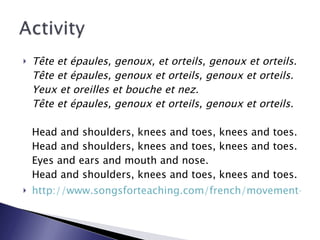
Tête et épaules, genoux, et orteils, genoux et orteils. Tête et épaules, genoux et orteils, genoux et orteils. Yeux et oreilles et bouche et nez. Tête et épaules, genoux et orteils, genoux et orteils. Head and shoulders, knees and toes, knees and toes. Head and shoulders, knees and toes, knees and toes. Eyes and ears and mouth and nose. Head and shoulders, knees and toes, knees and toes.  http://www.songsforteaching.com/french/movement-activity-participation/teteepaulesgenouxorteils.php
My Grandfather was stationed outside of Paris for a few weeks during World War II.  He would tell me stories of what Paris was like when I was young We learned many different aspects of the French culture.  Marriage rate Eat main course and then salad
www.kwintessential.co.uk/.../france-country-profile.html This website is a good guide about French culture. www.teachersnetwork.org/teachnet/foreignlanguage.cfm This website has lots of good lesson plans about the French culture.
http://www.kwintessential.co.uk/resources/global-etiquette/france-country-profile.html http://www.state.gov/r/pa/ei/bgn/3842.htm http://www.discoverfrance.net/France/DF_music.shtml http://www.lvbeethoven.com/Bio/BiographyLudwig.html

France Ppt

  • 1.
    by Lynsey Wilkie& Andrew Backes Bonjour!
  • 2.
    Les Poissons- TheLittle Mermaid http://www.youtube.com/watch?v=XuuEDDyvzuE
  • 3.
    We were intriguedby their language and food. We were also interested and new about the French style and fashion. We were eager to find out more about their music because we knew nothing about it.
  • 4.
    France, and inparticular Paris, has played an important role as a center of high culture and of decorative arts since the seventeenth century, first in Europe, and from the nineteenth century on, worldwide. From the late nineteenth century, France has also played an important role in modern art, cinema, fashion and cuisine.
  • 5.
    French isa Romance language globally spoken by about 77 million people as a first language (mother tongue), By 190 million as a second language, and by about another 200 million people as an acquired foreign language, with significant speakers in 57 countries. Most native speakers of the language live in France, where the language originated. The rest live essentially in Canada. http://www.youtube.com/watch?v=i0C14Qv2Zl4
  • 6.
    France is asecular country where freedom of thought and of religion is preserved, by virtue of the 1789 Declaration of the Rights of Man and of the Citizen. The Republic is based on the principle of laïcité , that is of freedom of religion. A January 2007 poll found that 51% of the French population describe themselves as Catholics—and only half of those said they believed in God--, 31% as atheists, 4% as Muslims, 3% as Protestants and 1% as Jews.
  • 7.
    Growing out ofthe values of the Catholic church and rural communities, the basic unit of French society was traditionally held to be the family. Over the twentieth century, the "traditional" family structure in France has evolved from extended families to, after World War II, nuclear families. Since the 1960s, marriages have decreased and divorces have increased in France, and divorce law and legal family status have evolved to reflect these social changes.
  • 8.
    Voted by theFrench Parliament in November 1999 following some controversy, the pacte civil de solidarité ("civil pact of solidarity") commonly known as a PACS , is a form of civil union between two adults (same-sex or opposite-sex) for organizing their joint life. It brings rights and responsibilities, but less so than marriage. From a legal standpoint, a PACS is a "contract" drawn up between the two individuals, which is stamped and registered by the clerk of the court. Individuals who have registered a PACS are still considered "single" with regard to family status for some purposes, while they are increasingly considered in the same way as married couples are for other purposes.
  • 9.
    The French educationalsystem is highly centralized, organized, and ramified. It is divided into three different stages: primary education ; middle school ; and secondary education .
  • 10.
    Primary and secondaryeducation is predominantly public, while higher education has both public and private elements. At the end of secondary education, students take the baccalauréat exam, which allows them to pursue higher education. The baccalauréat pass rate in 1999 was 78.3%. In 1999–2000, educational spending amounted to 7% of the French GDP and 37% of the national budget. Since the Jules Ferry laws of 1881-2, named after the then Minister of Public Instruction, all state-funded schools, including universities, are independent from the roman catholic church. Education in these institutions is free. Non-secular institutions are allowed to organize education as well. The French educational system differs strongly from Northern-European and American systems in that it stresses the importance of the development of the individual as an independent intellectual rather than a productive servant .
  • 11.
    Traditional French cultureplaces a high priority on the enjoyment of food. The French typically eat only a simple breakfast of, say, coffee or tea, and bread, breakfast pastries, or yogurt. Lunch and dinner are the main meals of the day. Formal four course meals consist of a starter course, a main course followed by a salad course, and finally a cheese and/or a dessert course. While French cuisine is often associated with rich desserts, in most homes dessert consists of only a fruit or yogurt.
  • 12.
    In France, cutleryis used in the continental manner (with the fork in the left hand, prongs facing down and the knife in the right hand). French etiquette prohibits the placing of hands below the table. The legal drinking age is officially 18 for strong liquors (21% vol. alcohol), and 16 for most alcohol drinks (beer, wine). France is one of the oldest wine-producing regions of Europe. France now produces the most wine by value in the world. Bordeaux wine, Bourgogne wine and Champagne are important agricultural products.
  • 13.
    The French "national"sport is football (soccer). The most-watched sports in France are football (soccer), rugby , basketball, cycling, sailing and tennis. France is notable for holding (and winning) the football World Cup in 1998, for holding the annual cycling race Tour de France, and the tennis Grand Slam tournament Roland Garros, or the French Open. Sport is encouraged in school, and local sports clubs receive financial support from the local governments. The modern Olympics were invented in France, in 1894.
  • 14.
    Since the 16thcentury, France has been the fashion capital of the World Famous top designers Chanel Christian Dior, Hermes, Jean-Paul Gaultier, Louis Vuitton, Dior Fashion Week is held in late January to reveal what is ‘in’ for the following Spring and Summer months
  • 15.
  • 16.
    Indigenous Folk Musicand features styles from Africa, Latin America, and Asia Most well known for its classical music Modern times is known for the development of hip hop, techno, funk, and pop http://www.youtube.com/watch?v=3bSM72xQ2Wk http://www.youtube.com/watch?v=Triray9w3rs
  • 17.
    Ludwig van Beethovenregarded as one of the greatest masters of musical construction, Symphony Number 9- http://www.youtube.com/watch?v=_-mvutiDRvQ Moonlight Sonata http://www.youtube.com/watch?v=vQVeaIHWWck
  • 18.
    Tête et épaules,genoux, et orteils, genoux et orteils. Tête et épaules, genoux et orteils, genoux et orteils. Yeux et oreilles et bouche et nez. Tête et épaules, genoux et orteils, genoux et orteils. Head and shoulders, knees and toes, knees and toes. Head and shoulders, knees and toes, knees and toes. Eyes and ears and mouth and nose. Head and shoulders, knees and toes, knees and toes. http://www.songsforteaching.com/french/movement-activity-participation/teteepaulesgenouxorteils.php
  • 19.
    My Grandfather wasstationed outside of Paris for a few weeks during World War II. He would tell me stories of what Paris was like when I was young We learned many different aspects of the French culture. Marriage rate Eat main course and then salad
  • 20.
    www.kwintessential.co.uk/.../france-country-profile.html This websiteis a good guide about French culture. www.teachersnetwork.org/teachnet/foreignlanguage.cfm This website has lots of good lesson plans about the French culture.
  • 21.