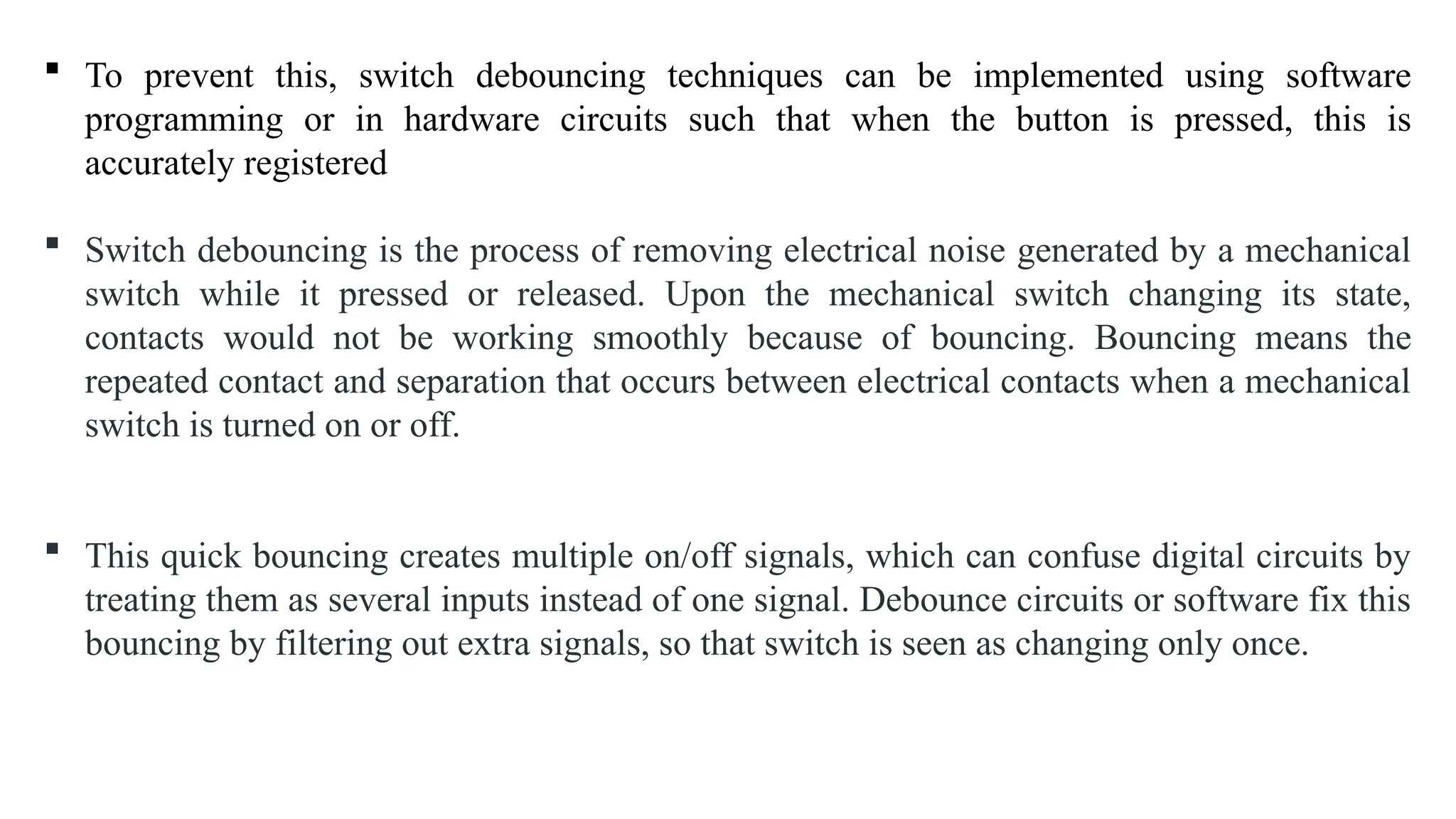
Explain the concepts of switch bouncing
 switches and push buttons toggle between two states: “on” and “off”
 usually in terms of different levels of voltage-
5V is “High” or ON
0V represents “Low” or OFF.
 They are fundamental to all systems, such as keyboards.
 press the button, the metal contacts inside the switch touch together to make a
circuit.
 This is not direct contact, but more like when you bounce, and the
circuit opens and shuts quickly before sticking.
 This process is called contact bounce
 it will read multiple false signals from one button press, which causes
error within the system.
 To prevent this, switch debouncing techniques can be implemented using software
programming or in hardware circuits such that when the button is pressed, this is
accurately registered
 Switch debouncing is the process of removing electrical noise generated by a mechanical
switch while it pressed or released. Upon the mechanical switch changing its state,
contacts would not be working smoothly because of bouncing. Bouncing means the
repeated contact and separation that occurs between electrical contacts when a mechanical
switch is turned on or off.
 This quick bouncing creates multiple on/off signals, which can confuse digital circuits by
treating them as several inputs instead of one signal. Debounce circuits or software fix this
bouncing by filtering out extra signals, so that switch is seen as changing only once.
 Software Switch Debouncing
In this method, the switch’s bouncing state effect is eliminated using various algorithms and
filters. The programmer can design an algorithm with use of shift register and counters such
that it will register the switch’s state after a delay. Another method is to use filter algorithms
on the sampled input from the switch and determine the state of switch based on the output
of such digital filter. All this can make the software slightly inefficient, adding to delay in
performance if not implemented correctly.
 Hardware debouncing
In this category, there are various implementations of circuits which can be used for
eliminating the effect of switch debouncing right at the hardware level. The different types
of circuits used are:
S-R Flip Flop Latch
The circuit when introduced in the output part of the switch, it
will retain the voltage level of the input as the output state. Thus,
latching to the input, when change in state is introduced. This
method is useful, but adds to the bulkiness of the simple circuit.
R-C circuit.
This circuit involves the combination of a resistor and a capacitor
circuit to act as a filter to smooth out the output glitch for the
switch. Use of dedicated ICs. There are various Integrated
Circuits available in market specifically designed to eliminate the
switch bouncing action. These implement the use of combination
circuits to eliminate the fluctuating output of the switch.
Advantages of Switch Debounce in Digital Circuits
•Improved Signal Integrity: For the reason that it only allows clean and stable
signals pass on to the digital circuits and eliminates false positives by bouncing,
debouncing should exist.
•Consistent and Reliable Operation :It ensures consistent switch input without
inaccuracies and it is the crucial need for systems like keyboards,
microcontrollers, or any input-driven electronics.
•Prevent unpredictive behavior: If there’s no debouncing, then the digital
circuits can function unpredictively and thus may result in an incorrect output,
or the whole system may fail.
Disadvantages of Switch Debounce in Digital Circuits
•Complexity in design: The debounce circuits also add more components or
code in hardware and software, respectively.
•There is a minimum delay, allowing the effect to settle fully. The impact will
introduce some delays in systems that need a quick response.
•Additional Resources: In software-based methods, debouncing depends on
the processing resources that scan switch inputs to filter them. This could
decrease the performance.

Switch Debouncing in digital system.pptx

  • 1.
    Explain the conceptsof switch bouncing  switches and push buttons toggle between two states: “on” and “off”  usually in terms of different levels of voltage- 5V is “High” or ON 0V represents “Low” or OFF.  They are fundamental to all systems, such as keyboards.  press the button, the metal contacts inside the switch touch together to make a circuit.
  • 2.
     This isnot direct contact, but more like when you bounce, and the circuit opens and shuts quickly before sticking.  This process is called contact bounce  it will read multiple false signals from one button press, which causes error within the system.
  • 3.
     To preventthis, switch debouncing techniques can be implemented using software programming or in hardware circuits such that when the button is pressed, this is accurately registered  Switch debouncing is the process of removing electrical noise generated by a mechanical switch while it pressed or released. Upon the mechanical switch changing its state, contacts would not be working smoothly because of bouncing. Bouncing means the repeated contact and separation that occurs between electrical contacts when a mechanical switch is turned on or off.  This quick bouncing creates multiple on/off signals, which can confuse digital circuits by treating them as several inputs instead of one signal. Debounce circuits or software fix this bouncing by filtering out extra signals, so that switch is seen as changing only once.
  • 4.
     Software SwitchDebouncing In this method, the switch’s bouncing state effect is eliminated using various algorithms and filters. The programmer can design an algorithm with use of shift register and counters such that it will register the switch’s state after a delay. Another method is to use filter algorithms on the sampled input from the switch and determine the state of switch based on the output of such digital filter. All this can make the software slightly inefficient, adding to delay in performance if not implemented correctly.  Hardware debouncing In this category, there are various implementations of circuits which can be used for eliminating the effect of switch debouncing right at the hardware level. The different types of circuits used are:
  • 5.
    S-R Flip FlopLatch The circuit when introduced in the output part of the switch, it will retain the voltage level of the input as the output state. Thus, latching to the input, when change in state is introduced. This method is useful, but adds to the bulkiness of the simple circuit. R-C circuit. This circuit involves the combination of a resistor and a capacitor circuit to act as a filter to smooth out the output glitch for the switch. Use of dedicated ICs. There are various Integrated Circuits available in market specifically designed to eliminate the switch bouncing action. These implement the use of combination circuits to eliminate the fluctuating output of the switch.
  • 6.
    Advantages of SwitchDebounce in Digital Circuits •Improved Signal Integrity: For the reason that it only allows clean and stable signals pass on to the digital circuits and eliminates false positives by bouncing, debouncing should exist. •Consistent and Reliable Operation :It ensures consistent switch input without inaccuracies and it is the crucial need for systems like keyboards, microcontrollers, or any input-driven electronics. •Prevent unpredictive behavior: If there’s no debouncing, then the digital circuits can function unpredictively and thus may result in an incorrect output, or the whole system may fail.
  • 7.
    Disadvantages of SwitchDebounce in Digital Circuits •Complexity in design: The debounce circuits also add more components or code in hardware and software, respectively. •There is a minimum delay, allowing the effect to settle fully. The impact will introduce some delays in systems that need a quick response. •Additional Resources: In software-based methods, debouncing depends on the processing resources that scan switch inputs to filter them. This could decrease the performance.