紙版は絶版、電⼦書籍は販売中


#cswift
:
@available(*, unavailable, renamed: "NewProtocol")
typealias PreviousProtocol = NewProtocol
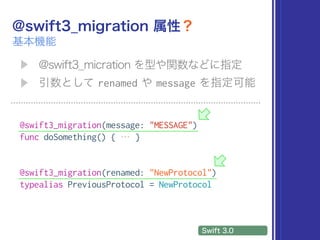
renamed message
@swift3_migration(message: "MESSAGE")
func doSomething() { … }
@swift3_migration(renamed: "NewProtocol")
typealias PreviousProtocol = NewProtocol
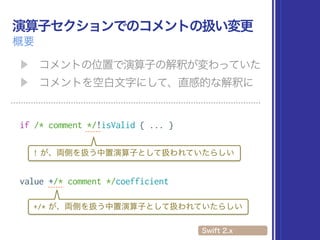
if /* comment */!isValid { ... }
value +/* comment */coefficient
!
+/*
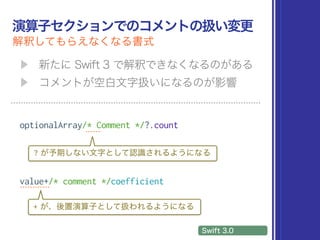
optionalArray/* Comment */?.count
value+/* comment */coefficient
?
+
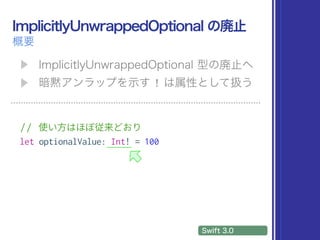
!
let optionalValue: Int! = 100
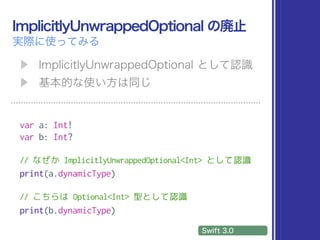
var a: Int!
var b: Int?
// なぜか ImplicitlyUnwrappedOptional<Int> として認識
print(a.dynamicType)
// こちらは Optional<Int> 型として認識
print(b.dynamicType)
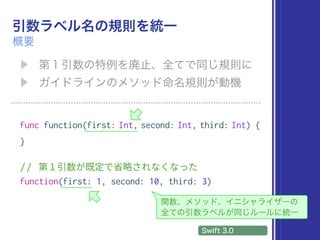
func function(first: Int, second: Int, third: Int) {
}
function(first: 1, second: 10, third: 3)
_
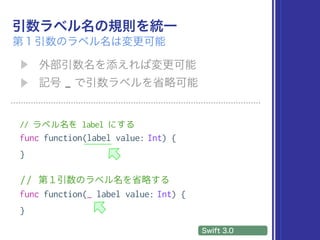
// ラベル名を label にする
func function(label value: Int) {
}
func function(_ label value: Int) {
}
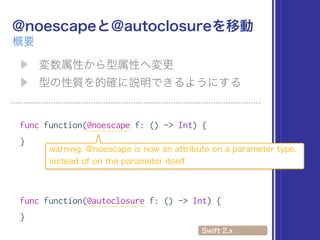
func function(@noescape f: () -> Int) {
}
func function(@autoclosure f: () -> Int) {
}
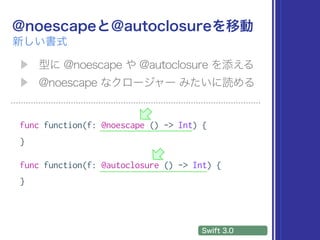
func function(f: @noescape () -> Int) {
}
func function(f: @autoclosure () -> Int) {
}
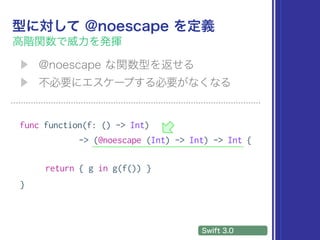
func function(f: () -> Int)
-> (@noescape (Int) -> Int) -> Int {
return { g in g(f()) }
}
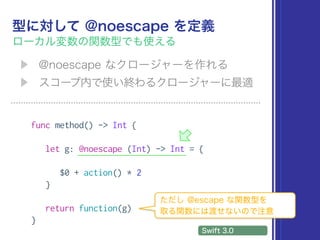
func method() -> Int {
let g: @noescape (Int) -> Int = {
$0 + action() * 2
}
return function(g)
}
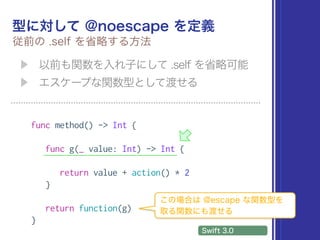
func method() -> Int {
func g(_ value: Int) -> Int {
return value + action() * 2
}
return function(g)
}
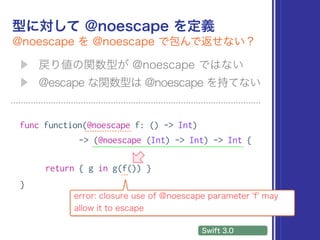
func function(@noescape f: () -> Int)
-> (@noescape (Int) -> Int) -> Int {
return { g in g(f()) }
}
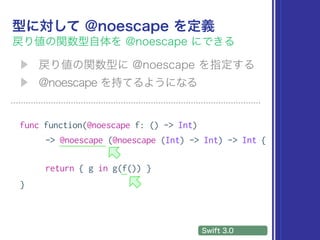
func function(@noescape f: () -> Int)
-> @noescape (@noescape (Int) -> Int) -> Int {
return { g in g(f()) }
}
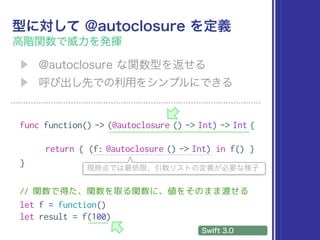
func function() -> (@autoclosure () -> Int) -> Int {
return { (f: @autoclosure () -> Int) in f() }
}
// 関数で得た、関数を取る関数に、値をそのまま渡せる
let f = function()
let result = f(100)
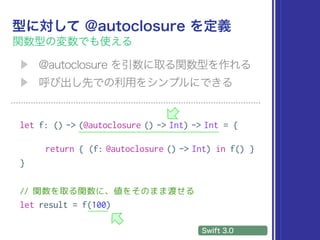
let f: () -> (@autoclosure () -> Int) -> Int = {
return { (f: @autoclosure () -> Int) in f() }
}
// 関数を取る関数に、値をそのまま渡せる
let result = f(100)
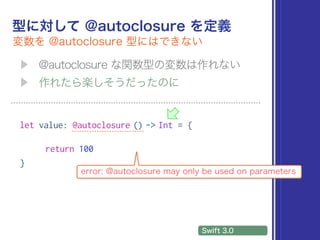
let value: @autoclosure () -> Int = {
return 100
}
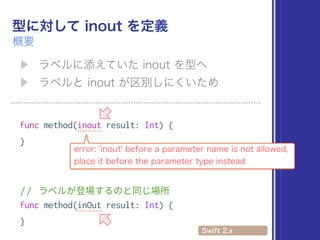
func method(inout result: Int) {
}
func method(inOut result: Int) {
}


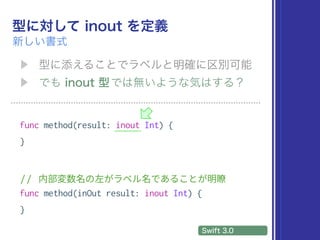
func method(result: inout Int) {
}
func method(inOut result: inout Int) {
}
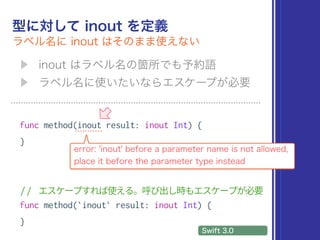
func method(inout result: inout Int) {
}
func method(`inout` result: inout Int) {
}


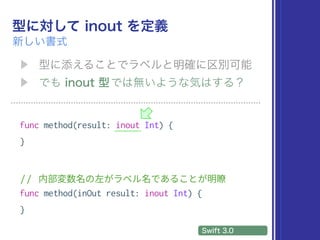
func method(result: inout Int) {
}
func method(inOut result: inout Int) {
}
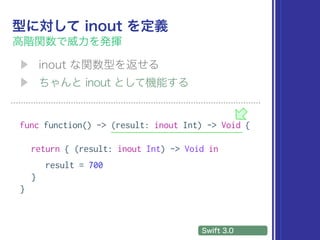
func function() -> (result: inout Int) -> Void {
return { (result: inout Int) -> Void in
result = 700
}
}
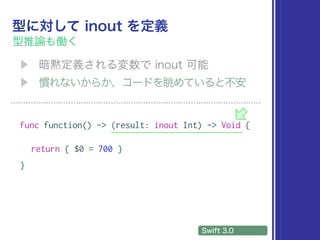
func function() -> (result: inout Int) -> Void {
return { $0 = 700 }
}
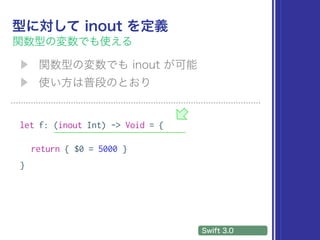
let f: (inout Int) -> Void = {
return { $0 = 5000 }
}
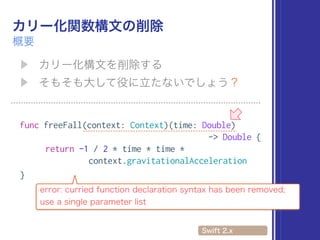
func freeFall(context: Context)(time: Double)
-> Double {
return -1 / 2 * time * time *
context.gravitationalAcceleration
}
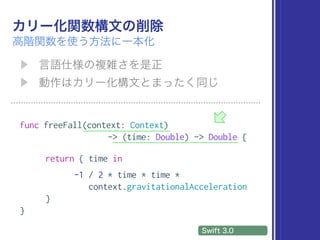
func freeFall(context: Context)
-> (time: Double) -> Double {
return { time in
-1 / 2 * time * time *
context.gravitationalAcceleration
}
}
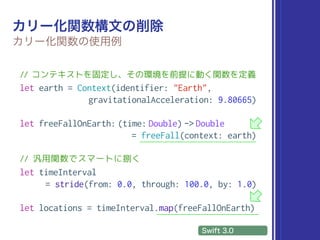
// コンテキストを固定し、その環境を前提に動く関数を定義
let earth = Context(identifier: "Earth",
gravitationalAcceleration: 9.80665)
let freeFallOnEarth: (time: Double) -> Double
= freeFall(context: earth)
// 汎用関数でスマートに捌く
let timeInterval
= stride(from: 0.0, through: 100.0, by: 1.0)
let locations = timeInterval.map(freeFallOnEarth)
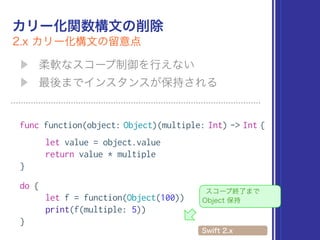
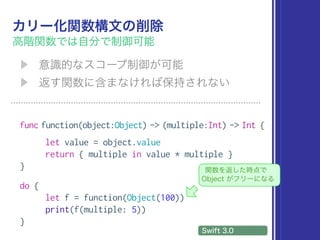
func function(object: Object)(multiple: Int) -> Int {
let value = object.value
return value * multiple
}
do {
let f = function(Object(100))
print(f(multiple: 5))
}
func function(object:Object) -> (multiple:Int) -> Int {
let value = object.value
return { multiple in value * multiple }
}
do {
let f = function(Object(100))
print(f(multiple: 5))
}
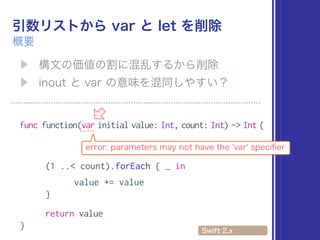
func function(var initial value: Int, count: Int) -> Int {
(1 ..< count).forEach { _ in
value += value
}
return value
}
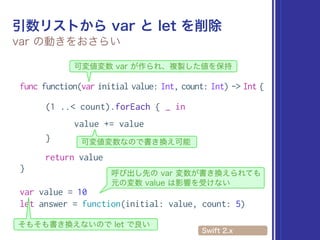
func function(var initial value: Int, count: Int) -> Int {
(1 ..< count).forEach { _ in
value += value
}
return value
}
var value = 10
let answer = function(initial: value, count: 5)
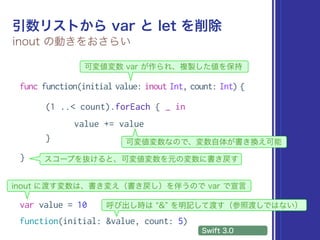
func function(initial value: inout Int, count: Int) {
(1 ..< count).forEach { _ in
value += value
}
}
var value = 10
function(initial: &value, count: 5)
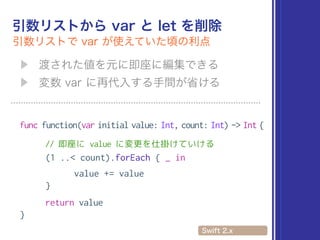
func function(var initial value: Int, count: Int) -> Int {
// 即座に value に変更を仕掛けていける
(1 ..< count).forEach { _ in
value += value
}
return value
}
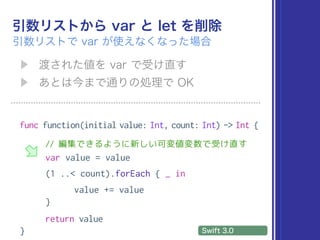
func function(initial value: Int, count: Int) -> Int {
// 編集できるように新しい可変値変数で受け直す
var value = value
(1 ..< count).forEach { _ in
value += value
}
return value
}
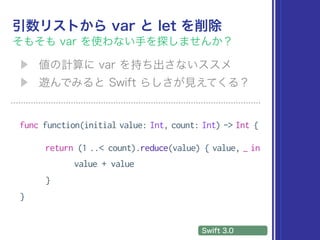
func function(initial value: Int, count: Int) -> Int {
return (1 ..< count).reduce(value) { value, _ in
value + value
}
}
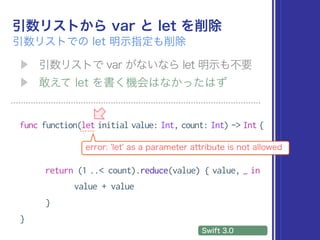
func function(let initial value: Int, count: Int) -> Int {
return (1 ..< count).reduce(value) { value, _ in
value + value
}
}
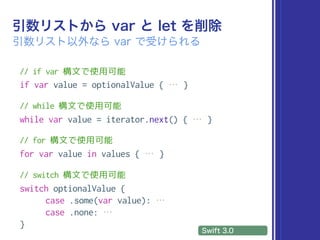
// if var 構文で使用可能
if var value = optionalValue { … }
// while 構文で使用可能
while var value = iterator.next() { … }
// for 構文で使用可能
for var value in values { … }
// switch 構文で使用可能
switch optionalValue {
case .some(var value): …
case .none: …
}
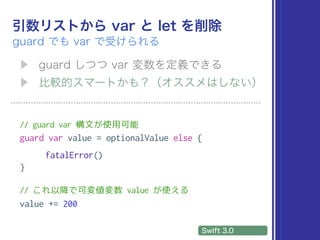
// guard var 構文が使用可能
guard var value = optionalValue else {
fatalError()
}
// これ以降で可変値変数 value が使える
value += 200
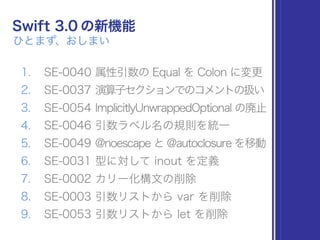
Swift 3.0 の新しい機能(のうちの9つ)

Swift 3.0 の新しい機能(のうちの9つ)