Download as PDF, PPTX


![Self-introduction
/laʒenɔʁɛ̃k/ カマイルカlagénorhynque
(defprofile lagénorhynque
:name "Kent OHASHI"
:languages [Clojure Haskell Python Scala
English français Deutsch русский]
:interests [programming language-learning mathematics]
:contributing [github.com/japan-clojurians/clojure-site-ja])](https://image.slidesharecdn.com/mp-in-clojure-170617053154/85/MP-in-Clojure-2-320.jpg)

![e.g.
※ #渋⾕ java なので⼀応 Java の例から^_^;
java.util.Optional
jshell> Optional<Integer> a = Optional.of(2)
a ==> Optional[2]
jshell> Optional<Integer> b = Optional.of(3)
b ==> Optional[3]
jshell> a.flatMap( x -> // with `flatMap` & `map`
...> b.map( y ->
...> x * y
...> )
...> )
$3 ==> Optional[6]](https://image.slidesharecdn.com/mp-in-clojure-170617053154/85/MP-in-Clojure-9-320.jpg)
![e.g. scala.Option
scala> val a = Some(2)
a: Some[Int] = Some(2)
scala> val b = Some(3)
b: Some[Int] = Some(3)
scala> a.flatMap { x => // with `flatMap` & `map`
| b.map { y =>
| x * y
| }
| }
res0: Option[Int] = Some(6)
scala> for { // with `for` expression
| x <- a
| y <- b
| } yield x * y
res1: Option[Int] = Some(6)](https://image.slidesharecdn.com/mp-in-clojure-170617053154/85/MP-in-Clojure-10-320.jpg)
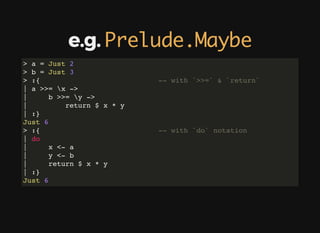
![e.g. cats.monad.maybe
user=> (require '[cats.core :as m]
#_=> '[cats.monad.maybe :as maybe])
nil
user=> (def a (maybe/just 2))
#'user/a
user=> (def b (maybe/just 3))
#'user/b
user=> (m/>>= a (fn [x] ; with `>>=` & `return`
#_=> (m/>>= b (fn [y]
#_=> (m/return (* x y))))))
#<Just 6>
user=> (m/mlet [x a ; with `mlet` macro
#_=> y b]
#_=> (m/return (* x y)))
#<Just 6>](https://image.slidesharecdn.com/mp-in-clojure-170617053154/85/MP-in-Clojure-12-320.jpg)


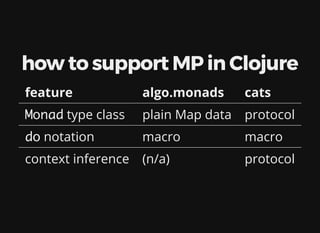
![anatomy of algo.monads
user=> (require '[clojure.algo.monads :as m])
nil
user=> (m/domonad m/maybe-m
#_=> [x 2
#_=> y 3]
#_=> (* x y))
6](https://image.slidesharecdn.com/mp-in-clojure-170617053154/85/MP-in-Clojure-18-320.jpg)
![macroexpand-1
clojure.algo.monads/with-monad ?
user=> (macroexpand-1
#_=> '(m/domonad m/maybe-m
#_=> [x 2
#_=> y 3]
#_=> (* x y)))
(clojure.algo.monads/with-monad m/maybe-m
(m-bind 2 (fn [x]
(m-bind 3 (fn [y]
(m-result (* x y)))))))](https://image.slidesharecdn.com/mp-in-clojure-170617053154/85/MP-in-Clojure-19-320.jpg)
![macroexpand-1 once more
clojure.algo.monads/maybe-m ?
user=> (macroexpand-1 *1)
(clojure.core/let [name__3075__auto__ m/maybe-m
m-bind (:m-bind name__3075__auto__)
m-result (:m-result name__3075__auto__)
m-zero (:m-zero name__3075__auto__)
m-plus (:m-plus name__3075__auto__)]
(clojure.tools.macro/with-symbol-macros
(m-bind 2 (fn [x]
(m-bind 3 (fn [y]
(m-result (* x y))))))))](https://image.slidesharecdn.com/mp-in-clojure-170617053154/85/MP-in-Clojure-20-320.jpg)
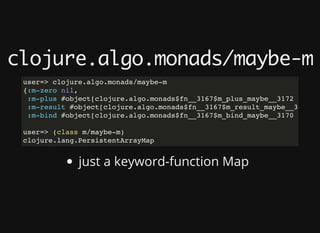
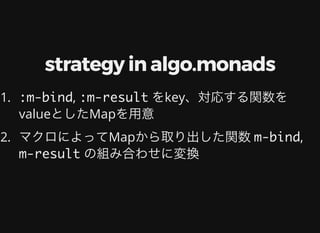
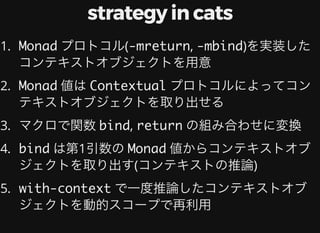
![anatomy of cats
user=> (require '[cats.core :as m]
#_=> '[cats.monad.maybe :as maybe])
nil
user=> (m/mlet [x (maybe/just 2)
#_=> y (maybe/just 3)]
#_=> (m/return (* x y)))
#<Just 6>](https://image.slidesharecdn.com/mp-in-clojure-170617053154/85/MP-in-Clojure-23-320.jpg)
![macroexpand-1
cats.core/bind ?
without explicit monad context?
user=> (macroexpand-1
#_=> '(m/mlet [x (maybe/just 2)
#_=> y (maybe/just 3)]
#_=> (m/return (* x y))))
(cats.core/bind (maybe/just 2) (clojure.core/fn [x]
(cats.core/bind (maybe/just 3) (clojure.core/fn [y]
(do (m/return (* x y)))))))](https://image.slidesharecdn.com/mp-in-clojure-170617053154/85/MP-in-Clojure-24-320.jpg)
![cats.core/bind
cats.context/infer ?
can infer monad context?
user=> (source cats.core/bind)
(defn bind
;; (docstring here)
[mv f]
(let [ctx (ctx/infer mv)]
(p/-mbind ctx mv (fn [v]
(ctx/with-context ctx
(f v))))))
nil](https://image.slidesharecdn.com/mp-in-clojure-170617053154/85/MP-in-Clojure-25-320.jpg)
![cats.context/infer
cats.protocols/Contextual ?
user=> (source cats.context/infer)
(defn infer
;; (docstring here)
;; (0-arity pattern here)
([v]
(cond ; blank lines omitted
(not (nil? *context*))
*context*
(satisfies? p/Contextual v)
(p/-get-context v)
:else
(throw-illegal-argument
(str "No context is set and it can not be automatically "
"resolved from provided value")))))
nil](https://image.slidesharecdn.com/mp-in-clojure-170617053154/85/MP-in-Clojure-26-320.jpg)
![cats.protocols/Contextual
-get-context method
user=> (source cats.protocols/Contextual)
(defprotocol Contextual
"Abstraction that establishes a concrete type as a member of a contex
A great example is the Maybe monad type Just. It implements
this abstraction to establish that Just is part of
the Maybe monad."
(-get-context [_] "Get the context associated with the type."))
nil](https://image.slidesharecdn.com/mp-in-clojure-170617053154/85/MP-in-Clojure-27-320.jpg)
![cats.core/bind (again)
cats.protocols/-mbind ?
user=> (source cats.core/bind)
(defn bind
;; (docstring here)
[mv f]
(let [ctx (ctx/infer mv)]
(p/-mbind ctx mv (fn [v]
(ctx/with-context ctx
(f v))))))
nil](https://image.slidesharecdn.com/mp-in-clojure-170617053154/85/MP-in-Clojure-28-320.jpg)
![cats.protocols/Monad
-mreturn & -mbind methods
user=> (source cats.protocols/Monad))
(defprotocol Monad
"The Monad abstraction."
(-mreturn [m v])
(-mbind [m mv f]))
nil](https://image.slidesharecdn.com/mp-in-clojure-170617053154/85/MP-in-Clojure-29-320.jpg)
![cats.core/bind ( nally)
cats.context/with-context ?
user=> (source cats.core/bind)
(defn bind
;; (docstring here)
[mv f]
(let [ctx (ctx/infer mv)]
(p/-mbind ctx mv (fn [v]
(ctx/with-context ctx
(f v))))))
nil](https://image.slidesharecdn.com/mp-in-clojure-170617053154/85/MP-in-Clojure-30-320.jpg)
![cats.context/with-context
dynamic Var *context*
user=> (source cats.context/with-context)
(defmacro with-context
"Set current context to specific monad."
[ctx & body]
`(do
(when-not (context? ~ctx)
(throw-illegal-argument
"The provided context does not implements Context."))
(binding [*context* ~ctx]
~@body)))
nil
user=> (source cats.context/*context*)
(def ^:dynamic *context* nil)
nil](https://image.slidesharecdn.com/mp-in-clojure-170617053154/85/MP-in-Clojure-31-320.jpg)
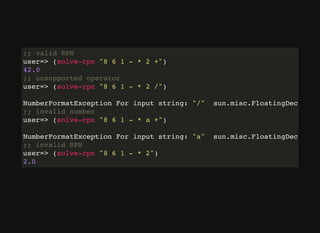
![without monads
naïve implementation
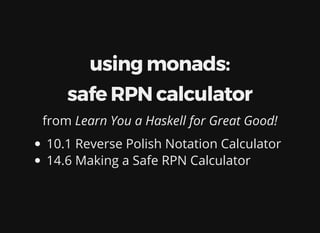
(defn- folding-function [[x y & ys :as xs] s]
(cond
(and x y (= s "*")) (conj ys (* y x))
(and x y (= s "+")) (conj ys (+ y x))
(and x y (= s "-")) (conj ys (- y x))
:else (conj xs (Double/parseDouble s))))
(defn solve-rpn [s]
(as-> s v
(str/split v #"s+")
(reduce folding-function () v)
(first v)))](https://image.slidesharecdn.com/mp-in-clojure-170617053154/85/MP-in-Clojure-37-320.jpg)
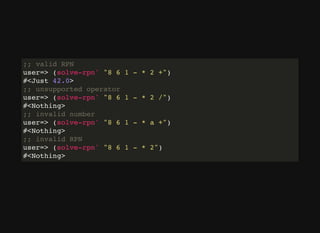
![with Maybe monad
valid ⇒ just x ; invalid ⇒ nothing
lift-m for lifting conj function
(defn- read-maybe [s]
(try
(maybe/just (Double/parseDouble s))
(catch NumberFormatException _
(maybe/nothing))))
(defn- folding-function' [[x y & ys :as xs] s]
(cond
(and x y (= s "*")) (maybe/just (conj ys (* y x)))
(and x y (= s "+")) (maybe/just (conj ys (+ y x)))
(and x y (= s "-")) (maybe/just (conj ys (- y x)))
:else ((m/lift-m 1 #(conj xs %))
(read-maybe s))))](https://image.slidesharecdn.com/mp-in-clojure-170617053154/85/MP-in-Clojure-39-320.jpg)
![reduce with monadic function using foldm
length of result sequence ≠ 1 ⇒ nothing
MonadZero
cf. MonadPlus, Alternative
(defn solve-rpn' [s]
(m/mlet [result (m/foldm folding-function'
()
(str/split s #"s+"))
:when (= (count result) 1)]
(m/return (first result))))](https://image.slidesharecdn.com/mp-in-clojure-170617053154/85/MP-in-Clojure-40-320.jpg)
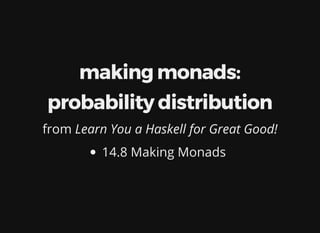
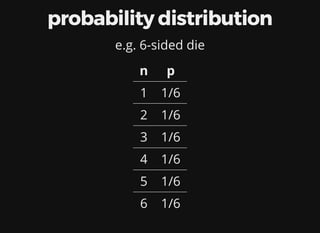
![implementing Prob monad
define the data type Prob
(deftype Prob [v]
p/Contextual
(-get-context [_] context)
p/Extract
(-extract [_] v)
p/Printable
(-repr [_]
(str "#<Prob " (pr-str v) ">"))
Object
(equals [this obj]
(= (.v this) (.v obj))))](https://image.slidesharecdn.com/mp-in-clojure-170617053154/85/MP-in-Clojure-44-320.jpg)
![define the context object for Prob
(def context
(reify
;; (other protocol implementations here)
p/Monad
(-mreturn [m v]
(p/-pure m v))
(-mbind [_ mv f]
(assert (prob? mv)
(str "Context mismatch: " (p/-repr mv)
" is not allowed to use with prob context."))
(->Prob (for [[x p] (p/-extract mv)
[y q] (p/-extract (f x))]
[y (* p q)])))
;; (below omitted)](https://image.slidesharecdn.com/mp-in-clojure-170617053154/85/MP-in-Clojure-45-320.jpg)
![define factory/conversion functions
(defn uniform [s] ; sequence
(let [n (count s)] ; -> Prob value of uniform distribution
(->> s
(map (fn [x] [x (/ 1 n)]))
->Prob)))
(defn prob->dist [prob] ; Prob value -> Map of distribution
(letfn [(add-prob [d [x p]]
(update d x (fnil #(+ % p) 0)))]
(reduce add-prob {} (p/-extract prob))))](https://image.slidesharecdn.com/mp-in-clojure-170617053154/85/MP-in-Clojure-46-320.jpg)
![sum of 2 dice
user=> (def die (range 1 (inc 6)))
#'user/die
user=> (def prob
#_=> (m/mlet [d1 (uniform die)
#_=> d2 (uniform die)]
#_=> (m/return (+ d1 d2))))
#'user/prob
user=> prob
#<Prob ([2 1/36] [3 1/36] [4 1/36] [5 1/36] [6 1/36] [7 1/36] [3 1/36]
user=> (prob->dist prob)
{7 1/6, 4 1/12, 6 5/36, 3 1/18, 12 1/36, 2 1/36, 11 1/18,
9 1/9, 5 1/9, 10 1/12, 8 5/36}](https://image.slidesharecdn.com/mp-in-clojure-170617053154/85/MP-in-Clojure-47-320.jpg)
![Monty Hall problem
user=> (def doors #{:a :b :c})
#'user/doors
user=> (prob->dist
#_=> (m/mlet [prize (uniform doors)
#_=> choice (uniform doors)]
#_=> (m/return (if (= choice prize)
#_=> :win
#_=> :lose))))
{:win 1/3, :lose 2/3}](https://image.slidesharecdn.com/mp-in-clojure-170617053154/85/MP-in-Clojure-48-320.jpg)
![user=> (prob->dist
#_=> (m/mlet [prize (uniform doors)
#_=> choice (uniform doors)
#_=> opened (uniform (disj doors prize choice))
#_=> choice' (uniform (disj doors opened choice))]
#_=> (m/return (if (= choice' prize)
#_=> :win
#_=> :lose))))
{:lose 1/3, :win 2/3}](https://image.slidesharecdn.com/mp-in-clojure-170617053154/85/MP-in-Clojure-49-320.jpg)


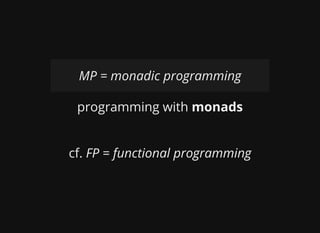
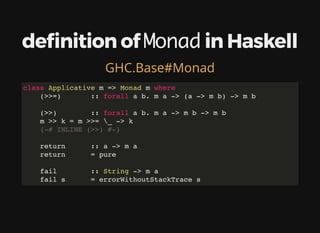
This document discusses monadic programming (MP) in Clojure. It begins with introductions to monads and monadic programming in Haskell. It then discusses reasons for using MP in Clojure despite it not having static typing or being purely functional. It explains two libraries for MP in Clojure - clojure.algo.monads and funcool/cats - and how they implement monads using macros and protocols. Examples are given of using monads for error handling in a reverse Polish notation calculator and for representing probability distributions.


![谷歌留痕技术教程[ 𝙩𝙤𝙥 𝟮𝟯𝟯. 𝙘 𝙤𝙢 ]](https://cdn.slidesharecdn.com/ss_thumbnails/top233-260130173900-2eb784f9-thumbnail.jpg?width=640&height=640&fit=bounds)


![20260201 [FOSDEM] gomodjail - library sandboxing for Go modules.pdf](https://cdn.slidesharecdn.com/ss_thumbnails/20260201fosdemgomodjail-librarysandboxingforgomodules-260201225659-76609ec4-thumbnail.jpg?width=640&height=640&fit=bounds)

