Swift 3 :
Protocols
군산대학교 컴퓨터정보통신공학부 컴퓨터정보공학전공
남 광 우
kwnam@kunsan.ac.kr
Swift 3 Tour and Language Guide by Apple
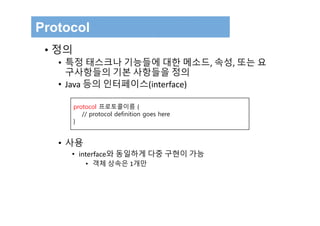
Protocol
• 정의
• 특정 태스크나 기능들에 대한 메소드, 속성, 또는 요
구사항들의 기본 사항들을 정의
• Java 등의 인터페이스(interface)
• 사용
• interface와 동일하게 다중 구현이 가능
• 객체 상속은 1개만
protocol 프로토콜이름 {
// protocol definition goes here
}
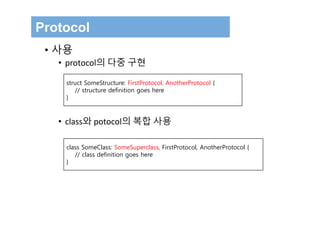
Protocol
• 사용
• protocol의 다중 구현
• class와 potocol의 복합 사용
struct SomeStructure: FirstProtocol, AnotherProtocol {
// structure definition goes here
}
class SomeClass: SomeSuperclass, FirstProtocol, AnotherProtocol {
// class definition goes here
}
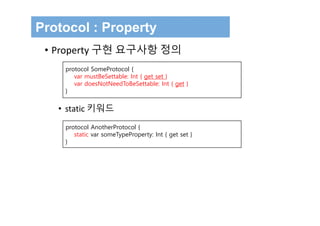
Protocol : Property
• Property 구현 요구사항 정의
• static 키워드
protocol SomeProtocol {
var mustBeSettable: Int { get set }
var doesNotNeedToBeSettable: Int { get }
}
protocol AnotherProtocol {
static var someTypeProperty: Int { get set }
}
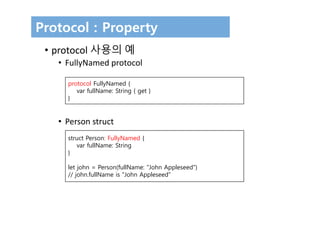
Protocol : Property
• protocol 사용의 예
• FullyNamed protocol
• Person struct
protocol FullyNamed {
var fullName: String { get }
}
struct Person: FullyNamed {
var fullName: String
}
let john = Person(fullName: "John Appleseed")
// john.fullName is "John Appleseed"
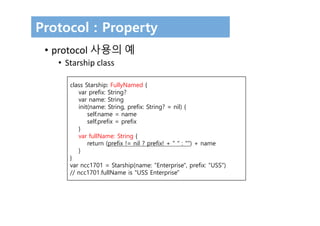
Protocol : Property
• protocol 사용의 예
• Starship class
class Starship: FullyNamed {
var prefix: String?
var name: String
init(name: String, prefix: String? = nil) {
self.name = name
self.prefix = prefix
}
var fullName: String {
return (prefix != nil ? prefix! + " " : "") + name
}
}
var ncc1701 = Starship(name: "Enterprise", prefix: "USS")
// ncc1701.fullName is "USS Enterprise"
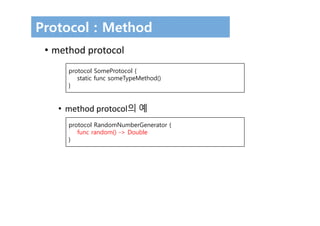
Protocol : Method
• method protocol
• method protocol의 예
protocol SomeProtocol {
static func someTypeMethod()
}
protocol RandomNumberGenerator {
func random() -> Double
}
Protocol : Method
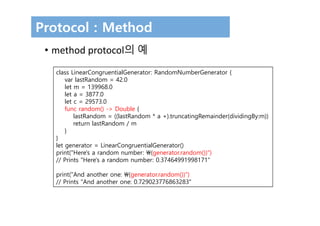
• method protocol의 예
class LinearCongruentialGenerator: RandomNumberGenerator {
var lastRandom = 42.0
let m = 139968.0
let a = 3877.0
let c = 29573.0
func random() -> Double {
lastRandom = ((lastRandom * a +).truncatingRemainder(dividingBy:m))
return lastRandom / m
}
}
let generator = LinearCongruentialGenerator()
print("Here's a random number: (generator.random())")
// Prints "Here's a random number: 0.37464991998171“
print("And another one: (generator.random())")
// Prints "And another one: 0.729023776863283"
Protocol : Mutating Method
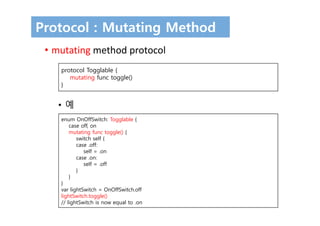
• mutating method protocol
• 예
protocol Togglable {
mutating func toggle()
}
enum OnOffSwitch: Togglable {
case off, on
mutating func toggle() {
switch self {
case .off:
self = .on
case .on:
self = .off
}
}
}
var lightSwitch = OnOffSwitch.off
lightSwitch.toggle()
// lightSwitch is now equal to .on
Protocol : Initializer
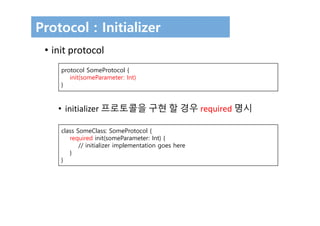
• init protocol
• initializer 프로토콜을 구현 할 경우 required 명시
protocol SomeProtocol {
init(someParameter: Int)
}
class SomeClass: SomeProtocol {
required init(someParameter: Int) {
// initializer implementation goes here
}
}
Protocol : Initializer
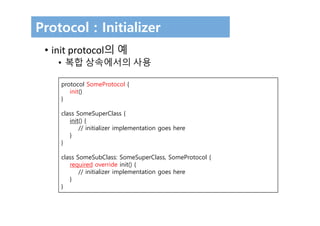
• init protocol의 예 
• 복합 상속에서의 사용
protocol SomeProtocol {
init()
}
class SomeSuperClass {
init() {
// initializer implementation goes here
}
}
class SomeSubClass: SomeSuperClass, SomeProtocol {
required override init() {
// initializer implementation goes here
}
}
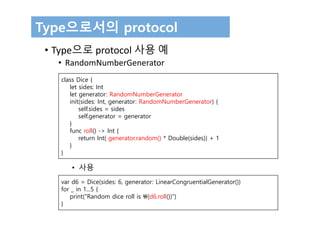
Type으로서의 protocol
• Type으로 protocol 사용 예 
• RandomNumberGenerator
• 사용
class Dice {
let sides: Int
let generator: RandomNumberGenerator
init(sides: Int, generator: RandomNumberGenerator) {
self.sides = sides
self.generator = generator
}
func roll() -> Int {
return Int( generator.random() * Double(sides)) + 1
}
}
var d6 = Dice(sides: 6, generator: LinearCongruentialGenerator())
for _ in 1...5 {
print("Random dice roll is (d6.roll())")
}
Delegation 패턴에서의 사용
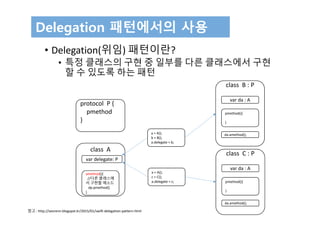
• Delegation(위임) 패턴이란?
• 특정 클래스의 구현 중 일부를 다른 클래스에서 구현
할 수 있도록 하는 패턴
참고 : http://seorenn.blogspot.kr/2015/01/swift‐delegation‐pattern.html
class  A
protocol  P {
pmethod
}
var delegate: P
amethod(){
//다른 클래스에
서 구현할 메소드
dp.pmethod() 
}
class  B : P
var da : A
a = A();
b = B();
a.delegate = b;
pmethod(){
}
da.amethod();
class  C : P
var da : A
pmethod(){
}
da.amethod();
a = A();
c = C();
a.delegate = c;
Delegation 패턴에서의 사용
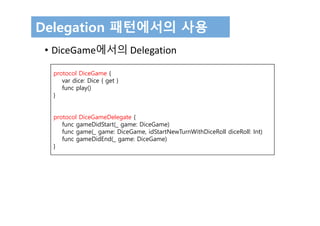
• DiceGame에서의 Delegation
protocol DiceGame {
var dice: Dice { get }
func play()
}
protocol DiceGameDelegate {
func gameDidStart(_ game: DiceGame)
func game(_ game: DiceGame, idStartNewTurnWithDiceRoll diceRoll: Int)
func gameDidEnd(_ game: DiceGame)
}
Delegation 패턴에서의 사용
• DiceGame에서의 Delegation
class SnakesAndLadders: DiceGame {
let finalSquare = 25
let dice = Dice(sides: 6, generator: LinearCongruentialGenerator())
var square = 0
var board: [Int]
init() {
board = Array(repeating: 0, count: finalSquare + 1)
board[03] = +08; board[06] = +11; board[09] = +09; board[10] = +02
board[14] = -10; board[19] = -11; board[22] = -02; board[24] = -08
}
var delegate: DiceGameDelegate?
func play() {
square = 0
delegate?.gameDidStart(self)
gameLoop: while square != finalSquare {
let diceRoll = dice.roll()
delegate?.game(self, didStartNewTurnWithDiceRoll: diceRoll)
switch square + diceRoll {
case finalSquare:
break gameLoop
case let newSquare where newSquare > finalSquare:
continue gameLoop
default:
square += diceRoll
square += board[square]
}
}
delegate?.gameDidEnd(self)
}
}
Delegation 패턴에서의 사용
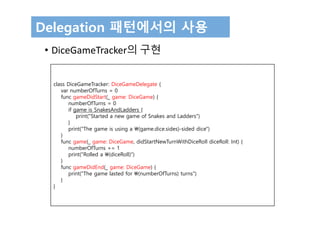
• DiceGameTracker의 구현
class DiceGameTracker: DiceGameDelegate {
var numberOfTurns = 0
func gameDidStart(_ game: DiceGame) {
numberOfTurns = 0
if game is SnakesAndLadders {
print("Started a new game of Snakes and Ladders")
}
print("The game is using a (game.dice.sides)-sided dice")
}
func game(_ game: DiceGame, didStartNewTurnWithDiceRoll diceRoll: Int) {
numberOfTurns += 1
print("Rolled a (diceRoll)")
}
func gameDidEnd(_ game: DiceGame) {
print("The game lasted for (numberOfTurns) turns")
}
}
Delegation 패턴에서의 사용
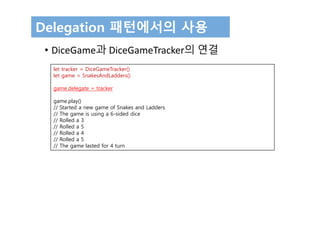
• DiceGame과 DiceGameTracker의 연결
let tracker = DiceGameTracker()
let game = SnakesAndLadders()
game.delegate = tracker
game.play()
// Started a new game of Snakes and Ladders
// The game is using a 6-sided dice
// Rolled a 3
// Rolled a 5
// Rolled a 4
// Rolled a 5
// The game lasted for 4 turn
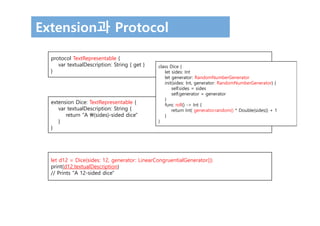
Extension과 Protocol
protocol TextRepresentable {
var textualDescription: String { get }
}
extension Dice: TextRepresentable {
var textualDescription: String {
return "A (sides)-sided dice"
}
}
let d12 = Dice(sides: 12, generator: LinearCongruentialGenerator())
print(d12.textualDescription)
// Prints "A 12-sided dice"
class Dice {
let sides: Int
let generator: RandomNumberGenerator
init(sides: Int, generator: RandomNumberGenerator) {
self.sides = sides
self.generator = generator
}
func roll() -> Int {
return Int( generator.random() * Double(sides)) + 1
}
}
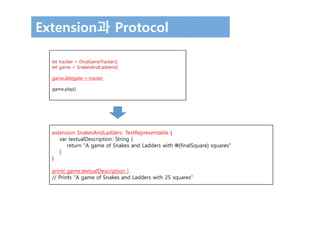
extension SnakesAndLadders: TextRepresentable {
var textualDescription: String {
return "A game of Snakes and Ladders with (finalSquare) squares"
}
}
print( game.textualDescription )
// Prints "A game of Snakes and Ladders with 25 squares"
Extension과 Protocol
let tracker = DiceGameTracker()
let game = SnakesAndLadders()
game.delegate = tracker
game.play()
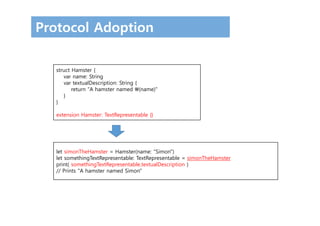
Protocol Adoption
struct Hamster {
var name: String
var textualDescription: String {
return "A hamster named (name)"
}
}
extension Hamster: TextRepresentable {}
let simonTheHamster = Hamster(name: "Simon")
let somethingTextRepresentable: TextRepresentable = simonTheHamster
print( somethingTextRepresentable.textualDescription )
// Prints "A hamster named Simon"
Protocol Type의 Collection
let things: [TextRepresentable] = [game, d12, simonTheHamster]
for thing in things {
print(thing.textualDescription)
}
// A game of Snakes and Ladders with 25 squares
// A 12-sided dice
// A hamster named Simon
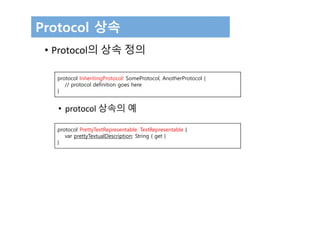
Protocol 상속
protocol InheritingProtocol: SomeProtocol, AnotherProtocol {
// protocol definition goes here
}
protocol PrettyTextRepresentable: TextRepresentable {
var prettyTextualDescription: String { get }
}
• Protocol의 상속 정의
• protocol 상속의 예
extension SnakesAndLadders: PrettyTextRepresentable {
var prettyTextualDescription: String {
var output = textualDescription + ":n"
for index in 1...finalSquare {
switch board[index] {
case let ladder where ladder > 0:
output += "▲ "
case let snake where snake < 0:
output += "▼ "
default:
output += "○ "
}
}
return output
}
}
• 상속된 protocol의 사용
Protocol 상속
print(game.prettyTextualDescription)
// A game of Snakes and Ladders with 25 squares:
// ○ ○ ▲ ○ ○ ▲ ○ ○ ▲ ▲ ○ ○ ○ ▼ ○ ○ ○ ○ ▼ ○ ○ ▼ ○ ▼
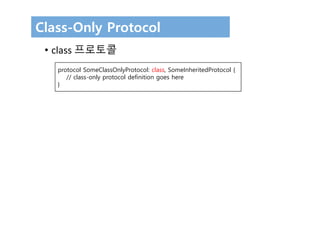
Class-Only Protocol
protocol SomeClassOnlyProtocol: class, SomeInheritedProtocol {
// class-only protocol definition goes here
}
• class 프로토콜
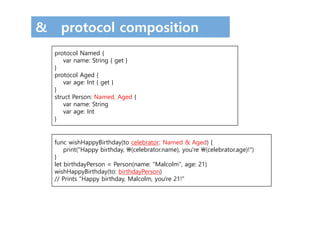
& protocol composition
protocol Named {
var name: String { get }
}
protocol Aged {
var age: Int { get }
}
struct Person: Named, Aged {
var name: String
var age: Int
}
func wishHappyBirthday(to celebrator: Named & Aged) {
print("Happy birthday, (celebrator.name), you're (celebrator.age)!")
}
let birthdayPerson = Person(name: "Malcolm", age: 21)
wishHappyBirthday(to: birthdayPerson)
// Prints "Happy birthday, Malcolm, you're 21!"
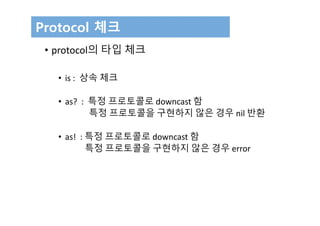
Protocol 체크
• protocol의 타입 체크
• is :  상속 체크
• as?  :  특정 프로토콜로 downcast 함
특정 프로토콜을 구현하지 않은 경우 nil 반환
• as!  : 특정 프로토콜로 downcast 함
특정 프로토콜을 구현하지 않은 경우 error
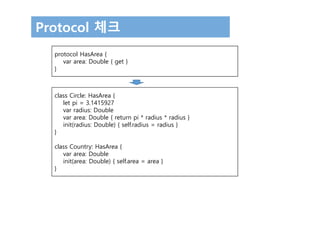
Protocol 체크
protocol HasArea {
var area: Double { get }
}
class Circle: HasArea {
let pi = 3.1415927
var radius: Double
var area: Double { return pi * radius * radius }
init(radius: Double) { self.radius = radius }
}
class Country: HasArea {
var area: Double
init(area: Double) { self.area = area }
}
Protocol 체크
class Animal {
var legs: Int
init(legs: Int) { self.legs = legs }
}
let objects: [AnyObject] = [
Circle(radius: 2.0),
Country(area: 243_610),
Animal(legs: 4)
]
for object in objects {
if let objectWithArea = object as? HasArea {
print("Area is (objectWithArea.area)")
} else {
print("Something that doesn't have an area")
}
}
// Area is 12.5663708
// Area is 243610.0
// Something that doesn't have an area
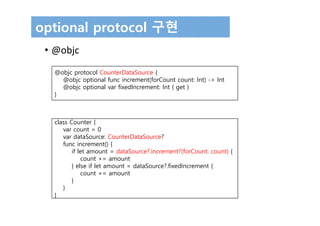
optional protocol 구현
@objc protocol CounterDataSource {
@objc optional func increment(forCount count: Int) -> Int
@objc optional var fixedIncrement: Int { get }
}
class Counter {
var count = 0
var dataSource: CounterDataSource?
func increment() {
if let amount = dataSource?.increment?(forCount: count) {
count += amount
} else if let amount = dataSource?.fixedIncrement {
count += amount
}
}
}
• @objc
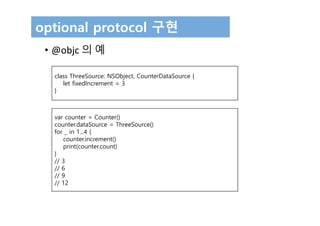
optional protocol 구현
• @objc 의 예
class ThreeSource: NSObject, CounterDataSource {
let fixedIncrement = 3
}
var counter = Counter()
counter.dataSource = ThreeSource()
for _ in 1...4 {
counter.increment()
print(counter.count)
}
// 3
// 6
// 9
// 12
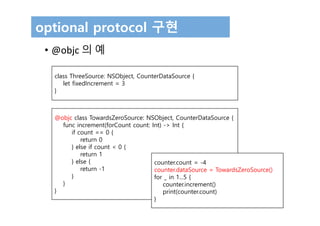
optional protocol 구현
• @objc 의 예
class ThreeSource: NSObject, CounterDataSource {
let fixedIncrement = 3
}
@objc class TowardsZeroSource: NSObject, CounterDataSource {
func increment(forCount count: Int) -> Int {
if count == 0 {
return 0
} else if count < 0 {
return 1
} else {
return -1
}
}
}
counter.count = -4
counter.dataSource = TowardsZeroSource()
for _ in 1...5 {
counter.increment()
print(counter.count)
}

Swift 3 Programming for iOS : Protocol

  • 1.
    Swift 3 : Protocols 군산대학교컴퓨터정보통신공학부 컴퓨터정보공학전공 남 광 우 kwnam@kunsan.ac.kr Swift 3 Tour and Language Guide by Apple
  • 2.
    Protocol • 정의 • 특정태스크나 기능들에 대한 메소드, 속성, 또는 요 구사항들의 기본 사항들을 정의 • Java 등의 인터페이스(interface) • 사용 • interface와 동일하게 다중 구현이 가능 • 객체 상속은 1개만 protocol 프로토콜이름 { // protocol definition goes here }
  • 3.
    Protocol • 사용 • protocol의다중 구현 • class와 potocol의 복합 사용 struct SomeStructure: FirstProtocol, AnotherProtocol { // structure definition goes here } class SomeClass: SomeSuperclass, FirstProtocol, AnotherProtocol { // class definition goes here }
  • 4.
    Protocol : Property •Property 구현 요구사항 정의 • static 키워드 protocol SomeProtocol { var mustBeSettable: Int { get set } var doesNotNeedToBeSettable: Int { get } } protocol AnotherProtocol { static var someTypeProperty: Int { get set } }
  • 5.
    Protocol : Property •protocol 사용의 예 • FullyNamed protocol • Person struct protocol FullyNamed { var fullName: String { get } } struct Person: FullyNamed { var fullName: String } let john = Person(fullName: "John Appleseed") // john.fullName is "John Appleseed"
  • 6.
    Protocol : Property •protocol 사용의 예 • Starship class class Starship: FullyNamed { var prefix: String? var name: String init(name: String, prefix: String? = nil) { self.name = name self.prefix = prefix } var fullName: String { return (prefix != nil ? prefix! + " " : "") + name } } var ncc1701 = Starship(name: "Enterprise", prefix: "USS") // ncc1701.fullName is "USS Enterprise"
  • 7.
    Protocol : Method •method protocol • method protocol의 예 protocol SomeProtocol { static func someTypeMethod() } protocol RandomNumberGenerator { func random() -> Double }
  • 8.
    Protocol : Method •method protocol의 예 class LinearCongruentialGenerator: RandomNumberGenerator { var lastRandom = 42.0 let m = 139968.0 let a = 3877.0 let c = 29573.0 func random() -> Double { lastRandom = ((lastRandom * a +).truncatingRemainder(dividingBy:m)) return lastRandom / m } } let generator = LinearCongruentialGenerator() print("Here's a random number: (generator.random())") // Prints "Here's a random number: 0.37464991998171“ print("And another one: (generator.random())") // Prints "And another one: 0.729023776863283"
  • 9.
    Protocol : MutatingMethod • mutating method protocol • 예 protocol Togglable { mutating func toggle() } enum OnOffSwitch: Togglable { case off, on mutating func toggle() { switch self { case .off: self = .on case .on: self = .off } } } var lightSwitch = OnOffSwitch.off lightSwitch.toggle() // lightSwitch is now equal to .on
  • 10.
    Protocol : Initializer •init protocol • initializer 프로토콜을 구현 할 경우 required 명시 protocol SomeProtocol { init(someParameter: Int) } class SomeClass: SomeProtocol { required init(someParameter: Int) { // initializer implementation goes here } }
  • 11.
    Protocol : Initializer •init protocol의 예  • 복합 상속에서의 사용 protocol SomeProtocol { init() } class SomeSuperClass { init() { // initializer implementation goes here } } class SomeSubClass: SomeSuperClass, SomeProtocol { required override init() { // initializer implementation goes here } }
  • 12.
    Type으로서의 protocol • Type으로protocol 사용 예  • RandomNumberGenerator • 사용 class Dice { let sides: Int let generator: RandomNumberGenerator init(sides: Int, generator: RandomNumberGenerator) { self.sides = sides self.generator = generator } func roll() -> Int { return Int( generator.random() * Double(sides)) + 1 } } var d6 = Dice(sides: 6, generator: LinearCongruentialGenerator()) for _ in 1...5 { print("Random dice roll is (d6.roll())") }
  • 13.
    Delegation 패턴에서의 사용 •Delegation(위임) 패턴이란? • 특정 클래스의 구현 중 일부를 다른 클래스에서 구현 할 수 있도록 하는 패턴 참고 : http://seorenn.blogspot.kr/2015/01/swift‐delegation‐pattern.html class  A protocol  P { pmethod } var delegate: P amethod(){ //다른 클래스에 서 구현할 메소드 dp.pmethod()  } class  B : P var da : A a = A(); b = B(); a.delegate = b; pmethod(){ } da.amethod(); class  C : P var da : A pmethod(){ } da.amethod(); a = A(); c = C(); a.delegate = c;
  • 14.
    Delegation 패턴에서의 사용 •DiceGame에서의 Delegation protocol DiceGame { var dice: Dice { get } func play() } protocol DiceGameDelegate { func gameDidStart(_ game: DiceGame) func game(_ game: DiceGame, idStartNewTurnWithDiceRoll diceRoll: Int) func gameDidEnd(_ game: DiceGame) }
  • 15.
    Delegation 패턴에서의 사용 •DiceGame에서의 Delegation class SnakesAndLadders: DiceGame { let finalSquare = 25 let dice = Dice(sides: 6, generator: LinearCongruentialGenerator()) var square = 0 var board: [Int] init() { board = Array(repeating: 0, count: finalSquare + 1) board[03] = +08; board[06] = +11; board[09] = +09; board[10] = +02 board[14] = -10; board[19] = -11; board[22] = -02; board[24] = -08 } var delegate: DiceGameDelegate? func play() { square = 0 delegate?.gameDidStart(self) gameLoop: while square != finalSquare { let diceRoll = dice.roll() delegate?.game(self, didStartNewTurnWithDiceRoll: diceRoll) switch square + diceRoll { case finalSquare: break gameLoop case let newSquare where newSquare > finalSquare: continue gameLoop default: square += diceRoll square += board[square] } } delegate?.gameDidEnd(self) } }
  • 16.
    Delegation 패턴에서의 사용 •DiceGameTracker의 구현 class DiceGameTracker: DiceGameDelegate { var numberOfTurns = 0 func gameDidStart(_ game: DiceGame) { numberOfTurns = 0 if game is SnakesAndLadders { print("Started a new game of Snakes and Ladders") } print("The game is using a (game.dice.sides)-sided dice") } func game(_ game: DiceGame, didStartNewTurnWithDiceRoll diceRoll: Int) { numberOfTurns += 1 print("Rolled a (diceRoll)") } func gameDidEnd(_ game: DiceGame) { print("The game lasted for (numberOfTurns) turns") } }
  • 17.
    Delegation 패턴에서의 사용 •DiceGame과 DiceGameTracker의 연결 let tracker = DiceGameTracker() let game = SnakesAndLadders() game.delegate = tracker game.play() // Started a new game of Snakes and Ladders // The game is using a 6-sided dice // Rolled a 3 // Rolled a 5 // Rolled a 4 // Rolled a 5 // The game lasted for 4 turn
  • 18.
    Extension과 Protocol protocol TextRepresentable{ var textualDescription: String { get } } extension Dice: TextRepresentable { var textualDescription: String { return "A (sides)-sided dice" } } let d12 = Dice(sides: 12, generator: LinearCongruentialGenerator()) print(d12.textualDescription) // Prints "A 12-sided dice" class Dice { let sides: Int let generator: RandomNumberGenerator init(sides: Int, generator: RandomNumberGenerator) { self.sides = sides self.generator = generator } func roll() -> Int { return Int( generator.random() * Double(sides)) + 1 } }
  • 19.
    extension SnakesAndLadders: TextRepresentable{ var textualDescription: String { return "A game of Snakes and Ladders with (finalSquare) squares" } } print( game.textualDescription ) // Prints "A game of Snakes and Ladders with 25 squares" Extension과 Protocol let tracker = DiceGameTracker() let game = SnakesAndLadders() game.delegate = tracker game.play()
  • 20.
    Protocol Adoption struct Hamster{ var name: String var textualDescription: String { return "A hamster named (name)" } } extension Hamster: TextRepresentable {} let simonTheHamster = Hamster(name: "Simon") let somethingTextRepresentable: TextRepresentable = simonTheHamster print( somethingTextRepresentable.textualDescription ) // Prints "A hamster named Simon"
  • 21.
    Protocol Type의 Collection letthings: [TextRepresentable] = [game, d12, simonTheHamster] for thing in things { print(thing.textualDescription) } // A game of Snakes and Ladders with 25 squares // A 12-sided dice // A hamster named Simon
  • 22.
    Protocol 상속 protocol InheritingProtocol:SomeProtocol, AnotherProtocol { // protocol definition goes here } protocol PrettyTextRepresentable: TextRepresentable { var prettyTextualDescription: String { get } } • Protocol의 상속 정의 • protocol 상속의 예
  • 23.
    extension SnakesAndLadders: PrettyTextRepresentable{ var prettyTextualDescription: String { var output = textualDescription + ":n" for index in 1...finalSquare { switch board[index] { case let ladder where ladder > 0: output += "▲ " case let snake where snake < 0: output += "▼ " default: output += "○ " } } return output } } • 상속된 protocol의 사용 Protocol 상속 print(game.prettyTextualDescription) // A game of Snakes and Ladders with 25 squares: // ○ ○ ▲ ○ ○ ▲ ○ ○ ▲ ▲ ○ ○ ○ ▼ ○ ○ ○ ○ ▼ ○ ○ ▼ ○ ▼
  • 24.
    Class-Only Protocol protocol SomeClassOnlyProtocol:class, SomeInheritedProtocol { // class-only protocol definition goes here } • class 프로토콜
  • 25.
    & protocol composition protocolNamed { var name: String { get } } protocol Aged { var age: Int { get } } struct Person: Named, Aged { var name: String var age: Int } func wishHappyBirthday(to celebrator: Named & Aged) { print("Happy birthday, (celebrator.name), you're (celebrator.age)!") } let birthdayPerson = Person(name: "Malcolm", age: 21) wishHappyBirthday(to: birthdayPerson) // Prints "Happy birthday, Malcolm, you're 21!"
  • 26.
    Protocol 체크 • protocol의타입 체크 • is :  상속 체크 • as?  :  특정 프로토콜로 downcast 함 특정 프로토콜을 구현하지 않은 경우 nil 반환 • as!  : 특정 프로토콜로 downcast 함 특정 프로토콜을 구현하지 않은 경우 error
  • 27.
    Protocol 체크 protocol HasArea{ var area: Double { get } } class Circle: HasArea { let pi = 3.1415927 var radius: Double var area: Double { return pi * radius * radius } init(radius: Double) { self.radius = radius } } class Country: HasArea { var area: Double init(area: Double) { self.area = area } }
  • 28.
    Protocol 체크 class Animal{ var legs: Int init(legs: Int) { self.legs = legs } } let objects: [AnyObject] = [ Circle(radius: 2.0), Country(area: 243_610), Animal(legs: 4) ] for object in objects { if let objectWithArea = object as? HasArea { print("Area is (objectWithArea.area)") } else { print("Something that doesn't have an area") } } // Area is 12.5663708 // Area is 243610.0 // Something that doesn't have an area
  • 29.
    optional protocol 구현 @objcprotocol CounterDataSource { @objc optional func increment(forCount count: Int) -> Int @objc optional var fixedIncrement: Int { get } } class Counter { var count = 0 var dataSource: CounterDataSource? func increment() { if let amount = dataSource?.increment?(forCount: count) { count += amount } else if let amount = dataSource?.fixedIncrement { count += amount } } } • @objc
  • 30.
    optional protocol 구현 •@objc 의 예 class ThreeSource: NSObject, CounterDataSource { let fixedIncrement = 3 } var counter = Counter() counter.dataSource = ThreeSource() for _ in 1...4 { counter.increment() print(counter.count) } // 3 // 6 // 9 // 12
  • 31.
    optional protocol 구현 •@objc 의 예 class ThreeSource: NSObject, CounterDataSource { let fixedIncrement = 3 } @objc class TowardsZeroSource: NSObject, CounterDataSource { func increment(forCount count: Int) -> Int { if count == 0 { return 0 } else if count < 0 { return 1 } else { return -1 } } } counter.count = -4 counter.dataSource = TowardsZeroSource() for _ in 1...5 { counter.increment() print(counter.count) }