Swedbank Analysis                                                                  Nr 5  8 June 2012


    “Against the Odds – Lessons
    from the Recovery in the Baltics”
    In Riga on June 5th, the Bank of Latvia jointly with the International
    Monetary Fund (IMF) organised a conference celebrating the
    completion of Latvia’s IMF and EU supported program. The
    conference reviewed the policies that helped Latvia, Estonia and
    Lithuania emerge from the deep recession and also discussed the
    remaining challenges, as well as lessons for policy makers
    elsewhere.
    Swedbank’s Chief Economist, Cecilia Hermansson, was invited to
    speak at the conference. Other speakers included Christine Lagarde,
    Managing Director, IMF; Valdis Dombrovskis, Prime Minister of
    Latvia; Anders Borg, Minister of Finance, Sweden; Oliver Blanchard,
    Chief Economist, IMF; Ingrida Simonyte, Andris Vilks and Jurgen Ligi,
    Ministers of Finance from Lithuania, Latvia and Estonia; Jörg
    Asmussen, Executive Board Member, ECB; Olli Rehn, European
    Commissioner for Economic and Financial Affairs, EC; and Ilmars
    Rimsevics, Governor, Bank of Latvia.
    Below, find the speech delivered by Cecilia Hermansson while
    participating under the second session: Looking ahead: The
    remaining challenges for Latvia and the Baltics.


    Ladies and Gentlemen,
    Thank you for inviting me to participate in this very interesting high-
    level conference, celebrating Latvia’s completion of the IMF and EU-
    supported program, and, so far, all three Baltic countries’ successful
    recovery.

    The Baltic economies went through an extreme cycle of growth up to
    2007, and then a very steep decline in 2008 and 2009. The conver-
    gence since the 1990s has been impressive, even if we realize that
    growth rates gradually became unsustainable, driven by an excess in
    credit expansion and too much speed in domestic demand. Swedish
    banks, including Swedbank, aggravated the crisis, and have learnt
    many lessons, not least about lending principles and risk manage-
    ment. But to make it clear, it was never an option for Swedish banks
    to leave the Baltic region.

    The recovery since the crisis has also been impressive: high growth,
    strong budget consolidation, deleveraging, cost cutting and internal
    devaluation, the government’s successful issuing of bonds, current
    account surpluses and increased competitiveness – developments
    that would not have been possible without strong commitments and

              Economic Research Department, Swedbank AB (publ), SE-105 34 Stockholm, tel +46 (0)8-5859 7740
e-mail: ek.sekr@swedbank.com Internet: www.swedbank.com Responsible publisher: Cecilia Hermansson +46 (0)8-5859 7720.
                Magnus Alvesson +46 (0)8-5859 3341, Jörgen Kennemar +46 (0)8-5859 7730 ISSN 1103-4897
crisis awareness. Despite expectations of many academics and fi-
nancial analysts, the exchange rate peg has held, and Estonia has
even made it into the euro area. For Latvia, the support from IMF and
European partners has been crucial for its success, although I believe
the program would not have worked without the active involvement
and strong commitment of Latvia’s policy makers and population.

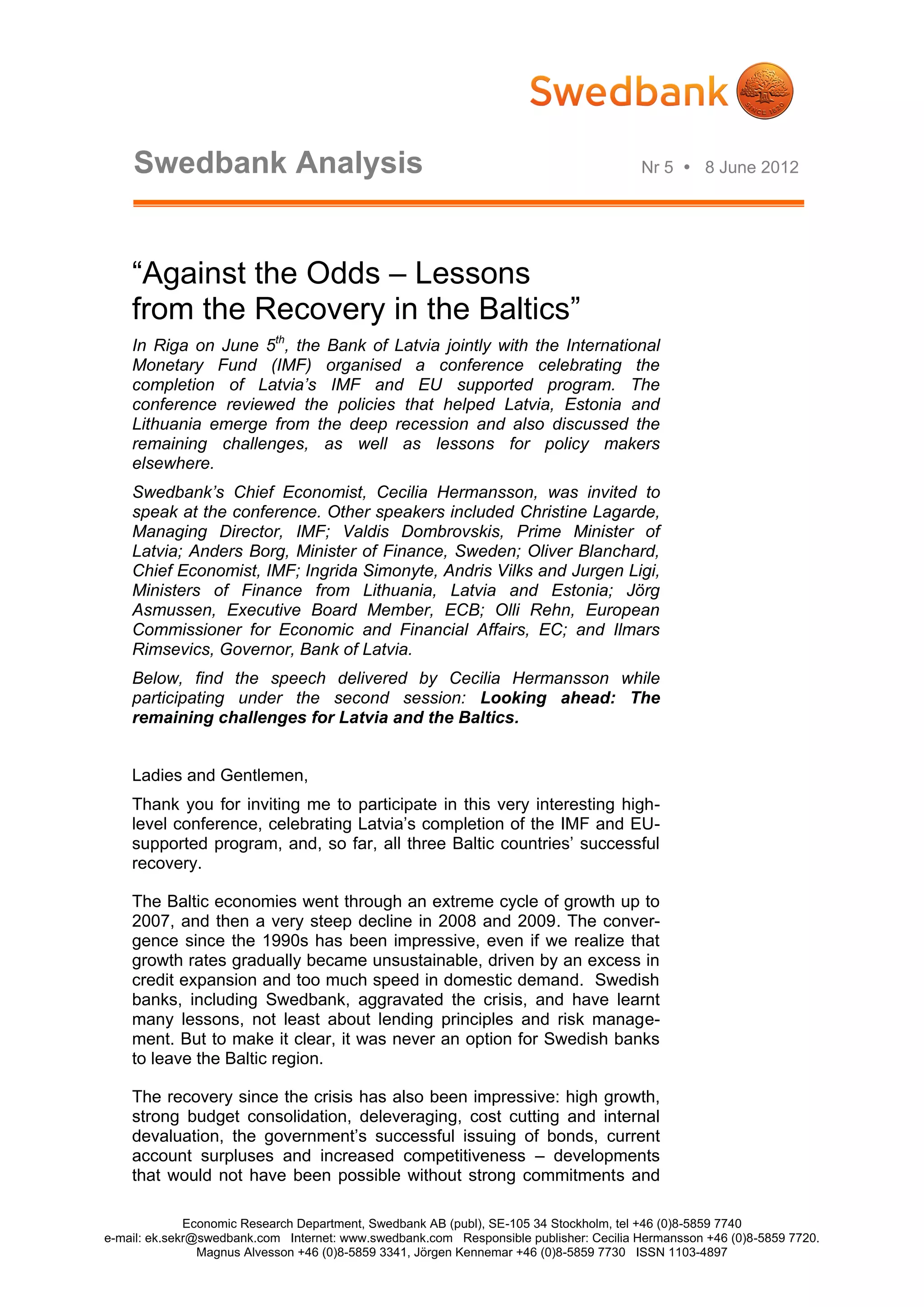
GDP-levels, Index 2000 = 100
                  190
                                                      Latvia
                  180

                  170
                                                               Lithuania
                  160

                  150
 Index 2000=100


                  140

                  130                                     Estonia

                  120

                  110
                                                           Eurozone
                  100

                  90

                  80
                        97 98 99 00 01 02 03 04 05 06 07 08 09 10 11


Source: Ecowin, National Statistics.


The deep recession has brought with it great economic and social
costs, such as high unemployment, increased poverty, emigration,
and an overhang of private debt. GDP levels are not yet back at pre-
crisis levels. The crisis in the euro area is now jeopardising the re-
covery in the Baltics. While acknowledging the great efforts and suc-
cess achieved by the Baltic countries, it is equally important that we
focus on the vulnerabilities that remain and the challenges that must
be dealt with in order to sustain the recovery and continue improving
competitiveness.

As it made sense for Estonia to become a member of the euro area, it
also makes sense for Latvia and Lithuania. For these countries, which
have for a long time maintained a fixed exchange rate regime, taking
the step towards full membership means access to a larger capital
market, increased stability and participation in euro area policymak-
ing. This, I believe, outweighs the possible drawbacks of giving up
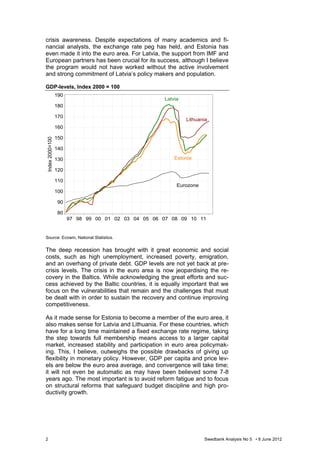
flexibility in monetary policy. However, GDP per capita and price lev-
els are below the euro area average, and convergence will take time;
it will not even be automatic as may have been believed some 7-8
years ago. The most important is to avoid reform fatigue and to focus
on structural reforms that safeguard budget discipline and high pro-
ductivity growth.


2                                                                     Swedbank Analysis No 5 • 8 June 2012
GDP per capita, EU-27 = 100

 120
 100
   80
   60
   40
   20
     0
           97 98 99 00 01 02 03 04 05 06 07 08 09 10
                    Eurozone     Estonia   Latvia   Lithuania

Source: Eurostat.


I will concentrate my discussion on three main challenges: 1) making
the most of globalisation and closing the productivity gap, 2) adapting
to demography and labor market trends, and 3) the need to
strengthen institutions.

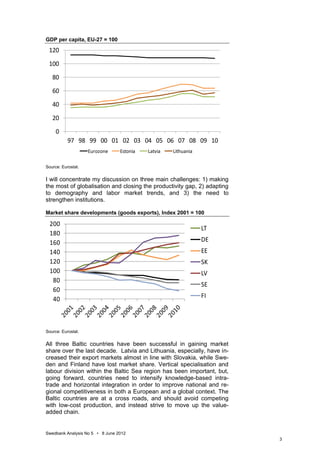
Market share developments (goods exports), Index 2001 = 100

 200
                                                                LT
 180
 160                                                            DE
 140                                                            EE
 120                                                            SK
 100                                                            LV
  80
                                                                SE
  60
  40                                                            FI


Source: Eurostat.


All three Baltic countries have been successful in gaining market
share over the last decade. Latvia and Lithuania, especially, have in-
creased their export markets almost in line with Slovakia, while Swe-
den and Finland have lost market share. Vertical specialisation and
labour division within the Baltic Sea region has been important, but,
going forward, countries need to intensify knowledge-based intra-
trade and horizontal integration in order to improve national and re-
gional competitiveness in both a European and a global context. The
Baltic countries are at a cross roads, and should avoid competing
with low-cost production, and instead strive to move up the value-
added chain.


Swedbank Analysis No 5 • 8 June 2012
                                                                          3
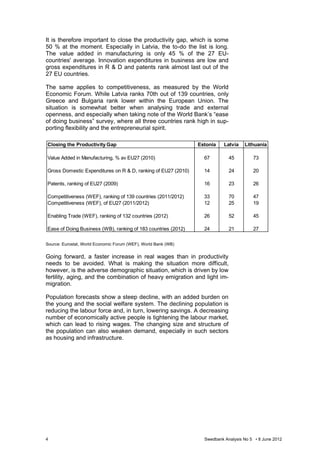
It is therefore important to close the productivity gap, which is some
50 % at the moment. Especially in Latvia, the to-do the list is long.
The value added in manufacturing is only 45 % of the 27 EU-
countries' average. Innovation expenditures in business are low and
gross expenditures in R & D and patents rank almost last out of the
27 EU countries.

The same applies to competitiveness, as measured by the World
Economic Forum. While Latvia ranks 70th out of 139 countries, only
Greece and Bulgaria rank lower within the European Union. The
situation is somewhat better when analysing trade and external
openness, and especially when taking note of the World Bank’s “ease
of doing business” survey, where all three countries rank high in sup-
porting flexibility and the entrepreneurial spirit.

Closing the Productivity Gap                                    Estonia    Latvia   Lithuania

Value Added in Manufacturing, % av EU27 (2010)                    67         45         73

Gross Domestic Expenditures on R & D, ranking of EU27 (2010)      14         24         20

Patents, ranking of EU27 (2009)                                   16         23         26

Competitiveness (WEF), ranking of 139 countries (2011/2012)       33         70         47
Competitiveness (WEF), of EU27 (2011/2012)                        12         25         19

Enabling Trade (WEF), ranking of 132 countries (2012)             26         52         45

Ease of Doing Business (WB), ranking of 183 countries (2012)      24         21         27

Source: Eurostat, World Economic Forum (WEF), World Bank (WB)


Going forward, a faster increase in real wages than in productivity
needs to be avoided. What is making the situation more difficult,
however, is the adverse demographic situation, which is driven by low
fertility, aging, and the combination of heavy emigration and light im-
migration.

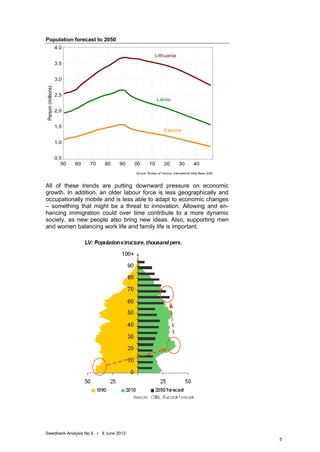
Population forecasts show a steep decline, with an added burden on
the young and the social welfare system. The declining population is
reducing the labour force and, in turn, lowering savings. A decreasing
number of economically active people is tightening the labour market,
which can lead to rising wages. The changing size and structure of
the population can also weaken demand, especially in such sectors
as housing and infrastructure.


4                                                                 Swedbank Analysis No 5 • 8 June 2012
Population forecast to 2050
                    4,0
                                                              Lithuania
                    3,5


                    3,0
Person (millions)


                    2,5
                                                              Latvia

                    2,0


                    1,5
                                                                    Estonia

                    1,0


                    0,5
                       50   60   70   80   90   00       10         20        30         40
                                                Source: Bureau of Census, International Data Base (IDB)


All of these trends are putting downward pressure on economic
growth. In addition, an older labour force is less geographically and
occupationally mobile and is less able to adapt to economic changes
– something that might be a threat to innovation. Allowing and en-
hancing immigration could over time contribute to a more dynamic
society, as new people also bring new ideas. Also, supporting men
and women balancing work life and family life is important.


Swedbank Analysis No 5 • 8 June 2012
                                                                                                          5
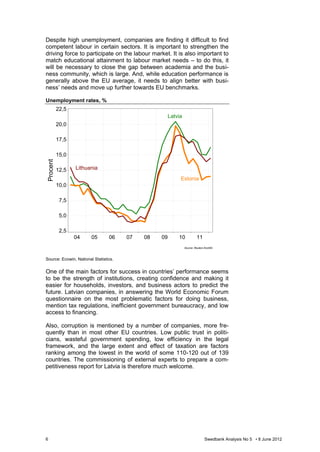
Despite high unemployment, companies are finding it difficult to find
competent labour in certain sectors. It is important to strengthen the
driving force to participate on the labour market. It is also important to
match educational attainment to labour market needs – to do this, it
will be necessary to close the gap between academia and the busi-
ness community, which is large. And, while education performance is
generally above the EU average, it needs to align better with busi-
ness’ needs and move up further towards EU benchmarks.

Unemployment rates, %
           22,5
                                                      Latvia
           20,0

           17,5

           15,0
 Procent


           12,5   Lithuania
                                                           Estonia
           10,0

            7,5

            5,0

            2,5
                  04    05       06    07   08   09       10            11
                                                               Source: Reuters EcoWin


Source: Ecowin, National Statistics.


One of the main factors for success in countries’ performance seems
to be the strength of institutions, creating confidence and making it
easier for households, investors, and business actors to predict the
future. Latvian companies, in answering the World Economic Forum
questionnaire on the most problematic factors for doing business,
mention tax regulations, inefficient government bureaucracy, and low
access to financing.

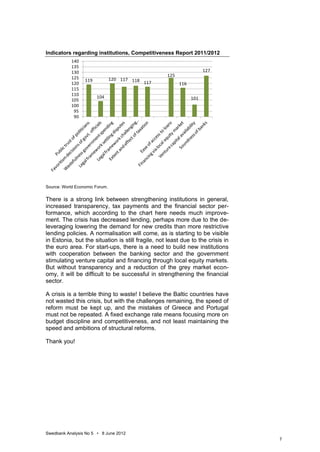
Also, corruption is mentioned by a number of companies, more fre-
quently than in most other EU countries. Low public trust in politi-
cians, wasteful government spending, low efficiency in the legal
framework, and the large extent and effect of taxation are factors
ranking among the lowest in the world of some 110-120 out of 139
countries. The commissioning of external experts to prepare a com-
petitiveness report for Latvia is therefore much welcome.


6                                                                             Swedbank Analysis No 5 • 8 June 2012
Indicators regarding institutions, Competitiveness Report 2011/2012
           140
           135
           130                                                       127
                                                   125
           125                  120 117 118
                  119                       117
           120                                           116
           115
           110
                        104                                    101
           105
           100
            95
            90


Source: World Economic Forum.


There is a strong link between strengthening institutions in general,
increased transparency, tax payments and the financial sector per-
formance, which according to the chart here needs much improve-
ment. The crisis has decreased lending, perhaps more due to the de-
leveraging lowering the demand for new credits than more restrictive
lending policies. A normalisation will come, as is starting to be visible
in Estonia, but the situation is still fragile, not least due to the crisis in
the euro area. For start-ups, there is a need to build new institutions
with cooperation between the banking sector and the government
stimulating venture capital and financing through local equity markets.
But without transparency and a reduction of the grey market econ-
omy, it will be difficult to be successful in strengthening the financial
sector.

A crisis is a terrible thing to waste! I believe the Baltic countries have
not wasted this crisis, but with the challenges remaining, the speed of
reform must be kept up, and the mistakes of Greece and Portugal
must not be repeated. A fixed exchange rate means focusing more on
budget discipline and competitiveness, and not least maintaining the
speed and ambitions of structural reforms.

Thank you!


Swedbank Analysis No 5 • 8 June 2012
                                                                                 7
Economic Research
Department                         Swedbank Analysis is published as a service to our customers. We believe
                                   that we have used reliable sources and methods in the preparation of the
SE-105 34 Stockholm                analyses reported in this publication. However, we cannot guarantee the
Telephone +46-(0)8-5859 7740       accuracy or completeness of the report and cannot be held responsible for
ek.sekr@swedbank.se
www.swedbank.se
                                   any error or omission in the underlying material or its use. Readers are en-
                                   couraged to base any (investment) decisions on other material as well. Nei-
Legally responsible publisher      ther Swedbank nor its employees may be held responsible for losses or
Cecilia Hermansson,
                                   damages, direct or indirect, owing to any errors or omissions in Swedbank
+46-8-5859 7720.
                                   Analysis.
Magnus Alvesson, +46-8-5859 3341
Jörgen Kennemar, +46-8-5859 7730
ISSN 1103-4897

Swedbank Analysis No.5 - June 8, 2012

  • 1.
    Swedbank Analysis Nr 5  8 June 2012 “Against the Odds – Lessons from the Recovery in the Baltics” In Riga on June 5th, the Bank of Latvia jointly with the International Monetary Fund (IMF) organised a conference celebrating the completion of Latvia’s IMF and EU supported program. The conference reviewed the policies that helped Latvia, Estonia and Lithuania emerge from the deep recession and also discussed the remaining challenges, as well as lessons for policy makers elsewhere. Swedbank’s Chief Economist, Cecilia Hermansson, was invited to speak at the conference. Other speakers included Christine Lagarde, Managing Director, IMF; Valdis Dombrovskis, Prime Minister of Latvia; Anders Borg, Minister of Finance, Sweden; Oliver Blanchard, Chief Economist, IMF; Ingrida Simonyte, Andris Vilks and Jurgen Ligi, Ministers of Finance from Lithuania, Latvia and Estonia; Jörg Asmussen, Executive Board Member, ECB; Olli Rehn, European Commissioner for Economic and Financial Affairs, EC; and Ilmars Rimsevics, Governor, Bank of Latvia. Below, find the speech delivered by Cecilia Hermansson while participating under the second session: Looking ahead: The remaining challenges for Latvia and the Baltics. Ladies and Gentlemen, Thank you for inviting me to participate in this very interesting high- level conference, celebrating Latvia’s completion of the IMF and EU- supported program, and, so far, all three Baltic countries’ successful recovery. The Baltic economies went through an extreme cycle of growth up to 2007, and then a very steep decline in 2008 and 2009. The conver- gence since the 1990s has been impressive, even if we realize that growth rates gradually became unsustainable, driven by an excess in credit expansion and too much speed in domestic demand. Swedish banks, including Swedbank, aggravated the crisis, and have learnt many lessons, not least about lending principles and risk manage- ment. But to make it clear, it was never an option for Swedish banks to leave the Baltic region. The recovery since the crisis has also been impressive: high growth, strong budget consolidation, deleveraging, cost cutting and internal devaluation, the government’s successful issuing of bonds, current account surpluses and increased competitiveness – developments that would not have been possible without strong commitments and Economic Research Department, Swedbank AB (publ), SE-105 34 Stockholm, tel +46 (0)8-5859 7740 e-mail: ek.sekr@swedbank.com Internet: www.swedbank.com Responsible publisher: Cecilia Hermansson +46 (0)8-5859 7720. Magnus Alvesson +46 (0)8-5859 3341, Jörgen Kennemar +46 (0)8-5859 7730 ISSN 1103-4897
  • 2.
    crisis awareness. Despiteexpectations of many academics and fi- nancial analysts, the exchange rate peg has held, and Estonia has even made it into the euro area. For Latvia, the support from IMF and European partners has been crucial for its success, although I believe the program would not have worked without the active involvement and strong commitment of Latvia’s policy makers and population. GDP-levels, Index 2000 = 100 190 Latvia 180 170 Lithuania 160 150 Index 2000=100 140 130 Estonia 120 110 Eurozone 100 90 80 97 98 99 00 01 02 03 04 05 06 07 08 09 10 11 Source: Ecowin, National Statistics. The deep recession has brought with it great economic and social costs, such as high unemployment, increased poverty, emigration, and an overhang of private debt. GDP levels are not yet back at pre- crisis levels. The crisis in the euro area is now jeopardising the re- covery in the Baltics. While acknowledging the great efforts and suc- cess achieved by the Baltic countries, it is equally important that we focus on the vulnerabilities that remain and the challenges that must be dealt with in order to sustain the recovery and continue improving competitiveness. As it made sense for Estonia to become a member of the euro area, it also makes sense for Latvia and Lithuania. For these countries, which have for a long time maintained a fixed exchange rate regime, taking the step towards full membership means access to a larger capital market, increased stability and participation in euro area policymak- ing. This, I believe, outweighs the possible drawbacks of giving up flexibility in monetary policy. However, GDP per capita and price lev- els are below the euro area average, and convergence will take time; it will not even be automatic as may have been believed some 7-8 years ago. The most important is to avoid reform fatigue and to focus on structural reforms that safeguard budget discipline and high pro- ductivity growth. 2 Swedbank Analysis No 5 • 8 June 2012
  • 3.
    GDP per capita,EU-27 = 100 120 100 80 60 40 20 0 97 98 99 00 01 02 03 04 05 06 07 08 09 10 Eurozone Estonia Latvia Lithuania Source: Eurostat. I will concentrate my discussion on three main challenges: 1) making the most of globalisation and closing the productivity gap, 2) adapting to demography and labor market trends, and 3) the need to strengthen institutions. Market share developments (goods exports), Index 2001 = 100 200 LT 180 160 DE 140 EE 120 SK 100 LV 80 SE 60 40 FI Source: Eurostat. All three Baltic countries have been successful in gaining market share over the last decade. Latvia and Lithuania, especially, have in- creased their export markets almost in line with Slovakia, while Swe- den and Finland have lost market share. Vertical specialisation and labour division within the Baltic Sea region has been important, but, going forward, countries need to intensify knowledge-based intra- trade and horizontal integration in order to improve national and re- gional competitiveness in both a European and a global context. The Baltic countries are at a cross roads, and should avoid competing with low-cost production, and instead strive to move up the value- added chain. Swedbank Analysis No 5 • 8 June 2012 3
  • 4.
    It is thereforeimportant to close the productivity gap, which is some 50 % at the moment. Especially in Latvia, the to-do the list is long. The value added in manufacturing is only 45 % of the 27 EU- countries' average. Innovation expenditures in business are low and gross expenditures in R & D and patents rank almost last out of the 27 EU countries. The same applies to competitiveness, as measured by the World Economic Forum. While Latvia ranks 70th out of 139 countries, only Greece and Bulgaria rank lower within the European Union. The situation is somewhat better when analysing trade and external openness, and especially when taking note of the World Bank’s “ease of doing business” survey, where all three countries rank high in sup- porting flexibility and the entrepreneurial spirit. Closing the Productivity Gap Estonia Latvia Lithuania Value Added in Manufacturing, % av EU27 (2010) 67 45 73 Gross Domestic Expenditures on R & D, ranking of EU27 (2010) 14 24 20 Patents, ranking of EU27 (2009) 16 23 26 Competitiveness (WEF), ranking of 139 countries (2011/2012) 33 70 47 Competitiveness (WEF), of EU27 (2011/2012) 12 25 19 Enabling Trade (WEF), ranking of 132 countries (2012) 26 52 45 Ease of Doing Business (WB), ranking of 183 countries (2012) 24 21 27 Source: Eurostat, World Economic Forum (WEF), World Bank (WB) Going forward, a faster increase in real wages than in productivity needs to be avoided. What is making the situation more difficult, however, is the adverse demographic situation, which is driven by low fertility, aging, and the combination of heavy emigration and light im- migration. Population forecasts show a steep decline, with an added burden on the young and the social welfare system. The declining population is reducing the labour force and, in turn, lowering savings. A decreasing number of economically active people is tightening the labour market, which can lead to rising wages. The changing size and structure of the population can also weaken demand, especially in such sectors as housing and infrastructure. 4 Swedbank Analysis No 5 • 8 June 2012
  • 5.
    Population forecast to2050 4,0 Lithuania 3,5 3,0 Person (millions) 2,5 Latvia 2,0 1,5 Estonia 1,0 0,5 50 60 70 80 90 00 10 20 30 40 Source: Bureau of Census, International Data Base (IDB) All of these trends are putting downward pressure on economic growth. In addition, an older labour force is less geographically and occupationally mobile and is less able to adapt to economic changes – something that might be a threat to innovation. Allowing and en- hancing immigration could over time contribute to a more dynamic society, as new people also bring new ideas. Also, supporting men and women balancing work life and family life is important. Swedbank Analysis No 5 • 8 June 2012 5
  • 6.
    Despite high unemployment,companies are finding it difficult to find competent labour in certain sectors. It is important to strengthen the driving force to participate on the labour market. It is also important to match educational attainment to labour market needs – to do this, it will be necessary to close the gap between academia and the busi- ness community, which is large. And, while education performance is generally above the EU average, it needs to align better with busi- ness’ needs and move up further towards EU benchmarks. Unemployment rates, % 22,5 Latvia 20,0 17,5 15,0 Procent 12,5 Lithuania Estonia 10,0 7,5 5,0 2,5 04 05 06 07 08 09 10 11 Source: Reuters EcoWin Source: Ecowin, National Statistics. One of the main factors for success in countries’ performance seems to be the strength of institutions, creating confidence and making it easier for households, investors, and business actors to predict the future. Latvian companies, in answering the World Economic Forum questionnaire on the most problematic factors for doing business, mention tax regulations, inefficient government bureaucracy, and low access to financing. Also, corruption is mentioned by a number of companies, more fre- quently than in most other EU countries. Low public trust in politi- cians, wasteful government spending, low efficiency in the legal framework, and the large extent and effect of taxation are factors ranking among the lowest in the world of some 110-120 out of 139 countries. The commissioning of external experts to prepare a com- petitiveness report for Latvia is therefore much welcome. 6 Swedbank Analysis No 5 • 8 June 2012
  • 7.
    Indicators regarding institutions,Competitiveness Report 2011/2012 140 135 130 127 125 125 120 117 118 119 117 120 116 115 110 104 101 105 100 95 90 Source: World Economic Forum. There is a strong link between strengthening institutions in general, increased transparency, tax payments and the financial sector per- formance, which according to the chart here needs much improve- ment. The crisis has decreased lending, perhaps more due to the de- leveraging lowering the demand for new credits than more restrictive lending policies. A normalisation will come, as is starting to be visible in Estonia, but the situation is still fragile, not least due to the crisis in the euro area. For start-ups, there is a need to build new institutions with cooperation between the banking sector and the government stimulating venture capital and financing through local equity markets. But without transparency and a reduction of the grey market econ- omy, it will be difficult to be successful in strengthening the financial sector. A crisis is a terrible thing to waste! I believe the Baltic countries have not wasted this crisis, but with the challenges remaining, the speed of reform must be kept up, and the mistakes of Greece and Portugal must not be repeated. A fixed exchange rate means focusing more on budget discipline and competitiveness, and not least maintaining the speed and ambitions of structural reforms. Thank you! Swedbank Analysis No 5 • 8 June 2012 7
  • 8.
    Economic Research Department Swedbank Analysis is published as a service to our customers. We believe that we have used reliable sources and methods in the preparation of the SE-105 34 Stockholm analyses reported in this publication. However, we cannot guarantee the Telephone +46-(0)8-5859 7740 accuracy or completeness of the report and cannot be held responsible for ek.sekr@swedbank.se www.swedbank.se any error or omission in the underlying material or its use. Readers are en- couraged to base any (investment) decisions on other material as well. Nei- Legally responsible publisher ther Swedbank nor its employees may be held responsible for losses or Cecilia Hermansson, damages, direct or indirect, owing to any errors or omissions in Swedbank +46-8-5859 7720. Analysis. Magnus Alvesson, +46-8-5859 3341 Jörgen Kennemar, +46-8-5859 7730 ISSN 1103-4897