Year-end report 2016, 2 February 2017
Q4 2016
Swedbank – Year-end report 2016 Page 1 of 51
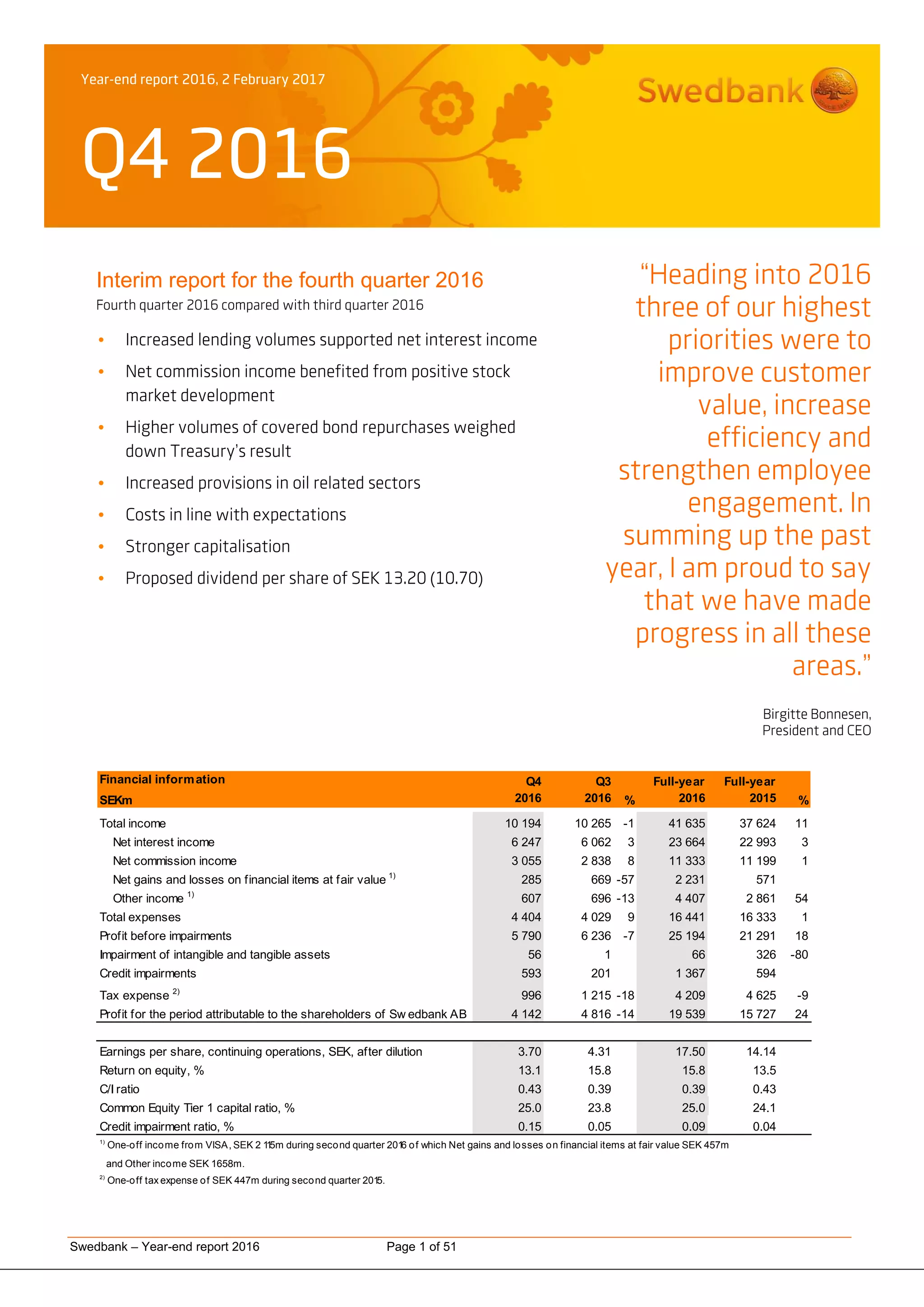
Interim report for the fourth quarter 2016
Fourth quarter 2016 compared with third quarter 2016
 Increased lending volumes supported net interest income
 Net commission income benefited from positive stock
market development
 Higher volumes of covered bond repurchases weighed
down Treasury’s result
 Increased provisions in oil related sectors
 Costs in line with expectations
 Stronger capitalisation
 Proposed dividend per share of SEK 13.20 (10.70)
“Heading into 2016
three of our highest
priorities were to
improve customer
value, increase
efficiency and
strengthen employee
engagement. In
summing up the past
year, I am proud to say
that we have made
progress in all these
areas.”
Birgitte Bonnesen,
President and CEO
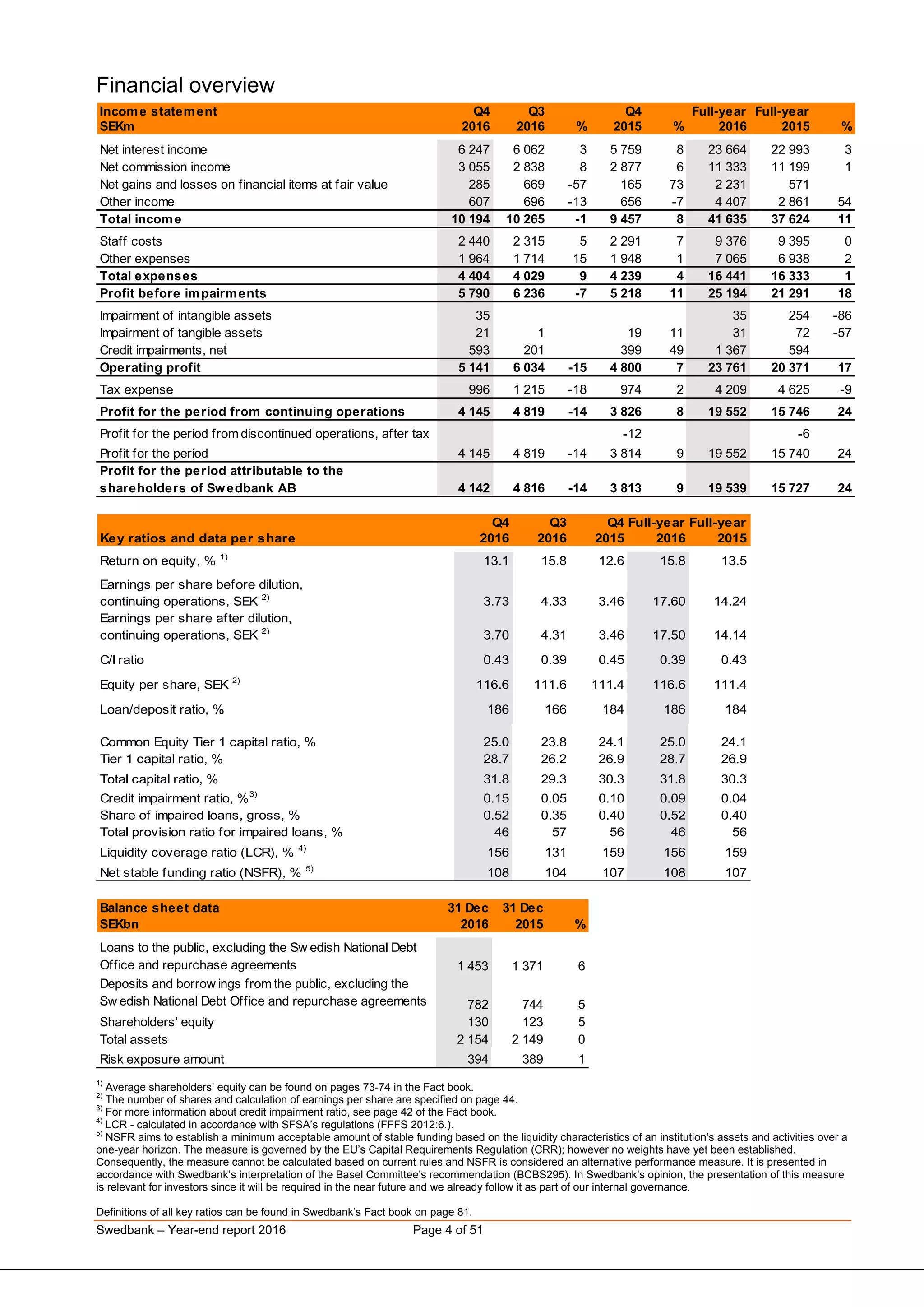
Financial information Q4 Q3 Full-year Full-year
SEKm 2016 2016 % 2016 2015 %
Total income 10 194 10 265 -1 41 635 37 624 11
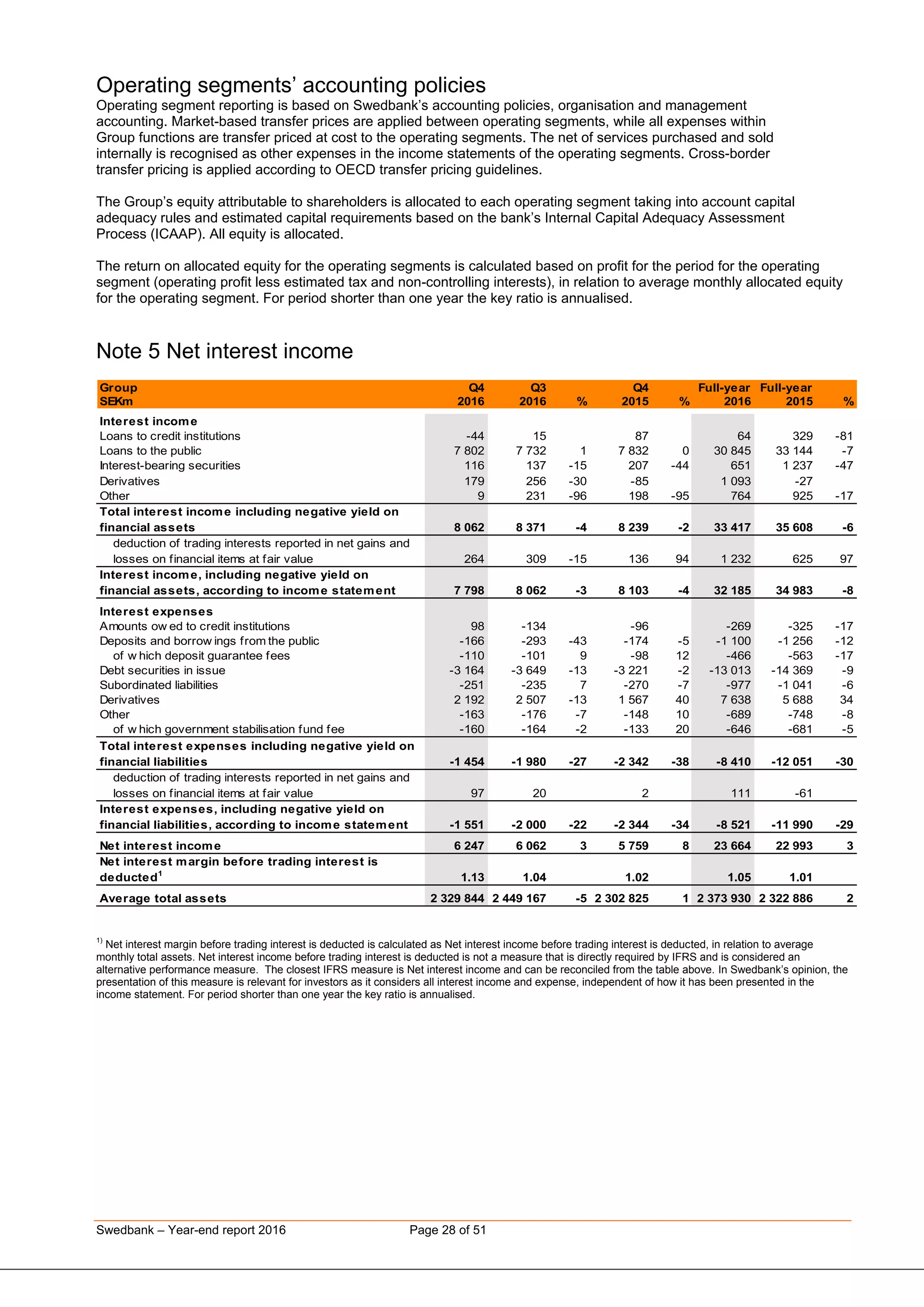
Net interest income 6 247 6 062 3 23 664 22 993 3
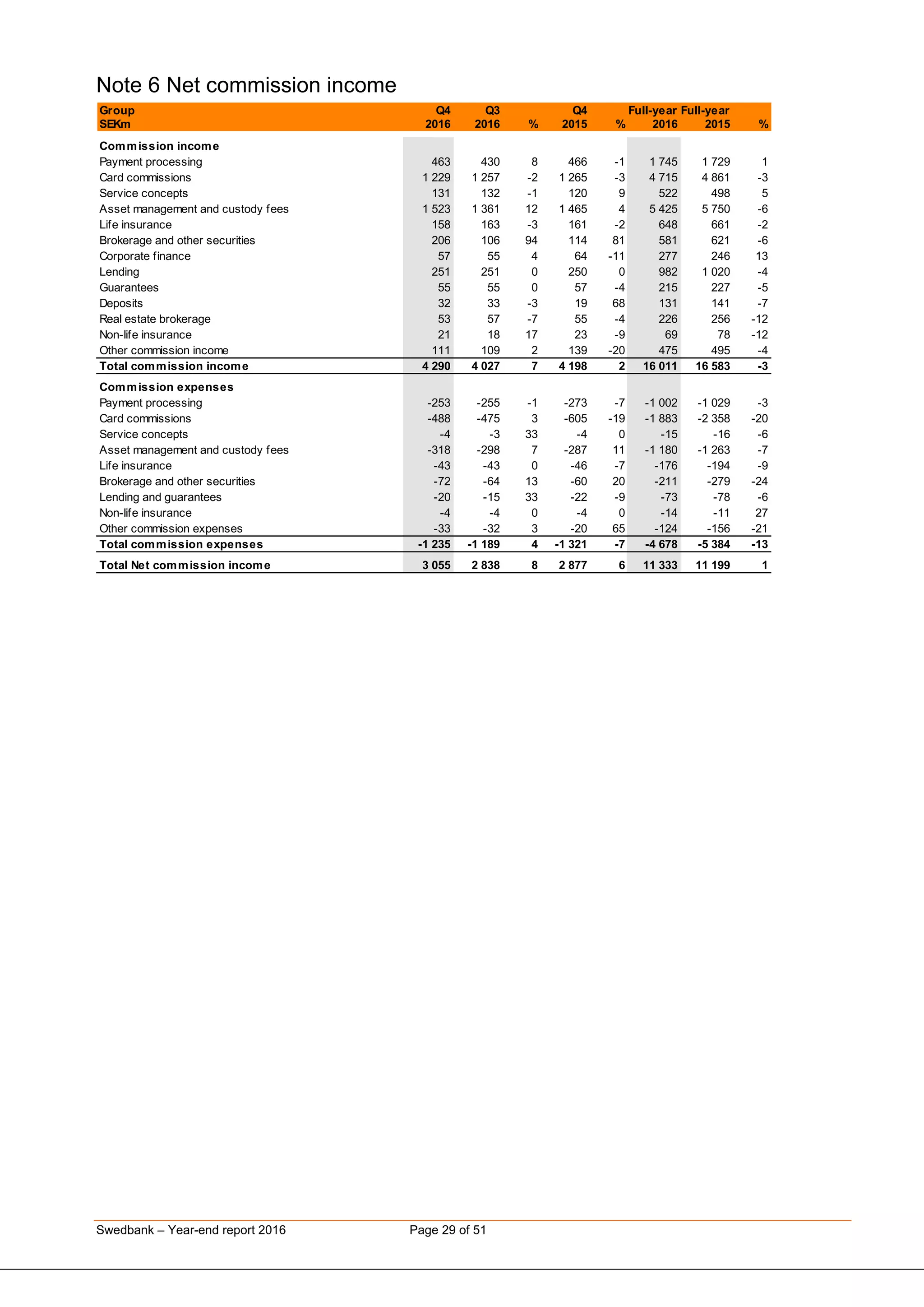
Net commission income 3 055 2 838 8 11 333 11 199 1
Net gains and losses on financial items at fair value 1)
285 669 -57 2 231 571
Other income 1)
607 696 -13 4 407 2 861 54
Total expenses 4 404 4 029 9 16 441 16 333 1
Profit before impairments 5 790 6 236 -7 25 194 21 291 18
Impairment of intangible and tangible assets 56 1 66 326 -80
Credit impairments 593 201 1 367 594
Tax expense 2)
996 1 215 -18 4 209 4 625 -9
Profit for the period attributable to the shareholders of Sw edbank AB 4 142 4 816 -14 19 539 15 727 24
Earnings per share, continuing operations, SEK, after dilution 3.70 4.31 17.50 14.14
Return on equity, % 13.1 15.8 15.8 13.5
C/I ratio 0.43 0.39 0.39 0.43
Common Equity Tier 1 capital ratio, % 25.0 23.8 25.0 24.1
Credit impairment ratio, % 0.15 0.05 0.09 0.04
1)
One-off income from VISA, SEK 2 115m during second quarter 2016 of which Net gains and losses on financial items at fair value SEK 457m
and Other income SEK 1658m.
2)
One-off tax expense of SEK 447m during second quarter 2015.
Swedbank – Year-end report 2016 Page 2 of 51
CEO Comment
Heading into 2016 three of our highest priorities were
to improve customer value, increase efficiency and
strengthen employee engagement. In summing up the
past year, I am proud to say that we have made
progress in all these areas.
The new executive management team I appointed in
the first half of the year worked to make our strategy
more concrete. We also created a new unit, Digital
Banking, to develop our digital offerings with the aim of
increasing customer value. During the year we
launched a number of new digital functions that make
everyday banking easier for our customers. In the last
quarter our corporate customers were able for the first
time to open multicurrency group accounts. Private
customers in the Baltic countries can now apply for
small loans in the Mobile Bank. We also increased
availability by translating basic information on products
and services on our Swedish website to eight
languages, and for doing so received an annual
diversity award from the magazine Privata Affärer.
We continued to strengthen a cost-conscious culture,
including by centralising procurement and automating
more processes. Efficiency improvements such as
these have enabled us to make more investments that
benefit our customers.
Perhaps the most important progress made was that
our employees now feel more engaged and prouder to
work at Swedbank. I am very pleased with this. More
satisfied employees create the conditions for more
satisfied customers.
There is room for improvement in several areas,
however. For example, our own Swedish customer
satisfaction survey, in which over 35 000 customers
were interviewed in the fourth quarter, showed only a
marginal improvement among private customers and a
slight decline among corporate customers. We are
therefore conducting a more thorough analysis to
develop additional improvement initiatives. A changing
world requires us to constantly improve. We therefore
have numerous initiatives planned in 2017 targeting
our customers and employees as well as several
efficiency improvements. Among other things, we will
establish a new unit, Customer Value Management, to
develop our ability to offer customised products and
services.
Strong financial result
From a macroeconomic standpoint the year ended on
a strong note. We saw good growth in Europe and the
US at the same time that the economic outlook is more
positive than it has been for a long time. The Swedish
economy also continues to grow. Geopolitical
uncertainty has risen in parts of the world, however,
and we face a number of important events such as
national elections and trade agreement negotiations
that could impact the global economy and the financial
sector.
Our financial results in the fourth quarter were
positively affected by volume growth in mortgage
lending at the same time that lending margins
increased slightly. Volumes grew after we took in the
last customer portfolio related to the acquisition of
Sparbanken Öresund and also due to continuous high
demand in the Swedish housing market. Our
population continues to grow. While this is
fundamentally positive in that it creates opportunities
for economic growth and well-being, it also increases
the need for an immediate solution to the imbalance
between supply and demand in the housing market.
Our politicians should come to an agreement as soon
as possible on a policy covering key areas such as the
rental market, building permit regulations and taxation
tied to housing. I am convinced that a sustainable
solution to the shortage of housing in Sweden can be
found.
Customer activity remained high in the Baltic countries
in the fourth quarter. This is reflected in both lending
volumes for private customers and payment
transactions.
An eventful quarter for equities and currencies led to
higher income in asset management and commissions.
Additionally, we helped several corporate customers
raise capital through bond issues. A highlight was
Kommuninvest’s green bond issue in SEK, the largest
to date.
Total expenses for the year amounted to SEK 16.4bn,
in line with our communication last quarter. Cost
efficiency remains one of our highest priorities in order
to create the investment capacity needed to provide
greater value to customers. As mentioned in the
publication of the third quarter results, we will utilise
this capacity to invest more in the areas of savings,
lending and digital banking. For the full-year 2017 we
therefore estimate our total expenses at SEK 16.7bn.
Credit quality remains solid with strong resilience in all
our home markets. During the quarter we allocated
further provisions in our oil related loan portfolio. We
will continue to work closely with our customers to find
constructive solutions to the challenges they face.
Our capital position was further strengthened during
the quarter. We maintain a comfortable buffer vis-à-vis
the minimum requirements set by the Swedish
Financial Supervisory Authority. This has enabled the
Board of Directors, for the fifth consecutive year, to
propose that 75 per cent of profit for the year be
distributed to shareholders. This corresponds to a
dividend of SEK 13.20 (10.70) per share for 2016.
Exciting year full of opportunities awaits
When I look ahead, I do so with confidence. We have
many activities underway that will offer our customers
an even better experience and bring us closer to the
modern bank we want to be. The new year has begun
at full speed and it is fantastic to see the positive
energy we succeeded in creating within the bank.
Because of this, I am greatly optimistic about the
challenges before us.
Birgitte Bonnesen
President and CEO
Swedbank – Year-end report 2016 Page 3 of 51
Table of contents
Page
Overview 5
Market 5
Important to note 5
Group development 5
Result fourth quarter 2016 compared with third quarter 2016 5
Result full-year 2016 compared with full-year 2015 6
Volume trend by product area 6
Credit and asset quality 8
Operational risks 9
Funding and liquidity 9
Ratings 9
Capital and capital adequacy 9
Other events 10
Events after 31 December 2016 10
Business segments
Swedish Banking 11
Baltic Banking 13
Large Corporates & Institutions 15
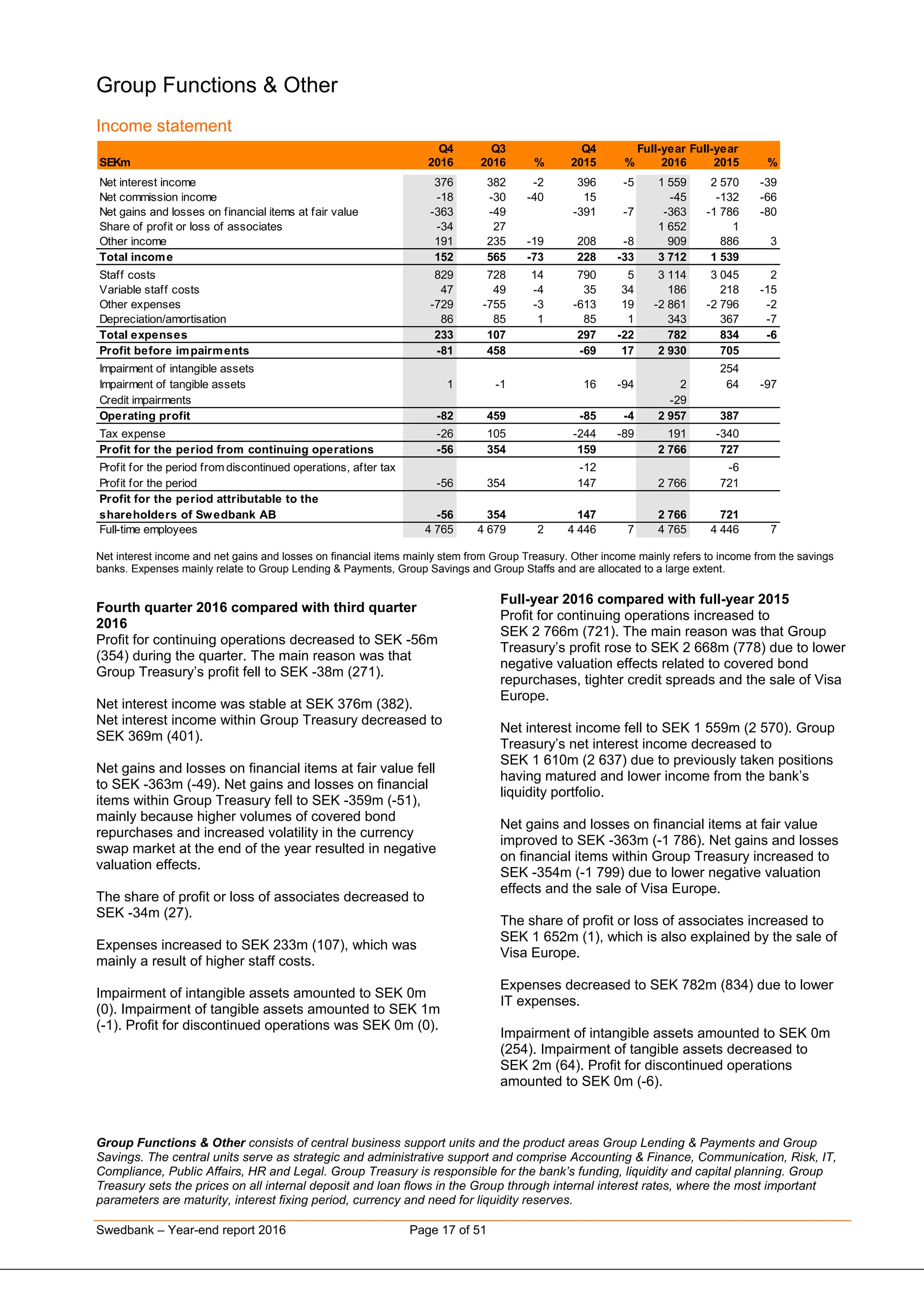
Group Functions & Other 17
Eliminations 18
Group
Income statement, condensed 20
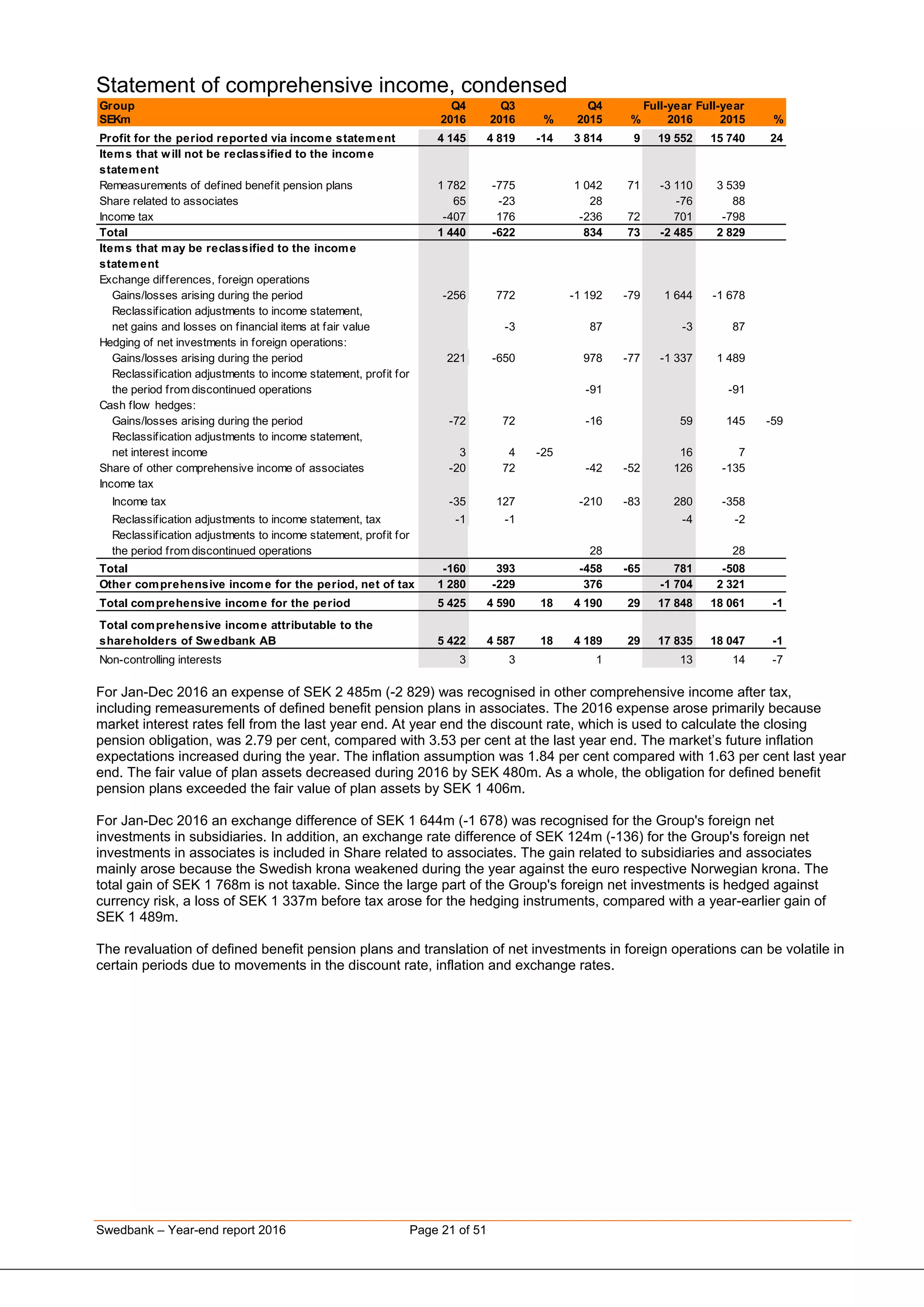
Statement of comprehensive income, condensed 21
Balance sheet, condensed 22
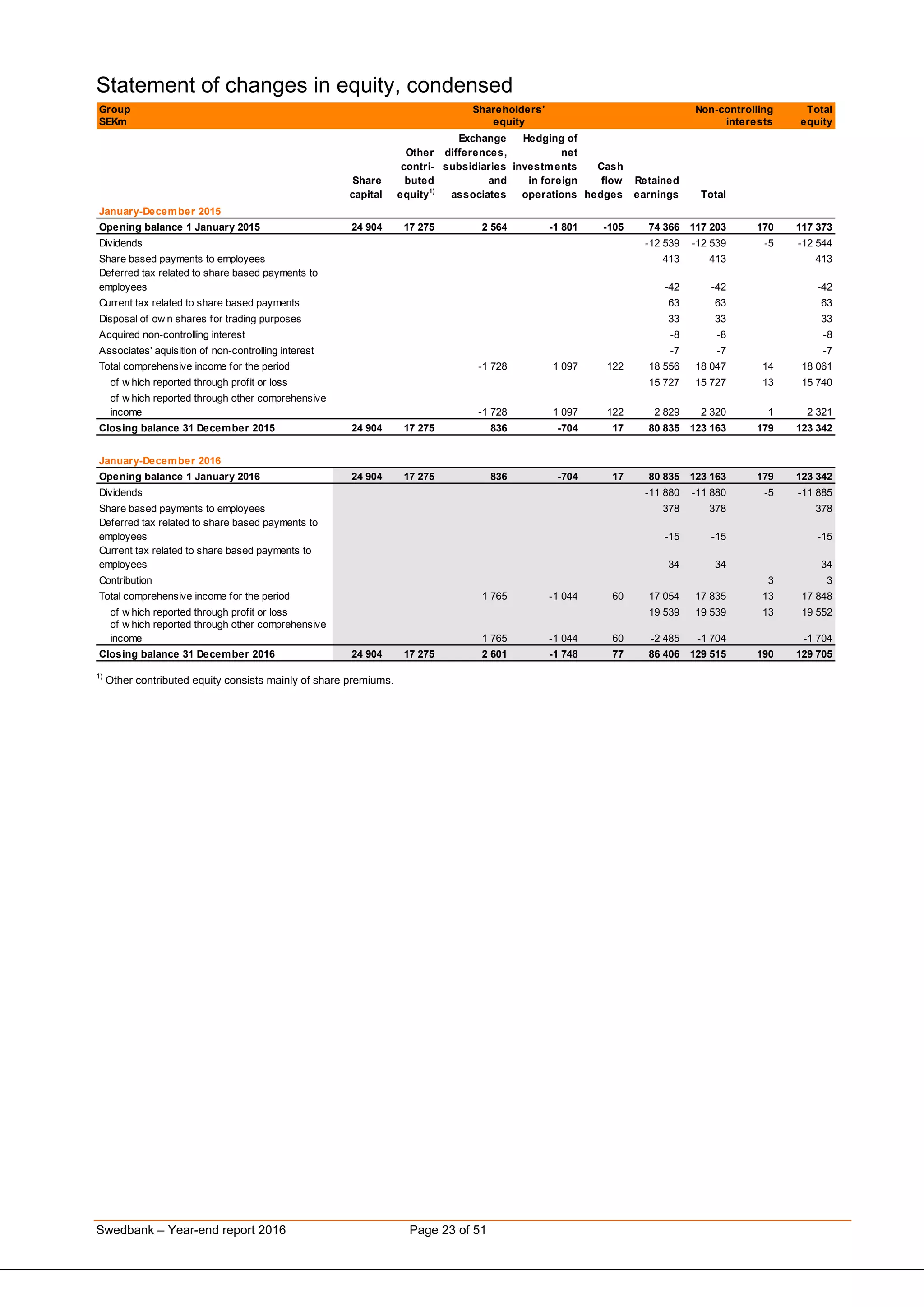
Statement of changes in equity, condensed 23
Cash flow statement, condensed 24
Notes 25
Parent company 44
Dividend paid and proposed disposition of earnings 49
Signatures of the Board of Directors and the President 50
Review report 50
Contact information 51
More detailed information can be found in Swedbank’s Fact book, www.swedbank.com/ir, under Financial information and publications.
Swedbank – Year-end report 2016 Page 4 of 51
Financial overview
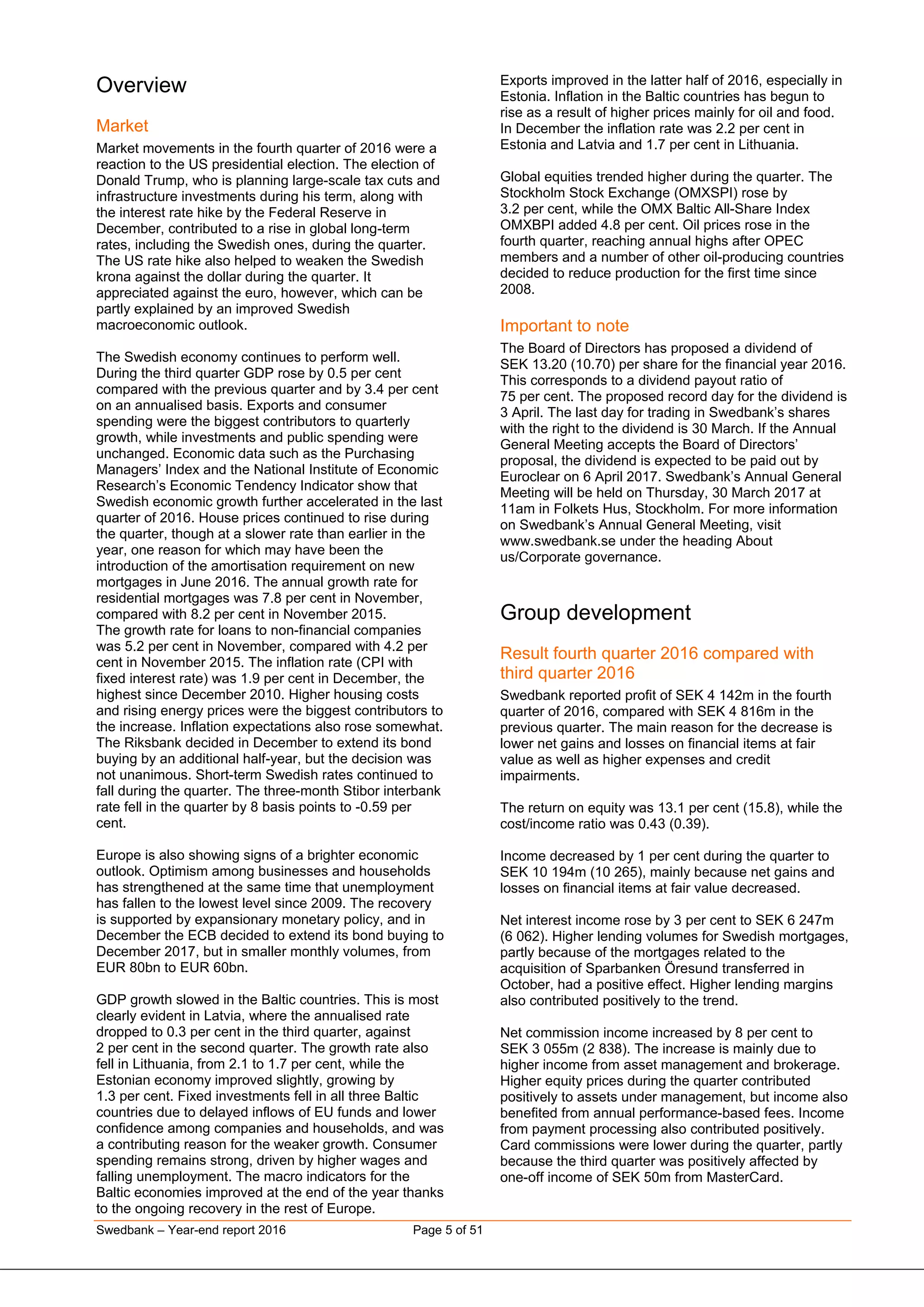
Income statement Q4 Q3 Q4 Full-year Full-year
SEKm 2016 2016 % 2015 % 2016 2015 %
Net interest income 6 247 6 062 3 5 759 8 23 664 22 993 3
Net commission income 3 055 2 838 8 2 877 6 11 333 11 199 1
Net gains and losses on financial items at fair value 285 669 -57 165 73 2 231 571
Other income 607 696 -13 656 -7 4 407 2 861 54
Total income 10 194 10 265 -1 9 457 8 41 635 37 624 11
Staff costs 2 440 2 315 5 2 291 7 9 376 9 395 0
Other expenses 1 964 1 714 15 1 948 1 7 065 6 938 2
Total expenses 4 404 4 029 9 4 239 4 16 441 16 333 1
Profit before impairments 5 790 6 236 -7 5 218 11 25 194 21 291 18
Impairment of intangible assets 35 0 0 35 254 -86
Impairment of tangible assets 21 1 19 11 31 72 -57
Credit impairments, net 593 201 399 49 1 367 594
Operating profit 5 141 6 034 -15 4 800 7 23 761 20 371 17
Tax expense 996 1 215 -18 974 2 4 209 4 625 -9
Profit for the period from continuing operations 4 145 4 819 -14 3 826 8 19 552 15 746 24
Profit for the period from discontinued operations, after tax 0 0 -12 0 -6
Profit for the period 4 145 4 819 -14 3 814 9 19 552 15 740 24
Profit for the period attributable to the
shareholders of Swedbank AB 4 142 4 816 -14 3 813 9 19 539 15 727 24
Q4 Q3 Q4 Full-year Full-year
Key ratios and data per share 2016 2016 2015 2016 2015
Return on equity, % 1)
13.1 15.8 12.6 15.8 13.5
Earnings per share before dilution,
continuing operations, SEK 2)
3.73 4.33 3.46 17.60 14.24
Earnings per share after dilution,
continuing operations, SEK 2)
3.70 4.31 3.46 17.50 14.14
C/I ratio 0.43 0.39 0.45 0.39 0.43
Equity per share, SEK 2)
116.6 111.6 111.4 116.6 111.4
Loan/deposit ratio, % 186 166 184 186 184
Common Equity Tier 1 capital ratio, % 25.0 23.8 24.1 25.0 24.1
Tier 1 capital ratio, % 28.7 26.2 26.9 28.7 26.9
Total capital ratio, % 31.8 29.3 30.3 31.8 30.3
Credit impairment ratio, %3)
0.15 0.05 0.10 0.09 0.04
Share of impaired loans, gross, % 0.52 0.35 0.40 0.52 0.40
Total provision ratio for impaired loans, % 46 57 56 46 56
Liquidity coverage ratio (LCR), % 4)
156 131 159 156 159
Net stable funding ratio (NSFR), % 5)
108 104 107 108 107
Balance sheet data 31 Dec 31 Dec
SEKbn 2016 2015 %
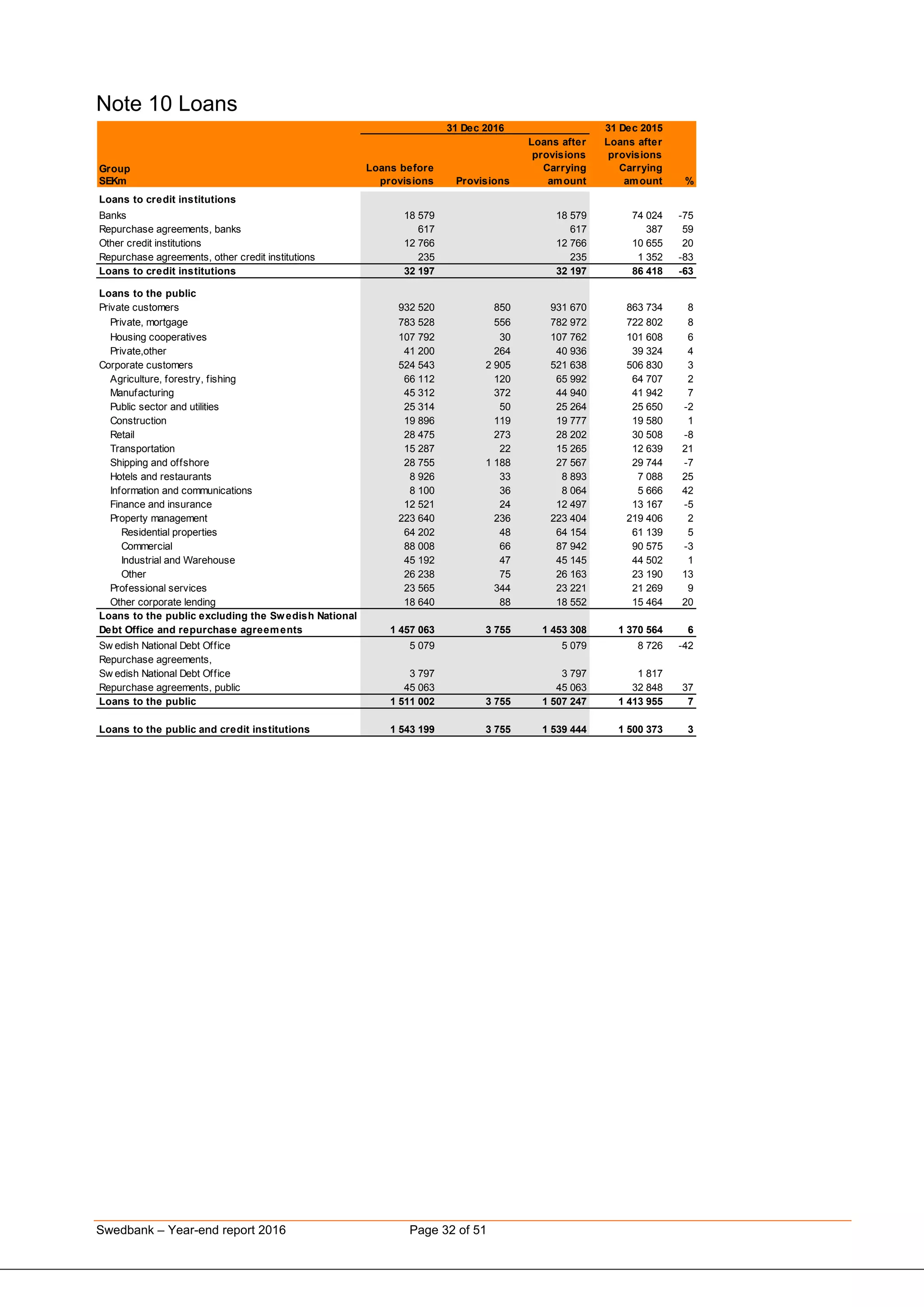
Loans to the public, excluding the Sw edish National Debt
Office and repurchase agreements 1 453 1 371 6
Deposits and borrow ings from the public, excluding the
Sw edish National Debt Office and repurchase agreements 782 744 5
Shareholders' equity 130 123 5
Total assets 2 154 2 149 0
Risk exposure amount 394 389 1
1)
Average shareholders’ equity can be found on pages 73-74 in the Fact book.
2)
The number of shares and calculation of earnings per share are specified on page 44.
3)
For more information about credit impairment ratio, see page 42 of the Fact book.
4)
LCR - calculated in accordance with SFSA’s regulations (FFFS 2012:6.).
5)
NSFR aims to establish a minimum acceptable amount of stable funding based on the liquidity characteristics of an institution’s assets and activities over a
one-year horizon. The measure is governed by the EU’s Capital Requirements Regulation (CRR); however no weights have yet been established.
Consequently, the measure cannot be calculated based on current rules and NSFR is considered an alternative performance measure. It is presented in
accordance with Swedbank’s interpretation of the Basel Committee’s recommendation (BCBS295). In Swedbank’s opinion, the presentation of this measure
is relevant for investors since it will be required in the near future and we already follow it as part of our internal governance.
Definitions of all key ratios can be found in Swedbank’s Fact book on page 81.
Swedbank – Year-end report 2016 Page 5 of 51
Overview
Market
Market movements in the fourth quarter of 2016 were a
reaction to the US presidential election. The election of
Donald Trump, who is planning large-scale tax cuts and
infrastructure investments during his term, along with
the interest rate hike by the Federal Reserve in
December, contributed to a rise in global long-term
rates, including the Swedish ones, during the quarter.
The US rate hike also helped to weaken the Swedish
krona against the dollar during the quarter. It
appreciated against the euro, however, which can be
partly explained by an improved Swedish
macroeconomic outlook.
The Swedish economy continues to perform well.
During the third quarter GDP rose by 0.5 per cent
compared with the previous quarter and by 3.4 per cent
on an annualised basis. Exports and consumer
spending were the biggest contributors to quarterly
growth, while investments and public spending were
unchanged. Economic data such as the Purchasing
Managers’ Index and the National Institute of Economic
Research’s Economic Tendency Indicator show that
Swedish economic growth further accelerated in the last
quarter of 2016. House prices continued to rise during
the quarter, though at a slower rate than earlier in the
year, one reason for which may have been the
introduction of the amortisation requirement on new
mortgages in June 2016. The annual growth rate for
residential mortgages was 7.8 per cent in November,
compared with 8.2 per cent in November 2015.
The growth rate for loans to non-financial companies
was 5.2 per cent in November, compared with 4.2 per
cent in November 2015. The inflation rate (CPI with
fixed interest rate) was 1.9 per cent in December, the
highest since December 2010. Higher housing costs
and rising energy prices were the biggest contributors to
the increase. Inflation expectations also rose somewhat.
The Riksbank decided in December to extend its bond
buying by an additional half-year, but the decision was
not unanimous. Short-term Swedish rates continued to
fall during the quarter. The three-month Stibor interbank
rate fell in the quarter by 8 basis points to -0.59 per
cent.
Europe is also showing signs of a brighter economic
outlook. Optimism among businesses and households
has strengthened at the same time that unemployment
has fallen to the lowest level since 2009. The recovery
is supported by expansionary monetary policy, and in
December the ECB decided to extend its bond buying to
December 2017, but in smaller monthly volumes, from
EUR 80bn to EUR 60bn.
GDP growth slowed in the Baltic countries. This is most
clearly evident in Latvia, where the annualised rate
dropped to 0.3 per cent in the third quarter, against
2 per cent in the second quarter. The growth rate also
fell in Lithuania, from 2.1 to 1.7 per cent, while the
Estonian economy improved slightly, growing by
1.3 per cent. Fixed investments fell in all three Baltic
countries due to delayed inflows of EU funds and lower
confidence among companies and households, and was
a contributing reason for the weaker growth. Consumer
spending remains strong, driven by higher wages and
falling unemployment. The macro indicators for the
Baltic economies improved at the end of the year thanks
to the ongoing recovery in the rest of Europe.
Exports improved in the latter half of 2016, especially in
Estonia. Inflation in the Baltic countries has begun to
rise as a result of higher prices mainly for oil and food.
In December the inflation rate was 2.2 per cent in
Estonia and Latvia and 1.7 per cent in Lithuania.
Global equities trended higher during the quarter. The
Stockholm Stock Exchange (OMXSPI) rose by
3.2 per cent, while the OMX Baltic All-Share Index
OMXBPI added 4.8 per cent. Oil prices rose in the
fourth quarter, reaching annual highs after OPEC
members and a number of other oil-producing countries
decided to reduce production for the first time since
2008.
Important to note
The Board of Directors has proposed a dividend of
SEK 13.20 (10.70) per share for the financial year 2016.
This corresponds to a dividend payout ratio of
75 per cent. The proposed record day for the dividend is
3 April. The last day for trading in Swedbank’s shares
with the right to the dividend is 30 March. If the Annual
General Meeting accepts the Board of Directors’
proposal, the dividend is expected to be paid out by
Euroclear on 6 April 2017. Swedbank’s Annual General
Meeting will be held on Thursday, 30 March 2017 at
11am in Folkets Hus, Stockholm. For more information
on Swedbank’s Annual General Meeting, visit
www.swedbank.se under the heading About
us/Corporate governance.
Group development
Result fourth quarter 2016 compared with
third quarter 2016
Swedbank reported profit of SEK 4 142m in the fourth
quarter of 2016, compared with SEK 4 816m in the
previous quarter. The main reason for the decrease is
lower net gains and losses on financial items at fair
value as well as higher expenses and credit
impairments.
The return on equity was 13.1 per cent (15.8), while the
cost/income ratio was 0.43 (0.39).
Income decreased by 1 per cent during the quarter to
SEK 10 194m (10 265), mainly because net gains and
losses on financial items at fair value decreased.
Net interest income rose by 3 per cent to SEK 6 247m
(6 062). Higher lending volumes for Swedish mortgages,
partly because of the mortgages related to the
acquisition of Sparbanken Öresund transferred in
October, had a positive effect. Higher lending margins
also contributed positively to the trend.
Net commission income increased by 8 per cent to
SEK 3 055m (2 838). The increase is mainly due to
higher income from asset management and brokerage.
Higher equity prices during the quarter contributed
positively to assets under management, but income also
benefited from annual performance-based fees. Income
from payment processing also contributed positively.
Card commissions were lower during the quarter, partly
because the third quarter was positively affected by
one-off income of SEK 50m from MasterCard.
Swedbank – Year-end report 2016 Page 6 of 51
Net gains and losses on financial items at fair value
decreased to SEK 285m (669), mainly because higher
volumes of repurchased covered bonds and increased
volatility in the FX swap market at the end of the year
resulted in negative valuation effects.
Other income decreased to SEK 607m (696) due to a
lower share of profit or loss of associates related to
lower income from Entercard.
Expenses amounted to SEK 4 404m (4 029). Staff costs
were seasonally higher at SEK 2 440m (2 315), but
were also affected by restructuring expenses of SEK
75m within Large Corporates & Institutions. Other
expenses were seasonally higher.
Impairment of intangible assets amounted to SEK 35m
(0) attributable to replacement of internally developed IT
systems. Impairment of tangible assets amounted to
SEK 21m (1).
Credit impairments increased to SEK 593m (201),
mainly due to increased provisions within Large
Corporates & Institutions for oil related commitments.
Swedish Banking and Baltic Banking reported net
recoveries.
The tax expense amounted to SEK 996m (1 215),
corresponding to an effective tax rate of 19.4 per cent
(20.1). The Group’s effective tax rate is estimated at
20-22 per cent in the medium term. The range has been
raised from 19-21 per cent now that the Swedish
parliament has adopted the proposal to eliminate the tax
deductibility of interest on certain subordinated debt.
Result full-year 2016 compared with full-year
2015
Profit for the year increased by 24 per cent to
SEK 19 539m (15 727). Increased income, mainly due
to the sale of Visa Europe, improved net gains and
losses on financial items within Group Treasury and
higher net interest income contributed positively to the
result. Increased credit impairments contributed
negatively. FX changes increased profit by SEK 52m.
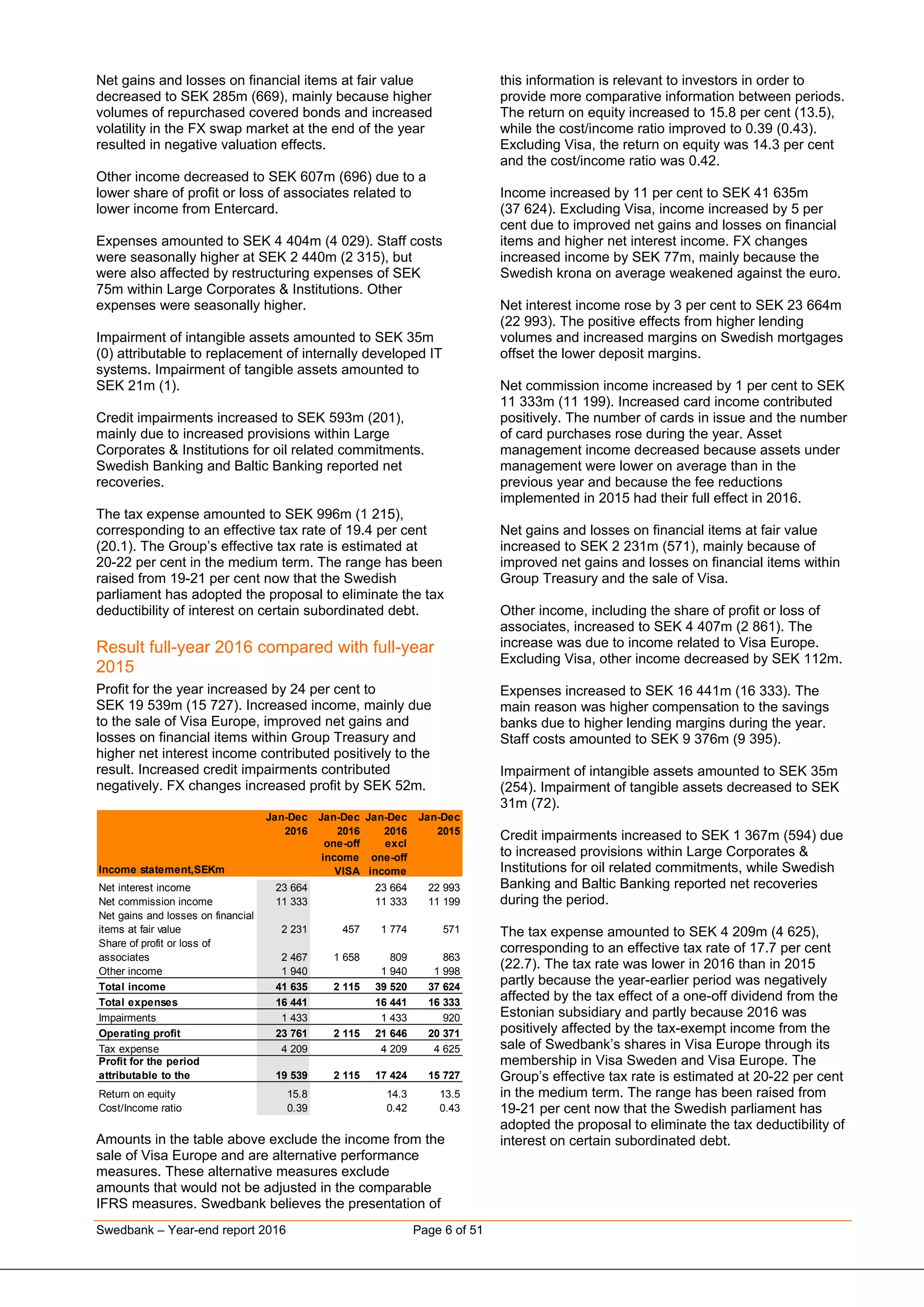
Jan-Dec Jan-Dec Jan-Dec Jan-Dec
2016 2016 2016 2015
Income statement,SEKm
one-off
income
VISA
excl
one-off
income
Net interest income 23 664 23 664 22 993
Net commission income 11 333 11 333 11 199
Net gains and losses on financial
items at fair value 2 231 457 1 774 571
Share of profit or loss of
associates 2 467 1 658 809 863
Other income 1 940 1 940 1 998
Total income 41 635 2 115 39 520 37 624
Total expenses 16 441 16 441 16 333
Impairments 1 433 1 433 920
Operating profit 23 761 2 115 21 646 20 371
Tax expense 4 209 4 209 4 625
Profit for the period
attributable to the 19 539 2 115 17 424 15 727
Return on equity 15.8 14.3 13.5
Cost/Income ratio 0.39 0.42 0.43
Amounts in the table above exclude the income from the
sale of Visa Europe and are alternative performance
measures. These alternative measures exclude
amounts that would not be adjusted in the comparable
IFRS measures. Swedbank believes the presentation of
this information is relevant to investors in order to
provide more comparative information between periods.
The return on equity increased to 15.8 per cent (13.5),
while the cost/income ratio improved to 0.39 (0.43).
Excluding Visa, the return on equity was 14.3 per cent
and the cost/income ratio was 0.42.
Income increased by 11 per cent to SEK 41 635m
(37 624). Excluding Visa, income increased by 5 per
cent due to improved net gains and losses on financial
items and higher net interest income. FX changes
increased income by SEK 77m, mainly because the
Swedish krona on average weakened against the euro.
Net interest income rose by 3 per cent to SEK 23 664m
(22 993). The positive effects from higher lending
volumes and increased margins on Swedish mortgages
offset the lower deposit margins.
Net commission income increased by 1 per cent to SEK
11 333m (11 199). Increased card income contributed
positively. The number of cards in issue and the number
of card purchases rose during the year. Asset
management income decreased because assets under
management were lower on average than in the
previous year and because the fee reductions
implemented in 2015 had their full effect in 2016.
Net gains and losses on financial items at fair value
increased to SEK 2 231m (571), mainly because of
improved net gains and losses on financial items within
Group Treasury and the sale of Visa.
Other income, including the share of profit or loss of
associates, increased to SEK 4 407m (2 861). The
increase was due to income related to Visa Europe.
Excluding Visa, other income decreased by SEK 112m.
Expenses increased to SEK 16 441m (16 333). The
main reason was higher compensation to the savings
banks due to higher lending margins during the year.
Staff costs amounted to SEK 9 376m (9 395).
Impairment of intangible assets amounted to SEK 35m
(254). Impairment of tangible assets decreased to SEK
31m (72).
Credit impairments increased to SEK 1 367m (594) due
to increased provisions within Large Corporates &
Institutions for oil related commitments, while Swedish
Banking and Baltic Banking reported net recoveries
during the period.
The tax expense amounted to SEK 4 209m (4 625),
corresponding to an effective tax rate of 17.7 per cent
(22.7). The tax rate was lower in 2016 than in 2015
partly because the year-earlier period was negatively
affected by the tax effect of a one-off dividend from the
Estonian subsidiary and partly because 2016 was
positively affected by the tax-exempt income from the
sale of Swedbank’s shares in Visa Europe through its
membership in Visa Sweden and Visa Europe. The
Group’s effective tax rate is estimated at 20-22 per cent
in the medium term. The range has been raised from
19-21 per cent now that the Swedish parliament has
adopted the proposal to eliminate the tax deductibility of
interest on certain subordinated debt.
Swedbank – Year-end report 2016 Page 7 of 51
Volume trend by product area
Swedbank’s main business is organised in two product
areas as of 1 June 2016: Group Lending & Payments
and Group Savings.
Lending
Total lending to the public, excluding repos and the
Swedish National Debt Office, increased by SEK 14bn
to SEK 1 453bn (1 439) compared with the end of the
third quarter. The main reason was higher mortgage
volumes. Compared with year-end 2015 the increase
was SEK 82bn, or growth of 6 per cent.
Lending to Swedish mortgage customers accounted for
the largest share of the increase, up SEK 21bn from the
previous quarter, of which SEK 12.7bn related to
Swedbank’s takeover in October of mortgages from
SBAB as a final step in the acquisition of Sparbanken
Öresund. At the end of the quarter the mortgage volume
in Swedish Banking amounted to SEK 719bn. In Baltic
Banking the mortgage volume was stable during the
quarter.
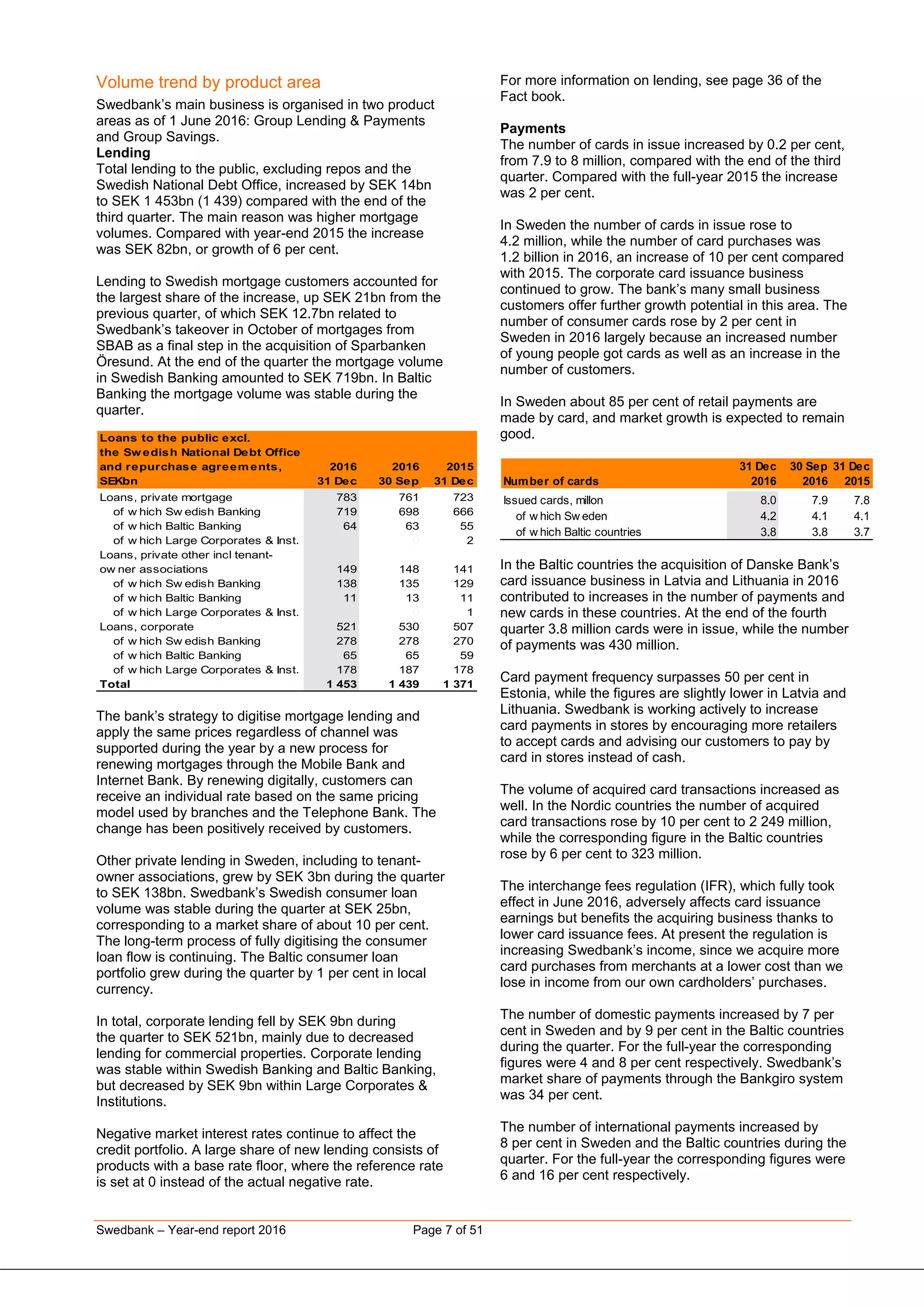
Loans to the public excl.
the Sw edish National Debt Office
and repurchase agreements,
SEKbn
2016
31 Dec
2016
30 Sep
2015
31 Dec
Loans, private mortgage 783 761 723
of w hich Sw edish Banking 719 698 666
of w hich Baltic Banking 64 63 55
of w hich Large Corporates & Inst. 0 0 2
Loans, private other incl tenant-
ow ner associations 149 148 141
of w hich Sw edish Banking 138 135 129
of w hich Baltic Banking 11 13 11
of w hich Large Corporates & Inst. 0 0 1
Loans, corporate 521 530 507
of w hich Sw edish Banking 278 278 270
of w hich Baltic Banking 65 65 59
of w hich Large Corporates & Inst. 178 187 178
Total 1 453 1 439 1 371
The bank’s strategy to digitise mortgage lending and
apply the same prices regardless of channel was
supported during the year by a new process for
renewing mortgages through the Mobile Bank and
Internet Bank. By renewing digitally, customers can
receive an individual rate based on the same pricing
model used by branches and the Telephone Bank. The
change has been positively received by customers.
Other private lending in Sweden, including to tenant-
owner associations, grew by SEK 3bn during the quarter
to SEK 138bn. Swedbank’s Swedish consumer loan
volume was stable during the quarter at SEK 25bn,
corresponding to a market share of about 10 per cent.
The long-term process of fully digitising the consumer
loan flow is continuing. The Baltic consumer loan
portfolio grew during the quarter by 1 per cent in local
currency.
In total, corporate lending fell by SEK 9bn during
the quarter to SEK 521bn, mainly due to decreased
lending for commercial properties. Corporate lending
was stable within Swedish Banking and Baltic Banking,
but decreased by SEK 9bn within Large Corporates &
Institutions.
Negative market interest rates continue to affect the
credit portfolio. A large share of new lending consists of
products with a base rate floor, where the reference rate
is set at 0 instead of the actual negative rate.
For more information on lending, see page 36 of the
Fact book.
Payments
The number of cards in issue increased by 0.2 per cent,
from 7.9 to 8 million, compared with the end of the third
quarter. Compared with the full-year 2015 the increase
was 2 per cent.
In Sweden the number of cards in issue rose to
4.2 million, while the number of card purchases was
1.2 billion in 2016, an increase of 10 per cent compared
with 2015. The corporate card issuance business
continued to grow. The bank’s many small business
customers offer further growth potential in this area. The
number of consumer cards rose by 2 per cent in
Sweden in 2016 largely because an increased number
of young people got cards as well as an increase in the
number of customers.
In Sweden about 85 per cent of retail payments are
made by card, and market growth is expected to remain
good.
31 Dec 30 Sep 31 Dec
Number of cards 2016 2016 2015
Issued cards, millon 8.0 7.9 7.8
of w hich Sw eden 4.2 4.1 4.1
of w hich Baltic countries 3.8 3.8 3.7
In the Baltic countries the acquisition of Danske Bank’s
card issuance business in Latvia and Lithuania in 2016
contributed to increases in the number of payments and
new cards in these countries. At the end of the fourth
quarter 3.8 million cards were in issue, while the number
of payments was 430 million.
Card payment frequency surpasses 50 per cent in
Estonia, while the figures are slightly lower in Latvia and
Lithuania. Swedbank is working actively to increase
card payments in stores by encouraging more retailers
to accept cards and advising our customers to pay by
card in stores instead of cash.
The volume of acquired card transactions increased as
well. In the Nordic countries the number of acquired
card transactions rose by 10 per cent to 2 249 million,
while the corresponding figure in the Baltic countries
rose by 6 per cent to 323 million.
The interchange fees regulation (IFR), which fully took
effect in June 2016, adversely affects card issuance
earnings but benefits the acquiring business thanks to
lower card issuance fees. At present the regulation is
increasing Swedbank’s income, since we acquire more
card purchases from merchants at a lower cost than we
lose in income from our own cardholders’ purchases.
The number of domestic payments increased by 7 per
cent in Sweden and by 9 per cent in the Baltic countries
during the quarter. For the full-year the corresponding
figures were 4 and 8 per cent respectively. Swedbank’s
market share of payments through the Bankgiro system
was 34 per cent.
The number of international payments increased by
8 per cent in Sweden and the Baltic countries during the
quarter. For the full-year the corresponding figures were
6 and 16 per cent respectively.
Swedbank – Year-end report 2016 Page 8 of 51
The number of Swish users at the end of the fourth
quarter included over 5 million private customers and
around 85 000 corporate customers in total in Sweden,
compared with 4.8 million private customers in the third
quarter.
Savings
Total deposits within the business areas – Swedish
Banking, Baltic Banking and Large Corporates &
Institutions – increased by SEK 2bn to SEK 779bn (777)
compared with the end of the third quarter. Of this
amount, 57 per cent (56) related to on demand deposits.
Total deposits from the public, including volumes
attributable to Group Treasury within Group Functions &
Other, fell by SEK 83bn during the quarter to SEK
782bn. Compared with the full-year 2015 deposits from
the public increased by SEK 38bn, or by 5 per cent.
Swedbank’s deposits from private customers increased
by 7 per cent to SEK 442bn (435) during the quarter.
The large part of the increase was attributable to Baltic
Banking.
Corporate deposits decreased during the quarter,
largely driven by lower volumes from US money market
funds within Group Treasury. Corporate deposits
increased in Swedish Banking but decreased in Large
Corporates & Institutions. In Baltic Banking they were
stable.
Deposits from the public excl.
the Swedish National Debt Office
and repurchase agreements,
SEKbn
2016
31 Dec
2016
30 Sep
2015
31 Dec
Deposits, private 442 435 399
of w hich Sw edish Banking 343 341 314
of w hich Baltic Banking 99 94 85
Deposits, corporate 340 430 345
of w hich Sw edish Banking 153 147 139
of w hich Baltic Banking 71 72 60
of w hich Large Corporates & Inst. 113 123 121
of w hich Group Functions & Other 3 88 25
Total 782 865 744
The market share for household deposits in Sweden
was stable at 21 per cent as of 31 December (21 per
cent as of 31 December 2015), while the share for
corporate deposits rose to 20 per cent (19). For more
information on deposits, see page 37 of the Fact book.
Asset management, 31 Dec 30 Sep 31 Dec
SEKbn 2016 2016 2015
Assets under management 794 769 742
Assets under management, Robur 789 764 738
of w hich Sw eden 754 727 706
of w hich Baltic countries 35 33 28
of w hich Norw ay 0 4 4
Assets under management, Other, Baltic
countries 5 5 4
Discretionary asset management 383 369 354
Fund assets under management by Swedbank Robur
amounted to SEK 789bn (SEK 764bn as of
30 September 2016), of which SEK 754bn (724) relates
to the Swedish business. Discretionary assets under
management increased to SEK 383bn (369).
Due to the low interest rates, the market continued to
see higher risk-taking during the fourth quarter with
outflows from money market funds and inflows to equity
index funds. The total net inflow in the Swedish fund
market was SEK 42.6bn during the period, of which
SEK 28.7bn was in equity funds, SEK 14.3bn was in
mixed funds and SEK 2.9bn was in fixed income funds.
Outflows from hedge funds and other funds totalled
SEK 3.3bn.
The market share of net flows in the fourth quarter was
9 per cent. Swedbank Robur is the largest player in
Sweden, with a market share of 21 per cent as of
31 December 2016 measured in fund assets under
management.
Swedbank Robur had a net inflow of SEK 3.8bn in the
Swedish fund market in the fourth quarter (SEK -0.6bn
in the third quarter). The positive inflow is due to the
annual inflow from the premium pension authority (PPM)
in December. Inflows included SEK 2.8bn in equity
funds and SEK 4.4bn in mixed funds. Fixed income
funds had a net outflow of SEK 3.3bn.
From a channel perspective, PPM accounted for SEK
5.1bn, while Swedish Banking and the savings banks
together accounted for an outflow of SEK 0.5bn.
Institutional clients had a positive inflow of SEK 0.3bn,
while third-party distribution had an outflow of SEK
1.1bn.
The share of equity funds that have outperformed their
comparative indices (after fees) decreased to 29 per
cent during the quarter, compared with 40 per cent at
the end of the third quarter of 2016. The corresponding
figures are 47 per cent (47) for fixed income funds and 0
per cent (15) for mixed funds.
Assets under management, life
insurance 31 Dec 30 Sep 31 Dec
SEKbn 2016 2016 2015
Sw eden 157 153 145
of w hich collective occupational
pensions 69 66 62
of w hich endow ment insurance 60 59 57
of w hich occupational pensions 19 19 17
of w hich other 9 9 9
Baltic countries 5 5 4
Swedbank was the eighth largest life insurance
company in Sweden as of 30 September 2016, with a
market share of about 6 per cent in premium payments
excluding capital transfers. The market share for
transferred capital was nearly 7 per cent, placing
Swedbank seventh. Swedbank is the largest life
insurance company in Estonia and the second largest in
Lithuania. Its market shares as of 30 November were 39
and 23 per cent respectively. The market share in Latvia
was 21 per cent. For the Baltic non-life business the
market shares for total premium income rose during the
period to between 4 and 16 per cent, with the highest
share in Estonia. In homeowner’s and vehicle insurance
Swedbank is the market leader in Estonia with shares of
31 and 24 per cent respectively. Non-life insurance is
offered in Sweden through the insurance company Tre
Kronor.
Credit and asset quality
Credit impairments amounted to SEK 593m in the fourth
quarter and SEK 1 367m for the full-year (SEK 594m for
the full-year 2015). The year-on-year difference mainly
relates to provisions for commitments in oil related
sectors, while credit impairments in other sectors remain
very low. Despite weak global growth, the economy in
Swedbank’s home markets has been relatively good,
which provided support to the solid performance.
Swedbank – Year-end report 2016 Page 9 of 51
Credit impairments, net
by business segment Full-year Full-year
SEKm 2016 2015 %
Sw edish Banking -51 482
Baltic Banking -35 -172 -80
Estonia 51 34 50
Latvia -10 -228 -96
Lithuania -76 22
Large Corporates & Institutions 1 482 284
Group Functions & Other -29 0
Total 1 367 594
Oil prices were stable during the quarter, but the major
oil companies are still reluctant to invest. Swedbank
continues to follow developments carefully and
maintains a close dialogue with impacted customers in
oil related sectors. Restructuring work is proceeding
according to plan. During the quarter one restructuring
process was deemed to be too weak, because of which
the bank allocated a provision for anticipated credit
impairment. This contributed to an increase in impaired
loans in the quarter to 0.52 per cent (0.35 in the third
quarter) of total lending. In total, the provision ratio for
impaired loans was 46 per cent (57). For more
information on credit risk, see pages 39-45 of the Fact
book.
Assets taken over amounted to SEK 405m (441 as of
31 December 2015). For more information on assets
taken over, see page 44 of the Fact book.
The amortisation requirement on new mortgages
introduced by the Swedish Financial Supervisory
Authority (SFSA) on 1 June gradually had an effect
during the second half of the year, and house prices are
now increasing at a slower rate. Amortisations in the
Swedish mortgage portfolio amounted to about SEK
12bn in the last 12-month period. The average loan-to-
value ratio for Swedbank’s mortgages was 54 per cent
in Sweden (57 on 31 December 2015), 49 per cent (51)
in Estonia, 91 per cent (98) in Latvia and 71 per cent
(79) in Lithuania, based on property level. For more
information, see pages 46-47 of the Fact book.
Operational risks
The bank’s direct losses attributable to operational risks
remained low in the fourth quarter. No major IT incidents
impacted customers to a significant degree during the
quarter. Compared with the fourth quarter of 2015 the
number of incidents declined. Nor did Swedbank have
any major disruptions to the Internet Bank and Mobile
Bank. Protection for the bank’s card customers is
currently being strengthened through implementation of
the 3D Secure system. Operational losses remained low
during the quarter.
In the spring of 2016 the Latvian Financial and Capital
Market Commission (FCMC) conducted an audit of the
effectiveness of Swedbank’s internal work to prevent
money laundering (AML) in Latvia. The audit identified
deficiencies in internal control systems, processes and
documentation. As a result, the FCMC and Swedbank
entered into an administrative agreement to mitigate the
deficiencies.
Funding and liquidity
For Swedbank the year was characterised by a slightly
lower capital market funding requirement, since the
inflow of deposits was higher than normal. During the
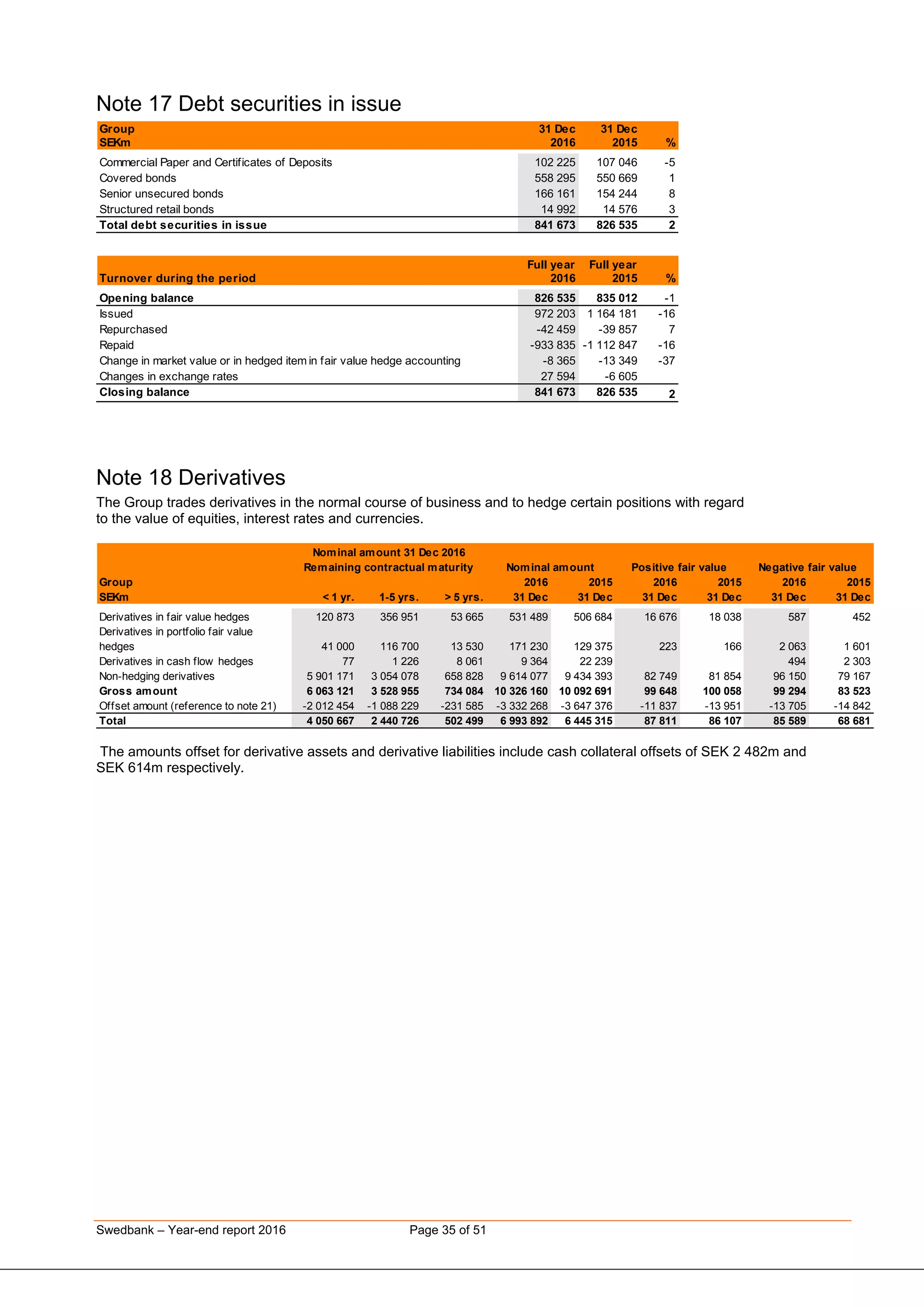
year Swedbank issued SEK 160bn in long-term debt, of
which SEK 44bn in the fourth quarter. Covered bond
issues accounted for the large part, SEK 125bn. The
total issue volume for 2017 is expected to be slightly
higher compared with 2016. Maturities for the full-year
2017 amounted nominally to SEK 166bn at the
beginning of the year. Issue plans are mainly affected
by changes in deposit volumes and lending growth and
are adjusted over the course of the year. Outstanding
short-term funding, commercial paper and Certificates of
Deposits included in debt securities in issue, amounted
to SEK 102bn (163) as of 31 December. At the same
time SEK 121bn was placed with central banks. The
liquidity reserve amounted to SEK 326bn (487) as of
31 December. The Group’s liquidity coverage ratio
(LCR) was 156 per cent (131), and for USD and EUR
was 160 per cent and 330 per cent respectively. As
described on page 4, Swedbank calculates the NSFR
according to our interpretation of the Basel Committee’s
latest proposal, resulting in Swedbank’s NSFR of
108 per cent (104). For more information on funding and
liquidity, see notes 15-17 on pages 35-36 and pages 56-
72 of the Fact book.
Ratings
During the fourth quarter there were no changes in
Swedbank’s ratings. Earlier in the year, in May, the
ratings agency Fitch upgraded Swedbank’s long-term
rating to AA- (A+) with a stable outlook.
Capital and capital adequacy
The Common Equity Tier 1 capital ratio was 25.0 per
cent on 31 December (23.8 per cent as of
30 September 2016 and 24.1 per cent as of
31 December 2015). Common Equity Tier 1 capital
increased by SEK 2.6bn during the quarter to
SEK 98.7bn. Profit after deducting the proposed
dividend positively affected Common Equity Tier 1
capital by SEK 0.9bn. The revaluation of the estimated
pension liability according to IAS 19 increased Common
Equity Tier 1 capital by about SEK 1.4bn, mainly due to
a higher discount rate.
Change in Common Equity Tier 1 capital, 2016, Swedbank
consolidated situation
93.9
98.71.44.0
96.0
-3.1
0.3
50
60
70
80
90
100
110
Q4 2015 Q3 2016 Profit
(consolidated
situation)
Anticipated
dividend
IAS 19 Other CET1
changes
Q4 2016
SEKbn
Increase Decrease
In December Swedbank issued USD 500m in Additional
Tier 1 capital (AT1) to optimise the capital structure. The
loan is perpetual with a call option after five years. The
instrument undergoes mandatory conversion to ordinary
shares if the bank’s regulatory capital decreases to a
certain level. The issue strengthened Swedbank’s Tier 1
capital ratio by 1.13 percentage points.
Swedbank – Year-end report 2016 Page 10 of 51
Swedbank’s leverage ratio was 5.4 per cent as of
31 December 2016 (4.5 per cent as of 30 September
2016), because total assets were lower at the end of the
fourth quarter than at the end of the third quarter and
the previously mentioned AT1 issue increased Tier 1
capital.
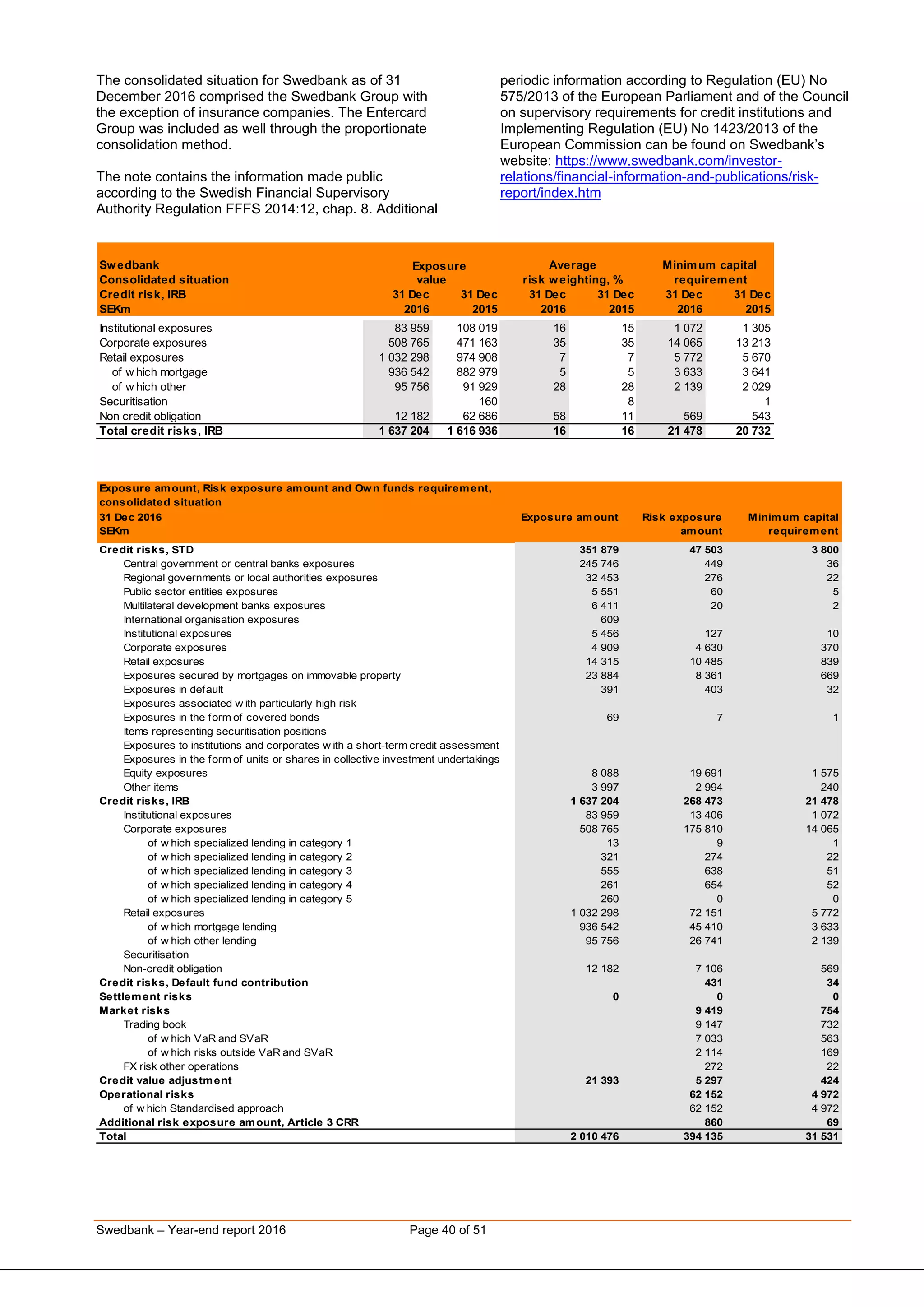
The risk exposure amount (REA) decreased by
SEK 9.6bn in the fourth quarter to SEK 394.1bn (SEK
403.7bn as of 30 September 2016). The reason was
that REA for credit risks decreased in total by SEK
6.6bn, mainly driven by a lower Probability of Default
(PD) in the estimated credit worthiness of customers
within Swedish Banking and Large Corporates &
Institutions, and because increased collateral values
had a positive effect on Loss Given Default (LGD). The
migration of mortgage volumes from SBAB was a
contributing reason why REA for private customers
increased in total by SEK 5.3bn during the quarter. This
was offset, however, by lower exposures to corporates
and institutions, which reduced REA correspondingly. In
total, REA for exposures increased by SEK 0.4bn, which
is explained by FX effects.
A lower REA for market risks, mainly driven by lower
interest rate risk due to smaller positions, as well as
lower REA for credit valuation adjustments (CVA risk),
also contributed to the total decrease in REA.
REA for operational risks was unchanged during the
quarter.
Change in REA, 2016, Swedbank consolidated situation
0.4
-2.7
-2.4
-1.8 -1.0 -2.1389.1
403.7
394.1
360
365
370
375
380
385
390
395
400
405
410
Q4 2015 Q3 2016 Exposure
change
Rating
migration
(PD)
LGD
changes
Other
credit risk
CVA risk Market
risk
Q4 2016
SEKbn
Increase Decrease
Uncertainty about capital regulations persists
internationally
Swedbank’s total Common Equity Tier 1 capital
requirement rose during the quarter to 21.9 per cent,
compared with Swedbank’s Common Equity Tier 1
capital ratio of 25.0 per cent as of 31 December 2016.
The requirement increased because the required risk
weight floor for mortgages in Pillar 2 increased in
relation to the total risk exposure amount. The total
requirement takes into account Swedbank’s Common
Equity Tier 1 capital requirement for individual Pillar 2
risks of 2.0 per cent as well as all announced increases
in countercyclical buffer values, including the increase
in the Swedish countercyclical buffer value to
2.0 per cent in March 2017.
In November the EU Commission proposed a package
of reforms to the EU’s rules for banks. The proposal
contained amendments in a number of areas, including
the capital requirements within Pillar 2, automatic
restrictions on discretionary payments, authorisation to
reduce the own funds and the eligible liabilities and the
framework for the minimum requirement for own funds
and eligible liabilities (MREL). The proposal also
introduces several new features, such as a binding
minimum leverage ratio requirement, a new category of
debt to fulfil the MREL, the Basel Committee’s new
standardised approach for measuring counterparty risk
exposures, the committee’s revised market risk
framework and the standard for Total Loss-Absorbing
Capacity (TLAC).
The European Parliament and the European Council are
evaluating the proposal, which could change before it is
finalised and has been adopted by the EU. Until then,
and before the Swedish legislators and authorities have
decided how it will be implemented in Sweden, it is
uncertain how it will affect Swedbank.
Work on capital requirements is also being done at an
international level. The Basel Committee, among others,
is trying to improve the comparability of banks’ capital
ratios. This includes revisions to the standardised
approach for calculating capital requirements for credit,
market and operational risks, limits on the banks’
use of internal models for credit risk, the introduction of
a minimum leverage ratio requirement and the
possibility of a capital floor for banks that use internal
models. The Basel Committee had previously planned
to complete this work by the end of 2016, but in January
2017 it acknowledged that it had postponed completion
to “the near future”. Owing to uncertainty about the new
requirements and how and when they will be
implemented, it is still too early to draw any conclusions
about the possible impact on Swedbank. With robust
profitability and strong capitalisation, Swedbank is well
positioned to meet future changes in capital
requirements.
Other events
On 6 October Lotta Lovén was named head of Digital
Banking in Swedbank. She previously shared leadership
with Girts Bērziņs, who has now been appointed head of
Strategy within Digital Banking. Both will remain
members of the Group Executive Committee.
On 16 December it was announced that the global
investment firm General Atlantic, in partnership with a
consortium led by the investors Pierre Siri and Henrik
Persson, had signed an agreement with all owners to
acquire the housing website Hemnet for approximately
SEK 2bn. Fastighetsbyrån owns 34 per cent of the
shares in Hemnet and through an option will acquire an
additional 8 per cent that will accrue to the company
through the sale.
Events after 31 December 2016
On 9 January Swedbank announced that the sale of
Fastighetsbyrån’s holding in Hemnet had been
completed. For Fastighetsbyrån’s owner, Swedbank, the
sale generated a tax-exempt capital gain of about
SEK 650m in the first quarter of 2017. The capital gain
will be recognised in Other income.
Swedbank – Year-end report 2016 Page 11 of 51
Swedish Banking
 Increased lending volumes and margins lent support to net interest income
 Good credit quality
 Transfer of mortgage volumes from SBAB
Income statement
Q4 Q3 Q4 Full-year Full-year
SEKm 2016 2016 % 2015 % 2016 2015 %
Net interest income 3 903 3 802 3 3 564 10 14 780 13 449 10
Net commission income 1 789 1 806 -1 1 765 1 6 938 7 188 -3
Net gains and losses on financial items at fair value 58 74 -22 82 -29 306 264 16
Share of profit or loss of associates 143 211 -32 155 -8 815 862 -5
Other income 168 128 31 186 -10 590 693 -15
Total income 6 061 6 021 1 5 752 5 23 429 22 456 4
Staff costs 759 828 -8 806 -6 3 222 3 419 -6
Variable staff costs 35 48 -27 28 25 141 155 -9
Other expenses 1 656 1 566 6 1 593 4 6 244 6 138 2
Depreciation/amortisation 23 26 -12 25 -8 99 106 -7
Total expenses 2 473 2 468 0 2 452 1 9 706 9 818 -1
Profit before impairments 3 588 3 553 1 3 300 9 13 723 12 638 9
Credit impairments -44 41 347 -51 482
Operating profit 3 632 3 512 3 2 953 23 13 774 12 156 13
Tax expense 738 749 -1 865 -15 2 943 2 826 4
Profit for the period 2 894 2 763 5 2 088 39 10 831 9 330 16
Profit for the period attributable to the
shareholders of Swedbank AB 2 891 2 760 5 2 087 39 10 818 9 317 16
Non-controlling interests 3 3 0 1 13 13 0
Return on allocated equity, % 1)4)
21.7 20.4 16.3 20.5 18.1
Loan/deposit ratio, % 229 228 235 229 235
Credit impairment ratio, % 2)
-0.02 0.01 0.13 0.00 0.04
Cost/income ratio 0.41 0.41 0.43 0.41 0.44
Loans, SEKbn3)
1 135 1 111 2 1 066 6 1 135 1 066 6
Deposits, SEKbn3)
496 488 2 453 9 496 453 9
Full-time employees 4 187 4 192 0 4 401 -5 4 187 4 401 -5
1) For information about average allocated equity see page 16 of the Fact book.
2) For more information about the credit impairment ratio see page 42 of the Fact book.
3) Excluding the Swedish National Debt Office and repurchase agreements.
4) Allocated equity is the operating segment's equity measure and is not a measure that is directly required by IFRS. Allocated equity and return on allocated
equity are therefore considered alternative performance measures. The allocated equity amounts per operating segment are reconciled to the Group Total
equity, the nearest IFRS measure, in note 4 operating segments. In Swedbank’s opinion, the presentation of this measure is relevant for investors since it is
used by Group management for internal governance and operating segment performance management purposes.
Result
Fourth quarter 2016 compared with third quarter
2016
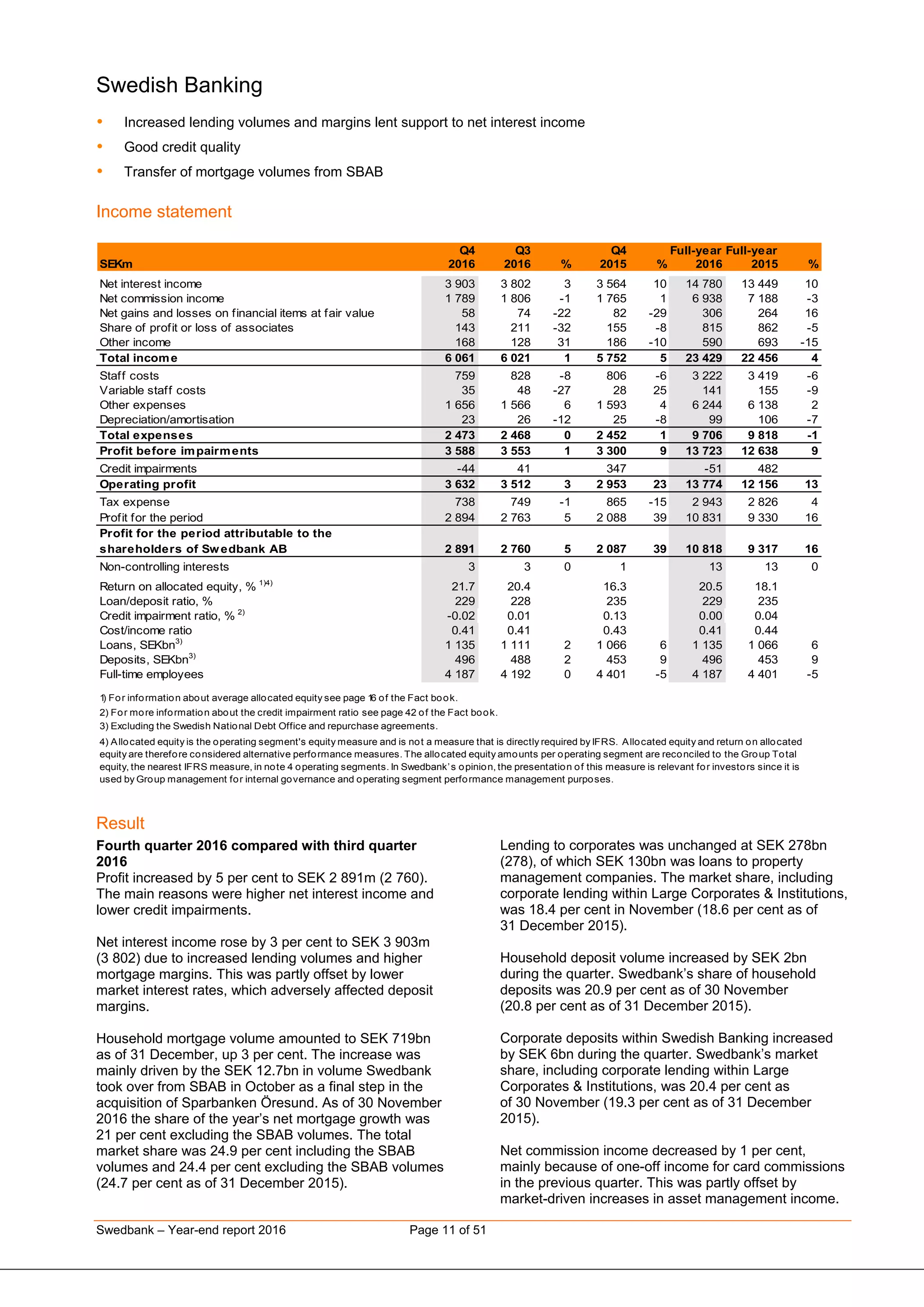
Profit increased by 5 per cent to SEK 2 891m (2 760).
The main reasons were higher net interest income and
lower credit impairments.
Net interest income rose by 3 per cent to SEK 3 903m
(3 802) due to increased lending volumes and higher
mortgage margins. This was partly offset by lower
market interest rates, which adversely affected deposit
margins.
Household mortgage volume amounted to SEK 719bn
as of 31 December, up 3 per cent. The increase was
mainly driven by the SEK 12.7bn in volume Swedbank
took over from SBAB in October as a final step in the
acquisition of Sparbanken Öresund. As of 30 November
2016 the share of the year’s net mortgage growth was
21 per cent excluding the SBAB volumes. The total
market share was 24.9 per cent including the SBAB
volumes and 24.4 per cent excluding the SBAB volumes
(24.7 per cent as of 31 December 2015).
Lending to corporates was unchanged at SEK 278bn
(278), of which SEK 130bn was loans to property
management companies. The market share, including
corporate lending within Large Corporates & Institutions,
was 18.4 per cent in November (18.6 per cent as of
31 December 2015).
Household deposit volume increased by SEK 2bn
during the quarter. Swedbank’s share of household
deposits was 20.9 per cent as of 30 November
(20.8 per cent as of 31 December 2015).
Corporate deposits within Swedish Banking increased
by SEK 6bn during the quarter. Swedbank’s market
share, including corporate lending within Large
Corporates & Institutions, was 20.4 per cent as
of 30 November (19.3 per cent as of 31 December
2015).
Net commission income decreased by 1 per cent,
mainly because of one-off income for card commissions
in the previous quarter. This was partly offset by
market-driven increases in asset management income.
Swedbank – Year-end report 2016 Page 12 of 51
The net fund flow was negative, with inflows to equity
and mixed funds and outflows from fixed income funds.
The share of associates’ profit decreased due to lower
income from Entercard.
Total expenses were stable with a further decrease in
staff costs.
Net recoveries of SEK 44m were recognised in the
fourth quarter, mainly due to a recovery of a single
commitment, compared with the third quarter, when
credit impairments of SEK 41m were recognised.
Full-year 2016 compared with full-year 2015
Profit for the period increased by 16 per cent to
SEK 10 818m (9 317) due to higher net interest income
and lower expenses and credit impairments.
Net interest income increased by 10 per cent to
SEK 14 780m (13 449), mainly through higher lending
volumes and mortgage margins. This was partly offset
by lower deposit margins.
Net commission income decreased by 3 per cent to
SEK 6 938m (7 188). The decrease was mainly due to
lower asset management income, which was affected
by reduced fund fees. Income from equity trading and
structured products decreased but was partly offset by
higher card and payment commissions resulting from
higher volumes.
The share of associates’ profit fell, mainly due to one-off
income related to Entercard and Sparbanken Skåne in
2015.
Expenses decreased during the year, mainly related to
staff costs.
Net recoveries amounted to SEK 51m, compared with
credit impairments of SEK 482m in 2015.
Business development
Swedish Banking is continuing to see its customers’
needs and habits change as they bank more through
digital channels and the Telephone Bank.
During the quarter several functions were added to the
beta version of the new Internet Bank, including
improved document management and services that
make it easier for customers to manage their savings
and pensions.
We are also trying to increase availability. The
Christmas and New Year’s holiday was the first during
which we could be reached by phone round the clock.
We have also made it possible for more people to use
the bank, including by translating basic information on
our products and services at swedbank.se to eight
languages. This helped us to receive an annual diversity
award from the magazine Privata Affärer.
As part of ongoing improvements, we continue asking
customers for their opinions of our services and
offerings. Last autumn we conducted an extensive
survey of around 35 000 private and corporate
customers. Compared with the year’s Swedish Quality
Index survey, the results were better for private
customers and unchanged for corporate customers.
Through further analysis and actions, we want to
simplify contact options and develop better technology
and processes to meet customers where, when and
how they choose. We are also trying to be more
proactive and encourage personal interaction in all
channels.
On the corporate side we are constantly strengthening
our offering for SMEs. During the quarter we began the
launch of multicurrency group accounts. We have also
simplified the lending process for small businesses so
that they get faster help with their loan applications.
Christer Trägårdh
Head of Swedish Banking
Sweden is Swedbank’s largest market, with around 4 million private customers and more than 250 000 corporate
customers. This makes it Sweden’s largest bank by number of customers. Through our digital channels (Internet Bank
and Mobile Bank), the Telephone Bank and branches, and with the cooperation of savings banks and franchisees, we are
always available. Swedbank is part of the community. Branch managers have a strong mandate to act in their local
communities. The bank’s presence and engagement are expressed in various ways. A project called “Young Jobs”, which
has created several thousand trainee positions for young people, has played an important part in recent years. Swedbank
has 248 branches in Sweden.
Swedbank – Year-end report 2016 Page 13 of 51
Baltic Banking
 Increased household lending
 Payments and asset management raised net commission income
 Continued strong credit quality
Income statement
Q4 Q3 Q4 Full-year Full-year
SEKm 2016 2016 % 2015 % 2016 2015 %
Net interest income 1 061 1 045 2 962 10 3 994 3 558 12
Net commission income 582 511 14 548 6 2 074 2 052 1
Net gains and losses on financial items at fair value 62 59 5 59 5 220 202 9
Other income 151 126 20 117 29 524 475 10
Total income 1 856 1 741 7 1 686 10 6 812 6 287 8
Staff costs 238 234 2 218 9 895 827 8
Variable staff costs 15 18 -17 17 -12 68 73 -7
Other expenses 423 364 16 386 10 1 479 1 445 2
Depreciation/amortisation 28 28 0 32 -13 114 136 -16
Total expenses 704 644 9 653 8 2 556 2 481 3
Profit before impairments 1 152 1 097 5 1 033 12 4 256 3 806 12
Impairment of tangible assets 20 1 3 21 8
Credit impairments -15 -28 -46 -112 -87 -35 -172 -80
Operating profit 1 147 1 124 2 1 142 0 4 270 3 970 8
Tax expense 169 152 11 183 -8 586 1 510 -61
Profit for the period 978 972 1 959 2 3 684 2 460 50
Profit for the period attributable to the
shareholders of Swedbank AB 978 972 1 959 2 3 684 2 460 50
Return on allocated equity, % 1)4)
19.2 19.2 19.3 18.0 12.3
Loan/deposit ratio, % 83 85 86 83 86
Credit impairment ratio, % 2)
-0.04 -0.08 -0.35 -0.03 -0.14
Cost/income ratio 0.38 0.37 0.39 0.38 0.39
Loans, SEKbn3)
140 141 -1 124 13 140 124 13
Deposits, SEKbn3)
170 166 2 145 17 170 145 17
Full-time employees 3 839 3 872 -1 3 811 1 3 839 3 811 1
1) For information about average allocated equity see page 18 of the Fact book.
2) For more information about the credit impairment ratio see page 42 of the Fact book.
3) Excluding the Swedish National Debt Office and repurchase agreements.
4) Allocated equity is the operating segment's equity measure and is not a measure that is directly required by IFRS. Allocated equity and return on allocated
equity are therefore considered alternative performance measures. The allocated equity amounts per operating segment are reconciled to the Group Total
equity, the nearest IFRS measure, in note 4 operating segments. In Swedbank’s opinion, the presentation of this measure is relevant for investors since it is
used by Group management for internal governance and operating segment performance management purposes.
Result
Fourth quarter 2016 compared with third quarter
2016
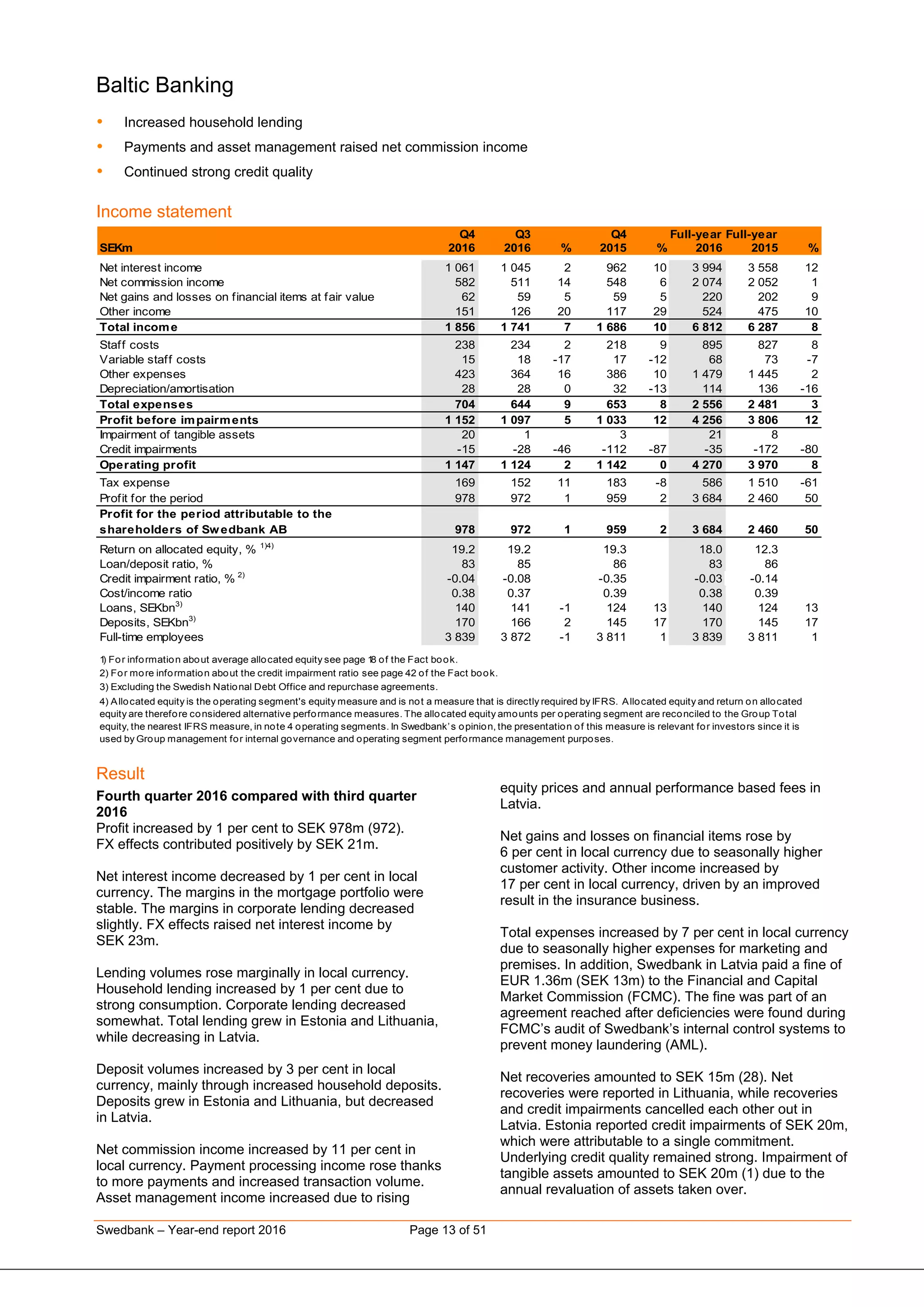
Profit increased by 1 per cent to SEK 978m (972).
FX effects contributed positively by SEK 21m.
Net interest income decreased by 1 per cent in local
currency. The margins in the mortgage portfolio were
stable. The margins in corporate lending decreased
slightly. FX effects raised net interest income by
SEK 23m.
Lending volumes rose marginally in local currency.
Household lending increased by 1 per cent due to
strong consumption. Corporate lending decreased
somewhat. Total lending grew in Estonia and Lithuania,
while decreasing in Latvia.
Deposit volumes increased by 3 per cent in local
currency, mainly through increased household deposits.
Deposits grew in Estonia and Lithuania, but decreased
in Latvia.
Net commission income increased by 11 per cent in
local currency. Payment processing income rose thanks
to more payments and increased transaction volume.
Asset management income increased due to rising
equity prices and annual performance based fees in
Latvia.
Net gains and losses on financial items rose by
6 per cent in local currency due to seasonally higher
customer activity. Other income increased by
17 per cent in local currency, driven by an improved
result in the insurance business.
Total expenses increased by 7 per cent in local currency
due to seasonally higher expenses for marketing and
premises. In addition, Swedbank in Latvia paid a fine of
EUR 1.36m (SEK 13m) to the Financial and Capital
Market Commission (FCMC). The fine was part of an
agreement reached after deficiencies were found during
FCMC’s audit of Swedbank’s internal control systems to
prevent money laundering (AML).
Net recoveries amounted to SEK 15m (28). Net
recoveries were reported in Lithuania, while recoveries
and credit impairments cancelled each other out in
Latvia. Estonia reported credit impairments of SEK 20m,
which were attributable to a single commitment.
Underlying credit quality remained strong. Impairment of
tangible assets amounted to SEK 20m (1) due to the
annual revaluation of assets taken over.
Swedbank – Year-end report 2016 Page 14 of 51
Full-year 2016 compared with full-year 2015
Profit increased to SEK 3 684m (2 460), mostly due to
higher tax expenses in the previous year resulting from
an extra dividend from the Estonian subsidiary as well
as increased income. FX effects raised full-year profit by
SEK 35m.
Net interest income in local currency rose by
11 per cent. The increase was mainly due to higher
lending volumes, including the loan portfolio acquired
from Danske Bank, lower deposit guarantee fees and
somewhat higher mortgage margins. To offset the
impact of negative interest rates, we apply base rate
floors in our lending. FX effects increased net interest
income by SEK 48m.
Lending volume rose by 8 per cent in local currency.
The increase was evident in all loan portfolios, including
mortgages, corporate lending, consumer loans and
leasing. Deposit volume grew by 12 per cent in local
currency.
Net commission income was unchanged in local
currency. Higher customer activity strengthened
payment processing income. Asset management
commissions also rose. At the same time net
commission income was negatively affected by the new
regulation on card interchange fees.
Net gains and losses on financial items at fair value
increased by 8 per cent in local currency. Other income
rose by 9 per cent in local currency.
Total expenses increased by 2 per cent in local
currency. The increase was a result of higher staff
costs, but was offset somewhat by lower marketing
expenses and depreciation as well as a VAT refund in
Lithuania in the first quarter.
Net recoveries amounted to SEK 35m, compared with
net recoveries of SEK 172m in 2015.
Business development
We continue to offer our Baltic customers more digital
solutions. Private customers can now open additional
accounts in the Internet Bank. In the Mobile Bank they
can apply for small loans and easily make payments
using the banklink service. Corporate customers can
now check their possible leasing limit in the Internet
Bank.
We are constantly seeing changes in the way customers
bank, with greater use of the Mobile Bank, partly driven
by a number of activation campaigns. The number of
active Mobile Bank users grew by 24 per cent during the
quarter. We are also pleased that the number of
contactless cards is increasing and that their
acceptance is growing as more major retailers add
contactless terminals.
Swedbank has modified its pricing model in Lithuania by
introducing packages of commonly used services. For a
fixed monthly charge, private customers receive an
unlimited number of electronic payments, a contactless
debit card, free incoming payments and free of charge
ATM withdrawals up to a specific amount. For
companies we have introduced a monthly service fee
that replaces the previous fee structure.
Last autumn we launched a local news portal in all three
Baltic countries to help consumers and entrepreneurs
make more-informed and balanced financial decisions.
During the fourth quarter Swedbank in Latvia entered
into an agreement with the Financial and Capital Market
Commission (FCMC), which includes a number of
activities to improve Swedbank’s internal control
systems for preventing money laundering (AML). The
agreement is an outcome of the audit FCMC conducted
in the spring of 2016 and which identified deficiencies in
Swedbank Latvia’s internal control systems, processes
and documentation. Swedbank takes the findings in the
Commission’s audit very seriously and is currently
implementing a series of actions to mitigate the
deficiencies.
Priit Perens
Head of Baltic Banking
Swedbank is the largest bank by number of customers in Estonia, Latvia and Lithuania, with around 4 million private
customers and over a quarter million corporate customers. According to surveys, Swedbank is also the most respected
company in the financial sector. Through its digital channels (Telephone Bank, Internet Bank and Mobile Bank) and
branches, the bank is always available. Swedbank is part of the local community. Its local social engagement is
expressed in many ways, with initiatives to promote education, entrepreneurship and social welfare. Swedbank has 35
branches in Estonia, 41 in Latvia and 65 in Lithuania.
Swedbank – Year-end report 2016 Page 15 of 51
Large Corporates & Institutions
 Increased average volumes positively affected net interest income
 Higher stock prices fuelled increase in net commission income
 Provisions for credit impairments for oil related commitments
Income statement
Q4 Q3 Q4 Full-year Full-year
SEKm 2016 2016 % 2015 % 2016 2015 %
Net interest income 908 833 9 837 8 3 332 3 416 -2
Net commission income 691 542 27 528 31 2 334 2 011 16
Net gains and losses on financial items at fair value 530 583 -9 415 28 2 068 1 892 9
Other income 13 18 -28 36 -64 77 140 -45
Total income 2 142 1 976 8 1 816 18 7 811 7 459 5
Staff costs 457 348 31 380 20 1 518 1 430 6
Variable staff costs 60 62 -3 17 232 228 2
Other expenses 478 410 17 450 6 1 703 1 596 7
Depreciation/amortisation 16 28 -43 15 7 73 63 16
Total expenses 1 011 848 19 862 17 3 526 3 317 6
Profit before impairments 1 131 1 128 0 954 19 4 285 4 142 3
Impairment of intangible assets 35 0 0 35 0
Impairment of tangible assets 0 1 0 8 0
Credit impairments 652 188 164 1 482 284
Operating profit 444 939 -53 790 -44 2 760 3 858 -28
Tax expense 115 209 -45 170 -32 489 629 -22
Profit for the period 329 730 -55 620 -47 2 271 3 229 -30
Profit for the period attributable to the
shareholders of Swedbank AB 329 730 -55 620 -47 2 271 3 229 -30
Return on allocated equity, % 1)4)
6.7 14.6 13.0 11.6 16.3
Loan/deposit ratio, % 148 153 149 148 149
Credit impairment ratio, % 2)
0.84 0.24 0.21 0.59 0.10
Cost/income ratio 0.47 0.43 0.47 0.45 0.44
Loans, SEKbn3)
178 187 -5 181 -2 178 181 -2
Deposits, SEKbn3)
120 123 -2 121 -1 120 121 -1
Full-time employees 1 270 1 259 1 1 235 3 1 270 1 235 3
1) For information about average allocated equity see page 24 of the Fact book.
2) For more information about the credit impairment ratio see page 42 of the Fact book.
3) Excluding the Swedish National Debt Office and repurchase agreements.
4) Allocated equity is the operating segment's equity measure and is not a measure that is directly required by IFRS. Allocated equity and return on allocated
equity are therefore considered alternative performance measures. The allocated equity amounts per operating segment are reconciled to the Group Total
equity, the nearest IFRS measure, in note 4 operating segments. In Swedbank’s opinion, the presentation of this measure is relevant for investors since it is
used by Group management for internal governance and operating segment performance management purposes.
Result
Fourth quarter 2016 compared with third quarter
2016
Profit decreased to SEK 329m (730). Higher income
was offset by higher expenses and credit impairments.
Net interest income increased by 9 per cent. Net interest
income from lending rose due to increased average
volumes and slightly higher margins. Several small one-
off items in December also contributed positively. FX
changes positively affected lending volume by SEK 1bn.
Net interest income from deposits increased somewhat.
Swedbank still only charges financial institutions for
deposits in a few currencies.
Net commission income increased by 27 per cent,
mainly related to increased variable compensation for
discretionary asset management and the annual fees
Swedbank earned as a market maker in the covered
bond market. Income from bond issues also increased
during the period, which included a number of major
transactions.
Net gains and losses on financial items at fair value
decreased by 9 per cent, partly due to the third quarter
being positively impacted by higher demand for interest
rate hedging in a number of sectors. Lower income from
equity trading also weighed on the result, while higher
income from FX trading contributed positively.
Compared with the previous quarter total expenses
increased by 19 per cent, mainly due to expenses of
SEK 75m for redeployment programmes in connection
with a reorganisation, but also seasonally higher
expenses.
Credit impairments amounted to SEK 652m (188),
corresponding to a credit impairment ratio of 0.84 per
cent (0.24). The increase was largely attributable to oil
related commitments in Norway.
Full-year 2016 compared with full-year 2015
Profit for the year decreased by 30 per cent to
SEK 2 271m (3 229), mainly due to increased credit
impairments.
Swedbank – Year-end report 2016 Page 16 of 51
Net interest income decreased by 2 per cent to
SEK 3 332m (3 416). Net interest income from lending
fell due to lower margins. FX changes positively affected
lending volume by SEK 6bn. Net interest income related
to deposits increased after financial institutions began
being charged for negative interest rates. In 2016 they
were charged for a few foreign currencies as well.
Net commission income increased by 16 per cent to
SEK 2 334m (2 011). The increase mainly comes from
cards as a result of lower fees paid to Visa and
MasterCard. The increase is also due to higher income
from brokerage.
Net gains and losses on financial items at fair value rose
to SEK 2 068m, an increase of 9 per cent. Volatility was
high during the year, partly because of events such as
the US presidential election. Trading in equities and
corporate bonds accounted for the largest share of the
increase.
Total expenses increased by 6 per cent compared with
2015, mainly due to increased staff costs and IT
development expenses.
Credit impairments amounted to SEK 1 482m,
compared with SEK 284m in 2015. The impairments
were primarily attributable to increased provisions for
exposures in oil related sectors. The share of impaired
loans was 1.65 per cent (0.37).
Business development
To adapt the business to new demands in the form of
digitisation, regulations and changing customer
behaviour, Large Corporates & Institutions has modified
the organisational structure of the business units
Research, Investment Banking and Markets. Investment
Banking and Markets have been reorganised as two
new units: Capital Markets, which comprises all units
that offer funding and advisory products, and FICC
(Fixed Income, Currency and Commodities), which
brings together our fixed income and FX trading
services. Research has retained its current name and
comprises macro analysis as well as strategy and
allocation.
The new organisation gives us a more specialist-driven
and advisory sales organisation as well as clearer
ownership of products and processes. The organisation
is also better adapted to the Markets in Financial
Instruments Directive (MiFID II) by separating hedging
from capital and fund raising.
Despite a challenging market with lower bond issue
volumes in many of the bank’s markets, our income in
Sweden rose to new record levels, partly thanks to an
even more customer-centric approach with improved
advice and customised solutions. We have also
continued to focus on green bonds. In October, for
example, we helped Kommuninvest to float the largest
green bond issue in SEK to date.
Swedbank received a prestigious award as “Baltic M&A
Financial Adviser of the Year” during the quarter from
the media company Mergermarket.
Elisabeth Beskow & Ola Laurin
Co-Heads of Large Corporates & Institutions
Large Corporates & Institutions is responsible for Swedbank’s offering to customers with revenues above SEK 2 billion
and those whose needs are considered complex due to multinational operations or a need for advanced financing
solutions. They are also responsible for developing corporate and capital market products for other parts of the bank and
the Swedish savings banks. Large Corporates & Institutions works closely with customers, who receive advice on
decisions that create sustainable profits and growth. Large Corporates & Institutions is represented in Sweden, Norway,
Estonia, Latvia, Lithuania, Finland, Luxembourg, China, the US and South Africa.
Swedbank – Year-end report 2016 Page 17 of 51
Group Functions & Other
Income statement
Q4 Q3 Q4 Full-year Full-year
SEKm 2016 2016 % 2015 % 2016 2015 %
Net interest income 376 382 -2 396 -5 1 559 2 570 -39
Net commission income -18 -30 -40 15 -45 -132 -66
Net gains and losses on financial items at fair value -363 -49 -391 -7 -363 -1 786 -80
Share of profit or loss of associates -34 27 0 1 652 1
Other income 191 235 -19 208 -8 909 886 3
Total income 152 565 -73 228 -33 3 712 1 539
Staff costs 829 728 14 790 5 3 114 3 045 2
Variable staff costs 47 49 -4 35 34 186 218 -15
Other expenses -729 -755 -3 -613 19 -2 861 -2 796 -2
Depreciation/amortisation 86 85 1 85 1 343 367 -7
Total expenses 233 107 297 -22 782 834 -6
Profit before impairments -81 458 -69 17 2 930 705
Impairment of intangible assets 0 0 0 0 254
Impairment of tangible assets 1 -1 16 -94 2 64 -97
Credit impairments 0 0 0 -29 0
Operating profit -82 459 -85 -4 2 957 387
Tax expense -26 105 -244 -89 191 -340
Profit for the period from continuing operations -56 354 159 2 766 727
Profit for the period from discontinued operations, after tax 0 0 -12 0 -6
Profit for the period -56 354 147 2 766 721
Profit for the period attributable to the
shareholders of Swedbank AB -56 354 147 2 766 721
Full-time employees 4 765 4 679 2 4 446 7 4 765 4 446 7
Net interest income and net gains and losses on financial items mainly stem from Group Treasury. Other income mainly refers to income from the savings
banks. Expenses mainly relate to Group Lending & Payments, Group Savings and Group Staffs and are allocated to a large extent.
Fourth quarter 2016 compared with third quarter
2016
Profit for continuing operations decreased to SEK -56m
(354) during the quarter. The main reason was that
Group Treasury’s profit fell to SEK -38m (271).
Net interest income was stable at SEK 376m (382).
Net interest income within Group Treasury decreased to
SEK 369m (401).
Net gains and losses on financial items at fair value fell
to SEK -363m (-49). Net gains and losses on financial
items within Group Treasury fell to SEK -359m (-51),
mainly because higher volumes of covered bond
repurchases and increased volatility in the currency
swap market at the end of the year resulted in negative
valuation effects.
The share of profit or loss of associates decreased to
SEK -34m (27).
Expenses increased to SEK 233m (107), which was
mainly a result of higher staff costs.
Impairment of intangible assets amounted to SEK 0m
(0). Impairment of tangible assets amounted to SEK 1m
(-1). Profit for discontinued operations was SEK 0m (0).
Full-year 2016 compared with full-year 2015
Profit for continuing operations increased to
SEK 2 766m (721). The main reason was that Group
Treasury’s profit rose to SEK 2 668m (778) due to lower
negative valuation effects related to covered bond
repurchases, tighter credit spreads and the sale of Visa
Europe.
Net interest income fell to SEK 1 559m (2 570). Group
Treasury’s net interest income decreased to
SEK 1 610m (2 637) due to previously taken positions
having matured and lower income from the bank’s
liquidity portfolio.
Net gains and losses on financial items at fair value
improved to SEK -363m (-1 786). Net gains and losses
on financial items within Group Treasury increased to
SEK -354m (-1 799) due to lower negative valuation
effects and the sale of Visa Europe.
The share of profit or loss of associates increased to
SEK 1 652m (1), which is also explained by the sale of
Visa Europe.
Expenses decreased to SEK 782m (834) due to lower
IT expenses.
Impairment of intangible assets amounted to SEK 0m
(254). Impairment of tangible assets decreased to
SEK 2m (64). Profit for discontinued operations
amounted to SEK 0m (-6).
Group Functions & Other consists of central business support units and the product areas Group Lending & Payments and Group
Savings. The central units serve as strategic and administrative support and comprise Accounting & Finance, Communication, Risk, IT,
Compliance, Public Affairs, HR and Legal. Group Treasury is responsible for the bank’s funding, liquidity and capital planning. Group
Treasury sets the prices on all internal deposit and loan flows in the Group through internal interest rates, where the most important
parameters are maturity, interest fixing period, currency and need for liquidity reserves.
Swedbank – Year-end report 2016 Page 18 of 51
Eliminations
Income statement
Q4 Q3 Q4 Full-year Full-year
SEKm 2016 2016 % 2015 % 2016 2015 %
Net interest income -1 0 0 -1 0
Net commission income 11 9 22 21 -48 32 80 -60
Net gains and losses on financial items at fair value -2 2 0 0 -1
Other income -25 -49 49 -46 46 -160 -196 18
Total income -17 -38 55 -25 -32 -129 -117 -10
Staff costs 0 0 0 0 0
Variable staff costs 0 0 0 0 0
Other expenses -17 -38 55 -25 -32 -129 -117 -10
Depreciation/amortisation 0 0 0 0 0
Total expenses -17 -38 55 -25 -32 -129 -117 -10
Group eliminations mainly consist of eliminations of internal transactions between Group Functions and the other business segments.
Swedbank – Year-end report 2016 Page 19 of 51
Group Page
Income statement, condensed 20
Statement of comprehensive income, condensed 21
Balance sheet, condensed 22
Statement of changes in equity, condensed 23
Cash flow statement, condensed 24
Notes
Note 1 Accounting policies 25
Note 2 Critical accounting estimates 25
Note 3 Changes in the Group structure 25
Note 4 Operating segments (business areas) 26
Note 5 Net interest income 28
Note 6 Net commission income 29
Note 7 Net gains and losses on financial items at fair value 30
Note 8 Other expenses 31
Note 9 Credit impairments 31
Note 10 Loans 32
Note 11 Impaired loans etc. 33
Note 12 Assets taken over for protection of claims and cancelled leases 33
Note 13 Credit exposures 33
Note 14 Intangible assets 34
Note 15 Amounts owed to credit institutions 34
Note 16 Deposits and borrowings from the public 34
Note 17 Debt securities in issue 35
Note 18 Derivatives 35
Note 19 Financial instruments carried at fair value 36
Note 20 Pledged collateral 38
Note 21 Offsetting financial assets and liabilities 38
Note 22 Capital adequacy consolidated situation 39
Note 23 Internal capital requirement 42
Note 24 Risks and uncertainties 42
Note 25 Related-party transactions 43
Note 26 Swedbank’s share 43
Parent company
Income statement, condensed 44
Statement of comprehensive income, condensed 44
Balance sheet, condensed 45
Statement of changes in equity, condensed 46
Cash flow statement, condensed 46
Capital adequacy 47
More detailed information including definitions can be found in Swedbank’s Fact book, www.swedbank.com/ir, under
Financial information and publications.
Swedbank – Year-end report 2016 Page 20 of 51
Income statement, condensed
Group Q4 Q3 Q4 Full-year Full-year
SEKm 2016 2016 % 2015 % 2016 2015 %
Interest income 8 175 8 531 -4 8 103 1 33 728 34 983 -4
Negative yield on financial assets -377 -469 -20 0 -1 543 0
Interest income, including negative yield on financial
assets 7 798 8 062 -3 8 103 -4 32 185 34 983 -8
Interest expenses -1 908 -2 143 -11 -2 344 -19 -9 256 -11 990 -23
Negative yield on financial liabilities 357 143 0 735 0
Interest expenses, including negative yield on
financial liabilities -1 551 -2 000 -22 -2 344 -34 -8 521 -11 990 -29
Net interest income (note 5) 6 247 6 062 3 5 759 8 23 664 22 993 3
Commission income 4 290 4 027 7 4 198 2 16 011 16 583 -3
Commission expenses -1 235 -1 189 4 -1 321 -7 -4 678 -5 384 -13
Net commission income (note 6) 3 055 2 838 8 2 877 6 11 333 11 199 1
Net gains and losses on financial items at fair value (note 7) 285 669 -57 165 73 2 231 571
Insurance premiums 582 501 16 506 15 2 137 2 001 7
Insurance provisions -362 -327 11 -313 16 -1 383 -1 293 7
Net insurance 220 174 26 193 14 754 708 6
Share of profit or loss of associates 109 238 -54 155 -30 2 467 863
Other income 278 284 -2 308 -10 1 186 1 290 -8
Total income 10 194 10 265 -1 9 457 8 41 635 37 624 11
Staff costs 2 440 2 315 5 2 291 7 9 376 9 395 0
Other expenses (note 8) 1 811 1 547 17 1 791 1 6 436 6 266 3
Depreciation/amortisation 153 167 -8 157 -3 629 672 -6
Total expenses 4 404 4 029 9 4 239 4 16 441 16 333 1
Profit before impairments 5 790 6 236 -7 5 218 11 25 194 21 291 18
Impairment of intangible assets (note 14) 35 0 0 35 254 -86
Impairment of tangible assets 21 1 19 11 31 72 -57
Credit impairments (note 9) 593 201 399 49 1 367 594
Operating profit 5 141 6 034 -15 4 800 7 23 761 20 371 17
Tax expense 996 1 215 -18 974 2 4 209 4 625 -9
Profit for the period from continuing operations 4 145 4 819 -14 3 826 8 19 552 15 746 24
Profit for the period from discontinued operations, after tax 0 0 -12 0 -6
Profit for the period 4 145 4 819 -14 3 814 9 19 552 15 740 24
Profit for the period attributable to the
shareholders of Swedbank AB 4 142 4 816 -14 3 813 9 19 539 15 727 24
of w hich profit for the period from continuing operations 4 142 4 816 -14 3 825 8 19 539 15 733 24
of w hich profit for the period from discontinued operations 0 0 -12 0 -6
Non-controlling interests 3 3 0 1 13 13 0
of w hich profit for the period from continuing operations 3 3 0 1 13 13 0
SEK
Earnings per share, continuing operations, SEK 3.73 4.33 3.46 17.60 14.24
after dilution 3.70 4.31 3.46 17.50 14.14
Earnings per share, total operations, SEK 3.73 4.33 3.44 17.60 14.23
after dilution 3.70 4.31 3.44 17.50 14.13
Swedbank – Year-end report 2016 Page 21 of 51
Statement of comprehensive income, condensed
Group Q4 Q3 Q4 Full-year Full-year
SEKm 2016 2016 % 2015 % 2016 2015 %
Profit for the period reported via income statement 4 145 4 819 -14 3 814 9 19 552 15 740 24
Items that will not be reclassified to the income
statement
Remeasurements of defined benefit pension plans 1 782 -775 1 042 71 -3 110 3 539
Share related to associates 65 -23 28 -76 88
Income tax -407 176 -236 72 701 -798
Total 1 440 -622 834 73 -2 485 2 829
Items that may be reclassified to the income
statement
Exchange differences, foreign operations
Gains/losses arising during the period -256 772 -1 192 -79 1 644 -1 678
Reclassification adjustments to income statement,
net gains and losses on financial items at fair value 0 -3 87 -3 87
Hedging of net investments in foreign operations:
Gains/losses arising during the period 221 -650 978 -77 -1 337 1 489
Reclassification adjustments to income statement, profit for
the period from discontinued operations 0 0 -91 0 -91
Cash flow hedges:
Gains/losses arising during the period -72 72 -16 59 145 -59
Reclassification adjustments to income statement,
net interest income 3 4 -25 0 16 7
Share of other comprehensive income of associates -20 72 -42 -52 126 -135
Income tax
Income tax -35 127 -210 -83 280 -358
Reclassification adjustments to income statement, tax -1 -1 0 0 -4 -2
Reclassification adjustments to income statement, profit for
the period from discontinued operations 0 0 28 0 28
Total -160 393 -458 -65 781 -508
Other comprehensive income for the period, net of tax 1 280 -229 376 -1 704 2 321
Total comprehensive income for the period 5 425 4 590 18 4 190 29 17 848 18 061 -1
Total comprehensive income attributable to the
shareholders of Swedbank AB 5 422 4 587 18 4 189 29 17 835 18 047 -1
Non-controlling interests 3 3 0 1 13 14 -7
For Jan-Dec 2016 an expense of SEK 2 485m (-2 829) was recognised in other comprehensive income after tax,
including remeasurements of defined benefit pension plans in associates. The 2016 expense arose primarily because
market interest rates fell from the last year end. At year end the discount rate, which is used to calculate the closing
pension obligation, was 2.79 per cent, compared with 3.53 per cent at the last year end. The market’s future inflation
expectations increased during the year. The inflation assumption was 1.84 per cent compared with 1.63 per cent last year
end. The fair value of plan assets decreased during 2016 by SEK 480m. As a whole, the obligation for defined benefit
pension plans exceeded the fair value of plan assets by SEK 1 406m.
For Jan-Dec 2016 an exchange difference of SEK 1 644m (-1 678) was recognised for the Group's foreign net
investments in subsidiaries. In addition, an exchange rate difference of SEK 124m (-136) for the Group's foreign net
investments in associates is included in Share related to associates. The gain related to subsidiaries and associates
mainly arose because the Swedish krona weakened during the year against the euro respective Norwegian krona. The
total gain of SEK 1 768m is not taxable. Since the large part of the Group's foreign net investments is hedged against
currency risk, a loss of SEK 1 337m before tax arose for the hedging instruments, compared with a year-earlier gain of
SEK 1 489m.
The revaluation of defined benefit pension plans and translation of net investments in foreign operations can be volatile in
certain periods due to movements in the discount rate, inflation and exchange rates.
Swedbank – Year-end report 2016 Page 22 of 51
Balance sheet, condensed
Group 31 Dec 31 Dec ∆
SEKm 2016 2015 SEKm %
Assets
Cash and balance w ith central banks 121 347 186 312 -64 965 -35
Loans to credit institutions (note 10) 32 197 86 418 -54 221 -63
Loans to the public (note 10) 1 507 247 1 413 955 93 292 7
Value change of interest hedged item in portfolio hedge 1 482 1 009 473 47
Interest-bearing securities 182 072 165 162 16 910 10
Financial assets for w hich customers bear the investment risk 160 114 153 442 6 672 4
Shares and participating interests 23 897 11 074 12 823
Investments in associates 7 319 5 382 1 937 36
Derivatives (note 18) 87 811 86 107 1 704 2
Intangible fixed assets (note 14) 14 279 13 690 589 4
Investment properties 0 8 -8
Tangible assets 1 864 1 981 -117 -6
Current tax assets 1 796 1 662 134 8
Deferred tax assets 160 192 -32 -17
Pension assets 0 1 274 -1 274
Other assets 8 067 14 677 -6 610 -45
Prepaid expenses and accrued income 4 551 6 362 -1 811 -28
Group of assets classified as held for sale 0 148 -148
Total assets 2 154 203 2 148 855 5 348 0
Liabilities and equity
Amounts ow ed to credit institutions (note 15) 71 831 150 493 -78 662 -52
Deposits and borrow ings from the public (note 16) 792 924 748 271 44 653 6
Financial liabilities for w hich customers bear the investment risk 161 051 157 836 3 215 2
Debt securities in issue (note 17) 841 673 826 535 15 138 2
Short positions, securities 11 614 8 191 3 423 42
Derivatives (note 18) 85 589 68 681 16 908 25
Current tax liabilities 992 105 887
Deferred tax liabilities 2 438 3 071 -633 -21
Pension provisions 1 406 17 1 389
Insurance provisions 1 820 1 728 92 5
Other liabilities and provisions 14 989 22 715 -7 726 -34
Accrued expenses and prepaid income 10 917 13 243 -2 326 -18
Subordinated liabilities 27 254 24 613 2 641 11
Liabilities directly associated w ith group of assets classified
as held for sale 0 14 -14
Total liabilities 2 024 498 2 025 513 -1 015 0
Equity
Non-controlling interests 190 179 11 6
Equity attributable to shareholders of the parent company 129 515 123 163 6 352 5
Total equity 129 705 123 342 6 363 5
Total liabilities and equity 2 154 203 2 148 855 5 348 0
Balance sheet analysis
Total assets have increased by SEK 5bn from 1 January 2016. Lending volumes, excluding the National Debt Office and
repos, increased by SEK 82bn. The increase primarily relates to Sweden of which SEK 43bn was mortgages. The rose
was offset by lower cash and balances with central banks, which decrease by SEK 65bn. The decrease is mainly
attributable to lower deposits with the US Federal Reserve and central banks in the euro system. Deposits and
borrowings from the public rose by a total of SEK 45bn, mainly for the volumes from Swedish and Baltic private customer
since the corporate deposits fell slightly. Lending to credit institutions decreased by SEK 54bn at the same time that
amounts owed to them decreased by SEK 79bn. Balance sheet items related to credit institutions fluctuate over time
depending on repos, among other things. The market value of derivatives increased on both the asset and liability side,
mainly due to large movements in interest rates and currencies. The increase in securities in issue was mainly a result of
higher issued volumes compared with repaid long-term securities funding of SEK 55bn. Short-term securities funding
decreased by SEK 17bn as an effect of lower issued volumes compared with repaid funding.
Investments in associate increased by SEK 1 658m because the associate VISA Sweden sold its share in VISA Europe to
VISA Inc. See also page 6.
Swedbank – Year-end report 2016 Page 23 of 51
Statement of changes in equity, condensed
Group Non-controlling Total
SEKm interests equity
Share
capital
Other
contri-
buted
equity1)
Exchange
differences,
subsidiaries
and
associates
Hedging of
net
investments
in foreign
operations
Cash
flow
hedges
Retained
earnings Total
January-December 2015
Opening balance 1 January 2015 24 904 17 275 2 564 -1 801 -105 74 366 117 203 170 117 373
Dividends 0 0 0 0 0 -12 539 -12 539 -5 -12 544
Share based payments to employees 0 0 0 0 0 413 413 0 413
Deferred tax related to share based payments to
employees 0 0 0 0 0 -42 -42 0 -42
Current tax related to share based payments 0 0 0 0 0 63 63 0 63
Disposal of ow n shares for trading purposes 0 0 0 0 0 33 33 0 33
Acquired non-controlling interest 0 0 0 0 0 -8 -8 0 -8
Associates' aquisition of non-controlling interest 0 0 0 0 0 -7 -7 0 -7
Total comprehensive income for the period 0 0 -1 728 1 097 122 18 556 18 047 14 18 061
of w hich reported through profit or loss 0 0 0 0 0 15 727 15 727 13 15 740
of w hich reported through other comprehensive
income 0 0 -1 728 1 097 122 2 829 2 320 1 2 321
Closing balance 31 December 2015 24 904 17 275 836 -704 17 80 835 123 163 179 123 342
January-December 2016
Opening balance 1 January 2016 24 904 17 275 836 -704 17 80 835 123 163 179 123 342
Dividends 0 0 0 0 0 -11 880 -11 880 -5 -11 885
Share based payments to employees 0 0 0 0 0 378 378 0 378
Deferred tax related to share based payments to
employees 0 0 0 0 0 -15 -15 0 -15
Current tax related to share based payments to
employees 0 0 0 0 0 34 34 0 34
Contribution 0 0 0 0 0 0 0 3 3
Total comprehensive income for the period 0 0 1 765 -1 044 60 17 054 17 835 13 17 848
of w hich reported through profit or loss 0 0 0 0 0 19 539 19 539 13 19 552
of w hich reported through other comprehensive
income 0 0 1 765 -1 044 60 -2 485 -1 704 0 -1 704
Closing balance 31 December 2016 24 904 17 275 2 601 -1 748 77 86 406 129 515 190 129 705
Shareholders'
equity
1)
Other contributed equity consists mainly of share premiums.
Swedbank – Year-end report 2016 Page 24 of 51
Cash flow statement, condensed
Group Full-year Full-year
SEKm 2016 2015
Operating activities
Operating profit 23 761 20 371
Profit for the period from discontinued operations 0 -6
Adjustments for non-cash items in operating activities -2 174 74
Taxes paid -3 583 -4 660
Increase/decrease in loans to credit institutions 54 341 27 173
Increase/decrease in loans to the public -90 692 -17 976
Increase/decrease in holdings of securities for trading -29 220 4 820
Increase/decrease in deposits and borrow ings from the public including retail bonds 38 245 76 381
Increase/decrease in amounts ow ed to credit institutions -79 929 -19 342
Increase/decrease in other assets 7 829 30 492
Increase/decrease in other liabilities 27 777 -46 395
Cash flow from operating activities -53 645 70 932
Investing activities
Business combinations -19 0
Business disposals 20 245
Acquisitions of and contributions to associates -7 -10
Acquisitions of other fixed assets and strategic financial assets -451 -3 021
Disposals/maturity of other fixed assets and strategic financial assets 763 516
Cash flow from investing activities 306 -2 270
Financing activities
Issuance of interest-bearing securities 160 474 229 220
Redemption of interest-bearing securities -147 393 -132 963
Issuance of commercial paper etc. 816 259 941 257
Redemption of commercial paper etc. -831 404 -1 019 742
Dividends paid -11 885 -12 544
Cash flow from financing activities -13 949 5 228
Cash flow for the period -67 288 73 890
Cash and cash equivalents at the beginning of the period 186 312 113 768
Cash flow for the period -67 288 73 890
Exchange rate differences on cash and cash equivalents 2 323 -1 346
Cash and cash equivalents at end of the period 121 347 186 312
Swedbank – Year-end report 2016 Page 25 of 51
Note 1 Accounting policies
The interim report has been prepared in accordance
with IAS 34, Interim Financial Reporting. The
condensed consolidated financial statements have also
been prepared in accordance with the
recommendations and statements of the Financial
Reporting Council, the Annual Accounts Act for Credit
Institutions and Securities Companies and the directives
of the SFSA.
The Parent Company report has been prepared in
accordance with the Annual Accounts Act for Credit
Institutions and Securities Companies, the directives of
the SFSA and recommendation RFR 2 of the Financial
Reporting Council.
The accounting policies applied in the interim report
conform to those applied in the Annual Report for 2015,
which was prepared in accordance with International
Financial Reporting Standards as adopted by the
European Union and interpretations thereof. There have
been no significant changes to the Group’s accounting
policies set out in the 2015 Annual Report, except for
the changes as set out below.
Change in presentation
According to the IFRS Interpretations Committee,
negative yield on financial assets does not meet the
definition of revenue according to IAS 18, Revenue and
should therefore not be presented as part of interest
income. Accordingly, the same view applies to negative
yield on financial liabilities. During 2016, the negative
yield amounts recognised within Interest income and
Interest expense, respectively, have become material to
the Group. Therefore the Group has changed the
presentation of the income statement to present
separate line items for negative yield on financial assets
and negative yield on financial liabilities within Net
interest income. Amounts for 2015 have not been
restated as they were not considered material.
Other IFRS changes
The amended standards which have been adopted
have not had a significant effect on the financial
position, results or disclosures of the Group or the
parent company. For more information about these,
refer to page 76 of the 2015 Annual Report.
Note 2 Critical accounting estimates
Presentation of consolidated financial statements in
conformity with IFRS requires the executive
management to make judgments and estimates that
affect the recognised amounts for assets, liabilities and
disclosures of contingent assets and liabilities as of the
closing day as well as the recognised income and
expenses during the report period. The executive
management continuously evaluates these judgments
and estimates, including assessing control over
investment funds, the fair value of financial instruments,
provisions for credit impairments, impairment testing of
goodwill, deferred taxes and defined benefit pension
provisions. There have been no significant changes to
the basis upon which the critical accounting policies and
judgments have been determined compared with 31
December 2015.
Note 3 Changes in the Group structure
External
During the third quarter of 2016 the Group acquired
all shares in the Lithuanian fund management
company UAB Danske Capital investicijų valdymas
for SEK 21 m.
During the fourth quarter of 2016 the Group sold all
shares in Swedbank Asset Management in Norway for
SEK 28m.
Swedbank – Year-end report 2016 Page 26 of 51
Note 4 Operating segments (business areas)
Jan-D ec Large Gro up
2016 Swedish B altic C o rpo rates & F unctio ns
SEKm B anking B anking Institutio ns & Other Eliminatio ns Gro up
Income statement
Net interest income 14 780 3 994 3 332 1559 -1 23 664
Net commission income 6 938 2 074 2 334 -45 32 11333
Net gains and losses on financial items at fair value 306 220 2 068 -363 0 2 231
Share of profit or loss of associates 815 0 0 1652 0 2 467
Other income 590 524 77 909 -160 1940
T o tal inco me 23 429 6 812 7 811 3 712 -129 41 635
of which internal income 105 0 54 642 -801 0
Staff costs 3 222 895 1518 3 114 0 8 749
Variable staff costs 141 68 232 186 0 627
Other expenses 6 244 1479 1703 -2 861 -129 6 436
Depreciation/amortisation 99 114 73 343 0 629
T o tal expenses 9 706 2 556 3 526 782 -129 16 441
P ro fit befo re impairments 13 723 4 256 4 285 2 930 0 25 194
Impairment of intangible assets 0 0 35 0 0 35
Impairment of tangible assets 0 21 8 2 0 31
Credit impairments -51 -35 1482 -29 0 1367
Operating pro fit 13 774 4 270 2 760 2 957 0 23 761
Tax expense 2 943 586 489 191 0 4 209
Profit for the period from continuing operations 10 831 3 684 2 271 2 766 0 19 552
Profit for the period from discontinued
operations, after tax 0 0 0 0 0 0
Profit for the period 10 831 3 684 2 271 2 766 0 19 552
P ro fit fo r the perio d attributable to the
shareho lders o f Swedbank A B 10 818 3 684 2 271 2 766 0 19 539
Non-controlling interests 13 0 0 0 0 13
Balance sheet, SEKbn
Cash and balances with central banks 0 3 2 116 0 121
Loans to credit institutions 5 0 43 194 -210 32
Loans to the public 1135 140 228 4 0 1507
Bonds and other interest-bearing securities 0 1 34 152 -5 182
Financial assets for which customers bear inv. risk 156 4 0 0 0 160
Investments in associates 4 0 0 3 0 7
Derivatives 0 0 97 34 -43 88
Total tangible and intangible assets 2 11 0 3 0 16
Other assets 4 36 33 505 -537 41
T o tal assets 1 306 195 437 1 011 -795 2 154
Amounts owed to credit institutions 24 0 164 90 -206 72
Deposits and borrowings from the public 500 171 127 0 -5 793
Debt securities in issue 0 0 18 831 -7 842
Financial liabilities for which customers bear inv. risk 157 4 0 0 0 161
Derivatives 0 0 103 26 -43 86
Other liabilities 572 0 5 0 -534 43
Subordinated liabilities 0 0 0 27 0 27
T o tal liabilities 1 253 175 417 974 -795 2 024
Allocated equity
3
53 20 20 37 0 130
T o tal liabilities and equity 1 306 195 437 1 011 -795 2 154
Key figures
Return on allocated equity, %
3
20.5 18.0 11.6 9.1 0.0 15.8
Cost/income ratio 0.41 0.38 0.45 0.21 0.00 0.39
Credit impairment ratio, %
1
0.00 -0.03 0.59 -0.13 0.00 0.09
Loan/deposit ratio, % 229 83 148 0 0 186
Loans, SEKbn
2
1135 140 178 0 0 1453
Deposits, SEKbn
2
496 170 120 -4 0 782
Risk exposure amount, Basel 3, SEKbn 182 79 110 23 0 394
Full-time employees 4 187 3 839 1270 4 765 0 14 061
Allocated equity, average, SEKbn
3
53 20 20 30 0 123
1)
For more information about the Credit impairment ratio see page 42 of the Fact book.
2)
Excluding the Swedish National Debt Office and repurchase agreements.
3)
Allocated equity is the operating segment's equity measure and is not a measure that is directly required by IFRS. Allocated equity and return on allocated
equity are therefore considered alternative performance measures. The allocated equity amounts per operating segment are reconciled to the Group Total
equity, the nearest IFRS measure, in the table above. In Swedbank’s opinion, the presentation of this measure is relevant for investors since it used by
Group management for internal governance and operating segment performance management purposes.
Swedbank – Year-end report 2016 Page 27 of 51
Jan-D ec Large Gro up
2015 Swedish B altic C o rpo rates & F unctio ns
SEKm B anking B anking Institutio ns & Other Eliminatio ns Gro up
Income statement
Net interest income 13 449 3 558 3 416 2 570 0 22 993
Net commission income 7 188 2 052 2 011 -132 80 11199
Net gains and losses on financial items at fair value 264 202 1892 -1786 -1 571
Share of profit or loss of associates 862 0 0 1 0 863
Other income 693 475 140 886 -196 1998
T o tal inco me 22 456 6 287 7 459 1 539 -117 37 624
of which internal income 102 0 116 624 -842 0
Staff costs 3 419 827 1430 3 045 0 8 721
Variable staff costs 155 73 228 218 0 674
Other expenses 6 138 1445 1596 -2 796 -117 6 266
Depreciation/amortisation 106 136 63 367 0 672
T o tal expenses 9 818 2 481 3 317 834 -117 16 333
P ro fit befo re impairments 12 638 3 806 4 142 705 0 21 291
Impairment of intangible assets 0 0 0 254 0 254
Impairment of tangible assets 0 8 0 64 0 72
Credit impairments 482 -172 284 0 0 594
Operating pro fit 12 156 3 970 3 858 387 0 20 371
Tax expense 2 826 1510 629 -340 0 4 625
Profit for the period from continuing operations 9 330 2 460 3 229 727 0 15 746
Profit for the period from discontinued
operations, after tax 0 0 0 -6 0 -6
Profit for the period 9 330 2 460 3 229 721 0 15 740
P ro fit fo r the perio d attributable to the
shareho lders o f Swedbank A B 9 317 2 460 3 229 721 0 15 727
Non-controlling interests 13 0 0 0 0 13
Balance sheet, SEKbn
Cash and balances with central banks 0 2 5 179 0 186
Loans to credit institutions 42 0 4 246 -206 86
Loans to the public 1065 125 217 7 0 1414
Bonds and other interest-bearing securities 0 1 33 134 -3 165
Financial assets for which customers bear inv. risk 153 3 0 0 -3 153
Investments in associates 3 0 0 2 0 5
Derivatives 0 0 92 44 -50 86
Total tangible and intangible assets 2 10 0 4 0 16
Other assets 5 27 92 414 -500 38
T o tal assets 1 270 168 443 1 030 -762 2 149
Amounts owed to credit institutions 89 0 198 63 -200 150
Deposits and borrowings from the public 457 145 121 31 -6 748
Debt securities in issue 0 0 17 819 -9 827
Financial liabilities for which customers bear inv. risk 155 3 0 0 0 158
Derivatives 0 0 88 31 -50 69
Other liabilities 518 0 0 28 -497 49
Subordinated liabilities 0 0 0 25 0 25
T o tal liabilities 1 219 148 424 997 -762 2 026
Allocated equity
3
51 20 19 33 0 123
T o tal liabilities and equity 1 270 168 443 1 030 -762 2 149
Key figures
Return on allocated equity, %
3
18.1 12.3 16.3 2.9 0.0 13.5
Cost/income ratio 0.44 0.39 0.44 0.54 0.00 0.43
Credit impairment ratio, %
1
0.04 -0.14 0.10 0.00 0.00 0.04
Loan/deposit ratio, % 235 86 149 0 0 184
Loans, SEKbn
2
1066 124 181 0 0 1371
Deposits, SEKbn
2
453 145 121 25 0 744
Risk exposure amount, Basel 3, SEKbn 183 74 112 20 0 389
Full-time employees 4 401 3 811 1235 4 446 0 13 893
Allocated equity, average, SEKbn
3
52 20 20 25 0 116
1)
For more information about the Credit impairment ratio see page 42 of the Fact book.
2)
Excluding the Swedish National Debt Office and repurchase agreements.
3)
Allocated equity is the operating segment's equity measure and is not a measure that is directly required by IFRS. Allocated equity and return on allocated
equity are therefore considered alternative performance measures. The allocated equity amounts per operating segment are reconciled to the Group Total
equity, the nearest IFRS measure, in the table above. In Swedbank’s opinion, the presentation of this measure is relevant for investors since it used by
Group management for internal governance and operating segment performance management purposes.
Swedbank – Year-end report 2016 Page 28 of 51
Operating segments’ accounting policies
Operating segment reporting is based on Swedbank’s accounting policies, organisation and management
accounting. Market-based transfer prices are applied between operating segments, while all expenses within
Group functions are transfer priced at cost to the operating segments. The net of services purchased and sold
internally is recognised as other expenses in the income statements of the operating segments. Cross-border
transfer pricing is applied according to OECD transfer pricing guidelines.
The Group’s equity attributable to shareholders is allocated to each operating segment taking into account capital
adequacy rules and estimated capital requirements based on the bank’s Internal Capital Adequacy Assessment
Process (ICAAP). All equity is allocated.
The return on allocated equity for the operating segments is calculated based on profit for the period for the operating
segment (operating profit less estimated tax and non-controlling interests), in relation to average monthly allocated equity
for the operating segment. For period shorter than one year the key ratio is annualised.
Note 5 Net interest income
Group Q4 Q3 Q4 Full-year Full-year
SEKm 2016 2016 % 2015 % 2016 2015 %
Interest income
Loans to credit institutions -44 15 87 64 329 -81
Loans to the public 7 802 7 732 1 7 832 0 30 845 33 144 -7
Interest-bearing securities 116 137 -15 207 -44 651 1 237 -47
Derivatives 179 256 -30 -85 1 093 -27
Other 9 231 -96 198 -95 764 925 -17
Total interest income including negative yield on
financial assets 8 062 8 371 -4 8 239 -2 33 417 35 608 -6
deduction of trading interests reported in net gains and
losses on financial items at fair value 264 309 -15 136 94 1 232 625 97
Interest income, including negative yield on
financial assets, according to income statement 7 798 8 062 -3 8 103 -4 32 185 34 983 -8
Interest expenses
Amounts ow ed to credit institutions 98 -134 -96 -269 -325 -17
Deposits and borrow ings from the public -166 -293 -43 -174 -5 -1 100 -1 256 -12
of w hich deposit guarantee fees -110 -101 9 -98 12 -466 -563 -17
Debt securities in issue -3 164 -3 649 -13 -3 221 -2 -13 013 -14 369 -9
Subordinated liabilities -251 -235 7 -270 -7 -977 -1 041 -6
Derivatives 2 192 2 507 -13 1 567 40 7 638 5 688 34
Other -163 -176 -7 -148 10 -689 -748 -8
of w hich government stabilisation fund fee -160 -164 -2 -133 20 -646 -681 -5
Total interest expenses including negative yield on
financial liabilities -1 454 -1 980 -27 -2 342 -38 -8 410 -12 051 -30
deduction of trading interests reported in net gains and
losses on financial items at fair value 97 20 2 111 -61
Interest expenses, including negative yield on
financial liabilities, according to income statement -1 551 -2 000 -22 -2 344 -34 -8 521 -11 990 -29
Net interest income 6 247 6 062 3 5 759 8 23 664 22 993 3
Net interest margin before trading interest is
deducted1
1.13 1.04 1.02 1.05 1.01
Average total assets 2 329 844 2 449 167 -5 2 302 825 1 2 373 930 2 322 886 2
1)
Net interest margin before trading interest is deducted is calculated as Net interest income before trading interest is deducted, in relation to average
monthly total assets. Net interest income before trading interest is deducted is not a measure that is directly required by IFRS and is considered an
alternative performance measure. The closest IFRS measure is Net interest income and can be reconciled from the table above. In Swedbank’s opinion, the
presentation of this measure is relevant for investors as it considers all interest income and expense, independent of how it has been presented in the
income statement. For period shorter than one year the key ratio is annualised.
Swedbank – Year-end report 2016 Page 29 of 51
Note 6 Net commission income
Group Q4 Q3 Q4 Full-year Full-year
SEKm 2016 2016 % 2015 % 2016 2015 %
Commission income
Payment processing 463 430 8 466 -1 1 745 1 729 1
Card commissions 1 229 1 257 -2 1 265 -3 4 715 4 861 -3
Service concepts 131 132 -1 120 9 522 498 5
Asset management and custody fees 1 523 1 361 12 1 465 4 5 425 5 750 -6
Life insurance 158 163 -3 161 -2 648 661 -2
Brokerage and other securities 206 106 94 114 81 581 621 -6
Corporate finance 57 55 4 64 -11 277 246 13
Lending 251 251 0 250 0 982 1 020 -4
Guarantees 55 55 0 57 -4 215 227 -5
Deposits 32 33 -3 19 68 131 141 -7
Real estate brokerage 53 57 -7 55 -4 226 256 -12
Non-life insurance 21 18 17 23 -9 69 78 -12
Other commission income 111 109 2 139 -20 475 495 -4
Total commission income 4 290 4 027 7 4 198 2 16 011 16 583 -3
Commission expenses
Payment processing -253 -255 -1 -273 -7 -1 002 -1 029 -3
Card commissions -488 -475 3 -605 -19 -1 883 -2 358 -20
Service concepts -4 -3 33 -4 0 -15 -16 -6
Asset management and custody fees -318 -298 7 -287 11 -1 180 -1 263 -7
Life insurance -43 -43 0 -46 -7 -176 -194 -9
Brokerage and other securities -72 -64 13 -60 20 -211 -279 -24
Lending and guarantees -20 -15 33 -22 -9 -73 -78 -6
Non-life insurance -4 -4 0 -4 0 -14 -11 27
Other commission expenses -33 -32 3 -20 65 -124 -156 -21
Total commission expenses -1 235 -1 189 4 -1 321 -7 -4 678 -5 384 -13
Total Net commission income 3 055 2 838 8 2 877 6 11 333 11 199 1
Swedbank – Year-end report 2016 Page 30 of 51
Note 7 Net gains and losses on financial items at fair value
Group Q4 Q3 Q4 Full-year Full-year
SEKm 2016 2016 % 2015 % 2016 2015 %
Valuation category, fair value through profit or loss
Shares and share related derivatives 51 185 -72 -57 946 367
of w hich dividend 34 8 10 67 325 -79
Interest-bearing securities and interest related derivatives 95 568 -83 374 -75 1 190 672 77
Loans to the public -483 -464 4 -841 -43 -1 494 -2 618 -43
Financial liabilities 93 109 -15 228 -59 200 977 -80
Other financial instruments -51 -119 -57 -58 -12 -296 74
Total fair value through profit or loss -295 279 -354 -17 546 -528
Hedge accounting
Ineffective part in hedge accounting at fair value 47 28 68 7 -60 -53 13
of w hich hedging instruments -5 872 -1 192 -2 647 -812 -4 804 -83
of w hich hedged items 5 919 1 220 2 654 752 4 751 -84
Ineffective part in portfolio hedge accounting at fair value 89 -47 2 8 -4
of w hich hedging instruments 1 019 19 519 96 -465 277
of w hich hedged items -930 -66 -517 80 473 -281
Ineffective part in hedging of net investments in
foreign operations 0 0 0 0 0
Total hedge accounting 136 -19 9 -52 -57 -9
Loan receivables at amortised cost 31 36 -14 40 -23 142 194 -27
Financial liabilities valued at amortised cost -132 -70 89 -106 25 -414 -803 -48
Trading related interest
Interest income 264 308 -14 135 96 1 232 625 97
Interest expense 97 20 3 111 -60
Total trading related interest 361 328 10 138 1 343 565
Change in exchange rates 184 115 60 438 -58 666 1 200 -45
Total net gains and losses on financial items
at fair value 285 669 -57 165 73 2 231 571
Distribution by business purpose
Financial instruments for trading related business 343 692 -50 512 -33 2 694 2 054 31
Financial instruments intended to be held to
contractual maturity -58 -23 -347 -83 -463 -1 483 -69
Total 285 669 -57 165 73 2 231 571
Swedbank – Year-end report 2016 Page 31 of 51
Note 8 Other expenses
Group Q4 Q3 Q4 Full-year Full-year
SEKm 2016 2016 % 2015 % 2016 2015 %
Premises and rents 315 282 12 357 -12 1 131 1 172 -3
IT expenses 524 437 20 525 0 1 834 1 888 -3
Telecommunications and postage 27 21 29 38 -29 118 158 -25
Advertising, PR and marketing 89 62 44 132 -33 285 340 -16
Consultants 76 76 0 94 -19 314 310 1
Compensation to savings banks 307 283 8 177 73 1 050 762 38
Other purchased services 192 177 8 170 13 708 617 15
Security transport and alarm systems 21 18 17 23 -9 72 83 -13
Supplies 37 17 25 48 103 108 -5
Travel 74 39 90 62 19 226 190 19
Entertainment 18 10 80 22 -18 51 54 -6
Repair/maintenance of inventories 32 25 28 39 -18 111 115 -3
Other expenses 99 100 -1 127 -22 433 469 -8
Total other expenses 1 811 1 547 17 1 791 1 6 436 6 266 3
Note 9 Credit impairments
Group Q4 Q3 Q4 Full-year Full-year
SEKm 2016 2016 % 2015 % 2016 2015 %
Provision for loans individually assessed
as impaired
Provisions 710 135 473 50 1 444 942 53
Reversal of previous provisions -183 -28 -7 -455 -204
Provision for homogenous groups of impaired loans, net -67 -12 -12 -69 -36 92
Total 460 95 454 1 920 702 31
Portfolio provisions for loans individually assessed
as not impaired -54 -10 -87 -38 97 -132
Write-offs
Established losses 17 283 -94 281 -94 1 214 954 27
Utilisation of previous provisions 55 -135 -137 -850 -501 70
Recoveries -57 -106 -46 -118 -52 -253 -428 -41
Total 15 42 -64 26 -42 111 25
Credit impairments for contingent liabilities and
other credit risk exposures 172 74 6 239 -1
Credit impairments 593 201 399 49 1 367 594
Credit impairment ratio, %1)
0.15 0.05 0.10 0.09 0.04
1)
For more information about credit impairment ratio, see page 42 of the Fact book.
Swedbank – Year-end report 2016 Page 32 of 51
Note 10 Loans
31 Dec 2015
Loans after Loans after
provisions provisions
Group Loans before Carrying Carrying
SEKm provisions Provisions amount amount %
Loans to credit institutions
Banks 18 579 0 18 579 74 024 -75
Repurchase agreements, banks 617 0 617 387 59
Other credit institutions 12 766 0 12 766 10 655 20
Repurchase agreements, other credit institutions 235 0 235 1 352 -83
Loans to credit institutions 32 197 0 32 197 86 418 -63
Loans to the public
Private customers 932 520 850 931 670 863 734 8
Private, mortgage 783 528 556 782 972 722 802 8
Housing cooperatives 107 792 30 107 762 101 608 6
Private,other 41 200 264 40 936 39 324 4
Corporate customers 524 543 2 905 521 638 506 830 3
Agriculture, forestry, fishing 66 112 120 65 992 64 707 2
Manufacturing 45 312 372 44 940 41 942 7
Public sector and utilities 25 314 50 25 264 25 650 -2
Construction 19 896 119 19 777 19 580 1
Retail 28 475 273 28 202 30 508 -8
Transportation 15 287 22 15 265 12 639 21
Shipping and offshore 28 755 1 188 27 567 29 744 -7
Hotels and restaurants 8 926 33 8 893 7 088 25
Information and communications 8 100 36 8 064 5 666 42
Finance and insurance 12 521 24 12 497 13 167 -5
Property management 223 640 236 223 404 219 406 2
Residential properties 64 202 48 64 154 61 139 5
Commercial 88 008 66 87 942 90 575 -3
Industrial and Warehouse 45 192 47 45 145 44 502 1
Other 26 238 75 26 163 23 190 13
Professional services 23 565 344 23 221 21 269 9
Other corporate lending 18 640 88 18 552 15 464 20
Loans to the public excluding the Swedish National
Debt Office and repurchase agreements 1 457 063 3 755 1 453 308 1 370 564 6
Sw edish National Debt Office 5 079 0 5 079 8 726 -42
Repurchase agreements,
Sw edish National Debt Office 3 797 0 3 797 1 817
Repurchase agreements, public 45 063 0 45 063 32 848 37
Loans to the public 1 511 002 3 755 1 507 247 1 413 955 7
Loans to the public and credit institutions 1 543 199 3 755 1 539 444 1 500 373 3
31 Dec 2016
Swedbank – Year-end report 2016 Page 33 of 51
Note 11 Impaired loans etc.
Group 31 Dec 31 Dec
SEKm 2016 2015 %
Impaired loans, gross 8 095 6 035 34
Provisions for individually assessed impaired loans 2 254 1 883 20
Provision for homogenous groups of impaired loans 453 541 -16
Impaired loans, net 5 388 3 611 49
of w hich private customers 1 113 1 380 -19
of w hich corporate customers 4 275 2 231 92
Portfolio provisions for loans individually assessed as not impaired 1 048 957 10
Share of impaired loans, gross, %1)
0.52 0.40 30
Share of impaired loans, net, %1)
0.35 0.24 46
Provision ratio for impaired loans, %1)
33 40 -18
Total provision ratio for impaired loans, % 1)
46 56 -18
Past due loans that are not impaired 3 164 3 581 -12
of w hich past due 5-30 days 1 768 2 127 -17
of w hich past due 31-60 days 857 819 5
of w hich past due 61-90 days 269 424 -37
of w hich past due more than 90 days 270 211 28
1)
For more information about impaired loans see page 43-44 in the Fact book.
Note 12 Assets taken over for protection of claims and cancelled leases
Group 31 Dec 31 Dec
SEKm 2016 2015 %
Buildings and land 257 408 -37
Shares and participating interests 3 17 -82
Other property taken over 120 6
Total assets taken over for protection of claims 380 431 -12
Cancelled leases 25 10
Total assets taken over for protection of claims
and cancelled leases 405 441 -8
of w hich acquired by Ektornet group 139 311 -55
Note 13 Credit exposures
Group 31 Dec 31 Dec
SEKm 2016 2015 %
Assets
Cash and balances w ith central banks 121 347 186 312 -35
Interest-bearing securities 182 072 165 162 10
Loans to credit institutions 32 197 86 418 -63
Loans to the public 1 507 247 1 413 955 7
Derivatives 87 811 86 107 2
Other financial assets 10 853 18 424 -41
Total assets 1 941 527 1 956 378 -1
Contingent liabilities and commitments
Guarantees 42 750 35 958 19
Commitments 262 701 235 312 12
Total contingent liabilities and commitments 305 451 271 270 13
Total credit exposures 2 246 978 2 227 648 1
Swedbank – Year-end report 2016 Page 34 of 51
Note 14 Intangible assets
Group 31 Dec 31 Dec
SEKm 2016 2015 %
With indefinite useful life
Goodw ill 12 408 12 010 3
Total 12 408 12 010 3
With finite useful life
Customer base 559 617 -9
Internally developed softw are 989 630 57
Other 323 433 -25
Total 1 871 1 680 11
Total intangible assets 14 279 13 690 4
Impairment testing of intangible assets
The annual test in 2016 did lead to an impairment of SEK 35m regarding internally developed software.
Note 15 Amounts owed to credit institutions
Group 31 Dec 31 Dec
SEKm 2016 2015 %
Amounts owed to credit institutions
Central banks 22 079 7 704
Banks 47 771 140 462 -66
Other credit institutions 1 968 1 508 31
Repurchase agreements - banks 13 3
Repurchase agreements - other credit institutions 0 816
Amounts owed to credit institutions 71 831 150 493 -52
Note 16 Deposits and borrowings from the public
Group 31 Dec 31 Dec
SEKm 2016 2015 %
Deposits from the public
Private customers 441 817 398 718 11
Corporate customers 340 214 345 268 -1
Deposits from the public excluding the Swedish National Debt Office
and repurchase agreements 782 031 743 986 5
Sw edish National Debt Office 1 1
Repurchase agreements - public 10 892 4 284
Deposits and borrowings from the public 792 924 748 271 6
Swedbank – Year-end report 2016 Page 35 of 51
Note 17 Debt securities in issue
Group 31 Dec 31 Dec
SEKm 2016 2015 %
Commercial Paper and Certificates of Deposits 102 225 107 046 -5
Covered bonds 558 295 550 669 1
Senior unsecured bonds 166 161 154 244 8
Structured retail bonds 14 992 14 576 3
Total debt securities in issue 841 673 826 535 2
Full year Full year
Turnover during the period 2016 2015 %
Opening balance 826 535 835 012 -1
Issued 972 203 1 164 181 -16
Repurchased -42 459 -39 857 7
Repaid -933 835 -1 112 847 -16
Change in market value or in hedged item in fair value hedge accounting -8 365 -13 349 -37
Changes in exchange rates 27 594 -6 605
Closing balance 841 673 826 535 2
Note 18 Derivatives
The Group trades derivatives in the normal course of business and to hedge certain positions with regard
to the value of equities, interest rates and currencies.
Group 2016 2015 2016 2015 2016 2015
SEKm < 1 yr. 1-5 yrs. > 5 yrs. 31 Dec 31 Dec 31 Dec 31 Dec 31 Dec 31 Dec
Derivatives in fair value hedges 120 873 356 951 53 665 531 489 506 684 16 676 18 038 587 452
Derivatives in portfolio fair value
hedges 41 000 116 700 13 530 171 230 129 375 223 166 2 063 1 601
Derivatives in cash flow hedges 77 1 226 8 061 9 364 22 239 0 0 494 2 303
Non-hedging derivatives 5 901 171 3 054 078 658 828 9 614 077 9 434 393 82 749 81 854 96 150 79 167
Gross amount 6 063 121 3 528 955 734 084 10 326 160 10 092 691 99 648 100 058 99 294 83 523
Offset amount (reference to note 21) -2 012 454 -1 088 229 -231 585 -3 332 268 -3 647 376 -11 837 -13 951 -13 705 -14 842
Total 4 050 667 2 440 726 502 499 6 993 892 6 445 315 87 811 86 107 85 589 68 681
Nominal amount 31 Dec 2016
Remaining contractual maturity Nominal amount Positive fair value Negative fair value
The amounts offset for derivative assets and derivative liabilities include cash collateral offsets of SEK 2 482m and
SEK 614m respectively.
Swedbank – Year-end report 2016 Page 36 of 51
Note 19 Financial instruments at fair value
Group Fair Carrying Fair Carrying
SEKm value amount Difference value amount Difference
Assets
Financial assets covered by IAS 39
Cash and balances w ith central banks 121 347 121 347 0 186 312 186 312 0
Treasury bills etc. 107 647 107 571 76 76 628 76 552 76
Loans to credit institutions 32 197 32 197 0 86 418 86 418 0
Loans to the public 1 512 686 1 507 247 5 439 1 419 486 1 413 955 5 531
Value change of interest hedged items in portfolio hedge 1 482 1 482 0 1 009 1 009 0
Bonds and interest-bearing securities 74 508 74 501 7 88 618 88 610 8
Financial assets for w hich the customers bear the investment risk 160 114 160 114 0 153 442 153 442 0
Shares and participating interest 23 897 23 897 0 11 074 11 074 0
Derivatives 87 811 87 811 0 86 107 86 107 0
Other financial assets 10 851 10 851 0 18 424 18 424 0
Total 2 132 540 2 127 018 5 522 2 127 518 2 121 903 5 615
Investment in associates 7 319 5 382
Non-financial assets 19 866 21 569
Total 2 154 203 2 148 854
Liabilities
Financial liabilities covered by IAS 39
Amounts ow ed to credit institutions 71 615 71 831 -216 150 302 150 493 -191
Deposits and borrow ings from the public 792 905 792 924 -19 748 254 748 271 -17
Debt securities in issue 849 097 841 673 7 424 832 196 826 535 5 661
Financial liabilities for w hich the customers bear the investment risk 161 051 161 051 0 157 836 157 836 0
Subordinated liabilities 27 254 27 254 0 24 627 24 613 14
Derivatives 85 589 85 589 0 68 681 68 681 0
Short positions securities 11 614 11 614 0 8 191 8 191 0
Other financial liabilities 22 524 22 524 0 31 597 31 597 0
Total 2 021 649 2 014 460 7 189 2 021 683 2 016 217 5 466
Non-financial liabilities 10 038 9 297
Total 2 024 498 2 025 514
31 Dec 2016 31 Dec 2015
Valuation Valuation
Instruments with techniques techniques
quoted market using using non-
Group prices in active observable observable
31 Dec 2016 markets market data market data
SEKm (Level 1) (Level 2) (Level 3) Total
Assets
Treasury bills etc. 16 740 5 429 0 22 169
Loans to credit institutions 0 852 0 852
Loans to the public 0 190 512 0 190 512
Bonds and other interest-bearing securities 42 650 28 183 0 70 833
Financial assets for w hich the customers bearthe investment risk 160 115 0 0 160 115
Shares and participating interests 23 604 135 158 23 897
Derivatives 138 87 608 65 87 811
Total 243 247 312 719 223 556 189
Liabilities
Amounts ow ed to credit institutions 0 13 0 13
Deposits and borrow ings from the public 0 10 892 0 10 892
Debt securities in issue 3 270 19 830 0 23 100
Financial liabilities for w hich the customers bearthe investment risk 0 161 051 0 161 051
Derivatives 75 85 514 0 85 589
Short positions, securities 11 614 0 0 11 614
Total 14 959 277 300 0 292 259
The table above contains financial instruments measured at fair value by valuation level. The Group uses various
methods to determine the fair value for financial instruments depending on the degree of observable market data in
the valuation and activity in the market. Activity is continuously evaluated by analysing factors such as differences in
bid and ask prices.
The methods are divided into three different levels:
• Level 1: Unadjusted, quoted price on an active market
• Level 2: Adjusted, quoted price or valuation model with valuation parameters derived from an active market
• Level 3: Valuation model where a majority of valuation parameters are non-observable and based on internal
assumptions.
When financial assets and financial liabilities in active markets have market risks that offset each other, an average of
bid and ask prices is used as a basis to determine the fair values of the risk positions that offset each other. For any
open net positions, bid rates are applied for long positions and ask rates for short positions.
Swedbank – Year-end report 2016 Page 37 of 51
The Group has a continuous process whereby financial instruments that indicate a high level of internal estimates or
low level of observable market data are captured. The process determines the way to calculate and how the internal
assumptions are expected to affect the valuation. In cases where internal assumptions have a material impact on fair
value, the financial instrument is reported in level 3. The process also includes an analysis and evaluation based on
the quality of the valuation data as well as whether a type of financial instrument is to be transferred between levels.
When transfers occur between fair value hierarchy levels those are reflected as taking place at the end of each quarter.
There were no transfers of financial instruments between valuation levels 1 and 2 during the quarter.
Valuation Valuation
Instruments with techniques techniques
quoted market using using non-
Group prices in an observable observable
31 Dec 2015 active market market data market data
SEKm (Level 1) (Level 2) (Level 3) Total
Assets
Treasury bills etc. 24 650 51 434 0 76 084
Loans to credit institutions 0 1 739 0 1 739
Loans to the public 0 230 976 0 230 976
Bonds and other interest-bearing securities 59 213 25 479 0 84 692
Financial assets for w hich the customers bearthe investment risk 153 442 0 0 153 442
Shares and participating interests 10 908 93 73 11 074
Derivatives 166 85 827 114 86 107
Total 248 379 395 548 187 644 114
Liabilities
Amounts ow ed to credit institutions 0 816 0 816
Deposits and borrow ings from the public 0 4 447 0 4 447
Debt securities in issue 1 509 18 914 0 20 423
Financial liabilities for w hich the customers bearthe investment risk 0 157 836 0 157 836
Derivatives 28 68 653 0 68 681
Short positions, securities 8 191 0 0 8 191
Total 9 728 250 666 0 260 394
Changes in level 3
Group Equity
SEKm instruments Derivatives Total
January-December 2016
Opening balance 1 January 2016 73 114 187
Purchases 3 0 3
VISA Inc. C shares received 62 0 62
Sale of assets -55 0 -55
Maturities 0 -19 -19
Issues 0 1 1
Transferred from Level 1 to Level 3 64 0 64
Transferred from Level 3 to Level 2 0 -8 -8
Gains or losses 11 -23 -12
of w hich in the income statement, net gains and losses on financial
items at fair value 11 -23 -12
of w hich changes in unrealised gains or losses
for items held at closing day 17 -19 -2
Closing balance 31 December 2016 158 65 223
Assets
Level 3 primarily contains unlisted equity instruments and illiquid options. In connection with the sale of shares in
VISA Europe convertible preference shares in VISA Inc. were obtained. The shares are subject to selling restrictions
for a period of up to 12 years and under certain conditions may have to be returned. Because liquid quotes are not
available for the instrument, its fair value is established with significant elements of own internal assumptions and
reported in level 3 as equity instruments. The options hedge changes in the market value of hybrid debt instruments,
so-called structured products. Structured products consist of a corresponding option element and a host contract,
which in principle is an ordinary interest-bearing bond. When the Group evaluates the level on which the financial
instruments are reported, the entire instrument is assessed on an individual basis. Since the bond portion of the
structured products represents the majority of the financial instrument’s fair value, the internal assumptions used to
value the illiquid option element normally do not have a significant effect on the valuation and the financial instrument
is typically reported in level 2. However, the Group typically hedges the market risks that arise in structured products
by holding individual options. The internal assumptions used to in the valuation of the individual financial instruments
are therefore of greater significance, because of which several are reported as derivatives in level 3.
For all options included in level 3 an analysis is performed based on historical movements in contract prices. Given
this, it is not likely that future price movements will affect the market value for options in level 3 with more than +/-
SEK 19m.
Financial instruments are transferred to or from level 3 depending on whether the internal assumptions have changed
in significance to the valuation.
Swedbank – Year-end report 2016 Page 38 of 51
Changes in level 3
Group Equity
SEKm instruments Derivatives Total
January-December 2015
Opening balance 1 January 2015 77 81 158
Purchases 16 0 16
Sale of assets -15 0 -15
Maturities 0 -35 -35
Issues 0 9 9
Transferred from Level 2 to Level 3 0 148 148
Transferred from Level 3 to Level 2 -2 0 -2
Transferred from Level 3 to Level 1 0 -83 -83
Gains or losses -3 -6 -9
of w hich in the income statement, net gains and losses on financial
items at fair value -3 -6 -9
of w hich changes in unrealised gains or losses
for items held at closing day 0 -47 -47
Closing balance 31 December 2015 73 114 187
Assets
Note 20 Pledged collateral
Group 31 Dec 31 Dec
SEKm 2016 2015 %
Loan receivables1
542 278 517 904 5
Financial assets pledged for policyholders 157 804 145 410 9
Other assets pledged 37 546 43 361 -13
Pledged collateral 737 628 706 675 4
1)
From 2016 only the collateral used in the pledge are reported instead of the total available collateral. Comparative
numbers have been restated.
Note 21 Offsetting financial assets and liabilities
Group 31 Dec 31 Dec 31 Dec 31 Dec
SEKm 2016 2015 % 2016 2015 %
Financial assets and liabilities, which have been offset or are subject to
netting or similar agreements
Gross amount 152 098 134 805 13 111 865 88 752 26
Offset amount -16 340 -16 950 -4 -18 208 -17 841 2
Net amounts presented in the balance sheet 135 758 117 855 15 93 657 70 911 32
Related amounts not offset in the balance sheet
Financial instruments, netting arrangements 46 691 44 698 4 46 691 44 698 4
Financial Instruments, collateral 40 853 32 614 25 4 391 3 041 44
Cash, collateral 12 676 19 915 -36 13 775 15 653 -12
Total amount not offset in the balance sheet 100 220 97 227 3 64 857 63 392 2
Net amount 35 538 20 628 72 28 800 7 519
Assets Liabilities
The amounts offset for financial assets and financial liabilities include cash collateral offsets of SEK 2 482m and SEK
614m respectively
Swedbank – Year-end report 2016 Page 39 of 51
Note 22 Capital adequacy, consolidated situation
Capital adequacy 31 Dec 31 Dec
SEKm 2016 2015
Shareholders' equity according to the Group's balance sheet 129 515 123 163
Non-controlling interests 78 54
Anticipated dividend -14 695 -11 828
Deconsolidation of insurance companies 96 -1 249
Value changes in ow n financial liabilities -2 31
Cash flow hedges -77 -17
Additional value adjustments 1)
-598 -474
Goodw ill -12 497 -12 097
Deferred tax assets -114 -95
Intangible assets -1 601 -1 438
Net provisions for reported IRB credit exposures -1 376 -1 089
Shares deducted from CET1 capital -50 -42
Defined benefit pension fund assets 2)
0 -993
Common Equity Tier 1 capital 98 679 93 926
Additional Tier 1 capital 14 281 10 624
Total Tier 1 capital 112 960 104 550
Tier 2 capital 12 229 13 269
Total capital 125 189 117 819
Minimum capital requirement for credit risks, standardised approach 3 800 3 823
Minimum capital requirement for credit risks, IRB 21 478 20 732
Minimum capital requirement for credit risk, default fund contribution 34 4
Minimum capital requirement for settlement risks 0 1
Minimum capital requirement for market risks 754 858
Trading book 732 848
of w hich VaR and SVaR 563 525
of w hich risks outside VaR and SVaR 169 323
FX risk other operations 22 10
Minimum capital requirement for credit value adjustment 424 594
Minimum capital requirement for operational risks 4 972 5 047
Additional minimum capital requirement, Article 3 CRR 69 69
Minimum capital requirement 31 531 31 128
Risk exposure amount credit risks 316 407 306 996
Risk exposure amount settlement risks 0 7
Risk exposure amount market risks 9 419 10 730
Risk exposure amount credit value adjustment 5 297 7 422
Risk exposure amount operational risks 62 152 63 083
Additional risk exposure amount, Article 3 CRR 860 860
Risk exposure amount 394 135 389 098
Common Equity Tier 1 capital ratio, % 25.0 24.1
Tier 1 capital ratio, % 28.7 26.9
Total capital ratio, % 31.8 30.3
Capital buffer requirement 3 )
31 Dec 31 Dec
% 2016 2015
CET1 capital requirement including buffer requirements 11.0 10.7
of w hich minimum CET1 requirement 4.5 4.5
of w hich capital conservation buffer 2.5 2.5
of w hich countercyclical capital buffer 1.0 0.7
of w hich systemic risk buffer 3.0 3.0
CET 1 capital available to meet buffer requirement 4)
20.5 19.6
Capital adequacy Basel 1 floor 31 Dec 31 Dec
SEKm 2016 2015
Capital requirement Basel 1 floor 75 749 68 577
Ow n funds Basel 3 adjusted according to rules for Basel 1 floor 126 565 118 908
Surplus of capital according to Basel 1 floor 50 816 50 331
Leverage ratio 31 Dec 31 Dec
2016 2015
Tier 1 Capital, SEKm 112 960 104 550
Leverage ratio exposure, SEKm 2 098 179 2 102 284
Leverage ratio, % 5.4 5.0
1)
Adjustment due to the implementation of EBA’s technical standards on prudent valuation. The objective of these standards is to
determine prudent values of fair valued positions.
2)
Net pension assets.
3)
Buffer requirement according to Swedish implementation of CRD IV.
4)
CET1 capital ratio as reported, less minimum requirement of 4.5% (excluding buffer requirements) and less any CET1 items used to
meet the Tier 1 and total capital requirements.
.
Swedbank – Year-end report 2016 Page 40 of 51
The consolidated situation for Swedbank as of 31
December 2016 comprised the Swedbank Group with
the exception of insurance companies. The Entercard
Group was included as well through the proportionate
consolidation method.
The note contains the information made public
according to the Swedish Financial Supervisory
Authority Regulation FFFS 2014:12, chap. 8. Additional
periodic information according to Regulation (EU) No
575/2013 of the European Parliament and of the Council
on supervisory requirements for credit institutions and
Implementing Regulation (EU) No 1423/2013 of the
European Commission can be found on Swedbank’s
website: https://www.swedbank.com/investor-
relations/financial-information-and-publications/risk-
report/index.htm
Swedbank
Consolidated situation
Credit risk, IRB 31 Dec 31 Dec 31 Dec 31 Dec 31 Dec 31 Dec
SEKm 2016 2015 2016 2015 2016 2015
Institutional exposures 83 959 108 019 16 15 1 072 1 305
Corporate exposures 508 765 471 163 35 35 14 065 13 213
Retail exposures 1 032 298 974 908 7 7 5 772 5 670
of w hich mortgage 936 542 882 979 5 5 3 633 3 641
of w hich other 95 756 91 929 28 28 2 139 2 029
Securitisation 0 160 0 8 0 1
Non credit obligation 12 182 62 686 58 11 569 543
Total credit risks, IRB 1 637 204 1 616 936 16 16 21 478 20 732
requirement
Exposure
value risk weighting, %
Average Minimum capital
Exposure amount, Risk exposure amount and Own funds requirement,
consolidated situation
31 Dec 2016
SEKm
Exposure amount Risk exposure
amount
Minimum capital
requirement
Credit risks, STD 351 879 47 503 3 800
Central government or central banks exposures 245 746 449 36
Regional governments or local authorities exposures 32 453 276 22
Public sector entities exposures 5 551 60 5
Multilateral development banks exposures 6 411 20 2
International organisation exposures 609 0 0
Institutional exposures 5 456 127 10
Corporate exposures 4 909 4 630 370
Retail exposures 14 315 10 485 839
Exposures secured by mortgages on immovable property 23 884 8 361 669
Exposures in default 391 403 32
Exposures associated w ith particularly high risk 0 0 0
Exposures in the form of covered bonds 69 7 1
Items representing securitisation positions 0 0 0
Exposures to institutions and corporates w ith a short-term credit assessment 0 0 0
Exposures in the form of units or shares in collective investment undertakings 0 0 0
Equity exposures 8 088 19 691 1 575
Other items 3 997 2 994 240
Credit risks, IRB 1 637 204 268 473 21 478
Institutional exposures 83 959 13 406 1 072
Corporate exposures 508 765 175 810 14 065
of w hich specialized lending in category 1 13 9 1
of w hich specialized lending in category 2 321 274 22
of w hich specialized lending in category 3 555 638 51
of w hich specialized lending in category 4 261 654 52
of w hich specialized lending in category 5 260 0 0
Retail exposures 1 032 298 72 151 5 772
of w hich mortgage lending 936 542 45 410 3 633
of w hich other lending 95 756 26 741 2 139
Securitisation 0 0 0
Non-credit obligation 12 182 7 106 569
Credit risks, Default fund contribution 0 431 34
Settlement risks 0 0 0
Market risks 0 9 419 754
Trading book 0 9 147 732
of w hich VaR and SVaR 0 7 033 563
of w hich risks outside VaR and SVaR 0 2 114 169
FX risk other operations 0 272 22
Credit value adjustment 21 393 5 297 424
Operational risks 0 62 152 4 972
of w hich Standardised approach 0 62 152 4 972
Additional risk exposure amount, Article 3 CRR 0 860 69
Total 2 010 476 394 135 31 531
Swedbank – Year-end report 2016 Page 41 of 51
Exposure amount, Risk exposure amount and Own funds requirement,
consolidated situation
31 Dec 2015
SEKm
Exposure amount Risk exposure
amount
Minimum capital
requirement
Credit risks, STD 371 639 47 786 3 823
Central government or central banks exposures 266 646 379 30
Regional governments or local authorities exposures 35 385 274 22
Public sector entities exposures 9 860 56 4
Multilateral development banks exposures 6 015 0 0
International organisation exposures 1 964 0 0
Institutional exposures 5 049 803 64
Corporate exposures 9 580 9 041 723
Retail exposures 23 212 16 854 1 348
Exposures secured by mortgages on immovable property 2 349 834 67
Exposures in default 356 420 34
Exposures associated w ith particularly high risk 0 0 0
Exposures in the form of covered bonds 48 7 1
Items representing securitisation positions 0 0 0
Exposures to institutions and corporates w ith a short-term credit assessment 0 0 0
Exposures in the form of units or shares in collective investment undertakings 0 0 0
Equity exposures 6 074 14 808 1 185
Other items 5 101 4 310 345
Credit risks, IRB 1 616 936 259 158 20 732
Institutional exposures 108 019 16 312 1 305
Corporate exposures 471 163 165 160 13 213
of w hich specialized lending in category 1 25 18 1
of w hich specialized lending in category 2 501 429 34
of w hich specialized lending in category 3 654 752 60
of w hich specialized lending in category 4 273 682 55
of w hich specialized lending in category 5 329 0 0
Retail exposures 974 908 70 875 5 670
of w hich mortgage lending 837 752 45 052 3 604
of w hich other lending 137 156 25 824 2 066
Securitisation 160 12 1
Non-credit obligation 62 686 6 799 543
Credit risks, Default fund contribution 0 53 4
Settlement risks 1 7 1
Market risks 0 10 730 858
Trading book 0 10 608 848
of w hich VaR and SVaR 0 6 566 525
of w hich risks outside VaR and SVaR 0 4 042 323
FX risk other operations 0 122 10
Credit value adjustment 25 492 7 422 594
Operational risks 0 63 083 5 047
of w hich Standardised approach 0 63 083 5 047
Additional risk exposure amount, Article 3 CRR 0 860 69
Total 2 014 067 389 098 31 128
Credit risks
The Internal Ratings-Based Approach (IRB) is applied
within the Swedish part of Swedbank’s consolidated
situation, including the branch offices in New York and
Oslo but excluding Entercard, several small subsidiaries
and certain exposure classes such as exposures to
national governments and municipalities. IRB is also
applied for the majority of Swedbank’s exposure classes
in the Baltic countries.
When Swedbank acts as clearing member, the bank
calculates a capital base requirement for its pre-funded,
qualifying and non-qualifying central counterparty
default fund contributions.
For exposures, excluding capital requirement for default
fund contributions, where IRB-approach is not applied,
the standardized approach is used.
Market risks
Under current regulations capital adequacy for market
risks can be based on either a standardised approach or
an internal Value at Risk model, which requires the
approval of the SFSA. The parent company has
received such approval and uses its internal VaR model
for general interest rate risks, general and specific share
price risks and foreign exchange risks in the trading
book. The approval also covers operations in the Baltic
countries with respect to general interest rate risks and
foreign exchange risks in the trading book. Foreign
exchange risks outside the trading book, i.e. in other
operations, are mainly of a structural and strategic
nature and are less suited to a VaR model.
These risks are instead estimated according to the
standardised approach, as per the Group’s internal
approach to managing these risks.
Strategic foreign exchange risks mainly arise through
risks associated with holdings in foreign operations.
Credit value adjustment
The risk of a credit value adjustment is estimated
according to the standardised approach and was added
after the implementation of the new EU regulation
(CRR).
Swedbank – Year-end report 2016 Page 42 of 51
Operational risk
Swedbank calculates operational risk using the
standardised approach. The SFSA has stated that
Swedbank meets the qualitative requirements to apply
this method.
Basel 1 floor
The transition rules state that the minimum capital
requirement must not fall below 80 per cent of the
requirement according to the older Basel 1 rules.
Note 23 Internal capital requirement
This note provides information on the internal capital
assessment according to chapter 8, section 5 of the
SFSA’s regulation on prudential requirements and
capital buffers (2014:12). The internal capital
assessment is published in the interim report according
to chapter 8, section 4 of the SFSA’s regulation and
general advice on annual reports from credit institutions
and investment firms (2008:25).
A bank must identify measure and manage the risks
with which its activities are associated and have
sufficient capital to cover these risks. The purpose of the
Internal Capital Adequacy Assessment process (ICAAP)
is to ensure that the bank is sufficiently capitalised to
cover its risks and to conduct and develop its business
activities. Swedbank applies its own models and
processes to evaluate its capital requirements for all
relevant risks. The models that serve as a basis for the
internal capital assessment evaluate the need for
economic capital over a one-year horizon at a 99.9%
confidence level for each type of risk. Diversification
effects between various types of risks are not taken into
account in the calculation of economic capital.
As a complement to the economic capital calculation,
scenario-based simulations and stress tests are
conducted at least once a year. The analyses provide
an overview of the most important risks Swedbank is
exposed to by quantifying their impact on the income
statement and balance sheet as well as the capital base
and risk-weighted assets. The purpose is to ensure
efficient use of capital. The methodology serves as a
basis of proactive risk and capital management.
As of 31 December 2016 the internal capital
assessment for Swedbank’s consolidated situation
amounted to SEK 29.8bn (SEK 30.0bn as of 30
September 2016). The capital to meet the internal
capital assessment, i.e. the capital base, amounted to
SEK 125.2bn (SEK 118.2bn as of 30 September 2016)
(see Note 22). Swedbank’s internal capital assessment
using its own models is not comparable with the
estimated capital requirement that the SFSA releases
quarterly.
The internally estimated capital requirement for the
parent company is SEK 23.5bn (SEK 23.5bn as of 30
September 2016) and the capital base is SEK 99.8bn
(SEK 93.3bn as of 30 September 2016) (see the parent
company’s note on capital adequacy).
In addition to what is stated in this interim report, risk
management and capital adequacy according to the
Basel 3 framework are described in more detail in
Swedbank’s annual report for 2015 as well as in
Swedbank’s yearly Risk and Capital Adequacy Report,
available on www.swedbank.com.
Note 24 Risks and uncertainties
Swedbank’s earnings are affected by changes in
the global marketplace over which it has no control,
including macroeconomic factors such as GDP,
asset prices and unemployment as well as changes
in interest rates, equity prices and exchange rates.
In addition to what is stated in this interim report,
detailed descriptions are provided in Swedbank’s
2015 annual report and in the annual disclosure on
risk management and capital adequacy according
to Basel 2 rules, available on www.swedbank.com
Effect on value of assets and liabilities in SEK and foreign currency, including derivatives
if interest rates increase by 100bp, 31 Dec 2016
Group
SEKm < 5 years 5-10 years >10 years Total
Swedbank,
the Group -626 -227 202 -651
of w hich SEK -1 152 -121 119 -1 154
of w hich foreign currency 526 -106 83 503
Of which financial instruments at fair value
reported through profit or loss 168 261 17 446
of w hich SEK -431 300 -73 -204
of w hich foreign currency 599 -39 90 650
Swedbank – Year-end report 2016 Page 43 of 51
Note 25 Related-party transactions
During the period normal business transactions were
executed between companies in the Group, including
other related companies such as associates. Partly
owned savings banks are major associates.
Note 26 Swedbank’s share
31 Dec 31 Dec
2016 2015 %
SWED A
Share price, SEK 220.30 187.10 18
Number of outstanding ordinary shares 1 110 731 820 1 105 403 750 0
Market capitalisation, SEKm 244 694 206 821 18
31 Dec 31 Dec
Number of outstanding shares 2016 2015
Issued shares
SWED A 1 132 005 722 1 132 005 722
Repurchased shares
SWED A -21 273 902 -26 601 972
Repurchase of own shares for trading purposes
SWED A 0 0
Number of outstanding shares on the closing day 1 110 731 820 1 105 403 750
Q4 Q3 Q4 Full-year Full-year
Earnings per share 2016 2016 2015 2016 2015
Average number of shares
Average number of shares before dilution 1 110 731 820 1 110 731 820 1 105 400 254 1 110 031 401 1 104 894 828
Weighted average number of shares for potential ordinary shares
that incur a dilutive effect due to share-based compensation
programme 6 185 052 5 562 781 7 955 128 6 271 302 8 478 982
Average number of shares after dilution 1 116 916 872 1 116 294 601 1 113 355 382 1 116 302 703 1 113 373 810
Profit, SEKm
Profit for the period attributable to shareholders of Sw edbank 4 142 4 816 3 813 19 539 15 727
Earnings for the purpose of calculating earnings per share 4 142 4 816 3 813 19 539 15 727
Earnings per share, SEK
Earnings per share before dilution 3.73 4.33 3.44 17.60 14.23
Earnings per share after dilution 3.70 4.31 3.44 17.50 14.13
Within Sw edbank's share-based compensation programme, Sw edbank AB has during 2016 transferred 5 328
070 shares at no cost to employees.
Swedbank – Year-end report 2016 Page 44 of 51
Swedbank AB
Income statement, condensed
Parent company Q4 Q3 Q4 Full-year Full-year
SEKm 2016 2016 % 2015 % 2016 2015 %
Interest income 4 170 4 270 -2 3 873 8 16 886 15 875 6
Negative yield on financial assets -341 -467 -27 0 -1 496 0
Interest income, including negative yield on financial
assets 3 829 3 803 1 3 873 -1 15 390 15 875 -3
Interest expenses -993 -835 19 -809 23 -3 946 -3 702 7
Negative yield on financial liabilities 347 134 0 706 0
Interest expenses, including negative yield on
financial liabilities -646 -701 -8 -809 -20 -3 240 -3 702 -12
Net interest income 3 183 3 102 3 3 064 4 12 150 12 173 0
Dividends received 5 788 655 4 950 17 19 571 12 918 52
Commission income 2 445 2 321 5 2 540 -4 9 259 9 575 -3
Commission expenses -732 -707 4 -866 -15 -2 875 -3 426 -16
Net commission income 1 713 1 614 6 1 674 2 6 384 6 149 4
Net gains and losses on financial items at fair value 461 160 353 31 1 130 294
Other income 354 310 14 396 -11 1 308 1 259 4
Total income 11 499 5 841 97 10 437 10 40 543 32 793 24
Staff costs 2 092 1 897 10 1 827 15 7 855 7 667 2
Other expenses 1 325 1 040 27 1 277 4 4 633 4 536 2
Depreciation/amortisation and impairments of tangible
and intangible fixed assets 1 135 1 114 2 1 137 0 4 438 4 455 0
Total expenses 4 552 4 051 12 4 241 7 16 926 16 658 2
Profit before impairments 6 947 1 790 6 196 12 23 617 16 135 46
Impairment of financial fixed assets -8 1 134 80 236 -66
Credit impairments 592 221 471 26 1 399 658
Operating profit 6 363 1 568 5 591 14 22 138 15 241 45
Appropriations 186 0 -88 186 -137
Tax expense 1 364 230 1 304 5 2 494 1 917 30
Profit for the period 4 813 1 338 4 375 10 19 458 13 461 45
Statement of comprehensive income, condensed
Parent company Q4 Q3 Q4 Full-year Full-year
SEKm 2016 2016 % 2015 % 2016 2015 %
Profit for the period reported via income statement 4 813 1 338 4 375 10 19 458 13 461 45
Items that will not be reclassified to the income
statement
Remeasurements of defined benefit pension plans 0 0 0 0 8
Income tax 0 0 -1 0 -2
Total 0 0 -1 0 6
Items that may be reclassified to the income
statement
Cash flow hedges:
Gains/losses arising during the period 0 0 0 0 1
Reclassification adjustments to income statement,
net interest income 0 0 0 0 4
Income tax 0 0 0 0 -2
Total 0 0 0 0 3
Other comprehensive income for the period, net of tax 0 0 -1 0 9
Total comprehensive income for the period 4 813 1 338 4 374 10 19 458 13 470 44
Swedbank – Year-end report 2016 Page 45 of 51
Balance sheet, condensed
Parent company 31 Dec 31 Dec
SEKm 2016 2015 %
Assets
Cash and balance w ith central banks 64 193 131 859 -51
Loans to credit institutions 409 763 425 095 -4
Loans to the public 430 406 416 482 3
Interest-bearing securities 175 865 157 412 12
Shares and participating interests 82 267 70 325 17
Derivatives 96 243 98 300 -2
Other assets 35 437 39 595 -11
Total assets 1 294 174 1 339 068 -3
Liabilities and equity
Amounts ow ed to credit institutions 129 276 220 983 -41
Deposits and borrow ings from the public 617 704 599 476 3
Debt securities in issue 282 369 275 845 2
Derivatives 114 620 98 508 16
Other liabilities and provisions 27 390 32 240 -15
Subordinated liabilities 27 254 24 613 11
Untaxed reserves 10 206 10 021 2
Equity 85 355 77 382 10
Total liabilities and equity 1 294 174 1 339 068 -3
Pledged collateral 33 624 40 671 -17
Other assets pledged 4 241 3 666 16
Contingent liabilities 588 167 575 291 2
Commitments 232 134 205 982 13
Swedbank – Year-end report 2016 Page 46 of 51
Statement of changes in equity, condensed
Parent company
SEKm
Share
capital
Share
premium
reserve
Statutory
reserve
Cash flow
hedges
Retained
earnings Total
January-December 2015
Opening balance 1 January 2015 24 904 13 206 5 968 -3 31 907 75 982
Dividend 0 0 0 0 -12 539 -12 539
Disposal of ow n shares for trading purposes 0 0 0 0 33 33
Share based payments to employees 0 0 0 0 413 413
Deferred tax related to share based payments
to employees 0 0 0 0 -34 -34
Current tax related to share based payments
to employees 0 0 0 0 57 57
Total comprehensive income for the period 0 0 0 3 13 467 13 470
Closing balance 31 December 2015 24 904 13 206 5 968 0 33 304 77 382
January-December 2016
Opening balance 1 January 2016 24 904 13 206 5 968 0 33 304 77 382
Dividend 0 0 0 0 -11 880 -11 880
Share based payments to employees 0 0 0 0 378 378
Deferred tax related to share based payments
to employees 0 0 0 0 -13 -13
Current tax related to share based payments
to employees 0 0 0 0 30 30
Total comprehensive income for the period 0 0 0 0 19 458 19 458
Closing balance 31 December 2016 24 904 13 206 5 968 0 41 277 85 355
Cash flow statement, condensed
Parent company Full-year Full-year
SEKm 2016 2015
Cash flow from operating activities -61 179 97 570
Cash flow from investing activities 13 493 6 911
Cash flow from financing activities -19 980 -46 424
Cash flow for the period -67 666 58 057
Cash and cash equivalents at beginning of period 131 859 73 802
Cash flow for the period -67 666 58 057
Cash and cash equivalents at end of period 64 193 131 859
Swedbank – Year-end report 2016 Page 47 of 51
Capital adequacy
Capital adequacy, Parent company 31 Dec 31 Dec
SEKm 2016 2015
Common Equity Tier 1 capital 73 361 68 222
Additional Tier 1 capital 14 270 10 614
Tier 1 capital 87 631 78 836
Tier 2 capital 12 204 13 249
Total capital 99 835 92 085
Minimum capital requirement 23 537 24 395
Risk exposure amount 294 210 304 943
Common Equity Tier 1 capital ratio, % 24.9 22.4
Tier 1 capital ratio, % 29.8 25.9
Total capital ratio, % 33.9 30.2
Capital buffer requirement1)
31 Dec 31 Dec
% 2016 2015
CET1 capital requirement including buffer requirements 8.3 7.9
of w hich minimum CET1 requirement 4.5 4.5
of w hich capital conservation buffer 2.5 2.5
of w hich countercyclical capital buffer 1.3 0.9
CET 1 capital available to meet buffer requirement 2)
20.4 17.9
Capital adequacy transition rules Basel 1 floor3)
31 Dec 31 Dec
SEKm 2016 2015
Capital requirement Basel 1 floor 29 553 26 021
Ow n funds Basel 3 adjusted according to rules for Basel 1 floor 100 318 92 538
Surplus of capital according to Basel 1 floor 70 765 66 517
Leverage ratio 31 Dec 31 Dec
% 2016 2015
Tier 1 Capital, SEKm 87 631 78 836
Total exposure, SEKm 4)
1 004 780 1 094 371
Leverage ratio, %, 8.7 7.2
1)
Buffer requirement according to Swedish implementation of CRD IV.
2)
CET1 capital ratio as reported, less minimum requirement of 4.5% (excluding buffer requirements) and less any
CET1 items used to meet the Tier 1 and total capital requirements.
3)
Basel 1 floor based on the higher of the Basel 3 capital requirement and 80% of Basel 1 capital requirement. In the
latter case the own funds is adjusted according to CRR article 500.4.
4)
Taking into account exemption according to CRR article 429.7 excluding certain intragroup exposures.
Swedbank – Year-end report 2016 Page 48 of 51
Exposure amount, Risk exposure amount and Own funds requirement,
parent company
31 Dec 2016
SEKm
Exposure amount Risk exposure
amount
Minimum capital
requirement
Credit risks, STD 1 230 996 76 530 6 122
Central government or central banks exposures 185 049 70 6
Regional governments or local authorities exposures 23 475 60 5
Public sector entities exposures 4 034 46 4
Multilateral development banks exposures 3 890 1 0
International organisation exposures 20 0 0
Institutional exposures 944 642 753 60
Corporate exposures 3 734 3 665 293
Retail exposures 656 490 39
Exposures secured by mortgages on immovable property 2 317 811 65
Exposures in default 2 2 0
Exposures associated w ith particularly high risk 0 0 0
Exposures in the form of covered bonds 0 0 0
Items representing securitisation positions 0 0 0
Exposures to institutions and corporates w ith a short-term credit assessment 0 0 0
Exposures in the form of units or shares in collective investment undertakings 0 0 0
Equity exposures 62 321 69 787 5 583
Other items 856 846 68
Credit risks, IRB 600 185 166 590 13 327
Institutional exposures 90 999 14 860 1 189
Corporate exposures 409 505 124 448 9 956
of w hich specialized lending 0 0 0
Retail exposures 91 458 21 429 1 714
of w hich mortgage lending 13 949 3 014 241
of w hich other lending 77 509 18 415 1 473
Securitisation 0 0 0
Non-credit obligation 8 223 5 853 468
Credit risks, Default fund contribution 0 431 35
Settlement risks 0 0 0
Market risks 0 9 291 743
Trading book 0 9 026 722
of w hich VaR and SVaR 0 7 030 562
of w hich risks outside VaR and SVaR 0 1 996 160
FX risk other operations 0 265 21
Credit value adjustment 20 138 5 252 420
Operational risks 0 35 659 2 853
of w hich standardised approach 0 35 659 2 853
Additional risk exposure amount, Article 3 CRR 0 458 37
Total 1 851 319 294 210 23 537
Swedbank – Year-end report 2016 Page 49 of 51
Exposure amount, Risk exposure amount and Own funds requirement,
parent company
31 Dec 2015
SEKm
Exposure amount Risk exposure
amount
Minimum capital
requirement
Credit risks, STD 1 227 832 87 832 7 027
Central government or central banks exposures 207 150 96 8
Regional governments or local authorities exposures 26 589 59 5
Public sector entities exposures 7 043 44 4
Multilateral development banks exposures 4 440 0 0
International organisation exposures 1 242 0 0
Institutional exposures 899 526 1 883 151
Corporate exposures 8 218 7 906 632
Retail exposures 7 188 5 147 412
Exposures secured by mortgages on immovable property 2 067 724 58
Exposures in default 182 245 20
Exposures associated w ith particularly high risk 0 0 0
Exposures in the form of covered bonds 0 0 0
Items representing securitisation positions 0 0 0
Exposures to institutions and corporates w ith a short-term credit assessment 0 0 0
Exposures in the form of units or shares in collective investment undertakings 0 0 0
Equity exposures 63 137 70 688 5 655
Other items 1 050 1 040 83
Credit risks, IRB 640 928 160 804 12 863
Institutional exposures 113 117 17 727 1 418
Corporate exposures 379 982 116 614 9 329
of w hich specialized lending 0 0 0
Retail exposures 88 687 20 967 1 677
of w hich mortgage lending 12 691 2 811 225
of w hich other lending 75 996 18 156 1 452
Securitisation 160 11 1
Non-credit obligation 58 983 5 486 438
Credit risks, Default fund contribution 0 53 4
Settlement risks 1 7 1
Market risks 0 10 245 820
Trading book 0 10 144 812
of w hich VaR and SVaR 0 6 584 527
of w hich risks outside VaR and SVaR 0 3 560 285
FX risk other operations 0 101 8
Credit value adjustment 25 114 7 383 590
Operational risks 0 38 161 3 053
of w hich standardised approach 0 38 161 3 053
Additional risk exposure amount, Article 3 CRR 0 458 37
Total 1 893 875 304 943 24 395
Dividend paid and proposed disposition of earnings
Ordinary shares SEK per share Total SEK per share Total
Dividend paid 10.70 11 880 11.35 12 539
Proposed dividend 13.20 14 695 10.70 11 880
2016 2015
The Board of Directors recommends that shareholders receive a dividend of SEK 13.20 per ordinary share (10.70) in
2017 for the financial year 2016, corresponding to SEK 14 695m (11 880).
In accordance with the balance sheet of Swedbank AB, SEK 54 483m is at the disposal of the Annual General Meeting:
The Board of Directors recommends that the earnings be disposed as follows (SEKm):
A cash dividend of SEK 13.20 per ordinary share 14 695
To be carried forw ard to next year 39 788
Total disposed 54 483
The proposed total amounts to be distributed and carried forward to next year have been calculated on all 1 110 731 820
outstanding ordinary shares at 31 December of 2016, plus 2 505 078 outstanding ordinary shares entitled to dividends
which we expect to exercise by employees between 1 January and 30 March 2017 relating to remuneration programs.
The proposed total amounts to be distributed and carried forward to next year are ultimately calculated on the number
shares entitled to dividends on the record day. The amounts could change in the event of additional share repurchases or
sales of treasury shares before the record day.
Swedbank – Year-end report 2016 Page 50 of 51
Signatures of the Board of Directors and the President
The Board of Directors and the President hereby certify that the year-end report for 2016 provides a fair and accurate
overview of the operations, position and results of the parent company and the Group and describes the significant risks
and uncertainties faced by the parent company and the companies in the Group.
Stockholm, 1 February 2017
Lars Idermark Ulrika Francke
Chair Deputy Chair
Bodil Eriksson Göran Hedman Peter Norman
Board Member Board Member Board Member
Pia Rudengren Karl-Henrik Sundström Siv Svensson
Board Member Board Member Board Member
Camilla Linder Roger Ljung
Board Member Board Member
Employee Representative Employee Representative
Birgitte Bonnesen
President and CEO
Review report
Introduction
We have reviewed the year-end report for Swedbank AB (publ) for the period 1 January -31 December 2016. The Board
of Directors and the President are responsible for the preparation and presentation of this year-end report in accordance
with IAS 34 and the Annual Accounts Act for Credit Institutions and Securities Companies. Our responsibility is to express
a conclusion on this year-end report based on our review.
Scope of review
We conducted our review in accordance with the International Standard on Review Engagements (ISRE) 2410 Review of
Interim Financial Information performed by the company’s auditors. A review consists of making inquiries, primarily with
persons responsible for financial and accounting matters, and applying analytical and other review procedures. A review
is substantially less in scope than an audit conducted in accordance with ISA and other generally accepted auditing
practices. The procedures performed in a review do not enable us to obtain a level of assurance that would make us
aware of all significant matters that might be identified in an audit. Therefore, the conclusion expressed based on a review
does not give the same level of assurance as a conclusion expressed based on an audit.
Conclusion
Based on our review, nothing has come to our attention that causes us to believe that the year-end report for the Group is
not, in all material aspects, in accordance with IAS 34 and the Annual Accounts Act for Credit Institutions and Securities
Companies and as regards the parent company in accordance the Annual Accounts Act for Credit Institutions and
Securities Companies.
Stockholm, 1 February 2017
Deloitte AB
Svante Forsberg
Authorised Public Accountant
Swedbank – Year-end report 2016 Page 51 of 51
Publication of financial information
The Group’s financial reports can be found on www.swedbank.com/ir
Financial calendar 2017
Annual report for 2016 23 February 2017
Annual General Meeting 30 March 2017
Interim report for the first quarter 25 April 2017
Interim report for the second quarter 19 July 2017
Interim report for the third quarter 24 October 2017
For further information, please contact:
Birgitte Bonnesen
President and CEO
Telephone +46 70 815 04 90
Anders Karlsson
CFO
Telephone +46 8 585 938 77
+46 72 736 15 61
Gregori Karamouzis
Head of Investor Relations
Telephone +46 8 585 930 31
+46 72 740 63 38
Gabriel Francke Rodau
Head of Communications
Telephone +46 8 585 921 07
+46 70 144 89 66
Claes Warrén
Press Officer
Telephone +46 8 585 926 11
+46 70 375 00 54
Information on Swedbank’s strategy, values and share is also available on www.swedbank.com
Swedbank AB (publ)
Registration no. 502017-7753
Landsvägen 40
SE-105 34 Stockholm, Sweden
Telephone +46 8 585 900 00
www.swedbank.com
info@swedbank.se

Year end report 2016

  • 1.
    Year-end report 2016,2 February 2017 Q4 2016 Swedbank – Year-end report 2016 Page 1 of 51 Interim report for the fourth quarter 2016 Fourth quarter 2016 compared with third quarter 2016  Increased lending volumes supported net interest income  Net commission income benefited from positive stock market development  Higher volumes of covered bond repurchases weighed down Treasury’s result  Increased provisions in oil related sectors  Costs in line with expectations  Stronger capitalisation  Proposed dividend per share of SEK 13.20 (10.70) “Heading into 2016 three of our highest priorities were to improve customer value, increase efficiency and strengthen employee engagement. In summing up the past year, I am proud to say that we have made progress in all these areas.” Birgitte Bonnesen, President and CEO Financial information Q4 Q3 Full-year Full-year SEKm 2016 2016 % 2016 2015 % Total income 10 194 10 265 -1 41 635 37 624 11 Net interest income 6 247 6 062 3 23 664 22 993 3 Net commission income 3 055 2 838 8 11 333 11 199 1 Net gains and losses on financial items at fair value 1) 285 669 -57 2 231 571 Other income 1) 607 696 -13 4 407 2 861 54 Total expenses 4 404 4 029 9 16 441 16 333 1 Profit before impairments 5 790 6 236 -7 25 194 21 291 18 Impairment of intangible and tangible assets 56 1 66 326 -80 Credit impairments 593 201 1 367 594 Tax expense 2) 996 1 215 -18 4 209 4 625 -9 Profit for the period attributable to the shareholders of Sw edbank AB 4 142 4 816 -14 19 539 15 727 24 Earnings per share, continuing operations, SEK, after dilution 3.70 4.31 17.50 14.14 Return on equity, % 13.1 15.8 15.8 13.5 C/I ratio 0.43 0.39 0.39 0.43 Common Equity Tier 1 capital ratio, % 25.0 23.8 25.0 24.1 Credit impairment ratio, % 0.15 0.05 0.09 0.04 1) One-off income from VISA, SEK 2 115m during second quarter 2016 of which Net gains and losses on financial items at fair value SEK 457m and Other income SEK 1658m. 2) One-off tax expense of SEK 447m during second quarter 2015.
  • 2.
    Swedbank – Year-endreport 2016 Page 2 of 51 CEO Comment Heading into 2016 three of our highest priorities were to improve customer value, increase efficiency and strengthen employee engagement. In summing up the past year, I am proud to say that we have made progress in all these areas. The new executive management team I appointed in the first half of the year worked to make our strategy more concrete. We also created a new unit, Digital Banking, to develop our digital offerings with the aim of increasing customer value. During the year we launched a number of new digital functions that make everyday banking easier for our customers. In the last quarter our corporate customers were able for the first time to open multicurrency group accounts. Private customers in the Baltic countries can now apply for small loans in the Mobile Bank. We also increased availability by translating basic information on products and services on our Swedish website to eight languages, and for doing so received an annual diversity award from the magazine Privata Affärer. We continued to strengthen a cost-conscious culture, including by centralising procurement and automating more processes. Efficiency improvements such as these have enabled us to make more investments that benefit our customers. Perhaps the most important progress made was that our employees now feel more engaged and prouder to work at Swedbank. I am very pleased with this. More satisfied employees create the conditions for more satisfied customers. There is room for improvement in several areas, however. For example, our own Swedish customer satisfaction survey, in which over 35 000 customers were interviewed in the fourth quarter, showed only a marginal improvement among private customers and a slight decline among corporate customers. We are therefore conducting a more thorough analysis to develop additional improvement initiatives. A changing world requires us to constantly improve. We therefore have numerous initiatives planned in 2017 targeting our customers and employees as well as several efficiency improvements. Among other things, we will establish a new unit, Customer Value Management, to develop our ability to offer customised products and services. Strong financial result From a macroeconomic standpoint the year ended on a strong note. We saw good growth in Europe and the US at the same time that the economic outlook is more positive than it has been for a long time. The Swedish economy also continues to grow. Geopolitical uncertainty has risen in parts of the world, however, and we face a number of important events such as national elections and trade agreement negotiations that could impact the global economy and the financial sector. Our financial results in the fourth quarter were positively affected by volume growth in mortgage lending at the same time that lending margins increased slightly. Volumes grew after we took in the last customer portfolio related to the acquisition of Sparbanken Öresund and also due to continuous high demand in the Swedish housing market. Our population continues to grow. While this is fundamentally positive in that it creates opportunities for economic growth and well-being, it also increases the need for an immediate solution to the imbalance between supply and demand in the housing market. Our politicians should come to an agreement as soon as possible on a policy covering key areas such as the rental market, building permit regulations and taxation tied to housing. I am convinced that a sustainable solution to the shortage of housing in Sweden can be found. Customer activity remained high in the Baltic countries in the fourth quarter. This is reflected in both lending volumes for private customers and payment transactions. An eventful quarter for equities and currencies led to higher income in asset management and commissions. Additionally, we helped several corporate customers raise capital through bond issues. A highlight was Kommuninvest’s green bond issue in SEK, the largest to date. Total expenses for the year amounted to SEK 16.4bn, in line with our communication last quarter. Cost efficiency remains one of our highest priorities in order to create the investment capacity needed to provide greater value to customers. As mentioned in the publication of the third quarter results, we will utilise this capacity to invest more in the areas of savings, lending and digital banking. For the full-year 2017 we therefore estimate our total expenses at SEK 16.7bn. Credit quality remains solid with strong resilience in all our home markets. During the quarter we allocated further provisions in our oil related loan portfolio. We will continue to work closely with our customers to find constructive solutions to the challenges they face. Our capital position was further strengthened during the quarter. We maintain a comfortable buffer vis-à-vis the minimum requirements set by the Swedish Financial Supervisory Authority. This has enabled the Board of Directors, for the fifth consecutive year, to propose that 75 per cent of profit for the year be distributed to shareholders. This corresponds to a dividend of SEK 13.20 (10.70) per share for 2016. Exciting year full of opportunities awaits When I look ahead, I do so with confidence. We have many activities underway that will offer our customers an even better experience and bring us closer to the modern bank we want to be. The new year has begun at full speed and it is fantastic to see the positive energy we succeeded in creating within the bank. Because of this, I am greatly optimistic about the challenges before us. Birgitte Bonnesen President and CEO
  • 3.
    Swedbank – Year-endreport 2016 Page 3 of 51 Table of contents Page Overview 5 Market 5 Important to note 5 Group development 5 Result fourth quarter 2016 compared with third quarter 2016 5 Result full-year 2016 compared with full-year 2015 6 Volume trend by product area 6 Credit and asset quality 8 Operational risks 9 Funding and liquidity 9 Ratings 9 Capital and capital adequacy 9 Other events 10 Events after 31 December 2016 10 Business segments Swedish Banking 11 Baltic Banking 13 Large Corporates & Institutions 15 Group Functions & Other 17 Eliminations 18 Group Income statement, condensed 20 Statement of comprehensive income, condensed 21 Balance sheet, condensed 22 Statement of changes in equity, condensed 23 Cash flow statement, condensed 24 Notes 25 Parent company 44 Dividend paid and proposed disposition of earnings 49 Signatures of the Board of Directors and the President 50 Review report 50 Contact information 51 More detailed information can be found in Swedbank’s Fact book, www.swedbank.com/ir, under Financial information and publications.
  • 4.
    Swedbank – Year-endreport 2016 Page 4 of 51 Financial overview Income statement Q4 Q3 Q4 Full-year Full-year SEKm 2016 2016 % 2015 % 2016 2015 % Net interest income 6 247 6 062 3 5 759 8 23 664 22 993 3 Net commission income 3 055 2 838 8 2 877 6 11 333 11 199 1 Net gains and losses on financial items at fair value 285 669 -57 165 73 2 231 571 Other income 607 696 -13 656 -7 4 407 2 861 54 Total income 10 194 10 265 -1 9 457 8 41 635 37 624 11 Staff costs 2 440 2 315 5 2 291 7 9 376 9 395 0 Other expenses 1 964 1 714 15 1 948 1 7 065 6 938 2 Total expenses 4 404 4 029 9 4 239 4 16 441 16 333 1 Profit before impairments 5 790 6 236 -7 5 218 11 25 194 21 291 18 Impairment of intangible assets 35 0 0 35 254 -86 Impairment of tangible assets 21 1 19 11 31 72 -57 Credit impairments, net 593 201 399 49 1 367 594 Operating profit 5 141 6 034 -15 4 800 7 23 761 20 371 17 Tax expense 996 1 215 -18 974 2 4 209 4 625 -9 Profit for the period from continuing operations 4 145 4 819 -14 3 826 8 19 552 15 746 24 Profit for the period from discontinued operations, after tax 0 0 -12 0 -6 Profit for the period 4 145 4 819 -14 3 814 9 19 552 15 740 24 Profit for the period attributable to the shareholders of Swedbank AB 4 142 4 816 -14 3 813 9 19 539 15 727 24 Q4 Q3 Q4 Full-year Full-year Key ratios and data per share 2016 2016 2015 2016 2015 Return on equity, % 1) 13.1 15.8 12.6 15.8 13.5 Earnings per share before dilution, continuing operations, SEK 2) 3.73 4.33 3.46 17.60 14.24 Earnings per share after dilution, continuing operations, SEK 2) 3.70 4.31 3.46 17.50 14.14 C/I ratio 0.43 0.39 0.45 0.39 0.43 Equity per share, SEK 2) 116.6 111.6 111.4 116.6 111.4 Loan/deposit ratio, % 186 166 184 186 184 Common Equity Tier 1 capital ratio, % 25.0 23.8 24.1 25.0 24.1 Tier 1 capital ratio, % 28.7 26.2 26.9 28.7 26.9 Total capital ratio, % 31.8 29.3 30.3 31.8 30.3 Credit impairment ratio, %3) 0.15 0.05 0.10 0.09 0.04 Share of impaired loans, gross, % 0.52 0.35 0.40 0.52 0.40 Total provision ratio for impaired loans, % 46 57 56 46 56 Liquidity coverage ratio (LCR), % 4) 156 131 159 156 159 Net stable funding ratio (NSFR), % 5) 108 104 107 108 107 Balance sheet data 31 Dec 31 Dec SEKbn 2016 2015 % Loans to the public, excluding the Sw edish National Debt Office and repurchase agreements 1 453 1 371 6 Deposits and borrow ings from the public, excluding the Sw edish National Debt Office and repurchase agreements 782 744 5 Shareholders' equity 130 123 5 Total assets 2 154 2 149 0 Risk exposure amount 394 389 1 1) Average shareholders’ equity can be found on pages 73-74 in the Fact book. 2) The number of shares and calculation of earnings per share are specified on page 44. 3) For more information about credit impairment ratio, see page 42 of the Fact book. 4) LCR - calculated in accordance with SFSA’s regulations (FFFS 2012:6.). 5) NSFR aims to establish a minimum acceptable amount of stable funding based on the liquidity characteristics of an institution’s assets and activities over a one-year horizon. The measure is governed by the EU’s Capital Requirements Regulation (CRR); however no weights have yet been established. Consequently, the measure cannot be calculated based on current rules and NSFR is considered an alternative performance measure. It is presented in accordance with Swedbank’s interpretation of the Basel Committee’s recommendation (BCBS295). In Swedbank’s opinion, the presentation of this measure is relevant for investors since it will be required in the near future and we already follow it as part of our internal governance. Definitions of all key ratios can be found in Swedbank’s Fact book on page 81.
  • 5.
    Swedbank – Year-endreport 2016 Page 5 of 51 Overview Market Market movements in the fourth quarter of 2016 were a reaction to the US presidential election. The election of Donald Trump, who is planning large-scale tax cuts and infrastructure investments during his term, along with the interest rate hike by the Federal Reserve in December, contributed to a rise in global long-term rates, including the Swedish ones, during the quarter. The US rate hike also helped to weaken the Swedish krona against the dollar during the quarter. It appreciated against the euro, however, which can be partly explained by an improved Swedish macroeconomic outlook. The Swedish economy continues to perform well. During the third quarter GDP rose by 0.5 per cent compared with the previous quarter and by 3.4 per cent on an annualised basis. Exports and consumer spending were the biggest contributors to quarterly growth, while investments and public spending were unchanged. Economic data such as the Purchasing Managers’ Index and the National Institute of Economic Research’s Economic Tendency Indicator show that Swedish economic growth further accelerated in the last quarter of 2016. House prices continued to rise during the quarter, though at a slower rate than earlier in the year, one reason for which may have been the introduction of the amortisation requirement on new mortgages in June 2016. The annual growth rate for residential mortgages was 7.8 per cent in November, compared with 8.2 per cent in November 2015. The growth rate for loans to non-financial companies was 5.2 per cent in November, compared with 4.2 per cent in November 2015. The inflation rate (CPI with fixed interest rate) was 1.9 per cent in December, the highest since December 2010. Higher housing costs and rising energy prices were the biggest contributors to the increase. Inflation expectations also rose somewhat. The Riksbank decided in December to extend its bond buying by an additional half-year, but the decision was not unanimous. Short-term Swedish rates continued to fall during the quarter. The three-month Stibor interbank rate fell in the quarter by 8 basis points to -0.59 per cent. Europe is also showing signs of a brighter economic outlook. Optimism among businesses and households has strengthened at the same time that unemployment has fallen to the lowest level since 2009. The recovery is supported by expansionary monetary policy, and in December the ECB decided to extend its bond buying to December 2017, but in smaller monthly volumes, from EUR 80bn to EUR 60bn. GDP growth slowed in the Baltic countries. This is most clearly evident in Latvia, where the annualised rate dropped to 0.3 per cent in the third quarter, against 2 per cent in the second quarter. The growth rate also fell in Lithuania, from 2.1 to 1.7 per cent, while the Estonian economy improved slightly, growing by 1.3 per cent. Fixed investments fell in all three Baltic countries due to delayed inflows of EU funds and lower confidence among companies and households, and was a contributing reason for the weaker growth. Consumer spending remains strong, driven by higher wages and falling unemployment. The macro indicators for the Baltic economies improved at the end of the year thanks to the ongoing recovery in the rest of Europe. Exports improved in the latter half of 2016, especially in Estonia. Inflation in the Baltic countries has begun to rise as a result of higher prices mainly for oil and food. In December the inflation rate was 2.2 per cent in Estonia and Latvia and 1.7 per cent in Lithuania. Global equities trended higher during the quarter. The Stockholm Stock Exchange (OMXSPI) rose by 3.2 per cent, while the OMX Baltic All-Share Index OMXBPI added 4.8 per cent. Oil prices rose in the fourth quarter, reaching annual highs after OPEC members and a number of other oil-producing countries decided to reduce production for the first time since 2008. Important to note The Board of Directors has proposed a dividend of SEK 13.20 (10.70) per share for the financial year 2016. This corresponds to a dividend payout ratio of 75 per cent. The proposed record day for the dividend is 3 April. The last day for trading in Swedbank’s shares with the right to the dividend is 30 March. If the Annual General Meeting accepts the Board of Directors’ proposal, the dividend is expected to be paid out by Euroclear on 6 April 2017. Swedbank’s Annual General Meeting will be held on Thursday, 30 March 2017 at 11am in Folkets Hus, Stockholm. For more information on Swedbank’s Annual General Meeting, visit www.swedbank.se under the heading About us/Corporate governance. Group development Result fourth quarter 2016 compared with third quarter 2016 Swedbank reported profit of SEK 4 142m in the fourth quarter of 2016, compared with SEK 4 816m in the previous quarter. The main reason for the decrease is lower net gains and losses on financial items at fair value as well as higher expenses and credit impairments. The return on equity was 13.1 per cent (15.8), while the cost/income ratio was 0.43 (0.39). Income decreased by 1 per cent during the quarter to SEK 10 194m (10 265), mainly because net gains and losses on financial items at fair value decreased. Net interest income rose by 3 per cent to SEK 6 247m (6 062). Higher lending volumes for Swedish mortgages, partly because of the mortgages related to the acquisition of Sparbanken Öresund transferred in October, had a positive effect. Higher lending margins also contributed positively to the trend. Net commission income increased by 8 per cent to SEK 3 055m (2 838). The increase is mainly due to higher income from asset management and brokerage. Higher equity prices during the quarter contributed positively to assets under management, but income also benefited from annual performance-based fees. Income from payment processing also contributed positively. Card commissions were lower during the quarter, partly because the third quarter was positively affected by one-off income of SEK 50m from MasterCard.
  • 6.
    Swedbank – Year-endreport 2016 Page 6 of 51 Net gains and losses on financial items at fair value decreased to SEK 285m (669), mainly because higher volumes of repurchased covered bonds and increased volatility in the FX swap market at the end of the year resulted in negative valuation effects. Other income decreased to SEK 607m (696) due to a lower share of profit or loss of associates related to lower income from Entercard. Expenses amounted to SEK 4 404m (4 029). Staff costs were seasonally higher at SEK 2 440m (2 315), but were also affected by restructuring expenses of SEK 75m within Large Corporates & Institutions. Other expenses were seasonally higher. Impairment of intangible assets amounted to SEK 35m (0) attributable to replacement of internally developed IT systems. Impairment of tangible assets amounted to SEK 21m (1). Credit impairments increased to SEK 593m (201), mainly due to increased provisions within Large Corporates & Institutions for oil related commitments. Swedish Banking and Baltic Banking reported net recoveries. The tax expense amounted to SEK 996m (1 215), corresponding to an effective tax rate of 19.4 per cent (20.1). The Group’s effective tax rate is estimated at 20-22 per cent in the medium term. The range has been raised from 19-21 per cent now that the Swedish parliament has adopted the proposal to eliminate the tax deductibility of interest on certain subordinated debt. Result full-year 2016 compared with full-year 2015 Profit for the year increased by 24 per cent to SEK 19 539m (15 727). Increased income, mainly due to the sale of Visa Europe, improved net gains and losses on financial items within Group Treasury and higher net interest income contributed positively to the result. Increased credit impairments contributed negatively. FX changes increased profit by SEK 52m. Jan-Dec Jan-Dec Jan-Dec Jan-Dec 2016 2016 2016 2015 Income statement,SEKm one-off income VISA excl one-off income Net interest income 23 664 23 664 22 993 Net commission income 11 333 11 333 11 199 Net gains and losses on financial items at fair value 2 231 457 1 774 571 Share of profit or loss of associates 2 467 1 658 809 863 Other income 1 940 1 940 1 998 Total income 41 635 2 115 39 520 37 624 Total expenses 16 441 16 441 16 333 Impairments 1 433 1 433 920 Operating profit 23 761 2 115 21 646 20 371 Tax expense 4 209 4 209 4 625 Profit for the period attributable to the 19 539 2 115 17 424 15 727 Return on equity 15.8 14.3 13.5 Cost/Income ratio 0.39 0.42 0.43 Amounts in the table above exclude the income from the sale of Visa Europe and are alternative performance measures. These alternative measures exclude amounts that would not be adjusted in the comparable IFRS measures. Swedbank believes the presentation of this information is relevant to investors in order to provide more comparative information between periods. The return on equity increased to 15.8 per cent (13.5), while the cost/income ratio improved to 0.39 (0.43). Excluding Visa, the return on equity was 14.3 per cent and the cost/income ratio was 0.42. Income increased by 11 per cent to SEK 41 635m (37 624). Excluding Visa, income increased by 5 per cent due to improved net gains and losses on financial items and higher net interest income. FX changes increased income by SEK 77m, mainly because the Swedish krona on average weakened against the euro. Net interest income rose by 3 per cent to SEK 23 664m (22 993). The positive effects from higher lending volumes and increased margins on Swedish mortgages offset the lower deposit margins. Net commission income increased by 1 per cent to SEK 11 333m (11 199). Increased card income contributed positively. The number of cards in issue and the number of card purchases rose during the year. Asset management income decreased because assets under management were lower on average than in the previous year and because the fee reductions implemented in 2015 had their full effect in 2016. Net gains and losses on financial items at fair value increased to SEK 2 231m (571), mainly because of improved net gains and losses on financial items within Group Treasury and the sale of Visa. Other income, including the share of profit or loss of associates, increased to SEK 4 407m (2 861). The increase was due to income related to Visa Europe. Excluding Visa, other income decreased by SEK 112m. Expenses increased to SEK 16 441m (16 333). The main reason was higher compensation to the savings banks due to higher lending margins during the year. Staff costs amounted to SEK 9 376m (9 395). Impairment of intangible assets amounted to SEK 35m (254). Impairment of tangible assets decreased to SEK 31m (72). Credit impairments increased to SEK 1 367m (594) due to increased provisions within Large Corporates & Institutions for oil related commitments, while Swedish Banking and Baltic Banking reported net recoveries during the period. The tax expense amounted to SEK 4 209m (4 625), corresponding to an effective tax rate of 17.7 per cent (22.7). The tax rate was lower in 2016 than in 2015 partly because the year-earlier period was negatively affected by the tax effect of a one-off dividend from the Estonian subsidiary and partly because 2016 was positively affected by the tax-exempt income from the sale of Swedbank’s shares in Visa Europe through its membership in Visa Sweden and Visa Europe. The Group’s effective tax rate is estimated at 20-22 per cent in the medium term. The range has been raised from 19-21 per cent now that the Swedish parliament has adopted the proposal to eliminate the tax deductibility of interest on certain subordinated debt.
  • 7.
    Swedbank – Year-endreport 2016 Page 7 of 51 Volume trend by product area Swedbank’s main business is organised in two product areas as of 1 June 2016: Group Lending & Payments and Group Savings. Lending Total lending to the public, excluding repos and the Swedish National Debt Office, increased by SEK 14bn to SEK 1 453bn (1 439) compared with the end of the third quarter. The main reason was higher mortgage volumes. Compared with year-end 2015 the increase was SEK 82bn, or growth of 6 per cent. Lending to Swedish mortgage customers accounted for the largest share of the increase, up SEK 21bn from the previous quarter, of which SEK 12.7bn related to Swedbank’s takeover in October of mortgages from SBAB as a final step in the acquisition of Sparbanken Öresund. At the end of the quarter the mortgage volume in Swedish Banking amounted to SEK 719bn. In Baltic Banking the mortgage volume was stable during the quarter. Loans to the public excl. the Sw edish National Debt Office and repurchase agreements, SEKbn 2016 31 Dec 2016 30 Sep 2015 31 Dec Loans, private mortgage 783 761 723 of w hich Sw edish Banking 719 698 666 of w hich Baltic Banking 64 63 55 of w hich Large Corporates & Inst. 0 0 2 Loans, private other incl tenant- ow ner associations 149 148 141 of w hich Sw edish Banking 138 135 129 of w hich Baltic Banking 11 13 11 of w hich Large Corporates & Inst. 0 0 1 Loans, corporate 521 530 507 of w hich Sw edish Banking 278 278 270 of w hich Baltic Banking 65 65 59 of w hich Large Corporates & Inst. 178 187 178 Total 1 453 1 439 1 371 The bank’s strategy to digitise mortgage lending and apply the same prices regardless of channel was supported during the year by a new process for renewing mortgages through the Mobile Bank and Internet Bank. By renewing digitally, customers can receive an individual rate based on the same pricing model used by branches and the Telephone Bank. The change has been positively received by customers. Other private lending in Sweden, including to tenant- owner associations, grew by SEK 3bn during the quarter to SEK 138bn. Swedbank’s Swedish consumer loan volume was stable during the quarter at SEK 25bn, corresponding to a market share of about 10 per cent. The long-term process of fully digitising the consumer loan flow is continuing. The Baltic consumer loan portfolio grew during the quarter by 1 per cent in local currency. In total, corporate lending fell by SEK 9bn during the quarter to SEK 521bn, mainly due to decreased lending for commercial properties. Corporate lending was stable within Swedish Banking and Baltic Banking, but decreased by SEK 9bn within Large Corporates & Institutions. Negative market interest rates continue to affect the credit portfolio. A large share of new lending consists of products with a base rate floor, where the reference rate is set at 0 instead of the actual negative rate. For more information on lending, see page 36 of the Fact book. Payments The number of cards in issue increased by 0.2 per cent, from 7.9 to 8 million, compared with the end of the third quarter. Compared with the full-year 2015 the increase was 2 per cent. In Sweden the number of cards in issue rose to 4.2 million, while the number of card purchases was 1.2 billion in 2016, an increase of 10 per cent compared with 2015. The corporate card issuance business continued to grow. The bank’s many small business customers offer further growth potential in this area. The number of consumer cards rose by 2 per cent in Sweden in 2016 largely because an increased number of young people got cards as well as an increase in the number of customers. In Sweden about 85 per cent of retail payments are made by card, and market growth is expected to remain good. 31 Dec 30 Sep 31 Dec Number of cards 2016 2016 2015 Issued cards, millon 8.0 7.9 7.8 of w hich Sw eden 4.2 4.1 4.1 of w hich Baltic countries 3.8 3.8 3.7 In the Baltic countries the acquisition of Danske Bank’s card issuance business in Latvia and Lithuania in 2016 contributed to increases in the number of payments and new cards in these countries. At the end of the fourth quarter 3.8 million cards were in issue, while the number of payments was 430 million. Card payment frequency surpasses 50 per cent in Estonia, while the figures are slightly lower in Latvia and Lithuania. Swedbank is working actively to increase card payments in stores by encouraging more retailers to accept cards and advising our customers to pay by card in stores instead of cash. The volume of acquired card transactions increased as well. In the Nordic countries the number of acquired card transactions rose by 10 per cent to 2 249 million, while the corresponding figure in the Baltic countries rose by 6 per cent to 323 million. The interchange fees regulation (IFR), which fully took effect in June 2016, adversely affects card issuance earnings but benefits the acquiring business thanks to lower card issuance fees. At present the regulation is increasing Swedbank’s income, since we acquire more card purchases from merchants at a lower cost than we lose in income from our own cardholders’ purchases. The number of domestic payments increased by 7 per cent in Sweden and by 9 per cent in the Baltic countries during the quarter. For the full-year the corresponding figures were 4 and 8 per cent respectively. Swedbank’s market share of payments through the Bankgiro system was 34 per cent. The number of international payments increased by 8 per cent in Sweden and the Baltic countries during the quarter. For the full-year the corresponding figures were 6 and 16 per cent respectively.
  • 8.
    Swedbank – Year-endreport 2016 Page 8 of 51 The number of Swish users at the end of the fourth quarter included over 5 million private customers and around 85 000 corporate customers in total in Sweden, compared with 4.8 million private customers in the third quarter. Savings Total deposits within the business areas – Swedish Banking, Baltic Banking and Large Corporates & Institutions – increased by SEK 2bn to SEK 779bn (777) compared with the end of the third quarter. Of this amount, 57 per cent (56) related to on demand deposits. Total deposits from the public, including volumes attributable to Group Treasury within Group Functions & Other, fell by SEK 83bn during the quarter to SEK 782bn. Compared with the full-year 2015 deposits from the public increased by SEK 38bn, or by 5 per cent. Swedbank’s deposits from private customers increased by 7 per cent to SEK 442bn (435) during the quarter. The large part of the increase was attributable to Baltic Banking. Corporate deposits decreased during the quarter, largely driven by lower volumes from US money market funds within Group Treasury. Corporate deposits increased in Swedish Banking but decreased in Large Corporates & Institutions. In Baltic Banking they were stable. Deposits from the public excl. the Swedish National Debt Office and repurchase agreements, SEKbn 2016 31 Dec 2016 30 Sep 2015 31 Dec Deposits, private 442 435 399 of w hich Sw edish Banking 343 341 314 of w hich Baltic Banking 99 94 85 Deposits, corporate 340 430 345 of w hich Sw edish Banking 153 147 139 of w hich Baltic Banking 71 72 60 of w hich Large Corporates & Inst. 113 123 121 of w hich Group Functions & Other 3 88 25 Total 782 865 744 The market share for household deposits in Sweden was stable at 21 per cent as of 31 December (21 per cent as of 31 December 2015), while the share for corporate deposits rose to 20 per cent (19). For more information on deposits, see page 37 of the Fact book. Asset management, 31 Dec 30 Sep 31 Dec SEKbn 2016 2016 2015 Assets under management 794 769 742 Assets under management, Robur 789 764 738 of w hich Sw eden 754 727 706 of w hich Baltic countries 35 33 28 of w hich Norw ay 0 4 4 Assets under management, Other, Baltic countries 5 5 4 Discretionary asset management 383 369 354 Fund assets under management by Swedbank Robur amounted to SEK 789bn (SEK 764bn as of 30 September 2016), of which SEK 754bn (724) relates to the Swedish business. Discretionary assets under management increased to SEK 383bn (369). Due to the low interest rates, the market continued to see higher risk-taking during the fourth quarter with outflows from money market funds and inflows to equity index funds. The total net inflow in the Swedish fund market was SEK 42.6bn during the period, of which SEK 28.7bn was in equity funds, SEK 14.3bn was in mixed funds and SEK 2.9bn was in fixed income funds. Outflows from hedge funds and other funds totalled SEK 3.3bn. The market share of net flows in the fourth quarter was 9 per cent. Swedbank Robur is the largest player in Sweden, with a market share of 21 per cent as of 31 December 2016 measured in fund assets under management. Swedbank Robur had a net inflow of SEK 3.8bn in the Swedish fund market in the fourth quarter (SEK -0.6bn in the third quarter). The positive inflow is due to the annual inflow from the premium pension authority (PPM) in December. Inflows included SEK 2.8bn in equity funds and SEK 4.4bn in mixed funds. Fixed income funds had a net outflow of SEK 3.3bn. From a channel perspective, PPM accounted for SEK 5.1bn, while Swedish Banking and the savings banks together accounted for an outflow of SEK 0.5bn. Institutional clients had a positive inflow of SEK 0.3bn, while third-party distribution had an outflow of SEK 1.1bn. The share of equity funds that have outperformed their comparative indices (after fees) decreased to 29 per cent during the quarter, compared with 40 per cent at the end of the third quarter of 2016. The corresponding figures are 47 per cent (47) for fixed income funds and 0 per cent (15) for mixed funds. Assets under management, life insurance 31 Dec 30 Sep 31 Dec SEKbn 2016 2016 2015 Sw eden 157 153 145 of w hich collective occupational pensions 69 66 62 of w hich endow ment insurance 60 59 57 of w hich occupational pensions 19 19 17 of w hich other 9 9 9 Baltic countries 5 5 4 Swedbank was the eighth largest life insurance company in Sweden as of 30 September 2016, with a market share of about 6 per cent in premium payments excluding capital transfers. The market share for transferred capital was nearly 7 per cent, placing Swedbank seventh. Swedbank is the largest life insurance company in Estonia and the second largest in Lithuania. Its market shares as of 30 November were 39 and 23 per cent respectively. The market share in Latvia was 21 per cent. For the Baltic non-life business the market shares for total premium income rose during the period to between 4 and 16 per cent, with the highest share in Estonia. In homeowner’s and vehicle insurance Swedbank is the market leader in Estonia with shares of 31 and 24 per cent respectively. Non-life insurance is offered in Sweden through the insurance company Tre Kronor. Credit and asset quality Credit impairments amounted to SEK 593m in the fourth quarter and SEK 1 367m for the full-year (SEK 594m for the full-year 2015). The year-on-year difference mainly relates to provisions for commitments in oil related sectors, while credit impairments in other sectors remain very low. Despite weak global growth, the economy in Swedbank’s home markets has been relatively good, which provided support to the solid performance.
  • 9.
    Swedbank – Year-endreport 2016 Page 9 of 51 Credit impairments, net by business segment Full-year Full-year SEKm 2016 2015 % Sw edish Banking -51 482 Baltic Banking -35 -172 -80 Estonia 51 34 50 Latvia -10 -228 -96 Lithuania -76 22 Large Corporates & Institutions 1 482 284 Group Functions & Other -29 0 Total 1 367 594 Oil prices were stable during the quarter, but the major oil companies are still reluctant to invest. Swedbank continues to follow developments carefully and maintains a close dialogue with impacted customers in oil related sectors. Restructuring work is proceeding according to plan. During the quarter one restructuring process was deemed to be too weak, because of which the bank allocated a provision for anticipated credit impairment. This contributed to an increase in impaired loans in the quarter to 0.52 per cent (0.35 in the third quarter) of total lending. In total, the provision ratio for impaired loans was 46 per cent (57). For more information on credit risk, see pages 39-45 of the Fact book. Assets taken over amounted to SEK 405m (441 as of 31 December 2015). For more information on assets taken over, see page 44 of the Fact book. The amortisation requirement on new mortgages introduced by the Swedish Financial Supervisory Authority (SFSA) on 1 June gradually had an effect during the second half of the year, and house prices are now increasing at a slower rate. Amortisations in the Swedish mortgage portfolio amounted to about SEK 12bn in the last 12-month period. The average loan-to- value ratio for Swedbank’s mortgages was 54 per cent in Sweden (57 on 31 December 2015), 49 per cent (51) in Estonia, 91 per cent (98) in Latvia and 71 per cent (79) in Lithuania, based on property level. For more information, see pages 46-47 of the Fact book. Operational risks The bank’s direct losses attributable to operational risks remained low in the fourth quarter. No major IT incidents impacted customers to a significant degree during the quarter. Compared with the fourth quarter of 2015 the number of incidents declined. Nor did Swedbank have any major disruptions to the Internet Bank and Mobile Bank. Protection for the bank’s card customers is currently being strengthened through implementation of the 3D Secure system. Operational losses remained low during the quarter. In the spring of 2016 the Latvian Financial and Capital Market Commission (FCMC) conducted an audit of the effectiveness of Swedbank’s internal work to prevent money laundering (AML) in Latvia. The audit identified deficiencies in internal control systems, processes and documentation. As a result, the FCMC and Swedbank entered into an administrative agreement to mitigate the deficiencies. Funding and liquidity For Swedbank the year was characterised by a slightly lower capital market funding requirement, since the inflow of deposits was higher than normal. During the year Swedbank issued SEK 160bn in long-term debt, of which SEK 44bn in the fourth quarter. Covered bond issues accounted for the large part, SEK 125bn. The total issue volume for 2017 is expected to be slightly higher compared with 2016. Maturities for the full-year 2017 amounted nominally to SEK 166bn at the beginning of the year. Issue plans are mainly affected by changes in deposit volumes and lending growth and are adjusted over the course of the year. Outstanding short-term funding, commercial paper and Certificates of Deposits included in debt securities in issue, amounted to SEK 102bn (163) as of 31 December. At the same time SEK 121bn was placed with central banks. The liquidity reserve amounted to SEK 326bn (487) as of 31 December. The Group’s liquidity coverage ratio (LCR) was 156 per cent (131), and for USD and EUR was 160 per cent and 330 per cent respectively. As described on page 4, Swedbank calculates the NSFR according to our interpretation of the Basel Committee’s latest proposal, resulting in Swedbank’s NSFR of 108 per cent (104). For more information on funding and liquidity, see notes 15-17 on pages 35-36 and pages 56- 72 of the Fact book. Ratings During the fourth quarter there were no changes in Swedbank’s ratings. Earlier in the year, in May, the ratings agency Fitch upgraded Swedbank’s long-term rating to AA- (A+) with a stable outlook. Capital and capital adequacy The Common Equity Tier 1 capital ratio was 25.0 per cent on 31 December (23.8 per cent as of 30 September 2016 and 24.1 per cent as of 31 December 2015). Common Equity Tier 1 capital increased by SEK 2.6bn during the quarter to SEK 98.7bn. Profit after deducting the proposed dividend positively affected Common Equity Tier 1 capital by SEK 0.9bn. The revaluation of the estimated pension liability according to IAS 19 increased Common Equity Tier 1 capital by about SEK 1.4bn, mainly due to a higher discount rate. Change in Common Equity Tier 1 capital, 2016, Swedbank consolidated situation 93.9 98.71.44.0 96.0 -3.1 0.3 50 60 70 80 90 100 110 Q4 2015 Q3 2016 Profit (consolidated situation) Anticipated dividend IAS 19 Other CET1 changes Q4 2016 SEKbn Increase Decrease In December Swedbank issued USD 500m in Additional Tier 1 capital (AT1) to optimise the capital structure. The loan is perpetual with a call option after five years. The instrument undergoes mandatory conversion to ordinary shares if the bank’s regulatory capital decreases to a certain level. The issue strengthened Swedbank’s Tier 1 capital ratio by 1.13 percentage points.
  • 10.
    Swedbank – Year-endreport 2016 Page 10 of 51 Swedbank’s leverage ratio was 5.4 per cent as of 31 December 2016 (4.5 per cent as of 30 September 2016), because total assets were lower at the end of the fourth quarter than at the end of the third quarter and the previously mentioned AT1 issue increased Tier 1 capital. The risk exposure amount (REA) decreased by SEK 9.6bn in the fourth quarter to SEK 394.1bn (SEK 403.7bn as of 30 September 2016). The reason was that REA for credit risks decreased in total by SEK 6.6bn, mainly driven by a lower Probability of Default (PD) in the estimated credit worthiness of customers within Swedish Banking and Large Corporates & Institutions, and because increased collateral values had a positive effect on Loss Given Default (LGD). The migration of mortgage volumes from SBAB was a contributing reason why REA for private customers increased in total by SEK 5.3bn during the quarter. This was offset, however, by lower exposures to corporates and institutions, which reduced REA correspondingly. In total, REA for exposures increased by SEK 0.4bn, which is explained by FX effects. A lower REA for market risks, mainly driven by lower interest rate risk due to smaller positions, as well as lower REA for credit valuation adjustments (CVA risk), also contributed to the total decrease in REA. REA for operational risks was unchanged during the quarter. Change in REA, 2016, Swedbank consolidated situation 0.4 -2.7 -2.4 -1.8 -1.0 -2.1389.1 403.7 394.1 360 365 370 375 380 385 390 395 400 405 410 Q4 2015 Q3 2016 Exposure change Rating migration (PD) LGD changes Other credit risk CVA risk Market risk Q4 2016 SEKbn Increase Decrease Uncertainty about capital regulations persists internationally Swedbank’s total Common Equity Tier 1 capital requirement rose during the quarter to 21.9 per cent, compared with Swedbank’s Common Equity Tier 1 capital ratio of 25.0 per cent as of 31 December 2016. The requirement increased because the required risk weight floor for mortgages in Pillar 2 increased in relation to the total risk exposure amount. The total requirement takes into account Swedbank’s Common Equity Tier 1 capital requirement for individual Pillar 2 risks of 2.0 per cent as well as all announced increases in countercyclical buffer values, including the increase in the Swedish countercyclical buffer value to 2.0 per cent in March 2017. In November the EU Commission proposed a package of reforms to the EU’s rules for banks. The proposal contained amendments in a number of areas, including the capital requirements within Pillar 2, automatic restrictions on discretionary payments, authorisation to reduce the own funds and the eligible liabilities and the framework for the minimum requirement for own funds and eligible liabilities (MREL). The proposal also introduces several new features, such as a binding minimum leverage ratio requirement, a new category of debt to fulfil the MREL, the Basel Committee’s new standardised approach for measuring counterparty risk exposures, the committee’s revised market risk framework and the standard for Total Loss-Absorbing Capacity (TLAC). The European Parliament and the European Council are evaluating the proposal, which could change before it is finalised and has been adopted by the EU. Until then, and before the Swedish legislators and authorities have decided how it will be implemented in Sweden, it is uncertain how it will affect Swedbank. Work on capital requirements is also being done at an international level. The Basel Committee, among others, is trying to improve the comparability of banks’ capital ratios. This includes revisions to the standardised approach for calculating capital requirements for credit, market and operational risks, limits on the banks’ use of internal models for credit risk, the introduction of a minimum leverage ratio requirement and the possibility of a capital floor for banks that use internal models. The Basel Committee had previously planned to complete this work by the end of 2016, but in January 2017 it acknowledged that it had postponed completion to “the near future”. Owing to uncertainty about the new requirements and how and when they will be implemented, it is still too early to draw any conclusions about the possible impact on Swedbank. With robust profitability and strong capitalisation, Swedbank is well positioned to meet future changes in capital requirements. Other events On 6 October Lotta Lovén was named head of Digital Banking in Swedbank. She previously shared leadership with Girts Bērziņs, who has now been appointed head of Strategy within Digital Banking. Both will remain members of the Group Executive Committee. On 16 December it was announced that the global investment firm General Atlantic, in partnership with a consortium led by the investors Pierre Siri and Henrik Persson, had signed an agreement with all owners to acquire the housing website Hemnet for approximately SEK 2bn. Fastighetsbyrån owns 34 per cent of the shares in Hemnet and through an option will acquire an additional 8 per cent that will accrue to the company through the sale. Events after 31 December 2016 On 9 January Swedbank announced that the sale of Fastighetsbyrån’s holding in Hemnet had been completed. For Fastighetsbyrån’s owner, Swedbank, the sale generated a tax-exempt capital gain of about SEK 650m in the first quarter of 2017. The capital gain will be recognised in Other income.
  • 11.
    Swedbank – Year-endreport 2016 Page 11 of 51 Swedish Banking  Increased lending volumes and margins lent support to net interest income  Good credit quality  Transfer of mortgage volumes from SBAB Income statement Q4 Q3 Q4 Full-year Full-year SEKm 2016 2016 % 2015 % 2016 2015 % Net interest income 3 903 3 802 3 3 564 10 14 780 13 449 10 Net commission income 1 789 1 806 -1 1 765 1 6 938 7 188 -3 Net gains and losses on financial items at fair value 58 74 -22 82 -29 306 264 16 Share of profit or loss of associates 143 211 -32 155 -8 815 862 -5 Other income 168 128 31 186 -10 590 693 -15 Total income 6 061 6 021 1 5 752 5 23 429 22 456 4 Staff costs 759 828 -8 806 -6 3 222 3 419 -6 Variable staff costs 35 48 -27 28 25 141 155 -9 Other expenses 1 656 1 566 6 1 593 4 6 244 6 138 2 Depreciation/amortisation 23 26 -12 25 -8 99 106 -7 Total expenses 2 473 2 468 0 2 452 1 9 706 9 818 -1 Profit before impairments 3 588 3 553 1 3 300 9 13 723 12 638 9 Credit impairments -44 41 347 -51 482 Operating profit 3 632 3 512 3 2 953 23 13 774 12 156 13 Tax expense 738 749 -1 865 -15 2 943 2 826 4 Profit for the period 2 894 2 763 5 2 088 39 10 831 9 330 16 Profit for the period attributable to the shareholders of Swedbank AB 2 891 2 760 5 2 087 39 10 818 9 317 16 Non-controlling interests 3 3 0 1 13 13 0 Return on allocated equity, % 1)4) 21.7 20.4 16.3 20.5 18.1 Loan/deposit ratio, % 229 228 235 229 235 Credit impairment ratio, % 2) -0.02 0.01 0.13 0.00 0.04 Cost/income ratio 0.41 0.41 0.43 0.41 0.44 Loans, SEKbn3) 1 135 1 111 2 1 066 6 1 135 1 066 6 Deposits, SEKbn3) 496 488 2 453 9 496 453 9 Full-time employees 4 187 4 192 0 4 401 -5 4 187 4 401 -5 1) For information about average allocated equity see page 16 of the Fact book. 2) For more information about the credit impairment ratio see page 42 of the Fact book. 3) Excluding the Swedish National Debt Office and repurchase agreements. 4) Allocated equity is the operating segment's equity measure and is not a measure that is directly required by IFRS. Allocated equity and return on allocated equity are therefore considered alternative performance measures. The allocated equity amounts per operating segment are reconciled to the Group Total equity, the nearest IFRS measure, in note 4 operating segments. In Swedbank’s opinion, the presentation of this measure is relevant for investors since it is used by Group management for internal governance and operating segment performance management purposes. Result Fourth quarter 2016 compared with third quarter 2016 Profit increased by 5 per cent to SEK 2 891m (2 760). The main reasons were higher net interest income and lower credit impairments. Net interest income rose by 3 per cent to SEK 3 903m (3 802) due to increased lending volumes and higher mortgage margins. This was partly offset by lower market interest rates, which adversely affected deposit margins. Household mortgage volume amounted to SEK 719bn as of 31 December, up 3 per cent. The increase was mainly driven by the SEK 12.7bn in volume Swedbank took over from SBAB in October as a final step in the acquisition of Sparbanken Öresund. As of 30 November 2016 the share of the year’s net mortgage growth was 21 per cent excluding the SBAB volumes. The total market share was 24.9 per cent including the SBAB volumes and 24.4 per cent excluding the SBAB volumes (24.7 per cent as of 31 December 2015). Lending to corporates was unchanged at SEK 278bn (278), of which SEK 130bn was loans to property management companies. The market share, including corporate lending within Large Corporates & Institutions, was 18.4 per cent in November (18.6 per cent as of 31 December 2015). Household deposit volume increased by SEK 2bn during the quarter. Swedbank’s share of household deposits was 20.9 per cent as of 30 November (20.8 per cent as of 31 December 2015). Corporate deposits within Swedish Banking increased by SEK 6bn during the quarter. Swedbank’s market share, including corporate lending within Large Corporates & Institutions, was 20.4 per cent as of 30 November (19.3 per cent as of 31 December 2015). Net commission income decreased by 1 per cent, mainly because of one-off income for card commissions in the previous quarter. This was partly offset by market-driven increases in asset management income.
  • 12.
    Swedbank – Year-endreport 2016 Page 12 of 51 The net fund flow was negative, with inflows to equity and mixed funds and outflows from fixed income funds. The share of associates’ profit decreased due to lower income from Entercard. Total expenses were stable with a further decrease in staff costs. Net recoveries of SEK 44m were recognised in the fourth quarter, mainly due to a recovery of a single commitment, compared with the third quarter, when credit impairments of SEK 41m were recognised. Full-year 2016 compared with full-year 2015 Profit for the period increased by 16 per cent to SEK 10 818m (9 317) due to higher net interest income and lower expenses and credit impairments. Net interest income increased by 10 per cent to SEK 14 780m (13 449), mainly through higher lending volumes and mortgage margins. This was partly offset by lower deposit margins. Net commission income decreased by 3 per cent to SEK 6 938m (7 188). The decrease was mainly due to lower asset management income, which was affected by reduced fund fees. Income from equity trading and structured products decreased but was partly offset by higher card and payment commissions resulting from higher volumes. The share of associates’ profit fell, mainly due to one-off income related to Entercard and Sparbanken Skåne in 2015. Expenses decreased during the year, mainly related to staff costs. Net recoveries amounted to SEK 51m, compared with credit impairments of SEK 482m in 2015. Business development Swedish Banking is continuing to see its customers’ needs and habits change as they bank more through digital channels and the Telephone Bank. During the quarter several functions were added to the beta version of the new Internet Bank, including improved document management and services that make it easier for customers to manage their savings and pensions. We are also trying to increase availability. The Christmas and New Year’s holiday was the first during which we could be reached by phone round the clock. We have also made it possible for more people to use the bank, including by translating basic information on our products and services at swedbank.se to eight languages. This helped us to receive an annual diversity award from the magazine Privata Affärer. As part of ongoing improvements, we continue asking customers for their opinions of our services and offerings. Last autumn we conducted an extensive survey of around 35 000 private and corporate customers. Compared with the year’s Swedish Quality Index survey, the results were better for private customers and unchanged for corporate customers. Through further analysis and actions, we want to simplify contact options and develop better technology and processes to meet customers where, when and how they choose. We are also trying to be more proactive and encourage personal interaction in all channels. On the corporate side we are constantly strengthening our offering for SMEs. During the quarter we began the launch of multicurrency group accounts. We have also simplified the lending process for small businesses so that they get faster help with their loan applications. Christer Trägårdh Head of Swedish Banking Sweden is Swedbank’s largest market, with around 4 million private customers and more than 250 000 corporate customers. This makes it Sweden’s largest bank by number of customers. Through our digital channels (Internet Bank and Mobile Bank), the Telephone Bank and branches, and with the cooperation of savings banks and franchisees, we are always available. Swedbank is part of the community. Branch managers have a strong mandate to act in their local communities. The bank’s presence and engagement are expressed in various ways. A project called “Young Jobs”, which has created several thousand trainee positions for young people, has played an important part in recent years. Swedbank has 248 branches in Sweden.
  • 13.
    Swedbank – Year-endreport 2016 Page 13 of 51 Baltic Banking  Increased household lending  Payments and asset management raised net commission income  Continued strong credit quality Income statement Q4 Q3 Q4 Full-year Full-year SEKm 2016 2016 % 2015 % 2016 2015 % Net interest income 1 061 1 045 2 962 10 3 994 3 558 12 Net commission income 582 511 14 548 6 2 074 2 052 1 Net gains and losses on financial items at fair value 62 59 5 59 5 220 202 9 Other income 151 126 20 117 29 524 475 10 Total income 1 856 1 741 7 1 686 10 6 812 6 287 8 Staff costs 238 234 2 218 9 895 827 8 Variable staff costs 15 18 -17 17 -12 68 73 -7 Other expenses 423 364 16 386 10 1 479 1 445 2 Depreciation/amortisation 28 28 0 32 -13 114 136 -16 Total expenses 704 644 9 653 8 2 556 2 481 3 Profit before impairments 1 152 1 097 5 1 033 12 4 256 3 806 12 Impairment of tangible assets 20 1 3 21 8 Credit impairments -15 -28 -46 -112 -87 -35 -172 -80 Operating profit 1 147 1 124 2 1 142 0 4 270 3 970 8 Tax expense 169 152 11 183 -8 586 1 510 -61 Profit for the period 978 972 1 959 2 3 684 2 460 50 Profit for the period attributable to the shareholders of Swedbank AB 978 972 1 959 2 3 684 2 460 50 Return on allocated equity, % 1)4) 19.2 19.2 19.3 18.0 12.3 Loan/deposit ratio, % 83 85 86 83 86 Credit impairment ratio, % 2) -0.04 -0.08 -0.35 -0.03 -0.14 Cost/income ratio 0.38 0.37 0.39 0.38 0.39 Loans, SEKbn3) 140 141 -1 124 13 140 124 13 Deposits, SEKbn3) 170 166 2 145 17 170 145 17 Full-time employees 3 839 3 872 -1 3 811 1 3 839 3 811 1 1) For information about average allocated equity see page 18 of the Fact book. 2) For more information about the credit impairment ratio see page 42 of the Fact book. 3) Excluding the Swedish National Debt Office and repurchase agreements. 4) Allocated equity is the operating segment's equity measure and is not a measure that is directly required by IFRS. Allocated equity and return on allocated equity are therefore considered alternative performance measures. The allocated equity amounts per operating segment are reconciled to the Group Total equity, the nearest IFRS measure, in note 4 operating segments. In Swedbank’s opinion, the presentation of this measure is relevant for investors since it is used by Group management for internal governance and operating segment performance management purposes. Result Fourth quarter 2016 compared with third quarter 2016 Profit increased by 1 per cent to SEK 978m (972). FX effects contributed positively by SEK 21m. Net interest income decreased by 1 per cent in local currency. The margins in the mortgage portfolio were stable. The margins in corporate lending decreased slightly. FX effects raised net interest income by SEK 23m. Lending volumes rose marginally in local currency. Household lending increased by 1 per cent due to strong consumption. Corporate lending decreased somewhat. Total lending grew in Estonia and Lithuania, while decreasing in Latvia. Deposit volumes increased by 3 per cent in local currency, mainly through increased household deposits. Deposits grew in Estonia and Lithuania, but decreased in Latvia. Net commission income increased by 11 per cent in local currency. Payment processing income rose thanks to more payments and increased transaction volume. Asset management income increased due to rising equity prices and annual performance based fees in Latvia. Net gains and losses on financial items rose by 6 per cent in local currency due to seasonally higher customer activity. Other income increased by 17 per cent in local currency, driven by an improved result in the insurance business. Total expenses increased by 7 per cent in local currency due to seasonally higher expenses for marketing and premises. In addition, Swedbank in Latvia paid a fine of EUR 1.36m (SEK 13m) to the Financial and Capital Market Commission (FCMC). The fine was part of an agreement reached after deficiencies were found during FCMC’s audit of Swedbank’s internal control systems to prevent money laundering (AML). Net recoveries amounted to SEK 15m (28). Net recoveries were reported in Lithuania, while recoveries and credit impairments cancelled each other out in Latvia. Estonia reported credit impairments of SEK 20m, which were attributable to a single commitment. Underlying credit quality remained strong. Impairment of tangible assets amounted to SEK 20m (1) due to the annual revaluation of assets taken over.
  • 14.
    Swedbank – Year-endreport 2016 Page 14 of 51 Full-year 2016 compared with full-year 2015 Profit increased to SEK 3 684m (2 460), mostly due to higher tax expenses in the previous year resulting from an extra dividend from the Estonian subsidiary as well as increased income. FX effects raised full-year profit by SEK 35m. Net interest income in local currency rose by 11 per cent. The increase was mainly due to higher lending volumes, including the loan portfolio acquired from Danske Bank, lower deposit guarantee fees and somewhat higher mortgage margins. To offset the impact of negative interest rates, we apply base rate floors in our lending. FX effects increased net interest income by SEK 48m. Lending volume rose by 8 per cent in local currency. The increase was evident in all loan portfolios, including mortgages, corporate lending, consumer loans and leasing. Deposit volume grew by 12 per cent in local currency. Net commission income was unchanged in local currency. Higher customer activity strengthened payment processing income. Asset management commissions also rose. At the same time net commission income was negatively affected by the new regulation on card interchange fees. Net gains and losses on financial items at fair value increased by 8 per cent in local currency. Other income rose by 9 per cent in local currency. Total expenses increased by 2 per cent in local currency. The increase was a result of higher staff costs, but was offset somewhat by lower marketing expenses and depreciation as well as a VAT refund in Lithuania in the first quarter. Net recoveries amounted to SEK 35m, compared with net recoveries of SEK 172m in 2015. Business development We continue to offer our Baltic customers more digital solutions. Private customers can now open additional accounts in the Internet Bank. In the Mobile Bank they can apply for small loans and easily make payments using the banklink service. Corporate customers can now check their possible leasing limit in the Internet Bank. We are constantly seeing changes in the way customers bank, with greater use of the Mobile Bank, partly driven by a number of activation campaigns. The number of active Mobile Bank users grew by 24 per cent during the quarter. We are also pleased that the number of contactless cards is increasing and that their acceptance is growing as more major retailers add contactless terminals. Swedbank has modified its pricing model in Lithuania by introducing packages of commonly used services. For a fixed monthly charge, private customers receive an unlimited number of electronic payments, a contactless debit card, free incoming payments and free of charge ATM withdrawals up to a specific amount. For companies we have introduced a monthly service fee that replaces the previous fee structure. Last autumn we launched a local news portal in all three Baltic countries to help consumers and entrepreneurs make more-informed and balanced financial decisions. During the fourth quarter Swedbank in Latvia entered into an agreement with the Financial and Capital Market Commission (FCMC), which includes a number of activities to improve Swedbank’s internal control systems for preventing money laundering (AML). The agreement is an outcome of the audit FCMC conducted in the spring of 2016 and which identified deficiencies in Swedbank Latvia’s internal control systems, processes and documentation. Swedbank takes the findings in the Commission’s audit very seriously and is currently implementing a series of actions to mitigate the deficiencies. Priit Perens Head of Baltic Banking Swedbank is the largest bank by number of customers in Estonia, Latvia and Lithuania, with around 4 million private customers and over a quarter million corporate customers. According to surveys, Swedbank is also the most respected company in the financial sector. Through its digital channels (Telephone Bank, Internet Bank and Mobile Bank) and branches, the bank is always available. Swedbank is part of the local community. Its local social engagement is expressed in many ways, with initiatives to promote education, entrepreneurship and social welfare. Swedbank has 35 branches in Estonia, 41 in Latvia and 65 in Lithuania.
  • 15.
    Swedbank – Year-endreport 2016 Page 15 of 51 Large Corporates & Institutions  Increased average volumes positively affected net interest income  Higher stock prices fuelled increase in net commission income  Provisions for credit impairments for oil related commitments Income statement Q4 Q3 Q4 Full-year Full-year SEKm 2016 2016 % 2015 % 2016 2015 % Net interest income 908 833 9 837 8 3 332 3 416 -2 Net commission income 691 542 27 528 31 2 334 2 011 16 Net gains and losses on financial items at fair value 530 583 -9 415 28 2 068 1 892 9 Other income 13 18 -28 36 -64 77 140 -45 Total income 2 142 1 976 8 1 816 18 7 811 7 459 5 Staff costs 457 348 31 380 20 1 518 1 430 6 Variable staff costs 60 62 -3 17 232 228 2 Other expenses 478 410 17 450 6 1 703 1 596 7 Depreciation/amortisation 16 28 -43 15 7 73 63 16 Total expenses 1 011 848 19 862 17 3 526 3 317 6 Profit before impairments 1 131 1 128 0 954 19 4 285 4 142 3 Impairment of intangible assets 35 0 0 35 0 Impairment of tangible assets 0 1 0 8 0 Credit impairments 652 188 164 1 482 284 Operating profit 444 939 -53 790 -44 2 760 3 858 -28 Tax expense 115 209 -45 170 -32 489 629 -22 Profit for the period 329 730 -55 620 -47 2 271 3 229 -30 Profit for the period attributable to the shareholders of Swedbank AB 329 730 -55 620 -47 2 271 3 229 -30 Return on allocated equity, % 1)4) 6.7 14.6 13.0 11.6 16.3 Loan/deposit ratio, % 148 153 149 148 149 Credit impairment ratio, % 2) 0.84 0.24 0.21 0.59 0.10 Cost/income ratio 0.47 0.43 0.47 0.45 0.44 Loans, SEKbn3) 178 187 -5 181 -2 178 181 -2 Deposits, SEKbn3) 120 123 -2 121 -1 120 121 -1 Full-time employees 1 270 1 259 1 1 235 3 1 270 1 235 3 1) For information about average allocated equity see page 24 of the Fact book. 2) For more information about the credit impairment ratio see page 42 of the Fact book. 3) Excluding the Swedish National Debt Office and repurchase agreements. 4) Allocated equity is the operating segment's equity measure and is not a measure that is directly required by IFRS. Allocated equity and return on allocated equity are therefore considered alternative performance measures. The allocated equity amounts per operating segment are reconciled to the Group Total equity, the nearest IFRS measure, in note 4 operating segments. In Swedbank’s opinion, the presentation of this measure is relevant for investors since it is used by Group management for internal governance and operating segment performance management purposes. Result Fourth quarter 2016 compared with third quarter 2016 Profit decreased to SEK 329m (730). Higher income was offset by higher expenses and credit impairments. Net interest income increased by 9 per cent. Net interest income from lending rose due to increased average volumes and slightly higher margins. Several small one- off items in December also contributed positively. FX changes positively affected lending volume by SEK 1bn. Net interest income from deposits increased somewhat. Swedbank still only charges financial institutions for deposits in a few currencies. Net commission income increased by 27 per cent, mainly related to increased variable compensation for discretionary asset management and the annual fees Swedbank earned as a market maker in the covered bond market. Income from bond issues also increased during the period, which included a number of major transactions. Net gains and losses on financial items at fair value decreased by 9 per cent, partly due to the third quarter being positively impacted by higher demand for interest rate hedging in a number of sectors. Lower income from equity trading also weighed on the result, while higher income from FX trading contributed positively. Compared with the previous quarter total expenses increased by 19 per cent, mainly due to expenses of SEK 75m for redeployment programmes in connection with a reorganisation, but also seasonally higher expenses. Credit impairments amounted to SEK 652m (188), corresponding to a credit impairment ratio of 0.84 per cent (0.24). The increase was largely attributable to oil related commitments in Norway. Full-year 2016 compared with full-year 2015 Profit for the year decreased by 30 per cent to SEK 2 271m (3 229), mainly due to increased credit impairments.
  • 16.
    Swedbank – Year-endreport 2016 Page 16 of 51 Net interest income decreased by 2 per cent to SEK 3 332m (3 416). Net interest income from lending fell due to lower margins. FX changes positively affected lending volume by SEK 6bn. Net interest income related to deposits increased after financial institutions began being charged for negative interest rates. In 2016 they were charged for a few foreign currencies as well. Net commission income increased by 16 per cent to SEK 2 334m (2 011). The increase mainly comes from cards as a result of lower fees paid to Visa and MasterCard. The increase is also due to higher income from brokerage. Net gains and losses on financial items at fair value rose to SEK 2 068m, an increase of 9 per cent. Volatility was high during the year, partly because of events such as the US presidential election. Trading in equities and corporate bonds accounted for the largest share of the increase. Total expenses increased by 6 per cent compared with 2015, mainly due to increased staff costs and IT development expenses. Credit impairments amounted to SEK 1 482m, compared with SEK 284m in 2015. The impairments were primarily attributable to increased provisions for exposures in oil related sectors. The share of impaired loans was 1.65 per cent (0.37). Business development To adapt the business to new demands in the form of digitisation, regulations and changing customer behaviour, Large Corporates & Institutions has modified the organisational structure of the business units Research, Investment Banking and Markets. Investment Banking and Markets have been reorganised as two new units: Capital Markets, which comprises all units that offer funding and advisory products, and FICC (Fixed Income, Currency and Commodities), which brings together our fixed income and FX trading services. Research has retained its current name and comprises macro analysis as well as strategy and allocation. The new organisation gives us a more specialist-driven and advisory sales organisation as well as clearer ownership of products and processes. The organisation is also better adapted to the Markets in Financial Instruments Directive (MiFID II) by separating hedging from capital and fund raising. Despite a challenging market with lower bond issue volumes in many of the bank’s markets, our income in Sweden rose to new record levels, partly thanks to an even more customer-centric approach with improved advice and customised solutions. We have also continued to focus on green bonds. In October, for example, we helped Kommuninvest to float the largest green bond issue in SEK to date. Swedbank received a prestigious award as “Baltic M&A Financial Adviser of the Year” during the quarter from the media company Mergermarket. Elisabeth Beskow & Ola Laurin Co-Heads of Large Corporates & Institutions Large Corporates & Institutions is responsible for Swedbank’s offering to customers with revenues above SEK 2 billion and those whose needs are considered complex due to multinational operations or a need for advanced financing solutions. They are also responsible for developing corporate and capital market products for other parts of the bank and the Swedish savings banks. Large Corporates & Institutions works closely with customers, who receive advice on decisions that create sustainable profits and growth. Large Corporates & Institutions is represented in Sweden, Norway, Estonia, Latvia, Lithuania, Finland, Luxembourg, China, the US and South Africa.
  • 17.
    Swedbank – Year-endreport 2016 Page 17 of 51 Group Functions & Other Income statement Q4 Q3 Q4 Full-year Full-year SEKm 2016 2016 % 2015 % 2016 2015 % Net interest income 376 382 -2 396 -5 1 559 2 570 -39 Net commission income -18 -30 -40 15 -45 -132 -66 Net gains and losses on financial items at fair value -363 -49 -391 -7 -363 -1 786 -80 Share of profit or loss of associates -34 27 0 1 652 1 Other income 191 235 -19 208 -8 909 886 3 Total income 152 565 -73 228 -33 3 712 1 539 Staff costs 829 728 14 790 5 3 114 3 045 2 Variable staff costs 47 49 -4 35 34 186 218 -15 Other expenses -729 -755 -3 -613 19 -2 861 -2 796 -2 Depreciation/amortisation 86 85 1 85 1 343 367 -7 Total expenses 233 107 297 -22 782 834 -6 Profit before impairments -81 458 -69 17 2 930 705 Impairment of intangible assets 0 0 0 0 254 Impairment of tangible assets 1 -1 16 -94 2 64 -97 Credit impairments 0 0 0 -29 0 Operating profit -82 459 -85 -4 2 957 387 Tax expense -26 105 -244 -89 191 -340 Profit for the period from continuing operations -56 354 159 2 766 727 Profit for the period from discontinued operations, after tax 0 0 -12 0 -6 Profit for the period -56 354 147 2 766 721 Profit for the period attributable to the shareholders of Swedbank AB -56 354 147 2 766 721 Full-time employees 4 765 4 679 2 4 446 7 4 765 4 446 7 Net interest income and net gains and losses on financial items mainly stem from Group Treasury. Other income mainly refers to income from the savings banks. Expenses mainly relate to Group Lending & Payments, Group Savings and Group Staffs and are allocated to a large extent. Fourth quarter 2016 compared with third quarter 2016 Profit for continuing operations decreased to SEK -56m (354) during the quarter. The main reason was that Group Treasury’s profit fell to SEK -38m (271). Net interest income was stable at SEK 376m (382). Net interest income within Group Treasury decreased to SEK 369m (401). Net gains and losses on financial items at fair value fell to SEK -363m (-49). Net gains and losses on financial items within Group Treasury fell to SEK -359m (-51), mainly because higher volumes of covered bond repurchases and increased volatility in the currency swap market at the end of the year resulted in negative valuation effects. The share of profit or loss of associates decreased to SEK -34m (27). Expenses increased to SEK 233m (107), which was mainly a result of higher staff costs. Impairment of intangible assets amounted to SEK 0m (0). Impairment of tangible assets amounted to SEK 1m (-1). Profit for discontinued operations was SEK 0m (0). Full-year 2016 compared with full-year 2015 Profit for continuing operations increased to SEK 2 766m (721). The main reason was that Group Treasury’s profit rose to SEK 2 668m (778) due to lower negative valuation effects related to covered bond repurchases, tighter credit spreads and the sale of Visa Europe. Net interest income fell to SEK 1 559m (2 570). Group Treasury’s net interest income decreased to SEK 1 610m (2 637) due to previously taken positions having matured and lower income from the bank’s liquidity portfolio. Net gains and losses on financial items at fair value improved to SEK -363m (-1 786). Net gains and losses on financial items within Group Treasury increased to SEK -354m (-1 799) due to lower negative valuation effects and the sale of Visa Europe. The share of profit or loss of associates increased to SEK 1 652m (1), which is also explained by the sale of Visa Europe. Expenses decreased to SEK 782m (834) due to lower IT expenses. Impairment of intangible assets amounted to SEK 0m (254). Impairment of tangible assets decreased to SEK 2m (64). Profit for discontinued operations amounted to SEK 0m (-6). Group Functions & Other consists of central business support units and the product areas Group Lending & Payments and Group Savings. The central units serve as strategic and administrative support and comprise Accounting & Finance, Communication, Risk, IT, Compliance, Public Affairs, HR and Legal. Group Treasury is responsible for the bank’s funding, liquidity and capital planning. Group Treasury sets the prices on all internal deposit and loan flows in the Group through internal interest rates, where the most important parameters are maturity, interest fixing period, currency and need for liquidity reserves.
  • 18.
    Swedbank – Year-endreport 2016 Page 18 of 51 Eliminations Income statement Q4 Q3 Q4 Full-year Full-year SEKm 2016 2016 % 2015 % 2016 2015 % Net interest income -1 0 0 -1 0 Net commission income 11 9 22 21 -48 32 80 -60 Net gains and losses on financial items at fair value -2 2 0 0 -1 Other income -25 -49 49 -46 46 -160 -196 18 Total income -17 -38 55 -25 -32 -129 -117 -10 Staff costs 0 0 0 0 0 Variable staff costs 0 0 0 0 0 Other expenses -17 -38 55 -25 -32 -129 -117 -10 Depreciation/amortisation 0 0 0 0 0 Total expenses -17 -38 55 -25 -32 -129 -117 -10 Group eliminations mainly consist of eliminations of internal transactions between Group Functions and the other business segments.
  • 19.
    Swedbank – Year-endreport 2016 Page 19 of 51 Group Page Income statement, condensed 20 Statement of comprehensive income, condensed 21 Balance sheet, condensed 22 Statement of changes in equity, condensed 23 Cash flow statement, condensed 24 Notes Note 1 Accounting policies 25 Note 2 Critical accounting estimates 25 Note 3 Changes in the Group structure 25 Note 4 Operating segments (business areas) 26 Note 5 Net interest income 28 Note 6 Net commission income 29 Note 7 Net gains and losses on financial items at fair value 30 Note 8 Other expenses 31 Note 9 Credit impairments 31 Note 10 Loans 32 Note 11 Impaired loans etc. 33 Note 12 Assets taken over for protection of claims and cancelled leases 33 Note 13 Credit exposures 33 Note 14 Intangible assets 34 Note 15 Amounts owed to credit institutions 34 Note 16 Deposits and borrowings from the public 34 Note 17 Debt securities in issue 35 Note 18 Derivatives 35 Note 19 Financial instruments carried at fair value 36 Note 20 Pledged collateral 38 Note 21 Offsetting financial assets and liabilities 38 Note 22 Capital adequacy consolidated situation 39 Note 23 Internal capital requirement 42 Note 24 Risks and uncertainties 42 Note 25 Related-party transactions 43 Note 26 Swedbank’s share 43 Parent company Income statement, condensed 44 Statement of comprehensive income, condensed 44 Balance sheet, condensed 45 Statement of changes in equity, condensed 46 Cash flow statement, condensed 46 Capital adequacy 47 More detailed information including definitions can be found in Swedbank’s Fact book, www.swedbank.com/ir, under Financial information and publications.
  • 20.
    Swedbank – Year-endreport 2016 Page 20 of 51 Income statement, condensed Group Q4 Q3 Q4 Full-year Full-year SEKm 2016 2016 % 2015 % 2016 2015 % Interest income 8 175 8 531 -4 8 103 1 33 728 34 983 -4 Negative yield on financial assets -377 -469 -20 0 -1 543 0 Interest income, including negative yield on financial assets 7 798 8 062 -3 8 103 -4 32 185 34 983 -8 Interest expenses -1 908 -2 143 -11 -2 344 -19 -9 256 -11 990 -23 Negative yield on financial liabilities 357 143 0 735 0 Interest expenses, including negative yield on financial liabilities -1 551 -2 000 -22 -2 344 -34 -8 521 -11 990 -29 Net interest income (note 5) 6 247 6 062 3 5 759 8 23 664 22 993 3 Commission income 4 290 4 027 7 4 198 2 16 011 16 583 -3 Commission expenses -1 235 -1 189 4 -1 321 -7 -4 678 -5 384 -13 Net commission income (note 6) 3 055 2 838 8 2 877 6 11 333 11 199 1 Net gains and losses on financial items at fair value (note 7) 285 669 -57 165 73 2 231 571 Insurance premiums 582 501 16 506 15 2 137 2 001 7 Insurance provisions -362 -327 11 -313 16 -1 383 -1 293 7 Net insurance 220 174 26 193 14 754 708 6 Share of profit or loss of associates 109 238 -54 155 -30 2 467 863 Other income 278 284 -2 308 -10 1 186 1 290 -8 Total income 10 194 10 265 -1 9 457 8 41 635 37 624 11 Staff costs 2 440 2 315 5 2 291 7 9 376 9 395 0 Other expenses (note 8) 1 811 1 547 17 1 791 1 6 436 6 266 3 Depreciation/amortisation 153 167 -8 157 -3 629 672 -6 Total expenses 4 404 4 029 9 4 239 4 16 441 16 333 1 Profit before impairments 5 790 6 236 -7 5 218 11 25 194 21 291 18 Impairment of intangible assets (note 14) 35 0 0 35 254 -86 Impairment of tangible assets 21 1 19 11 31 72 -57 Credit impairments (note 9) 593 201 399 49 1 367 594 Operating profit 5 141 6 034 -15 4 800 7 23 761 20 371 17 Tax expense 996 1 215 -18 974 2 4 209 4 625 -9 Profit for the period from continuing operations 4 145 4 819 -14 3 826 8 19 552 15 746 24 Profit for the period from discontinued operations, after tax 0 0 -12 0 -6 Profit for the period 4 145 4 819 -14 3 814 9 19 552 15 740 24 Profit for the period attributable to the shareholders of Swedbank AB 4 142 4 816 -14 3 813 9 19 539 15 727 24 of w hich profit for the period from continuing operations 4 142 4 816 -14 3 825 8 19 539 15 733 24 of w hich profit for the period from discontinued operations 0 0 -12 0 -6 Non-controlling interests 3 3 0 1 13 13 0 of w hich profit for the period from continuing operations 3 3 0 1 13 13 0 SEK Earnings per share, continuing operations, SEK 3.73 4.33 3.46 17.60 14.24 after dilution 3.70 4.31 3.46 17.50 14.14 Earnings per share, total operations, SEK 3.73 4.33 3.44 17.60 14.23 after dilution 3.70 4.31 3.44 17.50 14.13
  • 21.
    Swedbank – Year-endreport 2016 Page 21 of 51 Statement of comprehensive income, condensed Group Q4 Q3 Q4 Full-year Full-year SEKm 2016 2016 % 2015 % 2016 2015 % Profit for the period reported via income statement 4 145 4 819 -14 3 814 9 19 552 15 740 24 Items that will not be reclassified to the income statement Remeasurements of defined benefit pension plans 1 782 -775 1 042 71 -3 110 3 539 Share related to associates 65 -23 28 -76 88 Income tax -407 176 -236 72 701 -798 Total 1 440 -622 834 73 -2 485 2 829 Items that may be reclassified to the income statement Exchange differences, foreign operations Gains/losses arising during the period -256 772 -1 192 -79 1 644 -1 678 Reclassification adjustments to income statement, net gains and losses on financial items at fair value 0 -3 87 -3 87 Hedging of net investments in foreign operations: Gains/losses arising during the period 221 -650 978 -77 -1 337 1 489 Reclassification adjustments to income statement, profit for the period from discontinued operations 0 0 -91 0 -91 Cash flow hedges: Gains/losses arising during the period -72 72 -16 59 145 -59 Reclassification adjustments to income statement, net interest income 3 4 -25 0 16 7 Share of other comprehensive income of associates -20 72 -42 -52 126 -135 Income tax Income tax -35 127 -210 -83 280 -358 Reclassification adjustments to income statement, tax -1 -1 0 0 -4 -2 Reclassification adjustments to income statement, profit for the period from discontinued operations 0 0 28 0 28 Total -160 393 -458 -65 781 -508 Other comprehensive income for the period, net of tax 1 280 -229 376 -1 704 2 321 Total comprehensive income for the period 5 425 4 590 18 4 190 29 17 848 18 061 -1 Total comprehensive income attributable to the shareholders of Swedbank AB 5 422 4 587 18 4 189 29 17 835 18 047 -1 Non-controlling interests 3 3 0 1 13 14 -7 For Jan-Dec 2016 an expense of SEK 2 485m (-2 829) was recognised in other comprehensive income after tax, including remeasurements of defined benefit pension plans in associates. The 2016 expense arose primarily because market interest rates fell from the last year end. At year end the discount rate, which is used to calculate the closing pension obligation, was 2.79 per cent, compared with 3.53 per cent at the last year end. The market’s future inflation expectations increased during the year. The inflation assumption was 1.84 per cent compared with 1.63 per cent last year end. The fair value of plan assets decreased during 2016 by SEK 480m. As a whole, the obligation for defined benefit pension plans exceeded the fair value of plan assets by SEK 1 406m. For Jan-Dec 2016 an exchange difference of SEK 1 644m (-1 678) was recognised for the Group's foreign net investments in subsidiaries. In addition, an exchange rate difference of SEK 124m (-136) for the Group's foreign net investments in associates is included in Share related to associates. The gain related to subsidiaries and associates mainly arose because the Swedish krona weakened during the year against the euro respective Norwegian krona. The total gain of SEK 1 768m is not taxable. Since the large part of the Group's foreign net investments is hedged against currency risk, a loss of SEK 1 337m before tax arose for the hedging instruments, compared with a year-earlier gain of SEK 1 489m. The revaluation of defined benefit pension plans and translation of net investments in foreign operations can be volatile in certain periods due to movements in the discount rate, inflation and exchange rates.
  • 22.
    Swedbank – Year-endreport 2016 Page 22 of 51 Balance sheet, condensed Group 31 Dec 31 Dec ∆ SEKm 2016 2015 SEKm % Assets Cash and balance w ith central banks 121 347 186 312 -64 965 -35 Loans to credit institutions (note 10) 32 197 86 418 -54 221 -63 Loans to the public (note 10) 1 507 247 1 413 955 93 292 7 Value change of interest hedged item in portfolio hedge 1 482 1 009 473 47 Interest-bearing securities 182 072 165 162 16 910 10 Financial assets for w hich customers bear the investment risk 160 114 153 442 6 672 4 Shares and participating interests 23 897 11 074 12 823 Investments in associates 7 319 5 382 1 937 36 Derivatives (note 18) 87 811 86 107 1 704 2 Intangible fixed assets (note 14) 14 279 13 690 589 4 Investment properties 0 8 -8 Tangible assets 1 864 1 981 -117 -6 Current tax assets 1 796 1 662 134 8 Deferred tax assets 160 192 -32 -17 Pension assets 0 1 274 -1 274 Other assets 8 067 14 677 -6 610 -45 Prepaid expenses and accrued income 4 551 6 362 -1 811 -28 Group of assets classified as held for sale 0 148 -148 Total assets 2 154 203 2 148 855 5 348 0 Liabilities and equity Amounts ow ed to credit institutions (note 15) 71 831 150 493 -78 662 -52 Deposits and borrow ings from the public (note 16) 792 924 748 271 44 653 6 Financial liabilities for w hich customers bear the investment risk 161 051 157 836 3 215 2 Debt securities in issue (note 17) 841 673 826 535 15 138 2 Short positions, securities 11 614 8 191 3 423 42 Derivatives (note 18) 85 589 68 681 16 908 25 Current tax liabilities 992 105 887 Deferred tax liabilities 2 438 3 071 -633 -21 Pension provisions 1 406 17 1 389 Insurance provisions 1 820 1 728 92 5 Other liabilities and provisions 14 989 22 715 -7 726 -34 Accrued expenses and prepaid income 10 917 13 243 -2 326 -18 Subordinated liabilities 27 254 24 613 2 641 11 Liabilities directly associated w ith group of assets classified as held for sale 0 14 -14 Total liabilities 2 024 498 2 025 513 -1 015 0 Equity Non-controlling interests 190 179 11 6 Equity attributable to shareholders of the parent company 129 515 123 163 6 352 5 Total equity 129 705 123 342 6 363 5 Total liabilities and equity 2 154 203 2 148 855 5 348 0 Balance sheet analysis Total assets have increased by SEK 5bn from 1 January 2016. Lending volumes, excluding the National Debt Office and repos, increased by SEK 82bn. The increase primarily relates to Sweden of which SEK 43bn was mortgages. The rose was offset by lower cash and balances with central banks, which decrease by SEK 65bn. The decrease is mainly attributable to lower deposits with the US Federal Reserve and central banks in the euro system. Deposits and borrowings from the public rose by a total of SEK 45bn, mainly for the volumes from Swedish and Baltic private customer since the corporate deposits fell slightly. Lending to credit institutions decreased by SEK 54bn at the same time that amounts owed to them decreased by SEK 79bn. Balance sheet items related to credit institutions fluctuate over time depending on repos, among other things. The market value of derivatives increased on both the asset and liability side, mainly due to large movements in interest rates and currencies. The increase in securities in issue was mainly a result of higher issued volumes compared with repaid long-term securities funding of SEK 55bn. Short-term securities funding decreased by SEK 17bn as an effect of lower issued volumes compared with repaid funding. Investments in associate increased by SEK 1 658m because the associate VISA Sweden sold its share in VISA Europe to VISA Inc. See also page 6.
  • 23.
    Swedbank – Year-endreport 2016 Page 23 of 51 Statement of changes in equity, condensed Group Non-controlling Total SEKm interests equity Share capital Other contri- buted equity1) Exchange differences, subsidiaries and associates Hedging of net investments in foreign operations Cash flow hedges Retained earnings Total January-December 2015 Opening balance 1 January 2015 24 904 17 275 2 564 -1 801 -105 74 366 117 203 170 117 373 Dividends 0 0 0 0 0 -12 539 -12 539 -5 -12 544 Share based payments to employees 0 0 0 0 0 413 413 0 413 Deferred tax related to share based payments to employees 0 0 0 0 0 -42 -42 0 -42 Current tax related to share based payments 0 0 0 0 0 63 63 0 63 Disposal of ow n shares for trading purposes 0 0 0 0 0 33 33 0 33 Acquired non-controlling interest 0 0 0 0 0 -8 -8 0 -8 Associates' aquisition of non-controlling interest 0 0 0 0 0 -7 -7 0 -7 Total comprehensive income for the period 0 0 -1 728 1 097 122 18 556 18 047 14 18 061 of w hich reported through profit or loss 0 0 0 0 0 15 727 15 727 13 15 740 of w hich reported through other comprehensive income 0 0 -1 728 1 097 122 2 829 2 320 1 2 321 Closing balance 31 December 2015 24 904 17 275 836 -704 17 80 835 123 163 179 123 342 January-December 2016 Opening balance 1 January 2016 24 904 17 275 836 -704 17 80 835 123 163 179 123 342 Dividends 0 0 0 0 0 -11 880 -11 880 -5 -11 885 Share based payments to employees 0 0 0 0 0 378 378 0 378 Deferred tax related to share based payments to employees 0 0 0 0 0 -15 -15 0 -15 Current tax related to share based payments to employees 0 0 0 0 0 34 34 0 34 Contribution 0 0 0 0 0 0 0 3 3 Total comprehensive income for the period 0 0 1 765 -1 044 60 17 054 17 835 13 17 848 of w hich reported through profit or loss 0 0 0 0 0 19 539 19 539 13 19 552 of w hich reported through other comprehensive income 0 0 1 765 -1 044 60 -2 485 -1 704 0 -1 704 Closing balance 31 December 2016 24 904 17 275 2 601 -1 748 77 86 406 129 515 190 129 705 Shareholders' equity 1) Other contributed equity consists mainly of share premiums.
  • 24.
    Swedbank – Year-endreport 2016 Page 24 of 51 Cash flow statement, condensed Group Full-year Full-year SEKm 2016 2015 Operating activities Operating profit 23 761 20 371 Profit for the period from discontinued operations 0 -6 Adjustments for non-cash items in operating activities -2 174 74 Taxes paid -3 583 -4 660 Increase/decrease in loans to credit institutions 54 341 27 173 Increase/decrease in loans to the public -90 692 -17 976 Increase/decrease in holdings of securities for trading -29 220 4 820 Increase/decrease in deposits and borrow ings from the public including retail bonds 38 245 76 381 Increase/decrease in amounts ow ed to credit institutions -79 929 -19 342 Increase/decrease in other assets 7 829 30 492 Increase/decrease in other liabilities 27 777 -46 395 Cash flow from operating activities -53 645 70 932 Investing activities Business combinations -19 0 Business disposals 20 245 Acquisitions of and contributions to associates -7 -10 Acquisitions of other fixed assets and strategic financial assets -451 -3 021 Disposals/maturity of other fixed assets and strategic financial assets 763 516 Cash flow from investing activities 306 -2 270 Financing activities Issuance of interest-bearing securities 160 474 229 220 Redemption of interest-bearing securities -147 393 -132 963 Issuance of commercial paper etc. 816 259 941 257 Redemption of commercial paper etc. -831 404 -1 019 742 Dividends paid -11 885 -12 544 Cash flow from financing activities -13 949 5 228 Cash flow for the period -67 288 73 890 Cash and cash equivalents at the beginning of the period 186 312 113 768 Cash flow for the period -67 288 73 890 Exchange rate differences on cash and cash equivalents 2 323 -1 346 Cash and cash equivalents at end of the period 121 347 186 312
  • 25.
    Swedbank – Year-endreport 2016 Page 25 of 51 Note 1 Accounting policies The interim report has been prepared in accordance with IAS 34, Interim Financial Reporting. The condensed consolidated financial statements have also been prepared in accordance with the recommendations and statements of the Financial Reporting Council, the Annual Accounts Act for Credit Institutions and Securities Companies and the directives of the SFSA. The Parent Company report has been prepared in accordance with the Annual Accounts Act for Credit Institutions and Securities Companies, the directives of the SFSA and recommendation RFR 2 of the Financial Reporting Council. The accounting policies applied in the interim report conform to those applied in the Annual Report for 2015, which was prepared in accordance with International Financial Reporting Standards as adopted by the European Union and interpretations thereof. There have been no significant changes to the Group’s accounting policies set out in the 2015 Annual Report, except for the changes as set out below. Change in presentation According to the IFRS Interpretations Committee, negative yield on financial assets does not meet the definition of revenue according to IAS 18, Revenue and should therefore not be presented as part of interest income. Accordingly, the same view applies to negative yield on financial liabilities. During 2016, the negative yield amounts recognised within Interest income and Interest expense, respectively, have become material to the Group. Therefore the Group has changed the presentation of the income statement to present separate line items for negative yield on financial assets and negative yield on financial liabilities within Net interest income. Amounts for 2015 have not been restated as they were not considered material. Other IFRS changes The amended standards which have been adopted have not had a significant effect on the financial position, results or disclosures of the Group or the parent company. For more information about these, refer to page 76 of the 2015 Annual Report. Note 2 Critical accounting estimates Presentation of consolidated financial statements in conformity with IFRS requires the executive management to make judgments and estimates that affect the recognised amounts for assets, liabilities and disclosures of contingent assets and liabilities as of the closing day as well as the recognised income and expenses during the report period. The executive management continuously evaluates these judgments and estimates, including assessing control over investment funds, the fair value of financial instruments, provisions for credit impairments, impairment testing of goodwill, deferred taxes and defined benefit pension provisions. There have been no significant changes to the basis upon which the critical accounting policies and judgments have been determined compared with 31 December 2015. Note 3 Changes in the Group structure External During the third quarter of 2016 the Group acquired all shares in the Lithuanian fund management company UAB Danske Capital investicijų valdymas for SEK 21 m. During the fourth quarter of 2016 the Group sold all shares in Swedbank Asset Management in Norway for SEK 28m.
  • 26.
    Swedbank – Year-endreport 2016 Page 26 of 51 Note 4 Operating segments (business areas) Jan-D ec Large Gro up 2016 Swedish B altic C o rpo rates & F unctio ns SEKm B anking B anking Institutio ns & Other Eliminatio ns Gro up Income statement Net interest income 14 780 3 994 3 332 1559 -1 23 664 Net commission income 6 938 2 074 2 334 -45 32 11333 Net gains and losses on financial items at fair value 306 220 2 068 -363 0 2 231 Share of profit or loss of associates 815 0 0 1652 0 2 467 Other income 590 524 77 909 -160 1940 T o tal inco me 23 429 6 812 7 811 3 712 -129 41 635 of which internal income 105 0 54 642 -801 0 Staff costs 3 222 895 1518 3 114 0 8 749 Variable staff costs 141 68 232 186 0 627 Other expenses 6 244 1479 1703 -2 861 -129 6 436 Depreciation/amortisation 99 114 73 343 0 629 T o tal expenses 9 706 2 556 3 526 782 -129 16 441 P ro fit befo re impairments 13 723 4 256 4 285 2 930 0 25 194 Impairment of intangible assets 0 0 35 0 0 35 Impairment of tangible assets 0 21 8 2 0 31 Credit impairments -51 -35 1482 -29 0 1367 Operating pro fit 13 774 4 270 2 760 2 957 0 23 761 Tax expense 2 943 586 489 191 0 4 209 Profit for the period from continuing operations 10 831 3 684 2 271 2 766 0 19 552 Profit for the period from discontinued operations, after tax 0 0 0 0 0 0 Profit for the period 10 831 3 684 2 271 2 766 0 19 552 P ro fit fo r the perio d attributable to the shareho lders o f Swedbank A B 10 818 3 684 2 271 2 766 0 19 539 Non-controlling interests 13 0 0 0 0 13 Balance sheet, SEKbn Cash and balances with central banks 0 3 2 116 0 121 Loans to credit institutions 5 0 43 194 -210 32 Loans to the public 1135 140 228 4 0 1507 Bonds and other interest-bearing securities 0 1 34 152 -5 182 Financial assets for which customers bear inv. risk 156 4 0 0 0 160 Investments in associates 4 0 0 3 0 7 Derivatives 0 0 97 34 -43 88 Total tangible and intangible assets 2 11 0 3 0 16 Other assets 4 36 33 505 -537 41 T o tal assets 1 306 195 437 1 011 -795 2 154 Amounts owed to credit institutions 24 0 164 90 -206 72 Deposits and borrowings from the public 500 171 127 0 -5 793 Debt securities in issue 0 0 18 831 -7 842 Financial liabilities for which customers bear inv. risk 157 4 0 0 0 161 Derivatives 0 0 103 26 -43 86 Other liabilities 572 0 5 0 -534 43 Subordinated liabilities 0 0 0 27 0 27 T o tal liabilities 1 253 175 417 974 -795 2 024 Allocated equity 3 53 20 20 37 0 130 T o tal liabilities and equity 1 306 195 437 1 011 -795 2 154 Key figures Return on allocated equity, % 3 20.5 18.0 11.6 9.1 0.0 15.8 Cost/income ratio 0.41 0.38 0.45 0.21 0.00 0.39 Credit impairment ratio, % 1 0.00 -0.03 0.59 -0.13 0.00 0.09 Loan/deposit ratio, % 229 83 148 0 0 186 Loans, SEKbn 2 1135 140 178 0 0 1453 Deposits, SEKbn 2 496 170 120 -4 0 782 Risk exposure amount, Basel 3, SEKbn 182 79 110 23 0 394 Full-time employees 4 187 3 839 1270 4 765 0 14 061 Allocated equity, average, SEKbn 3 53 20 20 30 0 123 1) For more information about the Credit impairment ratio see page 42 of the Fact book. 2) Excluding the Swedish National Debt Office and repurchase agreements. 3) Allocated equity is the operating segment's equity measure and is not a measure that is directly required by IFRS. Allocated equity and return on allocated equity are therefore considered alternative performance measures. The allocated equity amounts per operating segment are reconciled to the Group Total equity, the nearest IFRS measure, in the table above. In Swedbank’s opinion, the presentation of this measure is relevant for investors since it used by Group management for internal governance and operating segment performance management purposes.
  • 27.
    Swedbank – Year-endreport 2016 Page 27 of 51 Jan-D ec Large Gro up 2015 Swedish B altic C o rpo rates & F unctio ns SEKm B anking B anking Institutio ns & Other Eliminatio ns Gro up Income statement Net interest income 13 449 3 558 3 416 2 570 0 22 993 Net commission income 7 188 2 052 2 011 -132 80 11199 Net gains and losses on financial items at fair value 264 202 1892 -1786 -1 571 Share of profit or loss of associates 862 0 0 1 0 863 Other income 693 475 140 886 -196 1998 T o tal inco me 22 456 6 287 7 459 1 539 -117 37 624 of which internal income 102 0 116 624 -842 0 Staff costs 3 419 827 1430 3 045 0 8 721 Variable staff costs 155 73 228 218 0 674 Other expenses 6 138 1445 1596 -2 796 -117 6 266 Depreciation/amortisation 106 136 63 367 0 672 T o tal expenses 9 818 2 481 3 317 834 -117 16 333 P ro fit befo re impairments 12 638 3 806 4 142 705 0 21 291 Impairment of intangible assets 0 0 0 254 0 254 Impairment of tangible assets 0 8 0 64 0 72 Credit impairments 482 -172 284 0 0 594 Operating pro fit 12 156 3 970 3 858 387 0 20 371 Tax expense 2 826 1510 629 -340 0 4 625 Profit for the period from continuing operations 9 330 2 460 3 229 727 0 15 746 Profit for the period from discontinued operations, after tax 0 0 0 -6 0 -6 Profit for the period 9 330 2 460 3 229 721 0 15 740 P ro fit fo r the perio d attributable to the shareho lders o f Swedbank A B 9 317 2 460 3 229 721 0 15 727 Non-controlling interests 13 0 0 0 0 13 Balance sheet, SEKbn Cash and balances with central banks 0 2 5 179 0 186 Loans to credit institutions 42 0 4 246 -206 86 Loans to the public 1065 125 217 7 0 1414 Bonds and other interest-bearing securities 0 1 33 134 -3 165 Financial assets for which customers bear inv. risk 153 3 0 0 -3 153 Investments in associates 3 0 0 2 0 5 Derivatives 0 0 92 44 -50 86 Total tangible and intangible assets 2 10 0 4 0 16 Other assets 5 27 92 414 -500 38 T o tal assets 1 270 168 443 1 030 -762 2 149 Amounts owed to credit institutions 89 0 198 63 -200 150 Deposits and borrowings from the public 457 145 121 31 -6 748 Debt securities in issue 0 0 17 819 -9 827 Financial liabilities for which customers bear inv. risk 155 3 0 0 0 158 Derivatives 0 0 88 31 -50 69 Other liabilities 518 0 0 28 -497 49 Subordinated liabilities 0 0 0 25 0 25 T o tal liabilities 1 219 148 424 997 -762 2 026 Allocated equity 3 51 20 19 33 0 123 T o tal liabilities and equity 1 270 168 443 1 030 -762 2 149 Key figures Return on allocated equity, % 3 18.1 12.3 16.3 2.9 0.0 13.5 Cost/income ratio 0.44 0.39 0.44 0.54 0.00 0.43 Credit impairment ratio, % 1 0.04 -0.14 0.10 0.00 0.00 0.04 Loan/deposit ratio, % 235 86 149 0 0 184 Loans, SEKbn 2 1066 124 181 0 0 1371 Deposits, SEKbn 2 453 145 121 25 0 744 Risk exposure amount, Basel 3, SEKbn 183 74 112 20 0 389 Full-time employees 4 401 3 811 1235 4 446 0 13 893 Allocated equity, average, SEKbn 3 52 20 20 25 0 116 1) For more information about the Credit impairment ratio see page 42 of the Fact book. 2) Excluding the Swedish National Debt Office and repurchase agreements. 3) Allocated equity is the operating segment's equity measure and is not a measure that is directly required by IFRS. Allocated equity and return on allocated equity are therefore considered alternative performance measures. The allocated equity amounts per operating segment are reconciled to the Group Total equity, the nearest IFRS measure, in the table above. In Swedbank’s opinion, the presentation of this measure is relevant for investors since it used by Group management for internal governance and operating segment performance management purposes.
  • 28.
    Swedbank – Year-endreport 2016 Page 28 of 51 Operating segments’ accounting policies Operating segment reporting is based on Swedbank’s accounting policies, organisation and management accounting. Market-based transfer prices are applied between operating segments, while all expenses within Group functions are transfer priced at cost to the operating segments. The net of services purchased and sold internally is recognised as other expenses in the income statements of the operating segments. Cross-border transfer pricing is applied according to OECD transfer pricing guidelines. The Group’s equity attributable to shareholders is allocated to each operating segment taking into account capital adequacy rules and estimated capital requirements based on the bank’s Internal Capital Adequacy Assessment Process (ICAAP). All equity is allocated. The return on allocated equity for the operating segments is calculated based on profit for the period for the operating segment (operating profit less estimated tax and non-controlling interests), in relation to average monthly allocated equity for the operating segment. For period shorter than one year the key ratio is annualised. Note 5 Net interest income Group Q4 Q3 Q4 Full-year Full-year SEKm 2016 2016 % 2015 % 2016 2015 % Interest income Loans to credit institutions -44 15 87 64 329 -81 Loans to the public 7 802 7 732 1 7 832 0 30 845 33 144 -7 Interest-bearing securities 116 137 -15 207 -44 651 1 237 -47 Derivatives 179 256 -30 -85 1 093 -27 Other 9 231 -96 198 -95 764 925 -17 Total interest income including negative yield on financial assets 8 062 8 371 -4 8 239 -2 33 417 35 608 -6 deduction of trading interests reported in net gains and losses on financial items at fair value 264 309 -15 136 94 1 232 625 97 Interest income, including negative yield on financial assets, according to income statement 7 798 8 062 -3 8 103 -4 32 185 34 983 -8 Interest expenses Amounts ow ed to credit institutions 98 -134 -96 -269 -325 -17 Deposits and borrow ings from the public -166 -293 -43 -174 -5 -1 100 -1 256 -12 of w hich deposit guarantee fees -110 -101 9 -98 12 -466 -563 -17 Debt securities in issue -3 164 -3 649 -13 -3 221 -2 -13 013 -14 369 -9 Subordinated liabilities -251 -235 7 -270 -7 -977 -1 041 -6 Derivatives 2 192 2 507 -13 1 567 40 7 638 5 688 34 Other -163 -176 -7 -148 10 -689 -748 -8 of w hich government stabilisation fund fee -160 -164 -2 -133 20 -646 -681 -5 Total interest expenses including negative yield on financial liabilities -1 454 -1 980 -27 -2 342 -38 -8 410 -12 051 -30 deduction of trading interests reported in net gains and losses on financial items at fair value 97 20 2 111 -61 Interest expenses, including negative yield on financial liabilities, according to income statement -1 551 -2 000 -22 -2 344 -34 -8 521 -11 990 -29 Net interest income 6 247 6 062 3 5 759 8 23 664 22 993 3 Net interest margin before trading interest is deducted1 1.13 1.04 1.02 1.05 1.01 Average total assets 2 329 844 2 449 167 -5 2 302 825 1 2 373 930 2 322 886 2 1) Net interest margin before trading interest is deducted is calculated as Net interest income before trading interest is deducted, in relation to average monthly total assets. Net interest income before trading interest is deducted is not a measure that is directly required by IFRS and is considered an alternative performance measure. The closest IFRS measure is Net interest income and can be reconciled from the table above. In Swedbank’s opinion, the presentation of this measure is relevant for investors as it considers all interest income and expense, independent of how it has been presented in the income statement. For period shorter than one year the key ratio is annualised.
  • 29.
    Swedbank – Year-endreport 2016 Page 29 of 51 Note 6 Net commission income Group Q4 Q3 Q4 Full-year Full-year SEKm 2016 2016 % 2015 % 2016 2015 % Commission income Payment processing 463 430 8 466 -1 1 745 1 729 1 Card commissions 1 229 1 257 -2 1 265 -3 4 715 4 861 -3 Service concepts 131 132 -1 120 9 522 498 5 Asset management and custody fees 1 523 1 361 12 1 465 4 5 425 5 750 -6 Life insurance 158 163 -3 161 -2 648 661 -2 Brokerage and other securities 206 106 94 114 81 581 621 -6 Corporate finance 57 55 4 64 -11 277 246 13 Lending 251 251 0 250 0 982 1 020 -4 Guarantees 55 55 0 57 -4 215 227 -5 Deposits 32 33 -3 19 68 131 141 -7 Real estate brokerage 53 57 -7 55 -4 226 256 -12 Non-life insurance 21 18 17 23 -9 69 78 -12 Other commission income 111 109 2 139 -20 475 495 -4 Total commission income 4 290 4 027 7 4 198 2 16 011 16 583 -3 Commission expenses Payment processing -253 -255 -1 -273 -7 -1 002 -1 029 -3 Card commissions -488 -475 3 -605 -19 -1 883 -2 358 -20 Service concepts -4 -3 33 -4 0 -15 -16 -6 Asset management and custody fees -318 -298 7 -287 11 -1 180 -1 263 -7 Life insurance -43 -43 0 -46 -7 -176 -194 -9 Brokerage and other securities -72 -64 13 -60 20 -211 -279 -24 Lending and guarantees -20 -15 33 -22 -9 -73 -78 -6 Non-life insurance -4 -4 0 -4 0 -14 -11 27 Other commission expenses -33 -32 3 -20 65 -124 -156 -21 Total commission expenses -1 235 -1 189 4 -1 321 -7 -4 678 -5 384 -13 Total Net commission income 3 055 2 838 8 2 877 6 11 333 11 199 1
  • 30.
    Swedbank – Year-endreport 2016 Page 30 of 51 Note 7 Net gains and losses on financial items at fair value Group Q4 Q3 Q4 Full-year Full-year SEKm 2016 2016 % 2015 % 2016 2015 % Valuation category, fair value through profit or loss Shares and share related derivatives 51 185 -72 -57 946 367 of w hich dividend 34 8 10 67 325 -79 Interest-bearing securities and interest related derivatives 95 568 -83 374 -75 1 190 672 77 Loans to the public -483 -464 4 -841 -43 -1 494 -2 618 -43 Financial liabilities 93 109 -15 228 -59 200 977 -80 Other financial instruments -51 -119 -57 -58 -12 -296 74 Total fair value through profit or loss -295 279 -354 -17 546 -528 Hedge accounting Ineffective part in hedge accounting at fair value 47 28 68 7 -60 -53 13 of w hich hedging instruments -5 872 -1 192 -2 647 -812 -4 804 -83 of w hich hedged items 5 919 1 220 2 654 752 4 751 -84 Ineffective part in portfolio hedge accounting at fair value 89 -47 2 8 -4 of w hich hedging instruments 1 019 19 519 96 -465 277 of w hich hedged items -930 -66 -517 80 473 -281 Ineffective part in hedging of net investments in foreign operations 0 0 0 0 0 Total hedge accounting 136 -19 9 -52 -57 -9 Loan receivables at amortised cost 31 36 -14 40 -23 142 194 -27 Financial liabilities valued at amortised cost -132 -70 89 -106 25 -414 -803 -48 Trading related interest Interest income 264 308 -14 135 96 1 232 625 97 Interest expense 97 20 3 111 -60 Total trading related interest 361 328 10 138 1 343 565 Change in exchange rates 184 115 60 438 -58 666 1 200 -45 Total net gains and losses on financial items at fair value 285 669 -57 165 73 2 231 571 Distribution by business purpose Financial instruments for trading related business 343 692 -50 512 -33 2 694 2 054 31 Financial instruments intended to be held to contractual maturity -58 -23 -347 -83 -463 -1 483 -69 Total 285 669 -57 165 73 2 231 571
  • 31.
    Swedbank – Year-endreport 2016 Page 31 of 51 Note 8 Other expenses Group Q4 Q3 Q4 Full-year Full-year SEKm 2016 2016 % 2015 % 2016 2015 % Premises and rents 315 282 12 357 -12 1 131 1 172 -3 IT expenses 524 437 20 525 0 1 834 1 888 -3 Telecommunications and postage 27 21 29 38 -29 118 158 -25 Advertising, PR and marketing 89 62 44 132 -33 285 340 -16 Consultants 76 76 0 94 -19 314 310 1 Compensation to savings banks 307 283 8 177 73 1 050 762 38 Other purchased services 192 177 8 170 13 708 617 15 Security transport and alarm systems 21 18 17 23 -9 72 83 -13 Supplies 37 17 25 48 103 108 -5 Travel 74 39 90 62 19 226 190 19 Entertainment 18 10 80 22 -18 51 54 -6 Repair/maintenance of inventories 32 25 28 39 -18 111 115 -3 Other expenses 99 100 -1 127 -22 433 469 -8 Total other expenses 1 811 1 547 17 1 791 1 6 436 6 266 3 Note 9 Credit impairments Group Q4 Q3 Q4 Full-year Full-year SEKm 2016 2016 % 2015 % 2016 2015 % Provision for loans individually assessed as impaired Provisions 710 135 473 50 1 444 942 53 Reversal of previous provisions -183 -28 -7 -455 -204 Provision for homogenous groups of impaired loans, net -67 -12 -12 -69 -36 92 Total 460 95 454 1 920 702 31 Portfolio provisions for loans individually assessed as not impaired -54 -10 -87 -38 97 -132 Write-offs Established losses 17 283 -94 281 -94 1 214 954 27 Utilisation of previous provisions 55 -135 -137 -850 -501 70 Recoveries -57 -106 -46 -118 -52 -253 -428 -41 Total 15 42 -64 26 -42 111 25 Credit impairments for contingent liabilities and other credit risk exposures 172 74 6 239 -1 Credit impairments 593 201 399 49 1 367 594 Credit impairment ratio, %1) 0.15 0.05 0.10 0.09 0.04 1) For more information about credit impairment ratio, see page 42 of the Fact book.
  • 32.
    Swedbank – Year-endreport 2016 Page 32 of 51 Note 10 Loans 31 Dec 2015 Loans after Loans after provisions provisions Group Loans before Carrying Carrying SEKm provisions Provisions amount amount % Loans to credit institutions Banks 18 579 0 18 579 74 024 -75 Repurchase agreements, banks 617 0 617 387 59 Other credit institutions 12 766 0 12 766 10 655 20 Repurchase agreements, other credit institutions 235 0 235 1 352 -83 Loans to credit institutions 32 197 0 32 197 86 418 -63 Loans to the public Private customers 932 520 850 931 670 863 734 8 Private, mortgage 783 528 556 782 972 722 802 8 Housing cooperatives 107 792 30 107 762 101 608 6 Private,other 41 200 264 40 936 39 324 4 Corporate customers 524 543 2 905 521 638 506 830 3 Agriculture, forestry, fishing 66 112 120 65 992 64 707 2 Manufacturing 45 312 372 44 940 41 942 7 Public sector and utilities 25 314 50 25 264 25 650 -2 Construction 19 896 119 19 777 19 580 1 Retail 28 475 273 28 202 30 508 -8 Transportation 15 287 22 15 265 12 639 21 Shipping and offshore 28 755 1 188 27 567 29 744 -7 Hotels and restaurants 8 926 33 8 893 7 088 25 Information and communications 8 100 36 8 064 5 666 42 Finance and insurance 12 521 24 12 497 13 167 -5 Property management 223 640 236 223 404 219 406 2 Residential properties 64 202 48 64 154 61 139 5 Commercial 88 008 66 87 942 90 575 -3 Industrial and Warehouse 45 192 47 45 145 44 502 1 Other 26 238 75 26 163 23 190 13 Professional services 23 565 344 23 221 21 269 9 Other corporate lending 18 640 88 18 552 15 464 20 Loans to the public excluding the Swedish National Debt Office and repurchase agreements 1 457 063 3 755 1 453 308 1 370 564 6 Sw edish National Debt Office 5 079 0 5 079 8 726 -42 Repurchase agreements, Sw edish National Debt Office 3 797 0 3 797 1 817 Repurchase agreements, public 45 063 0 45 063 32 848 37 Loans to the public 1 511 002 3 755 1 507 247 1 413 955 7 Loans to the public and credit institutions 1 543 199 3 755 1 539 444 1 500 373 3 31 Dec 2016
  • 33.
    Swedbank – Year-endreport 2016 Page 33 of 51 Note 11 Impaired loans etc. Group 31 Dec 31 Dec SEKm 2016 2015 % Impaired loans, gross 8 095 6 035 34 Provisions for individually assessed impaired loans 2 254 1 883 20 Provision for homogenous groups of impaired loans 453 541 -16 Impaired loans, net 5 388 3 611 49 of w hich private customers 1 113 1 380 -19 of w hich corporate customers 4 275 2 231 92 Portfolio provisions for loans individually assessed as not impaired 1 048 957 10 Share of impaired loans, gross, %1) 0.52 0.40 30 Share of impaired loans, net, %1) 0.35 0.24 46 Provision ratio for impaired loans, %1) 33 40 -18 Total provision ratio for impaired loans, % 1) 46 56 -18 Past due loans that are not impaired 3 164 3 581 -12 of w hich past due 5-30 days 1 768 2 127 -17 of w hich past due 31-60 days 857 819 5 of w hich past due 61-90 days 269 424 -37 of w hich past due more than 90 days 270 211 28 1) For more information about impaired loans see page 43-44 in the Fact book. Note 12 Assets taken over for protection of claims and cancelled leases Group 31 Dec 31 Dec SEKm 2016 2015 % Buildings and land 257 408 -37 Shares and participating interests 3 17 -82 Other property taken over 120 6 Total assets taken over for protection of claims 380 431 -12 Cancelled leases 25 10 Total assets taken over for protection of claims and cancelled leases 405 441 -8 of w hich acquired by Ektornet group 139 311 -55 Note 13 Credit exposures Group 31 Dec 31 Dec SEKm 2016 2015 % Assets Cash and balances w ith central banks 121 347 186 312 -35 Interest-bearing securities 182 072 165 162 10 Loans to credit institutions 32 197 86 418 -63 Loans to the public 1 507 247 1 413 955 7 Derivatives 87 811 86 107 2 Other financial assets 10 853 18 424 -41 Total assets 1 941 527 1 956 378 -1 Contingent liabilities and commitments Guarantees 42 750 35 958 19 Commitments 262 701 235 312 12 Total contingent liabilities and commitments 305 451 271 270 13 Total credit exposures 2 246 978 2 227 648 1
  • 34.
    Swedbank – Year-endreport 2016 Page 34 of 51 Note 14 Intangible assets Group 31 Dec 31 Dec SEKm 2016 2015 % With indefinite useful life Goodw ill 12 408 12 010 3 Total 12 408 12 010 3 With finite useful life Customer base 559 617 -9 Internally developed softw are 989 630 57 Other 323 433 -25 Total 1 871 1 680 11 Total intangible assets 14 279 13 690 4 Impairment testing of intangible assets The annual test in 2016 did lead to an impairment of SEK 35m regarding internally developed software. Note 15 Amounts owed to credit institutions Group 31 Dec 31 Dec SEKm 2016 2015 % Amounts owed to credit institutions Central banks 22 079 7 704 Banks 47 771 140 462 -66 Other credit institutions 1 968 1 508 31 Repurchase agreements - banks 13 3 Repurchase agreements - other credit institutions 0 816 Amounts owed to credit institutions 71 831 150 493 -52 Note 16 Deposits and borrowings from the public Group 31 Dec 31 Dec SEKm 2016 2015 % Deposits from the public Private customers 441 817 398 718 11 Corporate customers 340 214 345 268 -1 Deposits from the public excluding the Swedish National Debt Office and repurchase agreements 782 031 743 986 5 Sw edish National Debt Office 1 1 Repurchase agreements - public 10 892 4 284 Deposits and borrowings from the public 792 924 748 271 6
  • 35.
    Swedbank – Year-endreport 2016 Page 35 of 51 Note 17 Debt securities in issue Group 31 Dec 31 Dec SEKm 2016 2015 % Commercial Paper and Certificates of Deposits 102 225 107 046 -5 Covered bonds 558 295 550 669 1 Senior unsecured bonds 166 161 154 244 8 Structured retail bonds 14 992 14 576 3 Total debt securities in issue 841 673 826 535 2 Full year Full year Turnover during the period 2016 2015 % Opening balance 826 535 835 012 -1 Issued 972 203 1 164 181 -16 Repurchased -42 459 -39 857 7 Repaid -933 835 -1 112 847 -16 Change in market value or in hedged item in fair value hedge accounting -8 365 -13 349 -37 Changes in exchange rates 27 594 -6 605 Closing balance 841 673 826 535 2 Note 18 Derivatives The Group trades derivatives in the normal course of business and to hedge certain positions with regard to the value of equities, interest rates and currencies. Group 2016 2015 2016 2015 2016 2015 SEKm < 1 yr. 1-5 yrs. > 5 yrs. 31 Dec 31 Dec 31 Dec 31 Dec 31 Dec 31 Dec Derivatives in fair value hedges 120 873 356 951 53 665 531 489 506 684 16 676 18 038 587 452 Derivatives in portfolio fair value hedges 41 000 116 700 13 530 171 230 129 375 223 166 2 063 1 601 Derivatives in cash flow hedges 77 1 226 8 061 9 364 22 239 0 0 494 2 303 Non-hedging derivatives 5 901 171 3 054 078 658 828 9 614 077 9 434 393 82 749 81 854 96 150 79 167 Gross amount 6 063 121 3 528 955 734 084 10 326 160 10 092 691 99 648 100 058 99 294 83 523 Offset amount (reference to note 21) -2 012 454 -1 088 229 -231 585 -3 332 268 -3 647 376 -11 837 -13 951 -13 705 -14 842 Total 4 050 667 2 440 726 502 499 6 993 892 6 445 315 87 811 86 107 85 589 68 681 Nominal amount 31 Dec 2016 Remaining contractual maturity Nominal amount Positive fair value Negative fair value The amounts offset for derivative assets and derivative liabilities include cash collateral offsets of SEK 2 482m and SEK 614m respectively.
  • 36.
    Swedbank – Year-endreport 2016 Page 36 of 51 Note 19 Financial instruments at fair value Group Fair Carrying Fair Carrying SEKm value amount Difference value amount Difference Assets Financial assets covered by IAS 39 Cash and balances w ith central banks 121 347 121 347 0 186 312 186 312 0 Treasury bills etc. 107 647 107 571 76 76 628 76 552 76 Loans to credit institutions 32 197 32 197 0 86 418 86 418 0 Loans to the public 1 512 686 1 507 247 5 439 1 419 486 1 413 955 5 531 Value change of interest hedged items in portfolio hedge 1 482 1 482 0 1 009 1 009 0 Bonds and interest-bearing securities 74 508 74 501 7 88 618 88 610 8 Financial assets for w hich the customers bear the investment risk 160 114 160 114 0 153 442 153 442 0 Shares and participating interest 23 897 23 897 0 11 074 11 074 0 Derivatives 87 811 87 811 0 86 107 86 107 0 Other financial assets 10 851 10 851 0 18 424 18 424 0 Total 2 132 540 2 127 018 5 522 2 127 518 2 121 903 5 615 Investment in associates 7 319 5 382 Non-financial assets 19 866 21 569 Total 2 154 203 2 148 854 Liabilities Financial liabilities covered by IAS 39 Amounts ow ed to credit institutions 71 615 71 831 -216 150 302 150 493 -191 Deposits and borrow ings from the public 792 905 792 924 -19 748 254 748 271 -17 Debt securities in issue 849 097 841 673 7 424 832 196 826 535 5 661 Financial liabilities for w hich the customers bear the investment risk 161 051 161 051 0 157 836 157 836 0 Subordinated liabilities 27 254 27 254 0 24 627 24 613 14 Derivatives 85 589 85 589 0 68 681 68 681 0 Short positions securities 11 614 11 614 0 8 191 8 191 0 Other financial liabilities 22 524 22 524 0 31 597 31 597 0 Total 2 021 649 2 014 460 7 189 2 021 683 2 016 217 5 466 Non-financial liabilities 10 038 9 297 Total 2 024 498 2 025 514 31 Dec 2016 31 Dec 2015 Valuation Valuation Instruments with techniques techniques quoted market using using non- Group prices in active observable observable 31 Dec 2016 markets market data market data SEKm (Level 1) (Level 2) (Level 3) Total Assets Treasury bills etc. 16 740 5 429 0 22 169 Loans to credit institutions 0 852 0 852 Loans to the public 0 190 512 0 190 512 Bonds and other interest-bearing securities 42 650 28 183 0 70 833 Financial assets for w hich the customers bearthe investment risk 160 115 0 0 160 115 Shares and participating interests 23 604 135 158 23 897 Derivatives 138 87 608 65 87 811 Total 243 247 312 719 223 556 189 Liabilities Amounts ow ed to credit institutions 0 13 0 13 Deposits and borrow ings from the public 0 10 892 0 10 892 Debt securities in issue 3 270 19 830 0 23 100 Financial liabilities for w hich the customers bearthe investment risk 0 161 051 0 161 051 Derivatives 75 85 514 0 85 589 Short positions, securities 11 614 0 0 11 614 Total 14 959 277 300 0 292 259 The table above contains financial instruments measured at fair value by valuation level. The Group uses various methods to determine the fair value for financial instruments depending on the degree of observable market data in the valuation and activity in the market. Activity is continuously evaluated by analysing factors such as differences in bid and ask prices. The methods are divided into three different levels: • Level 1: Unadjusted, quoted price on an active market • Level 2: Adjusted, quoted price or valuation model with valuation parameters derived from an active market • Level 3: Valuation model where a majority of valuation parameters are non-observable and based on internal assumptions. When financial assets and financial liabilities in active markets have market risks that offset each other, an average of bid and ask prices is used as a basis to determine the fair values of the risk positions that offset each other. For any open net positions, bid rates are applied for long positions and ask rates for short positions.
  • 37.
    Swedbank – Year-endreport 2016 Page 37 of 51 The Group has a continuous process whereby financial instruments that indicate a high level of internal estimates or low level of observable market data are captured. The process determines the way to calculate and how the internal assumptions are expected to affect the valuation. In cases where internal assumptions have a material impact on fair value, the financial instrument is reported in level 3. The process also includes an analysis and evaluation based on the quality of the valuation data as well as whether a type of financial instrument is to be transferred between levels. When transfers occur between fair value hierarchy levels those are reflected as taking place at the end of each quarter. There were no transfers of financial instruments between valuation levels 1 and 2 during the quarter. Valuation Valuation Instruments with techniques techniques quoted market using using non- Group prices in an observable observable 31 Dec 2015 active market market data market data SEKm (Level 1) (Level 2) (Level 3) Total Assets Treasury bills etc. 24 650 51 434 0 76 084 Loans to credit institutions 0 1 739 0 1 739 Loans to the public 0 230 976 0 230 976 Bonds and other interest-bearing securities 59 213 25 479 0 84 692 Financial assets for w hich the customers bearthe investment risk 153 442 0 0 153 442 Shares and participating interests 10 908 93 73 11 074 Derivatives 166 85 827 114 86 107 Total 248 379 395 548 187 644 114 Liabilities Amounts ow ed to credit institutions 0 816 0 816 Deposits and borrow ings from the public 0 4 447 0 4 447 Debt securities in issue 1 509 18 914 0 20 423 Financial liabilities for w hich the customers bearthe investment risk 0 157 836 0 157 836 Derivatives 28 68 653 0 68 681 Short positions, securities 8 191 0 0 8 191 Total 9 728 250 666 0 260 394 Changes in level 3 Group Equity SEKm instruments Derivatives Total January-December 2016 Opening balance 1 January 2016 73 114 187 Purchases 3 0 3 VISA Inc. C shares received 62 0 62 Sale of assets -55 0 -55 Maturities 0 -19 -19 Issues 0 1 1 Transferred from Level 1 to Level 3 64 0 64 Transferred from Level 3 to Level 2 0 -8 -8 Gains or losses 11 -23 -12 of w hich in the income statement, net gains and losses on financial items at fair value 11 -23 -12 of w hich changes in unrealised gains or losses for items held at closing day 17 -19 -2 Closing balance 31 December 2016 158 65 223 Assets Level 3 primarily contains unlisted equity instruments and illiquid options. In connection with the sale of shares in VISA Europe convertible preference shares in VISA Inc. were obtained. The shares are subject to selling restrictions for a period of up to 12 years and under certain conditions may have to be returned. Because liquid quotes are not available for the instrument, its fair value is established with significant elements of own internal assumptions and reported in level 3 as equity instruments. The options hedge changes in the market value of hybrid debt instruments, so-called structured products. Structured products consist of a corresponding option element and a host contract, which in principle is an ordinary interest-bearing bond. When the Group evaluates the level on which the financial instruments are reported, the entire instrument is assessed on an individual basis. Since the bond portion of the structured products represents the majority of the financial instrument’s fair value, the internal assumptions used to value the illiquid option element normally do not have a significant effect on the valuation and the financial instrument is typically reported in level 2. However, the Group typically hedges the market risks that arise in structured products by holding individual options. The internal assumptions used to in the valuation of the individual financial instruments are therefore of greater significance, because of which several are reported as derivatives in level 3. For all options included in level 3 an analysis is performed based on historical movements in contract prices. Given this, it is not likely that future price movements will affect the market value for options in level 3 with more than +/- SEK 19m. Financial instruments are transferred to or from level 3 depending on whether the internal assumptions have changed in significance to the valuation.
  • 38.
    Swedbank – Year-endreport 2016 Page 38 of 51 Changes in level 3 Group Equity SEKm instruments Derivatives Total January-December 2015 Opening balance 1 January 2015 77 81 158 Purchases 16 0 16 Sale of assets -15 0 -15 Maturities 0 -35 -35 Issues 0 9 9 Transferred from Level 2 to Level 3 0 148 148 Transferred from Level 3 to Level 2 -2 0 -2 Transferred from Level 3 to Level 1 0 -83 -83 Gains or losses -3 -6 -9 of w hich in the income statement, net gains and losses on financial items at fair value -3 -6 -9 of w hich changes in unrealised gains or losses for items held at closing day 0 -47 -47 Closing balance 31 December 2015 73 114 187 Assets Note 20 Pledged collateral Group 31 Dec 31 Dec SEKm 2016 2015 % Loan receivables1 542 278 517 904 5 Financial assets pledged for policyholders 157 804 145 410 9 Other assets pledged 37 546 43 361 -13 Pledged collateral 737 628 706 675 4 1) From 2016 only the collateral used in the pledge are reported instead of the total available collateral. Comparative numbers have been restated. Note 21 Offsetting financial assets and liabilities Group 31 Dec 31 Dec 31 Dec 31 Dec SEKm 2016 2015 % 2016 2015 % Financial assets and liabilities, which have been offset or are subject to netting or similar agreements Gross amount 152 098 134 805 13 111 865 88 752 26 Offset amount -16 340 -16 950 -4 -18 208 -17 841 2 Net amounts presented in the balance sheet 135 758 117 855 15 93 657 70 911 32 Related amounts not offset in the balance sheet Financial instruments, netting arrangements 46 691 44 698 4 46 691 44 698 4 Financial Instruments, collateral 40 853 32 614 25 4 391 3 041 44 Cash, collateral 12 676 19 915 -36 13 775 15 653 -12 Total amount not offset in the balance sheet 100 220 97 227 3 64 857 63 392 2 Net amount 35 538 20 628 72 28 800 7 519 Assets Liabilities The amounts offset for financial assets and financial liabilities include cash collateral offsets of SEK 2 482m and SEK 614m respectively
  • 39.
    Swedbank – Year-endreport 2016 Page 39 of 51 Note 22 Capital adequacy, consolidated situation Capital adequacy 31 Dec 31 Dec SEKm 2016 2015 Shareholders' equity according to the Group's balance sheet 129 515 123 163 Non-controlling interests 78 54 Anticipated dividend -14 695 -11 828 Deconsolidation of insurance companies 96 -1 249 Value changes in ow n financial liabilities -2 31 Cash flow hedges -77 -17 Additional value adjustments 1) -598 -474 Goodw ill -12 497 -12 097 Deferred tax assets -114 -95 Intangible assets -1 601 -1 438 Net provisions for reported IRB credit exposures -1 376 -1 089 Shares deducted from CET1 capital -50 -42 Defined benefit pension fund assets 2) 0 -993 Common Equity Tier 1 capital 98 679 93 926 Additional Tier 1 capital 14 281 10 624 Total Tier 1 capital 112 960 104 550 Tier 2 capital 12 229 13 269 Total capital 125 189 117 819 Minimum capital requirement for credit risks, standardised approach 3 800 3 823 Minimum capital requirement for credit risks, IRB 21 478 20 732 Minimum capital requirement for credit risk, default fund contribution 34 4 Minimum capital requirement for settlement risks 0 1 Minimum capital requirement for market risks 754 858 Trading book 732 848 of w hich VaR and SVaR 563 525 of w hich risks outside VaR and SVaR 169 323 FX risk other operations 22 10 Minimum capital requirement for credit value adjustment 424 594 Minimum capital requirement for operational risks 4 972 5 047 Additional minimum capital requirement, Article 3 CRR 69 69 Minimum capital requirement 31 531 31 128 Risk exposure amount credit risks 316 407 306 996 Risk exposure amount settlement risks 0 7 Risk exposure amount market risks 9 419 10 730 Risk exposure amount credit value adjustment 5 297 7 422 Risk exposure amount operational risks 62 152 63 083 Additional risk exposure amount, Article 3 CRR 860 860 Risk exposure amount 394 135 389 098 Common Equity Tier 1 capital ratio, % 25.0 24.1 Tier 1 capital ratio, % 28.7 26.9 Total capital ratio, % 31.8 30.3 Capital buffer requirement 3 ) 31 Dec 31 Dec % 2016 2015 CET1 capital requirement including buffer requirements 11.0 10.7 of w hich minimum CET1 requirement 4.5 4.5 of w hich capital conservation buffer 2.5 2.5 of w hich countercyclical capital buffer 1.0 0.7 of w hich systemic risk buffer 3.0 3.0 CET 1 capital available to meet buffer requirement 4) 20.5 19.6 Capital adequacy Basel 1 floor 31 Dec 31 Dec SEKm 2016 2015 Capital requirement Basel 1 floor 75 749 68 577 Ow n funds Basel 3 adjusted according to rules for Basel 1 floor 126 565 118 908 Surplus of capital according to Basel 1 floor 50 816 50 331 Leverage ratio 31 Dec 31 Dec 2016 2015 Tier 1 Capital, SEKm 112 960 104 550 Leverage ratio exposure, SEKm 2 098 179 2 102 284 Leverage ratio, % 5.4 5.0 1) Adjustment due to the implementation of EBA’s technical standards on prudent valuation. The objective of these standards is to determine prudent values of fair valued positions. 2) Net pension assets. 3) Buffer requirement according to Swedish implementation of CRD IV. 4) CET1 capital ratio as reported, less minimum requirement of 4.5% (excluding buffer requirements) and less any CET1 items used to meet the Tier 1 and total capital requirements. .
  • 40.
    Swedbank – Year-endreport 2016 Page 40 of 51 The consolidated situation for Swedbank as of 31 December 2016 comprised the Swedbank Group with the exception of insurance companies. The Entercard Group was included as well through the proportionate consolidation method. The note contains the information made public according to the Swedish Financial Supervisory Authority Regulation FFFS 2014:12, chap. 8. Additional periodic information according to Regulation (EU) No 575/2013 of the European Parliament and of the Council on supervisory requirements for credit institutions and Implementing Regulation (EU) No 1423/2013 of the European Commission can be found on Swedbank’s website: https://www.swedbank.com/investor- relations/financial-information-and-publications/risk- report/index.htm Swedbank Consolidated situation Credit risk, IRB 31 Dec 31 Dec 31 Dec 31 Dec 31 Dec 31 Dec SEKm 2016 2015 2016 2015 2016 2015 Institutional exposures 83 959 108 019 16 15 1 072 1 305 Corporate exposures 508 765 471 163 35 35 14 065 13 213 Retail exposures 1 032 298 974 908 7 7 5 772 5 670 of w hich mortgage 936 542 882 979 5 5 3 633 3 641 of w hich other 95 756 91 929 28 28 2 139 2 029 Securitisation 0 160 0 8 0 1 Non credit obligation 12 182 62 686 58 11 569 543 Total credit risks, IRB 1 637 204 1 616 936 16 16 21 478 20 732 requirement Exposure value risk weighting, % Average Minimum capital Exposure amount, Risk exposure amount and Own funds requirement, consolidated situation 31 Dec 2016 SEKm Exposure amount Risk exposure amount Minimum capital requirement Credit risks, STD 351 879 47 503 3 800 Central government or central banks exposures 245 746 449 36 Regional governments or local authorities exposures 32 453 276 22 Public sector entities exposures 5 551 60 5 Multilateral development banks exposures 6 411 20 2 International organisation exposures 609 0 0 Institutional exposures 5 456 127 10 Corporate exposures 4 909 4 630 370 Retail exposures 14 315 10 485 839 Exposures secured by mortgages on immovable property 23 884 8 361 669 Exposures in default 391 403 32 Exposures associated w ith particularly high risk 0 0 0 Exposures in the form of covered bonds 69 7 1 Items representing securitisation positions 0 0 0 Exposures to institutions and corporates w ith a short-term credit assessment 0 0 0 Exposures in the form of units or shares in collective investment undertakings 0 0 0 Equity exposures 8 088 19 691 1 575 Other items 3 997 2 994 240 Credit risks, IRB 1 637 204 268 473 21 478 Institutional exposures 83 959 13 406 1 072 Corporate exposures 508 765 175 810 14 065 of w hich specialized lending in category 1 13 9 1 of w hich specialized lending in category 2 321 274 22 of w hich specialized lending in category 3 555 638 51 of w hich specialized lending in category 4 261 654 52 of w hich specialized lending in category 5 260 0 0 Retail exposures 1 032 298 72 151 5 772 of w hich mortgage lending 936 542 45 410 3 633 of w hich other lending 95 756 26 741 2 139 Securitisation 0 0 0 Non-credit obligation 12 182 7 106 569 Credit risks, Default fund contribution 0 431 34 Settlement risks 0 0 0 Market risks 0 9 419 754 Trading book 0 9 147 732 of w hich VaR and SVaR 0 7 033 563 of w hich risks outside VaR and SVaR 0 2 114 169 FX risk other operations 0 272 22 Credit value adjustment 21 393 5 297 424 Operational risks 0 62 152 4 972 of w hich Standardised approach 0 62 152 4 972 Additional risk exposure amount, Article 3 CRR 0 860 69 Total 2 010 476 394 135 31 531
  • 41.
    Swedbank – Year-endreport 2016 Page 41 of 51 Exposure amount, Risk exposure amount and Own funds requirement, consolidated situation 31 Dec 2015 SEKm Exposure amount Risk exposure amount Minimum capital requirement Credit risks, STD 371 639 47 786 3 823 Central government or central banks exposures 266 646 379 30 Regional governments or local authorities exposures 35 385 274 22 Public sector entities exposures 9 860 56 4 Multilateral development banks exposures 6 015 0 0 International organisation exposures 1 964 0 0 Institutional exposures 5 049 803 64 Corporate exposures 9 580 9 041 723 Retail exposures 23 212 16 854 1 348 Exposures secured by mortgages on immovable property 2 349 834 67 Exposures in default 356 420 34 Exposures associated w ith particularly high risk 0 0 0 Exposures in the form of covered bonds 48 7 1 Items representing securitisation positions 0 0 0 Exposures to institutions and corporates w ith a short-term credit assessment 0 0 0 Exposures in the form of units or shares in collective investment undertakings 0 0 0 Equity exposures 6 074 14 808 1 185 Other items 5 101 4 310 345 Credit risks, IRB 1 616 936 259 158 20 732 Institutional exposures 108 019 16 312 1 305 Corporate exposures 471 163 165 160 13 213 of w hich specialized lending in category 1 25 18 1 of w hich specialized lending in category 2 501 429 34 of w hich specialized lending in category 3 654 752 60 of w hich specialized lending in category 4 273 682 55 of w hich specialized lending in category 5 329 0 0 Retail exposures 974 908 70 875 5 670 of w hich mortgage lending 837 752 45 052 3 604 of w hich other lending 137 156 25 824 2 066 Securitisation 160 12 1 Non-credit obligation 62 686 6 799 543 Credit risks, Default fund contribution 0 53 4 Settlement risks 1 7 1 Market risks 0 10 730 858 Trading book 0 10 608 848 of w hich VaR and SVaR 0 6 566 525 of w hich risks outside VaR and SVaR 0 4 042 323 FX risk other operations 0 122 10 Credit value adjustment 25 492 7 422 594 Operational risks 0 63 083 5 047 of w hich Standardised approach 0 63 083 5 047 Additional risk exposure amount, Article 3 CRR 0 860 69 Total 2 014 067 389 098 31 128 Credit risks The Internal Ratings-Based Approach (IRB) is applied within the Swedish part of Swedbank’s consolidated situation, including the branch offices in New York and Oslo but excluding Entercard, several small subsidiaries and certain exposure classes such as exposures to national governments and municipalities. IRB is also applied for the majority of Swedbank’s exposure classes in the Baltic countries. When Swedbank acts as clearing member, the bank calculates a capital base requirement for its pre-funded, qualifying and non-qualifying central counterparty default fund contributions. For exposures, excluding capital requirement for default fund contributions, where IRB-approach is not applied, the standardized approach is used. Market risks Under current regulations capital adequacy for market risks can be based on either a standardised approach or an internal Value at Risk model, which requires the approval of the SFSA. The parent company has received such approval and uses its internal VaR model for general interest rate risks, general and specific share price risks and foreign exchange risks in the trading book. The approval also covers operations in the Baltic countries with respect to general interest rate risks and foreign exchange risks in the trading book. Foreign exchange risks outside the trading book, i.e. in other operations, are mainly of a structural and strategic nature and are less suited to a VaR model. These risks are instead estimated according to the standardised approach, as per the Group’s internal approach to managing these risks. Strategic foreign exchange risks mainly arise through risks associated with holdings in foreign operations. Credit value adjustment The risk of a credit value adjustment is estimated according to the standardised approach and was added after the implementation of the new EU regulation (CRR).
  • 42.
    Swedbank – Year-endreport 2016 Page 42 of 51 Operational risk Swedbank calculates operational risk using the standardised approach. The SFSA has stated that Swedbank meets the qualitative requirements to apply this method. Basel 1 floor The transition rules state that the minimum capital requirement must not fall below 80 per cent of the requirement according to the older Basel 1 rules. Note 23 Internal capital requirement This note provides information on the internal capital assessment according to chapter 8, section 5 of the SFSA’s regulation on prudential requirements and capital buffers (2014:12). The internal capital assessment is published in the interim report according to chapter 8, section 4 of the SFSA’s regulation and general advice on annual reports from credit institutions and investment firms (2008:25). A bank must identify measure and manage the risks with which its activities are associated and have sufficient capital to cover these risks. The purpose of the Internal Capital Adequacy Assessment process (ICAAP) is to ensure that the bank is sufficiently capitalised to cover its risks and to conduct and develop its business activities. Swedbank applies its own models and processes to evaluate its capital requirements for all relevant risks. The models that serve as a basis for the internal capital assessment evaluate the need for economic capital over a one-year horizon at a 99.9% confidence level for each type of risk. Diversification effects between various types of risks are not taken into account in the calculation of economic capital. As a complement to the economic capital calculation, scenario-based simulations and stress tests are conducted at least once a year. The analyses provide an overview of the most important risks Swedbank is exposed to by quantifying their impact on the income statement and balance sheet as well as the capital base and risk-weighted assets. The purpose is to ensure efficient use of capital. The methodology serves as a basis of proactive risk and capital management. As of 31 December 2016 the internal capital assessment for Swedbank’s consolidated situation amounted to SEK 29.8bn (SEK 30.0bn as of 30 September 2016). The capital to meet the internal capital assessment, i.e. the capital base, amounted to SEK 125.2bn (SEK 118.2bn as of 30 September 2016) (see Note 22). Swedbank’s internal capital assessment using its own models is not comparable with the estimated capital requirement that the SFSA releases quarterly. The internally estimated capital requirement for the parent company is SEK 23.5bn (SEK 23.5bn as of 30 September 2016) and the capital base is SEK 99.8bn (SEK 93.3bn as of 30 September 2016) (see the parent company’s note on capital adequacy). In addition to what is stated in this interim report, risk management and capital adequacy according to the Basel 3 framework are described in more detail in Swedbank’s annual report for 2015 as well as in Swedbank’s yearly Risk and Capital Adequacy Report, available on www.swedbank.com. Note 24 Risks and uncertainties Swedbank’s earnings are affected by changes in the global marketplace over which it has no control, including macroeconomic factors such as GDP, asset prices and unemployment as well as changes in interest rates, equity prices and exchange rates. In addition to what is stated in this interim report, detailed descriptions are provided in Swedbank’s 2015 annual report and in the annual disclosure on risk management and capital adequacy according to Basel 2 rules, available on www.swedbank.com Effect on value of assets and liabilities in SEK and foreign currency, including derivatives if interest rates increase by 100bp, 31 Dec 2016 Group SEKm < 5 years 5-10 years >10 years Total Swedbank, the Group -626 -227 202 -651 of w hich SEK -1 152 -121 119 -1 154 of w hich foreign currency 526 -106 83 503 Of which financial instruments at fair value reported through profit or loss 168 261 17 446 of w hich SEK -431 300 -73 -204 of w hich foreign currency 599 -39 90 650
  • 43.
    Swedbank – Year-endreport 2016 Page 43 of 51 Note 25 Related-party transactions During the period normal business transactions were executed between companies in the Group, including other related companies such as associates. Partly owned savings banks are major associates. Note 26 Swedbank’s share 31 Dec 31 Dec 2016 2015 % SWED A Share price, SEK 220.30 187.10 18 Number of outstanding ordinary shares 1 110 731 820 1 105 403 750 0 Market capitalisation, SEKm 244 694 206 821 18 31 Dec 31 Dec Number of outstanding shares 2016 2015 Issued shares SWED A 1 132 005 722 1 132 005 722 Repurchased shares SWED A -21 273 902 -26 601 972 Repurchase of own shares for trading purposes SWED A 0 0 Number of outstanding shares on the closing day 1 110 731 820 1 105 403 750 Q4 Q3 Q4 Full-year Full-year Earnings per share 2016 2016 2015 2016 2015 Average number of shares Average number of shares before dilution 1 110 731 820 1 110 731 820 1 105 400 254 1 110 031 401 1 104 894 828 Weighted average number of shares for potential ordinary shares that incur a dilutive effect due to share-based compensation programme 6 185 052 5 562 781 7 955 128 6 271 302 8 478 982 Average number of shares after dilution 1 116 916 872 1 116 294 601 1 113 355 382 1 116 302 703 1 113 373 810 Profit, SEKm Profit for the period attributable to shareholders of Sw edbank 4 142 4 816 3 813 19 539 15 727 Earnings for the purpose of calculating earnings per share 4 142 4 816 3 813 19 539 15 727 Earnings per share, SEK Earnings per share before dilution 3.73 4.33 3.44 17.60 14.23 Earnings per share after dilution 3.70 4.31 3.44 17.50 14.13 Within Sw edbank's share-based compensation programme, Sw edbank AB has during 2016 transferred 5 328 070 shares at no cost to employees.
  • 44.
    Swedbank – Year-endreport 2016 Page 44 of 51 Swedbank AB Income statement, condensed Parent company Q4 Q3 Q4 Full-year Full-year SEKm 2016 2016 % 2015 % 2016 2015 % Interest income 4 170 4 270 -2 3 873 8 16 886 15 875 6 Negative yield on financial assets -341 -467 -27 0 -1 496 0 Interest income, including negative yield on financial assets 3 829 3 803 1 3 873 -1 15 390 15 875 -3 Interest expenses -993 -835 19 -809 23 -3 946 -3 702 7 Negative yield on financial liabilities 347 134 0 706 0 Interest expenses, including negative yield on financial liabilities -646 -701 -8 -809 -20 -3 240 -3 702 -12 Net interest income 3 183 3 102 3 3 064 4 12 150 12 173 0 Dividends received 5 788 655 4 950 17 19 571 12 918 52 Commission income 2 445 2 321 5 2 540 -4 9 259 9 575 -3 Commission expenses -732 -707 4 -866 -15 -2 875 -3 426 -16 Net commission income 1 713 1 614 6 1 674 2 6 384 6 149 4 Net gains and losses on financial items at fair value 461 160 353 31 1 130 294 Other income 354 310 14 396 -11 1 308 1 259 4 Total income 11 499 5 841 97 10 437 10 40 543 32 793 24 Staff costs 2 092 1 897 10 1 827 15 7 855 7 667 2 Other expenses 1 325 1 040 27 1 277 4 4 633 4 536 2 Depreciation/amortisation and impairments of tangible and intangible fixed assets 1 135 1 114 2 1 137 0 4 438 4 455 0 Total expenses 4 552 4 051 12 4 241 7 16 926 16 658 2 Profit before impairments 6 947 1 790 6 196 12 23 617 16 135 46 Impairment of financial fixed assets -8 1 134 80 236 -66 Credit impairments 592 221 471 26 1 399 658 Operating profit 6 363 1 568 5 591 14 22 138 15 241 45 Appropriations 186 0 -88 186 -137 Tax expense 1 364 230 1 304 5 2 494 1 917 30 Profit for the period 4 813 1 338 4 375 10 19 458 13 461 45 Statement of comprehensive income, condensed Parent company Q4 Q3 Q4 Full-year Full-year SEKm 2016 2016 % 2015 % 2016 2015 % Profit for the period reported via income statement 4 813 1 338 4 375 10 19 458 13 461 45 Items that will not be reclassified to the income statement Remeasurements of defined benefit pension plans 0 0 0 0 8 Income tax 0 0 -1 0 -2 Total 0 0 -1 0 6 Items that may be reclassified to the income statement Cash flow hedges: Gains/losses arising during the period 0 0 0 0 1 Reclassification adjustments to income statement, net interest income 0 0 0 0 4 Income tax 0 0 0 0 -2 Total 0 0 0 0 3 Other comprehensive income for the period, net of tax 0 0 -1 0 9 Total comprehensive income for the period 4 813 1 338 4 374 10 19 458 13 470 44
  • 45.
    Swedbank – Year-endreport 2016 Page 45 of 51 Balance sheet, condensed Parent company 31 Dec 31 Dec SEKm 2016 2015 % Assets Cash and balance w ith central banks 64 193 131 859 -51 Loans to credit institutions 409 763 425 095 -4 Loans to the public 430 406 416 482 3 Interest-bearing securities 175 865 157 412 12 Shares and participating interests 82 267 70 325 17 Derivatives 96 243 98 300 -2 Other assets 35 437 39 595 -11 Total assets 1 294 174 1 339 068 -3 Liabilities and equity Amounts ow ed to credit institutions 129 276 220 983 -41 Deposits and borrow ings from the public 617 704 599 476 3 Debt securities in issue 282 369 275 845 2 Derivatives 114 620 98 508 16 Other liabilities and provisions 27 390 32 240 -15 Subordinated liabilities 27 254 24 613 11 Untaxed reserves 10 206 10 021 2 Equity 85 355 77 382 10 Total liabilities and equity 1 294 174 1 339 068 -3 Pledged collateral 33 624 40 671 -17 Other assets pledged 4 241 3 666 16 Contingent liabilities 588 167 575 291 2 Commitments 232 134 205 982 13
  • 46.
    Swedbank – Year-endreport 2016 Page 46 of 51 Statement of changes in equity, condensed Parent company SEKm Share capital Share premium reserve Statutory reserve Cash flow hedges Retained earnings Total January-December 2015 Opening balance 1 January 2015 24 904 13 206 5 968 -3 31 907 75 982 Dividend 0 0 0 0 -12 539 -12 539 Disposal of ow n shares for trading purposes 0 0 0 0 33 33 Share based payments to employees 0 0 0 0 413 413 Deferred tax related to share based payments to employees 0 0 0 0 -34 -34 Current tax related to share based payments to employees 0 0 0 0 57 57 Total comprehensive income for the period 0 0 0 3 13 467 13 470 Closing balance 31 December 2015 24 904 13 206 5 968 0 33 304 77 382 January-December 2016 Opening balance 1 January 2016 24 904 13 206 5 968 0 33 304 77 382 Dividend 0 0 0 0 -11 880 -11 880 Share based payments to employees 0 0 0 0 378 378 Deferred tax related to share based payments to employees 0 0 0 0 -13 -13 Current tax related to share based payments to employees 0 0 0 0 30 30 Total comprehensive income for the period 0 0 0 0 19 458 19 458 Closing balance 31 December 2016 24 904 13 206 5 968 0 41 277 85 355 Cash flow statement, condensed Parent company Full-year Full-year SEKm 2016 2015 Cash flow from operating activities -61 179 97 570 Cash flow from investing activities 13 493 6 911 Cash flow from financing activities -19 980 -46 424 Cash flow for the period -67 666 58 057 Cash and cash equivalents at beginning of period 131 859 73 802 Cash flow for the period -67 666 58 057 Cash and cash equivalents at end of period 64 193 131 859
  • 47.
    Swedbank – Year-endreport 2016 Page 47 of 51 Capital adequacy Capital adequacy, Parent company 31 Dec 31 Dec SEKm 2016 2015 Common Equity Tier 1 capital 73 361 68 222 Additional Tier 1 capital 14 270 10 614 Tier 1 capital 87 631 78 836 Tier 2 capital 12 204 13 249 Total capital 99 835 92 085 Minimum capital requirement 23 537 24 395 Risk exposure amount 294 210 304 943 Common Equity Tier 1 capital ratio, % 24.9 22.4 Tier 1 capital ratio, % 29.8 25.9 Total capital ratio, % 33.9 30.2 Capital buffer requirement1) 31 Dec 31 Dec % 2016 2015 CET1 capital requirement including buffer requirements 8.3 7.9 of w hich minimum CET1 requirement 4.5 4.5 of w hich capital conservation buffer 2.5 2.5 of w hich countercyclical capital buffer 1.3 0.9 CET 1 capital available to meet buffer requirement 2) 20.4 17.9 Capital adequacy transition rules Basel 1 floor3) 31 Dec 31 Dec SEKm 2016 2015 Capital requirement Basel 1 floor 29 553 26 021 Ow n funds Basel 3 adjusted according to rules for Basel 1 floor 100 318 92 538 Surplus of capital according to Basel 1 floor 70 765 66 517 Leverage ratio 31 Dec 31 Dec % 2016 2015 Tier 1 Capital, SEKm 87 631 78 836 Total exposure, SEKm 4) 1 004 780 1 094 371 Leverage ratio, %, 8.7 7.2 1) Buffer requirement according to Swedish implementation of CRD IV. 2) CET1 capital ratio as reported, less minimum requirement of 4.5% (excluding buffer requirements) and less any CET1 items used to meet the Tier 1 and total capital requirements. 3) Basel 1 floor based on the higher of the Basel 3 capital requirement and 80% of Basel 1 capital requirement. In the latter case the own funds is adjusted according to CRR article 500.4. 4) Taking into account exemption according to CRR article 429.7 excluding certain intragroup exposures.
  • 48.
    Swedbank – Year-endreport 2016 Page 48 of 51 Exposure amount, Risk exposure amount and Own funds requirement, parent company 31 Dec 2016 SEKm Exposure amount Risk exposure amount Minimum capital requirement Credit risks, STD 1 230 996 76 530 6 122 Central government or central banks exposures 185 049 70 6 Regional governments or local authorities exposures 23 475 60 5 Public sector entities exposures 4 034 46 4 Multilateral development banks exposures 3 890 1 0 International organisation exposures 20 0 0 Institutional exposures 944 642 753 60 Corporate exposures 3 734 3 665 293 Retail exposures 656 490 39 Exposures secured by mortgages on immovable property 2 317 811 65 Exposures in default 2 2 0 Exposures associated w ith particularly high risk 0 0 0 Exposures in the form of covered bonds 0 0 0 Items representing securitisation positions 0 0 0 Exposures to institutions and corporates w ith a short-term credit assessment 0 0 0 Exposures in the form of units or shares in collective investment undertakings 0 0 0 Equity exposures 62 321 69 787 5 583 Other items 856 846 68 Credit risks, IRB 600 185 166 590 13 327 Institutional exposures 90 999 14 860 1 189 Corporate exposures 409 505 124 448 9 956 of w hich specialized lending 0 0 0 Retail exposures 91 458 21 429 1 714 of w hich mortgage lending 13 949 3 014 241 of w hich other lending 77 509 18 415 1 473 Securitisation 0 0 0 Non-credit obligation 8 223 5 853 468 Credit risks, Default fund contribution 0 431 35 Settlement risks 0 0 0 Market risks 0 9 291 743 Trading book 0 9 026 722 of w hich VaR and SVaR 0 7 030 562 of w hich risks outside VaR and SVaR 0 1 996 160 FX risk other operations 0 265 21 Credit value adjustment 20 138 5 252 420 Operational risks 0 35 659 2 853 of w hich standardised approach 0 35 659 2 853 Additional risk exposure amount, Article 3 CRR 0 458 37 Total 1 851 319 294 210 23 537
  • 49.
    Swedbank – Year-endreport 2016 Page 49 of 51 Exposure amount, Risk exposure amount and Own funds requirement, parent company 31 Dec 2015 SEKm Exposure amount Risk exposure amount Minimum capital requirement Credit risks, STD 1 227 832 87 832 7 027 Central government or central banks exposures 207 150 96 8 Regional governments or local authorities exposures 26 589 59 5 Public sector entities exposures 7 043 44 4 Multilateral development banks exposures 4 440 0 0 International organisation exposures 1 242 0 0 Institutional exposures 899 526 1 883 151 Corporate exposures 8 218 7 906 632 Retail exposures 7 188 5 147 412 Exposures secured by mortgages on immovable property 2 067 724 58 Exposures in default 182 245 20 Exposures associated w ith particularly high risk 0 0 0 Exposures in the form of covered bonds 0 0 0 Items representing securitisation positions 0 0 0 Exposures to institutions and corporates w ith a short-term credit assessment 0 0 0 Exposures in the form of units or shares in collective investment undertakings 0 0 0 Equity exposures 63 137 70 688 5 655 Other items 1 050 1 040 83 Credit risks, IRB 640 928 160 804 12 863 Institutional exposures 113 117 17 727 1 418 Corporate exposures 379 982 116 614 9 329 of w hich specialized lending 0 0 0 Retail exposures 88 687 20 967 1 677 of w hich mortgage lending 12 691 2 811 225 of w hich other lending 75 996 18 156 1 452 Securitisation 160 11 1 Non-credit obligation 58 983 5 486 438 Credit risks, Default fund contribution 0 53 4 Settlement risks 1 7 1 Market risks 0 10 245 820 Trading book 0 10 144 812 of w hich VaR and SVaR 0 6 584 527 of w hich risks outside VaR and SVaR 0 3 560 285 FX risk other operations 0 101 8 Credit value adjustment 25 114 7 383 590 Operational risks 0 38 161 3 053 of w hich standardised approach 0 38 161 3 053 Additional risk exposure amount, Article 3 CRR 0 458 37 Total 1 893 875 304 943 24 395 Dividend paid and proposed disposition of earnings Ordinary shares SEK per share Total SEK per share Total Dividend paid 10.70 11 880 11.35 12 539 Proposed dividend 13.20 14 695 10.70 11 880 2016 2015 The Board of Directors recommends that shareholders receive a dividend of SEK 13.20 per ordinary share (10.70) in 2017 for the financial year 2016, corresponding to SEK 14 695m (11 880). In accordance with the balance sheet of Swedbank AB, SEK 54 483m is at the disposal of the Annual General Meeting: The Board of Directors recommends that the earnings be disposed as follows (SEKm): A cash dividend of SEK 13.20 per ordinary share 14 695 To be carried forw ard to next year 39 788 Total disposed 54 483 The proposed total amounts to be distributed and carried forward to next year have been calculated on all 1 110 731 820 outstanding ordinary shares at 31 December of 2016, plus 2 505 078 outstanding ordinary shares entitled to dividends which we expect to exercise by employees between 1 January and 30 March 2017 relating to remuneration programs. The proposed total amounts to be distributed and carried forward to next year are ultimately calculated on the number shares entitled to dividends on the record day. The amounts could change in the event of additional share repurchases or sales of treasury shares before the record day.
  • 50.
    Swedbank – Year-endreport 2016 Page 50 of 51 Signatures of the Board of Directors and the President The Board of Directors and the President hereby certify that the year-end report for 2016 provides a fair and accurate overview of the operations, position and results of the parent company and the Group and describes the significant risks and uncertainties faced by the parent company and the companies in the Group. Stockholm, 1 February 2017 Lars Idermark Ulrika Francke Chair Deputy Chair Bodil Eriksson Göran Hedman Peter Norman Board Member Board Member Board Member Pia Rudengren Karl-Henrik Sundström Siv Svensson Board Member Board Member Board Member Camilla Linder Roger Ljung Board Member Board Member Employee Representative Employee Representative Birgitte Bonnesen President and CEO Review report Introduction We have reviewed the year-end report for Swedbank AB (publ) for the period 1 January -31 December 2016. The Board of Directors and the President are responsible for the preparation and presentation of this year-end report in accordance with IAS 34 and the Annual Accounts Act for Credit Institutions and Securities Companies. Our responsibility is to express a conclusion on this year-end report based on our review. Scope of review We conducted our review in accordance with the International Standard on Review Engagements (ISRE) 2410 Review of Interim Financial Information performed by the company’s auditors. A review consists of making inquiries, primarily with persons responsible for financial and accounting matters, and applying analytical and other review procedures. A review is substantially less in scope than an audit conducted in accordance with ISA and other generally accepted auditing practices. The procedures performed in a review do not enable us to obtain a level of assurance that would make us aware of all significant matters that might be identified in an audit. Therefore, the conclusion expressed based on a review does not give the same level of assurance as a conclusion expressed based on an audit. Conclusion Based on our review, nothing has come to our attention that causes us to believe that the year-end report for the Group is not, in all material aspects, in accordance with IAS 34 and the Annual Accounts Act for Credit Institutions and Securities Companies and as regards the parent company in accordance the Annual Accounts Act for Credit Institutions and Securities Companies. Stockholm, 1 February 2017 Deloitte AB Svante Forsberg Authorised Public Accountant
  • 51.
    Swedbank – Year-endreport 2016 Page 51 of 51 Publication of financial information The Group’s financial reports can be found on www.swedbank.com/ir Financial calendar 2017 Annual report for 2016 23 February 2017 Annual General Meeting 30 March 2017 Interim report for the first quarter 25 April 2017 Interim report for the second quarter 19 July 2017 Interim report for the third quarter 24 October 2017 For further information, please contact: Birgitte Bonnesen President and CEO Telephone +46 70 815 04 90 Anders Karlsson CFO Telephone +46 8 585 938 77 +46 72 736 15 61 Gregori Karamouzis Head of Investor Relations Telephone +46 8 585 930 31 +46 72 740 63 38 Gabriel Francke Rodau Head of Communications Telephone +46 8 585 921 07 +46 70 144 89 66 Claes Warrén Press Officer Telephone +46 8 585 926 11 +46 70 375 00 54 Information on Swedbank’s strategy, values and share is also available on www.swedbank.com Swedbank AB (publ) Registration no. 502017-7753 Landsvägen 40 SE-105 34 Stockholm, Sweden Telephone +46 8 585 900 00 www.swedbank.com info@swedbank.se