2017 OECD BUSINESS AND
FINANCE OUTLOOK
KEY FINDINGS
Adrian BLUNDELL-WIGNALL
Special Advisor to the Secretary-General
OECD Directorate for Financial and Enterprise Affairs
1. Is it the robots (technology) or trade causing the hollowing out of
the middle class?
2. Just how much does openness and a level playing field matter?
3. Is exchange rate targeting or pricing to market more important in
winning export share?
4. Using financial regulation as a competition tool rather than for
financial stability.
5. Is economic development via SOEs and subsidies now somehow
above the laws of economics as a 3rd way?
6. Do global banks collude to push up the cost of IPOs?
7. What role have companies played in the backlash against
globalisation?
8. Why should we be careful to have a mutually beneficial Brexit?
The Business & Finance Outlook:
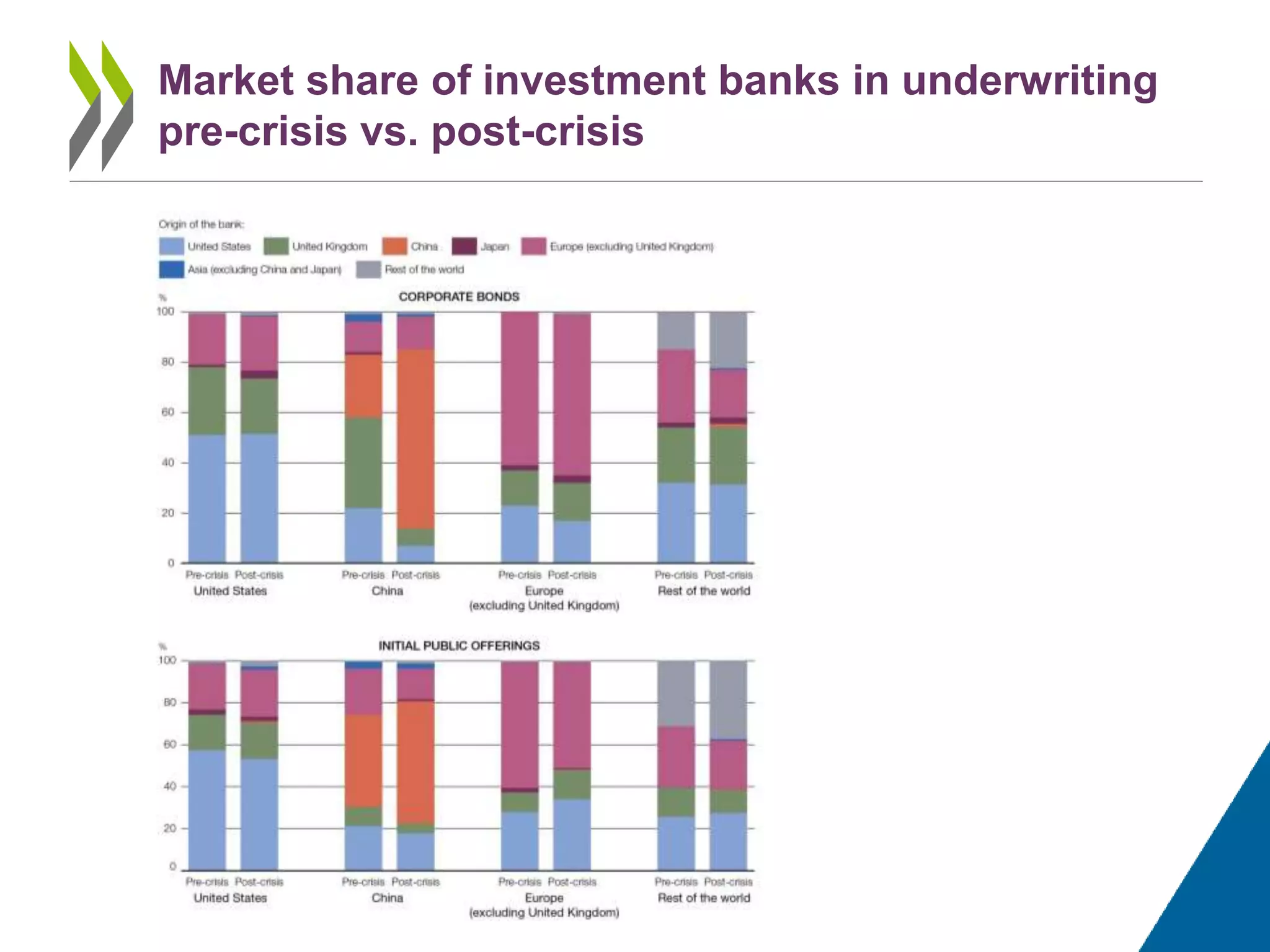
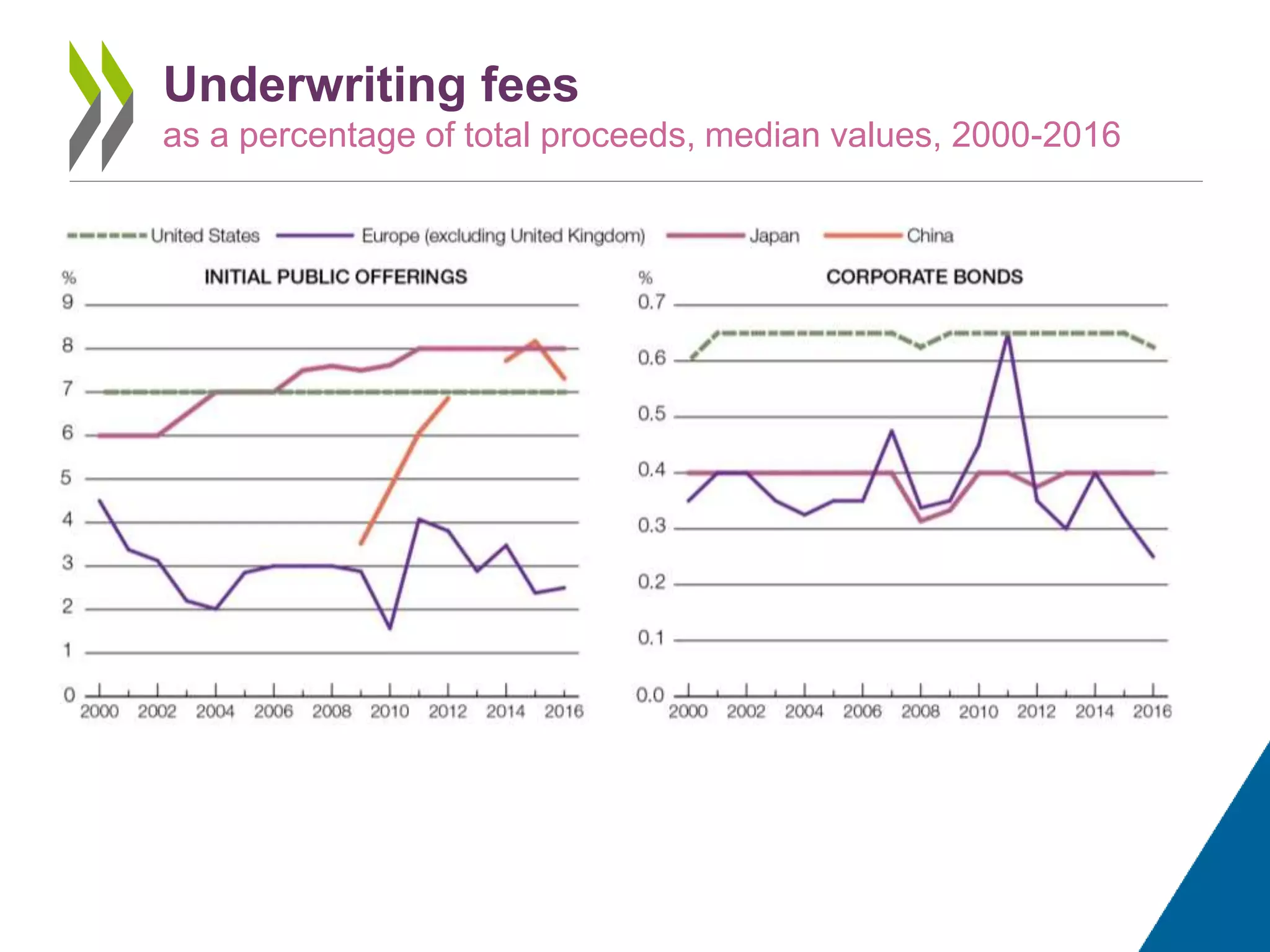
Lets look at 8 questions/issues
 The idea that it is technology and not trade comes from the
observation that jobs are disappearing in the middle class
 The losers in this story (those workers affected by reduced
hours, innovative work contracts and compressed
remuneration) belong to companies that are scattered within
their own industry (it is not workers of one industry versus
those of another).
 It is not the middle class as such that is being hollowed out—
rather, these ranks are swelled by those that work for middle-
paying companies that are forced to restructure or exit.
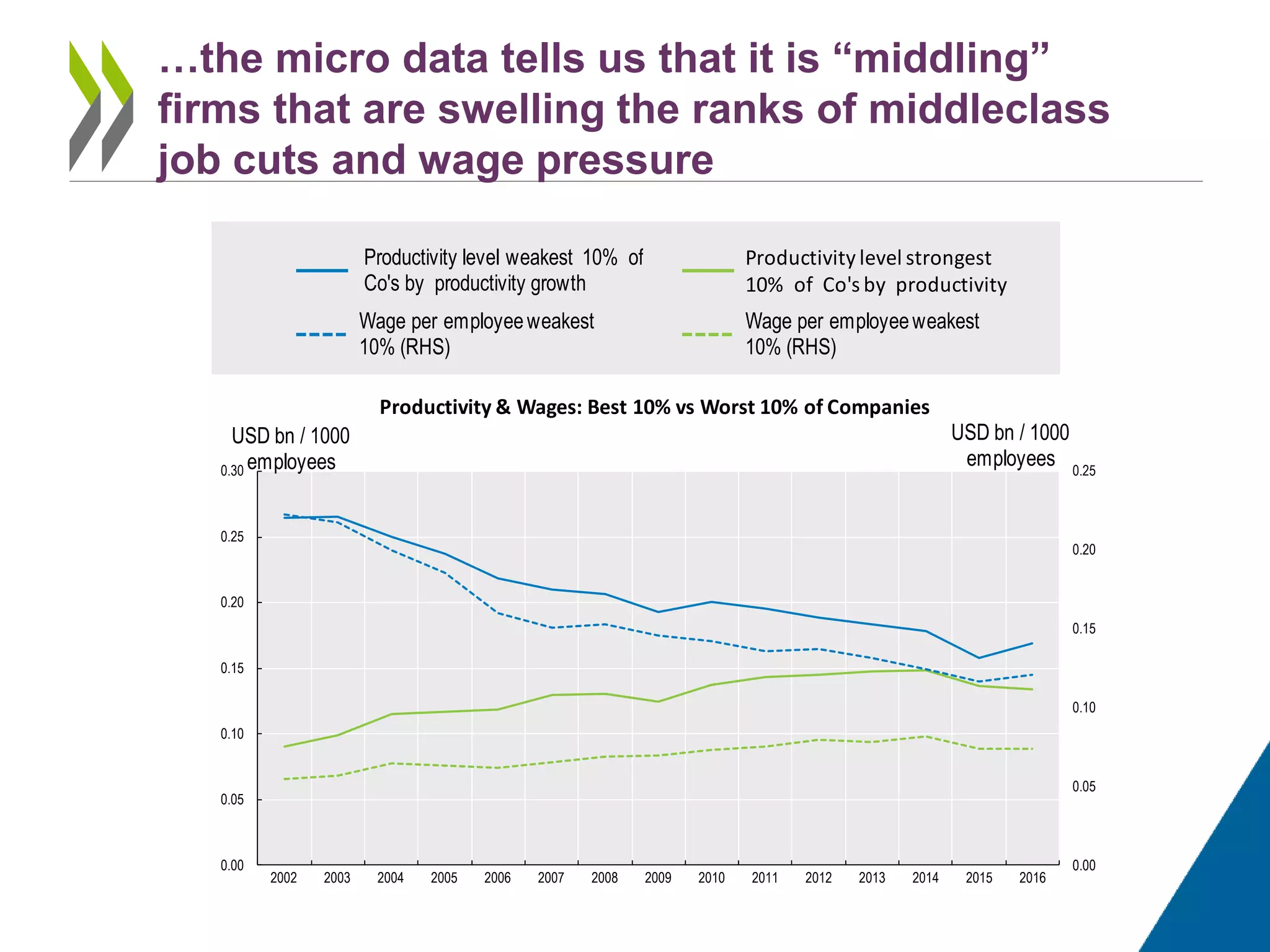
 Wages in incumbent “once were great” firms are being
compressed painfully towards the leaner global adapters as
their productivity falls.
(1) Is it the robots or trade causing the
hollowing out of the middle class?
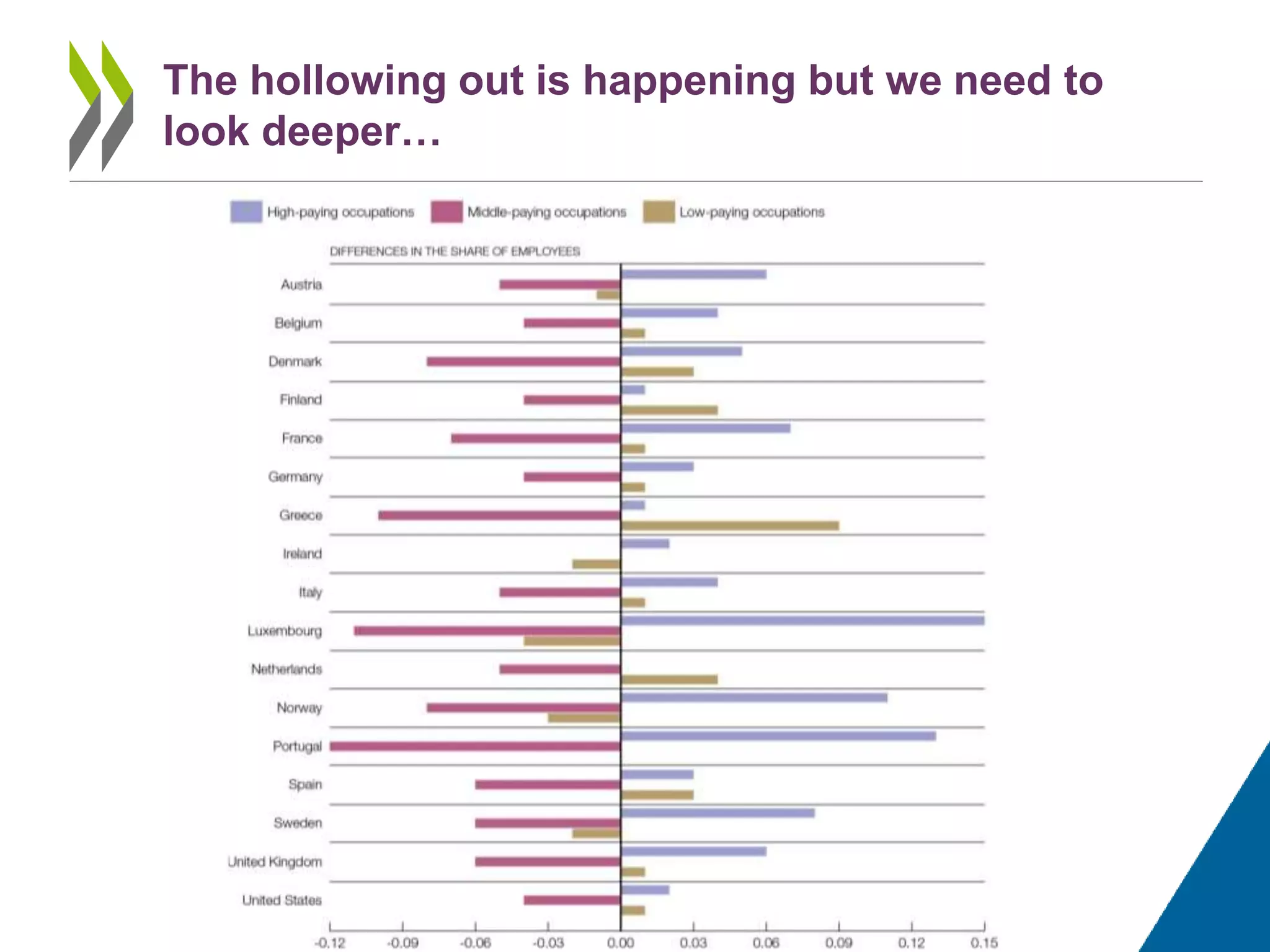
The hollowing out is happening but we need to
look deeper…
…the micro data tells us that it is “middling”
firms that are swelling the ranks of middleclass
job cuts and wage pressure
Productivity level weakest 10% of
Co's by productivity growth
Productivity level strongest
10% of Co's by productivity
Wage per employeeweakest
10% (RHS)
Wage per employeeweakest
10% (RHS)
0.00
0.05
0.10
0.15
0.20
0.25
0.00
0.05
0.10
0.15
0.20
0.25
0.30
2002 2003 2004 2005 2006 2007 2008 2009 2010 2011 2012 2013 2014 2015 2016
USD bn / 1000
employees
USD bn / 1000
employees
Productivity & Wages: Best 10% vs Worst 10% of Companies
 Winning market share and taking advantage of scale
economies matters. It requires investment, innovation and
new technology. The company data shows that it makes no
sense to try to separate these things out: to argue that “it’s not
trade, it’s the robots” that are hollowing out the middle
classes.
 The companies at the forefront of innovation and technology
(as reflected in productivity growth) are often multinationals
engaged in trade and foreign direct investment—they buy and
sell business segments, set up to produce abroad and the
export from multiple global production bases.
 And yes, they have the resources to invest in R&D or to buy
the start-ups that fit with their strategies as they fight it out in
the global market place.
Trade versus technology
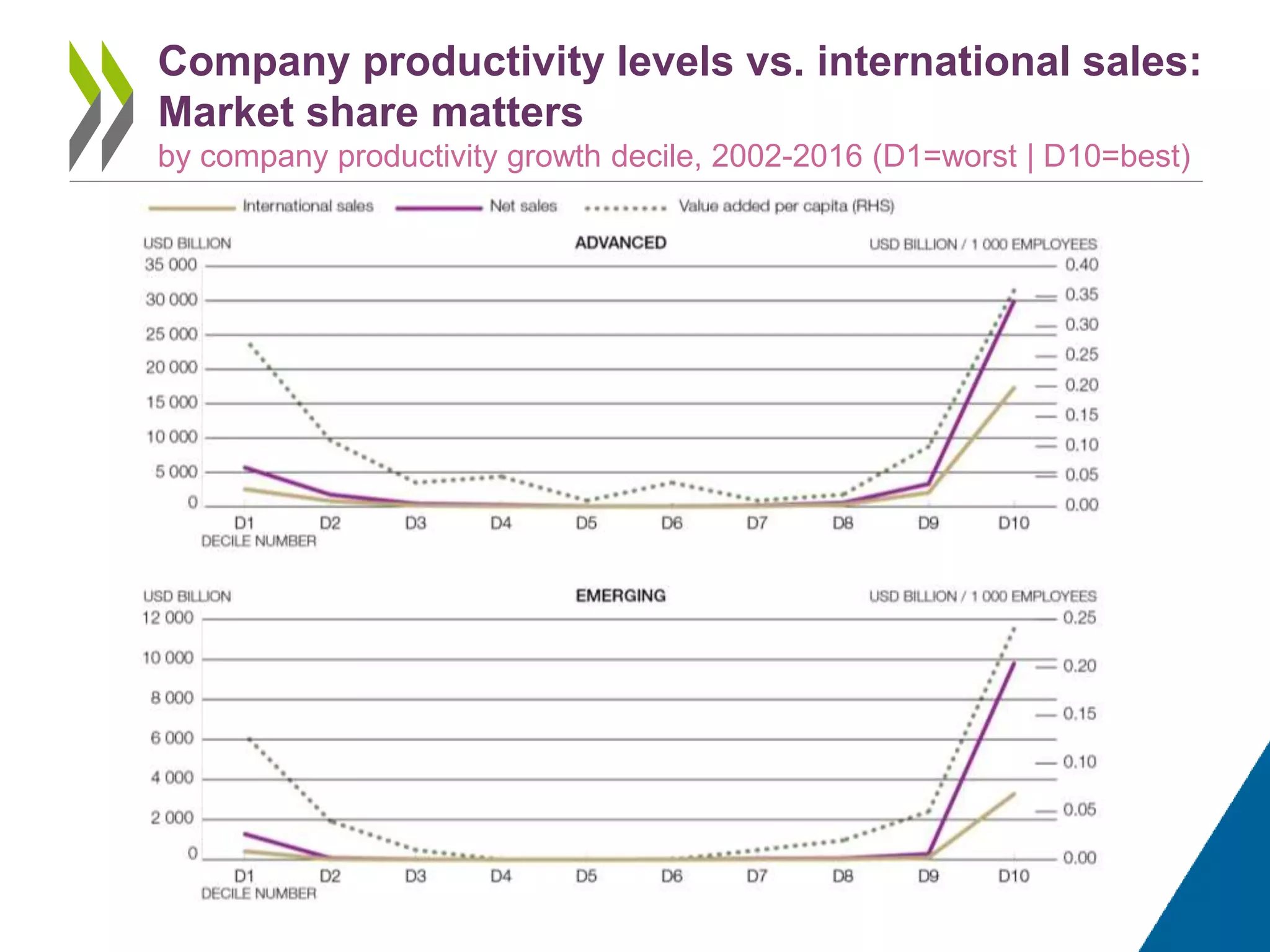
 Openness really matters.
 The fastest productivity growth companies are those that take
advantage of foreign sales, whether by exporting or by setting
up subsidiaries that produce abroad to serve foreign markets.
 They succeed in their home markets, force the exit of less
competitive firms and have the means to invest and innovate
further as they take advantage of scale economies in the
global economy.
 But there is a problem: not all economies are open to the
same extent and the playing field for doing business is by no
means level.
 It does not matter where firms sit in the value chain.
Maquiladoras are just as likely to face global competition as
any advanced-economy company, forcing them too to
restructure and enhance technology to remain competitive.
(2) Just how much does openness and a
level playing field matter?
Company productivity levels vs. international sales:
Market share matters
by company productivity growth decile, 2002-2016 (D1=worst | D10=best)
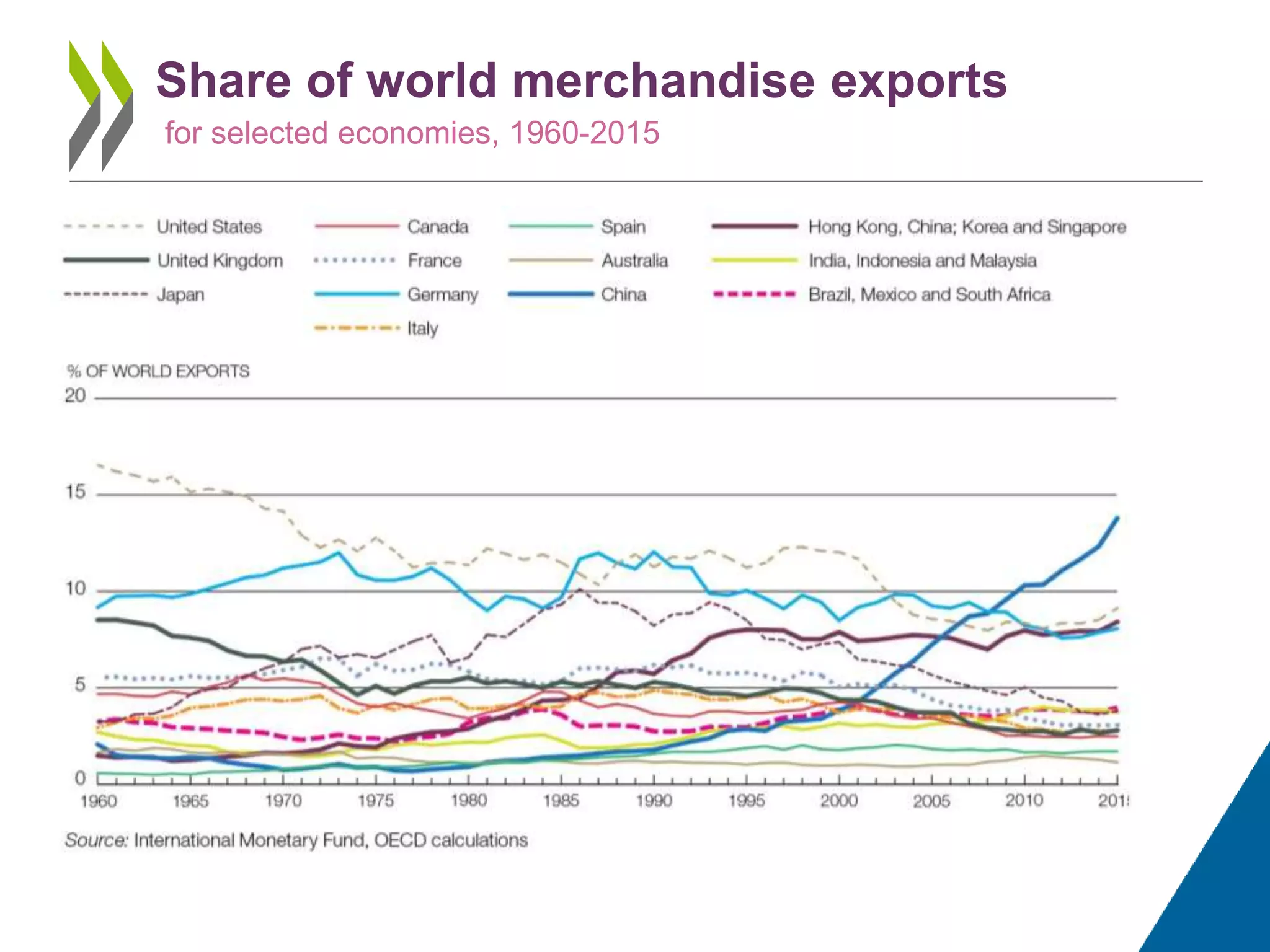
Share of world merchandise exports
for selected economies, 1960-2015
 Since entering WTO in 2001, China has quickly
become the largest exporting nation in the world, with
14% of merchandise exports and 18% of
manufacturing.
 Hong Kong (China), Singapore and Korea together
export as much as the United States or Germany (see
figure).
 Instead of exporting from home, companies can also
set up production abroad closer to foreign markets.
 China is now responsible for 11% of world M&A
outflows in 2016 while inward M&A has declined to a
low of 2% of the global total.
The spectacular takeover of trade by Asia
 No it cannot.
 Some large emerging economies have managed to pull
millions of people out of poverty—and the long-term
future of every country lies with continued success in this
regard.
 Competition too is to be welcomed. Like any sporting
match, let the best teams win.
 But also like any sporting match, the game needs to be
played with the same rulebook. If the same rules do not
apply to all, then fairness is put into question.
 If fairness is questioned, then sustainability of open trade
and investment in the global economy is also put at risk.
Can domestic policy compensate without
a level playing field?
 The level of the playing field is affected by capital
account and exchange rate management of
emerging economies.
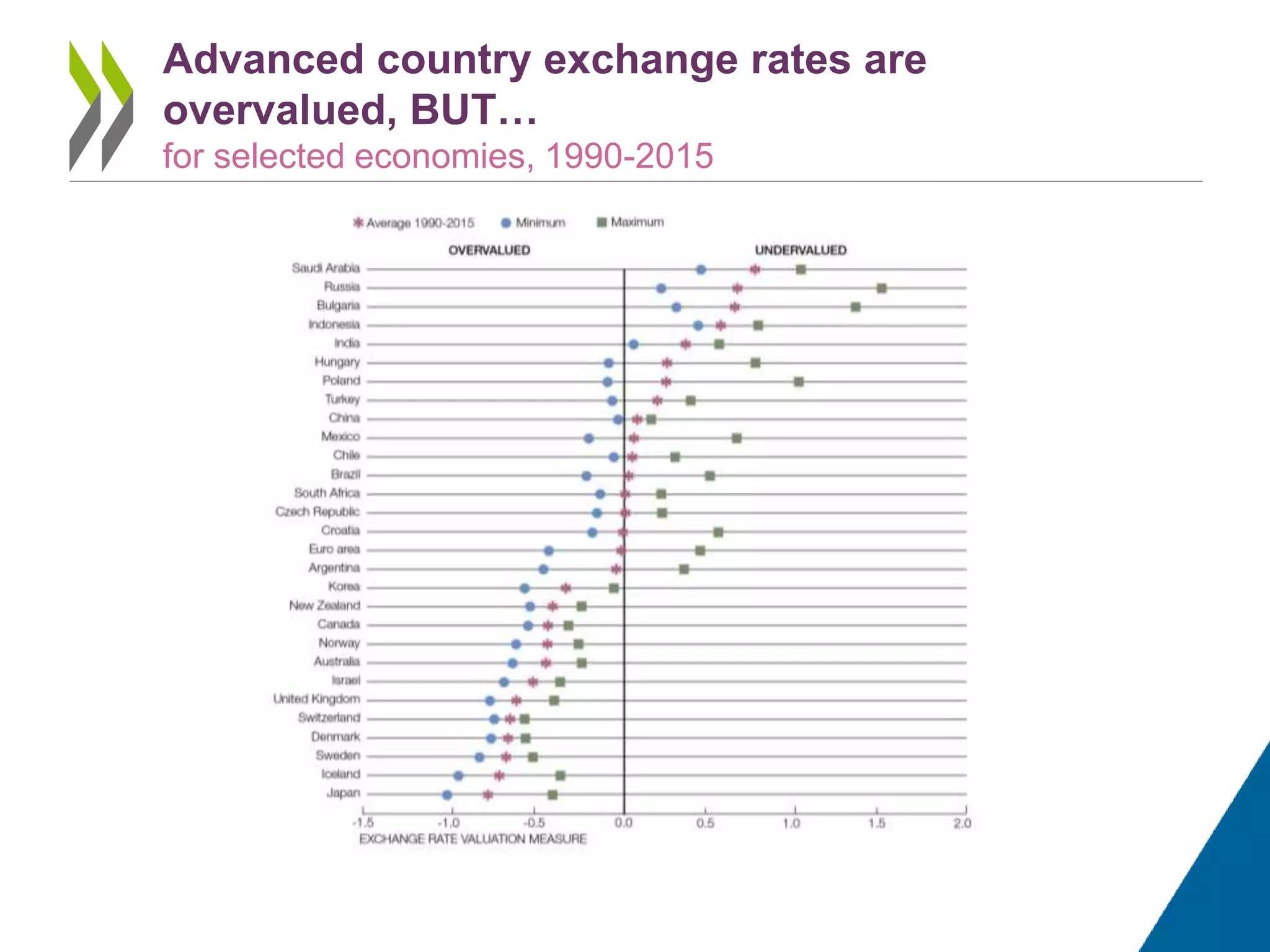
 Advanced economies generally have overvalued
real exchange rates—even after allowing for a
country’s level of economic development.
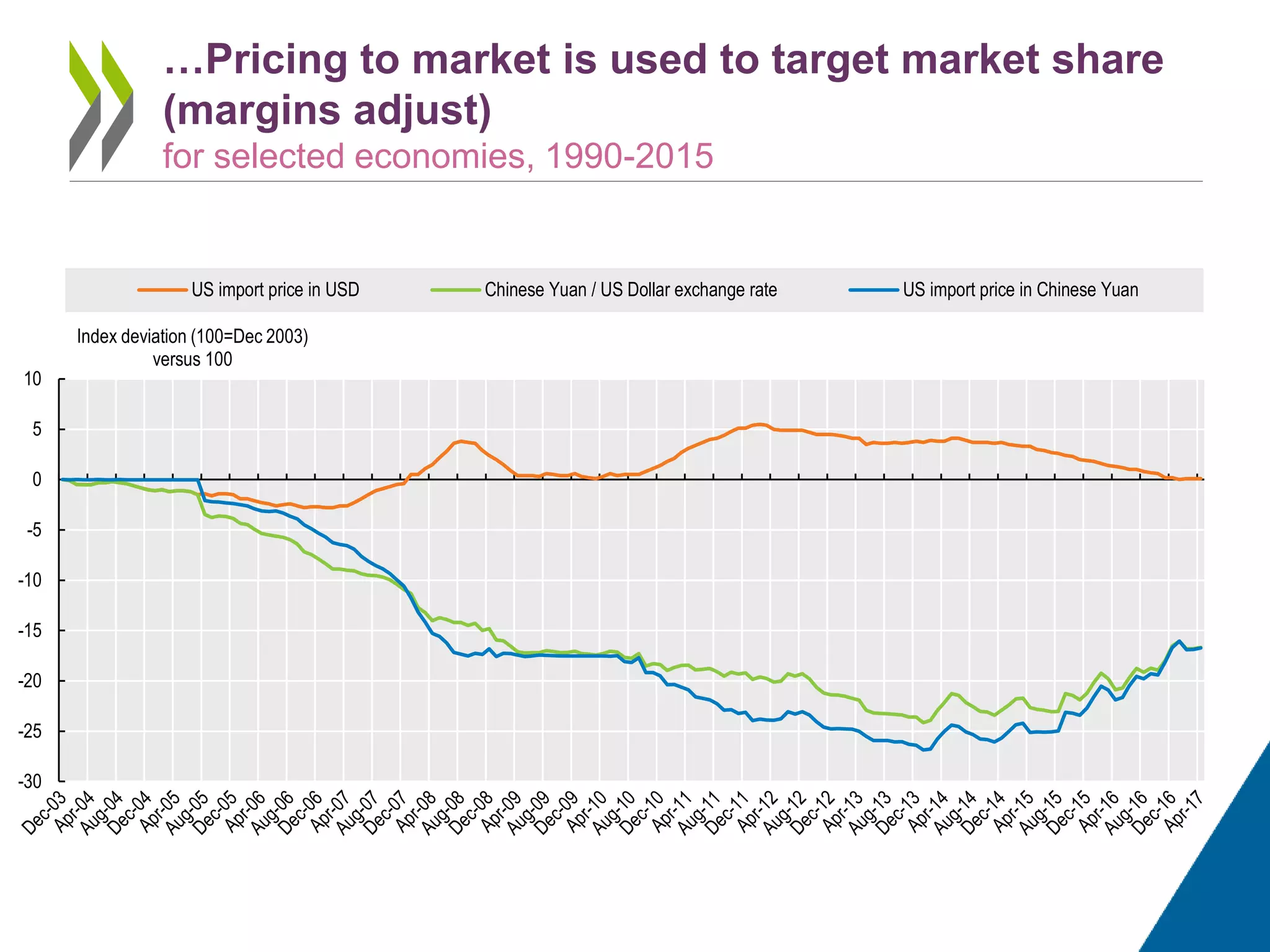
 Some large emerging economies also price to
market to ensure they obtain and maintain large
global market shares.
 This requires variable mark-up in pricing, particularly
when exchange rates are permitted to move.
(3) Is exchange rate targeting or pricing to market
more important in winning export share?
Advanced country exchange rates are
overvalued, BUT…
for selected economies, 1990-2015
…Pricing to market is used to target market share
(margins adjust)
for selected economies, 1990-2015
-30
-25
-20
-15
-10
-5
0
5
10
Index deviation (100=Dec 2003)
versus 100
US import price in USD Chinese Yuan / US Dollar exchange rate US import price in Chinese Yuan
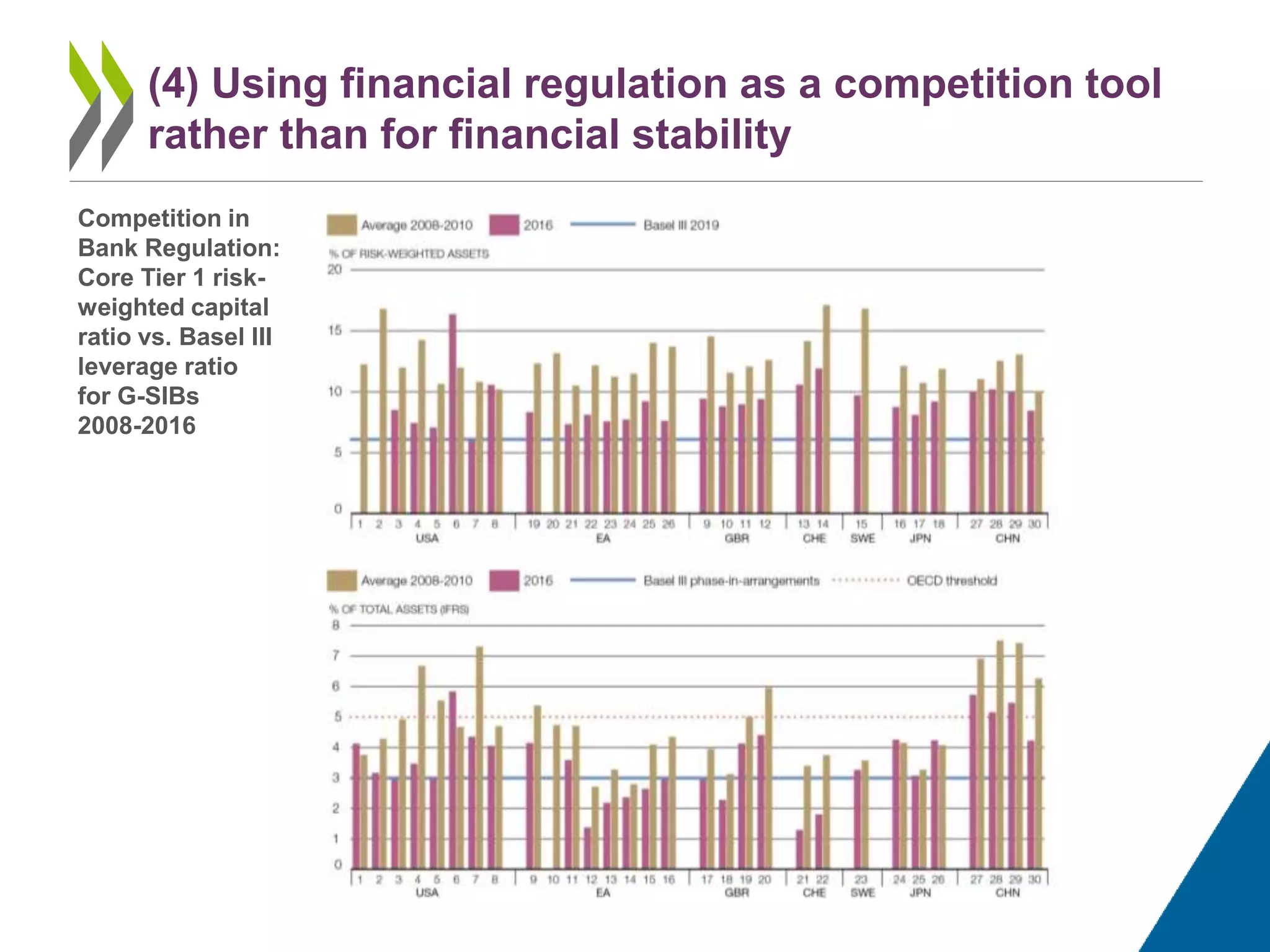
(4) Using financial regulation as a competition tool
rather than for financial stability
Competition in
Bank Regulation:
Core Tier 1 risk-
weighted capital
ratio vs. Basel III
leverage ratio
for G-SIBs
2008-2016
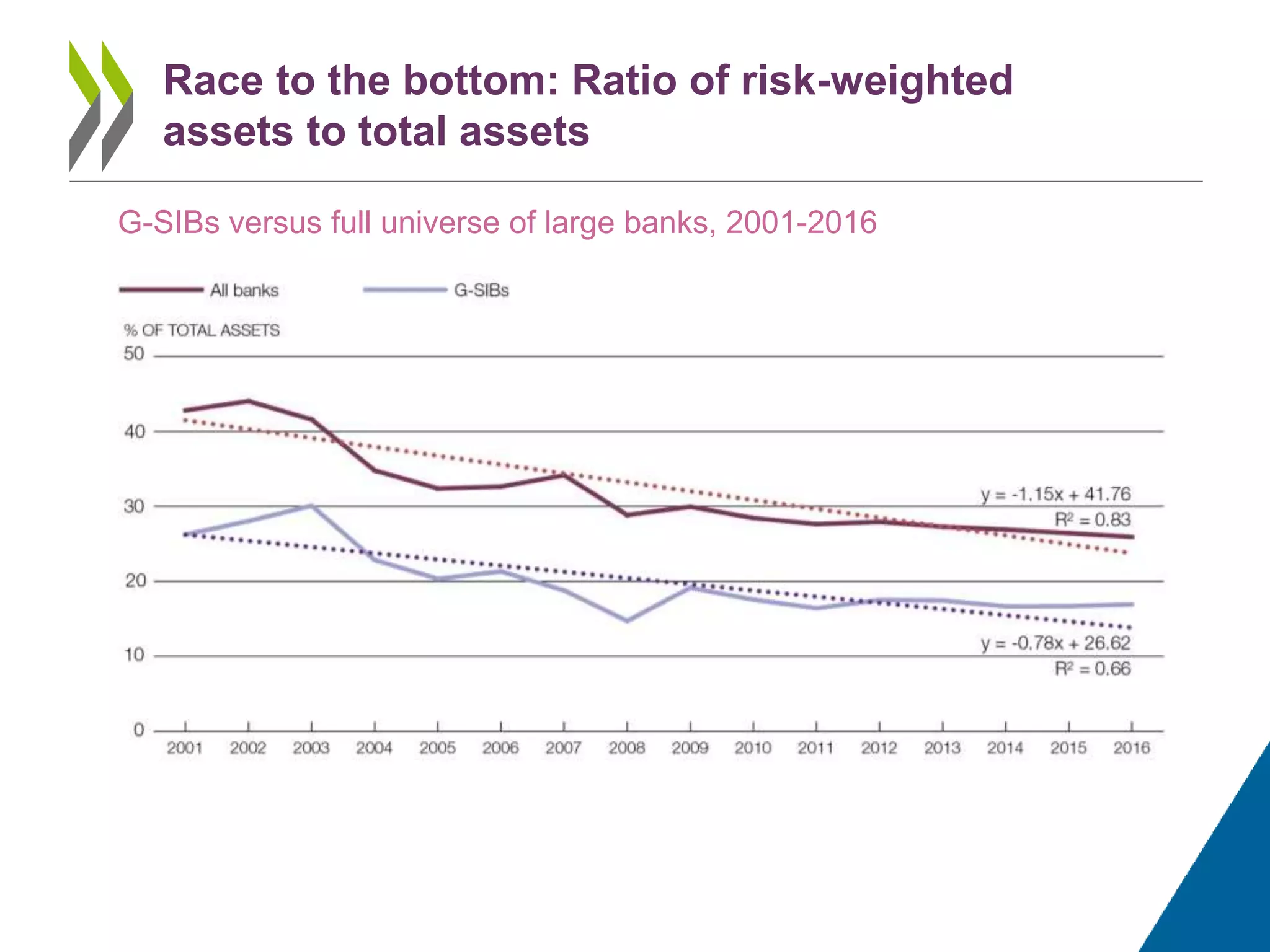
Race to the bottom: Ratio of risk-weighted
assets to total assets
G-SIBs versus full universe of large banks, 2001-2016
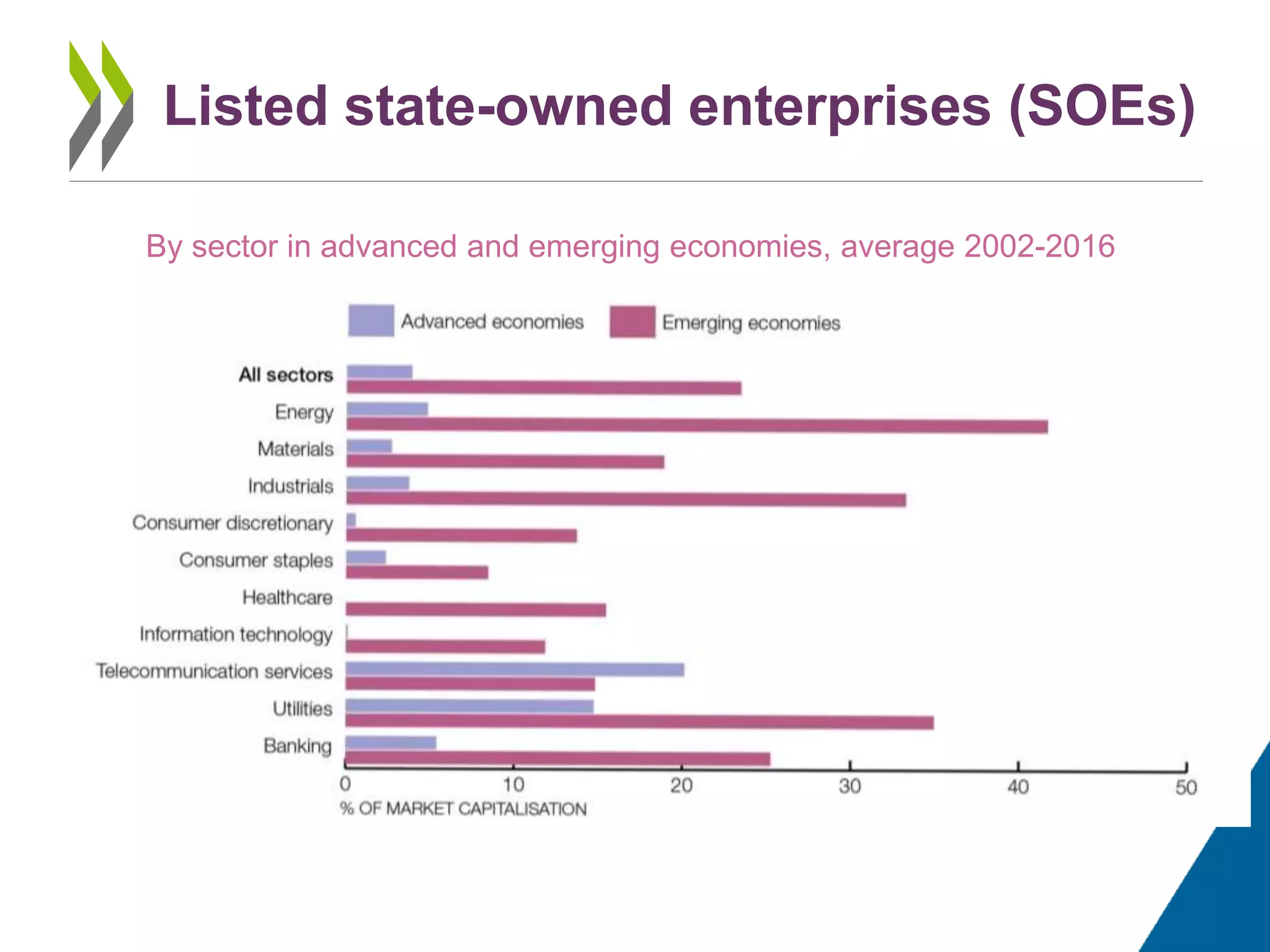
 These SOEs have become a force to be reckoned with.
The number of SOEs amongst the Fortune Global 500
companies grew from 9.8% in 2005 to 22.8% in 2014.
 The largest of these are Chinese banks that play an
important role in funding state-owned firms in all
industries, subsidising the cost of capital and facilitating
state-driven industrial strategies.
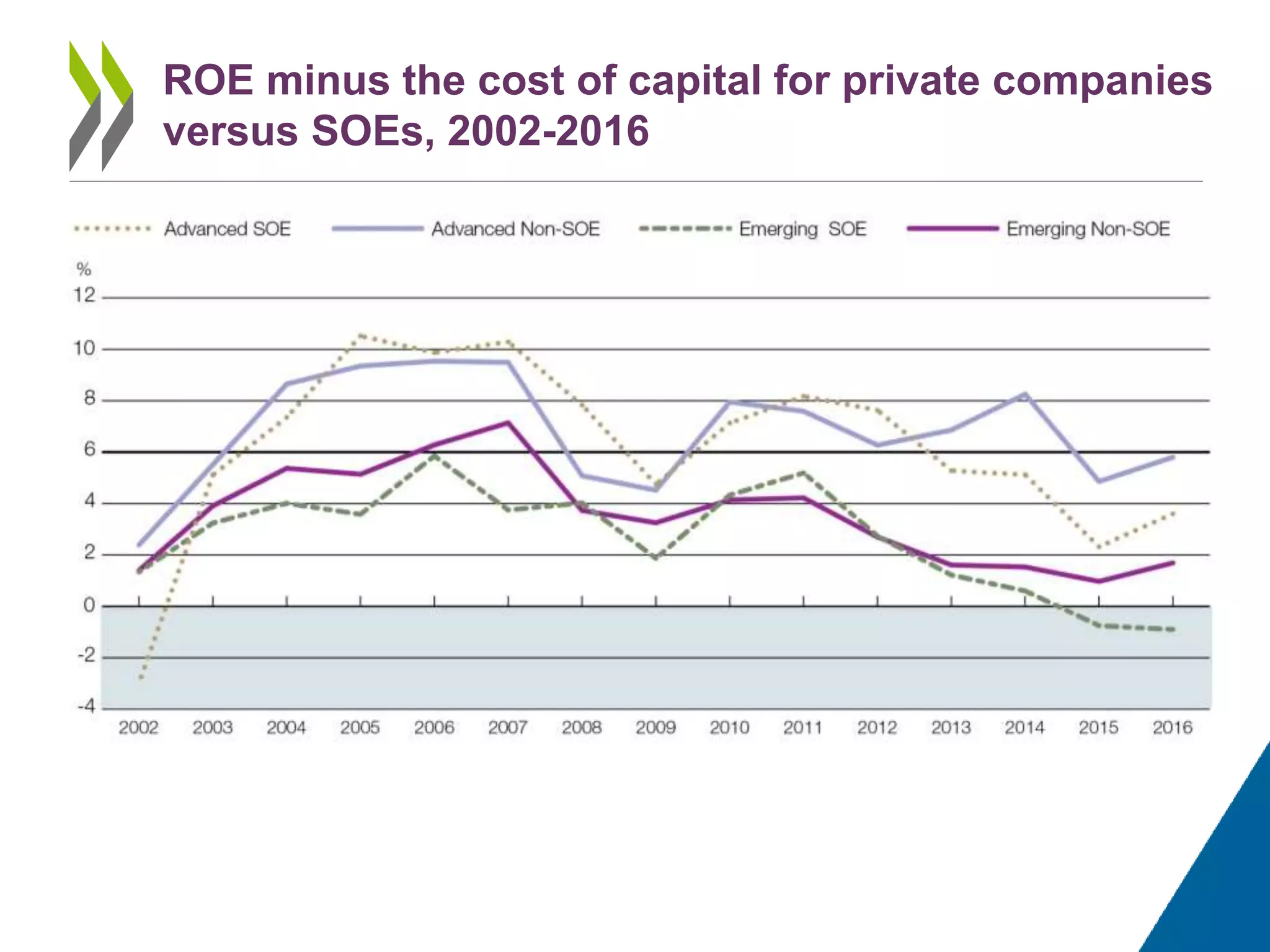
 Emerging market SOEs have greatly contributed to the
current excess capacity in key materials, energy and
industrial sectors. This is contributing to a decline in the
average return on equity in many sectors and countries.
(5) Is economic development via SOEs and
subsidies now somehow above the laws of
economics as a 3rd way?
Listed state-owned enterprises (SOEs)
By sector in advanced and emerging economies, average 2002-2016
ROE minus the cost of capital for private companies
versus SOEs, 2002-2016
 While SOEs benefit from subsidised funding,
private companies need equity finance for
corporate governance to operate via market-
based principal-agent incentives.
 Yet tacit collusion in underwriting appears to
raise costs excessively for IPOs, undermining
the incentive to use the equity market.
 Total fees collected from 10 IPOs worth USD
100 million each correspond to the entire IPO
float of another USD 100 M company.
(6) Do global banks collude to push up the
cost of IPOs?
Market share of investment banks in underwriting
pre-crisis vs. post-crisis
Underwriting fees
as a percentage of total proceeds, median values, 2000-2016
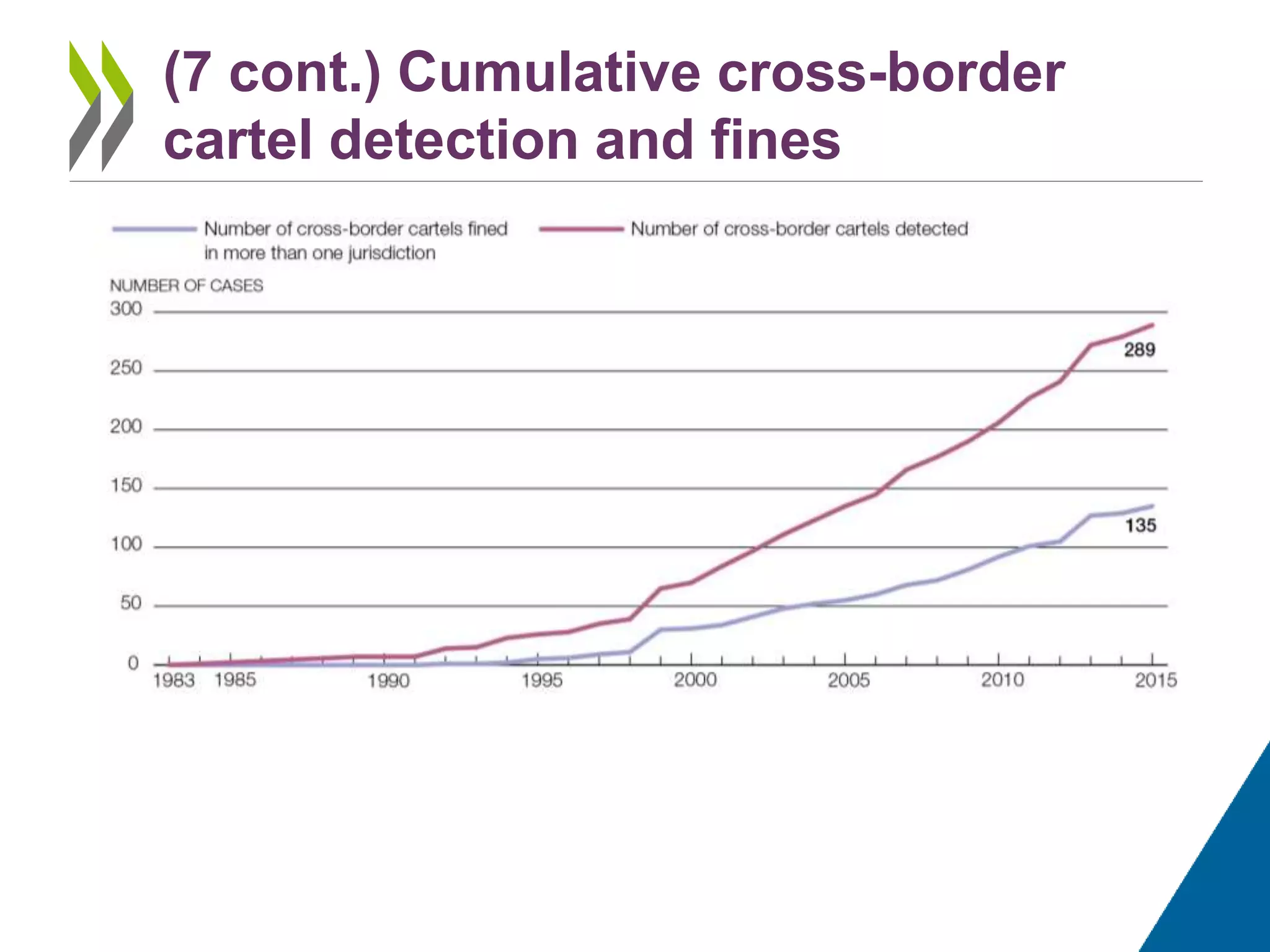
 Two hundred and forty cross-border cartels were
detected and fined between 1990 and 2015,
affecting USD 7.5 trillion in sales.
 Sustainable supply chains and better company
financial performance can go hand in hand – a
“win-win” outcome—so why cut corners
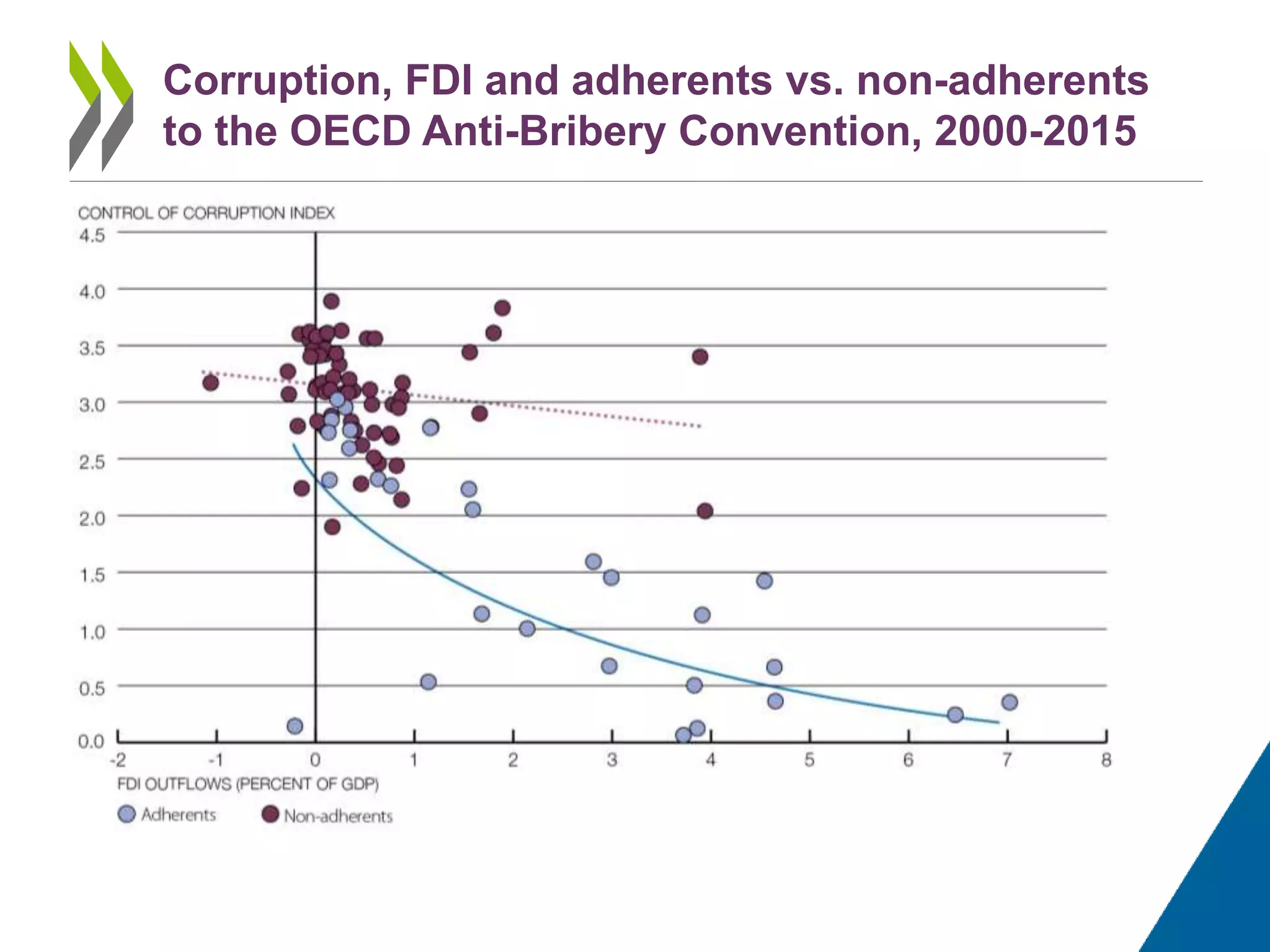
 Rent-seeking behaviour through bribery and
corruption is estimated by the World Bank to be
2% to 3% of world GDP (equivalent to the size of
the French economy).
(7) What role have companies played in
the backlash against globalisation?
(7 cont.) Cumulative cross-border
cartel detection and fines
Corruption, FDI and adherents vs. non-adherents
to the OECD Anti-Bribery Convention, 2000-2015
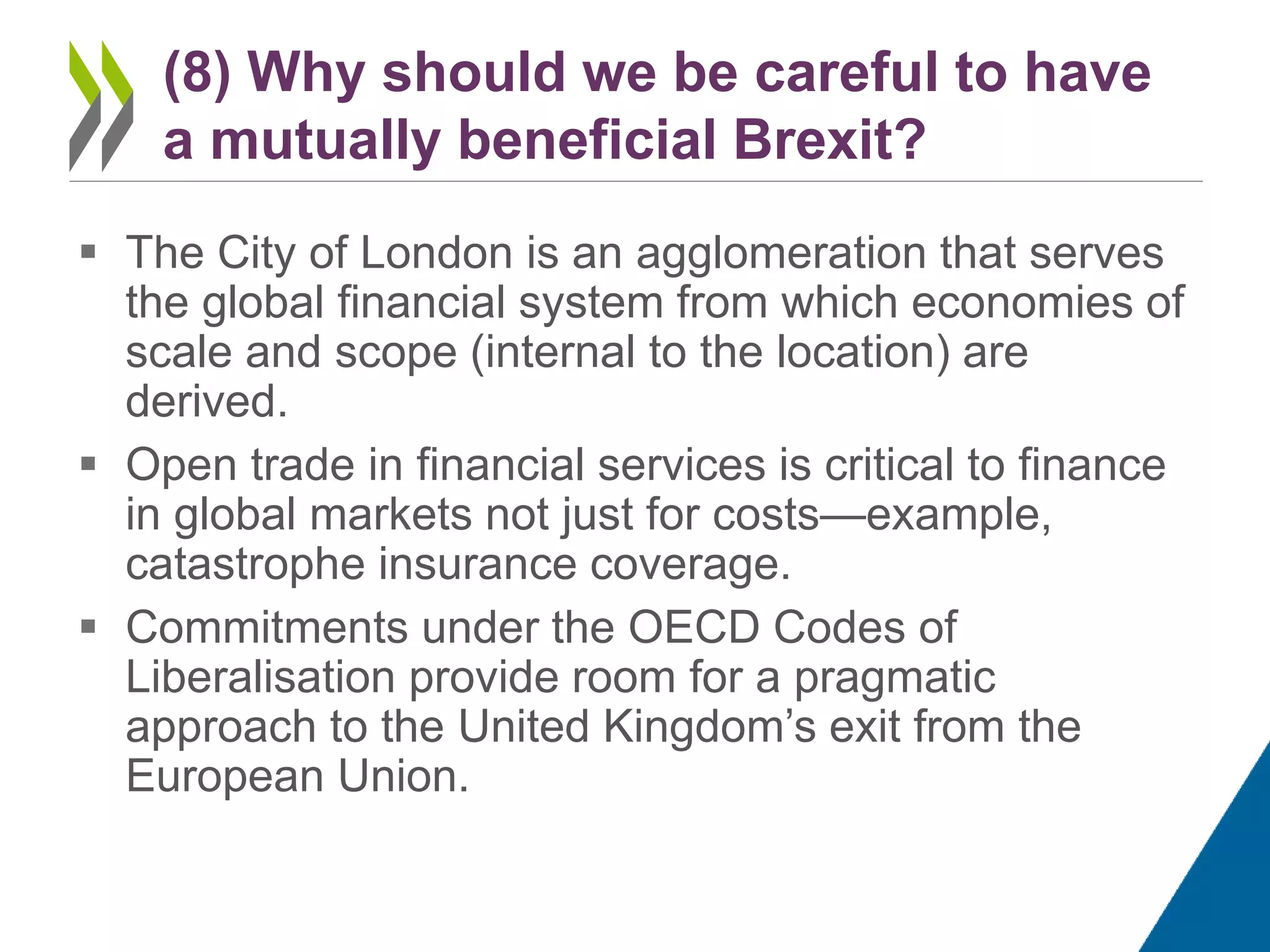
 The City of London is an agglomeration that serves
the global financial system from which economies of
scale and scope (internal to the location) are
derived.
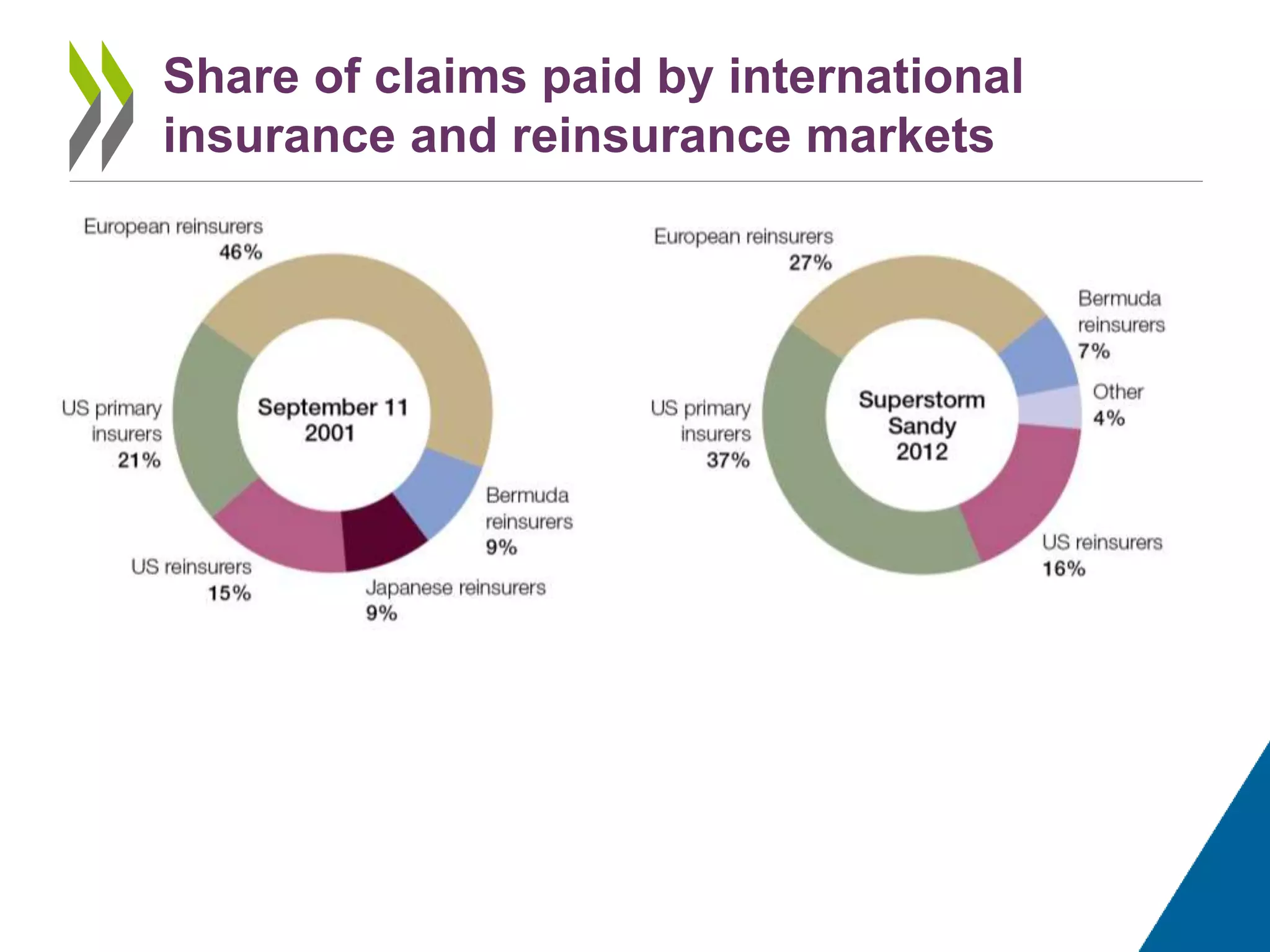
 Open trade in financial services is critical to finance
in global markets not just for costs—example,
catastrophe insurance coverage.
 Commitments under the OECD Codes of
Liberalisation provide room for a pragmatic
approach to the United Kingdom’s exit from the
European Union.
(8) Why should we be careful to have
a mutually beneficial Brexit?
Share of claims paid by international
insurance and reinsurance markets
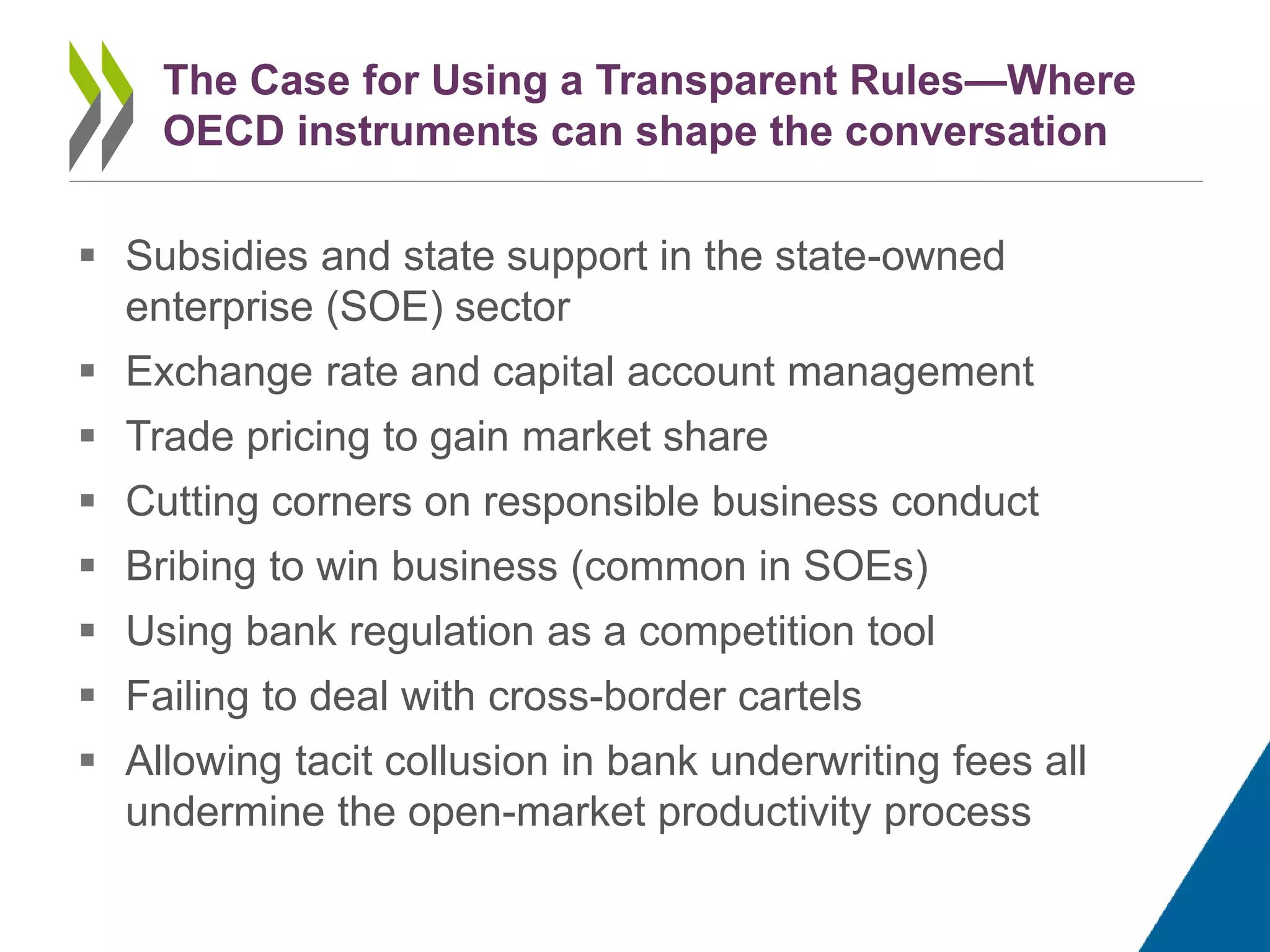
 Subsidies and state support in the state-owned
enterprise (SOE) sector
 Exchange rate and capital account management
 Trade pricing to gain market share
 Cutting corners on responsible business conduct
 Bribing to win business (common in SOEs)
 Using bank regulation as a competition tool
 Failing to deal with cross-border cartels
 Allowing tacit collusion in bank underwriting fees all
undermine the open-market productivity process
The Case for Using a Transparent Rules—Where
OECD instruments can shape the conversation
Thank you
Find the OECD Business
and Finance Outlook online
www.oecd.org/finance/
oecd-business-finance-outlook.htm

2017 OECD Business and Finance Outlook Key Findings

  • 1.
    2017 OECD BUSINESSAND FINANCE OUTLOOK KEY FINDINGS Adrian BLUNDELL-WIGNALL Special Advisor to the Secretary-General OECD Directorate for Financial and Enterprise Affairs
  • 2.
    1. Is itthe robots (technology) or trade causing the hollowing out of the middle class? 2. Just how much does openness and a level playing field matter? 3. Is exchange rate targeting or pricing to market more important in winning export share? 4. Using financial regulation as a competition tool rather than for financial stability. 5. Is economic development via SOEs and subsidies now somehow above the laws of economics as a 3rd way? 6. Do global banks collude to push up the cost of IPOs? 7. What role have companies played in the backlash against globalisation? 8. Why should we be careful to have a mutually beneficial Brexit? The Business & Finance Outlook: Lets look at 8 questions/issues
  • 3.
     The ideathat it is technology and not trade comes from the observation that jobs are disappearing in the middle class  The losers in this story (those workers affected by reduced hours, innovative work contracts and compressed remuneration) belong to companies that are scattered within their own industry (it is not workers of one industry versus those of another).  It is not the middle class as such that is being hollowed out— rather, these ranks are swelled by those that work for middle- paying companies that are forced to restructure or exit.  Wages in incumbent “once were great” firms are being compressed painfully towards the leaner global adapters as their productivity falls. (1) Is it the robots or trade causing the hollowing out of the middle class?
  • 4.
    The hollowing outis happening but we need to look deeper…
  • 5.
    …the micro datatells us that it is “middling” firms that are swelling the ranks of middleclass job cuts and wage pressure Productivity level weakest 10% of Co's by productivity growth Productivity level strongest 10% of Co's by productivity Wage per employeeweakest 10% (RHS) Wage per employeeweakest 10% (RHS) 0.00 0.05 0.10 0.15 0.20 0.25 0.00 0.05 0.10 0.15 0.20 0.25 0.30 2002 2003 2004 2005 2006 2007 2008 2009 2010 2011 2012 2013 2014 2015 2016 USD bn / 1000 employees USD bn / 1000 employees Productivity & Wages: Best 10% vs Worst 10% of Companies
  • 6.
     Winning marketshare and taking advantage of scale economies matters. It requires investment, innovation and new technology. The company data shows that it makes no sense to try to separate these things out: to argue that “it’s not trade, it’s the robots” that are hollowing out the middle classes.  The companies at the forefront of innovation and technology (as reflected in productivity growth) are often multinationals engaged in trade and foreign direct investment—they buy and sell business segments, set up to produce abroad and the export from multiple global production bases.  And yes, they have the resources to invest in R&D or to buy the start-ups that fit with their strategies as they fight it out in the global market place. Trade versus technology
  • 7.
     Openness reallymatters.  The fastest productivity growth companies are those that take advantage of foreign sales, whether by exporting or by setting up subsidiaries that produce abroad to serve foreign markets.  They succeed in their home markets, force the exit of less competitive firms and have the means to invest and innovate further as they take advantage of scale economies in the global economy.  But there is a problem: not all economies are open to the same extent and the playing field for doing business is by no means level.  It does not matter where firms sit in the value chain. Maquiladoras are just as likely to face global competition as any advanced-economy company, forcing them too to restructure and enhance technology to remain competitive. (2) Just how much does openness and a level playing field matter?
  • 8.
    Company productivity levelsvs. international sales: Market share matters by company productivity growth decile, 2002-2016 (D1=worst | D10=best)
  • 9.
    Share of worldmerchandise exports for selected economies, 1960-2015
  • 10.
     Since enteringWTO in 2001, China has quickly become the largest exporting nation in the world, with 14% of merchandise exports and 18% of manufacturing.  Hong Kong (China), Singapore and Korea together export as much as the United States or Germany (see figure).  Instead of exporting from home, companies can also set up production abroad closer to foreign markets.  China is now responsible for 11% of world M&A outflows in 2016 while inward M&A has declined to a low of 2% of the global total. The spectacular takeover of trade by Asia
  • 11.
     No itcannot.  Some large emerging economies have managed to pull millions of people out of poverty—and the long-term future of every country lies with continued success in this regard.  Competition too is to be welcomed. Like any sporting match, let the best teams win.  But also like any sporting match, the game needs to be played with the same rulebook. If the same rules do not apply to all, then fairness is put into question.  If fairness is questioned, then sustainability of open trade and investment in the global economy is also put at risk. Can domestic policy compensate without a level playing field?
  • 12.
     The levelof the playing field is affected by capital account and exchange rate management of emerging economies.  Advanced economies generally have overvalued real exchange rates—even after allowing for a country’s level of economic development.  Some large emerging economies also price to market to ensure they obtain and maintain large global market shares.  This requires variable mark-up in pricing, particularly when exchange rates are permitted to move. (3) Is exchange rate targeting or pricing to market more important in winning export share?
  • 13.
    Advanced country exchangerates are overvalued, BUT… for selected economies, 1990-2015
  • 14.
    …Pricing to marketis used to target market share (margins adjust) for selected economies, 1990-2015 -30 -25 -20 -15 -10 -5 0 5 10 Index deviation (100=Dec 2003) versus 100 US import price in USD Chinese Yuan / US Dollar exchange rate US import price in Chinese Yuan
  • 15.
    (4) Using financialregulation as a competition tool rather than for financial stability Competition in Bank Regulation: Core Tier 1 risk- weighted capital ratio vs. Basel III leverage ratio for G-SIBs 2008-2016
  • 16.
    Race to thebottom: Ratio of risk-weighted assets to total assets G-SIBs versus full universe of large banks, 2001-2016
  • 17.
     These SOEshave become a force to be reckoned with. The number of SOEs amongst the Fortune Global 500 companies grew from 9.8% in 2005 to 22.8% in 2014.  The largest of these are Chinese banks that play an important role in funding state-owned firms in all industries, subsidising the cost of capital and facilitating state-driven industrial strategies.  Emerging market SOEs have greatly contributed to the current excess capacity in key materials, energy and industrial sectors. This is contributing to a decline in the average return on equity in many sectors and countries. (5) Is economic development via SOEs and subsidies now somehow above the laws of economics as a 3rd way?
  • 18.
    Listed state-owned enterprises(SOEs) By sector in advanced and emerging economies, average 2002-2016
  • 19.
    ROE minus thecost of capital for private companies versus SOEs, 2002-2016
  • 20.
     While SOEsbenefit from subsidised funding, private companies need equity finance for corporate governance to operate via market- based principal-agent incentives.  Yet tacit collusion in underwriting appears to raise costs excessively for IPOs, undermining the incentive to use the equity market.  Total fees collected from 10 IPOs worth USD 100 million each correspond to the entire IPO float of another USD 100 M company. (6) Do global banks collude to push up the cost of IPOs?
  • 21.
    Market share ofinvestment banks in underwriting pre-crisis vs. post-crisis
  • 22.
    Underwriting fees as apercentage of total proceeds, median values, 2000-2016
  • 23.
     Two hundredand forty cross-border cartels were detected and fined between 1990 and 2015, affecting USD 7.5 trillion in sales.  Sustainable supply chains and better company financial performance can go hand in hand – a “win-win” outcome—so why cut corners  Rent-seeking behaviour through bribery and corruption is estimated by the World Bank to be 2% to 3% of world GDP (equivalent to the size of the French economy). (7) What role have companies played in the backlash against globalisation?
  • 24.
    (7 cont.) Cumulativecross-border cartel detection and fines
  • 25.
    Corruption, FDI andadherents vs. non-adherents to the OECD Anti-Bribery Convention, 2000-2015
  • 26.
     The Cityof London is an agglomeration that serves the global financial system from which economies of scale and scope (internal to the location) are derived.  Open trade in financial services is critical to finance in global markets not just for costs—example, catastrophe insurance coverage.  Commitments under the OECD Codes of Liberalisation provide room for a pragmatic approach to the United Kingdom’s exit from the European Union. (8) Why should we be careful to have a mutually beneficial Brexit?
  • 27.
    Share of claimspaid by international insurance and reinsurance markets
  • 28.
     Subsidies andstate support in the state-owned enterprise (SOE) sector  Exchange rate and capital account management  Trade pricing to gain market share  Cutting corners on responsible business conduct  Bribing to win business (common in SOEs)  Using bank regulation as a competition tool  Failing to deal with cross-border cartels  Allowing tacit collusion in bank underwriting fees all undermine the open-market productivity process The Case for Using a Transparent Rules—Where OECD instruments can shape the conversation
  • 29.
    Thank you Find theOECD Business and Finance Outlook online www.oecd.org/finance/ oecd-business-finance-outlook.htm