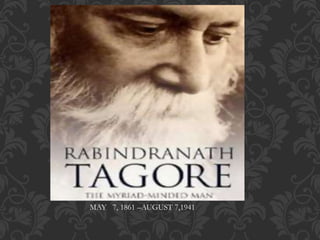
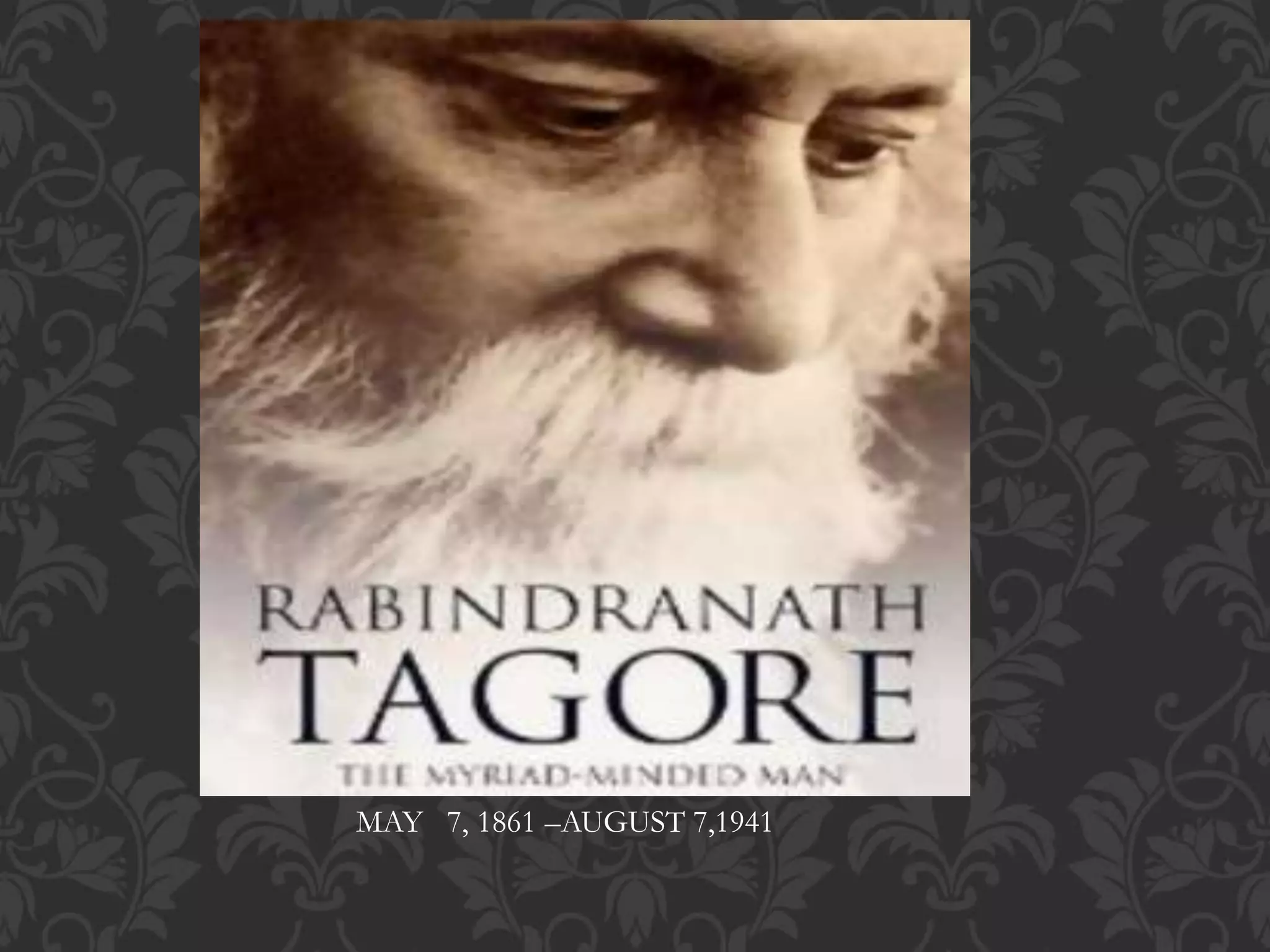
MAY 7, 1861 –AUGUST 7,1941
INTRODUCTION 
 Rabindranath Tagore (1861-1941) was the youngest son of Debendranath Tagore, a 
leader of the Brahmo Samaj, which was a new religious sect in nineteenth-century Bengal 
and which attempted a revival of the ultimate monistic basis of Hinduism as laid down in the 
Upanishads. 
 In his mature years, in addition to his many-sided literary activities, he managed the family 
estates, a project which brought him into close touch with common humanity and increased his 
interest in social reforms. 
 He also started an experimental school at Shantiniketan where he tried his Upanishadic 
ideals of education. From time to time he participated in the Indian nationalist movement, 
though in his own non-sentimental and visionary way; and Gandhi, the political father of 
modern India, was his devoted friend. Tagore was knighted by the ruling British Government in 
1915, but within a few years he resigned the honour as a protest against British policies in India. 
 Tagore had early success as a writer in his native Bengal. With his translations of some of his 
poems he became rapidly known in the West. In fact his fame attained a luminous height, taking 
him across continents on lecture tours and tours of friendship. For the world he became the 
voice of India's spiritual heritage; and for India, especially for Bengal, he became a great living 
institution.
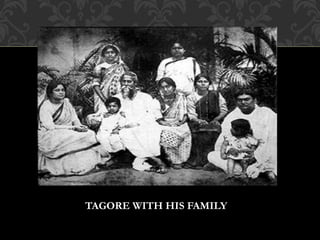
TAGORE WITH HIS FAMILY
FAMOUS WORKS 
Although Tagore wrote successfully in all literary genres, he was first of all a poet. Among 
his fifty and odd volumes of poetry are: 
 Manasi (1890) [The Ideal One], 
 Sonar Tari (1894) [The Golden Boat], 
 Gitanjali (1910) [Song Offerings], 
 Gitimalya (1914) [Wreath of Songs], and 
 Balaka (1916) [The Flight of Cranes]. 
The English renderings of his poetry, which include : 
 The Gardener (1913), 
 Fruit-Gathering (1916), and 
 The Fugitive (1921),. 
Tagore's major plays are : 
 Raja (1910) [The King of the Dark Chamber], 
 Dakghar (1912) [The Post Office], 
 Achalayatan (1912) [The Immovable], 
 Muktadhara (1922) [The Waterfall], and 
 Raktakaravi (1926) [Red Oleanders].
He is the author of several volumes of short stories and a number of novels, among them : 
 Gora (1910), 
 Ghare-Baire (1916) [The Home and the World], and 
 Yogayog (1929) [Crosscurrents]. 
Besides these, he wrote musical dramas, dance dramas, essays of all types, travel diaries, and two 
autobiographies, one in his middle years and the other shortly before his death in 1941. Tagore also 
left numerous drawings and paintings, and songs for which he wrote the music himself.
GITANJALI 
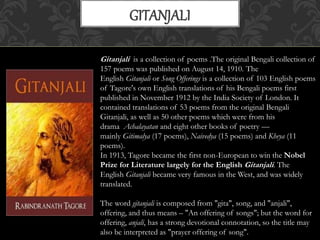
Gitanjali is a collection of poems .The original Bengali collection of 
157 poems was published on August 14, 1910. The 
English Gitanjali or Song Offerings is a collection of 103 English poems 
of Tagore's own English translations of his Bengali poems first 
published in November 1912 by the India Society of London. It 
contained translations of 53 poems from the original Bengali 
Gitanjali, as well as 50 other poems which were from his 
drama Achalayatan and eight other books of poetry — 
mainly Gitimalya (17 poems), Naivedya (15 poems) and Kheya (11 
poems). 
In 1913, Tagore became the first non-European to win the Nobel 
Prize for Literature largely for the EnglishGitanjali. The 
English Gitanjali became very famous in the West, and was widely 
translated. 
The word gitanjali is composed from "gita", song, and "anjali", 
offering, and thus means – "An offering of songs"; but the word for 
offering, anjali, has a strong devotional connotation, so the title may 
also be interpreted as "prayer offering of song".
A GLIMPSE OF 
GITANJALI 
. A Moments Indulgence 
I ask for a moment's indulgence to sit by thy side. The works 
that I have in hand I will finish afterwards. 
Away from the sight of thy face my heart knows no rest nor respite, 
and my work becomes an endless toil in a shoreless sea of toil. 
Today the summer has come at my window with its sighs and murmurs; and 
the bees are plying their minstrelsy at the court of the flowering grove. 
Now it is time to sit quite, face to face with thee, and to sing 
dedication of life in this silent and overflowing leisure.
SYNOPSIS 
A Moments Indulgence 
A Moments Indulgence by Rabindranath Tagore was written in 1910 as part of 
the Gitanjali collection, 157 poems in the original language of Bengali, and 103 in English 
translated by Tagore himself. 
The central focus of A Moments Indulgence is about dedicating ones time to God, which 
clearly brings the devotee joy. The speaker is aware that his soul has been engrossed in worldliness, 
thus putting aside worldly pleasures that man is often disillusioned by, the speaker begins devoting 
his time to God. 
 The poem begins with the speaker seeking a moment’s indulgence from his creator. This is 
evident as he says, he ‘will finish afterwards’ he task he was doing, in order to connect with his 
creator.. 
 The second stanza shows the extent of the speaker’s devotion to his creator. This can be seen 
through the way he says that when he is away from God, mentally or physically, his heart 
remains restless, and the tasks at hand seem like they will never end. It portrays a clear 
distinction between the pleasure one receives from worldliness, and the true spiritual joy one 
gains from devoting time to God.
 In the third stanza the speaker is talking about the present day, and describes the beauty of the 
world which is a gift from God. He uses nature imagery to describe the beauty of the day which 
is being enjoyed by both animals, the ‘bees’, plants, and ‘the flowering grove’. The speaker also 
uses sound descriptions of: ‘sighs and murmurs’ to describe the present day, this has connotations 
of peace and being at peace in the environment one is in, adding to the spiritual vibe of the 
poem. This implies that nature is close to God as it is content, reinforcing the second stanza’s idea 
that when away from God a person can not be content. 
 The fourth stanza shows that the speaker believes that the present time is the best time to 
dedicate himself to God; he does this by singing to God and sitting quietly. Surrounding himself 
with nature, and the speaker believes the silence and free time is the perfect time to devote time 
to his creator because he is not distracted by worldly tasks and is surrounded by a gift, the beauty 
of nature, which is from God.
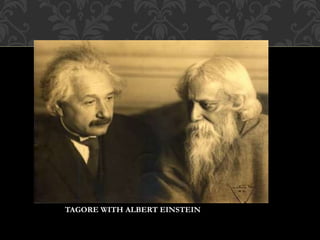
TAGORE WITH ALBERT EINSTEIN
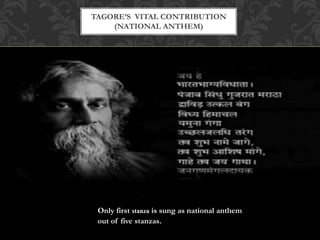
TAGORE’S VITAL CONTRIBUTION 
(NATIONAL ANTHEM) 
Only first stanza is sung as national anthem 
out of five stanzas.
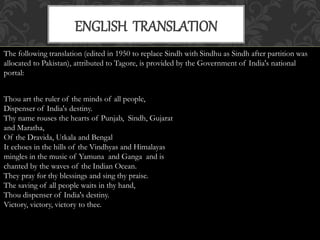
ENGLISH TRANSLATION 
The following translation (edited in 1950 to replace Sindh with Sindhu as Sindh after partition was 
allocated to Pakistan), attributed to Tagore, is provided by the Government of India's national 
portal: 
Thou art the ruler of the minds of all people, 
Dispenser of India's destiny. 
Thy name rouses the hearts of Punjab, Sindh, Gujarat 
and Maratha, 
Of the Dravida, Utkala and Bengal 
It echoes in the hills of the Vindhyas and Himalayas 
mingles in the music of Yamuna and Ganga and is 
chanted by the waves of the Indian Ocean. 
They pray for thy blessings and sing thy praise. 
The saving of all people waits in thy hand, 
Thou dispenser of India's destiny. 
Victory, victory, victory to thee.
BACKGROUND 
"Jana Gana Mana" is the national anthem of India Written in highly Sanskritised Bengali it is the 
first of five stanzas of a hym .It was first sung in Calcutta Session of the Indian National Congress 
on 27 December 1911.["Jana Gana Mana" was officially adopted by the Constituent Assembly as 
the Indian national anthem on 24 January 1950. 
The original poem was translated into Hindi-Urdu by Abid Ali 
A formal rendition of the national anthem takes fifty-two seconds. A shortened version consisting 
of the first and last lines (and taking about 20 seconds to play) is also staged occasionally.[Tagore 
wrote down the English translation.. of the song and along with Margaret Cousins (an expert in 
European music and wife of Irish poet James Cousins), set down the notation at Madanapalle in 
Andhra Pradesh, which is followed only when the song is sung in the original slow rendition style 
of singing. However, when the National Anthem version of the song is sung, it is often performed 
in the orchestral/choral adaptation made by the English composer Herbert Murrillat the behest 
of Nehru. 
An earlier poem by Tagore (Amar Sonar Bangla) was later selected as the national anthem of 
Bangladesh.
HISTORICAL SIGNIFICANCE 
The poem was composed in December 1911, coinciding with the visit of King George V at the 
time of the Coronation Durbar of George V and "Bharat Bhagya vidhata" and "Adhinayaka" was 
believed to be in praise of King George V as per the British newspapers. The composition was 
first sung during a convention of the then loyalist Indian National Congress in Calcutta on 26 Dec 
1911.[It was sung on the second day of the convention, and the agenda of that day devoted itself 
to a loyal welcome of George V on his visit to India.
LITERAL INTERPRETATION 
The proponents of the controversy stress the usage of the following words and phrases to 
claim that Jana Gana Mana was written for the King and the Queen of England- 
Stanza 1: (Indian) People wake up remembering your good name and ask for your blessings 
and they sing your glories. 
Stanza 2: Around your 'throne' people of all religions come and give their love and 
anxiously wait to hear your kind words. 
Stanza 3: Praise to the 'King' for being 'the charioteer'. 
Stanza 4: Drowned in deep ignorance, and suffering, poverty-striken, this unconscious 
country waits for the wink of our eye and your mother's (Earth's) true protection. 
Stanza 5: In your compassionate plans, the sleeping Bharat (India) will wake up. We bow 
down to your feet O Queen(Earth), and victory come to Rajeshwara (the lord of the lords).
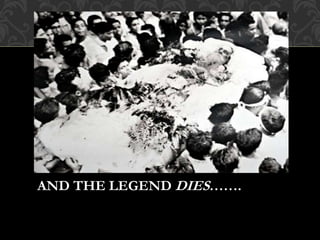
AND THE LEGEND DIES…….
THANK YOU 
SUBMITED BY 
 ANKITA MISHRA 
 PRIYAL JOSHI 
 SWATI RANKA

rabindranath tagore

  • 1.
    MAY 7, 1861–AUGUST 7,1941
  • 2.
    INTRODUCTION  RabindranathTagore (1861-1941) was the youngest son of Debendranath Tagore, a leader of the Brahmo Samaj, which was a new religious sect in nineteenth-century Bengal and which attempted a revival of the ultimate monistic basis of Hinduism as laid down in the Upanishads.  In his mature years, in addition to his many-sided literary activities, he managed the family estates, a project which brought him into close touch with common humanity and increased his interest in social reforms.  He also started an experimental school at Shantiniketan where he tried his Upanishadic ideals of education. From time to time he participated in the Indian nationalist movement, though in his own non-sentimental and visionary way; and Gandhi, the political father of modern India, was his devoted friend. Tagore was knighted by the ruling British Government in 1915, but within a few years he resigned the honour as a protest against British policies in India.  Tagore had early success as a writer in his native Bengal. With his translations of some of his poems he became rapidly known in the West. In fact his fame attained a luminous height, taking him across continents on lecture tours and tours of friendship. For the world he became the voice of India's spiritual heritage; and for India, especially for Bengal, he became a great living institution.
  • 3.
  • 4.
    FAMOUS WORKS AlthoughTagore wrote successfully in all literary genres, he was first of all a poet. Among his fifty and odd volumes of poetry are:  Manasi (1890) [The Ideal One],  Sonar Tari (1894) [The Golden Boat],  Gitanjali (1910) [Song Offerings],  Gitimalya (1914) [Wreath of Songs], and  Balaka (1916) [The Flight of Cranes]. The English renderings of his poetry, which include :  The Gardener (1913),  Fruit-Gathering (1916), and  The Fugitive (1921),. Tagore's major plays are :  Raja (1910) [The King of the Dark Chamber],  Dakghar (1912) [The Post Office],  Achalayatan (1912) [The Immovable],  Muktadhara (1922) [The Waterfall], and  Raktakaravi (1926) [Red Oleanders].
  • 5.
    He is theauthor of several volumes of short stories and a number of novels, among them :  Gora (1910),  Ghare-Baire (1916) [The Home and the World], and  Yogayog (1929) [Crosscurrents]. Besides these, he wrote musical dramas, dance dramas, essays of all types, travel diaries, and two autobiographies, one in his middle years and the other shortly before his death in 1941. Tagore also left numerous drawings and paintings, and songs for which he wrote the music himself.
  • 6.
    GITANJALI Gitanjali isa collection of poems .The original Bengali collection of 157 poems was published on August 14, 1910. The English Gitanjali or Song Offerings is a collection of 103 English poems of Tagore's own English translations of his Bengali poems first published in November 1912 by the India Society of London. It contained translations of 53 poems from the original Bengali Gitanjali, as well as 50 other poems which were from his drama Achalayatan and eight other books of poetry — mainly Gitimalya (17 poems), Naivedya (15 poems) and Kheya (11 poems). In 1913, Tagore became the first non-European to win the Nobel Prize for Literature largely for the EnglishGitanjali. The English Gitanjali became very famous in the West, and was widely translated. The word gitanjali is composed from "gita", song, and "anjali", offering, and thus means – "An offering of songs"; but the word for offering, anjali, has a strong devotional connotation, so the title may also be interpreted as "prayer offering of song".
  • 7.
    A GLIMPSE OF GITANJALI . A Moments Indulgence I ask for a moment's indulgence to sit by thy side. The works that I have in hand I will finish afterwards. Away from the sight of thy face my heart knows no rest nor respite, and my work becomes an endless toil in a shoreless sea of toil. Today the summer has come at my window with its sighs and murmurs; and the bees are plying their minstrelsy at the court of the flowering grove. Now it is time to sit quite, face to face with thee, and to sing dedication of life in this silent and overflowing leisure.
  • 8.
    SYNOPSIS A MomentsIndulgence A Moments Indulgence by Rabindranath Tagore was written in 1910 as part of the Gitanjali collection, 157 poems in the original language of Bengali, and 103 in English translated by Tagore himself. The central focus of A Moments Indulgence is about dedicating ones time to God, which clearly brings the devotee joy. The speaker is aware that his soul has been engrossed in worldliness, thus putting aside worldly pleasures that man is often disillusioned by, the speaker begins devoting his time to God.  The poem begins with the speaker seeking a moment’s indulgence from his creator. This is evident as he says, he ‘will finish afterwards’ he task he was doing, in order to connect with his creator..  The second stanza shows the extent of the speaker’s devotion to his creator. This can be seen through the way he says that when he is away from God, mentally or physically, his heart remains restless, and the tasks at hand seem like they will never end. It portrays a clear distinction between the pleasure one receives from worldliness, and the true spiritual joy one gains from devoting time to God.
  • 9.
     In thethird stanza the speaker is talking about the present day, and describes the beauty of the world which is a gift from God. He uses nature imagery to describe the beauty of the day which is being enjoyed by both animals, the ‘bees’, plants, and ‘the flowering grove’. The speaker also uses sound descriptions of: ‘sighs and murmurs’ to describe the present day, this has connotations of peace and being at peace in the environment one is in, adding to the spiritual vibe of the poem. This implies that nature is close to God as it is content, reinforcing the second stanza’s idea that when away from God a person can not be content.  The fourth stanza shows that the speaker believes that the present time is the best time to dedicate himself to God; he does this by singing to God and sitting quietly. Surrounding himself with nature, and the speaker believes the silence and free time is the perfect time to devote time to his creator because he is not distracted by worldly tasks and is surrounded by a gift, the beauty of nature, which is from God.
  • 10.
  • 11.
    TAGORE’S VITAL CONTRIBUTION (NATIONAL ANTHEM) Only first stanza is sung as national anthem out of five stanzas.
  • 12.
    ENGLISH TRANSLATION Thefollowing translation (edited in 1950 to replace Sindh with Sindhu as Sindh after partition was allocated to Pakistan), attributed to Tagore, is provided by the Government of India's national portal: Thou art the ruler of the minds of all people, Dispenser of India's destiny. Thy name rouses the hearts of Punjab, Sindh, Gujarat and Maratha, Of the Dravida, Utkala and Bengal It echoes in the hills of the Vindhyas and Himalayas mingles in the music of Yamuna and Ganga and is chanted by the waves of the Indian Ocean. They pray for thy blessings and sing thy praise. The saving of all people waits in thy hand, Thou dispenser of India's destiny. Victory, victory, victory to thee.
  • 13.
    BACKGROUND "Jana GanaMana" is the national anthem of India Written in highly Sanskritised Bengali it is the first of five stanzas of a hym .It was first sung in Calcutta Session of the Indian National Congress on 27 December 1911.["Jana Gana Mana" was officially adopted by the Constituent Assembly as the Indian national anthem on 24 January 1950. The original poem was translated into Hindi-Urdu by Abid Ali A formal rendition of the national anthem takes fifty-two seconds. A shortened version consisting of the first and last lines (and taking about 20 seconds to play) is also staged occasionally.[Tagore wrote down the English translation.. of the song and along with Margaret Cousins (an expert in European music and wife of Irish poet James Cousins), set down the notation at Madanapalle in Andhra Pradesh, which is followed only when the song is sung in the original slow rendition style of singing. However, when the National Anthem version of the song is sung, it is often performed in the orchestral/choral adaptation made by the English composer Herbert Murrillat the behest of Nehru. An earlier poem by Tagore (Amar Sonar Bangla) was later selected as the national anthem of Bangladesh.
  • 14.
    HISTORICAL SIGNIFICANCE Thepoem was composed in December 1911, coinciding with the visit of King George V at the time of the Coronation Durbar of George V and "Bharat Bhagya vidhata" and "Adhinayaka" was believed to be in praise of King George V as per the British newspapers. The composition was first sung during a convention of the then loyalist Indian National Congress in Calcutta on 26 Dec 1911.[It was sung on the second day of the convention, and the agenda of that day devoted itself to a loyal welcome of George V on his visit to India.
  • 15.
    LITERAL INTERPRETATION Theproponents of the controversy stress the usage of the following words and phrases to claim that Jana Gana Mana was written for the King and the Queen of England- Stanza 1: (Indian) People wake up remembering your good name and ask for your blessings and they sing your glories. Stanza 2: Around your 'throne' people of all religions come and give their love and anxiously wait to hear your kind words. Stanza 3: Praise to the 'King' for being 'the charioteer'. Stanza 4: Drowned in deep ignorance, and suffering, poverty-striken, this unconscious country waits for the wink of our eye and your mother's (Earth's) true protection. Stanza 5: In your compassionate plans, the sleeping Bharat (India) will wake up. We bow down to your feet O Queen(Earth), and victory come to Rajeshwara (the lord of the lords).
  • 16.
    AND THE LEGENDDIES…….
  • 17.
    THANK YOU SUBMITEDBY  ANKITA MISHRA  PRIYAL JOSHI  SWATI RANKA