Data Governance in a Federated Organization:
          A World Vision Case Study
          Data and Information Quality Conference
            26 June 2012 San Diego, California


                              Welcome
            Bienvenue Huan ying Karibu
            Yin dee Yo koso Maligayang
                    pagdating
        Dobro dosli Bienvenido Soo dhowow
          Velkommen Тавтай морилогтун
           Selamat datang Bun venit
         hwan-young-ham-ni-dah Akwaaba
        Willkommen Welkom Tavtai moril

                                                    1
Agenda


•World Vision—Who We Are, What We Do

•World Vision’s Federated Structure

•Development of a Data Governance Programme in a
Federated Structure

•Accomplishments and Challenges


                                                   2
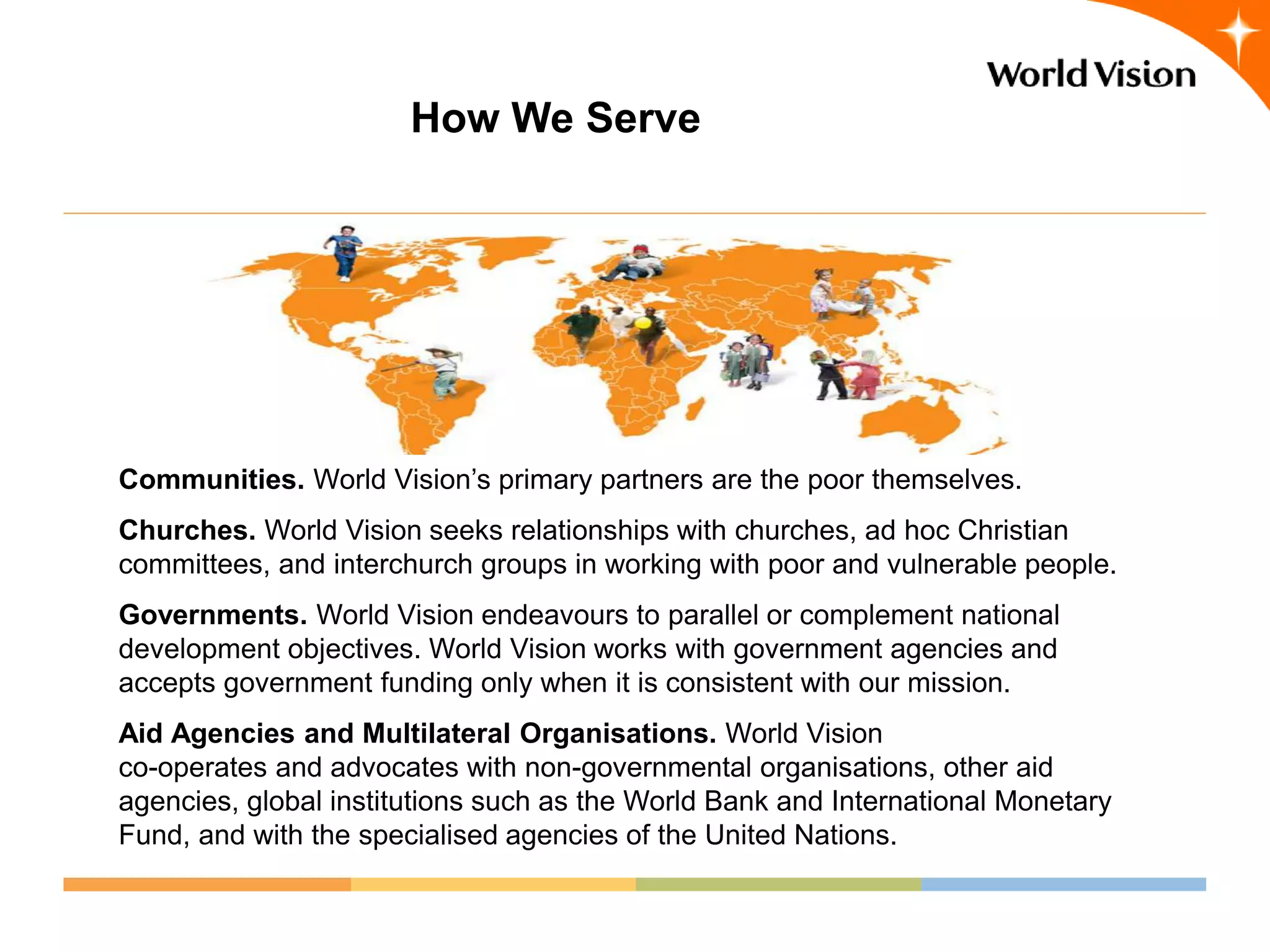
How We Serve


Communities. World Vision’s primary partners are the poor themselves.
Churches. World Vision seeks relationships with churches, ad hoc Christian
committees, and interchurch groups in working with poor and vulnerable people.
Governments. World Vision endeavours to parallel or complement national
development objectives. World Vision works with government agencies and
accepts government funding only when it is consistent with our mission.
Aid Agencies and Multilateral Organisations. World Vision
co-operates and advocates with non-governmental organisations, other aid
agencies, global institutions such as the World Bank and International Monetary
Fund, and with the specialised agencies of the United Nations.
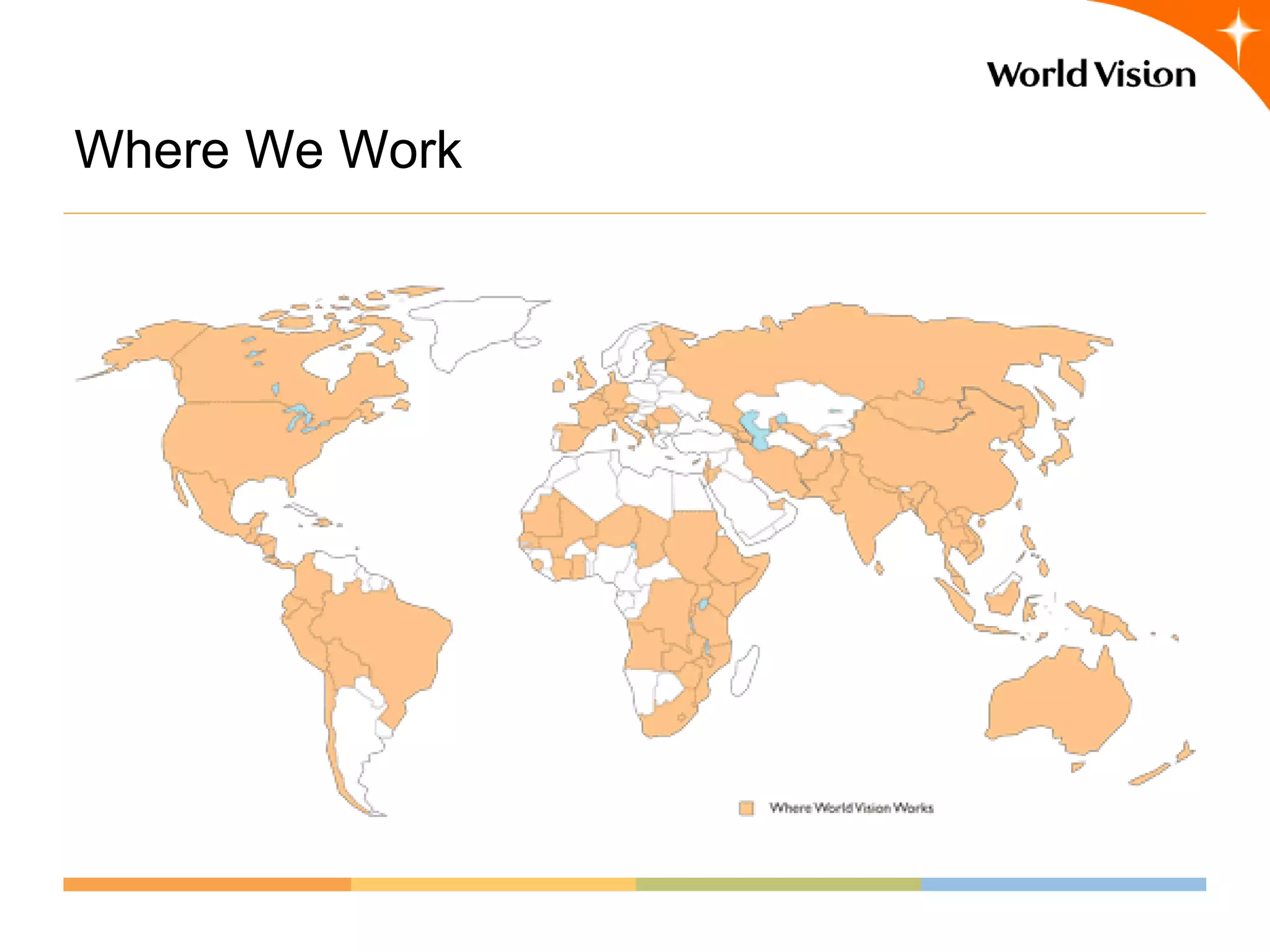
Where We Work
Employee Census FY 2011
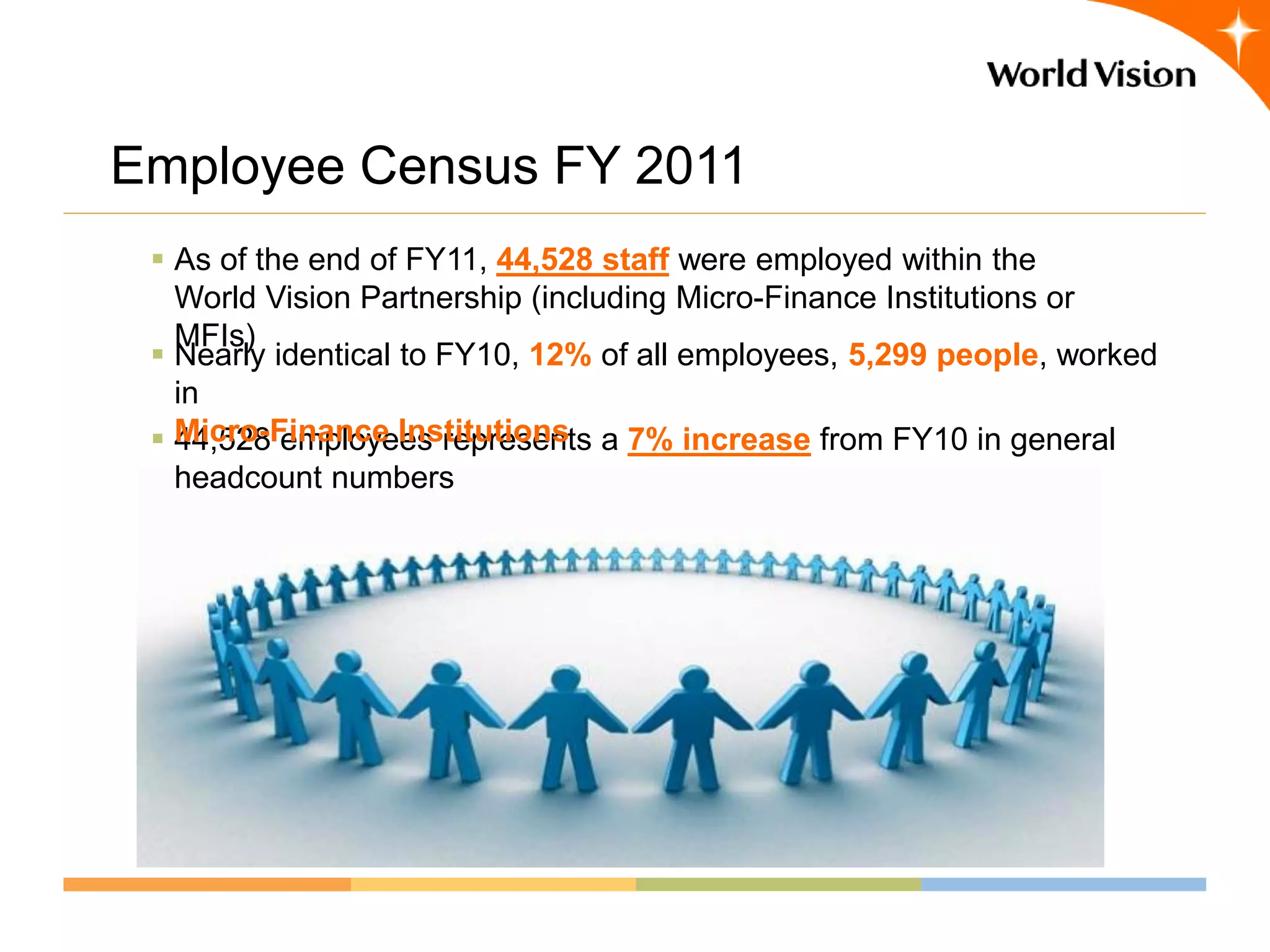
  As of the end of FY11, 44,528 staff were employed within the
   World Vision Partnership (including Micro-Finance Institutions or
   MFIs)
  Nearly identical to FY10, 12% of all employees, 5,299 people, worked
   in
  Micro-Finance Institutions a 7% increase from FY10 in general
   44,528 employees represents
   headcount numbers
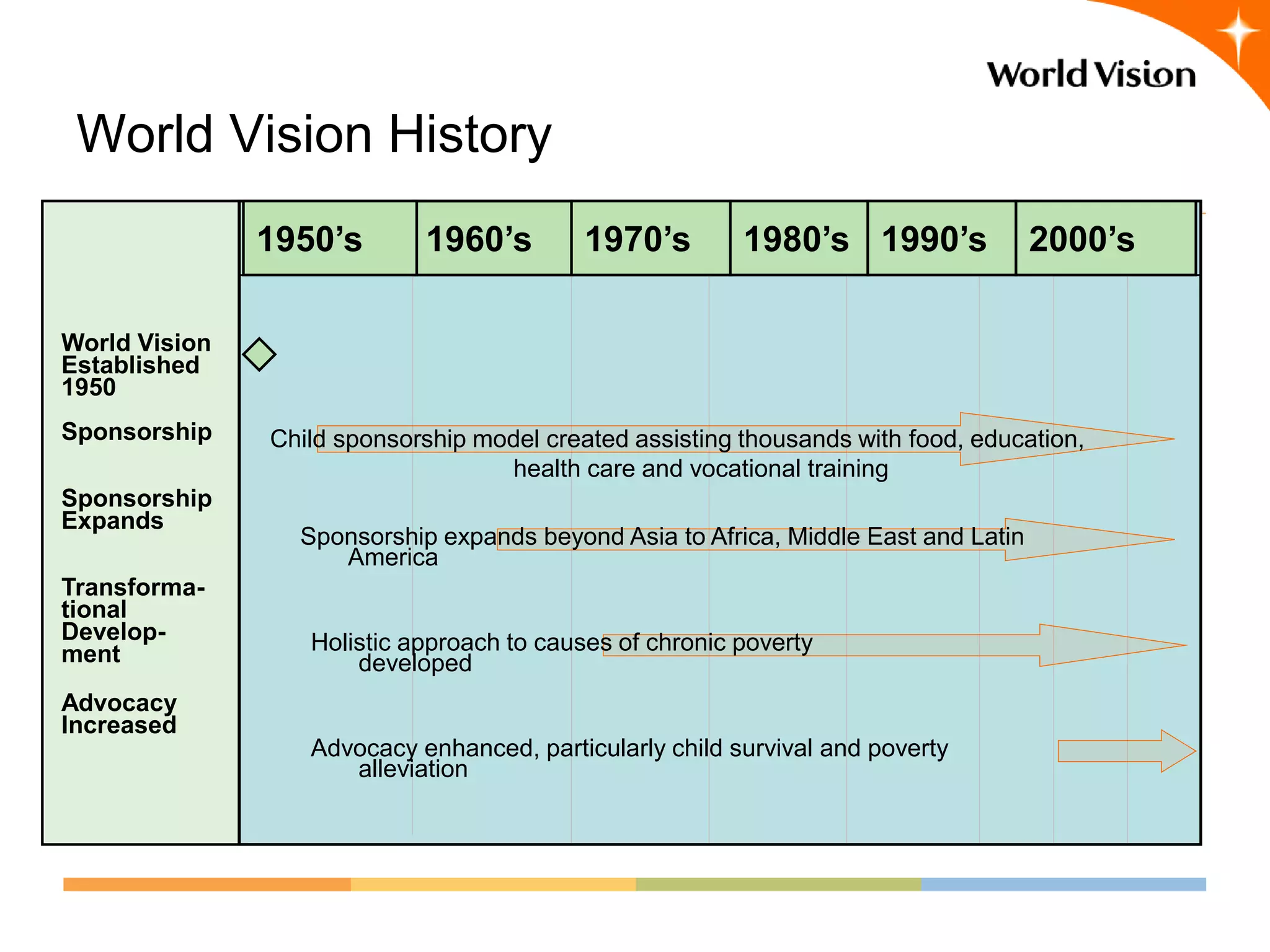
World Vision History
               1950’s       1960’s         1970’s        1980’s 1990’s              2000’s

World Vision
Established
1950
Sponsorship    Child sponsorship model created assisting thousands with food, education,
                                   health care and vocational training
Sponsorship
Expands
                 Sponsorship expands beyond Asia to Africa, Middle East and Latin
                    America
Transforma-
tional
Develop-          Holistic approach to causes of chronic poverty
ment                  developed
Advocacy
Increased
                  Advocacy enhanced, particularly child survival and poverty
                     alleviation
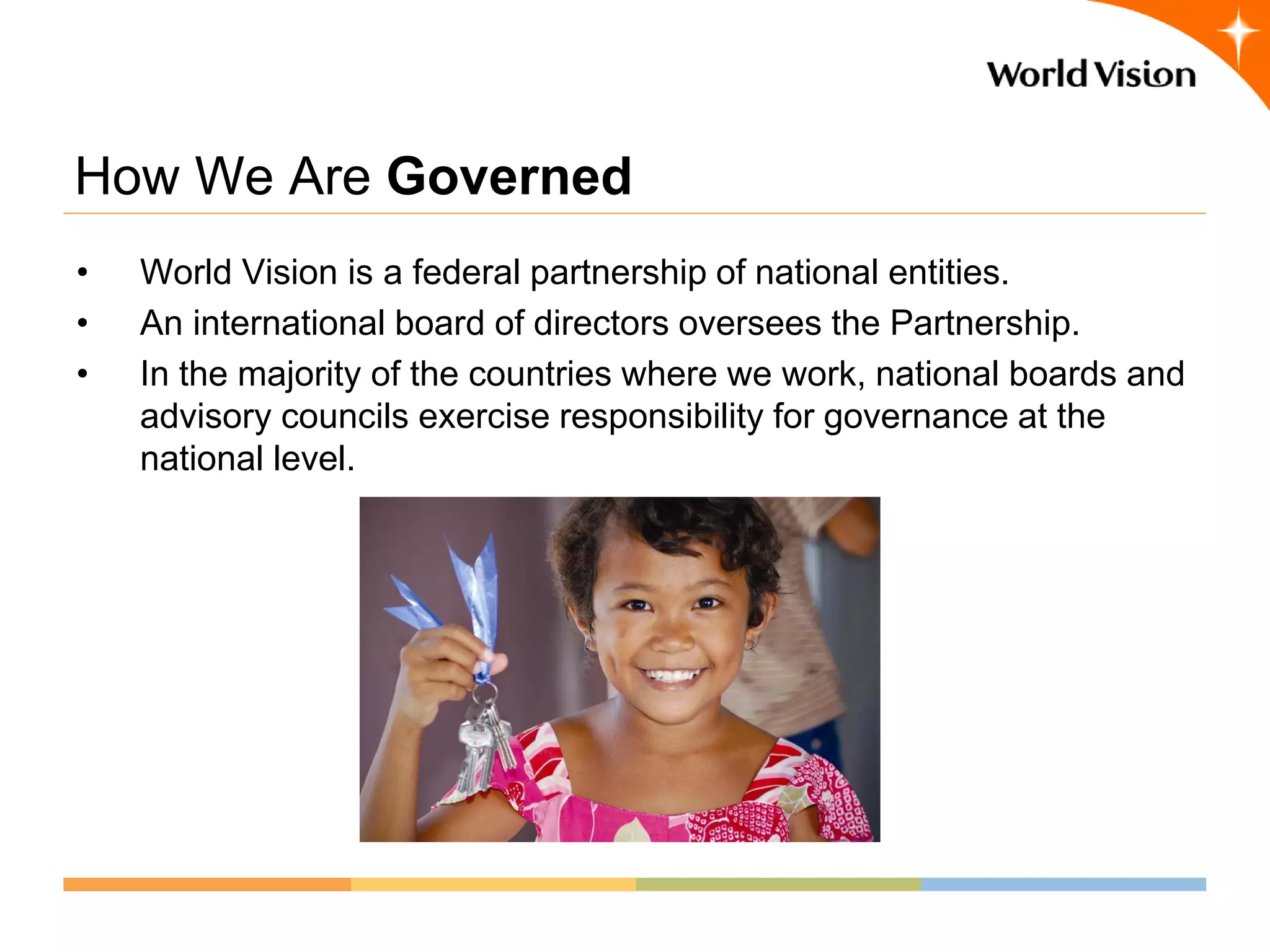
How We Are Governed
•   World Vision is a federal partnership of national entities.
•   An international board of directors oversees the Partnership.
•   In the majority of the countries where we work, national boards and
    advisory councils exercise responsibility for governance at the
    national level.
Components of World Vision’s
Federated Structure
• National Entities are legal entities representing World Vision in a
  specific country, including offices in the process of becoming legal
  entities
• World Vision International (WVI) is the registered legal entity that
  provides the formal international structure for the Partnership
• The WVI Council represents all member entities and provides the
  membership structure for the Partnership
• The WVI Board of Directors is the governing body of WVI as
  outlined in the By-Laws. The membership of the Board is broadly
  representative of the Partnership
• The Global Centre is the international office of the World Vision
  Partnership. It has operational responsibility through the
  International President for stewarding all the entities of the global
  Partnership based on a defined set of reserved powers. It operates
  under the authority of the WVI Board of Directors.
Role of the Global Centre

• The Global Centre is the Office of the President, Heads of each
  Functional Business Unit, and Regional Offices
• Authority of the Global Centre is to:
   • Lead in areas that have been delegated to it by the rest of the
     Partnership                 “Reserve Powers”
   • Take a global and regional view of issues
   • Serve the other entities in the Partnership
   • Deal with issues of broad impact or high risk affecting the global
     organisation                -issues that go beyond the scope
                                          or interests of any one entity
     and                                           that no single entity is
     able to address                               -shared infrastructure,
     shared knowledge                                       and expertise,
     and shared access to                                   resources.
WV Governance Profile

• Highly entrepreneurial and distributed authority, bordering on
  fragmented
• Within World Vision, pockets of relative maturity in
    • IT
    • Finance
    • Horizon (Programme Management Information System)
• No common urgency or mandate for a “Data Governance
  programme” but opportunities and precedent for “programmatic”
  approach
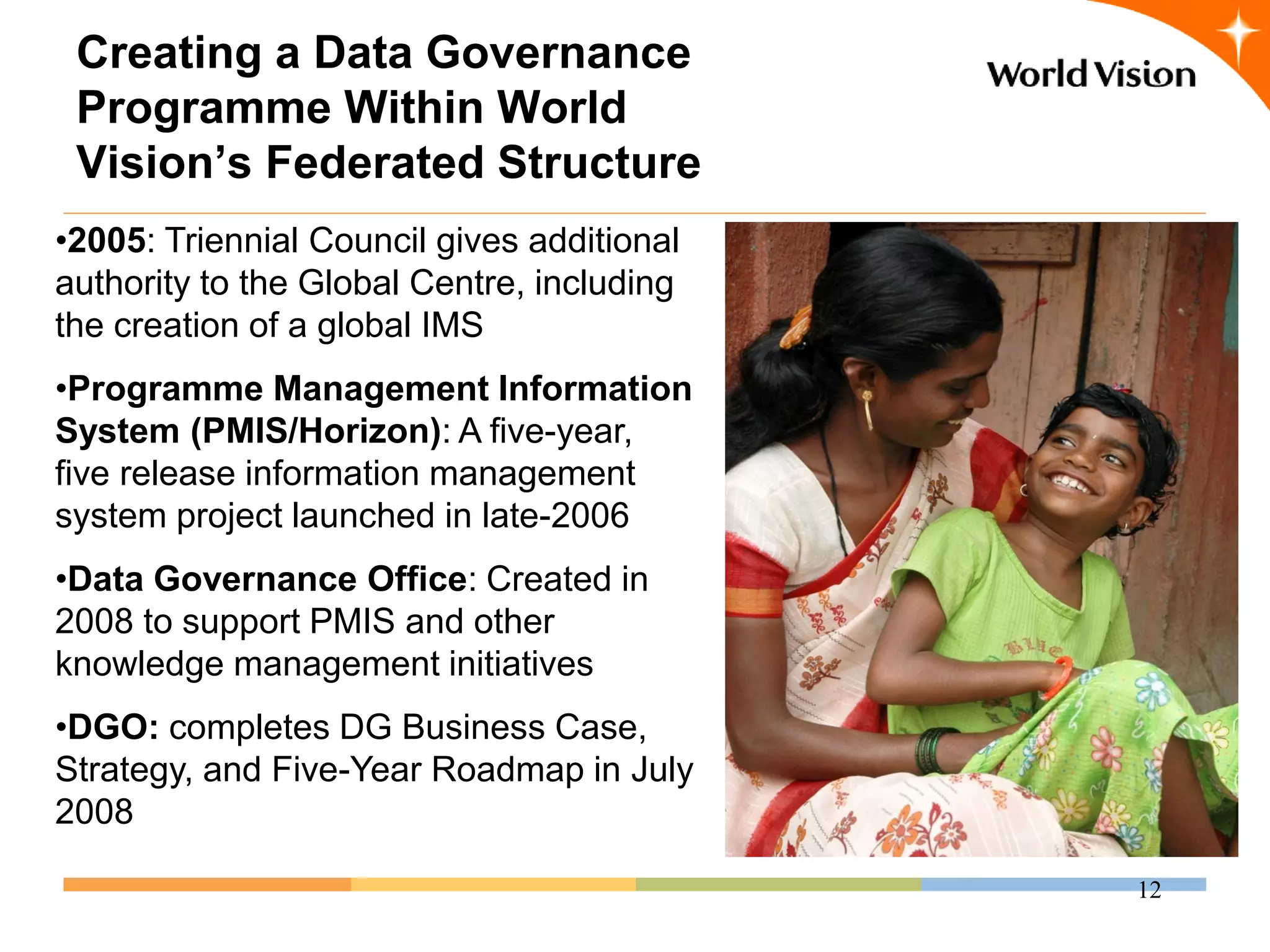
Creating a Data Governance
 Programme Within World
 Vision’s Federated Structure
•2005: Triennial Council gives additional
authority to the Global Centre, including
the creation of a global IMS
•Programme Management Information
System (PMIS/Horizon): A five-year,
five release information management
system project launched in late-2006
•Data Governance Office: Created in
2008 to support PMIS and other
knowledge management initiatives
•DGO: completes DG Business Case,
Strategy, and Five-Year Roadmap in July
2008

                                            12
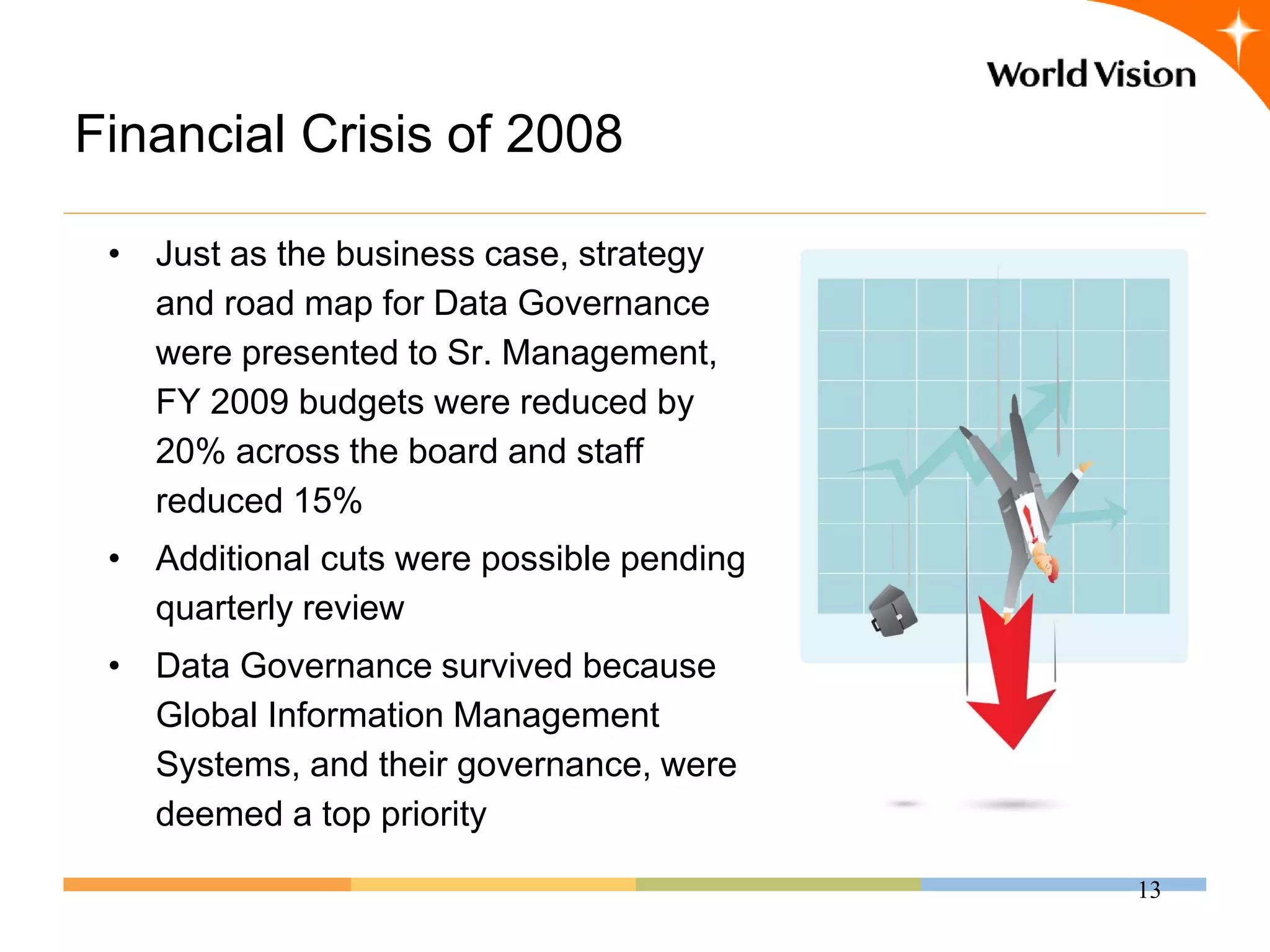
Financial Crisis of 2008

 • Just as the business case, strategy
   and road map for Data Governance
   were presented to Sr. Management,
   FY 2009 budgets were reduced by
   20% across the board and staff
   reduced 15%
 • Additional cuts were possible pending
   quarterly review
 • Data Governance survived because
   Global Information Management
   Systems, and their governance, were
   deemed a top priority

                                           13
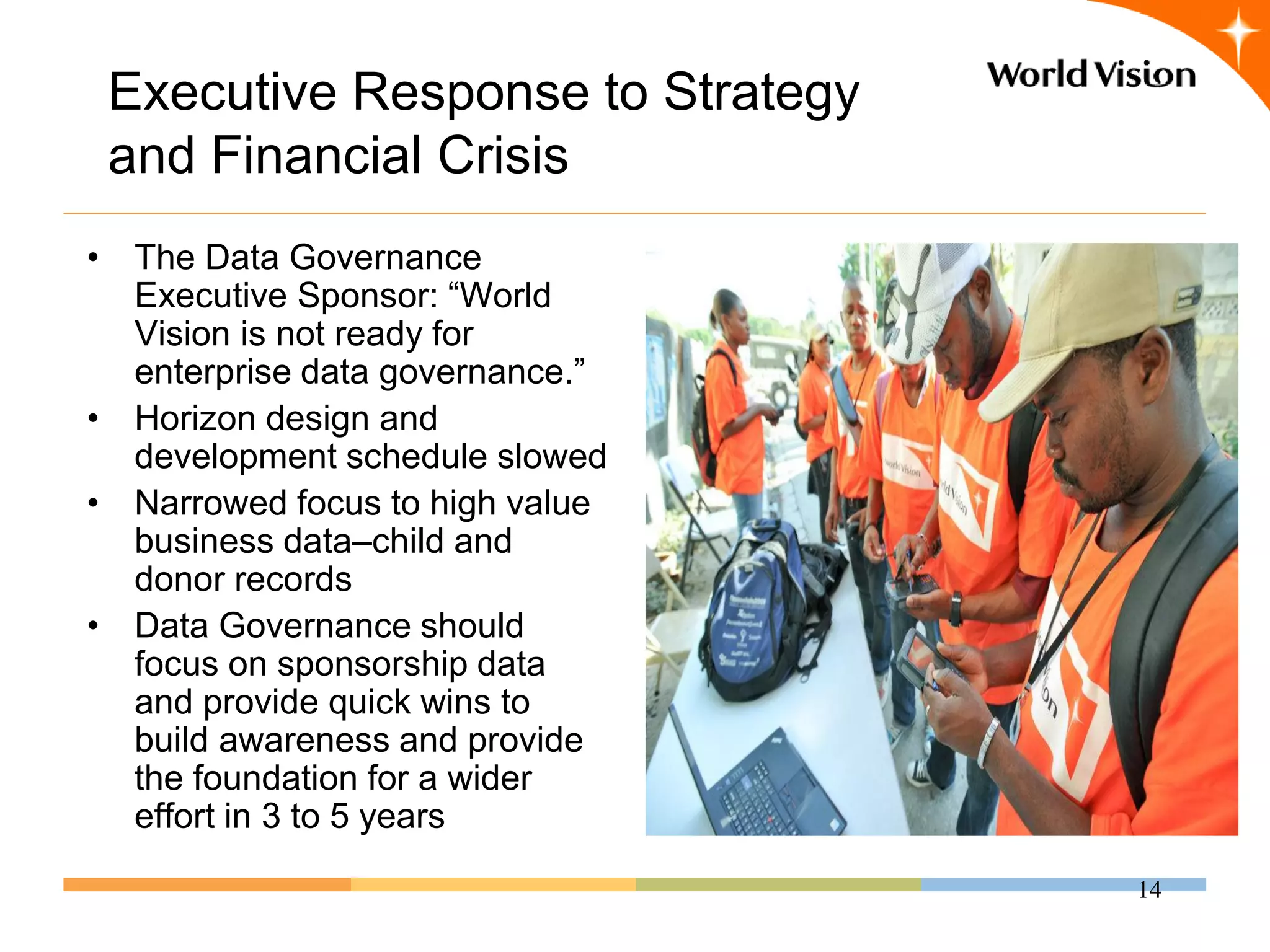
Executive Response to Strategy
 and Financial Crisis
• The Data Governance
  Executive Sponsor: “World
  Vision is not ready for
  enterprise data governance.”
• Horizon design and
  development schedule slowed
• Narrowed focus to high value
  business data–child and
  donor records
• Data Governance should
  focus on sponsorship data
  and provide quick wins to
  build awareness and provide
  the foundation for a wider
  effort in 3 to 5 years
                                  14
Impact to Data Governance
Programme
               Negative                             Positive
•Staffing requests for the DGO       •Executive Sponsor recognized
delayed indefinitely                 the need for governance of child
•Not ready to build enterprise-      and donor data
wide data governance programme           • 4.5 million child records
•In the fiscal climate of 2008-             scattered across 860+
2009, Data Governance needed                databases in 59 countries
to prove its value quickly           •The Sponsorship Business given
•The value of and need for data      high priority within financial crisis
governance not yet well              cuts
understood across the business,      •Funding to create a new
danger that DG would be viewed       sponsorship data management
as a luxury in a climate of budget   capability allowed a young data
scarcity                             governance programme to survive
                                                                      15
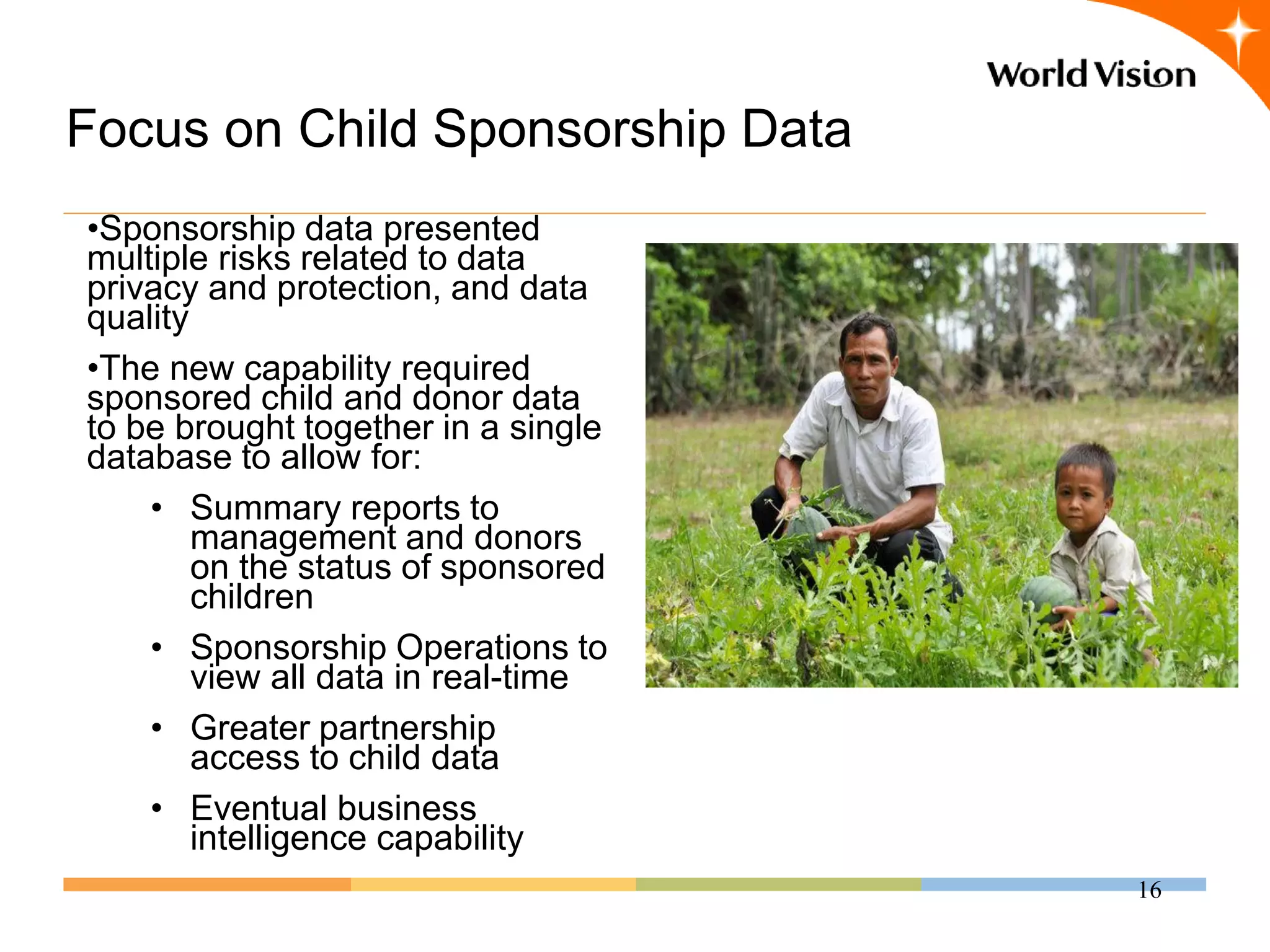
Focus on Child Sponsorship Data
•Sponsorship data presented
multiple risks related to data
privacy and protection, and data
quality
•The new capability required
sponsored child and donor data
to be brought together in a single
database to allow for:
    • Summary reports to
        management and donors
        on the status of sponsored
        children
    • Sponsorship Operations to
        view all data in real-time
    • Greater partnership
        access to child data
    • Eventual business
        intelligence capability
                                     16
EU Data Privacy and Protection
Directive…
 • The European Union (EU) has the most comprehensive data privacy
   and protection laws in the world.
 • Other countries have or will adopt the EU model
 • EU requirements became the guiding authority for evaluating
   business rules for governing data privacy and protection in World
   Vision
 • The WVI Data Governance Office recommended adopting the 8 EU
   requirements for data privacy and protection
 • Requirements are divided into two main categories:
    • Processing related to collecting and using Personally Identifiable
       Information (PII)
    • Cross border (International) data transfers
 …Became the key business driver for governance
  of Sponsorship data
Data Privacy and Protection Focus
• Business rules governing the management of PII
• Address PII within the context of new systems and expanded access
  to critical business information
• Create a global data privacy and protection policy tied to existing
  policies and informed by laws and regulations in multiple contexts
   • International conventions
   • National legal jurisdictions
   • Local legal jurisdictions
• Three WVI data subjects related to sponsorship programme:
   • Children
   • Parents/Guardians
   • Donors
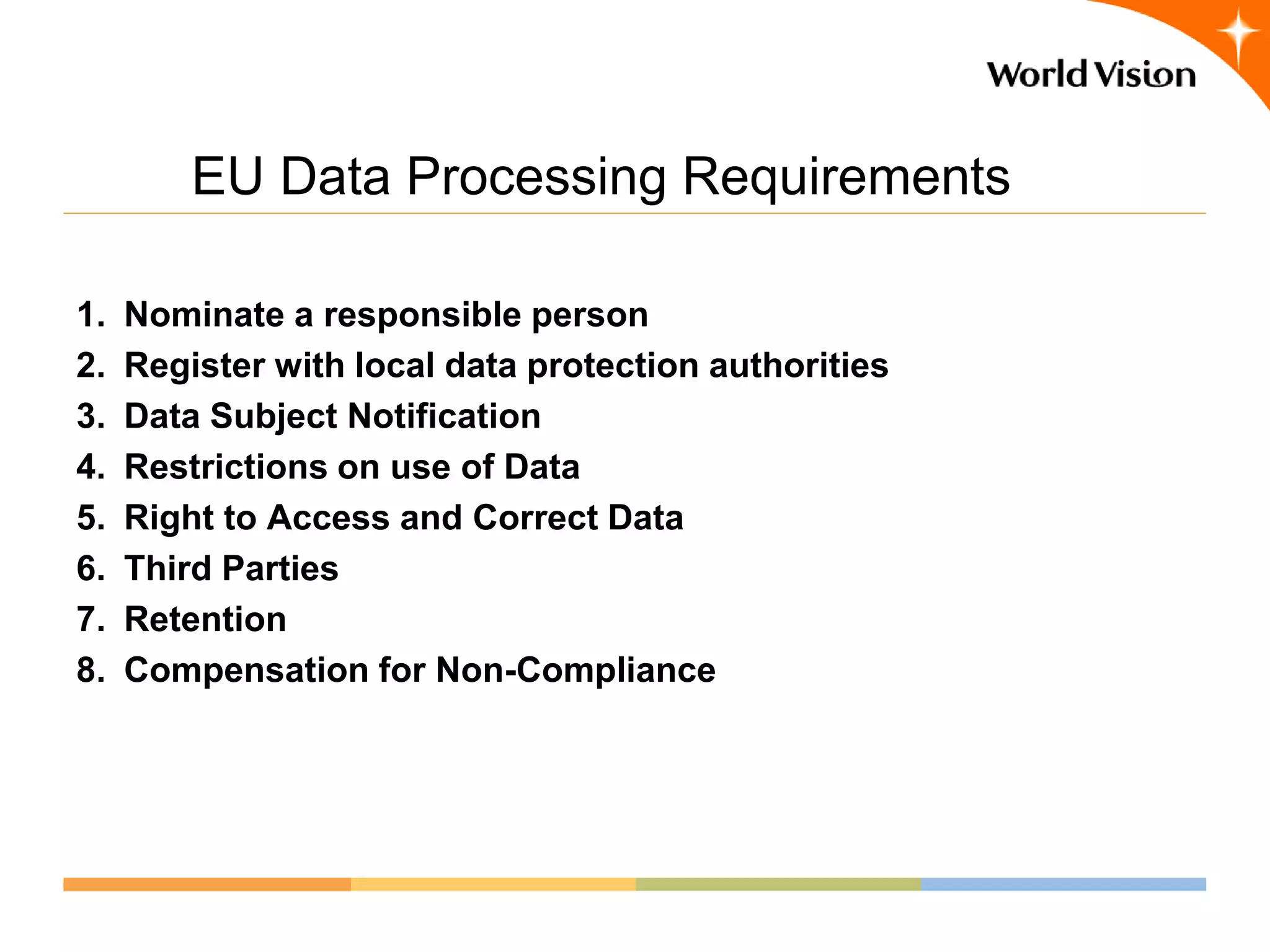
EU Data Processing Requirements

1.   Nominate a responsible person
2.   Register with local data protection authorities
3.   Data Subject Notification
4.   Restrictions on use of Data
5.   Right to Access and Correct Data
6.   Third Parties
7.   Retention
8.   Compensation for Non-Compliance
EU Data Transfer Requirements
• The EU generally prohibits the transfer of PII to any country outside
  the EU, unless that country is recognised by the EU as having
  adequate privacy protections in place.
• In 2010, only Argentina, Canada and Switzerland were recognized
  by the EU as safe destinations for EU data.
• Data transferred to non-recognized countries can only be done
  through four mechanisms:
   • Model Contracts (Data Transfer Agreements)
   • Safe Harbour (did does not cover Not-for-Profits)
   • Binding Corporate Rules (establishes a recognised legal basis
      for the international transfer of data)
   • Express Consent
Approach
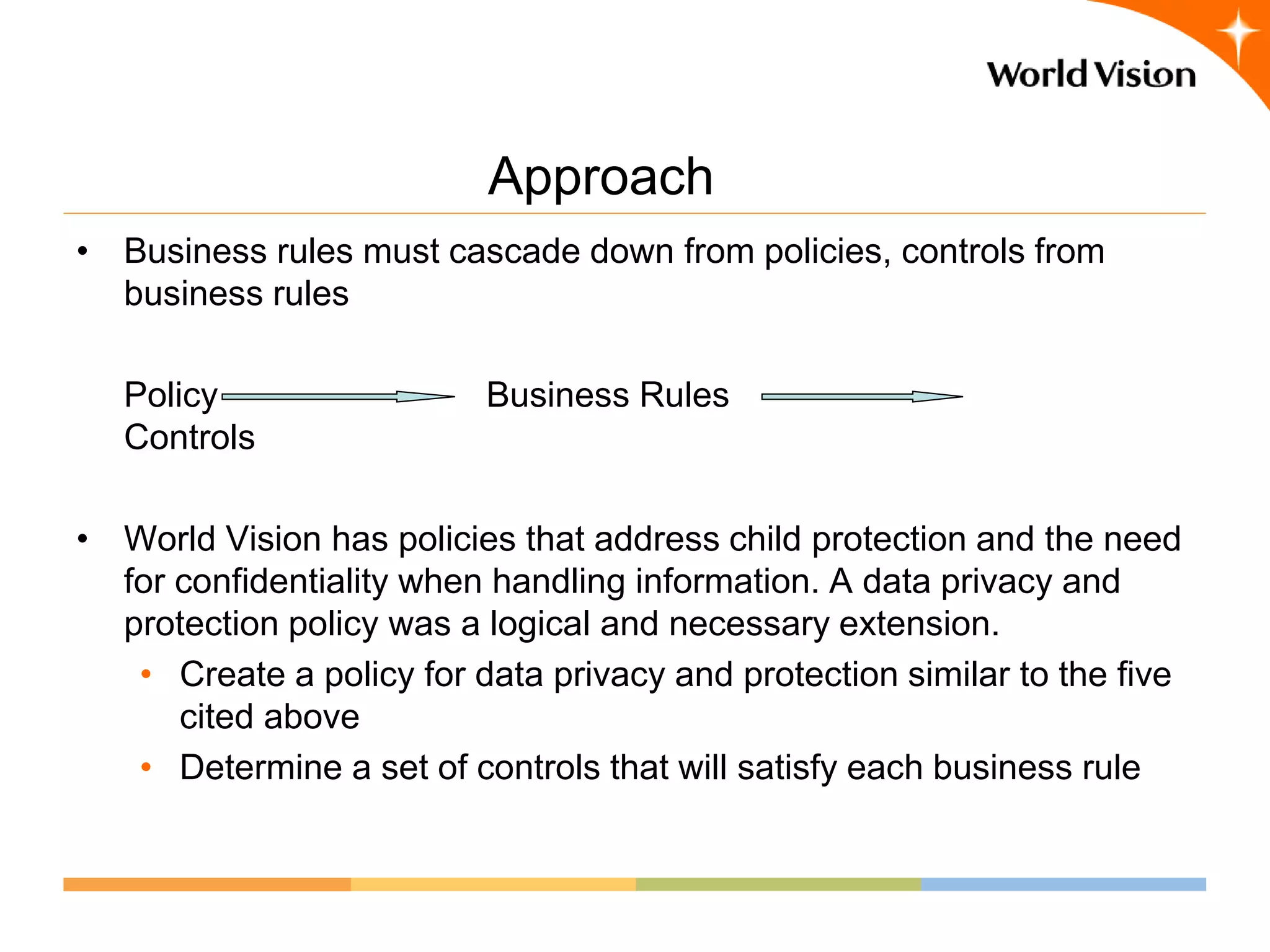
• Business rules must cascade down from policies, controls from
  business rules

   Policy                 Business Rules
   Controls

• World Vision has policies that address child protection and the need
  for confidentiality when handling information. A data privacy and
  protection policy was a logical and necessary extension.
   • Create a policy for data privacy and protection similar to the five
      cited above
   • Determine a set of controls that will satisfy each business rule
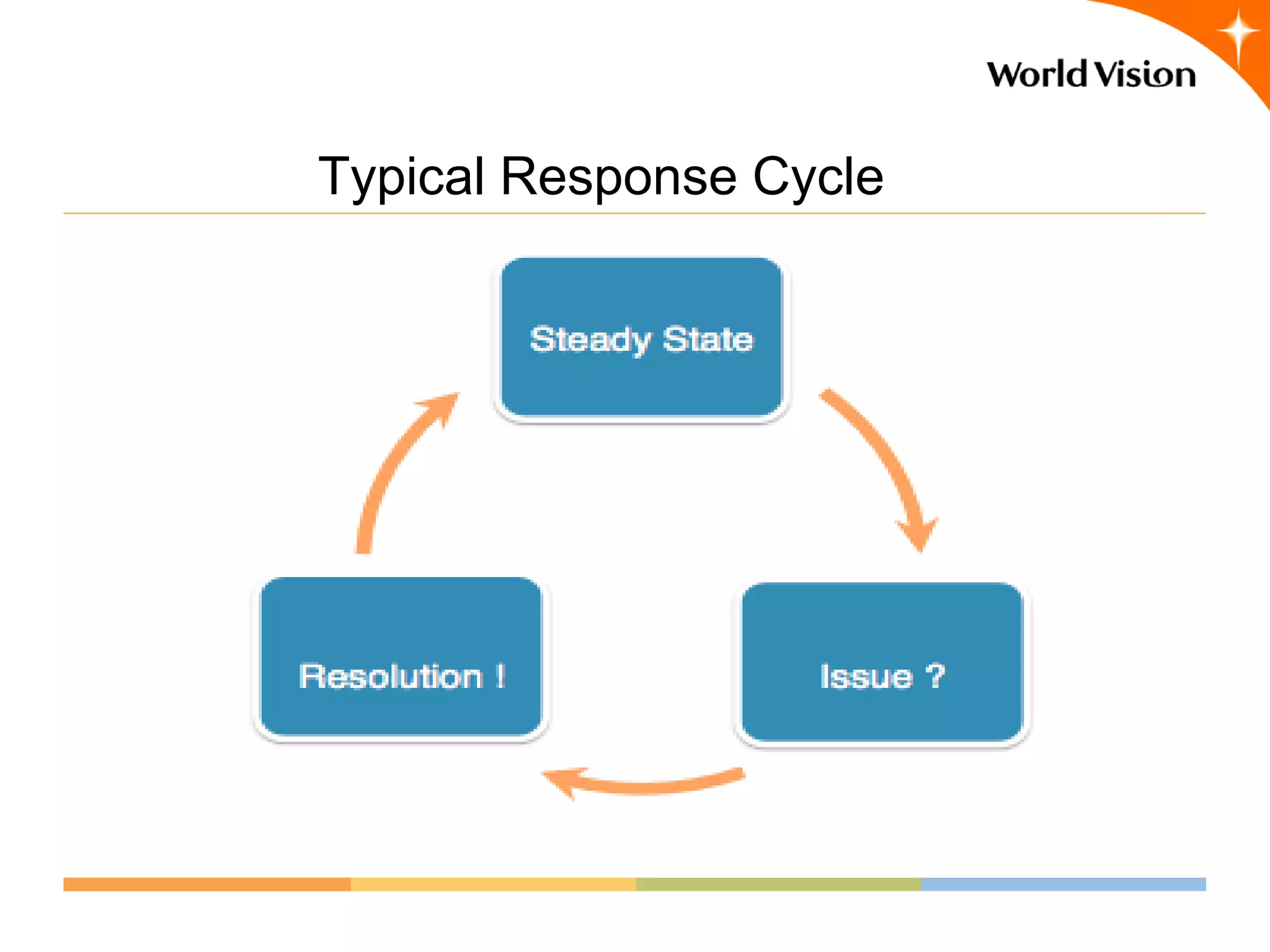
Typical Response Cycle
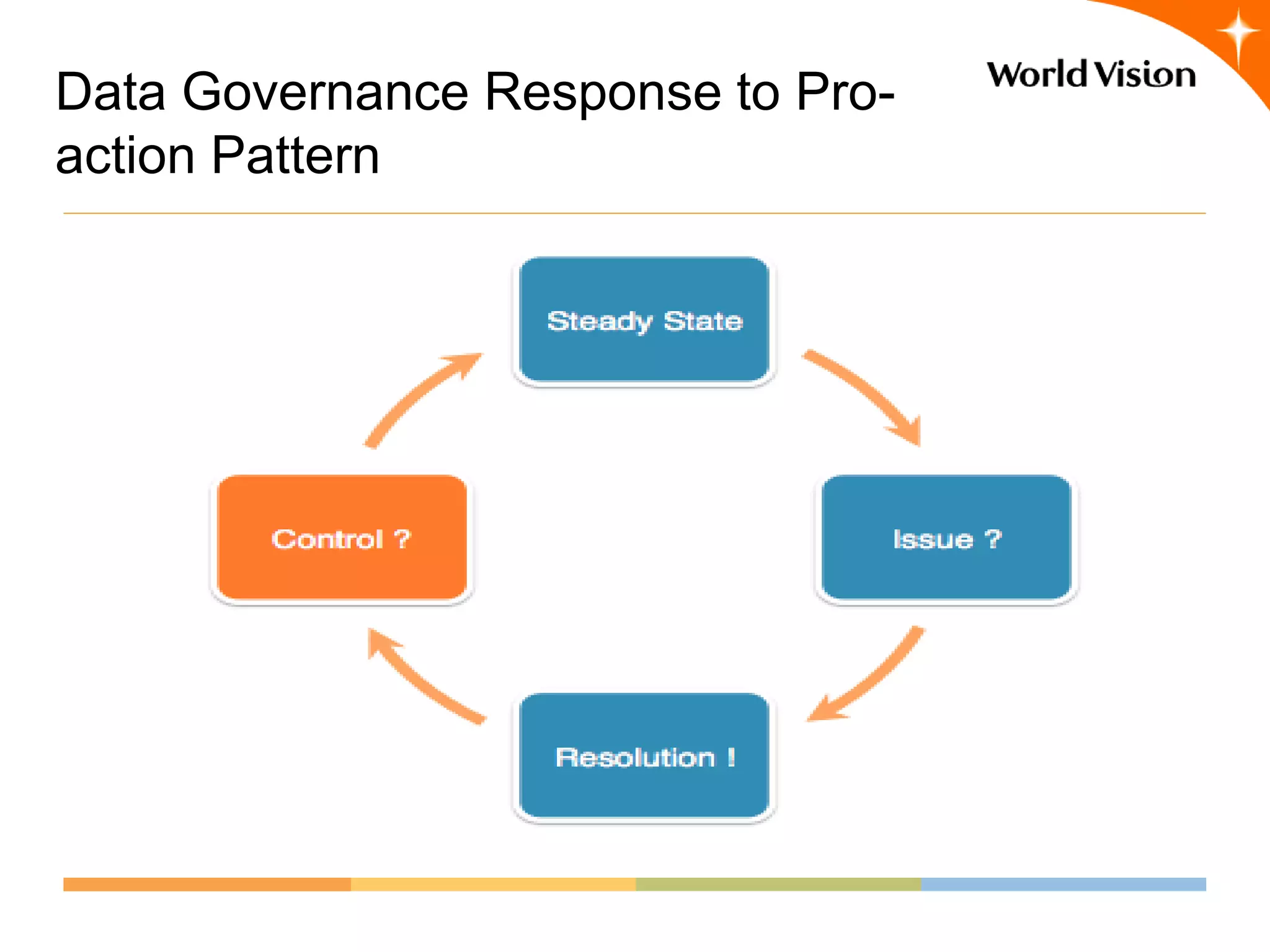
Data Governance Response to Pro-
action Pattern
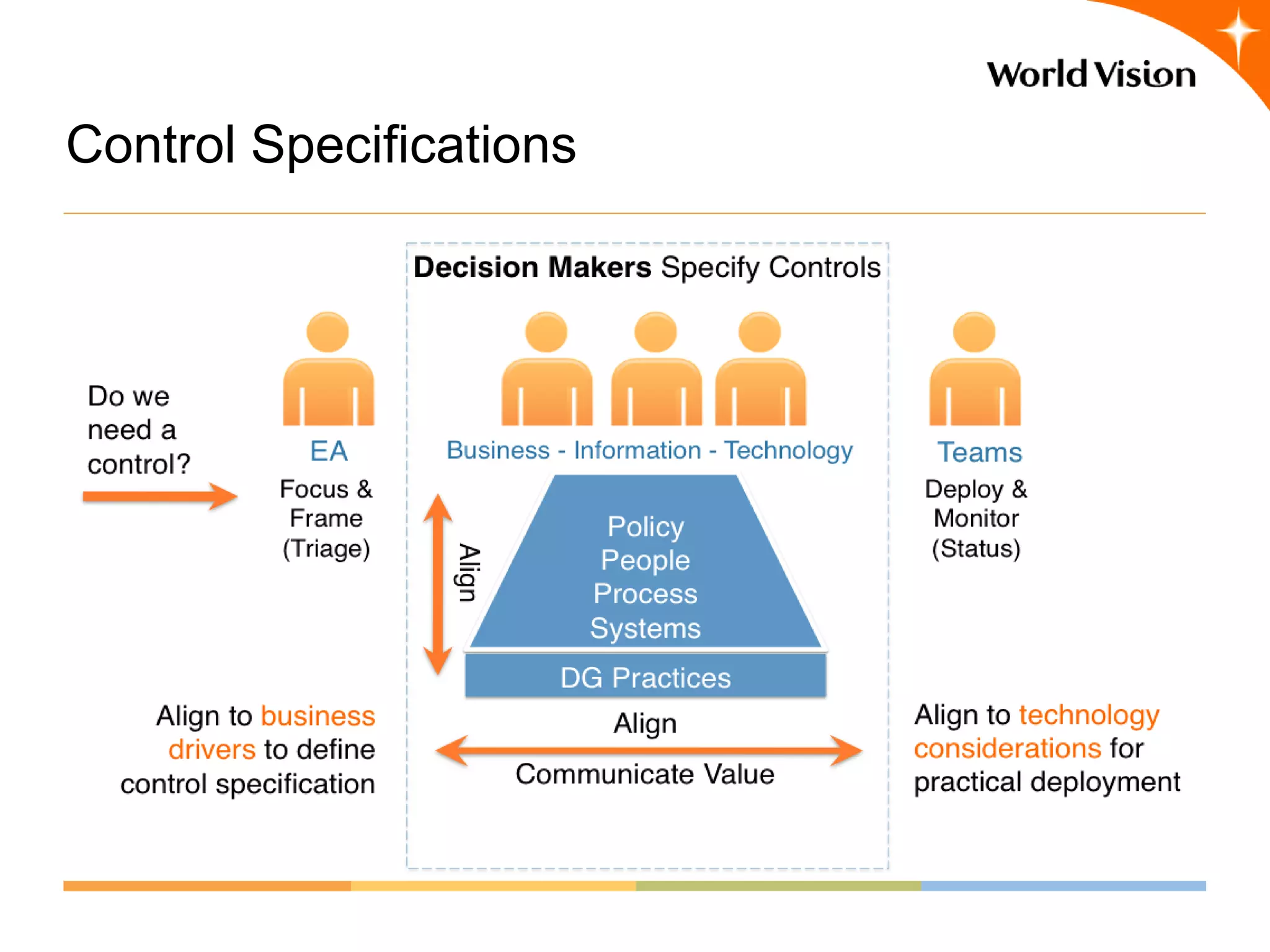
Control Specifications
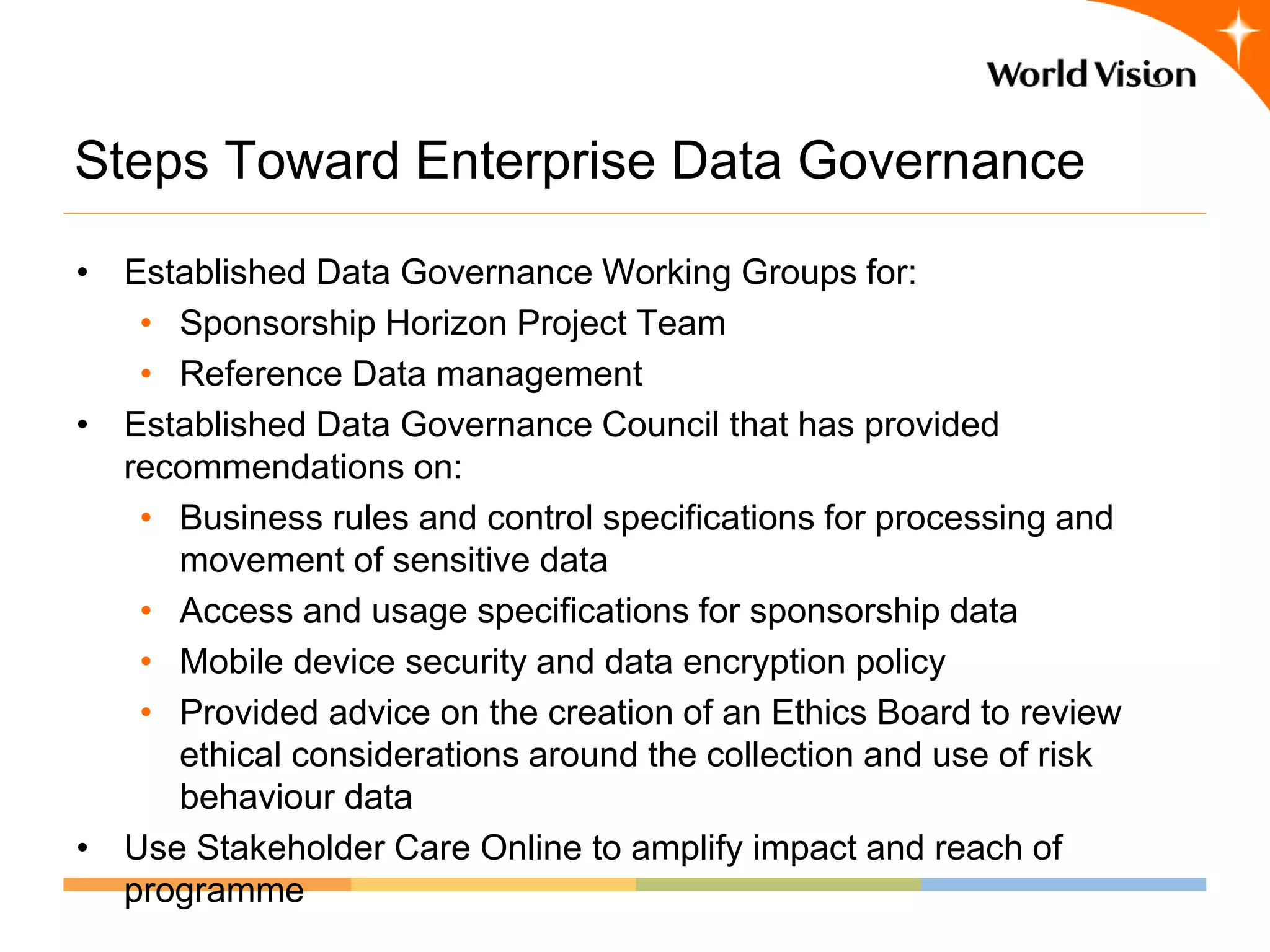
Steps Toward Enterprise Data Governance
• Established Data Governance Working Groups for:
   • Sponsorship Horizon Project Team
   • Reference Data management
• Established Data Governance Council that has provided
  recommendations on:
   • Business rules and control specifications for processing and
     movement of sensitive data
   • Access and usage specifications for sponsorship data
   • Mobile device security and data encryption policy
   • Provided advice on the creation of an Ethics Board to review
     ethical considerations around the collection and use of risk
     behaviour data
• Use Stakeholder Care Online to amplify impact and reach of
  programme
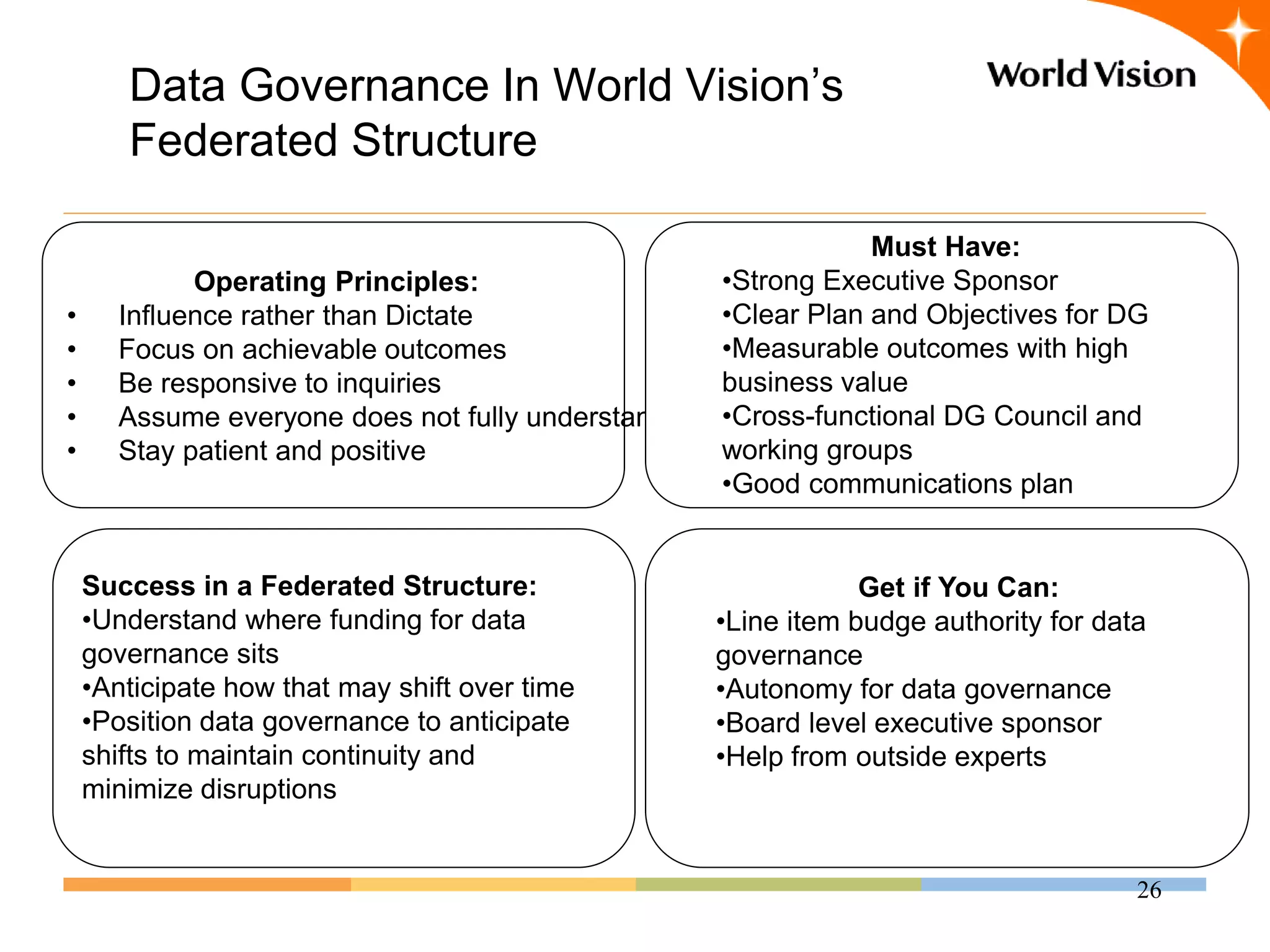
Data Governance In World Vision’s
       Federated Structure

                                                              Must Have:
            Operating Principles:                 •Strong Executive Sponsor
•     Influence rather than Dictate               •Clear Plan and Objectives for DG
•     Focus on achievable outcomes                •Measurable outcomes with high
•     Be responsive to inquiries                  business value
•     Assume everyone does not fully understand   •Cross-functional DG Council and
•     Stay patient and positive                   working groups
                                                  •Good communications plan


    Success in a Federated Structure:                         Get if You Can:
    •Understand where funding for data            •Line item budge authority for data
    governance sits                               governance
    •Anticipate how that may shift over time      •Autonomy for data governance
    •Position data governance to anticipate       •Board level executive sponsor
    shifts to maintain continuity and             •Help from outside experts
    minimize disruptions


                                                                                    26
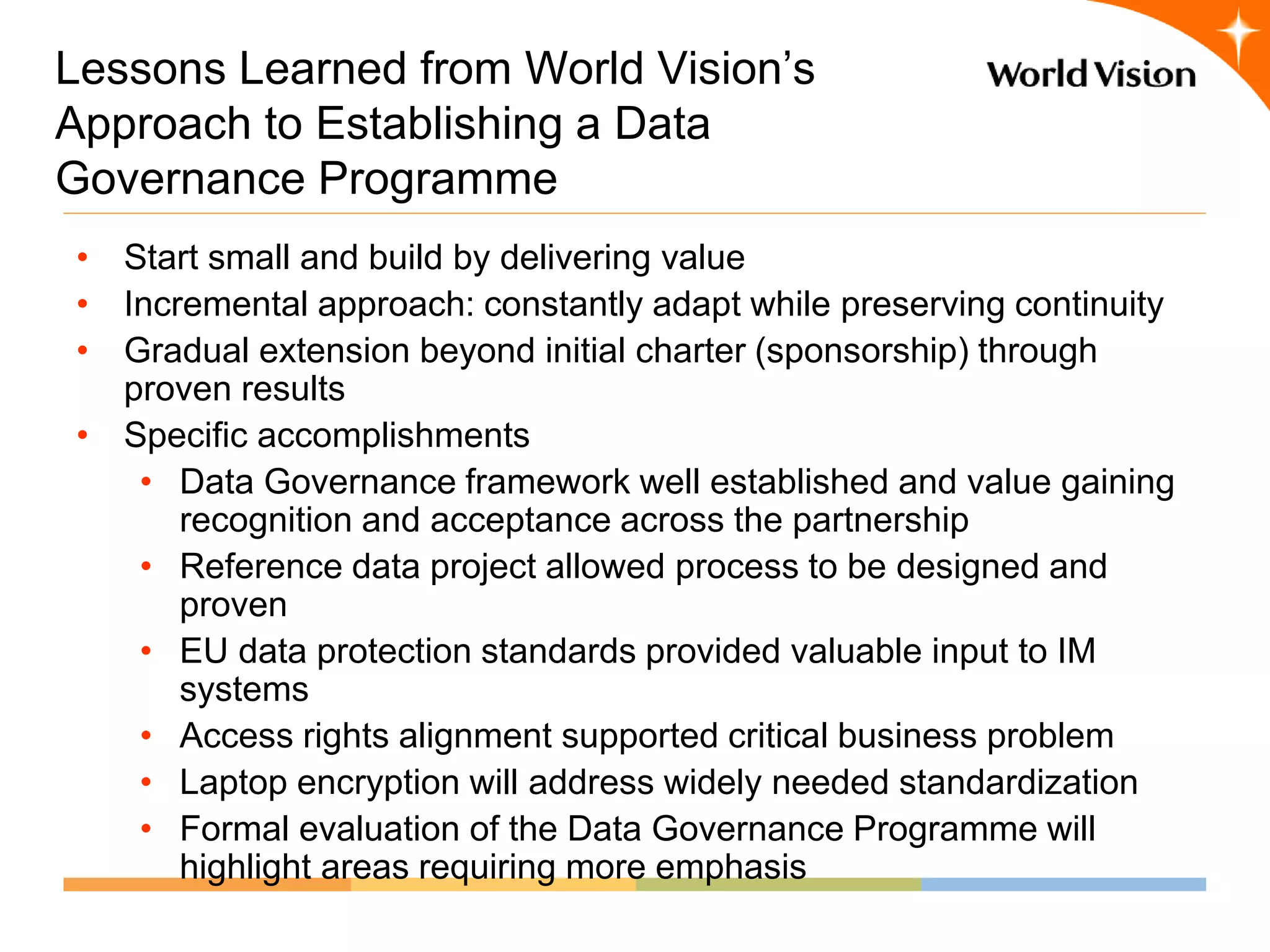
Lessons Learned from World Vision’s
Approach to Establishing a Data
Governance Programme
• Start small and build by delivering value
• Incremental approach: constantly adapt while preserving continuity
• Gradual extension beyond initial charter (sponsorship) through
  proven results
• Specific accomplishments
   • Data Governance framework well established and value gaining
      recognition and acceptance across the partnership
   • Reference data project allowed process to be designed and
      proven
   • EU data protection standards provided valuable input to IM
      systems
   • Access rights alignment supported critical business problem
   • Laptop encryption will address widely needed standardization
   • Formal evaluation of the Data Governance Programme will
      highlight areas requiring more emphasis
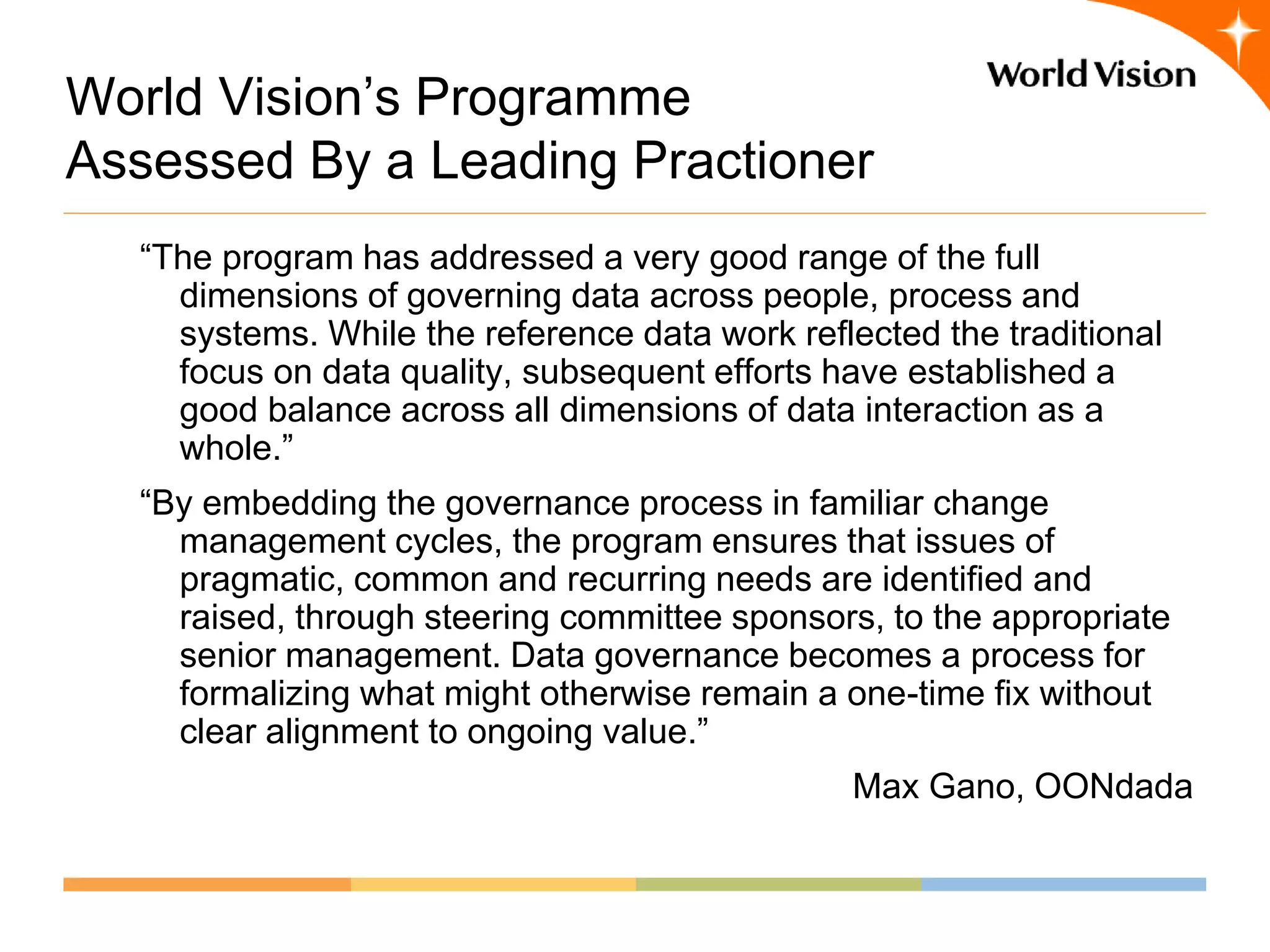
World Vision’s Programme
Assessed By a Leading Practioner
  “The program has addressed a very good range of the full
    dimensions of governing data across people, process and
    systems. While the reference data work reflected the traditional
    focus on data quality, subsequent efforts have established a
    good balance across all dimensions of data interaction as a
    whole.”
  “By embedding the governance process in familiar change
    management cycles, the program ensures that issues of
    pragmatic, common and recurring needs are identified and
    raised, through steering committee sponsors, to the appropriate
    senior management. Data governance becomes a process for
    formalizing what might otherwise remain a one-time fix without
    clear alignment to ongoing value.”
                                               Max Gano, OONdada
Questions

            Mark_simpson@wvi.org

               (202) 368 8835

                 www.wvi.org

      Skype: Mark Simpson in Fairfax, VA

Data Governance in a Federated Organization - A Case Study of World Vision International

  • 1.
    Data Governance ina Federated Organization: A World Vision Case Study Data and Information Quality Conference 26 June 2012 San Diego, California Welcome Bienvenue Huan ying Karibu Yin dee Yo koso Maligayang pagdating Dobro dosli Bienvenido Soo dhowow Velkommen Тавтай морилогтун Selamat datang Bun venit hwan-young-ham-ni-dah Akwaaba Willkommen Welkom Tavtai moril 1
  • 2.
    Agenda •World Vision—Who WeAre, What We Do •World Vision’s Federated Structure •Development of a Data Governance Programme in a Federated Structure •Accomplishments and Challenges 2
  • 3.
    How We Serve Communities.World Vision’s primary partners are the poor themselves. Churches. World Vision seeks relationships with churches, ad hoc Christian committees, and interchurch groups in working with poor and vulnerable people. Governments. World Vision endeavours to parallel or complement national development objectives. World Vision works with government agencies and accepts government funding only when it is consistent with our mission. Aid Agencies and Multilateral Organisations. World Vision co-operates and advocates with non-governmental organisations, other aid agencies, global institutions such as the World Bank and International Monetary Fund, and with the specialised agencies of the United Nations.
  • 4.
  • 5.
    Employee Census FY2011  As of the end of FY11, 44,528 staff were employed within the World Vision Partnership (including Micro-Finance Institutions or MFIs)  Nearly identical to FY10, 12% of all employees, 5,299 people, worked in  Micro-Finance Institutions a 7% increase from FY10 in general 44,528 employees represents headcount numbers
  • 7.
    World Vision History 1950’s 1960’s 1970’s 1980’s 1990’s 2000’s World Vision Established 1950 Sponsorship Child sponsorship model created assisting thousands with food, education, health care and vocational training Sponsorship Expands Sponsorship expands beyond Asia to Africa, Middle East and Latin America Transforma- tional Develop- Holistic approach to causes of chronic poverty ment developed Advocacy Increased Advocacy enhanced, particularly child survival and poverty alleviation
  • 8.
    How We AreGoverned • World Vision is a federal partnership of national entities. • An international board of directors oversees the Partnership. • In the majority of the countries where we work, national boards and advisory councils exercise responsibility for governance at the national level.
  • 9.
    Components of WorldVision’s Federated Structure • National Entities are legal entities representing World Vision in a specific country, including offices in the process of becoming legal entities • World Vision International (WVI) is the registered legal entity that provides the formal international structure for the Partnership • The WVI Council represents all member entities and provides the membership structure for the Partnership • The WVI Board of Directors is the governing body of WVI as outlined in the By-Laws. The membership of the Board is broadly representative of the Partnership • The Global Centre is the international office of the World Vision Partnership. It has operational responsibility through the International President for stewarding all the entities of the global Partnership based on a defined set of reserved powers. It operates under the authority of the WVI Board of Directors.
  • 10.
    Role of theGlobal Centre • The Global Centre is the Office of the President, Heads of each Functional Business Unit, and Regional Offices • Authority of the Global Centre is to: • Lead in areas that have been delegated to it by the rest of the Partnership “Reserve Powers” • Take a global and regional view of issues • Serve the other entities in the Partnership • Deal with issues of broad impact or high risk affecting the global organisation -issues that go beyond the scope or interests of any one entity and that no single entity is able to address -shared infrastructure, shared knowledge and expertise, and shared access to resources.
  • 11.
    WV Governance Profile •Highly entrepreneurial and distributed authority, bordering on fragmented • Within World Vision, pockets of relative maturity in • IT • Finance • Horizon (Programme Management Information System) • No common urgency or mandate for a “Data Governance programme” but opportunities and precedent for “programmatic” approach
  • 12.
    Creating a DataGovernance Programme Within World Vision’s Federated Structure •2005: Triennial Council gives additional authority to the Global Centre, including the creation of a global IMS •Programme Management Information System (PMIS/Horizon): A five-year, five release information management system project launched in late-2006 •Data Governance Office: Created in 2008 to support PMIS and other knowledge management initiatives •DGO: completes DG Business Case, Strategy, and Five-Year Roadmap in July 2008 12
  • 13.
    Financial Crisis of2008 • Just as the business case, strategy and road map for Data Governance were presented to Sr. Management, FY 2009 budgets were reduced by 20% across the board and staff reduced 15% • Additional cuts were possible pending quarterly review • Data Governance survived because Global Information Management Systems, and their governance, were deemed a top priority 13
  • 14.
    Executive Response toStrategy and Financial Crisis • The Data Governance Executive Sponsor: “World Vision is not ready for enterprise data governance.” • Horizon design and development schedule slowed • Narrowed focus to high value business data–child and donor records • Data Governance should focus on sponsorship data and provide quick wins to build awareness and provide the foundation for a wider effort in 3 to 5 years 14
  • 15.
    Impact to DataGovernance Programme Negative Positive •Staffing requests for the DGO •Executive Sponsor recognized delayed indefinitely the need for governance of child •Not ready to build enterprise- and donor data wide data governance programme • 4.5 million child records •In the fiscal climate of 2008- scattered across 860+ 2009, Data Governance needed databases in 59 countries to prove its value quickly •The Sponsorship Business given •The value of and need for data high priority within financial crisis governance not yet well cuts understood across the business, •Funding to create a new danger that DG would be viewed sponsorship data management as a luxury in a climate of budget capability allowed a young data scarcity governance programme to survive 15
  • 16.
    Focus on ChildSponsorship Data •Sponsorship data presented multiple risks related to data privacy and protection, and data quality •The new capability required sponsored child and donor data to be brought together in a single database to allow for: • Summary reports to management and donors on the status of sponsored children • Sponsorship Operations to view all data in real-time • Greater partnership access to child data • Eventual business intelligence capability 16
  • 17.
    EU Data Privacyand Protection Directive… • The European Union (EU) has the most comprehensive data privacy and protection laws in the world. • Other countries have or will adopt the EU model • EU requirements became the guiding authority for evaluating business rules for governing data privacy and protection in World Vision • The WVI Data Governance Office recommended adopting the 8 EU requirements for data privacy and protection • Requirements are divided into two main categories: • Processing related to collecting and using Personally Identifiable Information (PII) • Cross border (International) data transfers …Became the key business driver for governance of Sponsorship data
  • 18.
    Data Privacy andProtection Focus • Business rules governing the management of PII • Address PII within the context of new systems and expanded access to critical business information • Create a global data privacy and protection policy tied to existing policies and informed by laws and regulations in multiple contexts • International conventions • National legal jurisdictions • Local legal jurisdictions • Three WVI data subjects related to sponsorship programme: • Children • Parents/Guardians • Donors
  • 19.
    EU Data ProcessingRequirements 1. Nominate a responsible person 2. Register with local data protection authorities 3. Data Subject Notification 4. Restrictions on use of Data 5. Right to Access and Correct Data 6. Third Parties 7. Retention 8. Compensation for Non-Compliance
  • 20.
    EU Data TransferRequirements • The EU generally prohibits the transfer of PII to any country outside the EU, unless that country is recognised by the EU as having adequate privacy protections in place. • In 2010, only Argentina, Canada and Switzerland were recognized by the EU as safe destinations for EU data. • Data transferred to non-recognized countries can only be done through four mechanisms: • Model Contracts (Data Transfer Agreements) • Safe Harbour (did does not cover Not-for-Profits) • Binding Corporate Rules (establishes a recognised legal basis for the international transfer of data) • Express Consent
  • 21.
    Approach • Business rulesmust cascade down from policies, controls from business rules Policy Business Rules Controls • World Vision has policies that address child protection and the need for confidentiality when handling information. A data privacy and protection policy was a logical and necessary extension. • Create a policy for data privacy and protection similar to the five cited above • Determine a set of controls that will satisfy each business rule
  • 22.
  • 23.
    Data Governance Responseto Pro- action Pattern
  • 24.
  • 25.
    Steps Toward EnterpriseData Governance • Established Data Governance Working Groups for: • Sponsorship Horizon Project Team • Reference Data management • Established Data Governance Council that has provided recommendations on: • Business rules and control specifications for processing and movement of sensitive data • Access and usage specifications for sponsorship data • Mobile device security and data encryption policy • Provided advice on the creation of an Ethics Board to review ethical considerations around the collection and use of risk behaviour data • Use Stakeholder Care Online to amplify impact and reach of programme
  • 26.
    Data Governance InWorld Vision’s Federated Structure Must Have: Operating Principles: •Strong Executive Sponsor • Influence rather than Dictate •Clear Plan and Objectives for DG • Focus on achievable outcomes •Measurable outcomes with high • Be responsive to inquiries business value • Assume everyone does not fully understand •Cross-functional DG Council and • Stay patient and positive working groups •Good communications plan Success in a Federated Structure: Get if You Can: •Understand where funding for data •Line item budge authority for data governance sits governance •Anticipate how that may shift over time •Autonomy for data governance •Position data governance to anticipate •Board level executive sponsor shifts to maintain continuity and •Help from outside experts minimize disruptions 26
  • 27.
    Lessons Learned fromWorld Vision’s Approach to Establishing a Data Governance Programme • Start small and build by delivering value • Incremental approach: constantly adapt while preserving continuity • Gradual extension beyond initial charter (sponsorship) through proven results • Specific accomplishments • Data Governance framework well established and value gaining recognition and acceptance across the partnership • Reference data project allowed process to be designed and proven • EU data protection standards provided valuable input to IM systems • Access rights alignment supported critical business problem • Laptop encryption will address widely needed standardization • Formal evaluation of the Data Governance Programme will highlight areas requiring more emphasis
  • 28.
    World Vision’s Programme AssessedBy a Leading Practioner “The program has addressed a very good range of the full dimensions of governing data across people, process and systems. While the reference data work reflected the traditional focus on data quality, subsequent efforts have established a good balance across all dimensions of data interaction as a whole.” “By embedding the governance process in familiar change management cycles, the program ensures that issues of pragmatic, common and recurring needs are identified and raised, through steering committee sponsors, to the appropriate senior management. Data governance becomes a process for formalizing what might otherwise remain a one-time fix without clear alignment to ongoing value.” Max Gano, OONdada
  • 29.
    Questions Mark_simpson@wvi.org (202) 368 8835 www.wvi.org Skype: Mark Simpson in Fairfax, VA