Sustainable Construction
Through Heat Processed
Recycled Coarse Aggregate
1
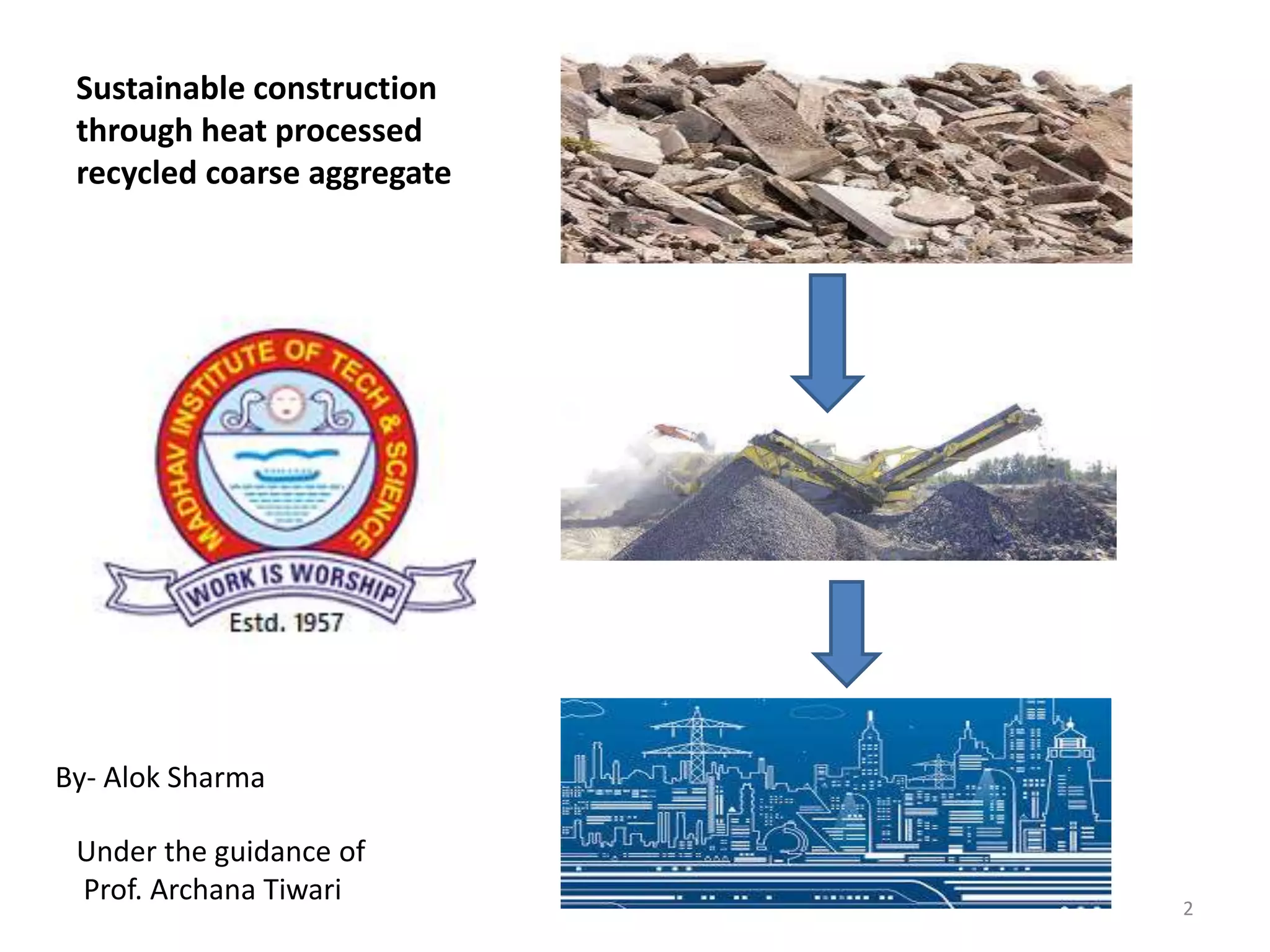
Sustainable construction
through heat processed
recycled coarse aggregate
By- Alok Sharma
Under the guidance of
Prof. Archana Tiwari 2
Introduction
• Concrete is the second largest material in
construction industry after water, concrete made-
up from four basic material cement, fine
aggregate, coarse aggregate, and water.
• major portion of concrete is coarse aggregate so
recycling of coarse aggregate is the way of
construction sustainability by reducing solid
waste produced from construction and
demolition waste and saving of natural resources
which are depleted day by day.
3
Terminology used in this study
• RCA- Recycled coarse aggregate
• HT-RCA – Heat treated recycled coarse
aggregate.
• AT-RCA – Acid treated recycled coarse
aggregate.
4
Objective
1. Understand the sustainable construction ,
need for society and problems through
literature and opinions of experts.
2. Forecast the new possibilities in construction
recycling industry.
3. Study of concrete mortar relation with
respect to high rise temperature.
4. Study of mechanical properties of coarse
aggregate with different mortar percentage.
5
• This work consist both qualitative and
numerical approach.
1. Qualitative work is done through conducting
interview over use of recycled coarse
aggregate.
The findings of interview are the clear picture of
possibility and resistance of its use.
6
2. Second approach is heat treatment of used
aggregate for further use as second
generation aggregate concrete and its
comparative study with natural coarse
aggregate.
This work is based on the interview findings.
7
Concrete and its importance
Now there is no alternative of concrete in
construction industry, almost complete
construction industry based on concrete
structures.
But solid waste generation through concrete
demolition waste is also very high.
8
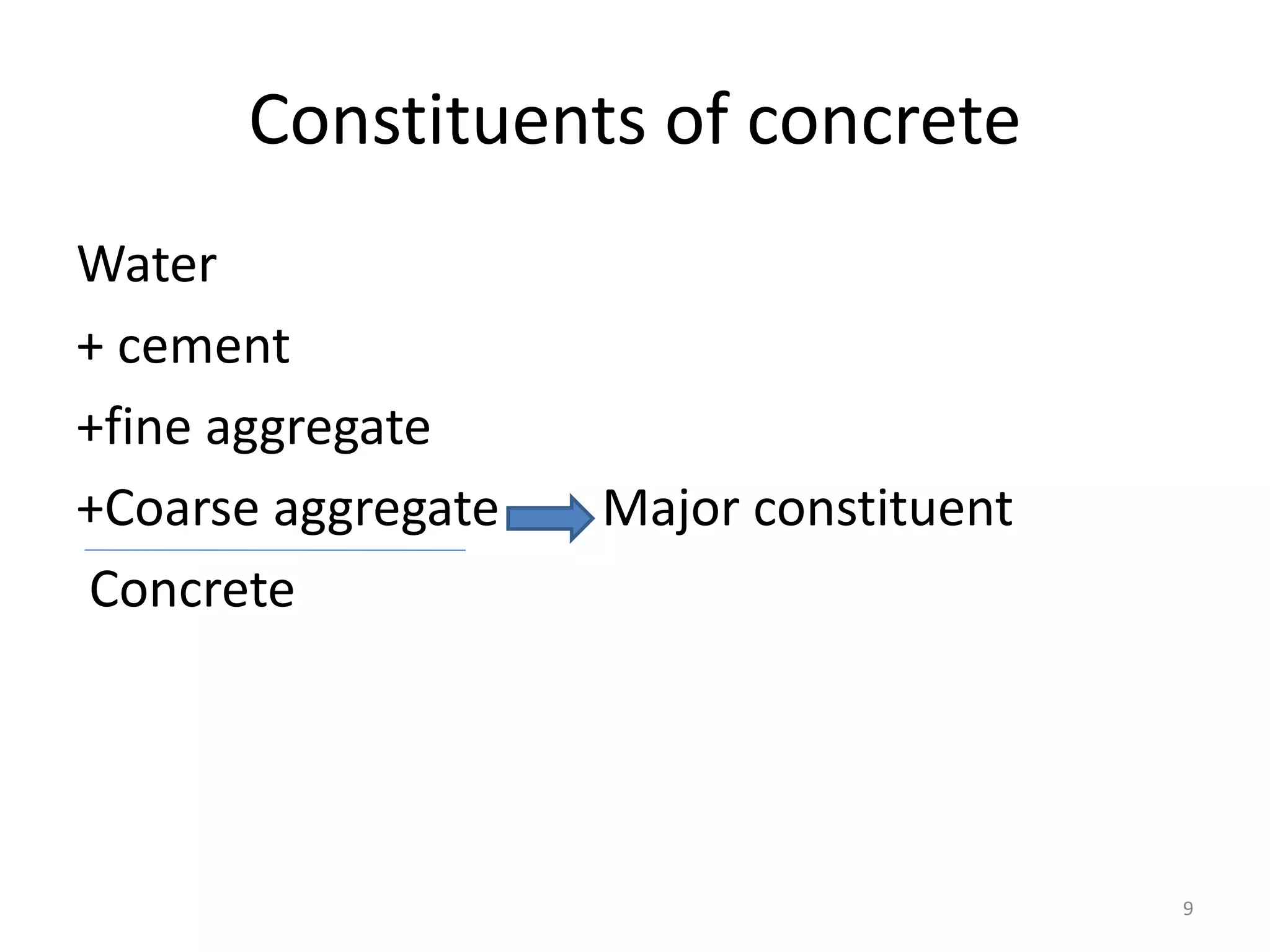
Constituents of concrete
Water
+ cement
+fine aggregate
+Coarse aggregate Major constituent
Concrete
9
Literature support
Author Journal Work Findings
(significance in this
study)
Sepani , Gregory,
Olivia Mirza, and
Won-Hee.
2016
(Science direct)
Recycled concrete in
structural applications
for sustainable
construction practice
in Australia
Collected merits
and resistance in
application of
recycled aggregate
Gives the clear idea
about
questionnaire and
interview
technique.
Sunil
Kumar(2017)
Challenges and
opportunities
associated with waste
management in India.
Recycling
challenges with
respect to
population growth.
Gives static
numbers of solid
waste and c and d
waste.
Purushothaman
(2019)
ICI journal
Characterization of
Recycle Concrete
Aggregate Based on
Attached Mortar
Content for Structural
Concrete application.
Study of RCA
mechanical
properties with
respect to mortar
percentage.
Gives idea of RCA
behavior with
respect to mortar
removal.
10
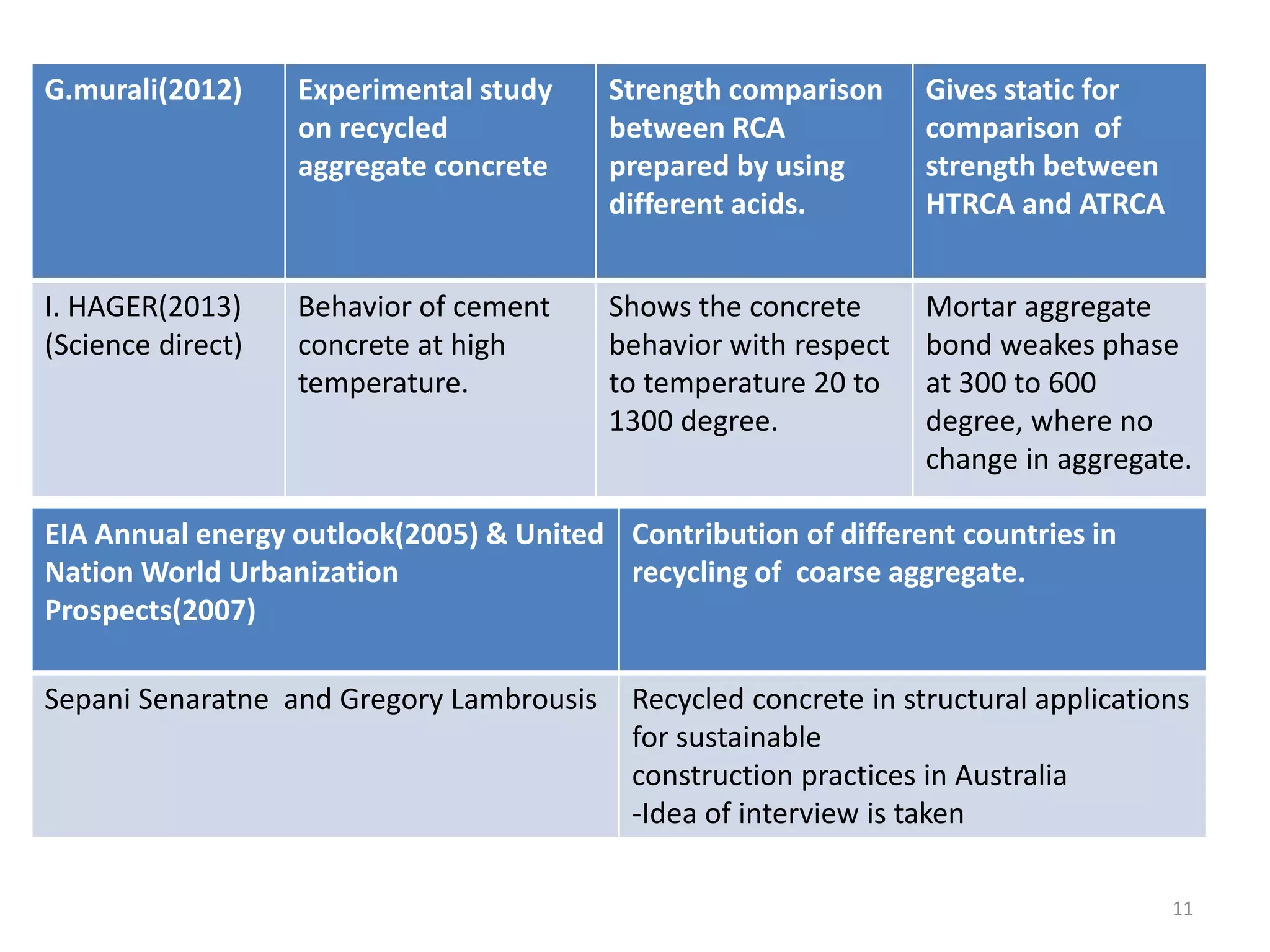
G.murali(2012) Experimental study
on recycled
aggregate concrete
Strength comparison
between RCA
prepared by using
different acids.
Gives static for
comparison of
strength between
HTRCA and ATRCA
I. HAGER(2013)
(Science direct)
Behavior of cement
concrete at high
temperature.
Shows the concrete
behavior with respect
to temperature 20 to
1300 degree.
Mortar aggregate
bond weakes phase
at 300 to 600
degree, where no
change in aggregate.
EIA Annual energy outlook(2005) & United
Nation World Urbanization
Prospects(2007)
Contribution of different countries in
recycling of coarse aggregate.
Sepani Senaratne and Gregory Lambrousis Recycled concrete in structural applications
for sustainable
construction practices in Australia
-Idea of interview is taken
11
Need of sustainability
sustainable construction is fill the present need
without compromise the future, which only
possible with low foot print over environment
from construction.
Concrete is the major part leads resource
depletion and solid waste accumulation which
makes future risk.
12
Role of RAC in sustainable
development
• Sustainable development is not mean to just
fulfill our present need only it meets the need
of future also.
• Every construction have a life span but after
the life span it become debris.
• But recycling of construction material is only
way to reuse and make the construction of
next generation.
13
C&D waste in india
26%
32%
28%
6%
3%
5%
C&D iawaste in ind
soil, sand and gravel
Brick mesonary
Concrete
Metal
Wood
Other
source-guideline of environmental
Management of Construction & demolition
waste march 2017 14
Coarse aggregate
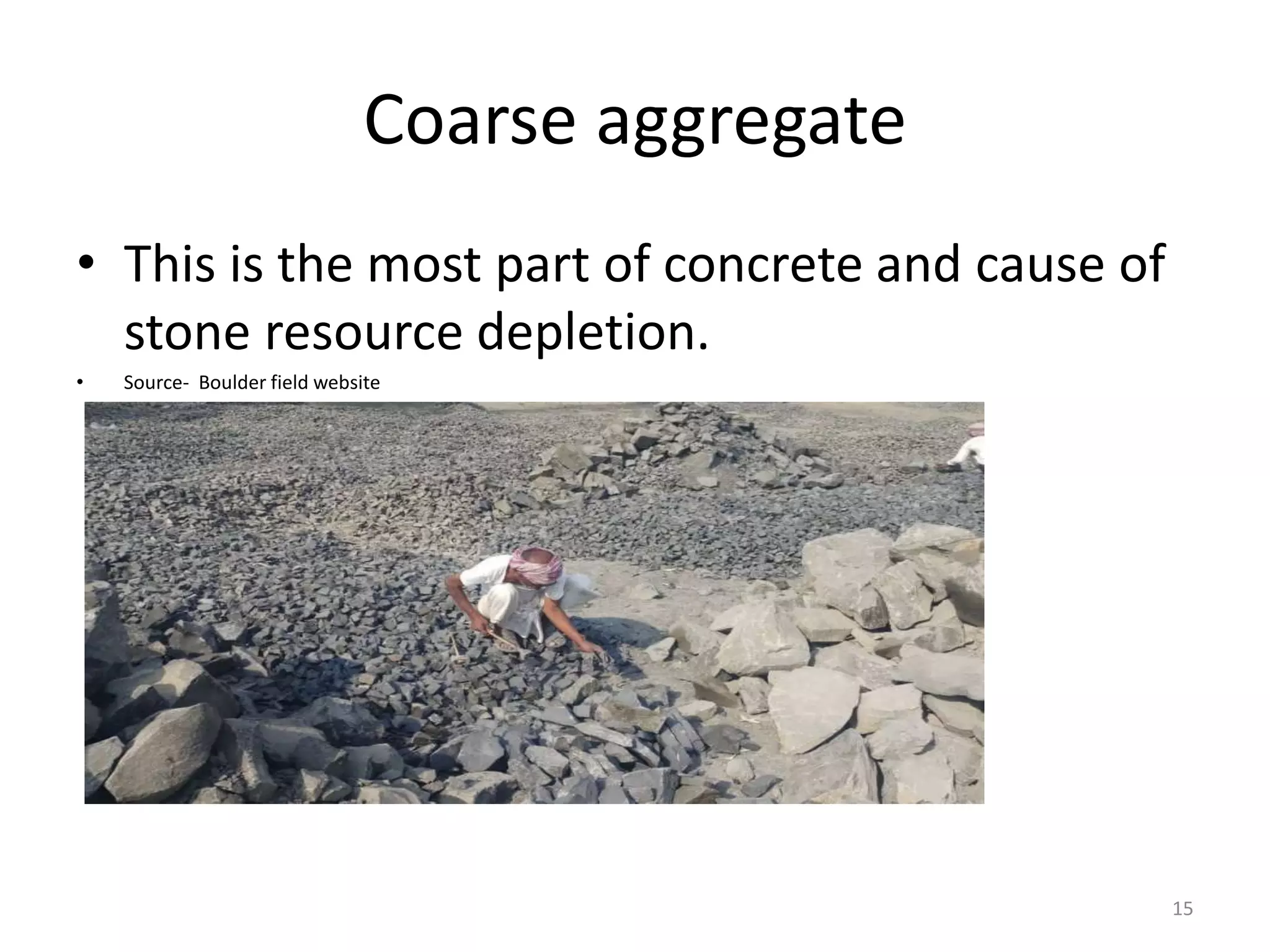
• This is the most part of concrete and cause of
stone resource depletion.
• Source- Boulder field website
15
Recycling of coarse aggregate
• Most part of concrete is made by coarse
aggregate, so recycling of coarse aggregate
leads sustainability.
• Used coarse aggregate is covered by adhesive
impurities, these impurities leads
heterogeneity in coarse aggregate.
16
What main adhesive impurities are
possible in Recycled aggregate
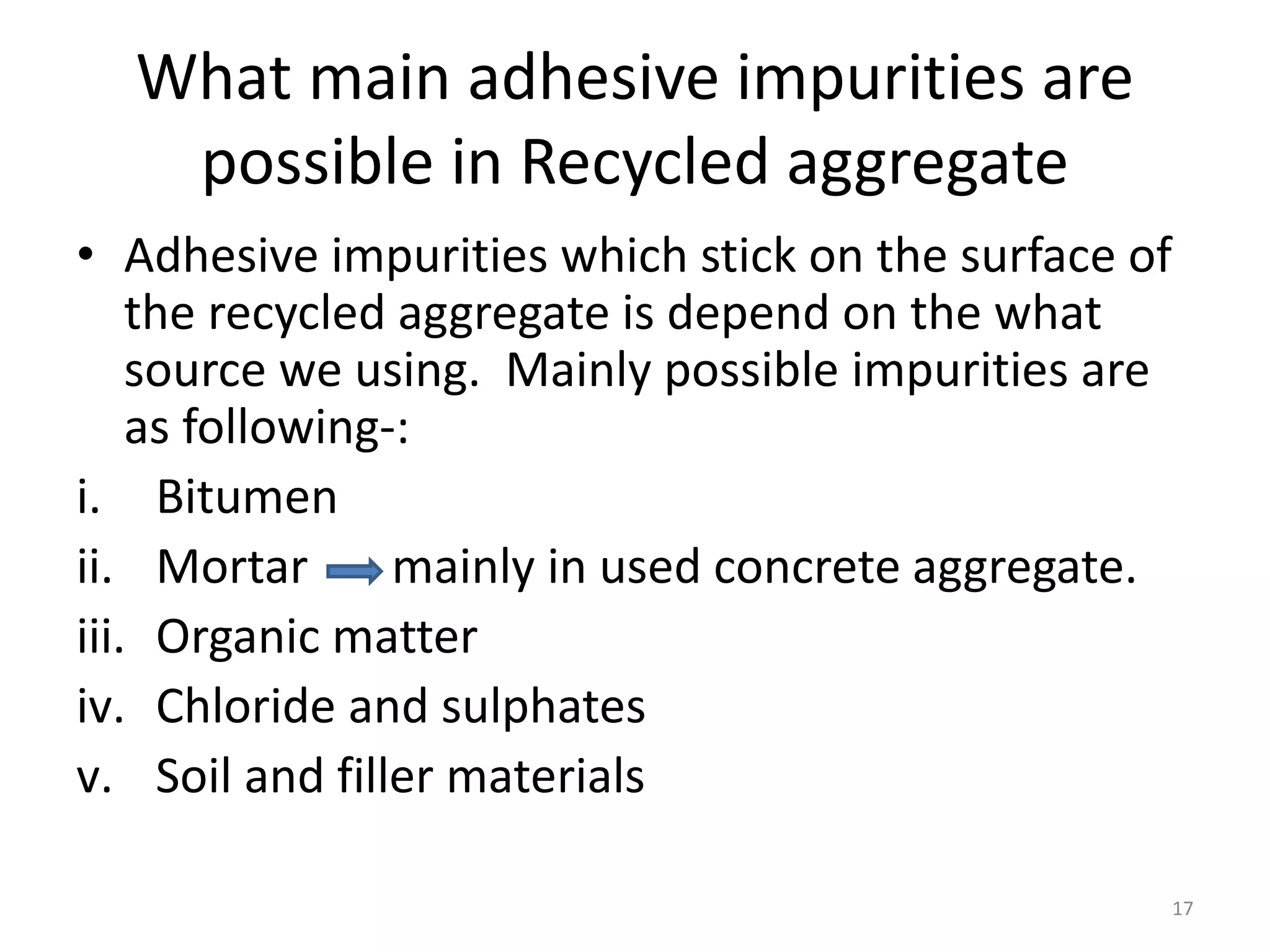
• Adhesive impurities which stick on the surface of
the recycled aggregate is depend on the what
source we using. Mainly possible impurities are
as following-:
i. Bitumen
ii. Mortar mainly in used concrete aggregate.
iii. Organic matter
iv. Chloride and sulphates
v. Soil and filler materials
17
How it is differ with natural
aggregates?
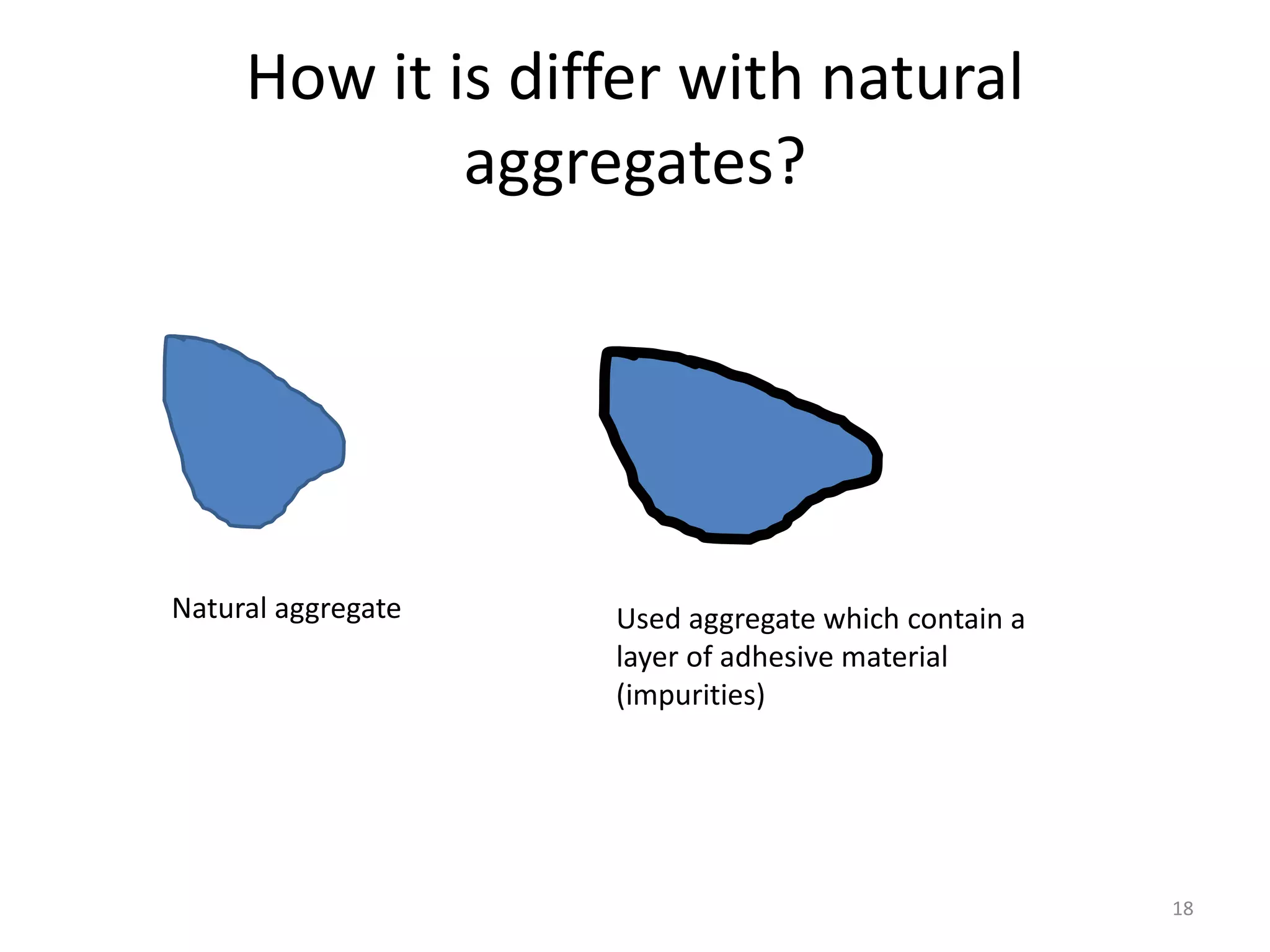
Natural aggregate Used aggregate which contain a
layer of adhesive material
(impurities)
18
Recycling of coarse aggregate is process to
remove impurity layer to make it
homogeneous and inert.
19
Methodology of Interview
Interview is conducted to know following
aspects of reuse of aggregate in construction
and infrastructure projects.
• Possibilities
• Resistance
• Benefit
• drawbacks
20
Idea from literature
Set of questions and relevant interview
personalities of questionnaire is adopted from
literatures of green building and sustainable
construction.
Sepani Senaratne and Gregory Lambrousis(Recycled concrete in structural
applications for sustainable construction practices in Australia)
21
Interviewed personality Aspect to use of RCA (Finding of this journal)
Builder -Cost( Initial cost is high in the case of RCA)
- Concrete speciation may be compromised in the case of
RCA
Designer -Higher green rating in the case of RCA
-Life cycle of RCA should be analyze properly.
-There is risk to fail because there no slandered for RCA.
Engineer -Favorable marine construction or higher exposed
environmental condition
22
Mode of questionnaire
The interview were conducted through Google
forms (e-interview ).
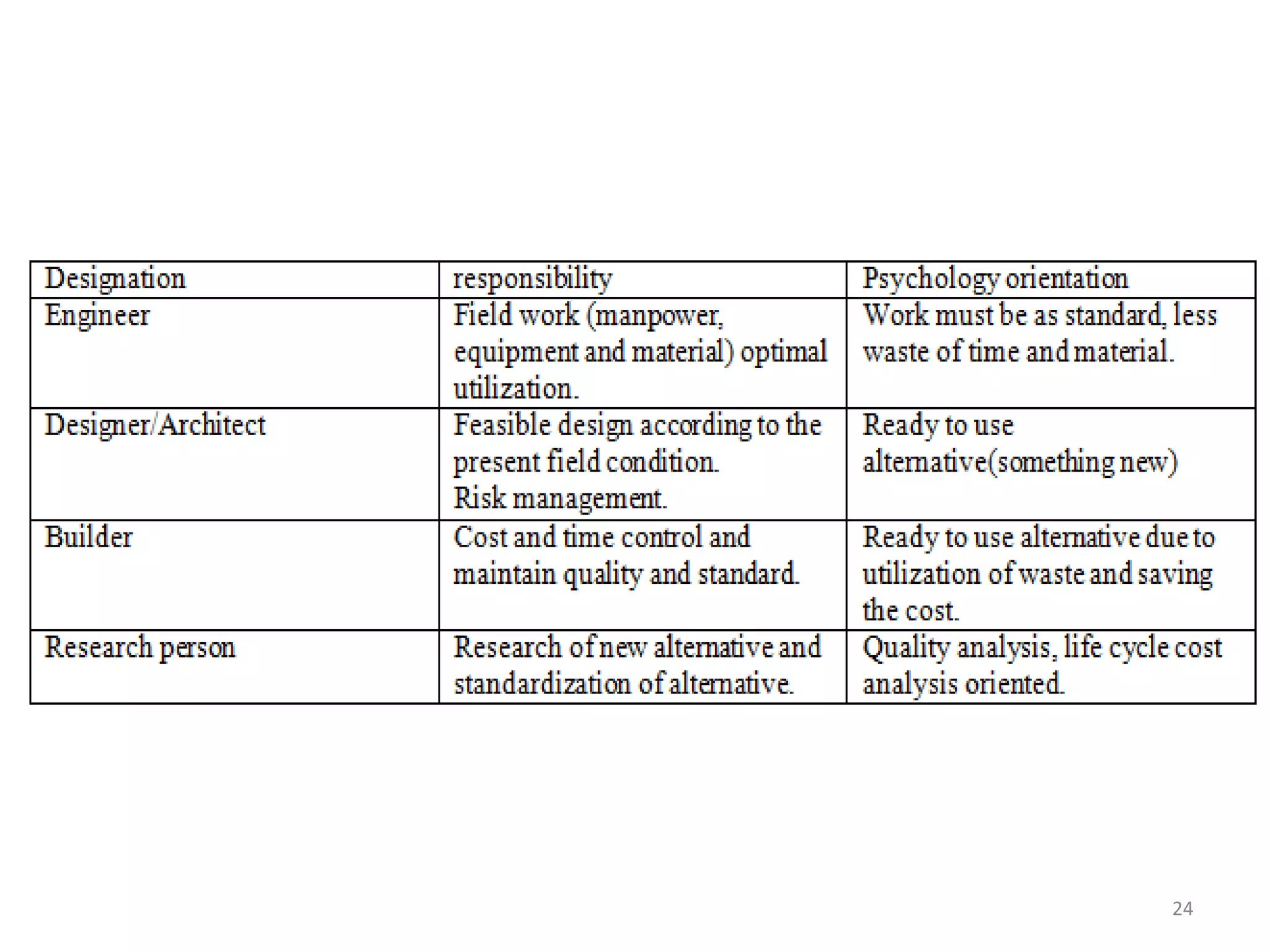
The expert panel is categories as following-
• Engineer-40
• Architect/ Designer-20
• Builder-14
• Research person-42
23
24
Area of construction project
Construction
project
Field
condition
Project
planning
Economy
designing
25
Questionnaire detail
The questionnaire contains all aspects of
recycled coarse aggregate and its application
in present civil and aviation society like cost,
merits, demerits, present scenario of solid
waste etc. and recommendation or suggestion
also considered.
26
Analysis of interview findings
Qualitative
analysise
• weakness and alternative analysise
• Adwanges and opportunity
Technical
analysise
• Analysise of strength perameters
• Analysise of durability perameter
Opportunity
analysise
• possiblity to minimise risk and cost
• possibility of use(structural and non structural)
27
Resistance
35%
26%
28%
11%
Higher initial cost
sufficient sources are avalable
There are no standard available
risk of failure
28
Present scenario of C&D waste
utilization
11%
24%
22%
21%
19%
3%
Send to recycling plant
using of land fills
use in highway road subgrade
partially use in new construction
Use in foundation fillings
Other use
29
30
31
32
Concept of temperature over concrete
• According to “Hager 2013” mortar is can not
withstand at high temperature(300 degree or
more), so removal of mortar layer can be
possible by using heat over used aggregate.
33
Methodology of heat treatment of
aggregate
Collection of
concrete
chunks
Control
heating of
these chunks
Mechanical
rubbing
Water washed
aggregate
grading
34
Special equipment used
Heating pan and pyrometer(IR
thermometer)
For heating action
Los angles abrasion machine For rubbing mechanism
35
Classification and nomenclature of
samples produce
1st stage recycled coarse aggregate(RCA-1)
This is produce by crush the concrete cube by
hammering process, after producing the chunks
below size 40mm washed with the help of water
without and jet impact.
2nd stage recycled coarse aggregate(RCA-2)
This is produced by using mechanical rubbing
process of RCA-1 with the help of Los angles
abrasion machine of 200revolution without balls.
36
3rd stage (HT-RCA)is the heat processing stage, in this
stage RCA-1 samples are heated up to 500 degree
Celsius then mechanical abrasion is performed dust
particles are removed with water washing.
AT-RCA is acid treated sample produce with the help of
cons. Acid and brush is use to removal of mortar from
aggregate, Acid treated pure sample is also produced
for calculation of mortar percentage.
37
Physical classification
RCA-1 (concrete chunks
produce by demolition)
Shape- Irregular (Angular)
shape by attrition and
crushing.
Rough surface
RCA-2 (recycled
aggregate; recycled by
mechanical process)
Shape- Irregular
(Rounded) shaped by
rough attrition.
Smooth surface
38
AT-RCA
(33% HCl is used )
Shape-Irregular shape
depend on crusher.
Rough(Granular)
39
Sample Mortar percentage
RCA-1
Recycled coarse aggregate without any
treatment
50.88
RCA-2
Recycled coarse aggregate only
mechanical rubbing is done
30.14
HT-RCA
Heat treated recycled coarse aggregate
18.30
AT-RCA
complete Mortar cleaned with acid and
soft brush
00
40
Test results and analysis
2.61
2.48
2.54
2.585
2.4
2.45
2.5
2.55
2.6
2.65
Natural aggregate RCA-1 RCA-2 HT-RCA
specific gravity
41
• These results show the purity is increasing
with respect to mortar removal.
• Purity in descending orders as
• N.A. > HT-RCA > RCA-2 > RCA-1
42
0.6
11.73
3.66
1.92
0
2
4
6
8
10
12
14
Natural aggregate RCA-1 RCA-2 HT-RCA
Water absorption percentage
43
1.42
1.27
1.328
1.41
1.563
1.395
1.475
1.52
0
0.2
0.4
0.6
0.8
1
1.2
1.4
1.6
1.8
N.A. RCA-1 RCA-2 HT-RCA
loose bul density kg/ltr
rodded bulk density kg/ ltr
44
45
Comparison between HTRCA and NA
• HTRCA is not as capable as natural aggregate
in water absorption, specific gravity, bulk
density, and impact value but significant
improvement compare to unheated recycled
aggregate.
46
Conclusion
The recycled aggregate is un-homogeneous in
nature due to mortar layer over it so variation
in strength is there but non structural use of
recycled coarse aggregate can be possible at
any stage of construction, and it can be use in
the repair works of concrete.
47
• Direct use of recycled concrete can be possible
in structural elements also but there is
uncertainty of failure pre eliminated with the
help of some essential tests on it those fulfill
strength criteria which is required.
48
Concern with
Quality
&
Standards require
Potential for High
green ratting
Force to optimum
use of RCA
Improvisation
of RCA
Life cycle cost
49
• Crushed concrete and demolition concrete
have approximate same impurity content, the
mortar impurity of primary crushed chunks of
concrete cubes is 50.88% by weight known as
RCA-1, after mechanical rubbing operation
performed on RCA-1 reduced mortar up to
30.41% known as RCA-2, and after heat
process this reduce up to 18.30%.
50
• In comparison with the natural aggregate,
RCA-1, RCA-2 and HT-RCA exhibited higher
absorptive capacities (11.73%,3.66%, and
1.92% respectively) and lower bulk densities
(1395,1475, and 1520 kg/m3 respectively).
These results are due to the presence and
relative quality of any adhered mortar in the
aggregates surface.
51
• Void content is also decreases with respect to
mortar impurity removal of RCA-1,RCA-2,and
HT-RCA (48.79%, 47.7%, and 45.45% ) but void
content of Natural aggregate 45.59% which is
higher than HT-RCA. In the case of void
content in compacted sample (rodded sample
) void content of natural aggregate is 40.11%
where void in HT-RCA contains 41.19% voids.
52
• In comparison with natural aggregate, all form
of RCA gives higher Impact value of
aggregate, the impact value reduces with
respect to mortar removal of RCA-1, RCA-2,
and HT-RCA (37.13%, 29.12%, and 23.25%
respectively ).
53
• The heat process of recycling of coarse
aggregate gives significant results as chemical
processing of recycling, after heat processing
the mortar was reduced up to 18.30% which
reduce the risk of failure, make it reliable in
design and increase homogeneous nature of
recycled coarse aggregate
54
Reference use this study
• [01]Bentz,DP;Peltz,MA;Duran-Herrera,A;Valdez,P; and Jurarez,CA; "Thermal properties of high-
volume fly ash mortars and concretes",Journal of Building Physics,2011,v.34(3),pp. 263–275.
• [02]Bui,Ngoc Kien; Satomi, Tomaki; and Takahashi,Hiroshi;"Effect of mineral admixtures on
properties of recycle aggregate concrete at high temprature" Construction and Building material
V.184,2018,pp.361-373.
• [03]Chung,Shan-Shan; and Lo, Carlos W.H.;" Evaluating sustainability in waste management: the
case of construction and demolition, chemical and clinical wastes in Hong Kong", Resources,
Conservation and Recycling,v.37,2003,p.p.119-145.
• [04] Guideline of environmental Management of Construction & demolition waste march 2017.
• [05] IS 10262:2019, design concrete mix
• [06] IS 12269:2013, OPC 53.
• [07] IS 269:2015, properties of cement.
• [08] IS 2386, part 1-8, aggregate test.
• [09] IS 383:1970, coarse aggregate.
• [10] IS 456:2000, properties of concrete.
• [11] IS 516:1959 part-4 , strength test of concrete.
55
• [12] Kou,S.C. and Poon,C.S.; "Enhancing the durability properties of concrete prepared with course
recycled aggregate", Construction and Building material,V.35,2012,pp.69-76.
• [13]Marinkovic,S.;Radonjanin,V.;Malesev,M.; and Ignjatovic,I.; "Comparative environmental
assessment of natural and recycled aggregate concrete",Waste Management,V.30,2010,pp.2255-
2264.
• [14]Murali,G.;Vardhan,C.M.Vivek;Rajan,Gabriela;Janani,G.J.;Janan, N.Shifu; and Ramyashri,R;
"Experimental study on recycled aggregate concrete", International Journal of Engineering Research
and Application(IJERA),V.2,march-april 2012,pp.407-410.
• [15] Murty,D.Sree Ramachandra; Suresh,D.;Dinkar,P.; and Lava kumar,S.K.V.S.T.; "High Volume Fly
Ash Cement, Recycle Course Aggregate and Stone Crusher Dust Combined For Sustainable
Structural Concrete"; ICI journal, January-march 2019.
•
• [16]Poon, C. S.; Shui, Z. H.; and Lam, L.; " Effect of microstructure of ITZ on compressive strength of
concrete prepared with recycled aggregates." 2004(18), 461-468.
• [17]Poon, C. S.; Shui, Z. H.; Lam, L.; Fok, H.; & Kou, S. C.; " Influence of moisture states of natural
and recycled aggregates on the slump and compressive strength of concrete".2004(34), 31-36.
• [18] Pour-Ghaz, M.; Castro, J.; Kladivko, E.; and Weiss, J.;" A Short Report on the Use of Pressure
Plates to Measure Desorption" West Lafayette, Indiana: Purdue University2011(43),pp..
• [19] Poulikakos, L.D.; Papadaskalopoulou,C.; Hofko,B.; Gschösser,F.; Cannone Falchetto,A.;
Bueno,M.; Arraigada, M; Sousa,J.; Ruiz,R.; Petit, J.; Loizidou,M.; and Partl,M.N." Harvesting the
unexplored potential of European waste materials for road construction", Resources, Conservation
and Recycling,V.116,2017,p.p.32-44.
• [20] Radojanin,Vlastimir;Malesev,Mirjana;Marinkovic,Snezana; and Malty,Ali Emhemd saed Al;
"Green recycle aggregate concrete", Construction and Building Material V.47,2013,pp.1503-1511.
56
• [21] Revathi,Purushotham and Selvi,R.Senthamil; "Characterisation of Recycle Concrete Aggregate
Based on Attached Mortar Content for Structural Concrete application" ,ICI journal, January-march
2019.
• [22]Senaratne,Sepani; Lambrousis, Gregory; Mirza,Olivia; Tam,Vivan W.Y. and Kang,Won-Hee
"Recycled concrete in structural applications for sustainable construction practices in Australia",
Science direct journal,V.180, 2017,p.p.751-758.
• [23] Sunil,Kumar; Stephen, R. Smith; Geoff,Fowler; Costas,Velis; S., Jyoti Kumar; Shashi, Arya Rena;
Rakesh,Kumar; and Christopher,Cheeseman; "Challenges and opportunities associated with waste
management in India", Journal of Royal society open science, February 2017.
• [24]Sustainable development union website of UN(2020) and Source-website of Europian
Demolition Association and Website of EPA, USA(2020).
• [25] Tiwari,Archana; and Dwivedi,Prakash;" Characteristics of Concrete Made with Partial
Replacement of Natural Aggregates by Aggregate Recovered from Waste Concrete", International
Journal of Engineering Research & Technology (IJERT),9th sept.2014, V.3, ISSN: 2278-0181.
• [26]Tosic,Nikola; Marinkovic,Snezana; Dosic,Tina; and Stanic,Milas;" Multicriteria optimization of
natural and recycled aggregate concrete for structural use",Journal of Cleaner
Production,2014,p.p.1-11.
• [27]Wagih,Ashraf M.; El-Karmoty,Hossam Z.;Ebid,Magda; and Okba Samir H.;"Recycled construction
and demolition concrete waste as aggregate for structural concrete", Journal Housing and Building
National Research center,V.9,2013,pp.193-200.
• [28]Yadhu,G. and S Aishwarya devi;"An Innovative Study on Reuse of Demolished Concrete
Waste"Journal of Civil and Environmental engineering,27 Aug.2015,V.5,pp.272-291.
• [29]Yonis,Adel; Ebead,Usama; and Judd,Simon;" Life cycle cost analysis of structural concrete using
seawater, recycled concrete aggregate, and GFRP reinforcement", Construction and Building
Materials,V.175,2018,p.p.152-160.
57
58

Sustainable construction trough heat processed recycled coarse aggregate

  • 1.
    Sustainable Construction Through HeatProcessed Recycled Coarse Aggregate 1
  • 2.
    Sustainable construction through heatprocessed recycled coarse aggregate By- Alok Sharma Under the guidance of Prof. Archana Tiwari 2
  • 3.
    Introduction • Concrete isthe second largest material in construction industry after water, concrete made- up from four basic material cement, fine aggregate, coarse aggregate, and water. • major portion of concrete is coarse aggregate so recycling of coarse aggregate is the way of construction sustainability by reducing solid waste produced from construction and demolition waste and saving of natural resources which are depleted day by day. 3
  • 4.
    Terminology used inthis study • RCA- Recycled coarse aggregate • HT-RCA – Heat treated recycled coarse aggregate. • AT-RCA – Acid treated recycled coarse aggregate. 4
  • 5.
    Objective 1. Understand thesustainable construction , need for society and problems through literature and opinions of experts. 2. Forecast the new possibilities in construction recycling industry. 3. Study of concrete mortar relation with respect to high rise temperature. 4. Study of mechanical properties of coarse aggregate with different mortar percentage. 5
  • 6.
    • This workconsist both qualitative and numerical approach. 1. Qualitative work is done through conducting interview over use of recycled coarse aggregate. The findings of interview are the clear picture of possibility and resistance of its use. 6
  • 7.
    2. Second approachis heat treatment of used aggregate for further use as second generation aggregate concrete and its comparative study with natural coarse aggregate. This work is based on the interview findings. 7
  • 8.
    Concrete and itsimportance Now there is no alternative of concrete in construction industry, almost complete construction industry based on concrete structures. But solid waste generation through concrete demolition waste is also very high. 8
  • 9.
    Constituents of concrete Water +cement +fine aggregate +Coarse aggregate Major constituent Concrete 9
  • 10.
    Literature support Author JournalWork Findings (significance in this study) Sepani , Gregory, Olivia Mirza, and Won-Hee. 2016 (Science direct) Recycled concrete in structural applications for sustainable construction practice in Australia Collected merits and resistance in application of recycled aggregate Gives the clear idea about questionnaire and interview technique. Sunil Kumar(2017) Challenges and opportunities associated with waste management in India. Recycling challenges with respect to population growth. Gives static numbers of solid waste and c and d waste. Purushothaman (2019) ICI journal Characterization of Recycle Concrete Aggregate Based on Attached Mortar Content for Structural Concrete application. Study of RCA mechanical properties with respect to mortar percentage. Gives idea of RCA behavior with respect to mortar removal. 10
  • 11.
    G.murali(2012) Experimental study onrecycled aggregate concrete Strength comparison between RCA prepared by using different acids. Gives static for comparison of strength between HTRCA and ATRCA I. HAGER(2013) (Science direct) Behavior of cement concrete at high temperature. Shows the concrete behavior with respect to temperature 20 to 1300 degree. Mortar aggregate bond weakes phase at 300 to 600 degree, where no change in aggregate. EIA Annual energy outlook(2005) & United Nation World Urbanization Prospects(2007) Contribution of different countries in recycling of coarse aggregate. Sepani Senaratne and Gregory Lambrousis Recycled concrete in structural applications for sustainable construction practices in Australia -Idea of interview is taken 11
  • 12.
    Need of sustainability sustainableconstruction is fill the present need without compromise the future, which only possible with low foot print over environment from construction. Concrete is the major part leads resource depletion and solid waste accumulation which makes future risk. 12
  • 13.
    Role of RACin sustainable development • Sustainable development is not mean to just fulfill our present need only it meets the need of future also. • Every construction have a life span but after the life span it become debris. • But recycling of construction material is only way to reuse and make the construction of next generation. 13
  • 14.
    C&D waste inindia 26% 32% 28% 6% 3% 5% C&D iawaste in ind soil, sand and gravel Brick mesonary Concrete Metal Wood Other source-guideline of environmental Management of Construction & demolition waste march 2017 14
  • 15.
    Coarse aggregate • Thisis the most part of concrete and cause of stone resource depletion. • Source- Boulder field website 15
  • 16.
    Recycling of coarseaggregate • Most part of concrete is made by coarse aggregate, so recycling of coarse aggregate leads sustainability. • Used coarse aggregate is covered by adhesive impurities, these impurities leads heterogeneity in coarse aggregate. 16
  • 17.
    What main adhesiveimpurities are possible in Recycled aggregate • Adhesive impurities which stick on the surface of the recycled aggregate is depend on the what source we using. Mainly possible impurities are as following-: i. Bitumen ii. Mortar mainly in used concrete aggregate. iii. Organic matter iv. Chloride and sulphates v. Soil and filler materials 17
  • 18.
    How it isdiffer with natural aggregates? Natural aggregate Used aggregate which contain a layer of adhesive material (impurities) 18
  • 19.
    Recycling of coarseaggregate is process to remove impurity layer to make it homogeneous and inert. 19
  • 20.
    Methodology of Interview Interviewis conducted to know following aspects of reuse of aggregate in construction and infrastructure projects. • Possibilities • Resistance • Benefit • drawbacks 20
  • 21.
    Idea from literature Setof questions and relevant interview personalities of questionnaire is adopted from literatures of green building and sustainable construction. Sepani Senaratne and Gregory Lambrousis(Recycled concrete in structural applications for sustainable construction practices in Australia) 21
  • 22.
    Interviewed personality Aspectto use of RCA (Finding of this journal) Builder -Cost( Initial cost is high in the case of RCA) - Concrete speciation may be compromised in the case of RCA Designer -Higher green rating in the case of RCA -Life cycle of RCA should be analyze properly. -There is risk to fail because there no slandered for RCA. Engineer -Favorable marine construction or higher exposed environmental condition 22
  • 23.
    Mode of questionnaire Theinterview were conducted through Google forms (e-interview ). The expert panel is categories as following- • Engineer-40 • Architect/ Designer-20 • Builder-14 • Research person-42 23
  • 24.
  • 25.
    Area of constructionproject Construction project Field condition Project planning Economy designing 25
  • 26.
    Questionnaire detail The questionnairecontains all aspects of recycled coarse aggregate and its application in present civil and aviation society like cost, merits, demerits, present scenario of solid waste etc. and recommendation or suggestion also considered. 26
  • 27.
    Analysis of interviewfindings Qualitative analysise • weakness and alternative analysise • Adwanges and opportunity Technical analysise • Analysise of strength perameters • Analysise of durability perameter Opportunity analysise • possiblity to minimise risk and cost • possibility of use(structural and non structural) 27
  • 28.
    Resistance 35% 26% 28% 11% Higher initial cost sufficientsources are avalable There are no standard available risk of failure 28
  • 29.
    Present scenario ofC&D waste utilization 11% 24% 22% 21% 19% 3% Send to recycling plant using of land fills use in highway road subgrade partially use in new construction Use in foundation fillings Other use 29
  • 30.
  • 31.
  • 32.
  • 33.
    Concept of temperatureover concrete • According to “Hager 2013” mortar is can not withstand at high temperature(300 degree or more), so removal of mortar layer can be possible by using heat over used aggregate. 33
  • 34.
    Methodology of heattreatment of aggregate Collection of concrete chunks Control heating of these chunks Mechanical rubbing Water washed aggregate grading 34
  • 35.
    Special equipment used Heatingpan and pyrometer(IR thermometer) For heating action Los angles abrasion machine For rubbing mechanism 35
  • 36.
    Classification and nomenclatureof samples produce 1st stage recycled coarse aggregate(RCA-1) This is produce by crush the concrete cube by hammering process, after producing the chunks below size 40mm washed with the help of water without and jet impact. 2nd stage recycled coarse aggregate(RCA-2) This is produced by using mechanical rubbing process of RCA-1 with the help of Los angles abrasion machine of 200revolution without balls. 36
  • 37.
    3rd stage (HT-RCA)isthe heat processing stage, in this stage RCA-1 samples are heated up to 500 degree Celsius then mechanical abrasion is performed dust particles are removed with water washing. AT-RCA is acid treated sample produce with the help of cons. Acid and brush is use to removal of mortar from aggregate, Acid treated pure sample is also produced for calculation of mortar percentage. 37
  • 38.
    Physical classification RCA-1 (concretechunks produce by demolition) Shape- Irregular (Angular) shape by attrition and crushing. Rough surface RCA-2 (recycled aggregate; recycled by mechanical process) Shape- Irregular (Rounded) shaped by rough attrition. Smooth surface 38
  • 39.
    AT-RCA (33% HCl isused ) Shape-Irregular shape depend on crusher. Rough(Granular) 39
  • 40.
    Sample Mortar percentage RCA-1 Recycledcoarse aggregate without any treatment 50.88 RCA-2 Recycled coarse aggregate only mechanical rubbing is done 30.14 HT-RCA Heat treated recycled coarse aggregate 18.30 AT-RCA complete Mortar cleaned with acid and soft brush 00 40
  • 41.
    Test results andanalysis 2.61 2.48 2.54 2.585 2.4 2.45 2.5 2.55 2.6 2.65 Natural aggregate RCA-1 RCA-2 HT-RCA specific gravity 41
  • 42.
    • These resultsshow the purity is increasing with respect to mortar removal. • Purity in descending orders as • N.A. > HT-RCA > RCA-2 > RCA-1 42
  • 43.
    0.6 11.73 3.66 1.92 0 2 4 6 8 10 12 14 Natural aggregate RCA-1RCA-2 HT-RCA Water absorption percentage 43
  • 44.
  • 45.
  • 46.
    Comparison between HTRCAand NA • HTRCA is not as capable as natural aggregate in water absorption, specific gravity, bulk density, and impact value but significant improvement compare to unheated recycled aggregate. 46
  • 47.
    Conclusion The recycled aggregateis un-homogeneous in nature due to mortar layer over it so variation in strength is there but non structural use of recycled coarse aggregate can be possible at any stage of construction, and it can be use in the repair works of concrete. 47
  • 48.
    • Direct useof recycled concrete can be possible in structural elements also but there is uncertainty of failure pre eliminated with the help of some essential tests on it those fulfill strength criteria which is required. 48
  • 49.
    Concern with Quality & Standards require Potentialfor High green ratting Force to optimum use of RCA Improvisation of RCA Life cycle cost 49
  • 50.
    • Crushed concreteand demolition concrete have approximate same impurity content, the mortar impurity of primary crushed chunks of concrete cubes is 50.88% by weight known as RCA-1, after mechanical rubbing operation performed on RCA-1 reduced mortar up to 30.41% known as RCA-2, and after heat process this reduce up to 18.30%. 50
  • 51.
    • In comparisonwith the natural aggregate, RCA-1, RCA-2 and HT-RCA exhibited higher absorptive capacities (11.73%,3.66%, and 1.92% respectively) and lower bulk densities (1395,1475, and 1520 kg/m3 respectively). These results are due to the presence and relative quality of any adhered mortar in the aggregates surface. 51
  • 52.
    • Void contentis also decreases with respect to mortar impurity removal of RCA-1,RCA-2,and HT-RCA (48.79%, 47.7%, and 45.45% ) but void content of Natural aggregate 45.59% which is higher than HT-RCA. In the case of void content in compacted sample (rodded sample ) void content of natural aggregate is 40.11% where void in HT-RCA contains 41.19% voids. 52
  • 53.
    • In comparisonwith natural aggregate, all form of RCA gives higher Impact value of aggregate, the impact value reduces with respect to mortar removal of RCA-1, RCA-2, and HT-RCA (37.13%, 29.12%, and 23.25% respectively ). 53
  • 54.
    • The heatprocess of recycling of coarse aggregate gives significant results as chemical processing of recycling, after heat processing the mortar was reduced up to 18.30% which reduce the risk of failure, make it reliable in design and increase homogeneous nature of recycled coarse aggregate 54
  • 55.
    Reference use thisstudy • [01]Bentz,DP;Peltz,MA;Duran-Herrera,A;Valdez,P; and Jurarez,CA; "Thermal properties of high- volume fly ash mortars and concretes",Journal of Building Physics,2011,v.34(3),pp. 263–275. • [02]Bui,Ngoc Kien; Satomi, Tomaki; and Takahashi,Hiroshi;"Effect of mineral admixtures on properties of recycle aggregate concrete at high temprature" Construction and Building material V.184,2018,pp.361-373. • [03]Chung,Shan-Shan; and Lo, Carlos W.H.;" Evaluating sustainability in waste management: the case of construction and demolition, chemical and clinical wastes in Hong Kong", Resources, Conservation and Recycling,v.37,2003,p.p.119-145. • [04] Guideline of environmental Management of Construction & demolition waste march 2017. • [05] IS 10262:2019, design concrete mix • [06] IS 12269:2013, OPC 53. • [07] IS 269:2015, properties of cement. • [08] IS 2386, part 1-8, aggregate test. • [09] IS 383:1970, coarse aggregate. • [10] IS 456:2000, properties of concrete. • [11] IS 516:1959 part-4 , strength test of concrete. 55
  • 56.
    • [12] Kou,S.C.and Poon,C.S.; "Enhancing the durability properties of concrete prepared with course recycled aggregate", Construction and Building material,V.35,2012,pp.69-76. • [13]Marinkovic,S.;Radonjanin,V.;Malesev,M.; and Ignjatovic,I.; "Comparative environmental assessment of natural and recycled aggregate concrete",Waste Management,V.30,2010,pp.2255- 2264. • [14]Murali,G.;Vardhan,C.M.Vivek;Rajan,Gabriela;Janani,G.J.;Janan, N.Shifu; and Ramyashri,R; "Experimental study on recycled aggregate concrete", International Journal of Engineering Research and Application(IJERA),V.2,march-april 2012,pp.407-410. • [15] Murty,D.Sree Ramachandra; Suresh,D.;Dinkar,P.; and Lava kumar,S.K.V.S.T.; "High Volume Fly Ash Cement, Recycle Course Aggregate and Stone Crusher Dust Combined For Sustainable Structural Concrete"; ICI journal, January-march 2019. • • [16]Poon, C. S.; Shui, Z. H.; and Lam, L.; " Effect of microstructure of ITZ on compressive strength of concrete prepared with recycled aggregates." 2004(18), 461-468. • [17]Poon, C. S.; Shui, Z. H.; Lam, L.; Fok, H.; & Kou, S. C.; " Influence of moisture states of natural and recycled aggregates on the slump and compressive strength of concrete".2004(34), 31-36. • [18] Pour-Ghaz, M.; Castro, J.; Kladivko, E.; and Weiss, J.;" A Short Report on the Use of Pressure Plates to Measure Desorption" West Lafayette, Indiana: Purdue University2011(43),pp.. • [19] Poulikakos, L.D.; Papadaskalopoulou,C.; Hofko,B.; Gschösser,F.; Cannone Falchetto,A.; Bueno,M.; Arraigada, M; Sousa,J.; Ruiz,R.; Petit, J.; Loizidou,M.; and Partl,M.N." Harvesting the unexplored potential of European waste materials for road construction", Resources, Conservation and Recycling,V.116,2017,p.p.32-44. • [20] Radojanin,Vlastimir;Malesev,Mirjana;Marinkovic,Snezana; and Malty,Ali Emhemd saed Al; "Green recycle aggregate concrete", Construction and Building Material V.47,2013,pp.1503-1511. 56
  • 57.
    • [21] Revathi,Purushothamand Selvi,R.Senthamil; "Characterisation of Recycle Concrete Aggregate Based on Attached Mortar Content for Structural Concrete application" ,ICI journal, January-march 2019. • [22]Senaratne,Sepani; Lambrousis, Gregory; Mirza,Olivia; Tam,Vivan W.Y. and Kang,Won-Hee "Recycled concrete in structural applications for sustainable construction practices in Australia", Science direct journal,V.180, 2017,p.p.751-758. • [23] Sunil,Kumar; Stephen, R. Smith; Geoff,Fowler; Costas,Velis; S., Jyoti Kumar; Shashi, Arya Rena; Rakesh,Kumar; and Christopher,Cheeseman; "Challenges and opportunities associated with waste management in India", Journal of Royal society open science, February 2017. • [24]Sustainable development union website of UN(2020) and Source-website of Europian Demolition Association and Website of EPA, USA(2020). • [25] Tiwari,Archana; and Dwivedi,Prakash;" Characteristics of Concrete Made with Partial Replacement of Natural Aggregates by Aggregate Recovered from Waste Concrete", International Journal of Engineering Research & Technology (IJERT),9th sept.2014, V.3, ISSN: 2278-0181. • [26]Tosic,Nikola; Marinkovic,Snezana; Dosic,Tina; and Stanic,Milas;" Multicriteria optimization of natural and recycled aggregate concrete for structural use",Journal of Cleaner Production,2014,p.p.1-11. • [27]Wagih,Ashraf M.; El-Karmoty,Hossam Z.;Ebid,Magda; and Okba Samir H.;"Recycled construction and demolition concrete waste as aggregate for structural concrete", Journal Housing and Building National Research center,V.9,2013,pp.193-200. • [28]Yadhu,G. and S Aishwarya devi;"An Innovative Study on Reuse of Demolished Concrete Waste"Journal of Civil and Environmental engineering,27 Aug.2015,V.5,pp.272-291. • [29]Yonis,Adel; Ebead,Usama; and Judd,Simon;" Life cycle cost analysis of structural concrete using seawater, recycled concrete aggregate, and GFRP reinforcement", Construction and Building Materials,V.175,2018,p.p.152-160. 57
  • 58.