www.eduserv.org.uk
Surviving a DDoS Attack
Matt Johnson, Head of Research, Eduserv
January 2015
Agenda
 Background
 Diary of the DDoS
 Attack profiles & social media
 Analysis and solution overview
 Costs
 Lessons learned
 Q&A
Background
 Eduserv is a registered charity providing IT services to
public good organisations
 Operates primary services from our Swindon datacentre,
secondary and DR services from Slough / London
 Providing hosting services since 1996
 IT services customer base
 20+ customers, across government, health, education and the
charity sectors
 Some of the government customers are high-profile targets
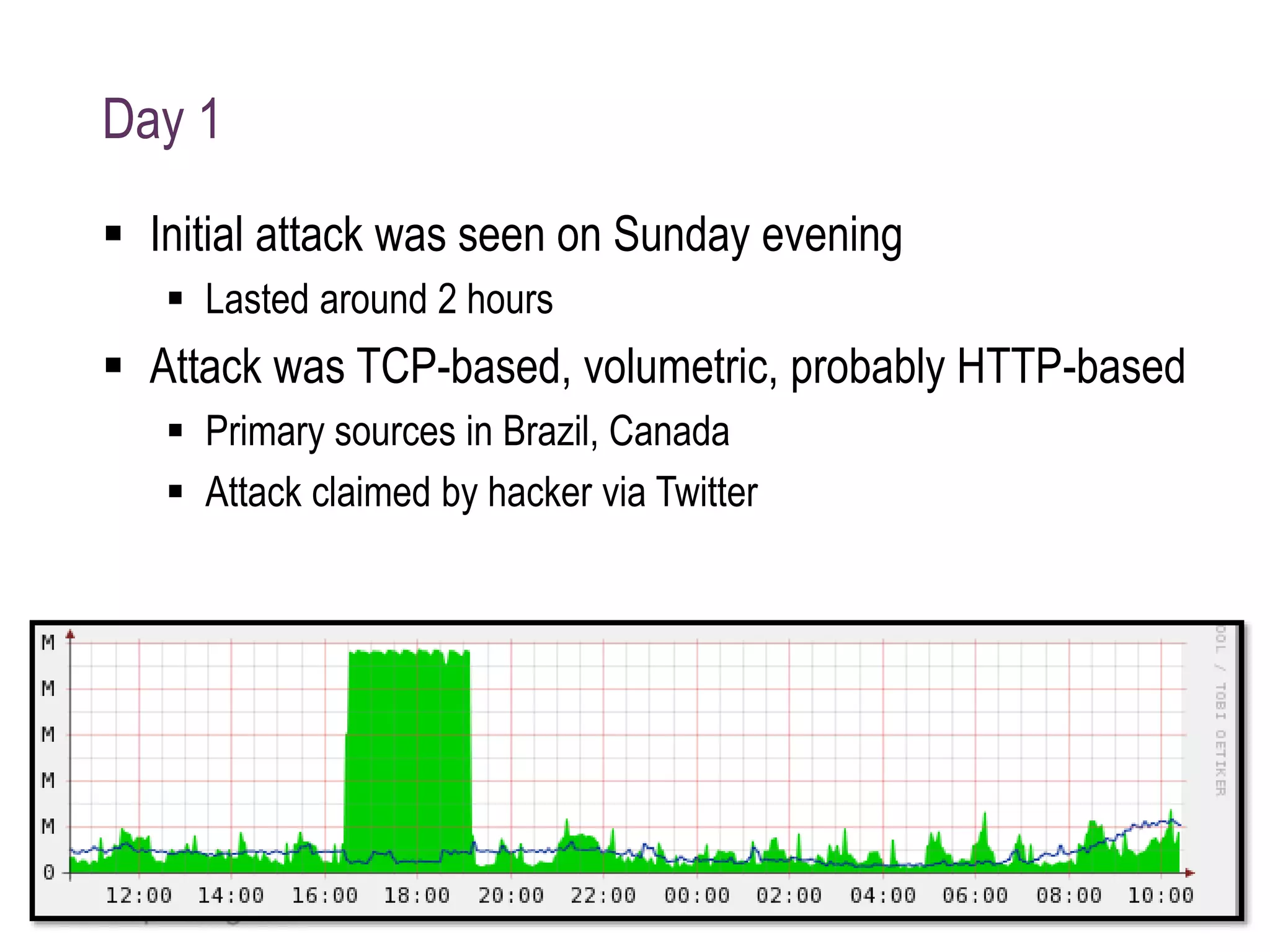
Day 1
 Initial attack was seen on Sunday evening
 Lasted around 2 hours
 Attack was TCP-based, volumetric, probably HTTP-based
 Primary sources in Brazil, Canada
 Attack claimed by hacker via Twitter
Day 2
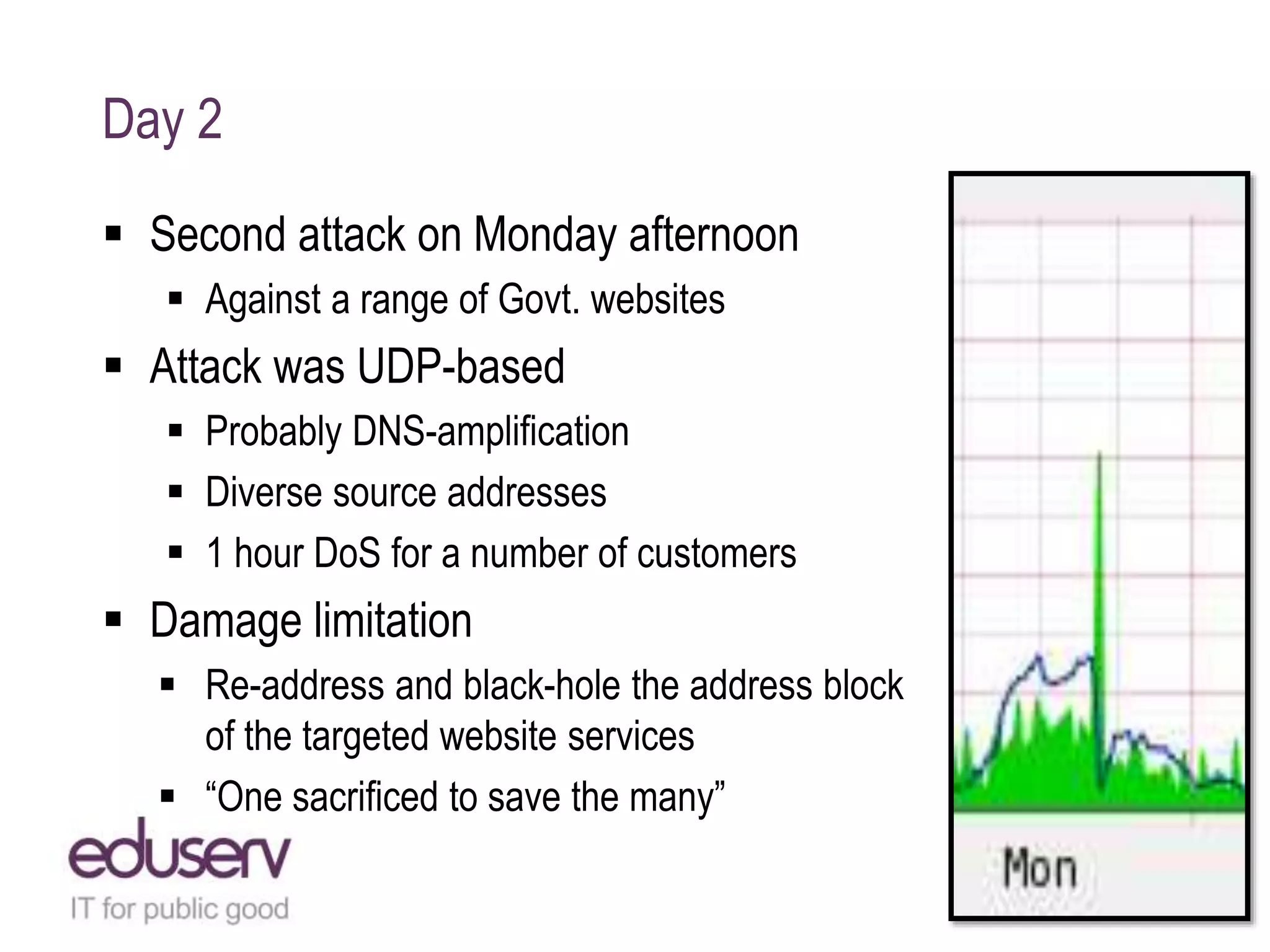
 Second attack on Monday afternoon
 Against a range of Govt. websites
 Attack was UDP-based
 Probably DNS-amplification
 Diverse source addresses
 1 hour DoS for a number of customers
 Damage limitation
 Re-address and black-hole the address block
of the targeted website services
 “One sacrificed to save the many”
Day 3
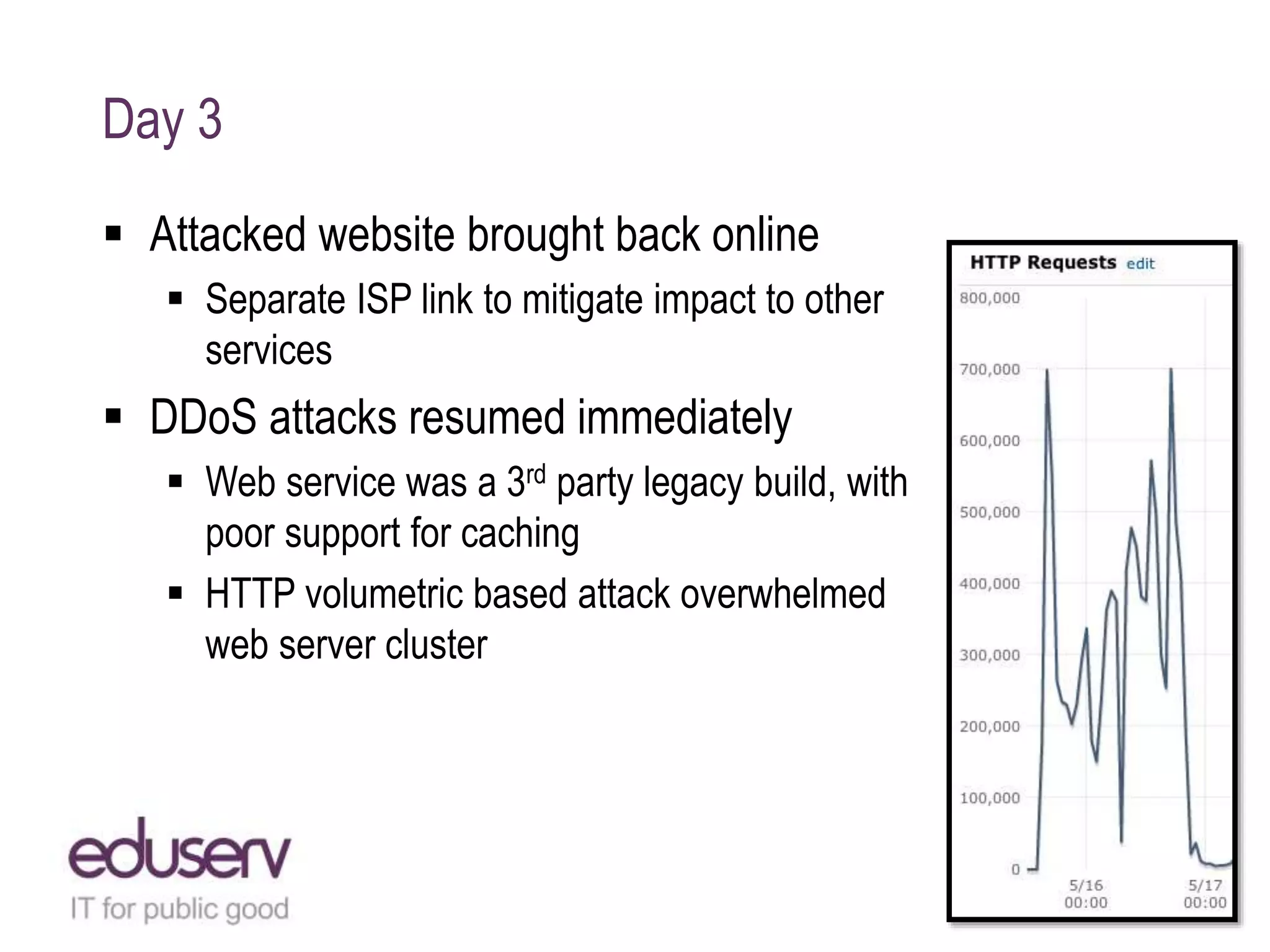
 Attacked website brought back online
 Separate ISP link to mitigate impact to other
services
 DDoS attacks resumed immediately
 Web service was a 3rd party legacy build, with
poor support for caching
 HTTP volumetric based attack overwhelmed
web server cluster
Attack Methods
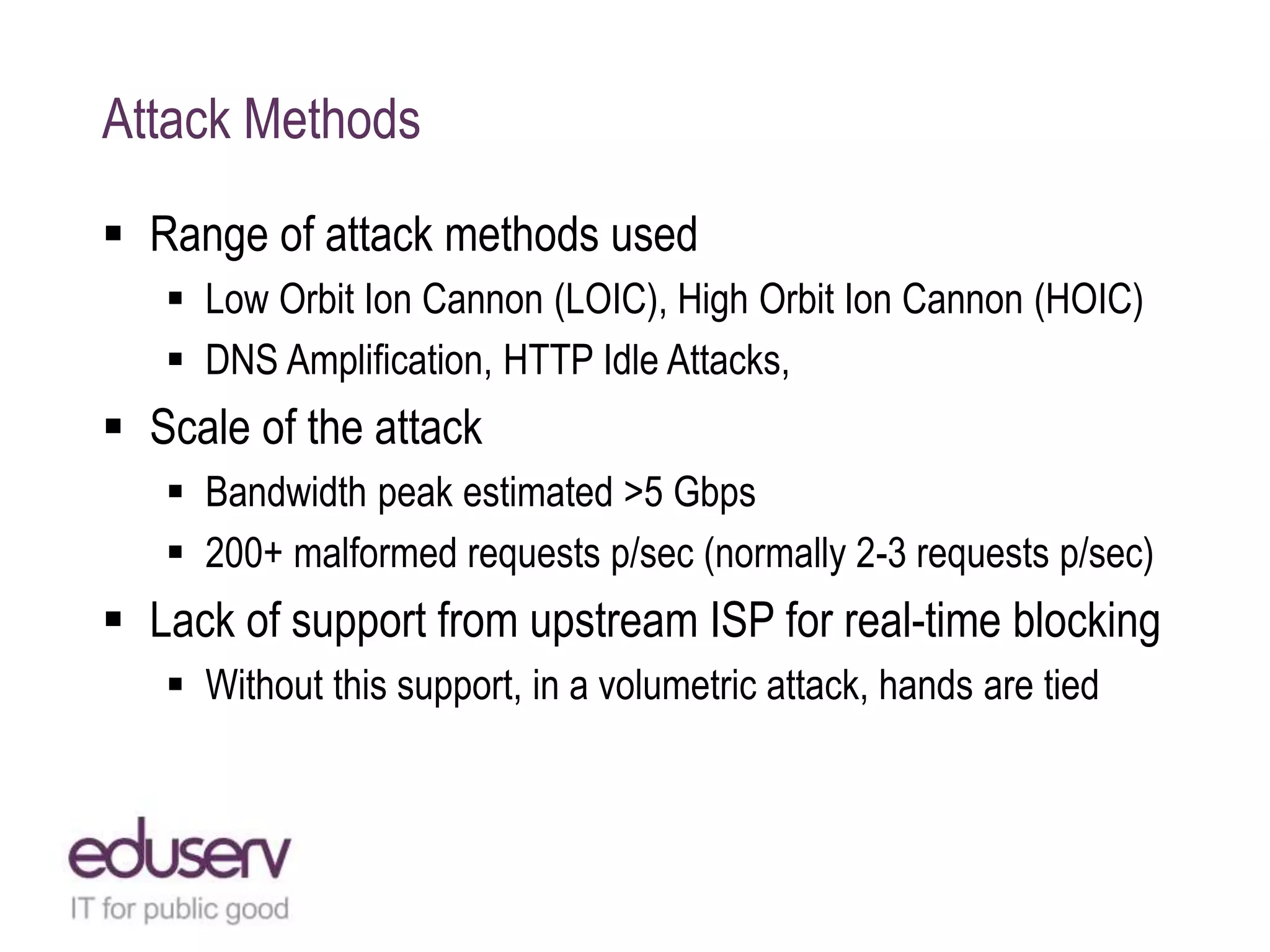
 Range of attack methods used
 Low Orbit Ion Cannon (LOIC), High Orbit Ion Cannon (HOIC)
 DNS Amplification, HTTP Idle Attacks,
 Scale of the attack
 Bandwidth peak estimated >5 Gbps
 200+ malformed requests p/sec (normally 2-3 requests p/sec)
 Lack of support from upstream ISP for real-time blocking
 Without this support, in a volumetric attack, hands are tied
Social Media
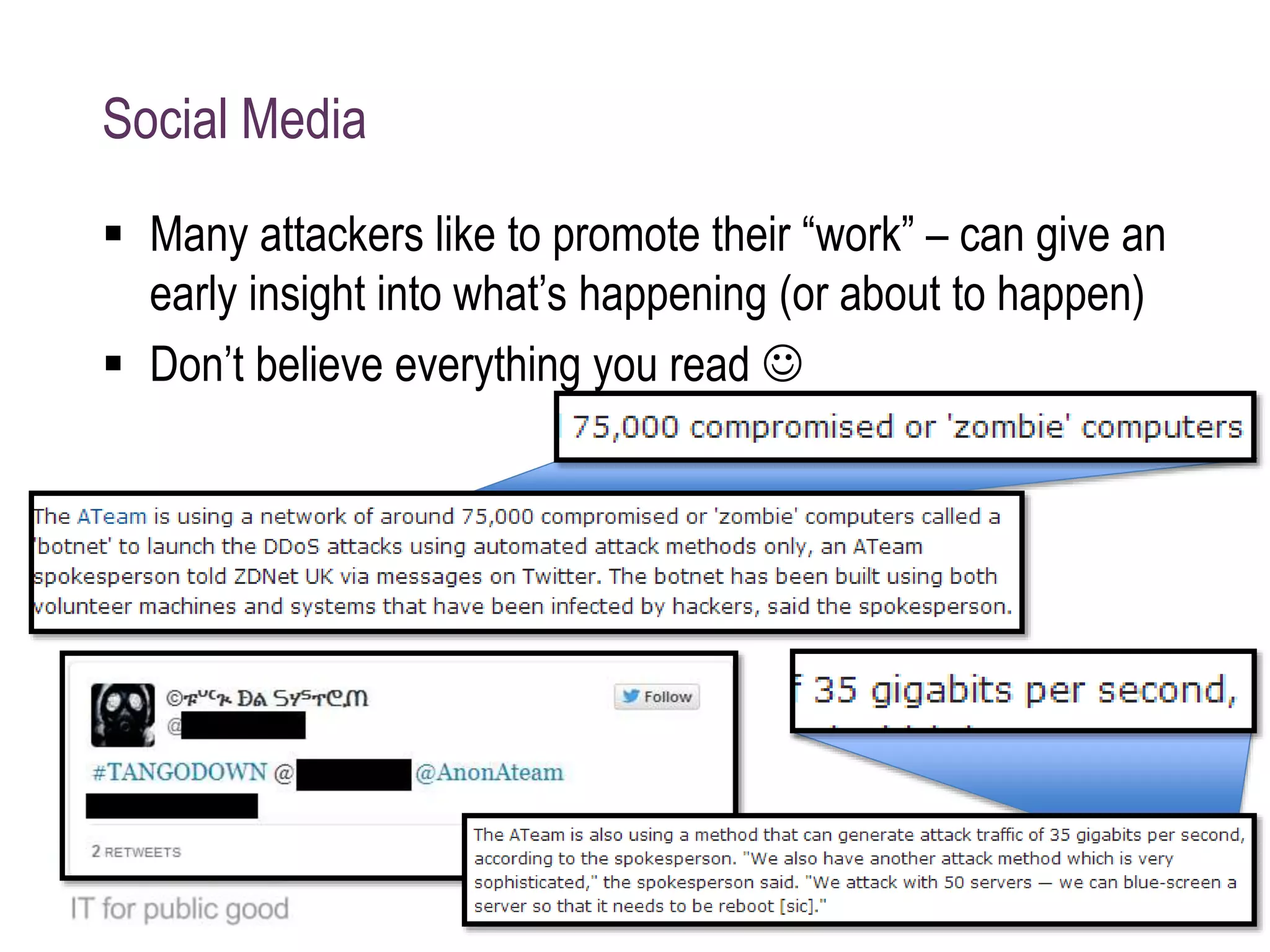
 Many attackers like to promote their “work” – can give an
early insight into what’s happening (or about to happen)
 Don’t believe everything you read 
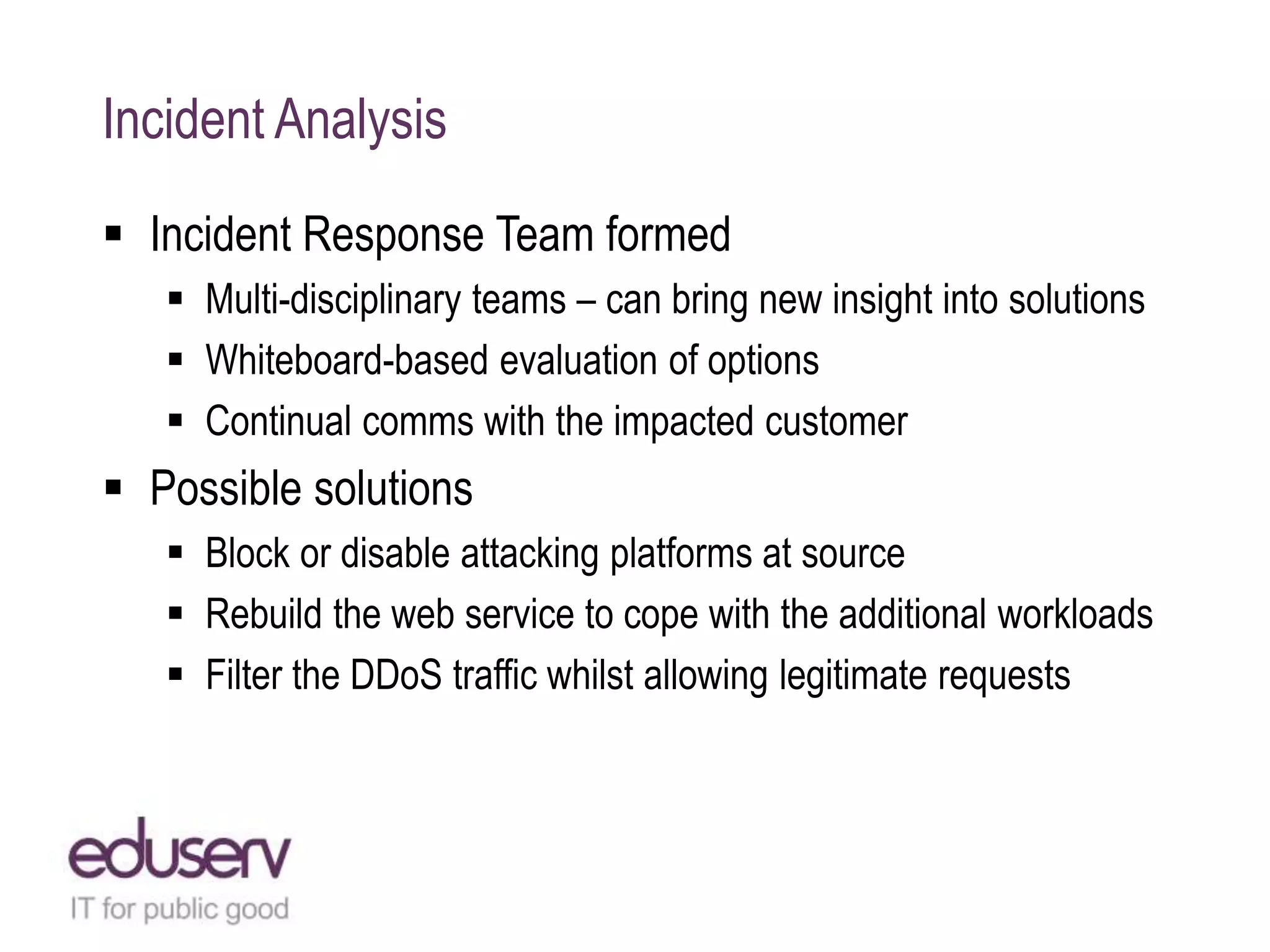
Incident Analysis
 Incident Response Team formed
 Multi-disciplinary teams – can bring new insight into solutions
 Whiteboard-based evaluation of options
 Continual comms with the impacted customer
 Possible solutions
 Block or disable attacking platforms at source
 Rebuild the web service to cope with the additional workloads
 Filter the DDoS traffic whilst allowing legitimate requests
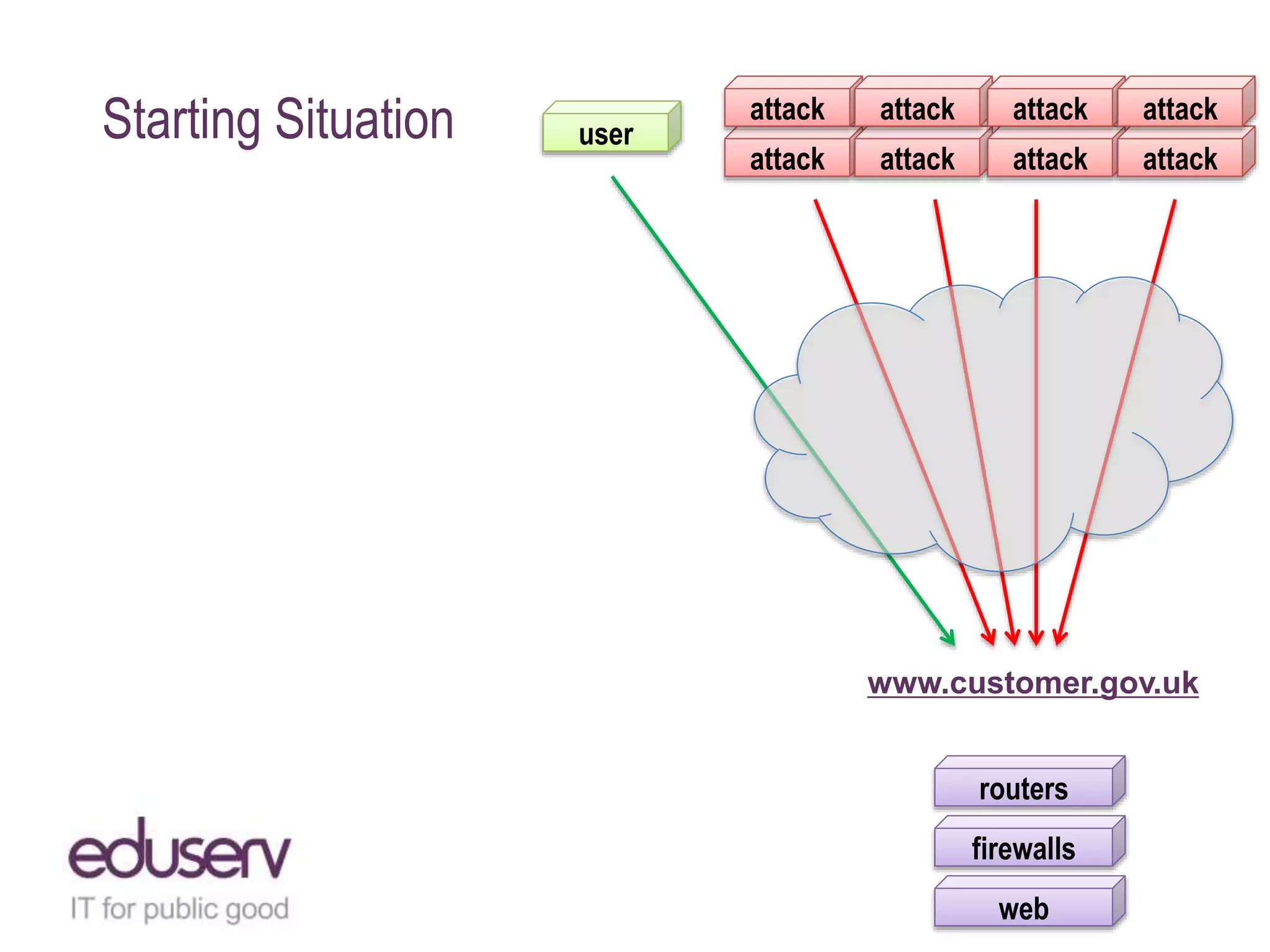
Starting Situation
attack attack attack attack
web
firewalls
routers
www.customer.gov.uk
user
www.customer.gov.uk
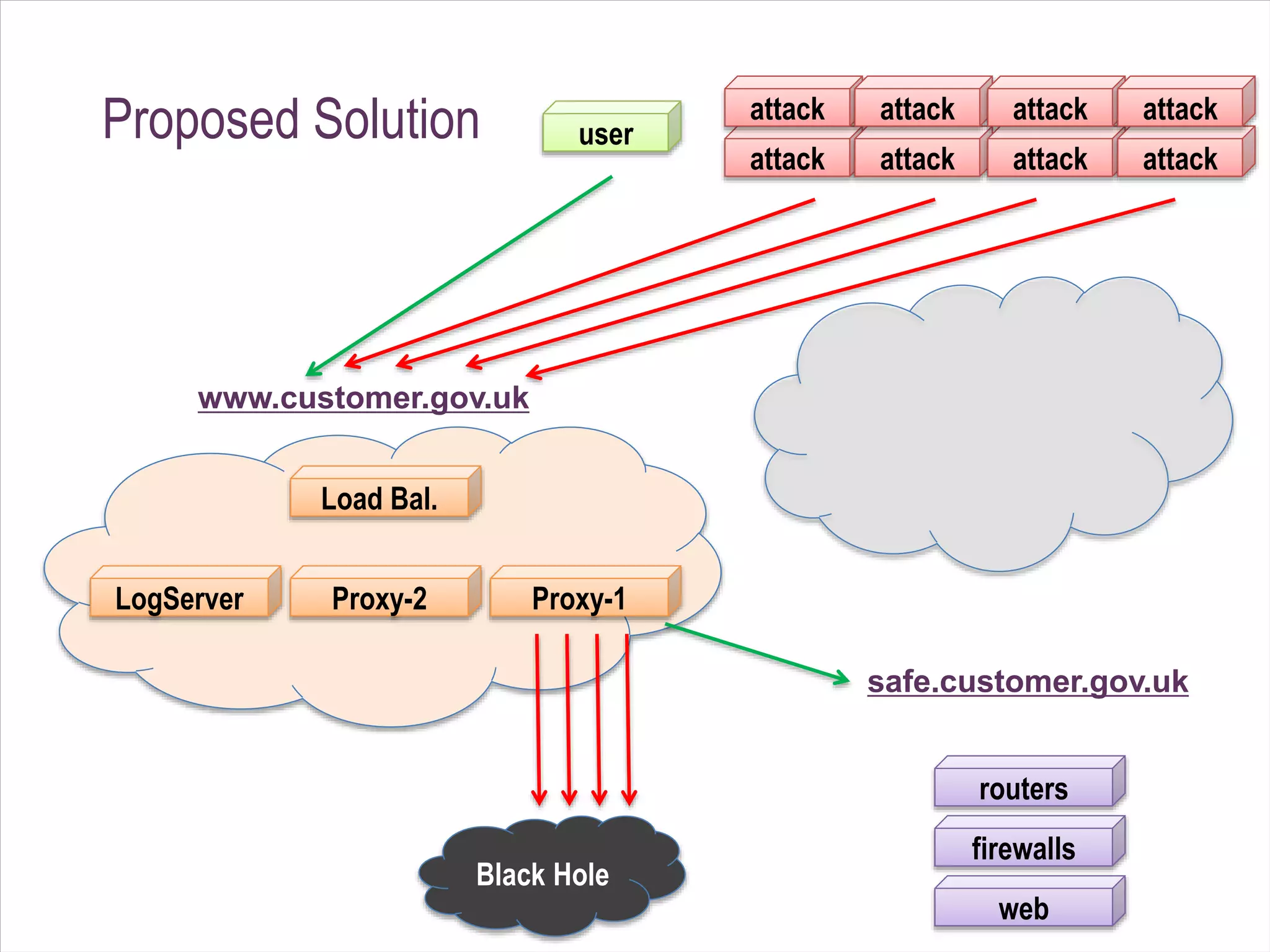
Proposed Solution
web
firewalls
routers
Proxy-2LogServer
Load Bal.
Proxy-1
attack attack attack attack
safe.customer.gov.uk
user
Black Hole
www.customer.gov.uk
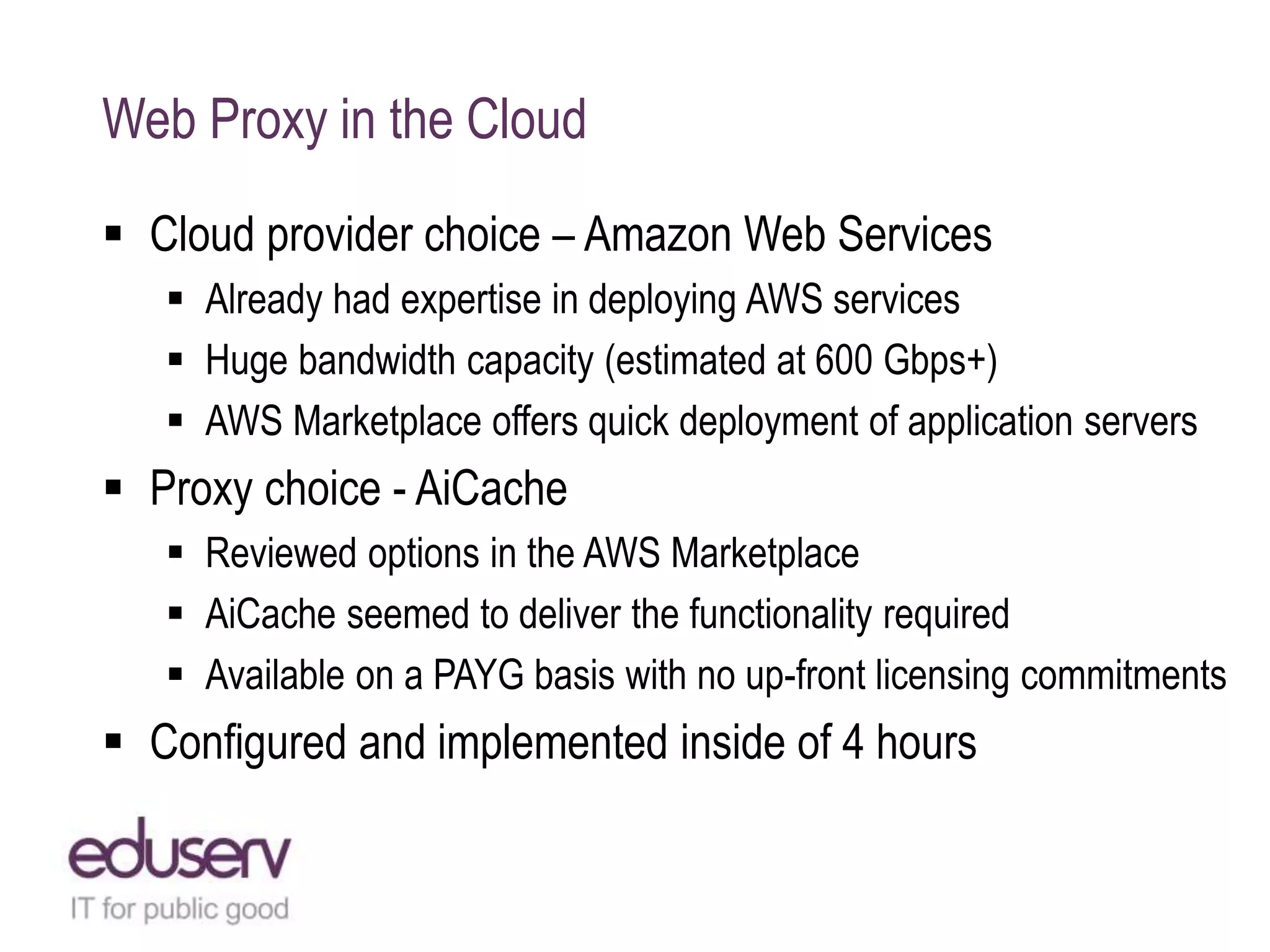
Web Proxy in the Cloud
 Cloud provider choice – Amazon Web Services
 Already had expertise in deploying AWS services
 Huge bandwidth capacity (estimated at 600 Gbps+)
 AWS Marketplace offers quick deployment of application servers
 Proxy choice - AiCache
 Reviewed options in the AWS Marketplace
 AiCache seemed to deliver the functionality required
 Available on a PAYG basis with no up-front licensing commitments
 Configured and implemented inside of 4 hours
Enabling DDoS protection
Total HTTP
requests
Valid HTTP
requests
Bad HTTP
requests
DDoS
protection
enabled
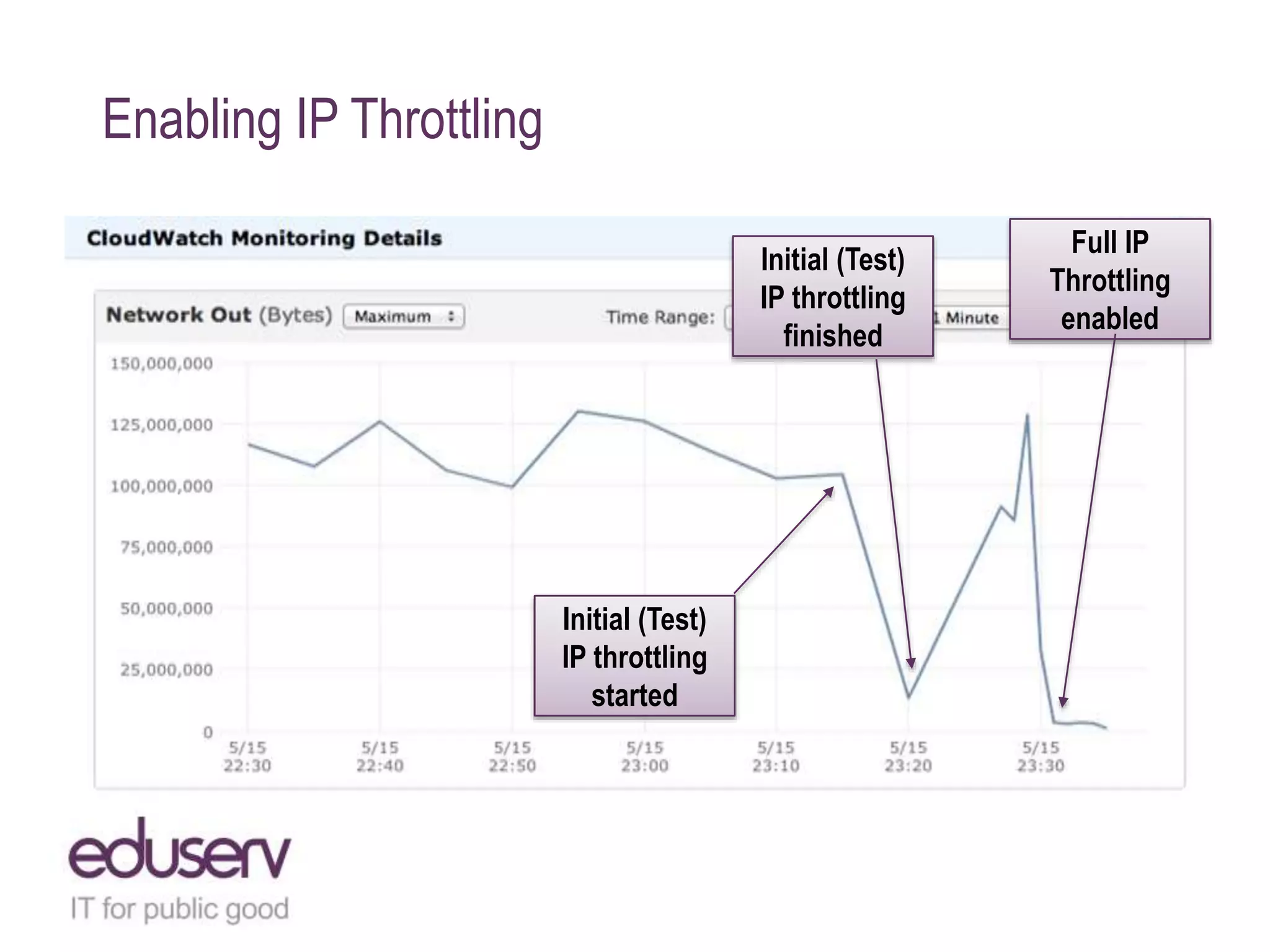
Enabling IP Throttling
Initial (Test)
IP throttling
started
Initial (Test)
IP throttling
finished
Full IP
Throttling
enabled
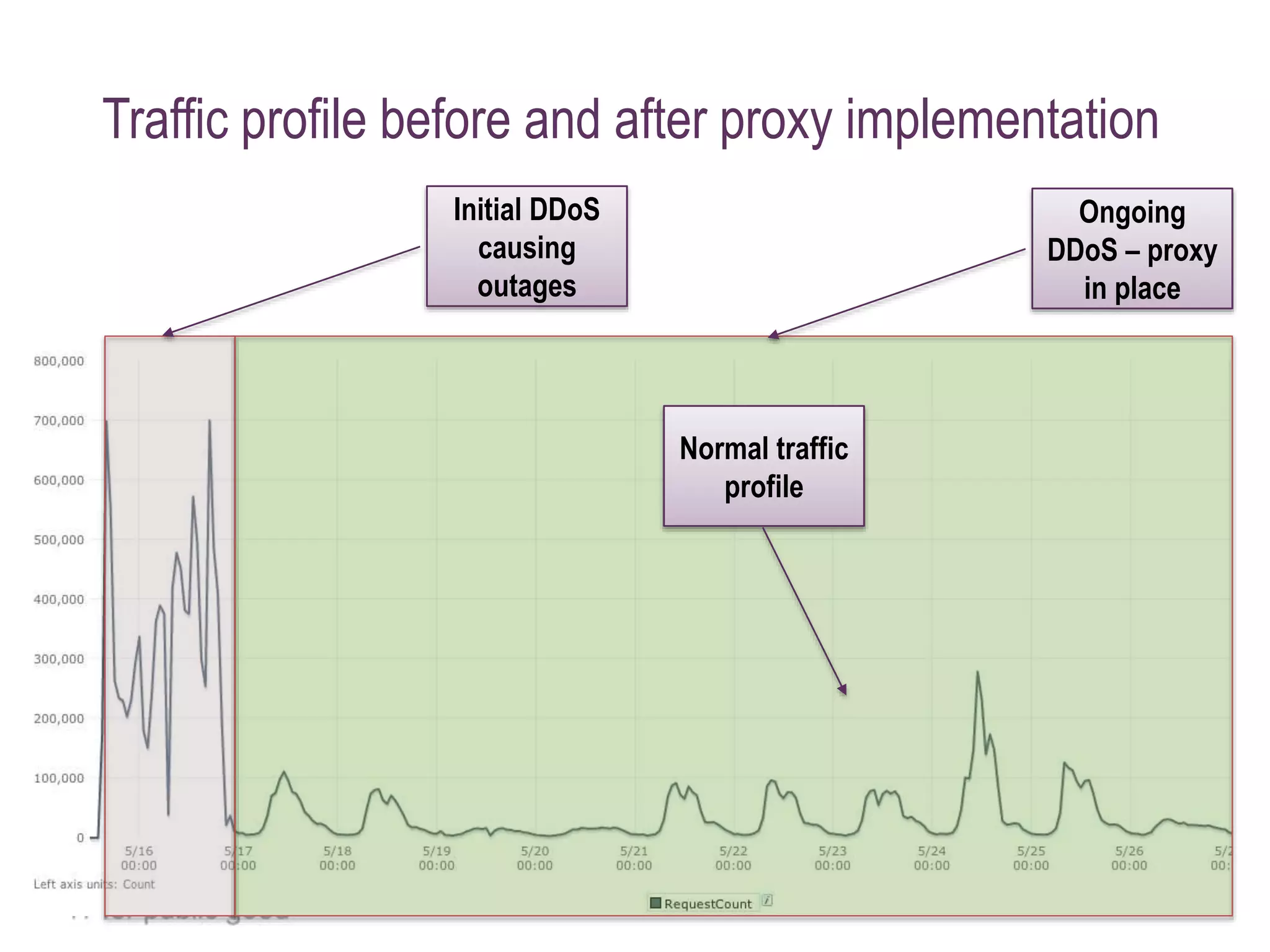
Traffic profile before and after proxy implementation
Initial DDoS
causing
outages
Ongoing
DDoS – proxy
in place
Normal traffic
profile
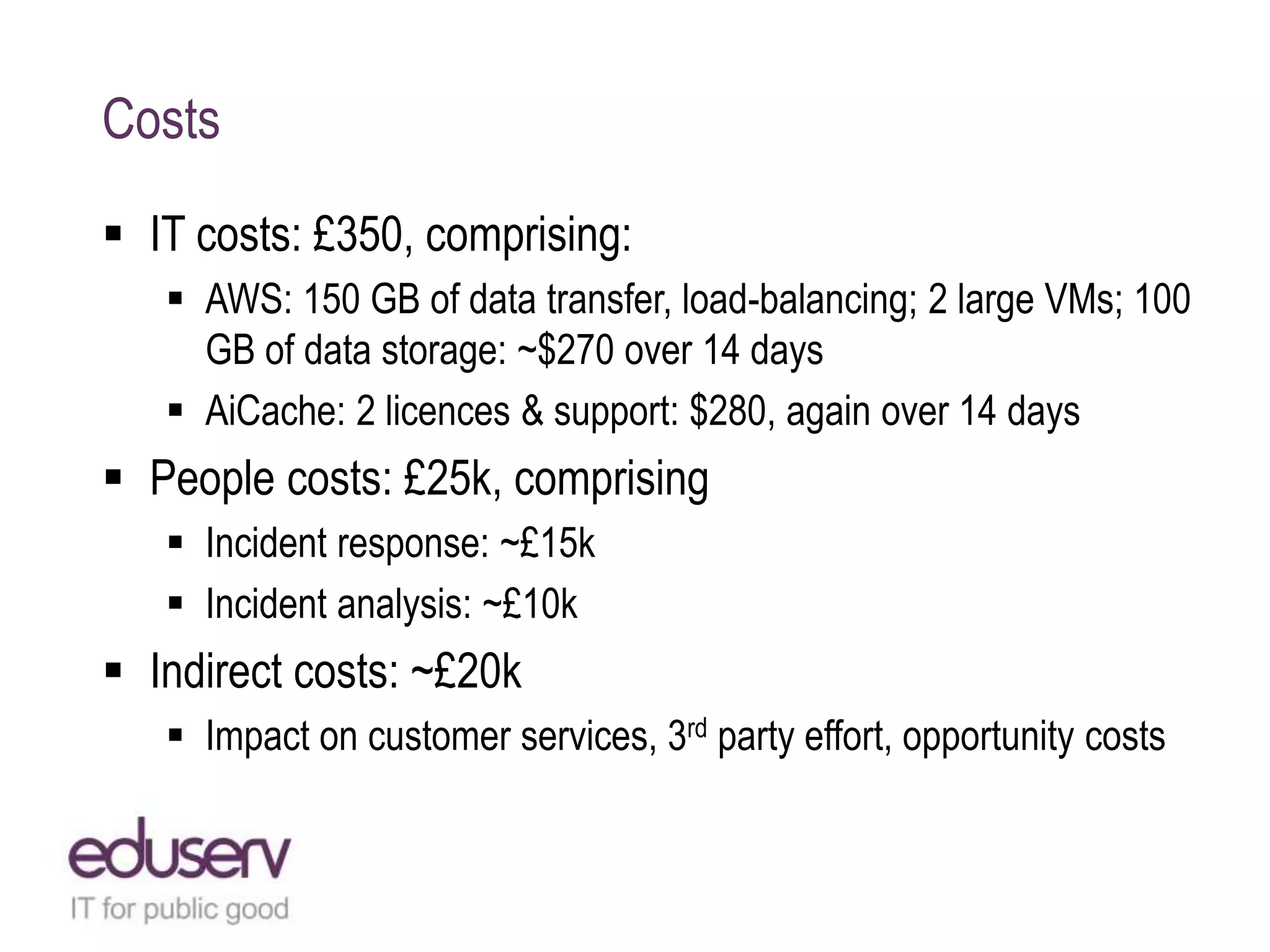
Costs
 IT costs: £350, comprising:
 AWS: 150 GB of data transfer, load-balancing; 2 large VMs; 100
GB of data storage: ~$270 over 14 days
 AiCache: 2 licences & support: $280, again over 14 days
 People costs: £25k, comprising
 Incident response: ~£15k
 Incident analysis: ~£10k
 Indirect costs: ~£20k
 Impact on customer services, 3rd party effort, opportunity costs
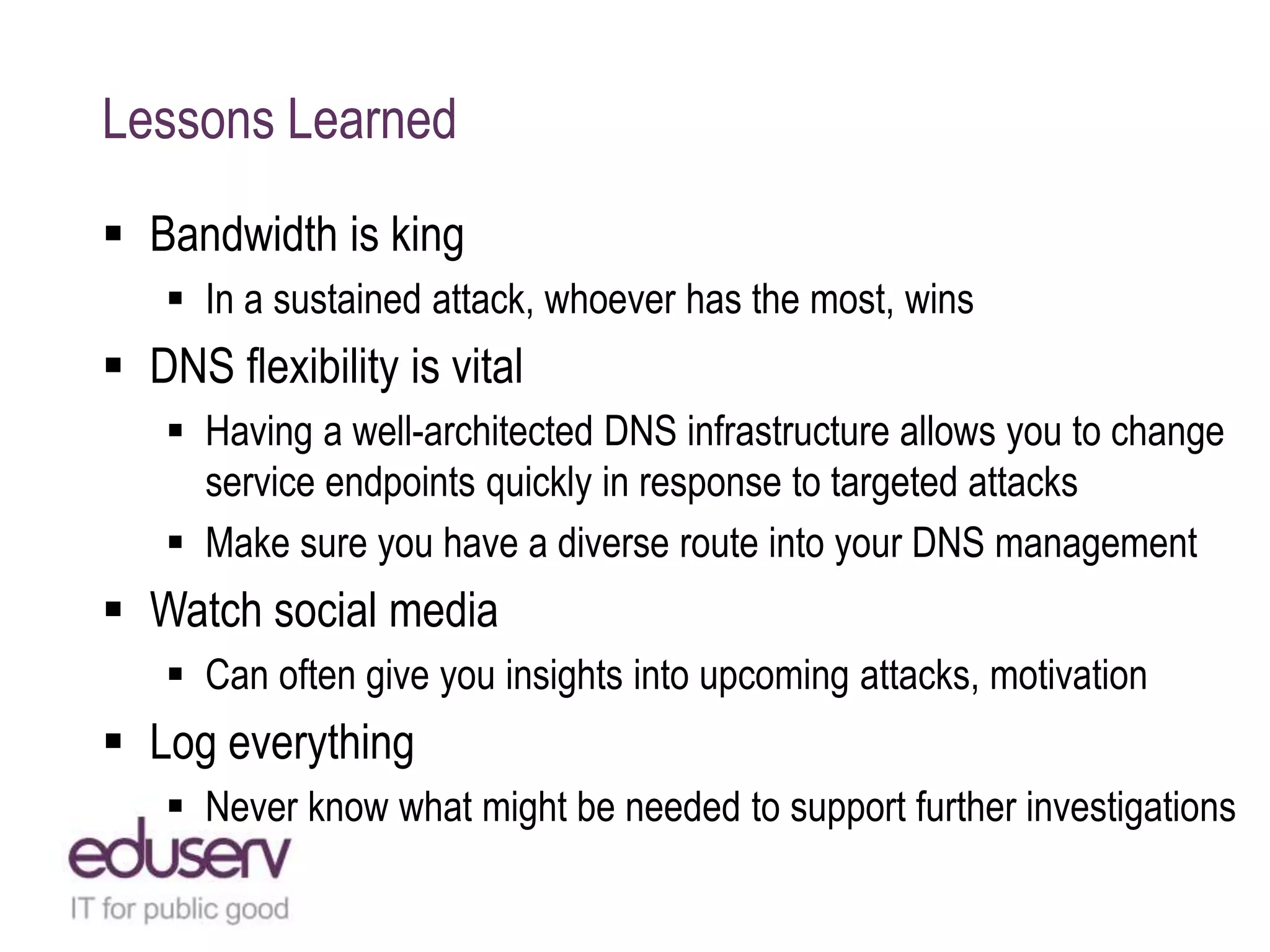
Lessons Learned
 Bandwidth is king
 In a sustained attack, whoever has the most, wins
 DNS flexibility is vital
 Having a well-architected DNS infrastructure allows you to change
service endpoints quickly in response to targeted attacks
 Make sure you have a diverse route into your DNS management
 Watch social media
 Can often give you insights into upcoming attacks, motivation
 Log everything
 Never know what might be needed to support further investigations
AWS Learning
 Amazon CloudWatch
 Useful near-real time insight into DDoS traffic (via ELB metrics)
 Provided evidence for the criminal investigation
 Only stores data for 2 weeks – grab the data whilst you can
 Needed to write custom CLI/API scripts to extract CloudWatch data
 Really could do with a built-in data export capability!
 AWS Elastic Load Balancer
 Partially mitigated some of the DDoS attack vectors
 Supports X-Forwarded-For (XFF) header to track originating IPs
AWS Learning
 EC2 capabilities
 AWS offers an incredibly easy way to tap into huge data pipes
 Incoming bandwidth is free… useful in DDoS situations
 Route53 is great!
 Supports simple mapping of Zone Apex to ELB target
 Geo-distributed endpoints make it incredibly quick and reliable
 Amazon Marketplace
 Great source of pre-configured AWS-ready services
 Use it!
Thank you! Questions?
 Matt Johnson
 Matt.Johnson@eduserv.org.uk
 @mhj_work
 www.eduserv.org.uk
 www.slideshare.net/eduserv

Surviving a DDOS Attack

  • 1.
    www.eduserv.org.uk Surviving a DDoSAttack Matt Johnson, Head of Research, Eduserv January 2015
  • 2.
    Agenda  Background  Diaryof the DDoS  Attack profiles & social media  Analysis and solution overview  Costs  Lessons learned  Q&A
  • 3.
    Background  Eduserv isa registered charity providing IT services to public good organisations  Operates primary services from our Swindon datacentre, secondary and DR services from Slough / London  Providing hosting services since 1996  IT services customer base  20+ customers, across government, health, education and the charity sectors  Some of the government customers are high-profile targets
  • 4.
    Day 1  Initialattack was seen on Sunday evening  Lasted around 2 hours  Attack was TCP-based, volumetric, probably HTTP-based  Primary sources in Brazil, Canada  Attack claimed by hacker via Twitter
  • 5.
    Day 2  Secondattack on Monday afternoon  Against a range of Govt. websites  Attack was UDP-based  Probably DNS-amplification  Diverse source addresses  1 hour DoS for a number of customers  Damage limitation  Re-address and black-hole the address block of the targeted website services  “One sacrificed to save the many”
  • 6.
    Day 3  Attackedwebsite brought back online  Separate ISP link to mitigate impact to other services  DDoS attacks resumed immediately  Web service was a 3rd party legacy build, with poor support for caching  HTTP volumetric based attack overwhelmed web server cluster
  • 7.
    Attack Methods  Rangeof attack methods used  Low Orbit Ion Cannon (LOIC), High Orbit Ion Cannon (HOIC)  DNS Amplification, HTTP Idle Attacks,  Scale of the attack  Bandwidth peak estimated >5 Gbps  200+ malformed requests p/sec (normally 2-3 requests p/sec)  Lack of support from upstream ISP for real-time blocking  Without this support, in a volumetric attack, hands are tied
  • 8.
    Social Media  Manyattackers like to promote their “work” – can give an early insight into what’s happening (or about to happen)  Don’t believe everything you read 
  • 9.
    Incident Analysis  IncidentResponse Team formed  Multi-disciplinary teams – can bring new insight into solutions  Whiteboard-based evaluation of options  Continual comms with the impacted customer  Possible solutions  Block or disable attacking platforms at source  Rebuild the web service to cope with the additional workloads  Filter the DDoS traffic whilst allowing legitimate requests
  • 10.
    Starting Situation attack attackattack attack attack attack attack attack web firewalls routers www.customer.gov.uk user
  • 11.
    www.customer.gov.uk Proposed Solution web firewalls routers Proxy-2LogServer Load Bal. Proxy-1 attackattack attack attack attack attack attack attack safe.customer.gov.uk user Black Hole www.customer.gov.uk
  • 12.
    Web Proxy inthe Cloud  Cloud provider choice – Amazon Web Services  Already had expertise in deploying AWS services  Huge bandwidth capacity (estimated at 600 Gbps+)  AWS Marketplace offers quick deployment of application servers  Proxy choice - AiCache  Reviewed options in the AWS Marketplace  AiCache seemed to deliver the functionality required  Available on a PAYG basis with no up-front licensing commitments  Configured and implemented inside of 4 hours
  • 13.
    Enabling DDoS protection TotalHTTP requests Valid HTTP requests Bad HTTP requests DDoS protection enabled
  • 14.
    Enabling IP Throttling Initial(Test) IP throttling started Initial (Test) IP throttling finished Full IP Throttling enabled
  • 15.
    Traffic profile beforeand after proxy implementation Initial DDoS causing outages Ongoing DDoS – proxy in place Normal traffic profile
  • 16.
    Costs  IT costs:£350, comprising:  AWS: 150 GB of data transfer, load-balancing; 2 large VMs; 100 GB of data storage: ~$270 over 14 days  AiCache: 2 licences & support: $280, again over 14 days  People costs: £25k, comprising  Incident response: ~£15k  Incident analysis: ~£10k  Indirect costs: ~£20k  Impact on customer services, 3rd party effort, opportunity costs
  • 17.
    Lessons Learned  Bandwidthis king  In a sustained attack, whoever has the most, wins  DNS flexibility is vital  Having a well-architected DNS infrastructure allows you to change service endpoints quickly in response to targeted attacks  Make sure you have a diverse route into your DNS management  Watch social media  Can often give you insights into upcoming attacks, motivation  Log everything  Never know what might be needed to support further investigations
  • 18.
    AWS Learning  AmazonCloudWatch  Useful near-real time insight into DDoS traffic (via ELB metrics)  Provided evidence for the criminal investigation  Only stores data for 2 weeks – grab the data whilst you can  Needed to write custom CLI/API scripts to extract CloudWatch data  Really could do with a built-in data export capability!  AWS Elastic Load Balancer  Partially mitigated some of the DDoS attack vectors  Supports X-Forwarded-For (XFF) header to track originating IPs
  • 19.
    AWS Learning  EC2capabilities  AWS offers an incredibly easy way to tap into huge data pipes  Incoming bandwidth is free… useful in DDoS situations  Route53 is great!  Supports simple mapping of Zone Apex to ELB target  Geo-distributed endpoints make it incredibly quick and reliable  Amazon Marketplace  Great source of pre-configured AWS-ready services  Use it!
  • 20.
    Thank you! Questions? Matt Johnson  Matt.Johnson@eduserv.org.uk  @mhj_work  www.eduserv.org.uk  www.slideshare.net/eduserv