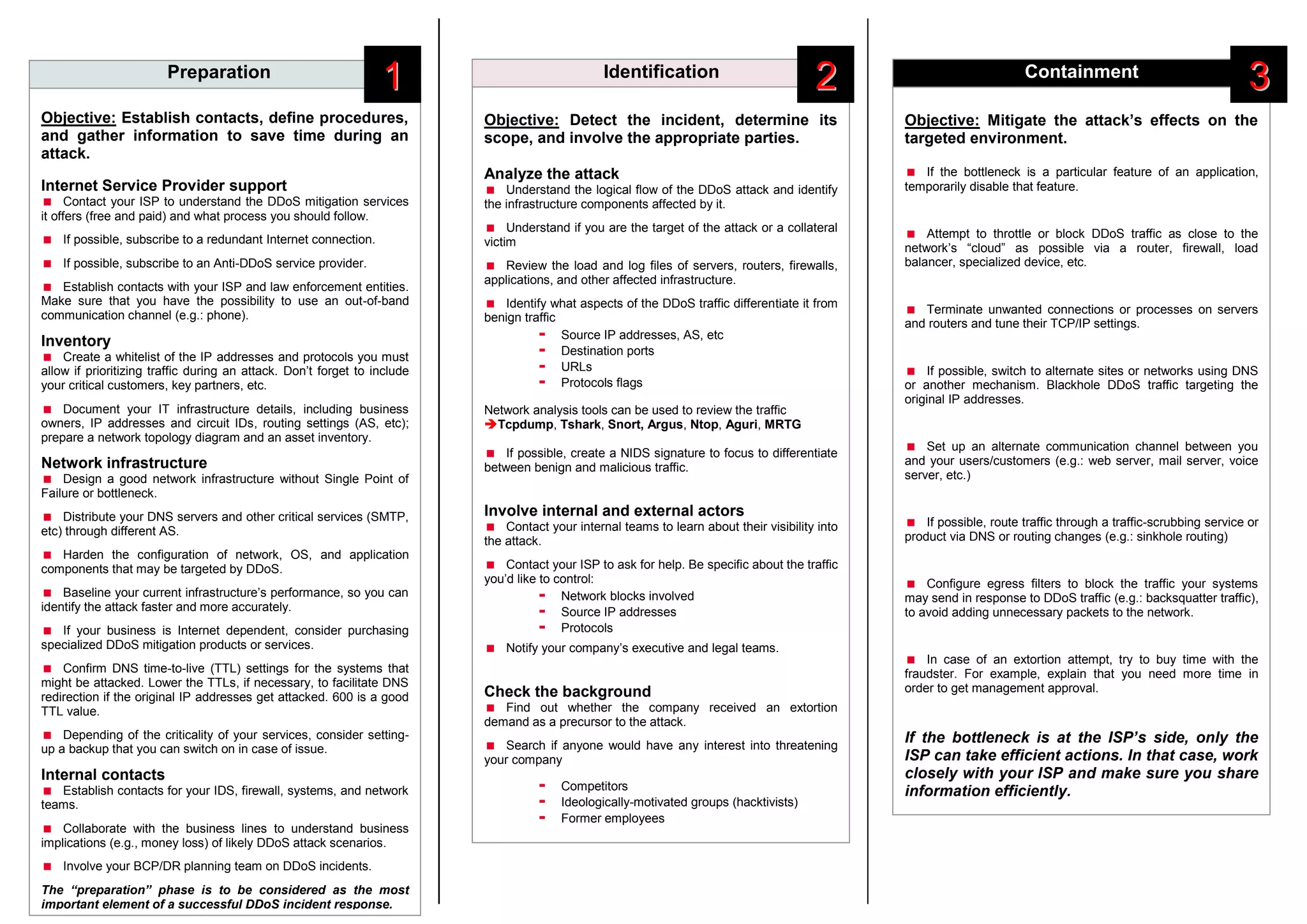
Preparation Identification Containment
Objective: Establish contacts, define procedures,
and gather information to save time during an
attack.
Internet Service Provider support
 Contact your ISP to understand the DDoS mitigation services
it offers (free and paid) and what process you should follow.
 If possible, subscribe to a redundant Internet connection.
 If possible, subscribe to an Anti-DDoS service provider.
 Establish contacts with your ISP and law enforcement entities.
Make sure that you have the possibility to use an out-of-band
communication channel (e.g.: phone).
Inventory
 Create a whitelist of the IP addresses and protocols you must
allow if prioritizing traffic during an attack. Don’t forget to include
your critical customers, key partners, etc.
 Document your IT infrastructure details, including business
owners, IP addresses and circuit IDs, routing settings (AS, etc);
prepare a network topology diagram and an asset inventory.
Network infrastructure
 Design a good network infrastructure without Single Point of
Failure or bottleneck.
 Distribute your DNS servers and other critical services (SMTP,
etc) through different AS.
 Harden the configuration of network, OS, and application
components that may be targeted by DDoS.
 Baseline your current infrastructure’s performance, so you can
identify the attack faster and more accurately.
 If your business is Internet dependent, consider purchasing
specialized DDoS mitigation products or services.
 Confirm DNS time-to-live (TTL) settings for the systems that
might be attacked. Lower the TTLs, if necessary, to facilitate DNS
redirection if the original IP addresses get attacked. 600 is a good
TTL value.
 Depending of the criticality of your services, consider setting-
up a backup that you can switch on in case of issue.
Internal contacts
 Establish contacts for your IDS, firewall, systems, and network
teams.
 Collaborate with the business lines to understand business
implications (e.g., money loss) of likely DDoS attack scenarios.
 Involve your BCP/DR planning team on DDoS incidents.
The “preparation” phase is to be considered as the most
important element of a successful DDoS incident response.
Objective: Detect the incident, determine its
scope, and involve the appropriate parties.
Analyze the attack
 Understand the logical flow of the DDoS attack and identify
the infrastructure components affected by it.
 Understand if you are the target of the attack or a collateral
victim
 Review the load and log files of servers, routers, firewalls,
applications, and other affected infrastructure.
 Identify what aspects of the DDoS traffic differentiate it from
benign traffic
- Source IP addresses, AS, etc
- Destination ports
- URLs
- Protocols flags
Network analysis tools can be used to review the traffic
Tcpdump, Tshark, Snort, Argus, Ntop, Aguri, MRTG
 If possible, create a NIDS signature to focus to differentiate
between benign and malicious traffic.
Involve internal and external actors
 Contact your internal teams to learn about their visibility into
the attack.
 Contact your ISP to ask for help. Be specific about the traffic
you’d like to control:
- Network blocks involved
- Source IP addresses
- Protocols
 Notify your company’s executive and legal teams.
Check the background
 Find out whether the company received an extortion
demand as a precursor to the attack.
 Search if anyone would have any interest into threatening
your company
- Competitors
- Ideologically-motivated groups (hacktivists)
- Former employees
Objective: Mitigate the attack’s effects on the
targeted environment.
 If the bottleneck is a particular feature of an application,
temporarily disable that feature.
 Attempt to throttle or block DDoS traffic as close to the
network’s “cloud” as possible via a router, firewall, load
balancer, specialized device, etc.
 Terminate unwanted connections or processes on servers
and routers and tune their TCP/IP settings.
 If possible, switch to alternate sites or networks using DNS
or another mechanism. Blackhole DDoS traffic targeting the
original IP addresses.
 Set up an alternate communication channel between you
and your users/customers (e.g.: web server, mail server, voice
server, etc.)
 If possible, route traffic through a traffic-scrubbing service or
product via DNS or routing changes (e.g.: sinkhole routing)
 Configure egress filters to block the traffic your systems
may send in response to DDoS traffic (e.g.: backsquatter traffic),
to avoid adding unnecessary packets to the network.
 In case of an extortion attempt, try to buy time with the
fraudster. For example, explain that you need more time in
order to get management approval.
If the bottleneck is at the ISP’s side, only the
ISP can take efficient actions. In that case, work
closely with your ISP and make sure you share
information efficiently.
11 22 33
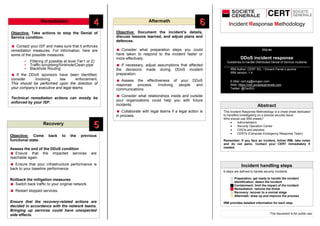
Remediation
Recovery
Aftermath
Incident Response Methodology
IRM #4
DDoS incident response
Guidelines to handle Distributed Denial of Service incidents
___________________________________________________
IRM Author: CERT SG / Vincent Ferran-Lacome
IRM version: 1.4
E-Mail: cert.sg@socgen.com
Web: https://cert.societegenerale.com
Twitter: @CertSG
Abstract
Incident handling steps
Objective: Take actions to stop the Denial of
Service condition.
 Contact your ISP and make sure that it enforces
remediation measures. For information, here are
some of the possible measures:
- Filtering (if possible at level Tier1 or 2)
- Traffic-scrubbing/Sinkhole/Clean-pipe
- Blackhole Routing
 If the DDoS sponsors have been identified,
consider involving law enforcement.
This should be performed upon the direction of
your company’s executive and legal teams.
Technical remediation actions can mostly be
enforced by your ISP.
Objective: Come back to the previous
functional state.
Assess the end of the DDoS condition
 Ensure that the impacted services are
reachable again.
 Ensure that your infrastructure performance is
back to your baseline performance.
Rollback the mitigation measures
 Switch back traffic to your original network.
 Restart stopped services.
Ensure that the recovery-related actions are
decided in accordance with the network teams.
Bringing up services could have unexpected
side effects.
Objective: Document the incident’s details,
discuss lessons learned, and adjust plans and
defences.
 Consider what preparation steps you could
have taken to respond to the incident faster or
more effectively.
 If necessary, adjust assumptions that affected
the decisions made during DDoS incident
preparation.
 Assess the effectiveness of your DDoS
response process, involving people and
communications.
 Consider what relationships inside and outside
your organizations could help you with future
incidents.
 Collaborate with legal teams if a legal action is
in process.
This Incident Response Methodology is a cheat sheet dedicated
to handlers investigating on a precise security issue.
Who should use IRM sheets?
 Administrators
 Security Operation Center
 CISOs and deputies
 CERTs (Computer Emergency Response Team)
Remember: If you face an incident, follow IRM, take notes
and do not panic. Contact your CERT immediately if
needed.
6 steps are defined to handle security Incidents
 Preparation: get ready to handle the incident
 Identification: detect the incident
 Containment: limit the impact of the incident
 Remediation: remove the threat
 Recovery: recover to a normal stage
 Aftermath: draw up and improve the process
IRM provides detailed information for each step.
This document is for public use
44
55
66

Irm 4-ddos

  • 1.
    Preparation Identification Containment Objective:Establish contacts, define procedures, and gather information to save time during an attack. Internet Service Provider support  Contact your ISP to understand the DDoS mitigation services it offers (free and paid) and what process you should follow.  If possible, subscribe to a redundant Internet connection.  If possible, subscribe to an Anti-DDoS service provider.  Establish contacts with your ISP and law enforcement entities. Make sure that you have the possibility to use an out-of-band communication channel (e.g.: phone). Inventory  Create a whitelist of the IP addresses and protocols you must allow if prioritizing traffic during an attack. Don’t forget to include your critical customers, key partners, etc.  Document your IT infrastructure details, including business owners, IP addresses and circuit IDs, routing settings (AS, etc); prepare a network topology diagram and an asset inventory. Network infrastructure  Design a good network infrastructure without Single Point of Failure or bottleneck.  Distribute your DNS servers and other critical services (SMTP, etc) through different AS.  Harden the configuration of network, OS, and application components that may be targeted by DDoS.  Baseline your current infrastructure’s performance, so you can identify the attack faster and more accurately.  If your business is Internet dependent, consider purchasing specialized DDoS mitigation products or services.  Confirm DNS time-to-live (TTL) settings for the systems that might be attacked. Lower the TTLs, if necessary, to facilitate DNS redirection if the original IP addresses get attacked. 600 is a good TTL value.  Depending of the criticality of your services, consider setting- up a backup that you can switch on in case of issue. Internal contacts  Establish contacts for your IDS, firewall, systems, and network teams.  Collaborate with the business lines to understand business implications (e.g., money loss) of likely DDoS attack scenarios.  Involve your BCP/DR planning team on DDoS incidents. The “preparation” phase is to be considered as the most important element of a successful DDoS incident response. Objective: Detect the incident, determine its scope, and involve the appropriate parties. Analyze the attack  Understand the logical flow of the DDoS attack and identify the infrastructure components affected by it.  Understand if you are the target of the attack or a collateral victim  Review the load and log files of servers, routers, firewalls, applications, and other affected infrastructure.  Identify what aspects of the DDoS traffic differentiate it from benign traffic - Source IP addresses, AS, etc - Destination ports - URLs - Protocols flags Network analysis tools can be used to review the traffic Tcpdump, Tshark, Snort, Argus, Ntop, Aguri, MRTG  If possible, create a NIDS signature to focus to differentiate between benign and malicious traffic. Involve internal and external actors  Contact your internal teams to learn about their visibility into the attack.  Contact your ISP to ask for help. Be specific about the traffic you’d like to control: - Network blocks involved - Source IP addresses - Protocols  Notify your company’s executive and legal teams. Check the background  Find out whether the company received an extortion demand as a precursor to the attack.  Search if anyone would have any interest into threatening your company - Competitors - Ideologically-motivated groups (hacktivists) - Former employees Objective: Mitigate the attack’s effects on the targeted environment.  If the bottleneck is a particular feature of an application, temporarily disable that feature.  Attempt to throttle or block DDoS traffic as close to the network’s “cloud” as possible via a router, firewall, load balancer, specialized device, etc.  Terminate unwanted connections or processes on servers and routers and tune their TCP/IP settings.  If possible, switch to alternate sites or networks using DNS or another mechanism. Blackhole DDoS traffic targeting the original IP addresses.  Set up an alternate communication channel between you and your users/customers (e.g.: web server, mail server, voice server, etc.)  If possible, route traffic through a traffic-scrubbing service or product via DNS or routing changes (e.g.: sinkhole routing)  Configure egress filters to block the traffic your systems may send in response to DDoS traffic (e.g.: backsquatter traffic), to avoid adding unnecessary packets to the network.  In case of an extortion attempt, try to buy time with the fraudster. For example, explain that you need more time in order to get management approval. If the bottleneck is at the ISP’s side, only the ISP can take efficient actions. In that case, work closely with your ISP and make sure you share information efficiently. 11 22 33
  • 2.
    Remediation Recovery Aftermath Incident Response Methodology IRM#4 DDoS incident response Guidelines to handle Distributed Denial of Service incidents ___________________________________________________ IRM Author: CERT SG / Vincent Ferran-Lacome IRM version: 1.4 E-Mail: cert.sg@socgen.com Web: https://cert.societegenerale.com Twitter: @CertSG Abstract Incident handling steps Objective: Take actions to stop the Denial of Service condition.  Contact your ISP and make sure that it enforces remediation measures. For information, here are some of the possible measures: - Filtering (if possible at level Tier1 or 2) - Traffic-scrubbing/Sinkhole/Clean-pipe - Blackhole Routing  If the DDoS sponsors have been identified, consider involving law enforcement. This should be performed upon the direction of your company’s executive and legal teams. Technical remediation actions can mostly be enforced by your ISP. Objective: Come back to the previous functional state. Assess the end of the DDoS condition  Ensure that the impacted services are reachable again.  Ensure that your infrastructure performance is back to your baseline performance. Rollback the mitigation measures  Switch back traffic to your original network.  Restart stopped services. Ensure that the recovery-related actions are decided in accordance with the network teams. Bringing up services could have unexpected side effects. Objective: Document the incident’s details, discuss lessons learned, and adjust plans and defences.  Consider what preparation steps you could have taken to respond to the incident faster or more effectively.  If necessary, adjust assumptions that affected the decisions made during DDoS incident preparation.  Assess the effectiveness of your DDoS response process, involving people and communications.  Consider what relationships inside and outside your organizations could help you with future incidents.  Collaborate with legal teams if a legal action is in process. This Incident Response Methodology is a cheat sheet dedicated to handlers investigating on a precise security issue. Who should use IRM sheets?  Administrators  Security Operation Center  CISOs and deputies  CERTs (Computer Emergency Response Team) Remember: If you face an incident, follow IRM, take notes and do not panic. Contact your CERT immediately if needed. 6 steps are defined to handle security Incidents  Preparation: get ready to handle the incident  Identification: detect the incident  Containment: limit the impact of the incident  Remediation: remove the threat  Recovery: recover to a normal stage  Aftermath: draw up and improve the process IRM provides detailed information for each step. This document is for public use 44 55 66