NAGPUR INSTITUTE OF TECHNOLOGY
GUIDED BY :-
MISS.RAJASHREE TALATULE
NIT POLYTECHNIC
MICRO PROJECT OF ELECTRONICS
MEASUREMENTS & INSTRUMENTATION
Presented By :-
Ashish Sadavarti
SURVEY OF
DIFFERENT
ELECTRONICS
INSTRUMENTS
CONTENT
• Voltmeter
• Ohmmeter
• Ammeter
• Multimeter
• CRO (Cathode Ray Oscilloscope)
VOLTMETER
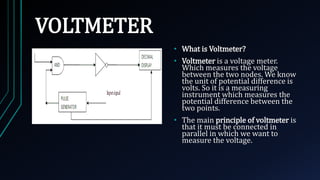
• What is Voltmeter?
• Voltmeter is a voltage meter.
Which measures the voltage
between the two nodes. We know
the unit of potential difference is
volts. So it is a measuring
instrument which measures the
potential difference between the
two points.
• The main principle of voltmeter is
that it must be connected in
parallel in which we want to
measure the voltage.
ADVANTAGE AND DISADVANTAGE
OF VOLTMETER
ADVANTAGE
• Read Compact and cheap
• Low power requirements
• Portability increased
• DVM can measure both AC &
DC voltage.
DISADVANTAGE
• It gives some extra feature are
expensive.
• Speed of operation is limited
due to the digitizing circuit.
• It is usually very hard to spot
transient voltage spikes , etc.
•
APPLICATION OF VOLTMETER
• Digital Voltmeter is used to know the actual voltage of different
components.
• DVM is widely used to check if there is power in the circuit, such
as mains outlet.
• Knowing the voltage across a circuit, current can be calculated.
OHMMETER
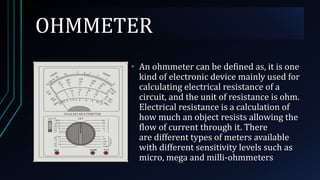
• An ohmmeter can be defined as, it is one
kind of electronic device mainly used for
calculating electrical resistance of a
circuit, and the unit of resistance is ohm.
Electrical resistance is a calculation of
how much an object resists allowing the
flow of current through it. There
are different types of meters available
with different sensitivity levels such as
micro, mega and milli-ohmmeters
APPLICATION OF OHMMETER
• This meter can be used to ensure the continuity of the circuit
which means if the sufficient flow of current or huge flow of
current through the circuit then the circuit will be detached.
• These are broadly used in electronic labs in engineering to
test the electronic components.
• These are used for small ics for debugging such as pcbs & other
stuff which requires to be executed in sensitive devices.
AMMETER
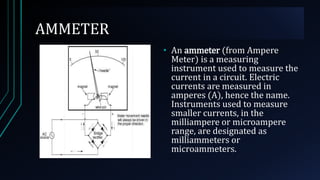
• An ammeter (from Ampere
Meter) is a measuring
instrument used to measure the
current in a circuit. Electric
currents are measured in
amperes (A), hence the name.
Instruments used to measure
smaller currents, in the
milliampere or microampere
range, are designated as
milliammeters or
microammeters.
ADVANTAGE AND DISADVANTAGE OF AMMETER
ADVANTAGE
• It can be used in high frequency
also.
• Uniform scale for most of the
ranges.
DISADVANTAGE
• The LCD display depends on a
battery or external power source.
When the battery is low, the
display will be dim, making it
difficult to read.
• In case of fluctuations or
transients, it can record an error.
• Warming of the meter during its
use can change its properties
leading to errors in measured
value.
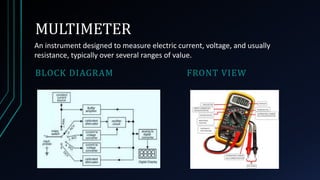
MULTIMETER
BLOCK DIAGRAM FRONT VIEW
An instrument designed to measure electric current, voltage, and usually
resistance, typically over several ranges of value.
ADVANTAGE AND DISADVANTAGE OF MULTIMETER
ADVANTAGE
• They are more accurate than analog
multimeters.
• They reduce reading and interpolation
errors.
• A digital multimeter's numerical display
solves this problem
DISADVANTAGE
• The LCD display depends on a battery or
external power source. When the battery
is low, the display will be dim, making it
difficult to read.
• It is more expensive than the analog type.
APPLICATION OF MULTIMETER
• Temperature and environmental applications
• Voltage measurements
• Current measurements
• Resistance measurements
• Time and frequency measurement
CRO (Cathode Ray Oscilloscope)
A Cathode Ray Oscilloscope (CRO) is an instrument generally used in a laboratory to
display, measure and analyse various waveforms of electrical circuits. A cathode ray
oscilloscope is a very fast X-Y plotters that can display an input signal versus time or
other signal.
ADVANTAGE AND DISADVANTAGE OF CRO
(CATHODE RAY OSCILLOSCOPE)
ADVANTAGE
• Time efficiency.
• Expertise and experience.
• Knowledge pool and problem
solving capacity.
• Mostly cost effective than to
develop and run the research
in-house.
DISADVANTAGE
• Conducting trials offshore
may raise ethical issues.
• Drugs may react differently to
those of different ethnic
backgrounds.
• Possible confidentiality loss.
• Project control loss - possible
loss of control over quality.
APPLICATION OF CRO (CATHODE RAY OSCILLOSCOPE)
• It can display different types of waveforms
• It can measure short time interval
• In voltmeter, it can measure potential difference
THANK YOU

SURVEY OF DIFFERENT ELECTRONICS INSTRUMENTS.pptx

  • 1.
    NAGPUR INSTITUTE OFTECHNOLOGY GUIDED BY :- MISS.RAJASHREE TALATULE NIT POLYTECHNIC MICRO PROJECT OF ELECTRONICS MEASUREMENTS & INSTRUMENTATION Presented By :- Ashish Sadavarti
  • 2.
  • 3.
    CONTENT • Voltmeter • Ohmmeter •Ammeter • Multimeter • CRO (Cathode Ray Oscilloscope)
  • 4.
    VOLTMETER • What isVoltmeter? • Voltmeter is a voltage meter. Which measures the voltage between the two nodes. We know the unit of potential difference is volts. So it is a measuring instrument which measures the potential difference between the two points. • The main principle of voltmeter is that it must be connected in parallel in which we want to measure the voltage.
  • 5.
    ADVANTAGE AND DISADVANTAGE OFVOLTMETER ADVANTAGE • Read Compact and cheap • Low power requirements • Portability increased • DVM can measure both AC & DC voltage. DISADVANTAGE • It gives some extra feature are expensive. • Speed of operation is limited due to the digitizing circuit. • It is usually very hard to spot transient voltage spikes , etc. •
  • 6.
    APPLICATION OF VOLTMETER •Digital Voltmeter is used to know the actual voltage of different components. • DVM is widely used to check if there is power in the circuit, such as mains outlet. • Knowing the voltage across a circuit, current can be calculated.
  • 7.
    OHMMETER • An ohmmetercan be defined as, it is one kind of electronic device mainly used for calculating electrical resistance of a circuit, and the unit of resistance is ohm. Electrical resistance is a calculation of how much an object resists allowing the flow of current through it. There are different types of meters available with different sensitivity levels such as micro, mega and milli-ohmmeters
  • 8.
    APPLICATION OF OHMMETER •This meter can be used to ensure the continuity of the circuit which means if the sufficient flow of current or huge flow of current through the circuit then the circuit will be detached. • These are broadly used in electronic labs in engineering to test the electronic components. • These are used for small ics for debugging such as pcbs & other stuff which requires to be executed in sensitive devices.
  • 9.
    AMMETER • An ammeter(from Ampere Meter) is a measuring instrument used to measure the current in a circuit. Electric currents are measured in amperes (A), hence the name. Instruments used to measure smaller currents, in the milliampere or microampere range, are designated as milliammeters or microammeters.
  • 10.
    ADVANTAGE AND DISADVANTAGEOF AMMETER ADVANTAGE • It can be used in high frequency also. • Uniform scale for most of the ranges. DISADVANTAGE • The LCD display depends on a battery or external power source. When the battery is low, the display will be dim, making it difficult to read. • In case of fluctuations or transients, it can record an error. • Warming of the meter during its use can change its properties leading to errors in measured value.
  • 11.
    MULTIMETER BLOCK DIAGRAM FRONTVIEW An instrument designed to measure electric current, voltage, and usually resistance, typically over several ranges of value.
  • 12.
    ADVANTAGE AND DISADVANTAGEOF MULTIMETER ADVANTAGE • They are more accurate than analog multimeters. • They reduce reading and interpolation errors. • A digital multimeter's numerical display solves this problem DISADVANTAGE • The LCD display depends on a battery or external power source. When the battery is low, the display will be dim, making it difficult to read. • It is more expensive than the analog type.
  • 13.
    APPLICATION OF MULTIMETER •Temperature and environmental applications • Voltage measurements • Current measurements • Resistance measurements • Time and frequency measurement
  • 14.
    CRO (Cathode RayOscilloscope) A Cathode Ray Oscilloscope (CRO) is an instrument generally used in a laboratory to display, measure and analyse various waveforms of electrical circuits. A cathode ray oscilloscope is a very fast X-Y plotters that can display an input signal versus time or other signal.
  • 15.
    ADVANTAGE AND DISADVANTAGEOF CRO (CATHODE RAY OSCILLOSCOPE) ADVANTAGE • Time efficiency. • Expertise and experience. • Knowledge pool and problem solving capacity. • Mostly cost effective than to develop and run the research in-house. DISADVANTAGE • Conducting trials offshore may raise ethical issues. • Drugs may react differently to those of different ethnic backgrounds. • Possible confidentiality loss. • Project control loss - possible loss of control over quality.
  • 16.
    APPLICATION OF CRO(CATHODE RAY OSCILLOSCOPE) • It can display different types of waveforms • It can measure short time interval • In voltmeter, it can measure potential difference
  • 17.