BUBBLE SORT
Presented By :
Ashish Sadavarti
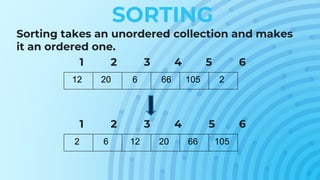
SORTING
Sorting takes an unordered collection and makes
it an ordered one.
1 2 3 4 5 6
1 2 3 4 5 6
12 20 6 66 105 2
2 6 12 20 66 105
BUBBLE SORT:
● It uses simple algorithm. It sorts by comparing each pair of
adjacent items and swapping them in the order. This will be
repeated until no swaps are needed . The algorithm got its
name from the way smaller elements “bubble” to the top of
the list.
● It is not much efficient when a list is having more then a few
elements . Among simple sorting algorithms, algorithms like
insertion sort are usually considered as more efficient.
● Bubble sort is little slower compared to other sorting
technique but it is easy because it deals with only two
elements at a time.
3
"Bubbling Up" the Largest Element
● Traverse a collection of elements
○ Move from the front to the end
○ “Bubble” the largest value to the end
using pair-wise comparisons and
swapping
5
12
35
42
77 101
1 2 3 4 5 6
"Bubbling Up" the Largest Element
● Traverse a collection of elements
○ Move from the front to the end
○ “Bubble” the largest value to the end
using pair-wise comparisons and
swapping
5
12
35
42
77 101
1 2 3 4 5 6
Swap
42 77
"Bubbling Up" the Largest Element
● Traverse a collection of elements
○ Move from the front to the end
○ “Bubble” the largest value to the end
using pair-wise comparisons and
swapping
5
12
35
77
42 101
1 2 3 4 5 6
Swap
35 77
"Bubbling Up" the Largest Element
● Traverse a collection of elements
○ Move from the front to the end
○ “Bubble” the largest value to the end
using pair-wise comparisons and
swapping
5
12
77
35
42 101
1 2 3 4 5 6
Swap
12 77
"Bubbling Up" the Largest Element
● Traverse a collection of elements
○ Move from the front to the end
○ “Bubble” the largest value to the end
using pair-wise comparisons and
swapping
5
77
12
35
42 101
1 2 3 4 5 6
No need to swap
"Bubbling Up" the Largest Element
● Traverse a collection of elements
○ Move from the front to the end
○ “Bubble” the largest value to the end
using pair-wise comparisons and
swapping
5
77
12
35
42 101
1 2 3 4 5 6
Swap
5 101
"Bubbling Up" the Largest Element
● Traverse a collection of elements
○ Move from the front to the end
○ “Bubble” the largest value to the end
using pair-wise comparisons and
swapping
77
12
35
42 5
1 2 3 4 5 6
101
Largest value correctly placed
The “Bubble Up” Algorithm
index <- 1
last_compare_at <- n – 1
loop
exitif(index > last_compare_at)
if(A[index] > A[index + 1]) then
Swap(A[index], A[index + 1])
endif
index <- index + 1
endloop
No, Swap isn’t built in.
Procedure Swap(a, b isoftype in/out Num)
t isoftype Num
t <- a
a <- b
b <- t
endprocedure // Swap
LB
Items of Interest
● Notice that only the largest value is
correctly placed
● All other values are still out of order
● So we need to repeat this process
77
12
35
42 5
1 2 3 4 5 6
101
Largest value correctly placed
Repeat “Bubble Up” How
Many Times?
● If we have N elements…
● And if each time we bubble an
element, we place it in its correct
location…
● Then we repeat the “bubble up”
process N – 1 times.
● This guarantees we’ll correctly
place all N elements.
“Bubbling” All the Elements
77
12
35
42 5
1 2 3 4 5 6
101
5
42
12
35 77
1 2 3 4 5 6
101
42
5
35
12 77
1 2 3 4 5 6
101
42
35
5
12 77
1 2 3 4 5 6
101
42
35
12
5 77
1 2 3 4 5 6
101
N
-
1
Reducing the Number of
Comparisons
12
35
42
77 101
1 2 3 4 5 6
5
77
12
35
42 5
1 2 3 4 5 6
101
5
42
12
35 77
1 2 3 4 5 6
101
42
5
35
12 77
1 2 3 4 5 6
101
42
35
5
12 77
1 2 3 4 5 6
101
Reducing the Number of
Comparisons
● On the Nth “bubble up”, we only need to
do MAX-N comparisons.
● For example:
○ This is the 4th “bubble up”
○ MAX is 6
○ Thus we have 2 comparisons to do
42
5
35
12 77
1 2 3 4 5 6
101
Putting It All Together
N is … // Size of Array
Arr_Type definesa Array[1..N] of Num
Procedure Swap(n1, n2 isoftype in/out Num)
temp isoftype Num
temp <- n1
n1 <- n2
n2 <- temp
endprocedure // Swap
procedure Bubblesort(A isoftype in/out Arr_Type)
to_do, index isoftype Num
to_do <- N – 1
loop
exitif(to_do = 0)
index <- 1
loop
exitif(index > to_do)
if(A[index] > A[index + 1]) then
Swap(A[index], A[index + 1])
endif
index <- index + 1
endloop
to_do <- to_do - 1
endloop
endprocedure // Bubblesort
Inner
loop
Outer
loop
Summary
● “Bubble Up” algorithm will move
largest value to its correct location (to
the right)
● Repeat “Bubble Up” until all elements
are correctly placed:
○ Maximum of N-1 times
○ Can finish early if no swapping
occurs
● We reduce the number of elements
we compare each time one is
correctly placed
Credits
● https://www.slideshare.net/manekar007/bubbl
e-sort-19001719
22
THANKYOU!

BUBBLESORT

  • 1.
    BUBBLE SORT Presented By: Ashish Sadavarti
  • 2.
    SORTING Sorting takes anunordered collection and makes it an ordered one. 1 2 3 4 5 6 1 2 3 4 5 6 12 20 6 66 105 2 2 6 12 20 66 105
  • 3.
    BUBBLE SORT: ● Ituses simple algorithm. It sorts by comparing each pair of adjacent items and swapping them in the order. This will be repeated until no swaps are needed . The algorithm got its name from the way smaller elements “bubble” to the top of the list. ● It is not much efficient when a list is having more then a few elements . Among simple sorting algorithms, algorithms like insertion sort are usually considered as more efficient. ● Bubble sort is little slower compared to other sorting technique but it is easy because it deals with only two elements at a time. 3
  • 4.
    "Bubbling Up" theLargest Element ● Traverse a collection of elements ○ Move from the front to the end ○ “Bubble” the largest value to the end using pair-wise comparisons and swapping 5 12 35 42 77 101 1 2 3 4 5 6
  • 5.
    "Bubbling Up" theLargest Element ● Traverse a collection of elements ○ Move from the front to the end ○ “Bubble” the largest value to the end using pair-wise comparisons and swapping 5 12 35 42 77 101 1 2 3 4 5 6 Swap 42 77
  • 6.
    "Bubbling Up" theLargest Element ● Traverse a collection of elements ○ Move from the front to the end ○ “Bubble” the largest value to the end using pair-wise comparisons and swapping 5 12 35 77 42 101 1 2 3 4 5 6 Swap 35 77
  • 7.
    "Bubbling Up" theLargest Element ● Traverse a collection of elements ○ Move from the front to the end ○ “Bubble” the largest value to the end using pair-wise comparisons and swapping 5 12 77 35 42 101 1 2 3 4 5 6 Swap 12 77
  • 8.
    "Bubbling Up" theLargest Element ● Traverse a collection of elements ○ Move from the front to the end ○ “Bubble” the largest value to the end using pair-wise comparisons and swapping 5 77 12 35 42 101 1 2 3 4 5 6 No need to swap
  • 9.
    "Bubbling Up" theLargest Element ● Traverse a collection of elements ○ Move from the front to the end ○ “Bubble” the largest value to the end using pair-wise comparisons and swapping 5 77 12 35 42 101 1 2 3 4 5 6 Swap 5 101
  • 10.
    "Bubbling Up" theLargest Element ● Traverse a collection of elements ○ Move from the front to the end ○ “Bubble” the largest value to the end using pair-wise comparisons and swapping 77 12 35 42 5 1 2 3 4 5 6 101 Largest value correctly placed
  • 11.
    The “Bubble Up”Algorithm index <- 1 last_compare_at <- n – 1 loop exitif(index > last_compare_at) if(A[index] > A[index + 1]) then Swap(A[index], A[index + 1]) endif index <- index + 1 endloop
  • 12.
    No, Swap isn’tbuilt in. Procedure Swap(a, b isoftype in/out Num) t isoftype Num t <- a a <- b b <- t endprocedure // Swap LB
  • 13.
    Items of Interest ●Notice that only the largest value is correctly placed ● All other values are still out of order ● So we need to repeat this process 77 12 35 42 5 1 2 3 4 5 6 101 Largest value correctly placed
  • 14.
    Repeat “Bubble Up”How Many Times? ● If we have N elements… ● And if each time we bubble an element, we place it in its correct location… ● Then we repeat the “bubble up” process N – 1 times. ● This guarantees we’ll correctly place all N elements.
  • 15.
    “Bubbling” All theElements 77 12 35 42 5 1 2 3 4 5 6 101 5 42 12 35 77 1 2 3 4 5 6 101 42 5 35 12 77 1 2 3 4 5 6 101 42 35 5 12 77 1 2 3 4 5 6 101 42 35 12 5 77 1 2 3 4 5 6 101 N - 1
  • 16.
    Reducing the Numberof Comparisons 12 35 42 77 101 1 2 3 4 5 6 5 77 12 35 42 5 1 2 3 4 5 6 101 5 42 12 35 77 1 2 3 4 5 6 101 42 5 35 12 77 1 2 3 4 5 6 101 42 35 5 12 77 1 2 3 4 5 6 101
  • 17.
    Reducing the Numberof Comparisons ● On the Nth “bubble up”, we only need to do MAX-N comparisons. ● For example: ○ This is the 4th “bubble up” ○ MAX is 6 ○ Thus we have 2 comparisons to do 42 5 35 12 77 1 2 3 4 5 6 101
  • 18.
  • 19.
    N is …// Size of Array Arr_Type definesa Array[1..N] of Num Procedure Swap(n1, n2 isoftype in/out Num) temp isoftype Num temp <- n1 n1 <- n2 n2 <- temp endprocedure // Swap
  • 20.
    procedure Bubblesort(A isoftypein/out Arr_Type) to_do, index isoftype Num to_do <- N – 1 loop exitif(to_do = 0) index <- 1 loop exitif(index > to_do) if(A[index] > A[index + 1]) then Swap(A[index], A[index + 1]) endif index <- index + 1 endloop to_do <- to_do - 1 endloop endprocedure // Bubblesort Inner loop Outer loop
  • 21.
    Summary ● “Bubble Up”algorithm will move largest value to its correct location (to the right) ● Repeat “Bubble Up” until all elements are correctly placed: ○ Maximum of N-1 times ○ Can finish early if no swapping occurs ● We reduce the number of elements we compare each time one is correctly placed
  • 22.
  • 23.