
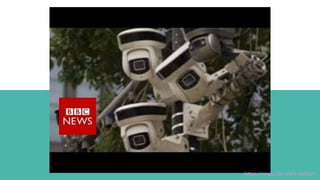
Surveillance Technologies: A primer
Hector Dominguez
August 10, 2019
Free Geek, Portland, OR
https://youtu.be/pNf4-d6fDoY
What is surveillance technology?
Surveillance technology means any software, electronic
device, system utilizing an electronic device, or similar
used, designed, or primarily intended to collect, retain,
analyze, process, or share audio, electronic, visual,
location, thermal, olfactory, biometric, or similar
information specifically associated with, or capable of
being associated with, any individual or group.
Why Surveillance Technologies?
Surveillance is used by governments for intelligence gathering, prevention of
crime, the protection of a process, person, group or object, or the
investigation of crime. It is also used by criminal organizations to plan and
commit crimes, and by businesses to gather intelligence on their competitors,
suppliers or customers.
Surveillance can be viewed as a violation of privacy, and as such is often
opposed by civil liberties activists.
Examples of surveillance technologies
Automated License Plate Readers
Body worn cameras
CCTV
Cell-Site Simulators/IMSI Catchers
Connected Transportation
De-Identification of Public Data
Digital Signs
Drones
Gunshot Detectors
Red light cameras
Facial Recognition
Location Services
Public Broadband
RFID/bluetooth
Smart Cards/Payment
Smart Grid/Smart meters
Social Networks Monitoring
Environmental Sensors
Satellite imagery
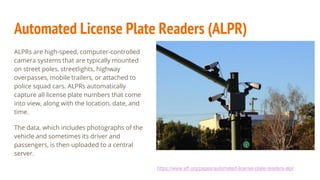
Automated License Plate Readers (ALPR)
ALPRs are high-speed, computer-controlled
camera systems that are typically mounted
on street poles, streetlights, highway
overpasses, mobile trailers, or attached to
police squad cars. ALPRs automatically
capture all license plate numbers that come
into view, along with the location, date, and
time.
The data, which includes photographs of the
vehicle and sometimes its driver and
passengers, is then uploaded to a central
server.
https://www.eff.org/pages/automated-license-plate-readers-alpr
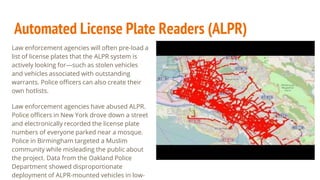
Automated License Plate Readers (ALPR)
Law enforcement agencies will often pre-load a
list of license plates that the ALPR system is
actively looking for—such as stolen vehicles
and vehicles associated with outstanding
warrants. Police officers can also create their
own hotlists.
Law enforcement agencies have abused ALPR.
Police officers in New York drove down a street
and electronically recorded the license plate
numbers of everyone parked near a mosque.
Police in Birmingham targeted a Muslim
community while misleading the public about
the project. Data from the Oakland Police
Department showed disproportionate
deployment of ALPR-mounted vehicles in low-
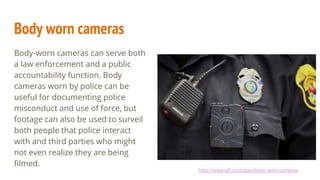
Body worn cameras
Body-worn cameras can serve both
a law enforcement and a public
accountability function. Body
cameras worn by police can be
useful for documenting police
misconduct and use of force, but
footage can also be used to surveil
both people that police interact
with and third parties who might
not even realize they are being
filmed.
https://www.eff.org/pages/body-worn-cameras
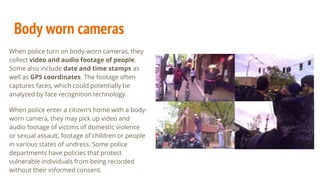
Body worn cameras
When police turn on body-worn cameras, they
collect video and audio footage of people.
Some also include date and time stamps as
well as GPS coordinates. The footage often
captures faces, which could potentially be
analyzed by face recognition technology.
When police enter a citizen’s home with a body-
worn camera, they may pick up video and
audio footage of victims of domestic violence
or sexual assault, footage of children or people
in various states of undress. Some police
departments have policies that protect
vulnerable individuals from being recorded
without their informed consent.
Closed-circuit television cameras (CCTV)
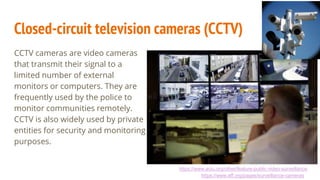
CCTV cameras are video cameras
that transmit their signal to a
limited number of external
monitors or computers. They are
frequently used by the police to
monitor communities remotely.
CCTV is also widely used by private
entities for security and monitoring
purposes.
https://www.aclu.org/other/feature-public-video-surveillance
https://www.eff.org/pages/surveillance-cameras
Closed-circuit television cameras (CCTV)
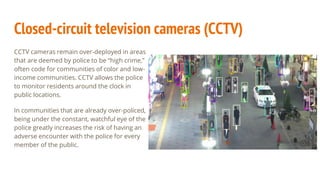
CCTV cameras remain over-deployed in areas
that are deemed by police to be “high crime,”
often code for communities of color and low-
income communities. CCTV allows the police
to monitor residents around the clock in
public locations.
In communities that are already over-policed,
being under the constant, watchful eye of the
police greatly increases the risk of having an
adverse encounter with the police for every
member of the public.
Cell-Site Simulators/IMSI Catchers
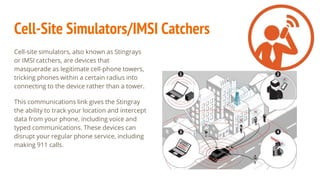
Cell-site simulators, also known as Stingrays
or IMSI catchers, are devices that
masquerade as legitimate cell-phone towers,
tricking phones within a certain radius into
connecting to the device rather than a tower.
This communications link gives the Stingray
the ability to track your location and intercept
data from your phone, including voice and
typed communications. These devices can
disrupt your regular phone service, including
making 911 calls.
Cell-Site Simulators/IMSI Catchers
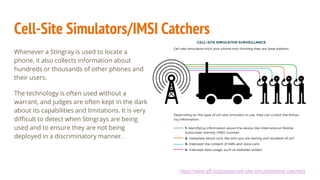
Whenever a Stingray is used to locate a
phone, it also collects information about
hundreds or thousands of other phones and
their users.
The technology is often used without a
warrant, and judges are often kept in the dark
about its capabilities and limitations. It is very
difficult to detect when Stingrays are being
used and to ensure they are not being
deployed in a discriminatory manner.
https://www.eff.org/pages/cell-site-simulatorsimsi-catchers
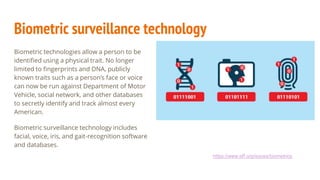
Biometric surveillance technology
Biometric technologies allow a person to be
identified using a physical trait. No longer
limited to fingerprints and DNA, publicly
known traits such as a person’s face or voice
can now be run against Department of Motor
Vehicle, social network, and other databases
to secretly identify and track almost every
American.
Biometric surveillance technology includes
facial, voice, iris, and gait-recognition software
and databases.
https://www.eff.org/issues/biometrics
Biometric surveillance technology
The U.S. military has used iris scanning
devices to identify detainees in Iraq and
Afghanistan.
The New York City Police Department was
among the first police departments to begin
using iris recognition.
On June 25, 2019, the U.S. Department of
Homeland Security (DHS) and ICE released a
Privacy Impact Assessment (PIA) on Rapid
DNA Operational Use [.pdf], stating that:
...Rapid DNA testing to establish a biological
parent-child relationship can be conducted in
approximately 90 minutes without human
review, unless there is an inconclusive result.
https://www.eff.org/deeplinks/2019/08/ices-rapid-dna-testing-
migrants-border-yet-another-iteration-family-separation
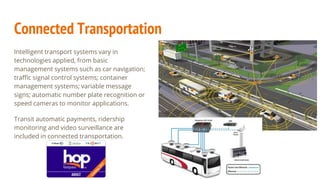
Connected Transportation
Intelligent transport systems vary in
technologies applied, from basic
management systems such as car navigation;
traffic signal control systems; container
management systems; variable message
signs; automatic number plate recognition or
speed cameras to monitor applications.
Transit automatic payments, ridership
monitoring and video surveillance are
included in connected transportation.
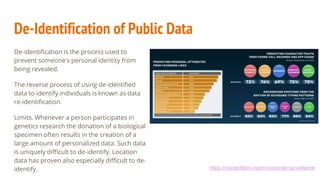
De-Identification of Public Data
De-identification is the process used to
prevent someone's personal identity from
being revealed.
The reverse process of using de-identified
data to identify individuals is known as data
re-identification.
Limits. Whenever a person participates in
genetics research the donation of a biological
specimen often results in the creation of a
large amount of personalized data. Such data
is uniquely difficult to de-identify. Location
data has proven also especially difficult to de-
identify. https://crackedlabs.org/en/corporate-surveillance
De-Identification of Public Data
Metadata can also be used to quickly
identify individuals. Looking at 200
tweets, researchers were able to use
associated metadata like timestamps,
number of followers, and account
creation time to identify anyone in a
group of 10,000 Twitter users 96.7%
of the time. Even when muddling the
metadata, a single person could still
be identified with more than 95%
accuracy.
New York City officials, accidentally
revealed the detailed comings and
goings of individual taxi drivers in a
case of a public release of data that
was poorly de-identified.
Medical records are have also proven
difficult to de-identify. In 2016, the
Australian government released an
anonymized dataset of medical billing
records, including prescriptions and
surgeries.
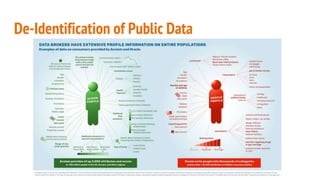
De-Identification of Public Data
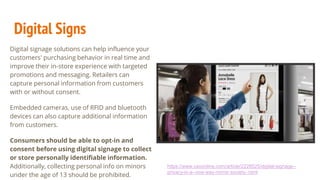
Digital Signs
Digital signage solutions can help influence your
customers' purchasing behavior in real time and
improve their in-store experience with targeted
promotions and messaging. Retailers can
capture personal information from customers
with or without consent.
Embedded cameras, use of RFID and bluetooth
devices can also capture additional information
from customers.
Consumers should be able to opt-in and
consent before using digital signage to collect
or store personally identifiable information.
Additionally, collecting personal info on minors
under the age of 13 should be prohibited.
https://www.csoonline.com/article/2228525/digital-signage--
privacy-in-a--one-way-mirror-society-.html
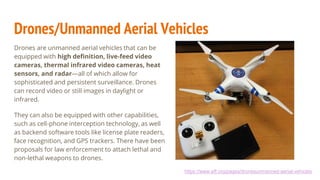
Drones/Unmanned Aerial Vehicles
Drones are unmanned aerial vehicles that can be
equipped with high definition, live-feed video
cameras, thermal infrared video cameras, heat
sensors, and radar—all of which allow for
sophisticated and persistent surveillance. Drones
can record video or still images in daylight or
infrared.
They can also be equipped with other capabilities,
such as cell-phone interception technology, as well
as backend software tools like license plate readers,
face recognition, and GPS trackers. There have been
proposals for law enforcement to attach lethal and
non-lethal weapons to drones.
https://www.eff.org/pages/dronesunmanned-aerial-vehicles
Drones/Unmanned Aerial Vehicles
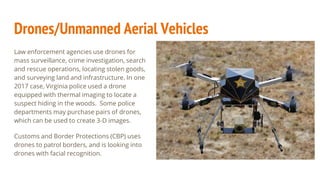
Law enforcement agencies use drones for
mass surveillance, crime investigation, search
and rescue operations, locating stolen goods,
and surveying land and infrastructure. In one
2017 case, Virginia police used a drone
equipped with thermal imaging to locate a
suspect hiding in the woods. Some police
departments may purchase pairs of drones,
which can be used to create 3-D images.
Customs and Border Protections (CBP) uses
drones to patrol borders, and is looking into
drones with facial recognition.
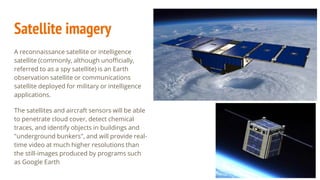
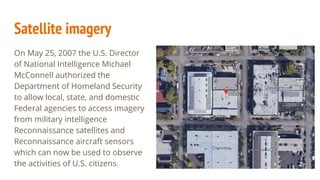
Satellite imagery
A reconnaissance satellite or intelligence
satellite (commonly, although unofficially,
referred to as a spy satellite) is an Earth
observation satellite or communications
satellite deployed for military or intelligence
applications.
The satellites and aircraft sensors will be able
to penetrate cloud cover, detect chemical
traces, and identify objects in buildings and
"underground bunkers", and will provide real-
time video at much higher resolutions than
the still-images produced by programs such
as Google Earth
Satellite imagery
On May 25, 2007 the U.S. Director
of National Intelligence Michael
McConnell authorized the
Department of Homeland Security
to allow local, state, and domestic
Federal agencies to access imagery
from military intelligence
Reconnaissance satellites and
Reconnaissance aircraft sensors
which can now be used to observe
the activities of U.S. citizens.
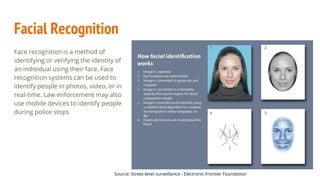
Facial Recognition
Source: Street-level surveillance - Electronic Frontier Foundation
Face recognition is a method of
identifying or verifying the identity of
an individual using their face. Face
recognition systems can be used to
identify people in photos, video, or in
real-time. Law enforcement may also
use mobile devices to identify people
during police stops
https://youtu.be/QxuyfWoVV98
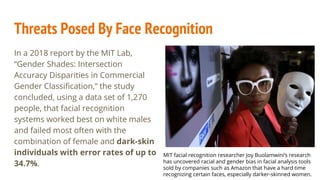
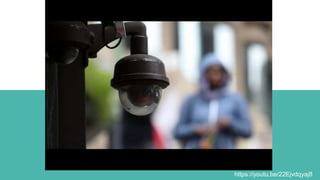
Threats Posed By Face Recognition
In a 2018 report by the MIT Lab,
“Gender Shades: Intersection
Accuracy Disparities in Commercial
Gender Classification,” the study
concluded, using a data set of 1,270
people, that facial recognition
systems worked best on white males
and failed most often with the
combination of female and dark-skin
individuals with error rates of up to
34.7%.
MIT facial recognition researcher Joy Buolamwini‘s research
has uncovered racial and gender bias in facial analysis tools
sold by companies such as Amazon that have a hard time
recognizing certain faces, especially darker-skinned women.
https://youtu.be/22Ejvdqyaj8
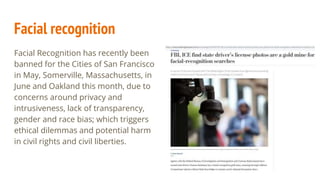
Facial recognition
Facial Recognition has recently been
banned for the Cities of San Francisco
in May, Somerville, Massachusetts, in
June and Oakland this month, due to
concerns around privacy and
intrusiveness, lack of transparency,
gender and race bias; which triggers
ethical dilemmas and potential harm
in civil rights and civil liberties.
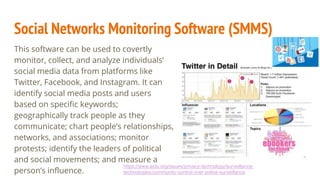
Social Networks Monitoring Software (SMMS)
This software can be used to covertly
monitor, collect, and analyze individuals’
social media data from platforms like
Twitter, Facebook, and Instagram. It can
identify social media posts and users
based on specific keywords;
geographically track people as they
communicate; chart people’s relationships,
networks, and associations; monitor
protests; identify the leaders of political
and social movements; and measure a
person’s influence.
https://www.aclu.org/issues/privacy-technology/surveillance-
technologies/community-control-over-police-surveillance
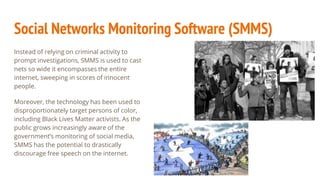
Social Networks Monitoring Software (SMMS)
Instead of relying on criminal activity to
prompt investigations, SMMS is used to cast
nets so wide it encompasses the entire
internet, sweeping in scores of innocent
people.
Moreover, the technology has been used to
disproportionately target persons of color,
including Black Lives Matter activists. As the
public grows increasingly aware of the
government’s monitoring of social media,
SMMS has the potential to drastically
discourage free speech on the internet.
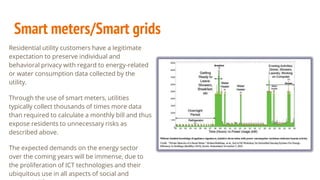
Smart meters/Smart grids
Residential utility customers have a legitimate
expectation to preserve individual and
behavioral privacy with regard to energy-related
or water consumption data collected by the
utility.
Through the use of smart meters, utilities
typically collect thousands of times more data
than required to calculate a monthly bill and thus
expose residents to unnecessary risks as
described above.
The expected demands on the energy sector
over the coming years will be immense, due to
the proliferation of ICT technologies and their
ubiquitous use in all aspects of social and
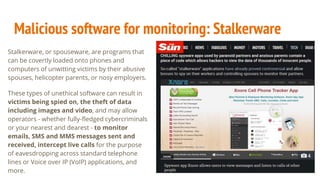
Malicious software for monitoring: Stalkerware
Stalkerware, or spouseware, are programs that
can be covertly loaded onto phones and
computers of unwitting victims by their abusive
spouses, helicopter parents, or nosy employers.
These types of unethical software can result in
victims being spied on, the theft of data
including images and video, and may allow
operators - whether fully-fledged cybercriminals
or your nearest and dearest - to monitor
emails, SMS and MMS messages sent and
received, intercept live calls for the purpose
of eavesdropping across standard telephone
lines or Voice over IP (VoIP) applications, and
more.
Other forms of Surveillance
Gunshot Detectors - microphones that are designed to detect the sound of a gunshot. By
placing them throughout an area, the microphones are able to triangulate a gunshot and
provide police with a limited geographic location from which a gunshot emanated.
Location Services - found in smartphones and in-car navigation systems give consumers
access to many useful services, such as mapping and finding the nearest Starbucks, but
there are serious questions about how vendors who gather that data use and sell it, most
often without users knowing.
Public Broadband - a broadband network dedicated to public safety (FirstNet) — was
inspired by the National Commission on Terrorist Attacks Upon the United States (the so-
called 9/11 Commission). FirstNet claims its services will provide CBP access to
“photographs, real-time audio/video feeds, and databases from other state, local, or Federal
agencies … to aid in the identification and apprehension of terrorists, undocumented aliens,
and smugglers.” These capabilities would be offered “in times of crisis or simply day-to-day
operations.”
Other forms of Surveillance
RFID - Tiny radio frequency identification (RFID) chips can be used to track goods, name tags, ID
badges or individuals by locating RFID readers in specific locations. This technology is very low cost.
Bluetooth - Tracking of cell phone users who had their Bluetooth set to "discoverable." These
networks are able to track and record the movements of these users around the city.
Smart Cards/Payment - Automatic Identification and Mobility (AIM) technologies are a diverse
family of technologies that share the common purpose of identifying, tracking, recording, storing
and communicating essential business, personal, or product data. In most cases, AIM technologies
serve as the front end of enterprise software systems, providing fast and accurate collection and
entry of data.
X-ray vans - The mobile technology uses x-ray radiation to see what no human eye can, such as
underneath clothing and car exteriors.
Other forms of Surveillance
Surveillance enabled light bulbs - LED surveillance light bulbs can actually conceal tiny cameras
and microphones that can stealthily monitor their surroundings and transmit their feeds back to a
central monitoring station.
Through-the-wall sensors/radar - This technology uses radar or similar technology to peer through
walls of a building. Currently, the technology is precise enough to ascertain how many people are in
a particular room within a dwelling unit and, over time, the clarity of the image produced may be
able to determine the identities of a building’s occupants.
Predictive policing software - Predictive policing software uses mathematical and analytical
techniques to attempt to predict future criminal activity, offenders, and victims.
Social credit systems - is a reputation system, currently being developed by the Chinese
government. By 2020, it is intended to standardise the assessment of citizens' and businesses'
economic and social reputation, or 'Social Credit'.
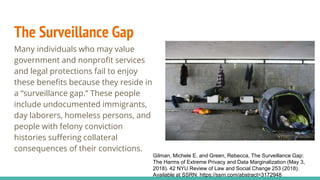
The Surveillance Gap
Many individuals who may value
government and nonprofit services
and legal protections fail to enjoy
these benefits because they reside in
a “surveillance gap.” These people
include undocumented immigrants,
day laborers, homeless persons, and
people with felony conviction
histories suffering collateral
consequences of their convictions.
Gilman, Michele E. and Green, Rebecca, The Surveillance Gap:
The Harms of Extreme Privacy and Data Marginalization (May 3,
2018). 42 NYU Review of Law and Social Change 253 (2018).
Available at SSRN: https://ssrn.com/abstract=3172948
Final comments
Privacy Impact Assessments (procedures, policies, transparency,
accountability) as a strategy for responsible use of technology.
Public use of surveillance is different to private use of surveillance
We should start thinking about Digital Rights as an extension of our civil rights
and civil liberties in the digital world
Trust is a social benefit, part of the social contract, that emerges from
communications, interdependencies and mutual understanding.
We still need to explore private surveillance and surveillance gap.

Surveillance technologies a primer

  • 1.
    Surveillance Technologies: Aprimer Hector Dominguez August 10, 2019 Free Geek, Portland, OR
  • 3.
  • 4.
    What is surveillancetechnology? Surveillance technology means any software, electronic device, system utilizing an electronic device, or similar used, designed, or primarily intended to collect, retain, analyze, process, or share audio, electronic, visual, location, thermal, olfactory, biometric, or similar information specifically associated with, or capable of being associated with, any individual or group.
  • 5.
    Why Surveillance Technologies? Surveillanceis used by governments for intelligence gathering, prevention of crime, the protection of a process, person, group or object, or the investigation of crime. It is also used by criminal organizations to plan and commit crimes, and by businesses to gather intelligence on their competitors, suppliers or customers. Surveillance can be viewed as a violation of privacy, and as such is often opposed by civil liberties activists.
  • 6.
    Examples of surveillancetechnologies Automated License Plate Readers Body worn cameras CCTV Cell-Site Simulators/IMSI Catchers Connected Transportation De-Identification of Public Data Digital Signs Drones Gunshot Detectors Red light cameras Facial Recognition Location Services Public Broadband RFID/bluetooth Smart Cards/Payment Smart Grid/Smart meters Social Networks Monitoring Environmental Sensors Satellite imagery
  • 7.
    Automated License PlateReaders (ALPR) ALPRs are high-speed, computer-controlled camera systems that are typically mounted on street poles, streetlights, highway overpasses, mobile trailers, or attached to police squad cars. ALPRs automatically capture all license plate numbers that come into view, along with the location, date, and time. The data, which includes photographs of the vehicle and sometimes its driver and passengers, is then uploaded to a central server. https://www.eff.org/pages/automated-license-plate-readers-alpr
  • 8.
    Automated License PlateReaders (ALPR) Law enforcement agencies will often pre-load a list of license plates that the ALPR system is actively looking for—such as stolen vehicles and vehicles associated with outstanding warrants. Police officers can also create their own hotlists. Law enforcement agencies have abused ALPR. Police officers in New York drove down a street and electronically recorded the license plate numbers of everyone parked near a mosque. Police in Birmingham targeted a Muslim community while misleading the public about the project. Data from the Oakland Police Department showed disproportionate deployment of ALPR-mounted vehicles in low-
  • 9.
    Body worn cameras Body-worncameras can serve both a law enforcement and a public accountability function. Body cameras worn by police can be useful for documenting police misconduct and use of force, but footage can also be used to surveil both people that police interact with and third parties who might not even realize they are being filmed. https://www.eff.org/pages/body-worn-cameras
  • 10.
    Body worn cameras Whenpolice turn on body-worn cameras, they collect video and audio footage of people. Some also include date and time stamps as well as GPS coordinates. The footage often captures faces, which could potentially be analyzed by face recognition technology. When police enter a citizen’s home with a body- worn camera, they may pick up video and audio footage of victims of domestic violence or sexual assault, footage of children or people in various states of undress. Some police departments have policies that protect vulnerable individuals from being recorded without their informed consent.
  • 11.
    Closed-circuit television cameras(CCTV) CCTV cameras are video cameras that transmit their signal to a limited number of external monitors or computers. They are frequently used by the police to monitor communities remotely. CCTV is also widely used by private entities for security and monitoring purposes. https://www.aclu.org/other/feature-public-video-surveillance https://www.eff.org/pages/surveillance-cameras
  • 12.
    Closed-circuit television cameras(CCTV) CCTV cameras remain over-deployed in areas that are deemed by police to be “high crime,” often code for communities of color and low- income communities. CCTV allows the police to monitor residents around the clock in public locations. In communities that are already over-policed, being under the constant, watchful eye of the police greatly increases the risk of having an adverse encounter with the police for every member of the public.
  • 13.
    Cell-Site Simulators/IMSI Catchers Cell-sitesimulators, also known as Stingrays or IMSI catchers, are devices that masquerade as legitimate cell-phone towers, tricking phones within a certain radius into connecting to the device rather than a tower. This communications link gives the Stingray the ability to track your location and intercept data from your phone, including voice and typed communications. These devices can disrupt your regular phone service, including making 911 calls.
  • 14.
    Cell-Site Simulators/IMSI Catchers Whenevera Stingray is used to locate a phone, it also collects information about hundreds or thousands of other phones and their users. The technology is often used without a warrant, and judges are often kept in the dark about its capabilities and limitations. It is very difficult to detect when Stingrays are being used and to ensure they are not being deployed in a discriminatory manner. https://www.eff.org/pages/cell-site-simulatorsimsi-catchers
  • 15.
    Biometric surveillance technology Biometrictechnologies allow a person to be identified using a physical trait. No longer limited to fingerprints and DNA, publicly known traits such as a person’s face or voice can now be run against Department of Motor Vehicle, social network, and other databases to secretly identify and track almost every American. Biometric surveillance technology includes facial, voice, iris, and gait-recognition software and databases. https://www.eff.org/issues/biometrics
  • 16.
    Biometric surveillance technology TheU.S. military has used iris scanning devices to identify detainees in Iraq and Afghanistan. The New York City Police Department was among the first police departments to begin using iris recognition. On June 25, 2019, the U.S. Department of Homeland Security (DHS) and ICE released a Privacy Impact Assessment (PIA) on Rapid DNA Operational Use [.pdf], stating that: ...Rapid DNA testing to establish a biological parent-child relationship can be conducted in approximately 90 minutes without human review, unless there is an inconclusive result. https://www.eff.org/deeplinks/2019/08/ices-rapid-dna-testing- migrants-border-yet-another-iteration-family-separation
  • 17.
    Connected Transportation Intelligent transportsystems vary in technologies applied, from basic management systems such as car navigation; traffic signal control systems; container management systems; variable message signs; automatic number plate recognition or speed cameras to monitor applications. Transit automatic payments, ridership monitoring and video surveillance are included in connected transportation.
  • 18.
    De-Identification of PublicData De-identification is the process used to prevent someone's personal identity from being revealed. The reverse process of using de-identified data to identify individuals is known as data re-identification. Limits. Whenever a person participates in genetics research the donation of a biological specimen often results in the creation of a large amount of personalized data. Such data is uniquely difficult to de-identify. Location data has proven also especially difficult to de- identify. https://crackedlabs.org/en/corporate-surveillance
  • 19.
    De-Identification of PublicData Metadata can also be used to quickly identify individuals. Looking at 200 tweets, researchers were able to use associated metadata like timestamps, number of followers, and account creation time to identify anyone in a group of 10,000 Twitter users 96.7% of the time. Even when muddling the metadata, a single person could still be identified with more than 95% accuracy. New York City officials, accidentally revealed the detailed comings and goings of individual taxi drivers in a case of a public release of data that was poorly de-identified. Medical records are have also proven difficult to de-identify. In 2016, the Australian government released an anonymized dataset of medical billing records, including prescriptions and surgeries.
  • 20.
  • 21.
    Digital Signs Digital signagesolutions can help influence your customers' purchasing behavior in real time and improve their in-store experience with targeted promotions and messaging. Retailers can capture personal information from customers with or without consent. Embedded cameras, use of RFID and bluetooth devices can also capture additional information from customers. Consumers should be able to opt-in and consent before using digital signage to collect or store personally identifiable information. Additionally, collecting personal info on minors under the age of 13 should be prohibited. https://www.csoonline.com/article/2228525/digital-signage-- privacy-in-a--one-way-mirror-society-.html
  • 22.
    Drones/Unmanned Aerial Vehicles Dronesare unmanned aerial vehicles that can be equipped with high definition, live-feed video cameras, thermal infrared video cameras, heat sensors, and radar—all of which allow for sophisticated and persistent surveillance. Drones can record video or still images in daylight or infrared. They can also be equipped with other capabilities, such as cell-phone interception technology, as well as backend software tools like license plate readers, face recognition, and GPS trackers. There have been proposals for law enforcement to attach lethal and non-lethal weapons to drones. https://www.eff.org/pages/dronesunmanned-aerial-vehicles
  • 23.
    Drones/Unmanned Aerial Vehicles Lawenforcement agencies use drones for mass surveillance, crime investigation, search and rescue operations, locating stolen goods, and surveying land and infrastructure. In one 2017 case, Virginia police used a drone equipped with thermal imaging to locate a suspect hiding in the woods. Some police departments may purchase pairs of drones, which can be used to create 3-D images. Customs and Border Protections (CBP) uses drones to patrol borders, and is looking into drones with facial recognition.
  • 24.
    Satellite imagery A reconnaissancesatellite or intelligence satellite (commonly, although unofficially, referred to as a spy satellite) is an Earth observation satellite or communications satellite deployed for military or intelligence applications. The satellites and aircraft sensors will be able to penetrate cloud cover, detect chemical traces, and identify objects in buildings and "underground bunkers", and will provide real- time video at much higher resolutions than the still-images produced by programs such as Google Earth
  • 25.
    Satellite imagery On May25, 2007 the U.S. Director of National Intelligence Michael McConnell authorized the Department of Homeland Security to allow local, state, and domestic Federal agencies to access imagery from military intelligence Reconnaissance satellites and Reconnaissance aircraft sensors which can now be used to observe the activities of U.S. citizens.
  • 26.
    Facial Recognition Source: Street-levelsurveillance - Electronic Frontier Foundation Face recognition is a method of identifying or verifying the identity of an individual using their face. Face recognition systems can be used to identify people in photos, video, or in real-time. Law enforcement may also use mobile devices to identify people during police stops
  • 27.
  • 28.
    Threats Posed ByFace Recognition In a 2018 report by the MIT Lab, “Gender Shades: Intersection Accuracy Disparities in Commercial Gender Classification,” the study concluded, using a data set of 1,270 people, that facial recognition systems worked best on white males and failed most often with the combination of female and dark-skin individuals with error rates of up to 34.7%. MIT facial recognition researcher Joy Buolamwini‘s research has uncovered racial and gender bias in facial analysis tools sold by companies such as Amazon that have a hard time recognizing certain faces, especially darker-skinned women.
  • 29.
  • 30.
    Facial recognition Facial Recognitionhas recently been banned for the Cities of San Francisco in May, Somerville, Massachusetts, in June and Oakland this month, due to concerns around privacy and intrusiveness, lack of transparency, gender and race bias; which triggers ethical dilemmas and potential harm in civil rights and civil liberties.
  • 31.
    Social Networks MonitoringSoftware (SMMS) This software can be used to covertly monitor, collect, and analyze individuals’ social media data from platforms like Twitter, Facebook, and Instagram. It can identify social media posts and users based on specific keywords; geographically track people as they communicate; chart people’s relationships, networks, and associations; monitor protests; identify the leaders of political and social movements; and measure a person’s influence. https://www.aclu.org/issues/privacy-technology/surveillance- technologies/community-control-over-police-surveillance
  • 32.
    Social Networks MonitoringSoftware (SMMS) Instead of relying on criminal activity to prompt investigations, SMMS is used to cast nets so wide it encompasses the entire internet, sweeping in scores of innocent people. Moreover, the technology has been used to disproportionately target persons of color, including Black Lives Matter activists. As the public grows increasingly aware of the government’s monitoring of social media, SMMS has the potential to drastically discourage free speech on the internet.
  • 33.
    Smart meters/Smart grids Residentialutility customers have a legitimate expectation to preserve individual and behavioral privacy with regard to energy-related or water consumption data collected by the utility. Through the use of smart meters, utilities typically collect thousands of times more data than required to calculate a monthly bill and thus expose residents to unnecessary risks as described above. The expected demands on the energy sector over the coming years will be immense, due to the proliferation of ICT technologies and their ubiquitous use in all aspects of social and
  • 34.
    Malicious software formonitoring: Stalkerware Stalkerware, or spouseware, are programs that can be covertly loaded onto phones and computers of unwitting victims by their abusive spouses, helicopter parents, or nosy employers. These types of unethical software can result in victims being spied on, the theft of data including images and video, and may allow operators - whether fully-fledged cybercriminals or your nearest and dearest - to monitor emails, SMS and MMS messages sent and received, intercept live calls for the purpose of eavesdropping across standard telephone lines or Voice over IP (VoIP) applications, and more.
  • 35.
    Other forms ofSurveillance Gunshot Detectors - microphones that are designed to detect the sound of a gunshot. By placing them throughout an area, the microphones are able to triangulate a gunshot and provide police with a limited geographic location from which a gunshot emanated. Location Services - found in smartphones and in-car navigation systems give consumers access to many useful services, such as mapping and finding the nearest Starbucks, but there are serious questions about how vendors who gather that data use and sell it, most often without users knowing. Public Broadband - a broadband network dedicated to public safety (FirstNet) — was inspired by the National Commission on Terrorist Attacks Upon the United States (the so- called 9/11 Commission). FirstNet claims its services will provide CBP access to “photographs, real-time audio/video feeds, and databases from other state, local, or Federal agencies … to aid in the identification and apprehension of terrorists, undocumented aliens, and smugglers.” These capabilities would be offered “in times of crisis or simply day-to-day operations.”
  • 36.
    Other forms ofSurveillance RFID - Tiny radio frequency identification (RFID) chips can be used to track goods, name tags, ID badges or individuals by locating RFID readers in specific locations. This technology is very low cost. Bluetooth - Tracking of cell phone users who had their Bluetooth set to "discoverable." These networks are able to track and record the movements of these users around the city. Smart Cards/Payment - Automatic Identification and Mobility (AIM) technologies are a diverse family of technologies that share the common purpose of identifying, tracking, recording, storing and communicating essential business, personal, or product data. In most cases, AIM technologies serve as the front end of enterprise software systems, providing fast and accurate collection and entry of data. X-ray vans - The mobile technology uses x-ray radiation to see what no human eye can, such as underneath clothing and car exteriors.
  • 37.
    Other forms ofSurveillance Surveillance enabled light bulbs - LED surveillance light bulbs can actually conceal tiny cameras and microphones that can stealthily monitor their surroundings and transmit their feeds back to a central monitoring station. Through-the-wall sensors/radar - This technology uses radar or similar technology to peer through walls of a building. Currently, the technology is precise enough to ascertain how many people are in a particular room within a dwelling unit and, over time, the clarity of the image produced may be able to determine the identities of a building’s occupants. Predictive policing software - Predictive policing software uses mathematical and analytical techniques to attempt to predict future criminal activity, offenders, and victims. Social credit systems - is a reputation system, currently being developed by the Chinese government. By 2020, it is intended to standardise the assessment of citizens' and businesses' economic and social reputation, or 'Social Credit'.
  • 38.
    The Surveillance Gap Manyindividuals who may value government and nonprofit services and legal protections fail to enjoy these benefits because they reside in a “surveillance gap.” These people include undocumented immigrants, day laborers, homeless persons, and people with felony conviction histories suffering collateral consequences of their convictions. Gilman, Michele E. and Green, Rebecca, The Surveillance Gap: The Harms of Extreme Privacy and Data Marginalization (May 3, 2018). 42 NYU Review of Law and Social Change 253 (2018). Available at SSRN: https://ssrn.com/abstract=3172948
  • 39.
    Final comments Privacy ImpactAssessments (procedures, policies, transparency, accountability) as a strategy for responsible use of technology. Public use of surveillance is different to private use of surveillance We should start thinking about Digital Rights as an extension of our civil rights and civil liberties in the digital world Trust is a social benefit, part of the social contract, that emerges from communications, interdependencies and mutual understanding. We still need to explore private surveillance and surveillance gap.