Download to read offline
![Macroeconomics of privacy and
security for identity management
and surveillance
Vasilios Katos
Department of Electrical and Computer Engineering,
Democritus University of Thrace, Xanthi, Greece
Frank Stowell
Department of Computing, University of Portsmouth, Portsmouth, UK, and
Peter Bednar
Department of Informatics, University of Lund, Lund, Sweden
Abstract
Purpose – The purpose of this paper is to develop an approach for investigating the impact of
surveillance technologies used to facilitate security and its effect upon privacy.
Design/methodology/approach – The authors develop a methodology by drawing on an
isomorphy of concepts from the discipline of Macroeconomics. This proposal is achieved by
considering security and privacy as economic goods, where surveillance is seen as security
technologies serving identity (ID) management and privacy is considered as being supported by ID
assurance solutions.
Findings – Reflecting upon Ashby’s Law of Requisite Variety, the authors conclude that surveillance
policies will not meet espoused ends and investigate an alternative strategy for policy making.
Practical implications – The result of this exercise suggests that the proposed methodology could
be a valuable tool for decision making at a strategic and aggregate level.
Originality/value – The paper extends the current literature on economics of privacy by
incorporating methods from macroeconomics.
Keywords Macroeconomics, Surveillance, Security, Privacy, Ashby’s law of requisite variety,
Information systems, Decision making
Paper type Research paper
1. Introduction
In this paper we raise questions about the effectiveness of what appear to be policies
regarding the installation of surveillance technologies. We ask if such technologies are
eroding individual privacy. In this paper we investigate whether it is possible to strike
a balance between surveillance as a means of citizen protection and at the same time
preserve privacy, since “[n]ew technologies mean that the consumer can unwittingly
become the integral part of a data collection system” (Rudall and Mann, 2008). In the
context of the paper the term “surveillance technologies” is used to describe all
monitoring technologies that continuously capture data on a wide scale.
The current issue and full text archive of this journal is available at
www.emeraldinsight.com/0368-492X.htm
A preliminary version of this paper appeared in Data Privacy Management (DPM) 2010.
K
42,1
140
Kybernetes
Vol. 42 No. 1, 2013
pp. 140-163
q Emerald Group Publishing Limited
0368-492X
DOI 10.1108/03684921311295538](https://image.slidesharecdn.com/17072901-140317065247-phpapp01/85/Journal-1-1-320.jpg)
![Macroeconomics of privacy and
security for identity management
and surveillance
Vasilios Katos
Department of Electrical and Computer Engineering,
Democritus University of Thrace, Xanthi, Greece
Frank Stowell
Department of Computing, University of Portsmouth, Portsmouth, UK, and
Peter Bednar
Department of Informatics, University of Lund, Lund, Sweden
Abstract
Purpose – The purpose of this paper is to develop an approach for investigating the impact of
surveillance technologies used to facilitate security and its effect upon privacy.
Design/methodology/approach – The authors develop a methodology by drawing on an
isomorphy of concepts from the discipline of Macroeconomics. This proposal is achieved by
considering security and privacy as economic goods, where surveillance is seen as security
technologies serving identity (ID) management and privacy is considered as being supported by ID
assurance solutions.
Findings – Reflecting upon Ashby’s Law of Requisite Variety, the authors conclude that surveillance
policies will not meet espoused ends and investigate an alternative strategy for policy making.
Practical implications – The result of this exercise suggests that the proposed methodology could
be a valuable tool for decision making at a strategic and aggregate level.
Originality/value – The paper extends the current literature on economics of privacy by
incorporating methods from macroeconomics.
Keywords Macroeconomics, Surveillance, Security, Privacy, Ashby’s law of requisite variety,
Information systems, Decision making
Paper type Research paper
1. Introduction
In this paper we raise questions about the effectiveness of what appear to be policies
regarding the installation of surveillance technologies. We ask if such technologies are
eroding individual privacy. In this paper we investigate whether it is possible to strike
a balance between surveillance as a means of citizen protection and at the same time
preserve privacy, since “[n]ew technologies mean that the consumer can unwittingly
become the integral part of a data collection system” (Rudall and Mann, 2008). In the
context of the paper the term “surveillance technologies” is used to describe all
monitoring technologies that continuously capture data on a wide scale.
The current issue and full text archive of this journal is available at
www.emeraldinsight.com/0368-492X.htm
A preliminary version of this paper appeared in Data Privacy Management (DPM) 2010.
K
42,1
140
Kybernetes
Vol. 42 No. 1, 2013
pp. 140-163
q Emerald Group Publishing Limited
0368-492X
DOI 10.1108/03684921311295538](https://image.slidesharecdn.com/17072901-140317065247-phpapp01/75/Journal-1-1-2048.jpg)
![1.1 Variety, control and heuristics
If we assume that the purpose of surveillance is to exercise control over a situation it
monitors, e.g. crime reduction, terrorist activities, then we must take into consideration
both the subject and the means of monitoring that subject. To this end we reflect upon
Ashby’s argument that in any situation:
[. . .] if a certain quality of disturbance is prevented by a regulator from reaching some
essential variables then that regulator must be capable of exerting at least that quantity of
selection (Ashby, 1960, p. 229).
In other words the variety in the controller must have as much variety as that which it
seeks to control. This revelation became known as Ashby’s Law of Requisite Variety
(LRV) which explains that in order to bring about effective control over any situation the
control mechanism must be capable of addressing as many different outcomes that it is
possible for a situation to develop. The more complex the system the more difficult it is
to predict its behaviour and the more difficult to exercise control. As a reminder of
the practical difficulty Sir David Pepper the recently retired Director of GCHQ (the UK’s
surveillance centre) said, “You would have to have so many people involved in the
securityservicesIam notsurewhatanybody else inthecountrywoulddo”(Pepper,2009).
It is axiomatic that in order to manage complexity we need to reduce its variety and
by thinking in terms of, “[. . .] heuristics rather than algorithms which, as Beer reminds
us that it is”, “[. . .] at once a way of coping with proliferating variety [. . .] instead of
trying to organise it in full detail, you organise it only somewhat; you then ride the
dynamics of the system” (Beer, 1981, p. 53). The present surveillance policy seems to be
one of collect as much information as possible in the hope that some of it may be useful at
some time. This policy is exemplified by the unofficial eavesdropping by the National
Security Agency (NSA), who are said to save all communication data for future use
(Harris, 2006) an approach underlined by a comment by a security expert who declared
that “If you can’t find the needle, you have to take the haystack” (Harris, 2006). A control
system seeking to control every conceivable eventuality generates so much variety that
it is impossible to analyse and control it. The only strategy open to us is to reduce variety
and simplify the situation into one over which we can exercise some degree of control.
1.2 Surveillance and privacy
In 1968, concerns were raised about the level of the US Government surveillance
activities. Christie (1968) pointed out that the growing level of surveillance was having
an impact upon the exercise of freedom of speech despite the claim that it had become
necessary on the grounds of protecting its citizens. Concerns were also raised by Christie
(1968, p. 876) about the threat to individual self-respect since, “[T]he individual can never
be sure that he is not under government surveillance whenever he walks the streets”. The
consumer privacy surveys by Westin (1991, 1994, 1996, 1998) which are run on a regular
basis have consistently revealed a high level of public concern about privacy. K. Taipale,
Executive Director of the Center for Advanced Studies in Science and Technology Policy
proposed that FISA should be modified to allow forthe electronic surveillance equivalent
of a Terry stop – under US law which says that in order to apprehend a person the police
officer has to have a legally based reason of suspicion. If we consider this in the context of
automated data mining it has been pointed out that if the officer’s suspicion was
subsequently unjustified the monitoring should be discontinued (Harris, 2006).
Macroeconomics
of privacy and
security
141](https://image.slidesharecdn.com/17072901-140317065247-phpapp01/85/Journal-1-2-320.jpg)
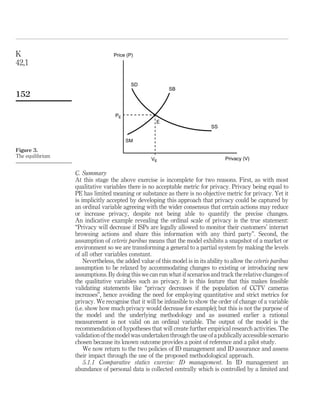
![it is desirable to understand the relationship between security and privacy in order to
detect or predict – at the very least – policy violations caused by security controls.
We offer a model showing the relationship between the two that will contribute to
providing reassurance to the population who may feel uneasy about the present policies
on surveillance.
3. Surveillance and modelling
Modelling the relationship between surveillance, security and privacy means that
certain assumptions have to be made as any model of such a situation is a simplification.
Because of the unlimited variety in the system it is impossible to give a full specification
and impossible to produce an exact algorithm. As Beer (1981, p. 53) points out “The
strange thing is we tend to live our lives by heuristics and try to control them by
algorithms.” But in adopting an heuristic it provides a route to “the eventual discovery of
a strategy” (Beer, 1981, p. 55). We cannot know the future and as a consequence cannot
work out a strategy in advance but what we should do instead is to devise a system of
control that enables us to learn and modify its unwanted effects. Beers point made in
another context, is that our concern is to link a high variety input with a high variety
output (Beer, 1981, p. 53) and as a consequence we have to find ways in which we can
reduce variety. We suggest it is possible to produce a description of the general direction
in which a given subject is likely to move and to provide a means of assessing the effect
of the actions taken. However, the complexity of the situation means that modelling it is
not a straight forward application of a formula.
3.1 Surveillance and privacy
The challenges in understanding and modelling privacy are primarily two-fold. The
first challenge relates to developing a definition of privacy; an exercise which is
difficult because of the “incompatible” and rich characteristics of privacy. Brunk (2002)
said that “[P]rivacy is a matter of intellectual and philosophical thought and retains
few tangible characteristics, making it resistant to simple explanation”. As such,
finding an objective and universally accepted definition of privacy could be argued to
be a futile exercise (Klopfer and Rubenstein, 1977); in fact Odlyzko (2003) goes further
by speculating that the privacy problem is intractable.
The lack of a clear definition of privacy within the literature means that it becomes
necessary to adopt one which has resonance with the underpinning thinking within
this research, namely that there should be a transparency about the level and type of
surveillance used. In this sense we subscribe to Westin’s (1967) definition summarised
as the ability of an individual to control the terms under which personal information is
acquired and used. Westin’s definition is appealing because it associates privacy with
the user, rather than the environment. That is it relates to the user’s opportunities and
capabilities to protect the outflow of their personal information and private data.
The second point we make is that privacy seems to be interwoven with security in a
way that any study or treatment of privacy in isolation can result in misleading
conclusions. For example, when developing security oriented systems most Member
Statesofthe EuropeanUnion are careful not toignorecitizensprivacy (seefor example the
EC Directive 1997/66/EC of the European Parliament, 1997). In contrast in the USA,
the TIA project, which focussed on applying surveillance and information technology
to track and monitor “terrorists” was terminated by the Congress (Williams, 2006).
Macroeconomics
of privacy and
security
143](https://image.slidesharecdn.com/17072901-140317065247-phpapp01/85/Journal-1-4-320.jpg)
![all these different systems is a non-trivial task. For example, in order to operate many
public sector agencies frequently circumvent their lack of interface by inventing
“simple” yet risky procedures such as the “Frisbee Network” of CD exchanges (BBC,
2007; Collins, 2007).
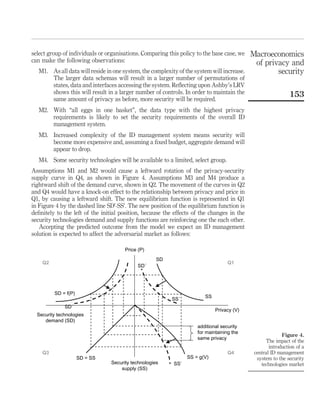
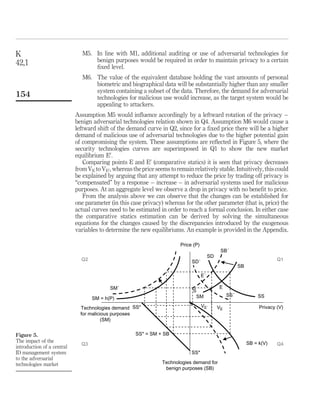
4.1.2 ID management: “many eggs in one basket”. The principle behind ID
management is to increase the amount of information collected for every citizen
(Crosby, 2008). Information is held for the purpose of protecting society from fraudulent
behaviour, criminal activities, and terrorism (Wang et al., 2002). ID management is
about the unreserved collection of data, which includes identification as well as
behavioural data. This will have an impact to security as Straub (1990) demonstrated
empirically that active monitoring of an information system is indeed a deterrent to
computer abuse. The practical implication of this principle requires surveillance
technologies to be implemented and coordinated and results in a trade-off between
security and privacy. The result is an increase in the level of complexity and cost
because by storing a plethora of personal data much will fall into special legislative
categories, high confidentiality. Ways of manipulating, handling, processing and
combining the data will also add to the complexity of its management. For a complex
system to be manageable it is necessary that the flexibility of the system and controls
will be reduced (Lucas and Olson, 1993). We are reminded that “[. . .] every real machine
embodies no less than an infinite number of variables” (Ashby, 1960, p. 15). In other
words the controller must be capable of responding with as much variety as the affects
of a changing environment has upon the object to be controlled. In order to model any
system we have to simplify and ignore all but a few of its variables which means that
the designer will effectively define an abstract system based upon their perception of
the systems requirements.
Potentially ID management creates a single point of failure, because if data mining
is applied the data could be accessible by unintended parties or authorities. Inference
control is an issue in many dimensional databases (Wang et al., 2004) because if the
data are available then they can be used for other than the intended purpose of
managed citizen identification. Security technologies focus on meeting the goals of
prevention, protection and recovery (Bishop, 2002) but the latter two do not contribute
to the goal of preserving privacy. Privacy is preserved when information about a
person is only disclosed to a specific group of entities (or subjects), and is one failure
which results in unauthorised disclosure of information. When dealing with a
centralised repository of data the problem of unauthorised disclosure becomes even
more challenging than providing a set of access control mechanisms because of the
data inference problem, i.e. data leaking information about other, higher classified data.
Challenges to privacy and security in this case is represented as an inference control
problem (Sweeney, 2002).
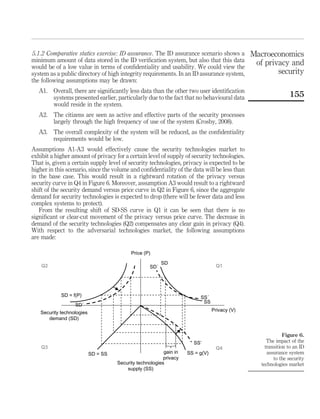
4.1.3 ID assurance: “an egg per basket”. The fundamental difference between an ID
management and an ID assurance system is that the latter intends to support the
development of a trusted system for identity verification. This is achieved through
minimizing the amount of data held on each citizen, thus supporting privacy. The data
itself is of low confidentiality as the data relate only to identification and not behaviour.
As a direct consequence surveillance is not required and privacy is supported. Because
of the relative limited scope, amount and confidentiality of the data, security
requirements will be less complex and less expensive.
Macroeconomics
of privacy and
security
147](https://image.slidesharecdn.com/17072901-140317065247-phpapp01/85/Journal-1-8-320.jpg)



This paper aims to develop a methodology for investigating the impact of surveillance technologies on privacy by viewing security and privacy as economic goods. The paper draws on concepts from macroeconomics to propose this methodology. It applies Ashby's Law of Requisite Variety to conclude that current surveillance policies will not achieve their intended goal of full protection and will instead erode individual privacy over time. The paper suggests an alternative strategic decision-making approach could help balance surveillance and privacy in a more effective manner.


