Occasion of revelation
'As-ibn-wa'il, who was one of the chiefs of
the pagans, met the holy Prophet (S)
coming out of the Sacred Mosque. He spoke
with him (S) for awhile.
In the meantime, a group of authoritative
men of the Quraish were sitting in the
Mosque watching him from a distance.
When 'As-ibn-Wa'il entered the Mosque
they asked him:
"To whom were you speaking?"
He answered:
"With this abtar one".
LADY
KHADIJAH
HOLY
PROPHET
(SAWW)
Qasim Tahir/Abdullah
Ibrahim
Occasion of revelation
The Arabs used to call the one who
had no son /abtar/, and 'abtar' means
'the animal whose tail is cut off'.
So, then. it means the one whose
succession in his seed has ceased, i.e.,
the one who has none to inherit him.
To console the holy Prophet (S), this
Surah was revealed with the glad
tidings of the greatest amount or the
highest degree of the grace of Allah,
bestowed on him.
Virtue
of
reciting
this
Surah
"He who recites it (Surah
Kawthar) Allah will
quench his thirst from
the streams of Heaven
and will recompense him
good rewards as many as
the number of every
sacrifice which the
servants of Allah make
on the day of the Feast of
Sacrifice, together with
those sacrifices which
are of the People of the
Book and the pagans.”
Surah Kauther
ِ
‫من‬ ْ‫ح‬َّ‫الر‬ ِ‫هللا‬ ِ
‫م‬ ْ
‫س‬ِ‫ب‬
ِ
‫يم‬ ِ
‫ح‬َّ‫الر‬
َ‫ر‬
َ
‫ث‬ْ
‫و‬
َ
‫ك‬
ْ
‫ال‬ َ
‫اك‬َ‫ن‬ْ‫ي‬
َ
‫ط‬ْ‫ع‬
َ
‫أ‬‫ا‬َّ‫ن‬ِ‫إ‬
ْ‫ر‬ َ‫ح‬
ْ
‫ان‬َ
‫و‬ َ
‫ك‬ِ‫ب‬َ‫ر‬ِ‫ل‬ ِ
‫ل‬َ‫ص‬
َ
‫ف‬
ُ‫ر‬
َ
‫ت‬ْ‫ب‬
َ
‫أل‬
ْ
‫ال‬ َ
‫و‬ ُ‫ه‬ َ
‫ك‬
َ
‫ئ‬ِ‫ن‬‫ا‬
َ
‫ش‬ َّ
‫ن‬ِ‫إ‬
Translation
1. “Surely (O Muhammad) We have
given you abundance (of good
(Kawthar).”
2. “Therefore to your Lord turn in
Prayer and Sacrifice.”
3. “Surely your enemy is the one who
will be without spring.”
Verse 1
• “Surely (O Muhammad) We have given you
abundance (of good (Kawthar).”
• The term /kauthar/ is a descriptive case
derived from /kathrat/ with the meaning of
'a lot of goodness, or blessing'; while gracious
persons are also called 'Kawthar'.
• Holy Prophet (S) "It is a stream in Heaven,
whiter than milk, more clear than a goblet
(of crystal) with dome-shaped ornaments
from pearls and rubies...”
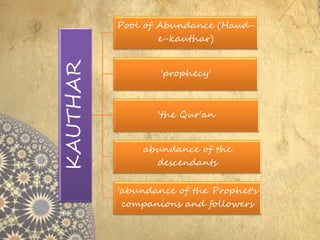
KAUTHAR
Pool of Abundance (Haud-
e-kauthar)
'prophecy'
'the Qur'an
abundance of the
descendants
'abundance of the Prophet's
companions and followers
Verse 2
2. “Therefore to your Lord turn in Prayer and
Sacrifice.”
Briefly, 'worship', in the form of prayer or making a
sacrifice, is only the Lord's and Benefactor's
privilege, and it is exclusively for the Pure Supreme
Being.
This refers to the behaviour of the pagans who used
to prostrate and sacrifice to the idols while they
knew their affluence belonged to Allah. and in any
case, the phrase 'your Lord', used in the verse, is a
clear evidence for the necessity of 'intention with
divine motive' in worship.
/wanhar/ based on /nahr/,
which is specific to
butchering a camel, is for the
reason that sacrificing a
camel, amongst other
offerings, enjoyed a higher
importance for the Muslims
of that time who liked it very
much, and thus, its
butchering was not possible
without the showing of
generosity.
Implied meaning: facing qiblah
when saying a prayer, raising of the
hands up to the throat and face
Verse 3
• "Surely your enemy is the one who will be
without offspring".
• ‫شانئ‬ 'enmity, spitefulness, and peevishness’;
and /sani'/ is the one who possesses these
characteristics.
• Qur'an, consoling the holy Prophet (S)
tells him that it is not him who will be
without offspring, but surely his enemy is.
Hazrat Fatima & Kauthar
Fakhr-i-Razi who, along with other commentaries on
'Kawthar', says:
“The third statement is that this Surah has been revealed
to reject those who criticized the holy Prophet (S) for his
lack of progeny, therefore, the meaning of the Surah is
that Allah shall give him a generation which will
remain stable through all ages.
And consider this, that although a number of Ahlul-Bait
have been martyred, the world is replete with them,
where as from the Ummayads (who were the enemies of
Islam) there remains no mentionable figure in the world.
Then, behold and see how many of the great men of
leadership such as Baqir, Sadiq, Rida, and Nafs-i-
Zakiyyah are found among them, (the household).”
Miracle of this Surah
Abundance
of good
Foretells
about his
generation
Enemies
will be
without
posterity
Allah & the plural pronoun
Allah introduces Himself by the first person
plural pronoun, thus:
"Surely We have given you abundance of good
(Kawthar)”.
This sense, and the likes of it, is for the
expression of Glory and Power, because when
the nobility talk about themselves, they
announce not only themselves, but, also their
commissionaires, and this refers to the power
and nobility as well as to the presence of those
in obedience along with the commands.
Supplication
• O Lord! Do not deprive us from the blessings
of that 'abundance of good' that You granted
to Your Prophet (S).
• O Lord! You know that we heartily love Your
Prophet (S) and his pure progeny (S); include
us among them.
• O Lord! The glory of his essence and his
religion is much noteable; add to this
grandeur, majesty and honour.

Tafseer of Surah Kauthar.pptx

  • 2.
    Occasion of revelation 'As-ibn-wa'il,who was one of the chiefs of the pagans, met the holy Prophet (S) coming out of the Sacred Mosque. He spoke with him (S) for awhile. In the meantime, a group of authoritative men of the Quraish were sitting in the Mosque watching him from a distance. When 'As-ibn-Wa'il entered the Mosque they asked him: "To whom were you speaking?" He answered: "With this abtar one".
  • 3.
  • 4.
    Occasion of revelation TheArabs used to call the one who had no son /abtar/, and 'abtar' means 'the animal whose tail is cut off'. So, then. it means the one whose succession in his seed has ceased, i.e., the one who has none to inherit him. To console the holy Prophet (S), this Surah was revealed with the glad tidings of the greatest amount or the highest degree of the grace of Allah, bestowed on him.
  • 5.
    Virtue of reciting this Surah "He who recitesit (Surah Kawthar) Allah will quench his thirst from the streams of Heaven and will recompense him good rewards as many as the number of every sacrifice which the servants of Allah make on the day of the Feast of Sacrifice, together with those sacrifices which are of the People of the Book and the pagans.”
  • 6.
    Surah Kauther ِ ‫من‬ ْ‫ح‬َّ‫الر‬ِ‫هللا‬ ِ ‫م‬ ْ ‫س‬ِ‫ب‬ ِ ‫يم‬ ِ ‫ح‬َّ‫الر‬ َ‫ر‬ َ ‫ث‬ْ ‫و‬ َ ‫ك‬ ْ ‫ال‬ َ ‫اك‬َ‫ن‬ْ‫ي‬ َ ‫ط‬ْ‫ع‬ َ ‫أ‬‫ا‬َّ‫ن‬ِ‫إ‬ ْ‫ر‬ َ‫ح‬ ْ ‫ان‬َ ‫و‬ َ ‫ك‬ِ‫ب‬َ‫ر‬ِ‫ل‬ ِ ‫ل‬َ‫ص‬ َ ‫ف‬ ُ‫ر‬ َ ‫ت‬ْ‫ب‬ َ ‫أل‬ ْ ‫ال‬ َ ‫و‬ ُ‫ه‬ َ ‫ك‬ َ ‫ئ‬ِ‫ن‬‫ا‬ َ ‫ش‬ َّ ‫ن‬ِ‫إ‬
  • 7.
    Translation 1. “Surely (OMuhammad) We have given you abundance (of good (Kawthar).” 2. “Therefore to your Lord turn in Prayer and Sacrifice.” 3. “Surely your enemy is the one who will be without spring.”
  • 8.
    Verse 1 • “Surely(O Muhammad) We have given you abundance (of good (Kawthar).” • The term /kauthar/ is a descriptive case derived from /kathrat/ with the meaning of 'a lot of goodness, or blessing'; while gracious persons are also called 'Kawthar'. • Holy Prophet (S) "It is a stream in Heaven, whiter than milk, more clear than a goblet (of crystal) with dome-shaped ornaments from pearls and rubies...”
  • 9.
    KAUTHAR Pool of Abundance(Haud- e-kauthar) 'prophecy' 'the Qur'an abundance of the descendants 'abundance of the Prophet's companions and followers
  • 10.
    Verse 2 2. “Thereforeto your Lord turn in Prayer and Sacrifice.” Briefly, 'worship', in the form of prayer or making a sacrifice, is only the Lord's and Benefactor's privilege, and it is exclusively for the Pure Supreme Being. This refers to the behaviour of the pagans who used to prostrate and sacrifice to the idols while they knew their affluence belonged to Allah. and in any case, the phrase 'your Lord', used in the verse, is a clear evidence for the necessity of 'intention with divine motive' in worship.
  • 11.
    /wanhar/ based on/nahr/, which is specific to butchering a camel, is for the reason that sacrificing a camel, amongst other offerings, enjoyed a higher importance for the Muslims of that time who liked it very much, and thus, its butchering was not possible without the showing of generosity. Implied meaning: facing qiblah when saying a prayer, raising of the hands up to the throat and face
  • 12.
    Verse 3 • "Surelyyour enemy is the one who will be without offspring". • ‫شانئ‬ 'enmity, spitefulness, and peevishness’; and /sani'/ is the one who possesses these characteristics. • Qur'an, consoling the holy Prophet (S) tells him that it is not him who will be without offspring, but surely his enemy is.
  • 13.
    Hazrat Fatima &Kauthar Fakhr-i-Razi who, along with other commentaries on 'Kawthar', says: “The third statement is that this Surah has been revealed to reject those who criticized the holy Prophet (S) for his lack of progeny, therefore, the meaning of the Surah is that Allah shall give him a generation which will remain stable through all ages. And consider this, that although a number of Ahlul-Bait have been martyred, the world is replete with them, where as from the Ummayads (who were the enemies of Islam) there remains no mentionable figure in the world. Then, behold and see how many of the great men of leadership such as Baqir, Sadiq, Rida, and Nafs-i- Zakiyyah are found among them, (the household).”
  • 14.
    Miracle of thisSurah Abundance of good Foretells about his generation Enemies will be without posterity
  • 15.
    Allah & theplural pronoun Allah introduces Himself by the first person plural pronoun, thus: "Surely We have given you abundance of good (Kawthar)”. This sense, and the likes of it, is for the expression of Glory and Power, because when the nobility talk about themselves, they announce not only themselves, but, also their commissionaires, and this refers to the power and nobility as well as to the presence of those in obedience along with the commands.
  • 16.
    Supplication • O Lord!Do not deprive us from the blessings of that 'abundance of good' that You granted to Your Prophet (S). • O Lord! You know that we heartily love Your Prophet (S) and his pure progeny (S); include us among them. • O Lord! The glory of his essence and his religion is much noteable; add to this grandeur, majesty and honour.