Surah Ikhlas
Chapter 112
(Monotheism)
-Meccan-
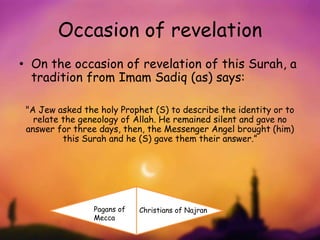
Occasion of revelation
• On the occasion of revelation of this Surah, a
tradition from Imam Sadiq (as) says:
"A Jew asked the holy Prophet (S) to describe the identity or to
relate the geneology of Allah. He remained silent and gave no
answer for three days, then, the Messenger Angel brought (him)
this Surah and he (S) gave them their answer.”
Pagans of
Mecca
Christians of Najran
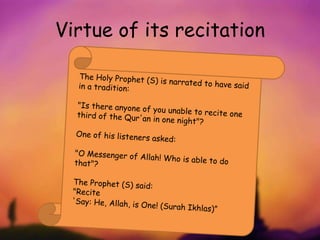
Virtue of its recitation
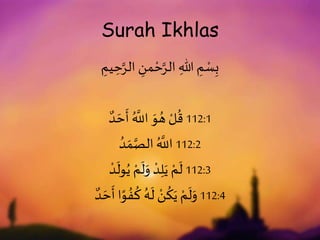
Surah Ikhlas
ِ
‫يم‬ ِ
‫ح‬َّ‫الر‬ ِ
‫من‬ ْ‫ح‬َّ‫الر‬ ِ‫هللا‬ ِ
‫م‬ ْ
‫س‬ِ‫ب‬
‫د‬ َ‫ح‬
َ
‫أ‬ ُ َّ
‫اَّلل‬ َ
‫و‬ ُ‫ه‬ ْ‫ل‬
ُ
‫ق‬ 112:1
ُ‫د‬ َ‫م‬َّ‫الص‬ ُ َّ
‫اَّلل‬ 112:2
ْ‫د‬
َ
‫ول‬ُ‫ي‬ ْ‫م‬
َ
‫ل‬َ
‫و‬ ْ‫د‬ِ‫ل‬َ‫ي‬ ْ‫م‬
َ
‫ل‬ 112:3
‫د‬ َ‫ح‬
َ
‫أ‬ ‫ا‬ً
‫و‬ ُ‫ف‬
ُ
‫ك‬ ُ‫ه‬
َ
‫ل‬ ْ
‫ن‬
ُ
‫ك‬َ‫ي‬ ْ‫م‬
َ
‫ل‬َ
‫و‬ 112:4
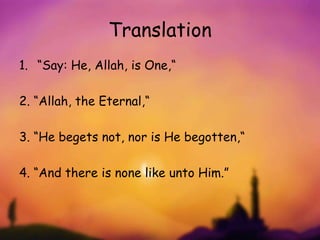
Translation
1. “Say: He, Allah, is One,“
2. “Allah, the Eternal,“
3. “He begets not, nor is He begotten,“
4. “And there is none like unto Him.”
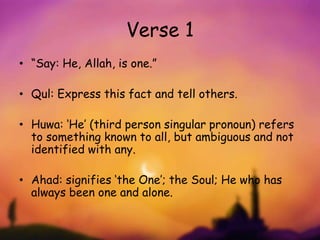
Verse 1
• “Say: He, Allah, is one.”
• Qul: Express this fact and tell others.
• Huwa: ‘He’ (third person singular pronoun) refers
to something known to all, but ambiguous and not
identified with any.
• Ahad: signifies ‘the One’; the Soul; He who has
always been one and alone.
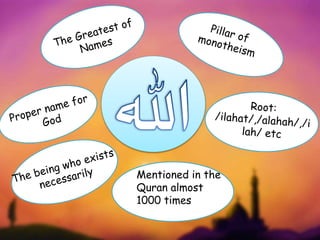
Mentioned in the
Quran almost
1000 times
‘One’ ٌ‫د‬ َ‫ح‬
َ
‫أ‬
• He is One with none comparable to Him, without any
beginning or end, unlimited by time, space or
circumstances.
• A tradition from Imam Baqir (A.S) says:
“Ahad and wahid both have one concept which is One
with nothing comparable or similar to it, and monotheism
is the confession to his Oneness.”
Verse 2
• “Allah, the Eternal”
• 'Samad means a Lord; one to whom reference
is made in matters of importance'.
• Some others have said that 'Samad' means
'something whose inside is not hollow, but it is
full'.
ٌ‫د‬ َ‫م‬َّ‫الص‬
• Imam Hussain ibn Ali (as) has stated 5 meanings for
‘samad’
I. Samad is a Lord Whose Lordship has attained its
utmost point or degree.
II. Samad is an Essence and Being that continues or
continues for ever or is everlasting.
III.Samad is the Existence that has not a hollow inside.
IV. Samad is the One Who takes no nourishment, food or
drink.
V. Samad is One Who does not sleep.
Verse 3
• "He begets not, nor is He begotten”
• Rejects the idea of the Christians, the Jews, and
the pagan Arabs who declared that Allah had a
child or is a father.
• Begets: negates any material and delicate things
emerging from Him, or He, the Sacred Essence,
emerging from any material and delicate thing.
Verse 4
• "And there is none like unto Him".
• /kufw/: equal from the point of position and rank’ or any
similarity.
• Considering this verse, the Holy Essence of Allah is free
from all qualities or obstacles that creatures have, and
free from all defects and limitations. This is 'Unity of
Attributes' that corresponds with 'Unity of Number’.
• Therefore, He is One in Essence, in attributes, and in
deeds; and He is unique in every aspect.
Explanation: The belief in the oneness of
Allah
• Imam Ali ibn Abi. Taleb (as) is quoted to have
said:
• “The first step of religion is to accept, understand
and realize Him (Allah) and a perfection of
understanding lies in conviction and the true way of
conviction is to sincerely believe that there is no god
but He…"
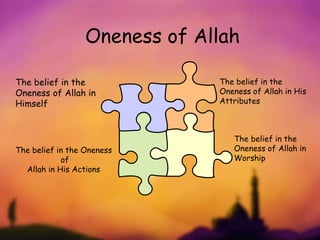
Oneness of Allah
The belief in the
Oneness of Allah in
Himself
The belief in the Oneness
of
Allah in His Actions
The belief in the
Oneness of Allah in His
Attributes
The belief in the
Oneness of Allah in
Worship
Supplication
• O Lord! Make us firm in monotheism throughout our
life.
• O Lord! Polytheism, like monotheism, has many
branches. Being saved from polytheism is not possible
but by Your Grace; envelop us in Your Mercy and Your
Grace.
• O Lord! Keep us alive with monotheism, put us in
death with monotheism, and unite us on the
Resurrection Day with the reality of monotheism.

Tafseer of Surah Ikhlas.pptx

  • 1.
  • 2.
    Occasion of revelation •On the occasion of revelation of this Surah, a tradition from Imam Sadiq (as) says: "A Jew asked the holy Prophet (S) to describe the identity or to relate the geneology of Allah. He remained silent and gave no answer for three days, then, the Messenger Angel brought (him) this Surah and he (S) gave them their answer.” Pagans of Mecca Christians of Najran
  • 3.
    Virtue of itsrecitation
  • 4.
    Surah Ikhlas ِ ‫يم‬ ِ ‫ح‬َّ‫الر‬ِ ‫من‬ ْ‫ح‬َّ‫الر‬ ِ‫هللا‬ ِ ‫م‬ ْ ‫س‬ِ‫ب‬ ‫د‬ َ‫ح‬ َ ‫أ‬ ُ َّ ‫اَّلل‬ َ ‫و‬ ُ‫ه‬ ْ‫ل‬ ُ ‫ق‬ 112:1 ُ‫د‬ َ‫م‬َّ‫الص‬ ُ َّ ‫اَّلل‬ 112:2 ْ‫د‬ َ ‫ول‬ُ‫ي‬ ْ‫م‬ َ ‫ل‬َ ‫و‬ ْ‫د‬ِ‫ل‬َ‫ي‬ ْ‫م‬ َ ‫ل‬ 112:3 ‫د‬ َ‫ح‬ َ ‫أ‬ ‫ا‬ً ‫و‬ ُ‫ف‬ ُ ‫ك‬ ُ‫ه‬ َ ‫ل‬ ْ ‫ن‬ ُ ‫ك‬َ‫ي‬ ْ‫م‬ َ ‫ل‬َ ‫و‬ 112:4
  • 5.
    Translation 1. “Say: He,Allah, is One,“ 2. “Allah, the Eternal,“ 3. “He begets not, nor is He begotten,“ 4. “And there is none like unto Him.”
  • 6.
    Verse 1 • “Say:He, Allah, is one.” • Qul: Express this fact and tell others. • Huwa: ‘He’ (third person singular pronoun) refers to something known to all, but ambiguous and not identified with any. • Ahad: signifies ‘the One’; the Soul; He who has always been one and alone.
  • 7.
    Mentioned in the Quranalmost 1000 times
  • 8.
    ‘One’ ٌ‫د‬ َ‫ح‬ َ ‫أ‬ •He is One with none comparable to Him, without any beginning or end, unlimited by time, space or circumstances. • A tradition from Imam Baqir (A.S) says: “Ahad and wahid both have one concept which is One with nothing comparable or similar to it, and monotheism is the confession to his Oneness.”
  • 9.
    Verse 2 • “Allah,the Eternal” • 'Samad means a Lord; one to whom reference is made in matters of importance'. • Some others have said that 'Samad' means 'something whose inside is not hollow, but it is full'.
  • 10.
    ٌ‫د‬ َ‫م‬َّ‫الص‬ • ImamHussain ibn Ali (as) has stated 5 meanings for ‘samad’ I. Samad is a Lord Whose Lordship has attained its utmost point or degree. II. Samad is an Essence and Being that continues or continues for ever or is everlasting. III.Samad is the Existence that has not a hollow inside. IV. Samad is the One Who takes no nourishment, food or drink. V. Samad is One Who does not sleep.
  • 12.
    Verse 3 • "Hebegets not, nor is He begotten” • Rejects the idea of the Christians, the Jews, and the pagan Arabs who declared that Allah had a child or is a father. • Begets: negates any material and delicate things emerging from Him, or He, the Sacred Essence, emerging from any material and delicate thing.
  • 13.
    Verse 4 • "Andthere is none like unto Him". • /kufw/: equal from the point of position and rank’ or any similarity. • Considering this verse, the Holy Essence of Allah is free from all qualities or obstacles that creatures have, and free from all defects and limitations. This is 'Unity of Attributes' that corresponds with 'Unity of Number’. • Therefore, He is One in Essence, in attributes, and in deeds; and He is unique in every aspect.
  • 14.
    Explanation: The beliefin the oneness of Allah • Imam Ali ibn Abi. Taleb (as) is quoted to have said: • “The first step of religion is to accept, understand and realize Him (Allah) and a perfection of understanding lies in conviction and the true way of conviction is to sincerely believe that there is no god but He…"
  • 15.
    Oneness of Allah Thebelief in the Oneness of Allah in Himself The belief in the Oneness of Allah in His Actions The belief in the Oneness of Allah in His Attributes The belief in the Oneness of Allah in Worship
  • 16.
    Supplication • O Lord!Make us firm in monotheism throughout our life. • O Lord! Polytheism, like monotheism, has many branches. Being saved from polytheism is not possible but by Your Grace; envelop us in Your Mercy and Your Grace. • O Lord! Keep us alive with monotheism, put us in death with monotheism, and unite us on the Resurrection Day with the reality of monotheism.