The Constitutional
Language of Liberty
Professor Heidi Jo Green, Political Science
Common Law
Administrative Law
Judicial Holdings: Stare Decisis
A Brief Overview of the
United States Legal System
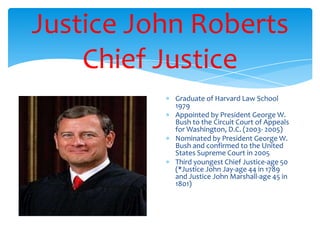
Justice John Roberts
Chief Justice
Graduate of Harvard Law School
1979
Appointed by President George W.
Bush to the Circuit Court of Appeals
for Washington, D.C. (2003- 2005)
Nominated by President George W.
Bush and confirmed to the United
States Supreme Court in 2005
Third youngest Chief Justice-age 50
(*Justice John Jay-age 44 in 1789
and Justice John Marshall-age 45 in
1801)
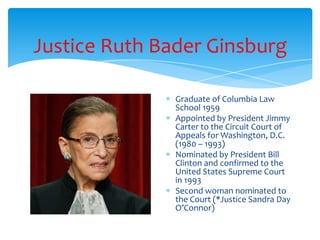
Justice Ruth Bader Ginsburg
Graduate of Columbia Law
School 1959
Appointed by President Jimmy
Carter to the Circuit Court of
Appeals for Washington, D.C.
(1980 – 1993)
Nominated by President Bill
Clinton and confirmed to the
United States Supreme Court
in 1993
Second woman nominated to
the Court (*Justice Sandra Day
O’Connor)
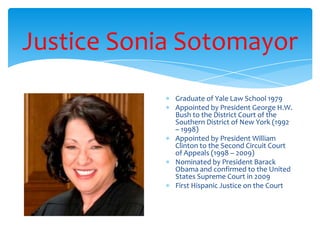
Justice Sonia Sotomayor
Graduate of Yale Law School 1979
Appointed by President George H.W.
Bush to the District Court of the
Southern District of New York (1992
– 1998)
Appointed by President William
Clinton to the Second Circuit Court
of Appeals (1998 – 2009)
Nominated by President Barack
Obama and confirmed to the United
States Supreme Court in 2009
First Hispanic Justice on the Court
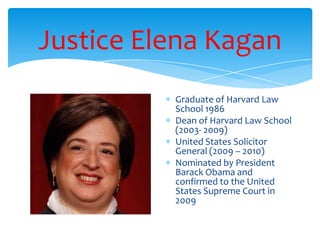
Justice Elena Kagan
Graduate of Harvard Law
School 1986
Dean of Harvard Law School
(2003- 2009)
United States Solicitor
General (2009 – 2010)
Nominated by President
Barack Obama and
confirmed to the United
States Supreme Court in
2009
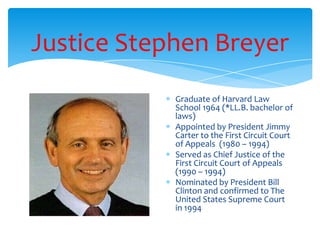
Justice Stephen Breyer
Graduate of Harvard Law
School 1964 (*LL.B. bachelor of
laws)
Appointed by President Jimmy
Carter to the First Circuit Court
of Appeals (1980 – 1994)
Served as Chief Justice of the
First Circuit Court of Appeals
(1990 – 1994)
Nominated by President Bill
Clinton and confirmed to The
United States Supreme Court
in 1994
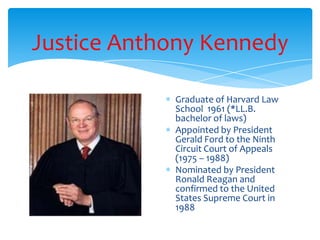
Justice Anthony Kennedy
Graduate of Harvard Law
School 1961 (*LL.B.
bachelor of laws)
Appointed by President
Gerald Ford to the Ninth
Circuit Court of Appeals
(1975 – 1988)
Nominated by President
Ronald Reagan and
confirmed to the United
States Supreme Court in
1988
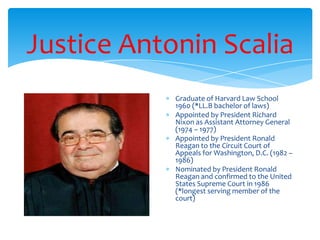
Justice Antonin Scalia
Graduate of Harvard Law School
1960 (*LL.B bachelor of laws)
Appointed by President Richard
Nixon as Assistant Attorney General
(1974 – 1977)
Appointed by President Ronald
Reagan to the Circuit Court of
Appeals for Washington, D.C. (1982 –
1986)
Nominated by President Ronald
Reagan and confirmed to the United
States Supreme Court in 1986
(*longest serving member of the
court)
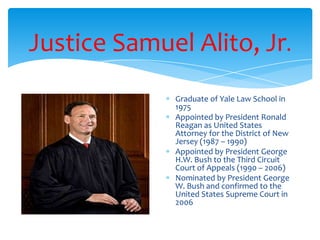
Justice Samuel Alito, Jr.
Graduate of Yale Law School in
1975
Appointed by President Ronald
Reagan as United States
Attorney for the District of New
Jersey (1987 – 1990)
Appointed by President George
H.W. Bush to the Third Circuit
Court of Appeals (1990 – 2006)
Nominated by President George
W. Bush and confirmed to the
United States Supreme Court in
2006
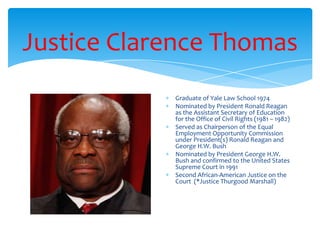
Justice Clarence Thomas
Graduate of Yale Law School 1974
Nominated by President Ronald Reagan
as the Assistant Secretary of Education
for the Office of Civil Rights (1981 – 1982)
Served as Chairperson of the Equal
Employment Opportunity Commission
under President(s) Ronald Reagan and
George H.W. Bush
Nominated by President George H.W.
Bush and confirmed to the United States
Supreme Court in 1991
Second African-American Justice on the
Court (*Justice Thurgood Marshall)
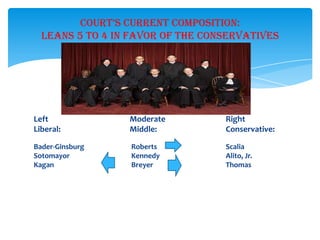
Left Moderate Right
Liberal: Middle: Conservative:
Bader-Ginsburg Roberts Scalia
Sotomayor Kennedy Alito, Jr.
Kagan Breyer Thomas
Court’s Current Composition:
Leans 5 to 4 in favor of the Conservatives
Congress shall make no law
respecting an establishment of
religion, or prohibiting the free
exercise thereof; or abridging the
freedom of speech, or of the press; or
the right of the people peaceably to
assemble, and to petition the
Government for a redress of
grievances.
First Amendment
Interpretation Question: Is speech “free” under any circumstance?
What if the speech leads to violent actions?
Brandenburg v. Ohio (1968)
Facts: A Ku Klux Klan leader was arrested under Ohio law for making
a speech at a Klan rally.
Decision: Free speech is protected unless it is “inciting or producing
imminent lawless action and is likely to incite or produce such
action.”
Key Interpretation: “Freedom of speech” has a broad definition and
is limited only by intent to produce and production of imminent
harm to others.
Freedom of Speech
Interpretation Question: Does “freedom of speech” allow
people to say things that are emotionally harmful to others?
Snyder v. Phelps (Westboro Baptist Church) (2010)
Facts: The Westboro Baptist Church picketed funerals of
military service people with signs that included slogans like
“Thank God for dead soldiers.”
Decision: The church members were protected in their speech.
Key Interpretation: “Freedom of speech” does include speech
that is emotionally harmful to others.
Freedom of Speech
Interpretation Question: Is the “free exercise of religion”
protected, even if animals are killed?
Church of the Lukumi Babalu Aye v. City of Hialeah (1992)
Facts: A church was barred from practicing animal sacrifice by a city
ordinance in Florida.
Decision: There was no “compelling government interest” in the
ordinance, so the city could not bar a religious practice.
Key Interpretation: “Exercise of religion” is given broad latitude
unless the government has a compelling interest in barring any
aspect of it and the law is made so that it does not exceed this
government interest.
Freedom of Religion
A well regulated
militia, being necessary to
the security of a free
state, the right of the
people to keep and bear
arms, shall not be
infringed.
Second
Amendment
Section 1. (for purposes of this presentation
section 1 has been outlined; there are 5
sections)
All persons born or naturalized in the United
States, and subject to the jurisdiction
thereof, are citizens of the United States and of
the state wherein they reside. No state shall
make or enforce any law which shall abridge
the privileges or immunities of citizens of the
United States; nor shall any state deprive any
person of life, liberty, or property, without due
process of law; nor deny to any person within its
jurisdiction the equal protection of the laws.
Fourteenth Amendment
Interpretation Questions:
Is the 2nd Amendment incorporated into the 14th Amendment (such that no
state can take away someone’s 2nd Amendment rights)?
What purpose does the right to bear arms serve?
McDonald v. Chicago (2009)
Facts: The suit was filed to challenge a gun ban.
Decisions: The 2nd Amendment is incorporated into the 14th Amendment.
The right to bear arms is “fundamental to the Nation’s scheme of ordered
liberty” and “deeply rooted in this Nation’s history and tradition.”
Key Interpretations: The right to bear arms is for self-defense and is a
protected right on the national and state levels.
Right to Bear Arms
The right of the people to be secure in their
persons, houses, papers, and
effects, against unreasonable searches
and seizures, shall not be violated, and no
warrants shall issue, but upon probable
cause, supported by oath or
affirmation, and particularly describing
the place to be searched, and the persons
or things to be seized.
Fourth Amendment
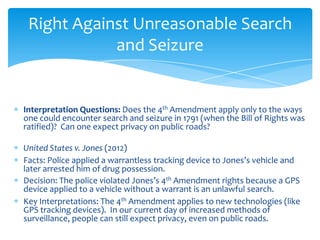
Interpretation Questions: Does the 4th Amendment apply only to the ways
one could encounter search and seizure in 1791 (when the Bill of Rights was
ratified)? Can one expect privacy on public roads?
United States v. Jones (2012)
Facts: Police applied a warrantless tracking device to Jones’s vehicle and
later arrested him of drug possession.
Decision: The police violated Jones’s 4th Amendment rights because a GPS
device applied to a vehicle without a warrant is an unlawful search.
Key Interpretations: The 4th Amendment applies to new technologies (like
GPS tracking devices). In our current day of increased methods of
surveillance, people can still expect privacy, even on public roads.
Right Against Unreasonable Search
and Seizure
No person shall be held to answer for a capital, or
otherwise infamous crime, unless on a presentment or
indictment of a grand jury, except in cases arising in
the land or naval forces, or in the militia, when in
actual service in time of war or public danger; nor
shall any person be subject for the same offense to
be twice put in jeopardy of life or limb; nor shall be
compelled in any criminal case to be a witness
against himself, nor be deprived of life, liberty, or
property, without due process of law; nor shall
private property be taken for public use, without
just compensation.
Fifth Amendment
In all criminal prosecutions, the accused shall enjoy
the right to a speedy and public trial, by an
impartial jury of the state and district wherein the
crime shall have been committed, which district
shall have been previously ascertained by law, and
to be informed of the nature and cause of the
accusation; to be confronted with the witnesses
against him; to have compulsory process for
obtaining witnesses in his favor, and to have the
assistance of counsel for his defense.
Sixth Amendment
Interpretation Questions: Do the 5th and 6th Amendments apply to non-
citizens? What rights do non-citizens have?
Wong Wing v. United States (1895)
Facts: The Chinese Exclusion Act allowed for hard labor and deportation
without a jury trial for Chinese people not in the country legally.
Decision: The hard labor provision is not valid because it would require a
jury trial under under the 5th and 6th Amendments. Deportation without a
jury trial is permitted because it’s not a punishment.
Key Interpretations: Non-citizens have rights under the Constitution, even
if they are not here legally, but they do not have the right to be here or to
stay here.
Right to a Trial by Jury:
non-citizenship
Excessive bail shall
not be required, nor
excessive fines
imposed, nor cruel and
unusual punishments
inflicted.
Eighth Amendment
Interpretation Question: Are punishments “cruel and unusual” when
required for adults and applied to juveniles?
Jackson v. Hobbs (2012)
Facts: A 14-year-old received the standard adult punishment in Arkansas of
life in prison without parole for a robbery that ended in homicide.
Decision: The Supreme Court reversed the punishment and held
that, under the 8th Amendment, juveniles (children under 18) cannot
receive the adult’s maximum punishment or a punishment that other
states do not commonly give juveniles.
Key Interpretation: Courts can determine what is “cruel and unusual”
based on information like the convicted person’s age.
Right Against Cruel and
Unusual Punishment
Questions?
Concept of Judicial Interpretation
In the end, what is Law?
What is the Constitution?
Living, breathing, and evolving or Stagnant and
needs to be re-written?
Conclusion

Supreme Court Constitutional Language

  • 1.
    The Constitutional Language ofLiberty Professor Heidi Jo Green, Political Science
  • 2.
    Common Law Administrative Law JudicialHoldings: Stare Decisis A Brief Overview of the United States Legal System
  • 3.
    Justice John Roberts ChiefJustice Graduate of Harvard Law School 1979 Appointed by President George W. Bush to the Circuit Court of Appeals for Washington, D.C. (2003- 2005) Nominated by President George W. Bush and confirmed to the United States Supreme Court in 2005 Third youngest Chief Justice-age 50 (*Justice John Jay-age 44 in 1789 and Justice John Marshall-age 45 in 1801)
  • 4.
    Justice Ruth BaderGinsburg Graduate of Columbia Law School 1959 Appointed by President Jimmy Carter to the Circuit Court of Appeals for Washington, D.C. (1980 – 1993) Nominated by President Bill Clinton and confirmed to the United States Supreme Court in 1993 Second woman nominated to the Court (*Justice Sandra Day O’Connor)
  • 5.
    Justice Sonia Sotomayor Graduateof Yale Law School 1979 Appointed by President George H.W. Bush to the District Court of the Southern District of New York (1992 – 1998) Appointed by President William Clinton to the Second Circuit Court of Appeals (1998 – 2009) Nominated by President Barack Obama and confirmed to the United States Supreme Court in 2009 First Hispanic Justice on the Court
  • 6.
    Justice Elena Kagan Graduateof Harvard Law School 1986 Dean of Harvard Law School (2003- 2009) United States Solicitor General (2009 – 2010) Nominated by President Barack Obama and confirmed to the United States Supreme Court in 2009
  • 7.
    Justice Stephen Breyer Graduateof Harvard Law School 1964 (*LL.B. bachelor of laws) Appointed by President Jimmy Carter to the First Circuit Court of Appeals (1980 – 1994) Served as Chief Justice of the First Circuit Court of Appeals (1990 – 1994) Nominated by President Bill Clinton and confirmed to The United States Supreme Court in 1994
  • 8.
    Justice Anthony Kennedy Graduateof Harvard Law School 1961 (*LL.B. bachelor of laws) Appointed by President Gerald Ford to the Ninth Circuit Court of Appeals (1975 – 1988) Nominated by President Ronald Reagan and confirmed to the United States Supreme Court in 1988
  • 9.
    Justice Antonin Scalia Graduateof Harvard Law School 1960 (*LL.B bachelor of laws) Appointed by President Richard Nixon as Assistant Attorney General (1974 – 1977) Appointed by President Ronald Reagan to the Circuit Court of Appeals for Washington, D.C. (1982 – 1986) Nominated by President Ronald Reagan and confirmed to the United States Supreme Court in 1986 (*longest serving member of the court)
  • 10.
    Justice Samuel Alito,Jr. Graduate of Yale Law School in 1975 Appointed by President Ronald Reagan as United States Attorney for the District of New Jersey (1987 – 1990) Appointed by President George H.W. Bush to the Third Circuit Court of Appeals (1990 – 2006) Nominated by President George W. Bush and confirmed to the United States Supreme Court in 2006
  • 11.
    Justice Clarence Thomas Graduateof Yale Law School 1974 Nominated by President Ronald Reagan as the Assistant Secretary of Education for the Office of Civil Rights (1981 – 1982) Served as Chairperson of the Equal Employment Opportunity Commission under President(s) Ronald Reagan and George H.W. Bush Nominated by President George H.W. Bush and confirmed to the United States Supreme Court in 1991 Second African-American Justice on the Court (*Justice Thurgood Marshall)
  • 12.
    Left Moderate Right Liberal:Middle: Conservative: Bader-Ginsburg Roberts Scalia Sotomayor Kennedy Alito, Jr. Kagan Breyer Thomas Court’s Current Composition: Leans 5 to 4 in favor of the Conservatives
  • 13.
    Congress shall makeno law respecting an establishment of religion, or prohibiting the free exercise thereof; or abridging the freedom of speech, or of the press; or the right of the people peaceably to assemble, and to petition the Government for a redress of grievances. First Amendment
  • 14.
    Interpretation Question: Isspeech “free” under any circumstance? What if the speech leads to violent actions? Brandenburg v. Ohio (1968) Facts: A Ku Klux Klan leader was arrested under Ohio law for making a speech at a Klan rally. Decision: Free speech is protected unless it is “inciting or producing imminent lawless action and is likely to incite or produce such action.” Key Interpretation: “Freedom of speech” has a broad definition and is limited only by intent to produce and production of imminent harm to others. Freedom of Speech
  • 15.
    Interpretation Question: Does“freedom of speech” allow people to say things that are emotionally harmful to others? Snyder v. Phelps (Westboro Baptist Church) (2010) Facts: The Westboro Baptist Church picketed funerals of military service people with signs that included slogans like “Thank God for dead soldiers.” Decision: The church members were protected in their speech. Key Interpretation: “Freedom of speech” does include speech that is emotionally harmful to others. Freedom of Speech
  • 16.
    Interpretation Question: Isthe “free exercise of religion” protected, even if animals are killed? Church of the Lukumi Babalu Aye v. City of Hialeah (1992) Facts: A church was barred from practicing animal sacrifice by a city ordinance in Florida. Decision: There was no “compelling government interest” in the ordinance, so the city could not bar a religious practice. Key Interpretation: “Exercise of religion” is given broad latitude unless the government has a compelling interest in barring any aspect of it and the law is made so that it does not exceed this government interest. Freedom of Religion
  • 17.
    A well regulated militia,being necessary to the security of a free state, the right of the people to keep and bear arms, shall not be infringed. Second Amendment
  • 18.
    Section 1. (forpurposes of this presentation section 1 has been outlined; there are 5 sections) All persons born or naturalized in the United States, and subject to the jurisdiction thereof, are citizens of the United States and of the state wherein they reside. No state shall make or enforce any law which shall abridge the privileges or immunities of citizens of the United States; nor shall any state deprive any person of life, liberty, or property, without due process of law; nor deny to any person within its jurisdiction the equal protection of the laws. Fourteenth Amendment
  • 19.
    Interpretation Questions: Is the2nd Amendment incorporated into the 14th Amendment (such that no state can take away someone’s 2nd Amendment rights)? What purpose does the right to bear arms serve? McDonald v. Chicago (2009) Facts: The suit was filed to challenge a gun ban. Decisions: The 2nd Amendment is incorporated into the 14th Amendment. The right to bear arms is “fundamental to the Nation’s scheme of ordered liberty” and “deeply rooted in this Nation’s history and tradition.” Key Interpretations: The right to bear arms is for self-defense and is a protected right on the national and state levels. Right to Bear Arms
  • 20.
    The right ofthe people to be secure in their persons, houses, papers, and effects, against unreasonable searches and seizures, shall not be violated, and no warrants shall issue, but upon probable cause, supported by oath or affirmation, and particularly describing the place to be searched, and the persons or things to be seized. Fourth Amendment
  • 21.
    Interpretation Questions: Doesthe 4th Amendment apply only to the ways one could encounter search and seizure in 1791 (when the Bill of Rights was ratified)? Can one expect privacy on public roads? United States v. Jones (2012) Facts: Police applied a warrantless tracking device to Jones’s vehicle and later arrested him of drug possession. Decision: The police violated Jones’s 4th Amendment rights because a GPS device applied to a vehicle without a warrant is an unlawful search. Key Interpretations: The 4th Amendment applies to new technologies (like GPS tracking devices). In our current day of increased methods of surveillance, people can still expect privacy, even on public roads. Right Against Unreasonable Search and Seizure
  • 22.
    No person shallbe held to answer for a capital, or otherwise infamous crime, unless on a presentment or indictment of a grand jury, except in cases arising in the land or naval forces, or in the militia, when in actual service in time of war or public danger; nor shall any person be subject for the same offense to be twice put in jeopardy of life or limb; nor shall be compelled in any criminal case to be a witness against himself, nor be deprived of life, liberty, or property, without due process of law; nor shall private property be taken for public use, without just compensation. Fifth Amendment
  • 23.
    In all criminalprosecutions, the accused shall enjoy the right to a speedy and public trial, by an impartial jury of the state and district wherein the crime shall have been committed, which district shall have been previously ascertained by law, and to be informed of the nature and cause of the accusation; to be confronted with the witnesses against him; to have compulsory process for obtaining witnesses in his favor, and to have the assistance of counsel for his defense. Sixth Amendment
  • 24.
    Interpretation Questions: Dothe 5th and 6th Amendments apply to non- citizens? What rights do non-citizens have? Wong Wing v. United States (1895) Facts: The Chinese Exclusion Act allowed for hard labor and deportation without a jury trial for Chinese people not in the country legally. Decision: The hard labor provision is not valid because it would require a jury trial under under the 5th and 6th Amendments. Deportation without a jury trial is permitted because it’s not a punishment. Key Interpretations: Non-citizens have rights under the Constitution, even if they are not here legally, but they do not have the right to be here or to stay here. Right to a Trial by Jury: non-citizenship
  • 25.
    Excessive bail shall notbe required, nor excessive fines imposed, nor cruel and unusual punishments inflicted. Eighth Amendment
  • 26.
    Interpretation Question: Arepunishments “cruel and unusual” when required for adults and applied to juveniles? Jackson v. Hobbs (2012) Facts: A 14-year-old received the standard adult punishment in Arkansas of life in prison without parole for a robbery that ended in homicide. Decision: The Supreme Court reversed the punishment and held that, under the 8th Amendment, juveniles (children under 18) cannot receive the adult’s maximum punishment or a punishment that other states do not commonly give juveniles. Key Interpretation: Courts can determine what is “cruel and unusual” based on information like the convicted person’s age. Right Against Cruel and Unusual Punishment
  • 27.
    Questions? Concept of JudicialInterpretation In the end, what is Law? What is the Constitution? Living, breathing, and evolving or Stagnant and needs to be re-written? Conclusion