11
Chapter 5Chapter 5
Civil LibertiesCivil Liberties
22Copyright © 2013 CengageCopyright © 2013 Cengage
 WHO GOVERNS?WHO GOVERNS?
1. Why do the courts play so large a role1. Why do the courts play so large a role
in deciding what our civil libertiesin deciding what our civil liberties
should be?should be?
 TO WHAT ENDS?TO WHAT ENDS?
1.1. Why not display religious symbols onWhy not display religious symbols on
government property?government property?
2.2. If a person confesses to committing aIf a person confesses to committing a
crime, why is that confessioncrime, why is that confession
sometimes not used in court?sometimes not used in court?
3.3. Does the Patriot Act reduce ourDoes the Patriot Act reduce our
liberties?liberties?
33Copyright © 2013 CengageCopyright © 2013 Cengage
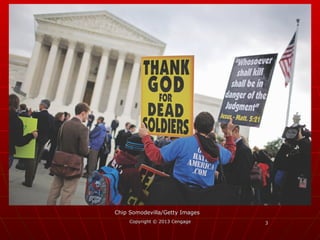
Chip Somodevilla/Getty ImagesChip Somodevilla/Getty Images
44
Culture and Civil LibertiesCulture and Civil Liberties
 Rights in ConflictRights in Conflict
 Cultural ConflictsCultural Conflicts
 Applying the Bill of Rights to theApplying the Bill of Rights to the
StatesStates
Copyright © 2013 CengageCopyright © 2013 Cengage
55
Rights in Conflict
 Examples:
• Right to a fair trial vs. freedom of the
press (Sam Sheppard case)
• US Government’s obligation to “provide
for the common defense” vs. freedom of
the press (“Pentagon Papers case”)
• Freedom of speech vs. preservation of
public order (Carl Kunz case)
Copyright © 2013 CengageCopyright © 2013 Cengage
66
Rights in Conflict
 Acts of the U.S. Congress restricting
civil liberties during wartime:
• Sedition Act of 1798
• Espionage and Sedition Acts 1917 1918‒
• Smith Act 1940
• Internal Security Act 1950
Copyright © 2013 CengageCopyright © 2013 Cengage
77Copyright © 2013 CengageCopyright © 2013 Cengage
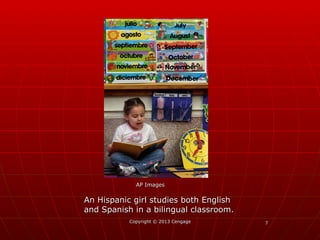
An Hispanic girl studies both EnglishAn Hispanic girl studies both English
and Spanish in a bilingual classroom.and Spanish in a bilingual classroom.
AP ImagesAP Images
88
Culture Conflicts
 Examples:
• Religious displays on public property
• Is bilingual education constitutionally
required?
• May private associations make their own
rules concerning the right to “associate
freely?”
• Balancing community sensitivities vs.
personal self-expression
Copyright © 2013 CengageCopyright © 2013 Cengage
99
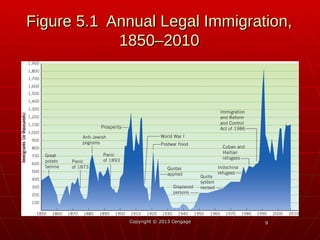
Figure 5.1 Annual Legal Immigration,Figure 5.1 Annual Legal Immigration,
1850–20101850–2010
Copyright © 2013 CengageCopyright © 2013 Cengage
1010
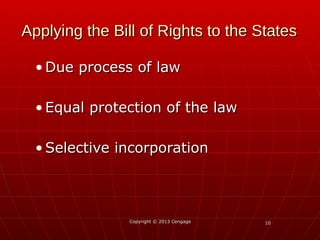
Applying the Bill of Rights to the StatesApplying the Bill of Rights to the States
• Due process of lawDue process of law
• Equal protection of the lawEqual protection of the law
• Selective incorporationSelective incorporation
Copyright © 2013 CengageCopyright © 2013 Cengage
1111
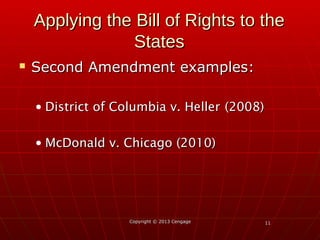
Applying the Bill of Rights to theApplying the Bill of Rights to the
StatesStates
 Second Amendment examples:Second Amendment examples:
• District of Columbia v. HellerDistrict of Columbia v. Heller (2008)(2008)
• McDonald v. Chicago (2010)McDonald v. Chicago (2010)
Copyright © 2013 CengageCopyright © 2013 Cengage
1212
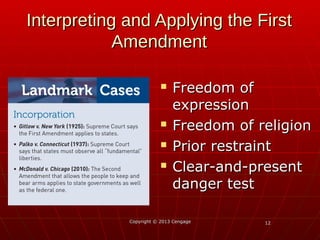
Interpreting and Applying the FirstInterpreting and Applying the First
AmendmentAmendment
 Freedom ofFreedom of
expressionexpression
 Freedom of religionFreedom of religion
 Prior restraintPrior restraint
 Clear-and-presentClear-and-present
danger testdanger test
Copyright © 2013 CengageCopyright © 2013 Cengage
1313
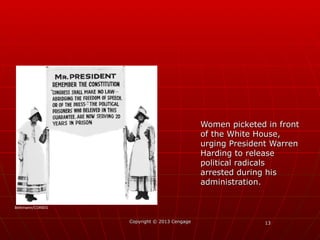
Women picketed in frontWomen picketed in front
of the White House,of the White House,
urging President Warrenurging President Warren
Harding to releaseHarding to release
political radicalspolitical radicals
arrested during hisarrested during his
administration.administration.
Copyright © 2013 CengageCopyright © 2013 Cengage
Bettmann/CORBIS
1414Copyright © 2013 CengageCopyright © 2013 Cengage
What is Speech?What is Speech?
 Forms of speech notForms of speech not
automatically givenautomatically given
constitutionalconstitutional
protection:protection:
1.1. LibelLibel
2.2. ObscenityObscenity
3.3. Symbolic SpeechSymbolic Speech
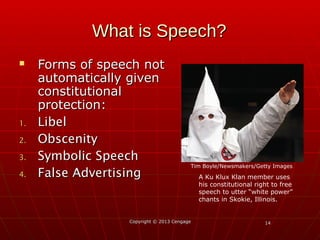
4.4. False AdvertisingFalse Advertising A Ku Klux Klan member uses
his constitutional right to free
speech to utter “white power”
chants in Skokie, Illinois.
Tim Boyle/Newsmakers/Getty Images
1515Copyright © 2013 CengageCopyright © 2013 Cengage
1616
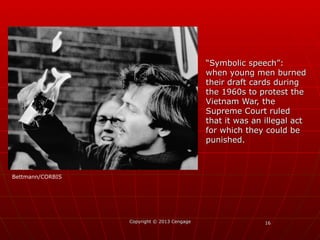
““Symbolic speech”:Symbolic speech”:
when young men burnedwhen young men burned
their draft cards duringtheir draft cards during
the 1960s to protest thethe 1960s to protest the
Vietnam War, theVietnam War, the
Supreme Court ruledSupreme Court ruled
that it was an illegal actthat it was an illegal act
for which they could befor which they could be
punished.punished.
Copyright © 2013 CengageCopyright © 2013 Cengage
Bettmann/CORBIS
1717
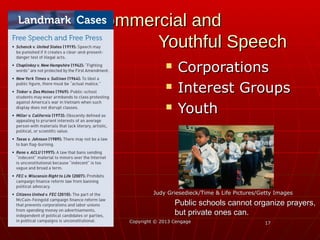
Commercial andCommercial and
Youthful SpeechYouthful Speech
 CorporationsCorporations
 Interest GroupsInterest Groups
 YouthYouth
Copyright © 2013 CengageCopyright © 2013 Cengage
Public schools cannot organize prayers,Public schools cannot organize prayers,
but private ones can.but private ones can.
Judy Griesedieck/Time & Life Pictures/Getty ImagesJudy Griesedieck/Time & Life Pictures/Getty Images
1818
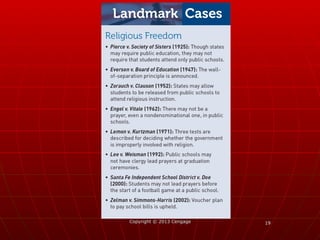
Church and StateChurch and State
 The Free Exercise Clause: CongressThe Free Exercise Clause: Congress
shall make no law prohibiting theshall make no law prohibiting the
“free exercise” of religion“free exercise” of religion
 Establishment Clause: CongressEstablishment Clause: Congress
shall make no law “respecting anshall make no law “respecting an
establishment of religion”establishment of religion”
 Wall of Separation Theory: CourtWall of Separation Theory: Court
ruling that government cannot beruling that government cannot be
involved with religioninvolved with religion
Copyright © 2013 CengageCopyright © 2013 Cengage
1919Copyright © 2013 CengageCopyright © 2013 Cengage
2020
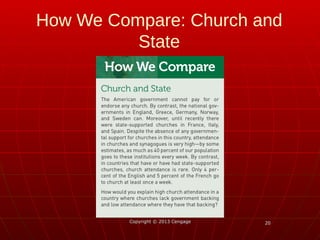
How We Compare: Church and
State
Copyright © 2013 CengageCopyright © 2013 Cengage
2121
Crime and Due ProcessCrime and Due Process
 The Exclusionary RuleThe Exclusionary Rule
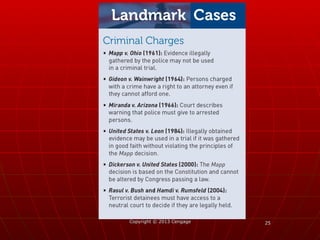
• Mapp v. OhioMapp v. Ohio
 Search and SeizureSearch and Seizure
• Search warrantsSearch warrants
• Giving permission for a searchGiving permission for a search
• ArrestArrest
• ““In plain view” and “under immediate control”In plain view” and “under immediate control”
Copyright © 2013 CengageCopyright © 2013 Cengage
2222
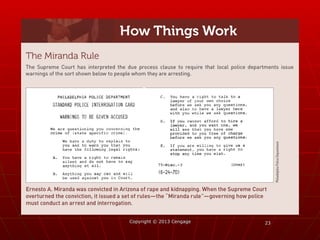
 Confessions and Self-IncriminationConfessions and Self-Incrimination
 Relaxing the Exclusionary RuleRelaxing the Exclusionary Rule
 Terrorism and Civil LibertiesTerrorism and Civil Liberties
 Searches without WarrantsSearches without Warrants
Copyright © 2013 CengageCopyright © 2013 Cengage
Crime and Due ProcessCrime and Due Process
2323Copyright © 2013 CengageCopyright © 2013 Cengage
2424Copyright © 2013 CengageCopyright © 2013 Cengage
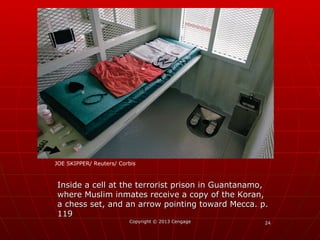
Inside a cell at the terrorist prison in Guantanamo,Inside a cell at the terrorist prison in Guantanamo,
where Muslim inmates receive a copy of the Koran,where Muslim inmates receive a copy of the Koran,
a chess set, and an arrow pointing toward Mecca. p.a chess set, and an arrow pointing toward Mecca. p.
119119
JOE SKIPPER/ Reuters/ Corbis
2525Copyright © 2013 CengageCopyright © 2013 Cengage
2626
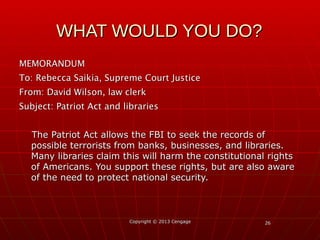
MEMORANDUMMEMORANDUM
To:To: Rebecca Saikia, Supreme Court JusticeRebecca Saikia, Supreme Court Justice
From:From: David Wilson, law clerkDavid Wilson, law clerk
Subject:Subject: Patriot Act and librariesPatriot Act and libraries
The Patriot Act allows the FBI to seek the records ofThe Patriot Act allows the FBI to seek the records of
possible terrorists from banks, businesses, and libraries.possible terrorists from banks, businesses, and libraries.
Many libraries claim this will harm the constitutional rightsMany libraries claim this will harm the constitutional rights
of Americans. You support these rights, but are also awareof Americans. You support these rights, but are also aware
of the need to protect national security.of the need to protect national security.
Copyright © 2013 CengageCopyright © 2013 Cengage
WHAT WOULD YOU DO?WHAT WOULD YOU DO?
2727
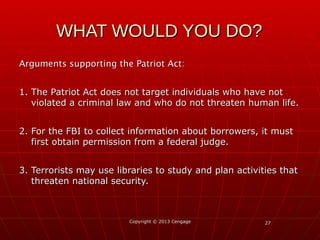
Arguments supporting the Patriot Act:Arguments supporting the Patriot Act:
1. The Patriot Act does not target individuals who have not1. The Patriot Act does not target individuals who have not
violated a criminal law and who do not threaten human life.violated a criminal law and who do not threaten human life.
2. For the FBI to collect information about borrowers, it must2. For the FBI to collect information about borrowers, it must
first obtain permission from a federal judge.first obtain permission from a federal judge.
3. Terrorists may use libraries to study and plan activities that3. Terrorists may use libraries to study and plan activities that
threaten national security.threaten national security.
Copyright © 2013 CengageCopyright © 2013 Cengage
WHAT WOULD YOU DO?WHAT WOULD YOU DO?
2828
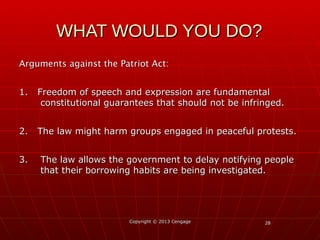
Arguments against the Patriot Act:Arguments against the Patriot Act:
1. Freedom of speech and expression are fundamental1. Freedom of speech and expression are fundamental
constitutional guarantees that should not be infringed.constitutional guarantees that should not be infringed.
2. The law might harm groups engaged in peaceful protests.2. The law might harm groups engaged in peaceful protests.
3. The law allows the government to delay notifying people3. The law allows the government to delay notifying people
that their borrowing habits are being investigated.that their borrowing habits are being investigated.
Copyright © 2013 CengageCopyright © 2013 Cengage
WHAT WOULD YOU DO?WHAT WOULD YOU DO?
2929
Your decision:Your decision:
Uphold this provision ?Uphold this provision ?
Overturn this provision ?Overturn this provision ?
Copyright © 2013 CengageCopyright © 2013 Cengage
WHAT WOULD YOU DO?WHAT WOULD YOU DO?

Chap5

  • 1.
    11 Chapter 5Chapter 5 CivilLibertiesCivil Liberties
  • 2.
    22Copyright © 2013CengageCopyright © 2013 Cengage  WHO GOVERNS?WHO GOVERNS? 1. Why do the courts play so large a role1. Why do the courts play so large a role in deciding what our civil libertiesin deciding what our civil liberties should be?should be?  TO WHAT ENDS?TO WHAT ENDS? 1.1. Why not display religious symbols onWhy not display religious symbols on government property?government property? 2.2. If a person confesses to committing aIf a person confesses to committing a crime, why is that confessioncrime, why is that confession sometimes not used in court?sometimes not used in court? 3.3. Does the Patriot Act reduce ourDoes the Patriot Act reduce our liberties?liberties?
  • 3.
    33Copyright © 2013CengageCopyright © 2013 Cengage Chip Somodevilla/Getty ImagesChip Somodevilla/Getty Images
  • 4.
    44 Culture and CivilLibertiesCulture and Civil Liberties  Rights in ConflictRights in Conflict  Cultural ConflictsCultural Conflicts  Applying the Bill of Rights to theApplying the Bill of Rights to the StatesStates Copyright © 2013 CengageCopyright © 2013 Cengage
  • 5.
    55 Rights in Conflict Examples: • Right to a fair trial vs. freedom of the press (Sam Sheppard case) • US Government’s obligation to “provide for the common defense” vs. freedom of the press (“Pentagon Papers case”) • Freedom of speech vs. preservation of public order (Carl Kunz case) Copyright © 2013 CengageCopyright © 2013 Cengage
  • 6.
    66 Rights in Conflict Acts of the U.S. Congress restricting civil liberties during wartime: • Sedition Act of 1798 • Espionage and Sedition Acts 1917 1918‒ • Smith Act 1940 • Internal Security Act 1950 Copyright © 2013 CengageCopyright © 2013 Cengage
  • 7.
    77Copyright © 2013CengageCopyright © 2013 Cengage An Hispanic girl studies both EnglishAn Hispanic girl studies both English and Spanish in a bilingual classroom.and Spanish in a bilingual classroom. AP ImagesAP Images
  • 8.
    88 Culture Conflicts  Examples: •Religious displays on public property • Is bilingual education constitutionally required? • May private associations make their own rules concerning the right to “associate freely?” • Balancing community sensitivities vs. personal self-expression Copyright © 2013 CengageCopyright © 2013 Cengage
  • 9.
    99 Figure 5.1 AnnualLegal Immigration,Figure 5.1 Annual Legal Immigration, 1850–20101850–2010 Copyright © 2013 CengageCopyright © 2013 Cengage
  • 10.
    1010 Applying the Billof Rights to the StatesApplying the Bill of Rights to the States • Due process of lawDue process of law • Equal protection of the lawEqual protection of the law • Selective incorporationSelective incorporation Copyright © 2013 CengageCopyright © 2013 Cengage
  • 11.
    1111 Applying the Billof Rights to theApplying the Bill of Rights to the StatesStates  Second Amendment examples:Second Amendment examples: • District of Columbia v. HellerDistrict of Columbia v. Heller (2008)(2008) • McDonald v. Chicago (2010)McDonald v. Chicago (2010) Copyright © 2013 CengageCopyright © 2013 Cengage
  • 12.
    1212 Interpreting and Applyingthe FirstInterpreting and Applying the First AmendmentAmendment  Freedom ofFreedom of expressionexpression  Freedom of religionFreedom of religion  Prior restraintPrior restraint  Clear-and-presentClear-and-present danger testdanger test Copyright © 2013 CengageCopyright © 2013 Cengage
  • 13.
    1313 Women picketed infrontWomen picketed in front of the White House,of the White House, urging President Warrenurging President Warren Harding to releaseHarding to release political radicalspolitical radicals arrested during hisarrested during his administration.administration. Copyright © 2013 CengageCopyright © 2013 Cengage Bettmann/CORBIS
  • 14.
    1414Copyright © 2013CengageCopyright © 2013 Cengage What is Speech?What is Speech?  Forms of speech notForms of speech not automatically givenautomatically given constitutionalconstitutional protection:protection: 1.1. LibelLibel 2.2. ObscenityObscenity 3.3. Symbolic SpeechSymbolic Speech 4.4. False AdvertisingFalse Advertising A Ku Klux Klan member uses his constitutional right to free speech to utter “white power” chants in Skokie, Illinois. Tim Boyle/Newsmakers/Getty Images
  • 15.
    1515Copyright © 2013CengageCopyright © 2013 Cengage
  • 16.
    1616 ““Symbolic speech”:Symbolic speech”: whenyoung men burnedwhen young men burned their draft cards duringtheir draft cards during the 1960s to protest thethe 1960s to protest the Vietnam War, theVietnam War, the Supreme Court ruledSupreme Court ruled that it was an illegal actthat it was an illegal act for which they could befor which they could be punished.punished. Copyright © 2013 CengageCopyright © 2013 Cengage Bettmann/CORBIS
  • 17.
    1717 Commercial andCommercial and YouthfulSpeechYouthful Speech  CorporationsCorporations  Interest GroupsInterest Groups  YouthYouth Copyright © 2013 CengageCopyright © 2013 Cengage Public schools cannot organize prayers,Public schools cannot organize prayers, but private ones can.but private ones can. Judy Griesedieck/Time & Life Pictures/Getty ImagesJudy Griesedieck/Time & Life Pictures/Getty Images
  • 18.
    1818 Church and StateChurchand State  The Free Exercise Clause: CongressThe Free Exercise Clause: Congress shall make no law prohibiting theshall make no law prohibiting the “free exercise” of religion“free exercise” of religion  Establishment Clause: CongressEstablishment Clause: Congress shall make no law “respecting anshall make no law “respecting an establishment of religion”establishment of religion”  Wall of Separation Theory: CourtWall of Separation Theory: Court ruling that government cannot beruling that government cannot be involved with religioninvolved with religion Copyright © 2013 CengageCopyright © 2013 Cengage
  • 19.
    1919Copyright © 2013CengageCopyright © 2013 Cengage
  • 20.
    2020 How We Compare:Church and State Copyright © 2013 CengageCopyright © 2013 Cengage
  • 21.
    2121 Crime and DueProcessCrime and Due Process  The Exclusionary RuleThe Exclusionary Rule • Mapp v. OhioMapp v. Ohio  Search and SeizureSearch and Seizure • Search warrantsSearch warrants • Giving permission for a searchGiving permission for a search • ArrestArrest • ““In plain view” and “under immediate control”In plain view” and “under immediate control” Copyright © 2013 CengageCopyright © 2013 Cengage
  • 22.
    2222  Confessions andSelf-IncriminationConfessions and Self-Incrimination  Relaxing the Exclusionary RuleRelaxing the Exclusionary Rule  Terrorism and Civil LibertiesTerrorism and Civil Liberties  Searches without WarrantsSearches without Warrants Copyright © 2013 CengageCopyright © 2013 Cengage Crime and Due ProcessCrime and Due Process
  • 23.
    2323Copyright © 2013CengageCopyright © 2013 Cengage
  • 24.
    2424Copyright © 2013CengageCopyright © 2013 Cengage Inside a cell at the terrorist prison in Guantanamo,Inside a cell at the terrorist prison in Guantanamo, where Muslim inmates receive a copy of the Koran,where Muslim inmates receive a copy of the Koran, a chess set, and an arrow pointing toward Mecca. p.a chess set, and an arrow pointing toward Mecca. p. 119119 JOE SKIPPER/ Reuters/ Corbis
  • 25.
    2525Copyright © 2013CengageCopyright © 2013 Cengage
  • 26.
    2626 MEMORANDUMMEMORANDUM To:To: Rebecca Saikia,Supreme Court JusticeRebecca Saikia, Supreme Court Justice From:From: David Wilson, law clerkDavid Wilson, law clerk Subject:Subject: Patriot Act and librariesPatriot Act and libraries The Patriot Act allows the FBI to seek the records ofThe Patriot Act allows the FBI to seek the records of possible terrorists from banks, businesses, and libraries.possible terrorists from banks, businesses, and libraries. Many libraries claim this will harm the constitutional rightsMany libraries claim this will harm the constitutional rights of Americans. You support these rights, but are also awareof Americans. You support these rights, but are also aware of the need to protect national security.of the need to protect national security. Copyright © 2013 CengageCopyright © 2013 Cengage WHAT WOULD YOU DO?WHAT WOULD YOU DO?
  • 27.
    2727 Arguments supporting thePatriot Act:Arguments supporting the Patriot Act: 1. The Patriot Act does not target individuals who have not1. The Patriot Act does not target individuals who have not violated a criminal law and who do not threaten human life.violated a criminal law and who do not threaten human life. 2. For the FBI to collect information about borrowers, it must2. For the FBI to collect information about borrowers, it must first obtain permission from a federal judge.first obtain permission from a federal judge. 3. Terrorists may use libraries to study and plan activities that3. Terrorists may use libraries to study and plan activities that threaten national security.threaten national security. Copyright © 2013 CengageCopyright © 2013 Cengage WHAT WOULD YOU DO?WHAT WOULD YOU DO?
  • 28.
    2828 Arguments against thePatriot Act:Arguments against the Patriot Act: 1. Freedom of speech and expression are fundamental1. Freedom of speech and expression are fundamental constitutional guarantees that should not be infringed.constitutional guarantees that should not be infringed. 2. The law might harm groups engaged in peaceful protests.2. The law might harm groups engaged in peaceful protests. 3. The law allows the government to delay notifying people3. The law allows the government to delay notifying people that their borrowing habits are being investigated.that their borrowing habits are being investigated. Copyright © 2013 CengageCopyright © 2013 Cengage WHAT WOULD YOU DO?WHAT WOULD YOU DO?
  • 29.
    2929 Your decision:Your decision: Upholdthis provision ?Uphold this provision ? Overturn this provision ?Overturn this provision ? Copyright © 2013 CengageCopyright © 2013 Cengage WHAT WOULD YOU DO?WHAT WOULD YOU DO?

Editor's Notes

  • #10 Replace with updated material.
  • #18 Landmark Cases Box needs Citizens United v. F.E.C (2010) added
  • #24 Replace with jpeg, p. 119