MULTI-THREADING IN JAVA
#Submitted by:
P. Vinay
-238r1a12q1
IT - D
Multithreading in
Java
Multithreading is a powerful feature in Java that allows a
program to execute multiple threads concurrently, improving
efficiency and responsiveness. This presentation will explore the
benefits, concepts, and best practices of utilizing multithreading
in Java development.
What is Multithreading?
1 3
2Concurrent
Execution
Multithreading enables a single
process to have multiple
threads running
simultaneously, each
performing a specific task.
Resource Sharing Threads
within a process share the same
memory space, allowing efficient
utilization of system resources.
Improved
Responsiveness
Multithreading can enhance the
overall responsiveness of an
application by allowing it to
continue processing other tasks
while waiting for a time-
consuming operation to
complete.
Benefits of Multithreading
Increased Efficiency
Multithreading can improve the
overall efficiency of a program by
utilizing system resources more
effectively and reducing idle time.
Enhanced Responsiveness
By allowing the application to
continue
processing other tasks while waiting
for a time-consuming operation,
multithreading can improve the user
experience.
Scalability
Multithreading enables applications
to scale more easily, as additional
threads
can be added to handle increased
workloads.
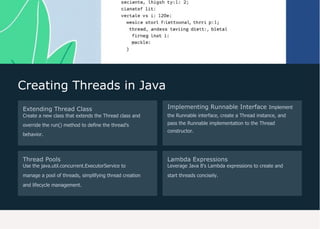
Creating Threads in Java
Thread Pools
Use the java.util.concurrent.ExecutorService to
manage a pool of threads, simplifying thread creation
and lifecycle management.
Extending Thread Class
Create a new class that extends the Thread class and
override the run() method to define the thread's
behavior.
Lambda Expressions
Leverage Java 8's Lambda expressions to create and
start threads concisely.
Implementing Runnable Interface Implement
the Runnable interface, create a Thread instance, and
pass the Runnable implementation to the Thread
constructor.
Thread Life Cycle
1
2
3
4
5
New
A thread is created but not yet
started.
Running
The thread is currently being executed by
the JVM.
Runnable
The thread is eligible for execution and is
waiting to be scheduled by the JVM.
Blocked/ Waiting
The thread is temporarily suspended and
cannot run until a certain condition is met.
Terminated
The thread has completed its task and is
no longer
active.
Thread
Synchronization
Semaphores
Provide a way to control the
number of threads that can
access a shared resource
simultaneously.
Synchronized Methods
Ensures that only one
thread can
access a method
at a time, preventing
race conditions.
Reentrant Locks
Offer more flexibility and
control over synchronization
compared to synchronized
methods and blocks.
Synchronized Blocks
Allows for more granular
synchronization, locking
specific code blocks instead
of entire
methods.
Deadlocks and
Starvation
3
4
2
1
Deadlocks
Occur when two or more threads are waiting for
each other to release resources, leading to a
circular dependency.
Starvation
A situation where a thread is continuously denied
access to a shared resource, leading to lack of
progress.
Fair Scheduling
Implementing fair scheduling policies can help
mitigate the risk of starvation in multithreaded
applications.
Resource Allocation
Careful management of shared resources and
the order in which they are acquired can help
prevent deadlocks.
Best Practices and Considerations
1
3 4
Utilize Thread Pools
Use thread pools to manage the lifecycle of
threads, improving performance and reducing
resource consumption.
Avoid Deadlocks
Carefully design the resource acquisition order
and consider using tools like lock hierarchies to
prevent deadlocks.
Monitor and Debug
Implement comprehensive logging and monitoring to
quickly identify and resolve multithreading-related
issues.
2Minimize Shared Resources
Reduce the number of shared resources to minimize
the potential for race conditions and synchronization
issues.
THANK YOU

Multithreading-in app app-Java.pdf (1).pdf

  • 1.
    MULTI-THREADING IN JAVA #Submittedby: P. Vinay -238r1a12q1 IT - D
  • 2.
    Multithreading in Java Multithreading isa powerful feature in Java that allows a program to execute multiple threads concurrently, improving efficiency and responsiveness. This presentation will explore the benefits, concepts, and best practices of utilizing multithreading in Java development.
  • 3.
    What is Multithreading? 13 2Concurrent Execution Multithreading enables a single process to have multiple threads running simultaneously, each performing a specific task. Resource Sharing Threads within a process share the same memory space, allowing efficient utilization of system resources. Improved Responsiveness Multithreading can enhance the overall responsiveness of an application by allowing it to continue processing other tasks while waiting for a time- consuming operation to complete.
  • 4.
    Benefits of Multithreading IncreasedEfficiency Multithreading can improve the overall efficiency of a program by utilizing system resources more effectively and reducing idle time. Enhanced Responsiveness By allowing the application to continue processing other tasks while waiting for a time-consuming operation, multithreading can improve the user experience. Scalability Multithreading enables applications to scale more easily, as additional threads can be added to handle increased workloads.
  • 5.
    Creating Threads inJava Thread Pools Use the java.util.concurrent.ExecutorService to manage a pool of threads, simplifying thread creation and lifecycle management. Extending Thread Class Create a new class that extends the Thread class and override the run() method to define the thread's behavior. Lambda Expressions Leverage Java 8's Lambda expressions to create and start threads concisely. Implementing Runnable Interface Implement the Runnable interface, create a Thread instance, and pass the Runnable implementation to the Thread constructor.
  • 6.
    Thread Life Cycle 1 2 3 4 5 New Athread is created but not yet started. Running The thread is currently being executed by the JVM. Runnable The thread is eligible for execution and is waiting to be scheduled by the JVM. Blocked/ Waiting The thread is temporarily suspended and cannot run until a certain condition is met. Terminated The thread has completed its task and is no longer active.
  • 7.
    Thread Synchronization Semaphores Provide a wayto control the number of threads that can access a shared resource simultaneously. Synchronized Methods Ensures that only one thread can access a method at a time, preventing race conditions. Reentrant Locks Offer more flexibility and control over synchronization compared to synchronized methods and blocks. Synchronized Blocks Allows for more granular synchronization, locking specific code blocks instead of entire methods.
  • 8.
    Deadlocks and Starvation 3 4 2 1 Deadlocks Occur whentwo or more threads are waiting for each other to release resources, leading to a circular dependency. Starvation A situation where a thread is continuously denied access to a shared resource, leading to lack of progress. Fair Scheduling Implementing fair scheduling policies can help mitigate the risk of starvation in multithreaded applications. Resource Allocation Careful management of shared resources and the order in which they are acquired can help prevent deadlocks.
  • 9.
    Best Practices andConsiderations 1 3 4 Utilize Thread Pools Use thread pools to manage the lifecycle of threads, improving performance and reducing resource consumption. Avoid Deadlocks Carefully design the resource acquisition order and consider using tools like lock hierarchies to prevent deadlocks. Monitor and Debug Implement comprehensive logging and monitoring to quickly identify and resolve multithreading-related issues. 2Minimize Shared Resources Reduce the number of shared resources to minimize the potential for race conditions and synchronization issues.
  • 10.