Definition
• Suppositories aresolid dosage forms inserted into body cavities
(rectum, vagina, urethra) where they melt or dissolve to give local or
systemic effects.
5.
Ideal Properties
• Meltor dissolve at body temperature.
• Non-irritant and stable.
• Compatible with drugs.
• Easily moldable and stable.
6.
Types (Based onRoute)
• Rectal (1–2 g): Local/Systemic.
• Vaginal (3–5 g): Local antifungal/contraceptive.
• Urethral (1–4 g male, 0.5–2 g female): Local action.
Ideal Base Characteristics
•Melt/dissolve at body temp.
• Inert, non-toxic.
• Compatible with drug.
• Good release & mold release properties.
12.
Methods of Preparation
•1. Molding (Fusion) Method.
• 2. Compression Method.
• 3. Hand Rolling Method.
13.
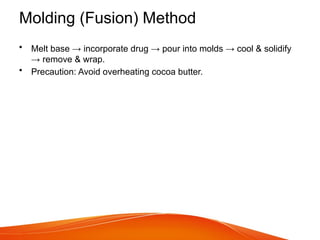
Molding (Fusion) Method
•Melt base → incorporate drug → pour into molds → cool & solidify
→ remove & wrap.
• Precaution: Avoid overheating cocoa butter.
14.
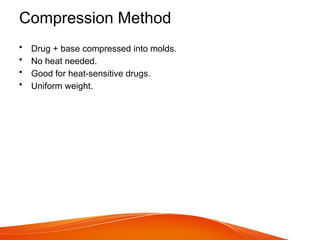
Compression Method
• Drug+ base compressed into molds.
• No heat needed.
• Good for heat-sensitive drugs.
• Uniform weight.
15.
Hand Rolling Method
•Drug mixed in softened base → rolled → cut to length.
• Simple and cheap.
• Used for cocoa butter base.
16.
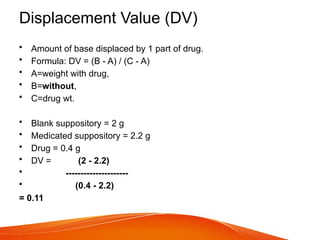
Displacement Value (DV)
•Amount of base displaced by 1 part of drug.
• Formula: DV = (B - A) / (C - A)
• A=weight with drug,
• B=without,
• C=drug wt.
• Blank suppository = 2 g
• Medicated suppository = 2.2 g
• Drug = 0.4 g
• DV = (2 - 2.2)
• ---------------------
• (0.4 - 2.2)
= 0.11
17.
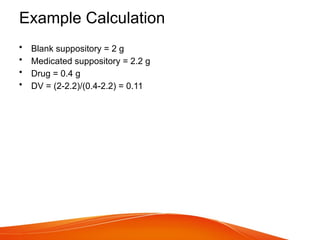
Example Calculation
• Blanksuppository = 2 g
• Medicated suppository = 2.2 g
• Drug = 0.4 g
• DV = (2-2.2)/(0.4-2.2) = 0.11
18.
Evaluation Tests
• Appearance
•Weight variation
• Melting range
• Disintegration time
• Liquefaction time
• Content uniformity
• Drug release
• Hardness.
19.
Storage & Packaging
•Store in cool, dry place.
• Wrap individually in foil.
• Protect from heat & light.