
Internship Report
On
Supply Chain Management Practices
of PRAN Group
Department of Management
University of Chittagong
i
Internship Report
On
Supply Chain Management Practices
of PRAN Group
Submitted To
Dr. Mohammad Khaled Afzal
Professor
Department of Management
University of Chittagong
Submitted By
Md. Abu Kausar Bhuiyan
ID: 13302020
Session: 2016-17
Department of Management
University of Chittagong
Date of Submission: 10 June, 2020
ii
LETTER OF SUBMISSION
June 10, 2020
To
Professor Dr. Mohammad Khaled Afzal
Supervisor of the Internship Report
Department of Management
University of Chittagong
Subject: Submission of Internship Report
Dear Sir,
With due respect, it is my great pleasure for having an opportunity to submit internship report
on “Supply Chain Management Practices of PRAN Group”. I have truly enjoyed my 8-
weeks attachment with the organization and highly appreciate their cooperation in this regard.
I tried my best to gather relevant information for preparing a complete report by following
internship report proposal. Without the sincere cooperation and proper guidance of you, it
would not possible for me to prepare the report.
I hope you will assess my report considering the limitations and mistakes of the study.
Sincerely yours
Md. Abu Kausar Bhuiyan
Id.: 13302020
Session: 2016-17
MBA, Department of Management (SCM)
University of Chittagong
iii
ACKNOWLEDGEMENTS
At the very beginning, my deepest gratitude goes to almighty Allah, who has enabled me to
complete my internship in good health and prepare the report accordingly. I also feel much
pleasure to express my gratitude, sincere appreciation and profound respect to my honorable
teacher Professor Dr. Mohammad Harisur Rahman Howladar the coordinators of the
internship program and also my respectable teacher Professor Dr. Md. Shahidur Rahman,
the honorable chairman for providing overall guidelines about internship report. I feel
grateful to the internship placement committee for arranging such an opportunity.
A special thanks goes to my departmental supervisor, Professor Dr. Mohammad Khaled
Afzal, for his generous help, valuable guidance and useful suggestions regarding this report.
The supervision and support by him help me a lot for the completion of internship program
properly.
I would also like to express my sincere gratitude to Lutfur Rahman Bhuyan, CO of SCM
Department of PRAN Group for his support and allowing me to complete my internship in
their reputed organization.
My gratitude also goes to Mahmud Sarwar(Assistant Manager) and Habibul
Hassan(Assistant Manager) for providing me with the necessary support throughout my
internship journey in the company. The cooperation of other managers, executives & other
staff of the PRAN Group are also gratefully acknowledged. Their generous support is greatly
appreciated.
Finally, I would like to thank the entire respondent for their cooperation.
iv
Supervisor’s Declaration
I am happy to certify that this internship report titled “Supply Chain Management
Practices of PRAN Group” is prepared by Md. Abu Kausar Bhuiyan, ID: 13302020,
Session: 2016-17, student of MBA Program, Department of Management, University of
Chittagong. According to my knowledge this is an original work performed under my
supervision and is not submitted elsewhere.
I, therefore recommend accepting it as his internship report for in MBA program.
Supervisor
…..…………………………………………….
(Professor Dr. Mohammad Khaled Afzal)
v
Executive Summary
As a part of requirement content of completion of MBA Program, this internship report is
conducted. The study has conducted titled on “Supply Chain Management Practices of PRAN
Group” under proper guideline.
Supply chain management is the management of the flow of goods and services and includes
all processes that transform raw materials into final products. In this day and age, SCM plays
an integral part of a firm's success. Efficiently running supply chains allow firms to quickly
deliver products to the end-user for a low cost. In this report it has been seen the practices of
SCM in the PRAN group – a leading company in Bangladesh established in 1981.
This study has been prepared based on the information collected from two types of sources.
One is oral interview, telephone, discussion; face-to-face discussions etc are the primary
sources. The other type of sources are published materials, books, journals, company website
etc are the secondary sources of the study. Firstly a brief overview about different functional
parts of the firm is discussed in chapter 2. Then, a discussion on the functions of SCM was
briefed in chapter 3. Next, SCM practices at PRAN group mainly – sourcing process, supplier
selection process, payment procedure, import process, distribution strategy and some
terminology that are practice were elaborately discussed. Later, in the SWOT analysis the
internal and external environmental conditions of the firm are discussed.
After that, the major problems faced by the PRAN group mainly – large number of SKUs,
lack of synchronizations and for those the recommendations – build a proactive plan and
strategy, integrate logistical process with suppliers are given. Finally, there is the lessons
learned and the reference part is given.
vi
Table of Contents
Chapter 1: Introduction...................................................................................................... 1
1.1 Introduction................................................................................................................. 1
1.2 Objective of the study.................................................................................................. 1
1.3 Rationale of the study.................................................................................................. 1
1.4 Methodology............................................................................................................... 2
1.5 Limitation of the study ................................................................................................ 2
Chapter 2: Organizational Overview ................................................................................. 4
2.1 Industry Overview:...................................................................................................... 4
2.2 Company Overview:.................................................................................................... 5
2.3 Company Profile: ........................................................................................................ 6
2.4 The Business of PRAN:............................................................................................... 7
2.5 Location of Factories:.................................................................................................. 8
2.6 Organogram: ............................................................................................................... 9
2.7 Mission, Vision & Aim: .............................................................................................. 9
2.8 Financial Information: ............................................................................................... 10
2.8.1 Capital:............................................................................................................... 10
2.8.2 Revenue:............................................................................................................. 10
2.8.3 Profitability Ratio ............................................................................................... 11
2.8.4 Earning per Share: .............................................................................................. 12
2.9 Marketing Information: ............................................................................................. 13
2.9.1 Brands of PRAN Group:..................................................................................... 13
2.9.2 Stock Keeping Units: .......................................................................................... 14
2.9.3 Distribution System: ........................................................................................... 15
2.10 About HRM:............................................................................................................ 16
2.10.1 Recruitment Process: ........................................................................................ 16
2.10.2 Selection Process: ............................................................................................. 17
vii
2.11 SCM:....................................................................................................................... 17
2.12 Production Process: ................................................................................................. 18
Chapter 3: Literature Review........................................................................................... 19
3.1 Supply Chain:............................................................................................................ 19
3.2 Supply Chain Management:....................................................................................... 20
3.3 Core Elements of SCM:............................................................................................. 20
3.4 Sourcing:................................................................................................................... 21
3.4.1 The Purchasing Process: ..................................................................................... 21
3.4.2 Supplier Selection:.............................................................................................. 26
3.5 Internal Operation: .................................................................................................... 27
3.5.1 Demand Forecasting: .......................................................................................... 27
3.5.2 Resource Planning System:................................................................................. 34
3.6 Distribution: .............................................................................................................. 39
3.6.1 Transportation: ................................................................................................... 39
3.6.2 Warehousing:...................................................................................................... 43
Chapter 4: Findings & Discussions .................................................................................. 45
4.1 Sourcing:................................................................................................................... 45
4.1.1 Types of Sourcing Used:..................................................................................... 45
4.1.2 Item Sourced: ..................................................................................................... 47
4.1.3 Vendor Selection System:................................................................................... 49
4.2 Purchasing:................................................................................................................ 52
4.2.1 Purchasing Process: ............................................................................................ 52
4.2.2 Payment System: ................................................................................................ 57
4.3 Distribution: .............................................................................................................. 59
4.3.1 Order Collection Point:....................................................................................... 59
4.3.2 Modes of Transportation Used:........................................................................... 59
4.3.3 Transportation Network:..................................................................................... 60
viii
4.4 Some Terminology Followed: ................................................................................... 62
Chapter 5: SWOT Analysis .............................................................................................. 65
5.1 Internal Strengths: ..................................................................................................... 65
5.2 Internal Weaknesses: ................................................................................................. 66
5.3 External Opportunities:.............................................................................................. 67
5.4 External Threats: ....................................................................................................... 68
Chapter 6: Problems, Recommendations & Conclusions................................................ 70
6.1 Problems or Challenges of PRAN Group:.................................................................. 70
6.2 Recommendations: .................................................................................................... 71
6.3 Conclusions:.............................................................................................................. 72
Chapter 7........................................................................................................................... 73
7.1 Lessons from Internship: ........................................................................................... 73
7.2 References................................................................................................................. 74
P a g e | 1
Chapter 1: Introduction
1.1 Introduction
In modern days supply chain management is a key driver for each and every organization. To
run a business properly SCM is a must. An effective SCM team is an essential need for each
and every organization. Supply chain is a dynamic management system where involves the
constant flow of information, products and funds between different stages. In this stages not
only included the manufacturer and suppliers, but also included transporters, warehouses and
retailers who are directly or indirectly related in fulfilling the customer requirement. It refers
to the resources needed to deliver goods and services to a consumer. It involves coordinating
and integrating these flows both within and among companies. The primary objective of the
supply chain management is to improve the service levels to customers while reducing
overall supply chain costs. Effective supply chain network is viewed as the driver of
reductions in lead times and costs, and improvements in product quality and responsiveness.
Therefore, there is no denying fact that, SCM is important for each of the sectors of a
company. This report deals with the overall SCM practices on PRAN Group.
1.2 Objective of the study
The broad objective of the report is to describe the Supply Chain Management Practices of
the PRAN Group.
Specific Objectives:
The specific objectives of this study are as follows:
a) To explore overall Supply Chain process of PRAN Group
b) To elaborate the sourcing process of the PRAN Group
c) To provide some suggestions after identifying the overall issues of PRAN Group
1.3 Rationale of the study
At the ending part of the report, there is problem identification and recommendation. The
study will allow learning about the SCM issues, importance, modern techniques and models
used to make it more efficient. The study will help to learn the practical procedures followed
by the leading organizations in SCM. Moreover, the study will help to differentiate between
P a g e | 2
the practice and the theories that direct to realize how the organization can improve their
SCM practice & process.
1.4 Methodology
The method of this report is mainly descriptive in nature. The data was collected during the
time of February – April; 2020, from SCM department of the head office of PRAN group, by
visiting different suppliers located at Jatrabari, Narayangonj & Fokirapul, and also by visiting
the Ghorashal factories (AMCL, PIP) of PRAN. The total number of respondent in this study
was 80. Two types of information sources are used. This are:
 Primary Source
 Secondary Source
Primary Source:
The primary information was collected by interviewing the staffs, employees, managers,
general manager of different departments, importers, distributors and observing
organizational procedures, structures. Primary data were mostly derived from the discussion
with the employees of the organization.
Secondary Source:
The secondary data are collected from the following sources:
 Website of PRAN
 Annual reports, newsletter and training materials of PRAN
 Internet
 Documentary files of the company
1.5 Limitation of the study
The limitations are:
 It is not allowed to collect information from all source
 The duration of collecting data becomes limited due to the lockdown for COVID-19
all over the country
 It is not allowed to publish some confidential documents
 Some data is collected from different unofficial sources. So there may be some type
of errors
P a g e | 3
However, the information that has been collected is quite helpful for to prepare this paper. I
therefore, hope that the study will be evaluated subject to the recognition of the above
mentioned shortcomings.
P a g e | 4
Chapter 2: Organizational Overview
2.1 Industry Overview:
Consumer goods refer to the final goods and services that are consumed by the households
and not used in the production process of other goods & services. On the other hand, Fast
Moving Consumer Goods (FMCG) are products that are sold rapidly and at comparatively
lower cost. Examples of such FMCGs are packaged foods, beverages, toiletries, over the
counter drugs and similar consumables.
The Fast Moving Consumer Goods (FMGC) sector is one of the largest sector in the
economy of Bangladesh, characterized by a strong multinational companies’ presence well-
established distribution networks, intense competition between the organized and
unorganized segments, and low operational costs. In our country, the journey of FMGC is
started by Haque Group. Haque group started it’s journey in 1947 as a distributor of British
biscuit gaint Huntley & Palmers. It is pioneer in many segments like Cream Crackers,
Bourbon, Sugar Glazed Biscuit, Chocolate Filled Chips etc. After that, in 1948 Bombay
Sweets & Co. Ltd. had come in this sector. After independence the Baby Food Product starts
its journey in 1973 which later turns in Cocola Food Product Ltd. in 1985. There are many
other companies in this sector like: Olympic, Aarong, Golden Harvest, Aftab, Transcom,
ACI, Danish and so on.
According to a study from Bangladesh Bureau of Statistics it is found that, most of the
expenditures are occurring in Food & Beverage items both in rural and urban areas. In Urban
areas, Housing and rent expenses are second area in terms of expenditure as % of total
Consumption expenditure by the individual consumers. In the past few years, the FMCG
industry in Bangladesh has experienced a dramatic growth in consumer durable items (Hamid
et al.,2008).
P a g e | 5
2.2 Company Overview:
PRAN stands for Program for Rural Advancement Nationally.
PRAN is currently the most well-known household name among the millions of people in
Bangladesh and abroad also. In 1981 for the first time PRAN starts its operation as a
processor of fruit and vegetable in Bangladesh. PRAN is one of the good numbers of favorite
food and beverages brand among the millions of people in Bangladesh. In addition to, PRAN
is exporting their goods around 192 countries and the major export markets are Asia, Middle
East & Africa.. They also set up their production plant at Calcata in India. PRAN is
producing more than 200 products under 10 different categories which are: Juice, Drinks,
Mineral, Carbonated Beverage, Bakery, Snacks, Culinary, Confectionary, Biscuit and Milk.
The company has adopted ISO 9001 as a guiding principle of its management system. The
company is complaint to HACCP & certified with HALAL which ensures only the best
quality products are reaches to the consumers table across the Globe. Currently, PRAN Group
is exporting $50 million per year to different countries.
P a g e | 6
2.3 Company Profile:
Name PRAN GROUP
Logo
Founder Major General Amjad Khan Chowdhury (retd)
Key Person
Ahsan Khan Chowdhury (CEO)
Md Eleash Mridha (Managing Director)
Location
PRAN Center
105, Middle Badda, Dhaka-1212
Establishment 1980
Business Type Manufacturer
Business Unit 20
No. of Total Employees 58000
Product
Juice, Beverage, Confectionary, Culinary, Dairy, Biscuit,
Frozen Food
Geographic Market Southeast Asia, North America, Europe, Middle East
Quality Standard
ISO 9001:2000, ISO 14001, ISO 22000, OHSAS 18001,
HACCP, HALAL Certification
Nature of Ownership Public Limited
Annual Sales Range
(USD)
US$5 Million – US$10 Million
P a g e | 7
Banks Dealing With HSBC, Standard Chartered, IPDC Finance, Al-Arafah, Primer,
Jamuna, IFIC, IDLC, UCBL
Key Suppliers
Bashundhara Group, ACI Group, Sajeeb Group, Citi Group,
Meghna Group, Linde, Fulkoli, Madnina Group
Website www.pranfoods.net
2.4 The Business of PRAN:
PRAN agriculture marketing company limited has controlled the nine individual Business
Units on their umbrella.
i. Agricultural Marketing Company Limited (AMCL)
ii. PRAN Foods Limited (PFL)
iii. PRAN Agro Limited (PAL)
iv. PRAN Agro Business Limited (PABL)
v. Bango Agro Processing Limited (BAPL)
vi. PRAN Dairy Limited (PDL)
vii. PRAN Beverage Limited (PBL)
viii. PRAN Confectionery Limited (PCL)
ix. PRAN Export Limited (PEL)
x. Mymensingh Agro Limited (MAL)
xi. PRAN Frozen Foods (PFF)
xii. PRAN Sweetened Confectionery Limited (PSCL)
xiii. Natore Ago Limited (NAL)
xiv. Habigonj Agro Limited (HAL)
xv. PRAN Tasty Treat (PTT)
xvi. Bango Bakers Limited (BBL)
xvii. Sun Basic Chemical Limited (SBCL)
xviii. Silvan Agro Limited (SAL)
xix. PRAN Industrial Park (PIP)
xx. Packmat Industries Limited (PIL)
P a g e | 8
2.5 Location of Factories:
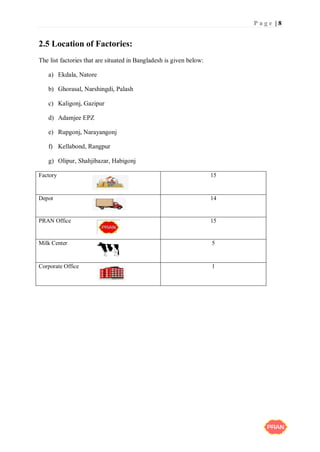
The list factories that are situated in Bangladesh is given below:
a) Ekdala, Natore
b) Ghorasal, Narshingdi, Palash
c) Kaligonj, Gazipur
d) Adamjee EPZ
e) Rupgonj, Narayangonj
f) Kellabond, Rangpur
g) Olipur, Shahjibazar, Habigonj
Factory 15
Depot 14
PRAN Office 15
Milk Center 5
Corporate Office 1
P a g e | 9
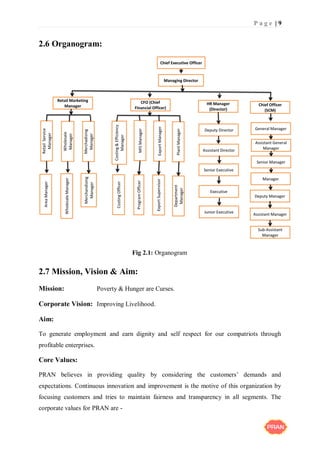
2.6 Organogram:
2.7 Mission, Vision & Aim:
Mission: Poverty & Hunger are Curses.
Corporate Vision: Improving Livelihood.
Aim:
To generate employment and earn dignity and self respect for our compatriots through
profitable enterprises.
Core Values:
PRAN believes in providing quality by considering the customers’ demands and
expectations. Continuous innovation and improvement is the motive of this organization by
focusing customers and tries to maintain fairness and transparency in all segments. The
corporate values for PRAN are -
Fig 2.1: Organogram
P a g e | 10
 Consumer Care
 Supplier Care
 Employee Care
 Trade Care
2.8 Financial Information:
2.8.1 Capital:
The PRAN Group has an authorized capital of taka 500 million.
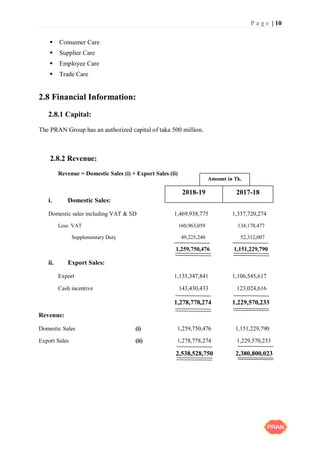
2.8.2 Revenue:
Revenue = Domestic Sales (i) + Export Sales (ii)
i. Domestic Sales:
Domestic sales including VAT & SD 1,469,938,775 1,337,720,274
Less: VAT 160,963,059 134,178,477
Supplementary Duty 49,225,240 52,312,007
1,259,750,476 1,151,229,790
ii. Export Sales:
Export 1,135,347,841 1,106,545,617
Cash incentive 143,430,433 123,024,616
1,278,778,274 1,229,570,233
Revenue:
Domestic Sales (i) 1,259,750,476 1,151,229,790
Export Sales (ii) 1,278,778,274 1,229,570,233
2,538,528,750 2,380,800,023
2018-19 2017-18
Amount in Tk.
P a g e | 11
Comments:
From the above statement, it is seen that both the domestic and export sale increases in
respect to the previous year. It is seen that the domestic sales increases to an approximate
amount of 10 crore and the export sales increases to 4 crore. So, in an average the total
revenue increases to 6.6% (approx.) than the previous year.
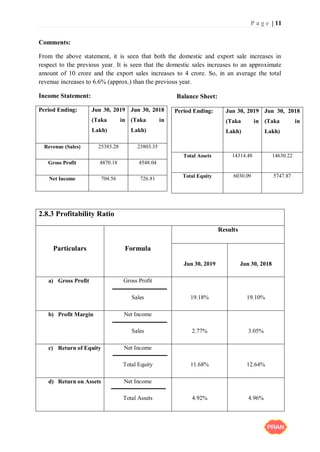
Income Statement:
Period Ending: Jun 30, 2019
(Taka in
Lakh)
Jun 30, 2018
(Taka in
Lakh)
Revenue (Sales) 25385.28 23803.35
Gross Profit 4870.18 4548.04
Net Income 704.56 726.81
2.8.3 Profitability Ratio
Particulars Formula
Results
Jun 30, 2019 Jun 30, 2018
a) Gross Profit Gross Profit
Sales 19.18% 19.10%
b) Profit Margin Net Income
Sales 2.77% 3.05%
c) Return of Equity Net Income
Total Equity 11.68% 12.64%
d) Return on Assets Net Income
Total Assets 4.92% 4.96%
Period Ending: Jun 30, 2019
(Taka in
Lakh)
Jun 30, 2018
(Taka in
Lakh)
Total Assets 14314.48 14630.22
Total Equity 6030.09 5747.87
Balance Sheet:
P a g e | 12
Comments:
a) Gross Profit: Gross profit is the profit a company makes after deducting the costs
associated with making and selling its products. From above table we can see that,
during the year 2019 and 2018 the revenue generated by the firm is 19.18% and
19.10% respectively which is a quite satisfactory in amount. But the revenue
generation rate in compare to the two year is nearly same, which is not so good.
b) Profit Margin: Profit margin indicates the profitability of a product, service, or
business. The difference between the gross profit and profit margin is that, gross
profit usually applies to a specific product or line rather than an entire business. On
the other, net profit margin is a calculation that expresses the profitability of an entire
company, not just a single product or service. And in case of profit margin, the higher
the percentage, the more profitable the company. But here it is seen that the
profitability decrease to 0.28%.
c) Return of Equity: The firm has a RoE of 11.68% and 12.64% in the year of 2019 &
2018 respectively, which means in every 1 taka of company equity, the firm generated
0.11 and 0.12 in profit.
d) Return on Assets: The firm has a RoA of 4.92% and 4.96% in the year of 2019 &
2018 respectively that means in every 1 taka of company asset, the firm generated
0.492 and 0.496 in profit.
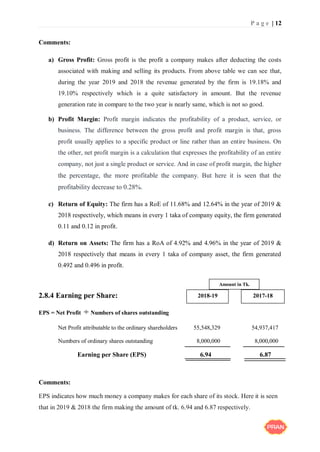
2.8.4 Earning per Share:
EPS = Net Profit ÷ Numbers of shares outstanding
Net Profit attributable to the ordinary shareholders 55,548,329 54,937,417
Numbers of ordinary shares outstanding 8,000,000 8,000,000
Earning per Share (EPS) 6.94 6.87
Comments:
EPS indicates how much money a company makes for each share of its stock. Here it is seen
that in 2019 & 2018 the firm making the amount of tk. 6.94 and 6.87 respectively.
2018-19 2017-18
Amount in Tk.
P a g e | 13
2.9 Marketing Information:
2.9.1 Brands of PRAN Group:
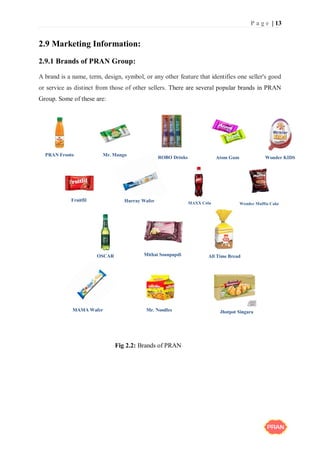
A brand is a name, term, design, symbol, or any other feature that identifies one seller's good
or service as distinct from those of other sellers. There are several popular brands in PRAN
Group. Some of these are:
PRAN Frooto Mr. Mango
Fruitfil
ROBO Drinks Atom Gum Wonder KIDS
r
Hurray Wafer MAXX Cola Wonder Muffin Cake
OSCAR Mithai Soanpapdi All Time Bread
MAMA Wafer Mr. Noodles Jhotpot Singara
Fig 2.2: Brands of PRAN
P a g e | 14
2.9.2 Stock Keeping Units:
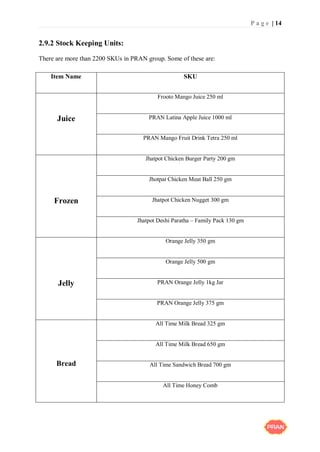
There are more than 2200 SKUs in PRAN group. Some of these are:
Item Name SKU
Juice
Frooto Mango Juice 250 ml
PRAN Latina Apple Juice 1000 ml
PRAN Mango Fruit Drink Tetra 250 ml
Frozen
Jhatpot Chicken Burger Party 200 gm
Jhotpat Chicken Meat Ball 250 gm
Jhatpot Chicken Nugget 300 gm
Jhatpot Deshi Paratha – Family Pack 130 gm
Jelly
Orange Jelly 350 gm
Orange Jelly 500 gm
PRAN Orange Jelly 1kg Jar
PRAN Orange Jelly 375 gm
Bread
All Time Milk Bread 325 gm
All Time Milk Bread 650 gm
All Time Sandwich Bread 700 gm
All Time Honey Comb
P a g e | 15
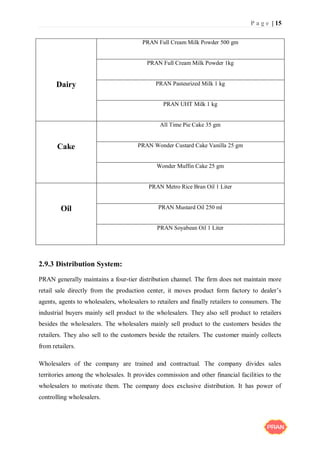
Dairy
PRAN Full Cream Milk Powder 500 gm
PRAN Full Cream Milk Powder 1kg
PRAN Pasteurized Milk 1 kg
PRAN UHT Milk 1 kg
Cake
All Time Pie Cake 35 gm
PRAN Wonder Custard Cake Vanilla 25 gm
Wonder Muffin Cake 25 gm
Oil
PRAN Metro Rice Bran Oil 1 Liter
PRAN Mustard Oil 250 ml
PRAN Soyabean Oil 1 Liter
2.9.3 Distribution System:
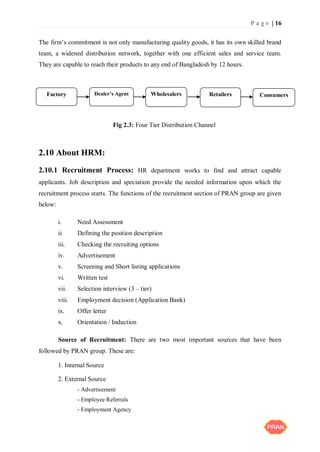
PRAN generally maintains a four-tier distribution channel. The firm does not maintain more
retail sale directly from the production center, it moves product form factory to dealer’s
agents, agents to wholesalers, wholesalers to retailers and finally retailers to consumers. The
industrial buyers mainly sell product to the wholesalers. They also sell product to retailers
besides the wholesalers. The wholesalers mainly sell product to the customers besides the
retailers. They also sell to the customers beside the retailers. The customer mainly collects
from retailers.
Wholesalers of the company are trained and contractual. The company divides sales
territories among the wholesales. It provides commission and other financial facilities to the
wholesalers to motivate them. The company does exclusive distribution. It has power of
controlling wholesalers.
P a g e | 16
The firm’s commitment is not only manufacturing quality goods, it has its own skilled brand
team, a widened distribution network, together with one efficient sales and service team.
They are capable to reach their products to any end of Bangladesh by 12 hours.
2.10 About HRM:
2.10.1 Recruitment Process: HR department works to find and attract capable
applicants. Job description and speciation provide the needed information upon which the
recruitment process starts. The functions of the recruitment section of PRAN group are given
below:
i. Need Assessment
ii. Defining the position description
iii. Checking the recruiting options
iv. Advertisement
v. Screening and Short listing applications
vi. Written test
vii. Selection interview (3 – tier)
viii. Employment decision (Application Bank)
ix. Offer letter
x. Orientation / Induction
Source of Recruitment: There are two most important sources that have been
followed by PRAN group. These are:
1. Internal Source
2. External Source
- Advertisement
- Employee Referrals
- Employment Agency
Factory Dealer’s Agent Wholesalers Retailers Consumers
Fig 2.3: Four Tier Distribution Channel
P a g e | 17
- Walk-ins & Write-ins
- Consulting the CV Bank
2.10.2 Selection Process:
Selection is the process of gathering information for the purpose of evaluating and deciding
who should be employed in particular jobs. In the section this below things are done:
- Screening & Short listing Applications
- Written Test
- Selection Interview
- Reference Check
- Employment Decision
- Offering The Role
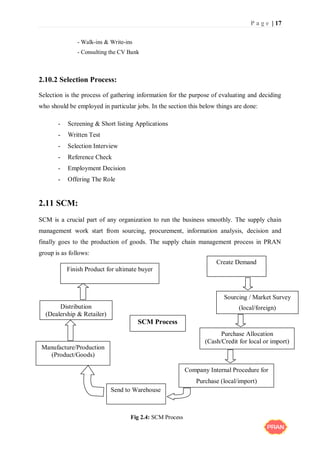
2.11 SCM:
SCM is a crucial part of any organization to run the business smoothly. The supply chain
management work start from sourcing, procurement, information analysis, decision and
finally goes to the production of goods. The supply chain management process in PRAN
group is as follows:
Create Demand
Sourcing / Market Survey
(local/foreign)
Finish Product for ultimate buyer
Purchase Allocation
(Cash/Credit for local or import)
Distribution
(Dealership & Retailer)
Manufacture/Production
(Product/Goods)
SCM Process
Company Internal Procedure for
Purchase (local/import)
Send to Warehouse
Fig 2.4: SCM Process
P a g e | 18
Working area of SCM in PRAN Group:
- Material planning based on sales forecast.
- Purchasing.
- Transportation
- Store & Inventory Management
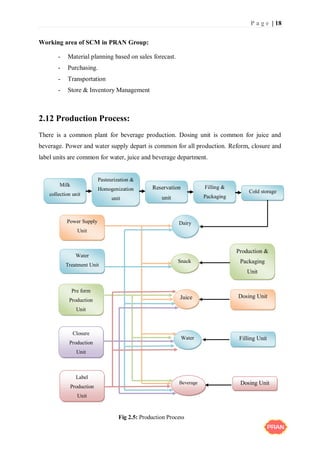
2.12 Production Process:
There is a common plant for beverage production. Dosing unit is common for juice and
beverage. Power and water supply depart is common for all production. Reform, closure and
label units are common for water, juice and beverage department.
Milk
collection unit
Pasteurization &
Homogenization
unit
Reservation
unit
Filling &
Packaging
unit
Cold storage
Power Supply
Unit
Water
Treatment Unit
Pre form
Production
Unit
Closure
Production
Unit
Label
Production
Unit
Production &
Packaging
Unit
Filling Unit
Dosing Unit
Dairy
Snack
Juice
Water
Beverage Dosing Unit
Fig 2.5: Production Process
P a g e | 19
Chapter 3: Literature Review
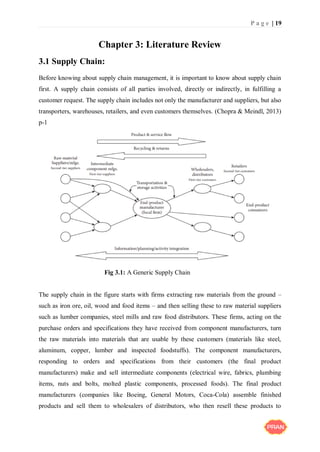
3.1 Supply Chain:
Before knowing about supply chain management, it is important to know about supply chain
first. A supply chain consists of all parties involved, directly or indirectly, in fulfilling a
customer request. The supply chain includes not only the manufacturer and suppliers, but also
transporters, warehouses, retailers, and even customers themselves. (Chopra & Meindl, 2013)
p-1
The supply chain in the figure starts with firms extracting raw materials from the ground –
such as iron ore, oil, wood and food items – and then selling these to raw material suppliers
such as lumber companies, steel mills and raw food distributors. These firms, acting on the
purchase orders and specifications they have received from component manufacturers, turn
the raw materials into materials that are usable by these customers (materials like steel,
aluminum, copper, lumber and inspected foodstuffs). The component manufacturers,
responding to orders and specifications from their customers (the final product
manufacturers) make and sell intermediate components (electrical wire, fabrics, plumbing
items, nuts and bolts, molted plastic components, processed foods). The final product
manufacturers (companies like Boeing, General Motors, Coca-Cola) assemble finished
products and sell them to wholesalers of distributors, who then resell these products to
Fig 3.1: A Generic Supply Chain
P a g e | 20
retailers as their product orders are received. Retailers in turn sell these products to us, the
end-product consumers. (Wisner, Tan, & Leong, 2012) p-6
3.2 Supply Chain Management:
There are various definition of supply chain management by different authors and
professional association. Some of these are:
“The management of upstream and downstream relationships with suppliers and customers in
order to deliver superior customer value at less cost to the supply chain as a whole.”
(Christopher, 2011) p-3
The Council of Supply Chain Management Professionals (CSCMP) defines supply chain
management as: “The planning and managing of all activities involved in sourcing and
procurement, conversion and all logistics management activities. Importantly, it also includes
coordination and collaboration with channel partners, which can be suppliers, intermediates,
third-party service providers and customers.”
The Institute for Supply Management (ISM) describes supply chain management as: “The
design and management of seamless, value-add processes across organizational boundaries to
meet the real needs of the end customers.”
The Singapore-based Logistics & Supply Chain Management Society defines supply chain
management as: “The coordinated set of techniques to plan and execute all steps in the global
network used to acquire raw materials from vendors, transform them into finished goods, and
deliver both goods and services to customers.” Wisner et al. (2012) p-8
3.3 Core Elements of SCM:
Supply Chain Management has three major parts. These are:
 Sourcing
 Internal Operation
 Distribution
P a g e | 21
3.4 Sourcing:
Purchasing, also called procurement is the process by which companies acquire raw
materials, components, products, services, or other resources from suppliers to execute their
operations. Sourcing is the entire set of business processes required to purchase goods and
services (Chopra & Meindl, 2013). Purchasing can be defined as the act of obtaining
merchandise, capital requirements, raw materials, services, or maintenance, repair and
operating (MRO) supplies in exchange for money or its equivalent. Purchasing can be
broadly classified into two categories:
 Merchants
 Industrial Buyers
The first category, merchants, includes the wholesalers and retailers, who primarily purchase
for resale purpose. Generally, merchants purchase their merchandise in volume to take
advantage of quantity discounts and other incentives such as transportation economy and
storage efficiency. On the other, the second category, industrial buyers, whose primary task is
to purchase raw materials for conversion purpose. Wisner et al. (2012)
3.4.1 The Purchasing Process:
The purchasing process can be categories into two types. These are:
 The Manual Purchasing Process
 Electronic Purchasing Process (e-Procurement)
3.4.1.1 The Manual Purchasing Process:
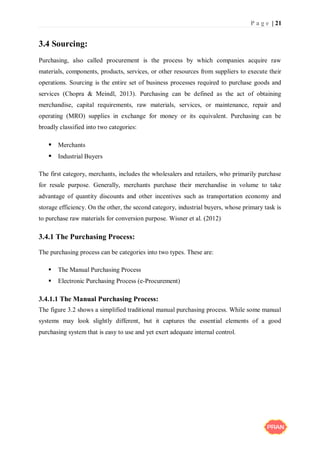
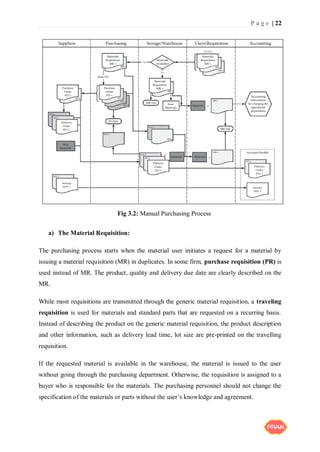
The figure 3.2 shows a simplified traditional manual purchasing process. While some manual
systems may look slightly different, but it captures the essential elements of a good
purchasing system that is easy to use and yet exert adequate internal control.
P a g e | 22
a) The Material Requisition:
The purchasing process starts when the material user initiates a request for a material by
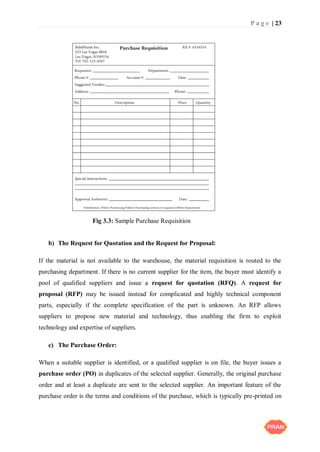
issuing a material requisition (MR) in duplicates. In some firm, purchase requisition (PR) is
used instead of MR. The product, quality and delivery due date are clearly described on the
MR.
While most requisitions are transmitted through the generic material requisition, a traveling
requisition is used for materials and standard parts that are requested on a recurring basis.
Instead of describing the product on the generic material requisition, the product description
and other information, such as delivery lead time, lot size are pre-printed on the travelling
requisition.
If the requested material is available in the warehouse, the material is issued to the user
without going through the purchasing department. Otherwise, the requisition is assigned to a
buyer who is responsible for the materials. The purchasing personnel should not change the
specification of the materials or parts without the user’s knowledge and agreement.
Fig 3.2: Manual Purchasing Process
P a g e | 23
b) The Request for Quotation and the Request for Proposal:
If the material is not available to the warehouse, the material requisition is routed to the
purchasing department. If there is no current supplier for the item, the buyer must identify a
pool of qualified suppliers and issue a request for quotation (RFQ). A request for
proposal (RFP) may be issued instead for complicated and highly technical component
parts, especially if the complete specification of the part is unknown. An RFP allows
suppliers to propose new material and technology, thus enabling the firm to exploit
technology and expertise of suppliers.
c) The Purchase Order:
When a suitable supplier is identified, or a qualified supplier is on file, the buyer issues a
purchase order (PO) in duplicates of the selected supplier. Generally, the original purchase
order and at least a duplicate are sent to the selected supplier. An important feature of the
purchase order is the terms and conditions of the purchase, which is typically pre-printed on
Fig 3.3: Sample Purchase Requisition
P a g e | 24
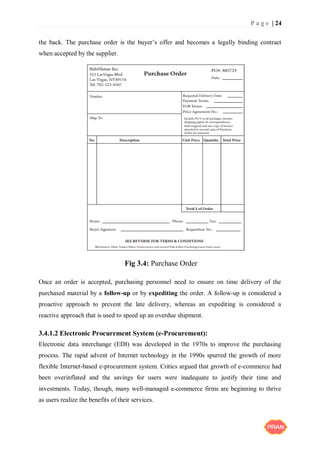
the back. The purchase order is the buyer’s offer and becomes a legally binding contract
when accepted by the supplier.
Once an order is accepted, purchasing personnel need to ensure on time delivery of the
purchased material by a follow-up or by expediting the order. A follow-up is considered a
proactive approach to prevent the late delivery, whereas an expediting is considered a
reactive approach that is used to speed up an overdue shipment.
3.4.1.2 Electronic Procurement System (e-Procurement):
Electronic data interchange (EDI) was developed in the 1970s to improve the purchasing
process. The rapid advent of Internet technology in the 1990s spurred the growth of more
flexible Internet-based e-procurement system. Critics argued that growth of e-commerce had
been overinflated and the savings for users were inadequate to justify their time and
investments. Today, though, many well-managed e-commerce firms are beginning to thrive
as users realize the benefits of their services.
Fig 3.4: Purchase Order
P a g e | 25
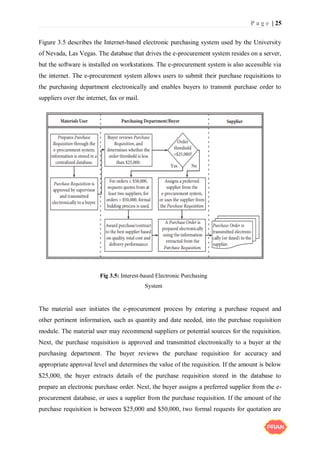
Figure 3.5 describes the Internet-based electronic purchasing system used by the University
of Nevada, Las Vegas. The database that drives the e-procurement system resides on a server,
but the software is installed on workstations. The e-procurement system is also accessible via
the internet. The e-procurement system allows users to submit their purchase requisitions to
the purchasing department electronically and enables buyers to transmit purchase order to
suppliers over the internet, fax or mail.
The material user initiates the e-procurement process by entering a purchase request and
other pertinent information, such as quantity and date needed, into the purchase requisition
module. The material user may recommend suppliers or potential sources for the requisition.
Next, the purchase requisition is approved and transmitted electronically to a buyer at the
purchasing department. The buyer reviews the purchase requisition for accuracy and
appropriate approval level and determines the value of the requisition. If the amount is below
$25,000, the buyer extracts details of the purchase requisition stored in the database to
prepare an electronic purchase order. Next, the buyer assigns a preferred supplier from the e-
procurement database, or uses a supplier from the purchase requisition. If the amount of the
purchase requisition is between $25,000 and $50,000, two formal requests for quotation are
Fig 3.5: Interest-based Electronic Purchasing
System
P a g e | 26
needed before the purchase order can be released. However, if the amount exceeds $50,000, a
supplier must be chosen by means of a formal bidding process. At the specified time and
place, bids are opened publicly. The purchase is awarded to the lowest responsible bidder
whose bid conforms to all requirements of the solicitation. Then an electronic purchase order
(or formal contract for purchase of services) is prepared and transmitted or mailed to the
selected supplier.
3.4.2 Supplier Selection:
The decision to select a supplier for office supplies or other noncritical materials is likely to
be an easy one. However, the process of selecting a group of component suppliers for
important materials, which can potentially impact the firm’s competitive advantage, is a
complex one and should be based on multiple criteria. Factors that firms should consider
while selecting supplier include:
1. Process and Product Technology: Suppliers should have competent process
technologies to produce superior products at a reasonable cost to enhance the buyer’s
competitive edge.
2. Willingness to Share Technology and Information: With the current trend that favors
outsourcing to exploit suppliers’ capabilities and to focus on core competencies, it is vital
that firms seek suppliers that are willing to share their technology and information.
Suppliers can assist in new product design and development through early supplier
involvement (ESI) to ensure cost-effective design choices, develop alternative
conceptual solutions, select the best components and technologies and help in design
assessment.
3. Quality: Quality levels of the purchased item should be a very important factor in
supplier selection. Product quality should be high and consistent since it can be directly
affect the quality of the finished goods.
4. Cost: While unit price of the material is not typically the sole criterion in supplier
selection, total cost of ownership is an important factor. Total cost of ownership or total
cost of acquisition includes the unit price of the materials, payment terms, cash discount,
ordering cost, carrying cost, logistical costs, maintenance costs and other more
qualitative costs that may not be easy to assess. The total cost of analysis demonstrates
how other costs beside unit price can affect the purchase decision.
5. Reliability: Besides reliable quality level, reliability refers to other supplier
characteristics – financial stability, delivery lead time.
P a g e | 27
6. Order System and Cycle Time: Placing orders with a supplier should be easy, quick
and effective. Delivery lead time should be short, so that small lot sizes can be ordered
on a frequent basis to reduce inventory holding costs.
7. Capacity: The firm should also consider whether the supplier has the capacity to fill
orders to meet requirements and the ability to fill large orders if needed.
8. Communication Capabilities: Suppliers should also possess a communication
capability that facilities between the parties.
9. Location: Geographical location is another important factor in supplier selection, as it
impacts delivery lead-time, transportation and logistical costs. Some firms require their
suppliers to be located within a certain distance from their facilities.
10. Service: Suppliers must be able to back up their products by providing good services
when needed.
There are numerous other factors – some strategies, other tactical – that a firm must consider
when choosing suppliers. The ability to select competent strategic supplier directly affect
firm’s competitive success.
3.5 Internal Operation:
Internal operation consists of several issues. These are:
 Demand Forecasting
 Resource Planning System
3.5.1 Demand Forecasting:
Forecasting is only one of three key activities in CPFR [Collaborative Planning, Forecasting
and Replenishment]. Planning is the process of working together to organize and to resolve
key barrier to rapid and effective delivery of goods in the supply chain. Replenishment is the
activity of accomplishing timely, accurate and complete fulfillment between partners in the
supply chain and between distribution centre and selling location. The middle activity,
Forecasting, has to have as its end result a reliable order forecast that the supplier actually
uses to drive acquisition and manufacturing to support on time and complete shipment.
P a g e | 28
3.5.1.1 Forecasting Techniques:
Understanding that a forecast is very often inaccurate does not mean that nothing can be done
to improve that forecast. Both qualitative and quantitative forecast are used by firm to make
their continuous improvement.
3.5.1.1.1 Qualitative Methods:
Qualitative forecasting methods are based on intuition and judgmental evaluation and are
generally used when data are limited, unavailable, or not current relevant. While this
approach can be very low cost, and its effectiveness depends to a large extent on the skill and
experience of the forecaster(s) and amount of relevant information available.
Some of these qualitative forecasting methods are:
a) Jury of Expertise: A group of senior management executives who are
knowledgeable about the market, their competitors and the business environment
collectively develop this forecast. This technique has the advantage of several
individuals with considerable experience working together, but if one member’s
views dominate the discussion, then the value and reliability of the output can be
diminished.
b) Delphi Method: A group of internal and external experts are surveyed during several
rounds in terms of future events and long-term forecasts of demand. Group members
do not physically meet thus avoid the scenario where one or a few experts could
dominate a discussion. The answer from the experts are accumulated after each round
of the survey and summarized. The summary of responses is then sent out to all the
experts in the next round, wherein individual experts can modify their responses
based on the group’s response summary. This iterative process continues until a
consensus is reached. The process can be both time-consuming and expensive.
c) Sales Force Composite: The sales force represents a good source of market
information. This type of forecast is generated based on the sales force’s knowledge
of the market and estimates of customer needs. Due to the proximity of the sales
personnel to the consumers, the forecast tends to be reliable, but individual biases
could negatively impact the effectiveness of this approach.
P a g e | 29
d) Consumer Survey: A questionnaire is developed that seeks input from the customers
on important issues such as future buying habits, new product ideas and opinions
about existing products. The survey is administrated through telephone, mail, internet
or personal interviews. Data collected from the survey are analyzed using statistical
tools and judgment to derive a set of meaningful results.
3.5.1.1.2 Quantitative Methods:
Quantitative methods use mathematical model and relevant historical data to generate
forecasts. The quantitative methods can be divided into two parts, Time Series forecasting
and Cause-and-effect forecasting.
i) Time Series Forecasting Model:
Time series forecasts are dependent on the availability of historical data. Forecasts are
estimated by extrapolating the past data into the future.
Some of the common time series forecasting approaches are:
a) Naïve Forecast:
Using the naïve forecast, the estimate for the next period is equal to the actual demand for
the immediate past period:
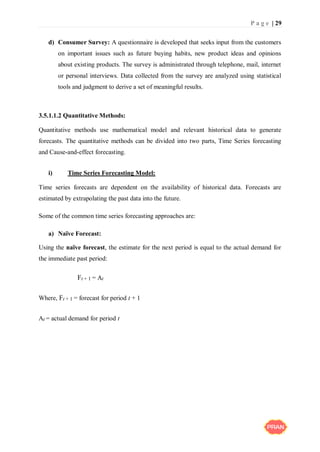
Ft + 1 = At
Where, Ft + 1 = forecast for period t + 1
At = actual demand for period t
P a g e | 30
b) Simple Moving Average Forecast:
The simple moving average forecast uses historical data to generate a forecast and works
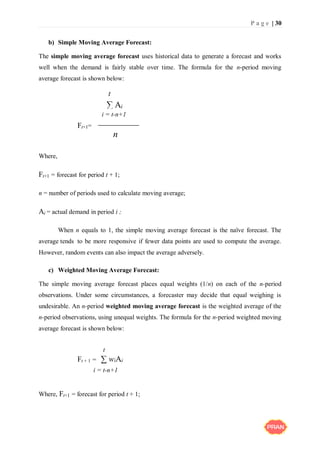
well when the demand is fairly stable over time. The formula for the n-period moving
average forecast is shown below:
∑ Ai
Ft+1=
Where,
Ft+1 = forecast for period t + 1;
n = number of periods used to calculate moving average;
Ai = actual demand in period i ;
When n equals to 1, the simple moving average forecast is the naïve forecast. The
average tends to be more responsive if fewer data points are used to compute the average.
However, random events can also impact the average adversely.
c) Weighted Moving Average Forecast:
The simple moving average forecast places equal weights (1/n) on each of the n-period
observations. Under some circumstances, a forecaster may decide that equal weighing is
undesirable. An n-period weighted moving average forecast is the weighted average of the
n-period observations, using unequal weights. The formula for the n-period weighted moving
average forecast is shown below:
Ft + 1 = ∑ wiAi
Where, Ft+1 = forecast for period t + 1;
n
t
i = t-n+1
i = t-n+1
t
P a g e | 31
n = number of periods used in determining the moving average;
Ai = actual demand in period i ;
wi = weight assigned to period i ; ∑ wi = 1.
d) Exponential Smoothing Forecast:
The exponential smoothing forecast is a sophisticated weighted moving average forecasting
technique in which the forecast for the next period’s demand is the current period’s forecast
adjusted by a fraction of the difference between the current period’s actual demand and
forecast. This approach requires less data than the weighted moving average method because
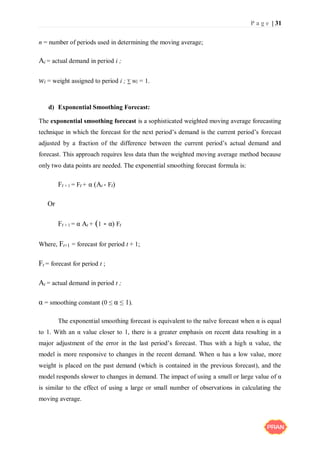
only two data points are needed. The exponential smoothing forecast formula is:
Ft + 1 = Ft + α (At - Ft)
Or
Ft + 1 = α At + (1 - α) Ft
Where, Ft+1 = forecast for period t + 1;
Ft = forecast for period t ;
At = actual demand in period t ;
α = smoothing constant (0 ≤ α ≤ 1).
The exponential smoothing forecast is equivalent to the naïve forecast when α is equal
to 1. With an α value closer to 1, there is a greater emphasis on recent data resulting in a
major adjustment of the error in the last period’s forecast. Thus with a high α value, the
model is more responsive to changes in the recent demand. When α has a low value, more
weight is placed on the past demand (which is contained in the previous forecast), and the
model responds slower to changes in demand. The impact of using a small or large value of α
is similar to the effect of using a large or small number of observations in calculating the
moving average.
P a g e | 32
e) Linear Trend Forecast:
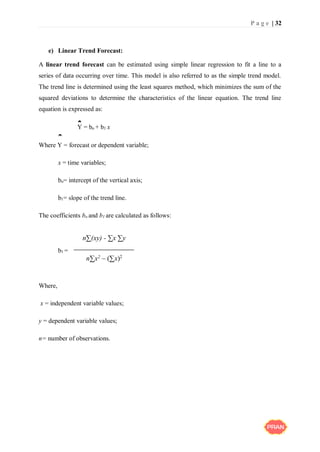
A linear trend forecast can be estimated using simple linear regression to fit a line to a
series of data occurring over time. This model is also referred to as the simple trend model.
The trend line is determined using the least squares method, which minimizes the sum of the
squared deviations to determine the characteristics of the linear equation. The trend line
equation is expressed as:
Y = bo + b1 x
Where Y = forecast or dependent variable;
x = time variables;
bo= intercept of the vertical axis;
b1= slope of the trend line.
The coefficients bo and b1 are calculated as follows:
b1 =
Where,
x = independent variable values;
y = dependent variable values;
n= number of observations.
ˆ
ˆ
n∑(xy) - ∑x ∑y
n∑x2 – (∑x)2
P a g e | 33
ii) Cause-and-Effect Model:
The cause-and-effect models have a cause (independent variable or variables) and an effect
(dependent variable). One of the more common models used is regression analysis. In
demand forecasting, the external variables that are related to demand are first identified. Once
the relationship between the external variable and demand is determined, it can be used as
forecasting tool.
a) Simple Linear Regression Forecast:
When there is only one explanatory variable, we have a simple linear regression forecast
equivalent to the linear trend forecast described earlier. The difference is that the x variable is
no longer time but instead an explanatory variable of demand. The regression equation is
expressed as follows:
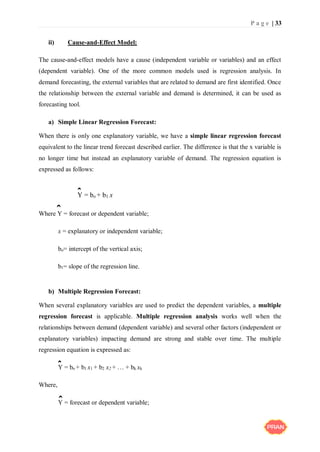
Y = bo + b1 x
Where Y = forecast or dependent variable;
x = explanatory or independent variable;
bo= intercept of the vertical axis;
b1= slope of the regression line.
b) Multiple Regression Forecast:
When several explanatory variables are used to predict the dependent variables, a multiple
regression forecast is applicable. Multiple regression analysis works well when the
relationships between demand (dependent variable) and several other factors (independent or
explanatory variables) impacting demand are strong and stable over time. The multiple
regression equation is expressed as:
Y = bo + b1 x1 + b2 x2 + … + bk xk
Where,
Y = forecast or dependent variable;
ˆ
ˆ
ˆ
ˆ
P a g e | 34
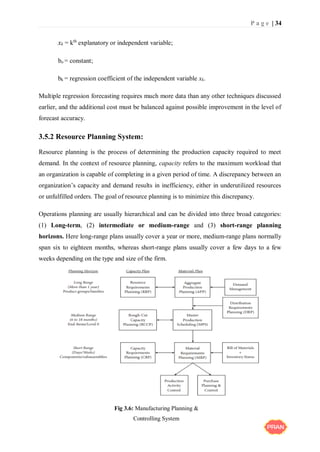
xk = kth
explanatory or independent variable;
bo = constant;
bk = regression coefficient of the independent variable xk.
Multiple regression forecasting requires much more data than any other techniques discussed
earlier, and the additional cost must be balanced against possible improvement in the level of
forecast accuracy.
3.5.2 Resource Planning System:
Resource planning is the process of determining the production capacity required to meet
demand. In the context of resource planning, capacity refers to the maximum workload that
an organization is capable of completing in a given period of time. A discrepancy between an
organization’s capacity and demand results in inefficiency, either in underutilized resources
or unfulfilled orders. The goal of resource planning is to minimize this discrepancy.
Operations planning are usually hierarchical and can be divided into three broad categories:
(1) Long-term, (2) intermediate or medium-range and (3) short-range planning
horizons. Here long-range plans usually cover a year or more, medium-range plans normally
span six to eighteen months, whereas short-range plans usually cover a few days to a few
weeks depending on the type and size of the firm.
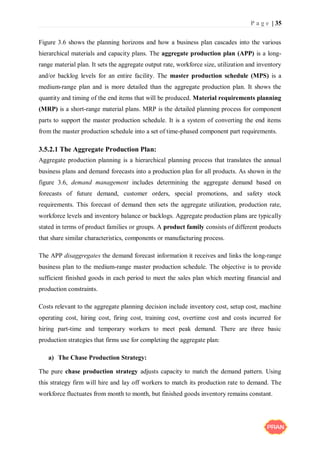
Fig 3.6: Manufacturing Planning &
Controlling System
P a g e | 35
Figure 3.6 shows the planning horizons and how a business plan cascades into the various
hierarchical materials and capacity plans. The aggregate production plan (APP) is a long-
range material plan. It sets the aggregate output rate, workforce size, utilization and inventory
and/or backlog levels for an entire facility. The master production schedule (MPS) is a
medium-range plan and is more detailed than the aggregate production plan. It shows the
quantity and timing of the end items that will be produced. Material requirements planning
(MRP) is a short-range material plans. MRP is the detailed planning process for component
parts to support the master production schedule. It is a system of converting the end items
from the master production schedule into a set of time-phased component part requirements.
3.5.2.1 The Aggregate Production Plan:
Aggregate production planning is a hierarchical planning process that translates the annual
business plans and demand forecasts into a production plan for all products. As shown in the
figure 3.6, demand management includes determining the aggregate demand based on
forecasts of future demand, customer orders, special promotions, and safety stock
requirements. This forecast of demand then sets the aggregate utilization, production rate,
workforce levels and inventory balance or backlogs. Aggregate production plans are typically
stated in terms of product families or groups. A product family consists of different products
that share similar characteristics, components or manufacturing process.
The APP disaggregates the demand forecast information it receives and links the long-range
business plan to the medium-range master production schedule. The objective is to provide
sufficient finished goods in each period to meet the sales plan which meeting financial and
production constraints.
Costs relevant to the aggregate planning decision include inventory cost, setup cost, machine
operating cost, hiring cost, firing cost, training cost, overtime cost and costs incurred for
hiring part-time and temporary workers to meet peak demand. There are three basic
production strategies that firms use for completing the aggregate plan:
a) The Chase Production Strategy:
The pure chase production strategy adjusts capacity to match the demand pattern. Using
this strategy firm will hire and lay off workers to match its production rate to demand. The
workforce fluctuates from month to month, but finished goods inventory remains constant.
P a g e | 36
The pure chase strategy obviously has a negative motivational impact on the workers, and it
assumes that workers can be hired and trained easily to perform the job. In this strategy, the
finished goods inventories always remain constant but the workforce fluctuates in response to
the demand pattern.
This strategy works well for make-to-order manufacturing firms since they cannot rely on
finished goods inventory to satisfy the fluctuating demand pattern. Make-to-order firms
generally produce one-of-kind, specialty products based on customer satisfaction. Make-to-
order products generally require highly skilled labor, capable of producing unique products
using general-purpose equipment. Although a chase production strategy works well when
unskilled labor is required, the strategy can be problematic when highly skilled workers are
needed, especially in a tight labor market.
b) The Level Production Strategy:
A pure level production strategy relies on a constant output rate and capacity while varying
inventory and backlog levels to handle the fluctuating demand pattern. Using this strategy,
the firm keeps its workforce level constant and relies on fluctuating finished goods
inventories and backlogs to meet demand. Since the level production strategy keeps a
constant output rate and capacity, it is more suited for firms that require highly skilled labor.
The workforce is likely to be more effective and their morale higher when compared to the
chase strategy.
This strategy works well for make-to-stock manufacturing firms, which typically emphasize
immediate delivery of off-the-shelf, standard goods at relatively low prices. Firms whose
trading partners seek the lowest prices of stock items might select the level production
strategy. Besides, this strategy works well in a situation where highly skilled workers are
needed in a tight labor market.
c) The Mixed Production Strategy:
Instead of using either the pure chase or level production strategy, many firms use a mixed
production strategy that strives to maintain a stable core workforce while using other short-
term means such as overtime, an additional shift, subcontracting or the hiring of part-time and
temporary workers to manage short-time high demand. Usually, these firms will then
schedule preventive maintenance, produce complementary products that require similar
P a g e | 37
resources but different demand cycles, or continue to produce the end items, holding these as
finished goods inventory during the off-peak demand periods.
If labor is the only constrained capacity, it may hire enough workers to run an additional shift
to cope with the high demand. Firms with multiple products and with customers seeking both
low-cost and make-to-order items may opt for this type of production strategy to minimize
stockouts and cycle time.
3.5.2.2 Master Production Scheduling:
The master production schedule is a time-phased, detailed disaggregation of the aggregate
production plan, listing the exact end items to be produced. It is more detailed than the
aggregate production plan. The MPS planning horizon is shorter than the aggregate
production plan’s, but must be longer than the production lead time to ensure the end item
can be completed within the planning horizon.
The master production schedule is the production quantity required to meet demand from all
sources and is the basis for computing the requirement of all time-phased end items. The
material requirements plan uses the MPS to compute component part and subassembly
requirements. Frequent changes to the MPS can be costly and may create:
a) System Nervousness:
System Nervousness can be defined as a situation wherein a small change in the upper-level
production plan causes a major change in the lower-level production plan.
If the production plan of any week during a month suddenly doubled, the firm would be
forced to quickly revise purchase orders, component assemble orders, and end-item
production orders, causing a ripple effect of change within the firm and up its supply chain to
its suppliers. The change would also likely cause missed delivery due dates. The firm needs
sufficient lead time to purchase items and manufacture the end items, especially if
manufacturing lead times and lot sizes are large.
Many firms use a time fence system to deal with this problem. The time fence system
separates the planning horizon into two segments: a firmed and a tentative segment. A firmed
segment is also known as a demand time fence, and it usually stretches from the current
period to a period several weeks into the future. A firmed segment stipulates that the
P a g e | 38
production plan or MPS cannot be altered except with the authorization of senior
management. The tentative segment is also known as the planning time fence, and it
typically stretches from the end of the firmed segment to several weeks farther into the future.
It usually covers a longer period than the firmed segment, and the master scheduler can
change production to meet changing conditions.
b) Available-to-promise Quantities:
In addition to providing time-phased production quantities of specific end items, the MPS
also provides vital information on whether additional orders can be accepted for delivery in
specific periods. This information is particularly important when customers are relying on the
firm to deliver the right quantity of products purchased on the desired delivery date. The
available-to-promise quantity provides a mechanism to allow the master production scheduler
or sales personnel to quickly negotiate new orders and delivery due dates with customers or
to quickly respond to customers’ changing demands.
3.5.2.3 Material Requirements Planning:
Material requirement planning is a software-based production planning and inventory control
system that has been used widely by manufacturing firms for computing dependent demand
and timing requirements. With the advent of computer and information technologies, the
span of MRP evolved to include aggregate production planning, master production
scheduling and capacity requirement planning to become closed-loop MRP. It further
evolved into manufacturing requirement planning (MRP-II) by including other aspect of
materials and resource planning.
Manufacturing requirement planning is used to calculate the exact quantity, needed dates and
planned order releases for components and subassemblies needed to manufacture the final
products listed on the MPS. MRP begins the computation process by first obtaining the
requirements of the final product from the MPS to calculate the requirements of Level 1
components and then working its way down to the lowest level components, taking into
account existing inventories and the time required for each processing step. While these
manufacturing and delivery lead times are disregarded in the MPS, they are considered in the
MRP computation process.
For MRP, a dependent demand management system, to work effectively, it requires: (1) the
independent demand information (the demand for the final product or service part) from the
P a g e | 39
MPS, (2) parent-component relationships from the bill of materials, including the planning
factor and lead-time information; and (3) the inventory status of the final product and all of
the components. MRP takes this information to compute the net requirements of the final
product and components, and then offsets the net requirements with appropriate lead times to
ensure orders are released on time for fabricating the higher level components or purchasing
the lower level components. This information is called planned order releases, is the most
important output of the MRP. A key benefit of MRP is that production information - such as
scheduled receipts, on-hand inventories, net requirements and planned order releases- is
available for the entire planning horizon; thus, it provides visibilities for schedulers to plan
ahead. Wisner et al. (2012)
3.6 Distribution:
Distribution can defined as a step wise procedure of moving products from the suppliers to
the end customer. For every stage in a supply chain whether suppliers, manufacturers or
customers there is distribution occurring from the previous stage. Raw materials are moved
from suppliers to the manufacturers and finished goods are moved from the manufacturers to
the customers. Distribution affects the supply chain cost and the experience the customer has.
(UK Essays, 2018)
Distribution has two main functions in Supply Chain - Transportation and Warehousing.
3.6.1 Transportation:
The main objective of transportation is moving people and things from one place to another.
In general terms, transportation objectives should be to satisfy customer requirements while
minimizing costs and making a reasonable profit. This section reviews a number of important
transportation elements within the logistics function. These are:
3.6.1.1 The Modes of Transportations:
There are five modes of transportations. Each of these modes offers distinctive advantages to
customers and their selection depends on a number of factors including the goods to be
transported, how quickly the goods are needed, the price shippers are willing to pay and the
locations of shippers and customers. These are:
P a g e | 40
a) Motor Carriers:
Motor carriers are the most flexible mode of transportation. It offers door-to-door service,
local pickup and delivery and small as well as large shipment hauling. It has very low fixed
and variable costs and can compete favorably with rail and air carrier for short to medium
hauls and is still competitive with other forms of transportation for long cross country
shipments particularly if there are multiple delivery destinations.
Motor carriers are most often classified as less-than-truckload (LTL) carriers or truckload
(TL) carriers. LTL carriers move small packages or shipments that take up less than one
truckload and the shipping fees are higher per hundred weights than TL fees, since the carrier
must consolidate many small shipments into one truckload, and then break the truckload back
down into individual deliveries.
Motor carriers can also be classified based on the types of goods they haul. General freight
carrier carry the majority of goods shipped, whereas specialized carriers transport liquid
petroleum, household goods, agricultural commodities building materials and other
specialized items.
b) Rail Carrier:
Rail carriers compete most favorably when the distance is long and the shipments are heavy
or bulky. Rail service is relatively slow and flexible; however less expensive than air and
motor carriers and can compete fairly well on long hauls. To better compete, railroads have
begun purchasing motor carrier companies and can thus offer point-to-point pickup and
delivery service using motor carrier and flatcars that carry truck trailers.
c) Air Carriers:
Transporting goods by air is very expensive relative to other modes, but also very fast,
particularly for long distances. For light, high-value goods that need to travel long distances
quickly, air transportation is the best of the modal alternatives. Air transportation is limited in
terms of geographic coverage. Today, about half of the goods transported by air are carried
by freight only airlines like FedEx, the world’s largest air cargo airline.
d) Water Carriers:
Shipping goods by water is very inexpensive but also very slow and inflexible. There are
several types of water transportation including inland waterway, lake, coastal and intercostals
P a g e | 41
ocean and global deep-sea carriers. Most of the inland waterway transportation is used to haul
heavy, bulky, low-value materials such as coal, grain and sand, and competes primarily with
rail and pipeline carriers. Inland water transportation is limited to areas accessible by water
and hence growth in this area of transportation is also limited.
e) Pipeline Carriers:
Pipeline carriers are very specialized with respect to the products they can carry; however,
once the initial investment of the pipeline is recovered, there is very little additional
maintenance cost, so long-term pipeline transportation tends to be very inexpensive. Pipelines
can haul materials that are only in liquid or gaseous state and so the growth potential for
pipelines is quite limited.
3.6.1.2 Transportation Pricing:
The two basic pricing strategies used by logistics service providers are cost-of-service pricing
and value-of-service pricing. These and other pricing topics are discussed below:
a) Cost-of-service Pricing:
Cost-of-service pricing is used when carriers establish prices based on their fixed and
variable costs of transportation. To accomplish this, carriers must be able to identify the
relevant costs and then accurately allocate these to each shipment. Cost-of-service pricing
varies based on volume and distance. As shipping volume increases, the portion of fixed costs
that are allocated to each shipment goes down, allowing the carrier to reduce prices. Large-
volume shipments also allow carriers to change carload or truckload rates instead of less-
than-carload or less-than-truckload rates. As the shipping distance increases, prices will tend
to rise, but not proportionally with distance, because fixed costs are essentially constant
regardless of distance. It represents the base, or lowest, shipping price for carriers; and in a
highly competitive market, carriers will price just above or near these level to maintain some
level of profitability.
b) Value-of-service Price:
Carriers price their services at the highest levels the market will bear. Prices are thus based on
the level of competition and the current volume demand for each service. This is a profit-
maximization price approach. If a carrier has a service that is in high demand with little
competition, prices will tend to be quite high. As other carriers notice the high profit potential
P a g e | 42
of this service, competition will eventually increase and prices will fall. As the level of
competition increases, carrier will seek ways to reduce their costs to maintain profitability.
c) Negotiated Pricing:
Negotiating transportation prices has become much more common among business shippers
and logistics providers. Shippers today are inclined to develop alliances with logistics
companies because of key role they play in allowing firms and their supply chains to be more
responsive to changing demand. Shippers want carriers to use cost-of-service pricing, while
carriers want to use value-of-service pricing. To maintain an equitable partnership, prices are
negotiated such that they fall somewhere between these two levels, allowing carriers to cover
their fixed and variable costs and make a reasonable profit, and allowing shippers to get the
logistics services they want at a reasonable price.
d) Term of Sale:
When products are purchased from a supplier, they may quote a price that includes
transportation to the buyer’s location. This is known as FOB destination pricing, or free-on-
board to the shipment’s destination. This also means that the supplier will be the legal owner
of the product until it safely reaches its destination. For high-value shipment, small shipment
or when the buyer has little transportation expertise, FOB destination is typically preferred.
Otherwise, the buyer may decide to purchase goods and supply its own transportation to the
shipping destination; in this case, the supplier quotes the lower FOB origination pricing.
P a g e | 43
3.6.2 Warehousing:
A warehouse is a planned space for the efficient storage and handling of goods and materials.
It functions as a storage place for large quantities of goods. Warehousing is not simply about
storage though. It also covers the administration and manual labor required in storage such as
delivery, documentation, examination and certification.
According to Robert Hughes, “warehousing is the set of activities that are involved in
receiving and storing of goods and preparing them for reshipment.”
3.6.2.1 Types of Warehouses:
Firms hold a inventories for a number of reasons, wherein warehouses are used t support
purchasing, production & distribution activities. Firms order raw materials, parts and
assemblies, which are typically shipped to a warehouse location closer to or inside the
buyer’s location, and then eventually transferred to the buyer’s various operations as needed.
The warehouses can be categorized into several types, such as-
a) Private Warehouses:
Private warehouses refer to warehouses that are owned by the firm storing the goods. For
firms with large volumes of goods to store or transfer, private warehouse represents an
opportunity to reduce the cost of warehousing. Besides the long term cost benefit private
warehouses can provide, another consideration is the level of control provided by the private
warehouses. Firms can decide what to store, what to process, what types of security to
provide and what types of equipments need to use. It can also enable firm to better utilize its
workforce and expertise in terms of transportation, warehousing and distribution centre
activities.
b) Public Warehouses:
Public warehouses are for profit-organizations that contract or lease a wide range of light
manufacturing, warehousing and distribution services to other companies. Public warehouse
provides a number of specialized services that firms can use to create customized services for
various shipments and goods. These are:
 Breakbulk – large-quantity shipments are broken down so that items can be combined
into specific customer orders and then shipped out.
P a g e | 44
 Repackaging – after breakbulk, items are repacked for specific customer order.
Warehouses can also do individual product packaging and labeling.
 Assembly – some public warehouses provides final assembly operations to satisfy
customer requests and to create customized final products.
 Quality Inspection – warehouse personnel can perform incoming and outgoing quality
inspection.
 Material handling, equipment maintenance and documentation services
 Short and long-term shortage
Besides the services shown here, public warehouses provide the short-term flexibility and
investment cost saving that private warehouse cannot offer.
3.6.2.2 Warehouse Location:
A number of location models and theories have been proposed over the years to optimally
locate factories, services and warehouses. German economist Johann Heinrich von Thűnen,
who is often regarded as the “father of location theory”, argued in the 1820s that
transportation costs alone should be minimized when considering facilities locations.
In the 1940s, Edgar Hoover recommended three types of location strategies. These are:
 Market Positioned Strategy – locates warehouses close to customers, to
maximize customer service level. This strategy is recommended when high levels
of distribution flexibility and customer service.
 Product Positioned Strategy – locates warehouses close to the sources of supply
to enable the firm to collect various goods while minimizing inbound
transportation costs. This strategy works well when there are large numbers of
goods purchased from many sources of supply and assortments of goods ordered
by customers.
 Intermediate Positioned Strategy – locates warehouses midway between the
sources of supply and the customers. This strategy is recommended when
distribution service requirements are relatively high and customers order product
assortments purchased from many suppliers. Wisner et al. (2012)
P a g e | 45
Chapter 4: Findings & Discussions
4.1 Sourcing:
4.1.1 Types of Sourcing Used:
In PRAN Group there are two types of sourcing used. These are:
i. Import or L/C Sourcing
ii. Local Sourcing
These two methods are discussed below:
i. Import or L/C Sourcing:
According to the demand given by the store (factory), the SCM start to source different buyer
from different countries. After finding the buyer the SCM contact with them through them
and asked them to send some sample of their respective product. The supplier sent their
sample through Fedex, DHL or some other courier.
After getting the sample, the SCM send the sample to the store for QC. After the sample gets
selected, the SCM confirm the supplier for a specific amount of order. Based on this
confirmation the supplier need to Proforma Invoice (PI). This PI contains all of the details
about the about the shipment like- Amount of Shipment, Payment Method, Duration of
Credit, Freight System, Insurance Policy, Incoterm, H.S code etc.
After getting the PI, SCM create the L/C with the respective bank. After proper documenting
these L/C forms are sent to the Local Bank, Bangladesh Bank & Bank of the respective
supplier. After the termination period, the supplier contact with his bank for the payment with
the proper document.
 Incoterm 2010:
Based on Incoterm 2010 these followings are used for shipment of goods. These are:
Ex-work (ExW): “Ex Works” means that the seller delivers when it places the goods at the
disposal of the buyer at the seller’s premises or at another named place (i.e., works, factory,
warehouse, etc.). The seller does not need to load the goods on any collecting vehicle, nor
does it need to clear the goods for export, where such clearance is applicable.
P a g e | 46
FCA – Free Carrier: “Free Carrier” means that the seller delivers the goods to the carrier or
another person nominated by the buyer at the seller’s premises or another named place. The
parties are well advised to specify as clearly as possible the point within the named place of
delivery, as the risk passes to the buyer at that point.
So from these two rules it is clear that, in case of import, SCM pays all the duties and
clearance after the product enters into the port. And all the risk goes to SCM, along with this,
all insurance costs are beard by the buyer.
 H.S Code:
The HS (Harmonized Commodity Description and Coding System) Code is a 6–10 digit
number that is required for all international shipments. This number is used by customs to
identify the products shipped across international borders. It is used as the basis for collecting
international trade statistics. Customs authorities use HS Codes to apply duties, taxes and
regulations on internationally shipped products.
Here, SCM uses Bangladesh Custom Tariff 2019-2020 as guidance for indentifying H.S
code and crosschecking the import and export duties.
 Landed Cost:
Landed cost is the total price of a product or shipment once it has arrived at a buyer's
doorstep. The landed cost includes the original price of the product, transportation fees (both
inland and ocean), customs, duties, taxes, tariffs, insurance, currency conversion, crating,
handling and payment fees.
Landed cost = product + shipping + customs + risk + overhead
ii. Local Sourcing:
After getting the demand from the Store (factory), the SCM is given Purchase Requisition
(PR) by the store. Based on this PR, SCM started to source supplier. The suppliers are
provided a sample and asked them to make their own sample based on the given sample. In
case of Carton, when the final sample gets from the supplier, this sample is sent to store for
testing the busting strength of the Carton.
P a g e | 47
If the sample is confirmed by the store, then SCM visit the supplier’s factory to evaluate their
capacity. If everything goes favorable, in that case the supplier is asked for their quotation- it
contains the price of the product.
The both party come to an agreement after a negotiation for the price. After the price is set,
SCM sent the supplier Purchase Order (PO) of some specific quantity. On the PO, details of
the product is given like- Delivery amount, Payment term, Bill number, PR number, Freight
system etc.
After producing the product, the supplier contact with SCM for transport. The SCM then
contact with the store for a schedule of transport. Based on the given schedule, the supplier
sent the delivery to transit where all of the delivery are received and loaded it for the store.
After receiving the goods the store sent a Goods Receiving Number (GRN) to SCM. Based
on this, SCM process the bill by attaching VAT Challan sent by the supplier. After all the
process has been done, this bill is sent to Bank for processing BEFTN so that the payment
can be done to supplier.
4.1.2 Item Sourced:
In the packaging sector, two types of item are sourced for making the packaging:
i. Level & Flexible Packaging
ii. Carton
i. Level & Flexible Packaging:
In case of level & flexible packing some of these items are sourced:
a) Pouch
Store SCM Supplier Transit
PR
Demand
PO Delivery
Finished Goods
GRN VAT Challan
Fig 4.1: Sourcing Process
P a g e | 48
b) ATC Box
c) Foil
d) Wrapper
e) Polyethylene Terephthalate (PETE)
f) Printing Package
The flexible packagings, that are used basically consists of the above items.
ii. Carton:
There are different types carton that are need to sourced. Actually there are two way to source
carton by the SCM. These are:
 Inhouse Production
 Outsource
Most of the cartons, especially for the exported product carton are produced through inhouse
by Packmat Industries Limited (PIL). On the other, for the local product, most of the carton
are sourced from outside.
The type of Cartons that are needed to be sourced is given below:
a) 3 ply Carton
b) 5 ply Carton
c) 7 ply Carton
d) White Board Carton
e) Swedish Board Carton
f) Virgin Liner Carton
g) Duplex Board Carton
(a) (b) (c) (d)
(g)
(f)
(e)
Fig 4.2: Different Types of Carton
P a g e | 49
4.1.3 Vendor Selection System:
The vendor selection actually depends on some key points. If a vendor going to satisfy these
following points, then the vendor is selected. This below section is discussed based on carton
section of PRAN Group. The key steps are:
i. Quality of the product
ii. Unit cost of production
iii. Capacity of the vendor
These issues are discussed below.
i. Quality of the product:
Quality of the product (carton) actually depends on the bursting strength of it and the
moisture content.
The bursting strength of cartoon means the capacity to hold products. The strength depends
on the type of carton and its ply. The corrugation that is used to make carton also effects here.
There are different types of flutes used to make corrugation. These are type A, B, C, E & F.
Flute size refers to the numbers of flutes per foot. The A and B type flute is mostly used here.
Flute
Designation
Flutes per
Foot
Flute
Thickness
A Flute 33 ± 3 4.8
B Flute 47 ± 3 3.2
C Flute 39 ± 3 4.0
E Flute 90 ± 4 1.6
F Flute 125 ± 4 0.8
Fig 4.3: Different Types of Flute
P a g e | 50
The moisture content of a carton means the ability to resist water. The types and quality of
the paper used to make the carton provides a great effect here. There are different types of
paper used in the packaging sector, among them most commonly used paper are:
 Liner Paper - 150 gsm
 Media Paper - 120 gsm
 Virgin Liner Paper - 300 gsm
Here, gsm means Gram per Square Meter. The denser papers have the ability to resist
moister.
ii. Unit cost of production:
The unit cost of production depends on the cost of materials used in production, that is-
paper, glue, pin, printing, overhead cost etc. Before selecting vendor, the SCM provides the
vendor a unit price for the product and ask the party whether their firm is capable of
providing the carton based this price. If the supplier agrees to give the product on this price,
then the supplier is going to get orders.
The formula to find out the cost of carton is:
[{(Length + Width + wastage) × (Width + Height + wastage) ÷ 2.54} ÷ 1550] × Carton
Quantity × Price.
Here, 1 inch = 2.54 cm
1 sq. meter = 1550 sq.inch
iii. Capacity of the vendor:
The capacity of a vendor is determined through the machineries they have. Based their
factory status it is calculated that whether the vendor is able to deliver the product on-time in
right quantity and right quality. The basic machines that each of the vendor required is given
below:
a) Corrugation Machine
b) Pesting Machine
c) Die-cutting Machine
d) Stitching Machine
P a g e | 51
e) Creasing Machine
f) Printing Machine
Based on the set of machine that a vendor has, their capacity is measured. One other
important thing is the stock keeping space available. If the supplier has available space then
they can be able to keep some inventory of raw material, which reduces the risk of stock out.
Also it is important to know that, whether the supplier has available fund to provide the
product, because almost all of the transaction has a payment termination period of 60 days.
By considering these above requirements a vendor is selected. As packaging is
a sensitive issue and based on this product, the final product reaches to the customer for final
consumption, so this issue always needs to keep in more careful consideration. Even if, the
package does not reach to factory on-time then the production also get stopped, that is why in
this sector it is also keep in consider the number of own vehicles for selecting a new vendor.
The quality of production and service the vendor provides always need to keep in continuous
follow up by SCM. By this way the sourcing in the packaging sector is done by the SCM.
(a) (b) (c)
(f)(e)(d)
Fig 4.4: Machineries
P a g e | 52
4.2 Purchasing:
4.2.1 Purchasing Process:
From the discussion of the previous part we already know that the purchasing can be held in
two ways – local & foreign. The processes of these are as follows:
a) Local Purchase Process:
Each and Every company has an internal format before purchase the materials or machine
from supplier. Such as PRAN maintains their internal rules and regulation when purchase
from the supplier. When production and operation generate demand for production on
material or machine then locally follow below system:
Purchase Requisition (PR) from operation
Purchase Order (PO) from Supply Chain
Supplier delivery to the warehouse
Store manager makes Goods Receiving Number (GRN)
SCM make GRN bill
Bill submit to accounts for supplier payment
Need approval from
Chief Operating Officer
(COO)
Market
survey
Supplier
QC test
Price approval
Fig 4.5: Local Purchasing Process
P a g e | 53
i. Purchase Requisition (PR) from operation:
Operation manager create demand for production then raise the purchase requisition (PR) of
the demanded materials then send to COO for permission to purchase by supply chain
manager in the local market. After the permission operation department send PR to supply
chain manager for collect and send the product to warehouse for production. PR contains the
details of a product with its full specifications and desired quantity. PRAN always follows the
production process that can’t stop in any moment for any purpose. Those material shortage or
machine damage we create KAIZEN for quickly solution and run the production.
ii. Purchase order (PO) from SCM:
After the permission of requisition form chief operating officer then supply chain manager
making purchase order (PO) form SCM software and visiting local market. To visit at least
three suppliers for good quality and reasonable price offer to purchase from supplier.
Searching the better supplier then making PO forwarding local supplier for supply the
materials into the warehouse. During purchase we follow the following techniques to
negotiate price and to ensure timely supply the goods in good condition:
Fig 4.6: Purchase Requisition
P a g e | 54
Selection of vendors consists of these three choices:
a) First Choice – Manufacturer
b) Second Choice – Direct importer
c) Third Choice – Trader
iii. Supplier delivery the product to Warehouse:
Supplier getting PO then arranges the material or product delivery at a specific time. At a
time supply chain manager and supplier both are always connecting each other for arrange
and delivery purpose, if supplier face any problem then inform to the supply chain manager.
Then supply chain manager discuss about the problematic issue about the operation manager
for discover a solution. Hopefully suppliers will success to deliver the product or materials
into the warehouse. Supply chain arranges transport to carry goods from suppliers ware house
to factory:
 By arranging truck/ pickup through PRAN’s own transport.
 By the suppliers negotiating price as including carrying.
 SCM himself arrange truck by taking consent from company transport.
 Small quantity items which are purchased in a day are stored there for sending to
factory ware houses.
 2(Two) store assistants are engaged to deliver goods to the factory. They do shifting
duty.
Fig 4.7: Purchase Order
P a g e | 55
 This arrangement has been done to supply small quantity of purchased goods at the
earliest possible time to factory.
iv. Store Manger makes Goods Receiving Number (GRN):
After finishing arrangement the material or product supplier send to the company warehouse
for producing the product. Store manager after receiving the material make a goods receiving
number (GRN). That each purchase requisition material appropriately supply or not, if found
any missing or incorrect material. Store manager must inform supply chain manager that
his/her supplier missing the supply on the material, so that the supply chain manager can
follow up the supplier and find out why it is missing? That’s why GRN is a must for each
product when received.
v. SCM Making GRN bill:
Supply chain manager when making supplier bill that time must follow store manager GRN.
The amount of bill depends on GRN, without GRN it is not possible to make any bill because
when making GRN that time store manager follow supplier challan quantity amount of
goods. Local suppliers are very small so the payment need to done quickly for making good
relation in future better service. That’s why supply chain manager and supplier needs to
buildup trusty relationship. Without trust it is impossible to do any business.
vi. Bill submit to the accounts for supplier payment:
It’s major term in any business to right time payment for according to the pay terms. In
PRAN local supplier supplies large amount products, so when supply chain manager
finishing the local bill works for pay supplier that time account department must do the
payment within 3 or 4 days.
b) Import Process:
As it was discussed earlier that, the purchasing actually occur in two ways. So import is an
important way in purchasing and supply chain management’s task is to fulfill the import
procedure by foreign companies. Each and every process of importing machinery or raw
materials is done through the letter of credit (L/C).
P a g e | 56
Step for opening L/C:
1. Applicant to be bank’s A/C holder: Bank will open the L/C on behalf of a person who
has an account with the bank.
2. Permissible item: The item to be imported must be permissible and not banned item. If the
item is from conditional list, the condition must be fulfilled to import the same.
3. Sufficient Security or margin: Price of some items fluctuates frequently. In case of those
items bank will be more careful to take sufficient cash margin or other security. Bank will
also follow Bangladesh Bank’s Instructions from time to time.
4. Business Establishment: Bank should not open an L/C on behalf of a floating business
man. The importer must have business establishment, particularly he must have business net
work for marketing the item to be imported.
5. Restricted Country: Goods not to be imported from Israel.
6. Credit report of the beneficiary: If the amount of L/C in one item exceeds Tk. 5 lac
against pro-forma invoice and Tk. 10 lac against indent, supplier’s credit report is mandatory.
The report will remain valid for one year.
7. Application of the client to open the L/C: The client will approach to open the L/C in
bank’s prescribed form, duly stamped & signed, along with the following papers &
documents:
a) Indent/ pro-forma invoice
b) Insurance cover note with money receipt
c) LCAF duly filled in & signed
d) Membership certificate from chamber of commerce/Trade Association
e) Tax payment certificate/declaration
f) IMP & TM form signed by the importer
g) Charge documents
h) IRC, Pass book, Trade license, Membership certificate & VAT registration
certificate in case of new client
i) Export L/C in case of Back to Back L/C
8. Permission from Ministry of Commerce: If the goods are in the list of controlled goods
or any restricted item, permission from ministry of commerce needs to be obtained.
P a g e | 57
9. Creditability of the Client: In consideration of all the above points, if Bank becomes
satisfied regarding the client then L/C may be opened on behalf of the client. Before opening
the L/C Bank will issue & authenticate a set of LCAF in the name of the importer.
10. Authentication/Registration of LCA form: When the importer submits LCAF (Letter of
Credit Authorization Form) with other paper to the bank and approach to open an L/C, bank
will authenticate the LCAF. Confirming the following:
a) IRC renewal fees paid by the importer
b) Item to be imported is eligible as per import policy/pass book of the importer
c) LCAF is duly filled in and signed by the importer.
After proper L/C is created, then the supply chain manager sends the demand of the product
to exporter. On the pro-forma invoice (PI) form the terms of payment and terms of sending
goods are given. After entering the goods to the port, the supply chain manager sent the
documents to third party authority for all the customs clearance of the goods. When the goods
are received by the factory, the store manager then send a GRN to the supply chain manager
for maintaining the proper record of the goods. So for import purchase, the most important
thing is to maintain a proper L/C.
4.2.2 Payment System:
In every company there are some payment systems that are followed to pay the supplier. In
this case, PRAN has also some payment process, these are as follows:
i. Cash Payment
ii. Check Payment
iii. BEFTN
In a brief, these are discussed below.
i. Cash Payment: Sometime the company needs pay the supplier is cash. It depends
on two things-
 Type of supplier & product: Some of suppliers have some policy to pay them in
cash. Actually this type of suppliers are very limited and it is needed make a
relationship with this suppliers because of their products- whether its quality or
the price of the product.
P a g e | 58
 Payment condition: Sometime, due to GRN shortage it becomes delay to pay a
supplier. On this case, after getting the GRN, without going to the formal process
of payment supplier is given the payment in cash to make the payment in proper
flow.
ii. Check Payment: It is the most common way to pay the suppliers. Every supplier
needs to provide a check book to the company. This check book is submitted to
the accounts department. So when the payment is done, the accounts make the
payment printed on a page of the check book to the respected bank of supplier.
iii. BEFTN: BEFTN means Bangladesh Electronic Funds Transfer Network. It is the
newest method payment. According to the new ordinance export oriented
company needs to adopt the BEFTN system. According to this system the fund is
electronically transferred from one bank to another which reduces the time and
paper work of transaction. After the fund is transferred from the company’s
respective bank a text message is sent to the supplier’s mobile number for
confirmation.
Fig 4.8: BEFTN Copy
P a g e | 59
4.3 Distribution:
4.3.1 Order Collection Point:
After purchasing it is important to reach the product in the factory at right time. For this, the
supply chain manager contacts with the store manager to send a transport to the supplier’s
location. But this is only when the supplier’s quantity is as much as to fill-up a truck or
covered van. Otherwise, the supplier needs to send the product to a raw material collection
point which is called “Transit Store”. After collecting the raw from different suppliers the
transit store sent them to the store. There are two schedules to leave for the store – one is in
the morning and another one is at the night.
4.3.2 Modes of Transportation Used:
During the time of distribution of the purchased raw material it is the most important task to
select a proper transportation. PRAN used different types of transports to distribute the raw
materials to factory. These are as follows:
- Air
- Package Carrier
- Truck
- Rail
- Water
- Intermodal
Air: It is rarely used medium of transportation. In case of export this medium is used. It is
mostly used in case of an urgent need. Actually most of the imported items are demanded
based on forecast, which has a general lead-time of one or two months. That is why this is
used rarely.
Package Carrier: It is the most important medium for transportation. It is generally used to
send or collect any sample from supplier and also send sample to the factory for QC test. The
most common package carriers are – Sundarban, S.A, Rainbow, Continental, Fedex, Aramex.
Truck: It is the mostly used medium of transportation. Here the truck load (TL) can be - FTL
or LTL. It depends on the capacity of the suppliers. In case of LTL it is tried to make a FTL
consists of two or more suppliers which actually reduce the cost of transportation. It is tried
P a g e | 60
to provide own transport truck, covered van or lorry to the suppliers where PRAN has own
transportation route.
Rail: Sometimes it is used rail road to distribute. It is used in case of strike or riot, when there
is no other way to use. It is used as an alternative way to run the process smoothly.
Water: It is often use in case of import raw materials. Most of the imported goods are sent
through cargo vessel. Though it is time-consuming, but it the most expensive way of
transport. It is used based on proper forecast, so no lead-time shortage is faced.
Intermodal: In some case, the intermodal transportation system is used. Actually when the
rail, water or air medium is used as a mode of transport on that time the intermodal
transportation system become necessary.
So these are the mode of transportation used by PRAN Group in case of raw materials
distribution.
4.3.3 Transportation Network:
Among the different type of transportation network, PRAN uses some specific network to
distribute the purchased raw materials to the factory. These are as follows:
- Direct Shipment Network
- Direct Shipment with Milk Run
- Cross Docking
Direct Shipment Network: With the direct shipment network option, the buyer structures
his transportation network so that all shipments come directly from each supplier to each
buyer location. It depends on the production capacity of the supplier. Basically the suppliers
with larger capacity are provided with this facility. So the suppliers whom are able to provide
FTL are usually given a truck or covered van to pick-up the products.
P a g e | 61
Direct Shipment with Milk Run: A milk run is a route on which a truck either delivers
product from a single supplier to multiple retailers or goes from multiple suppliers to a single
buyer location. In case of PRAN, the second method is useful. It is often used for the
suppliers of small production capacity. To meet up the regular depend it is important to do
business with both large and small suppliers. The small suppliers can provide LTL or less
than that. In that case, to support this it is done by providing two or three suppliers with a
single vehicle. So those suppliers are given different schedule to pick-up the products. On
that scheduled time, the vehicle goes to the location of supplier to collect the product.
FactorySupplier
Supplier Factory
Fig 4.9: Direct Shipment Network
Fig 4.10: Direct Shipment with Milk Run
P a g e | 62
Cross Docking: Here suppliers do not send shipments directly to buyer locations. The buyer
divides locations by geographic region and a DC is built for each region. In case of PRAN the
DC is called transit store, so the suppliers send their product to this transit store and from this
store the product distributed based on the factory location.
4.4 Some Terminology Followed:
Below some Japanese terminologies are given that are always followed by the SCM of PRAN
Group. These are as follows:
Practice of Six Sigma:
Mymensingh Agro Ltd has organized a training program called “Six Sigma Center of
Excellence”. About three hundred employees from both PRAN & RFL side of RIP Factory
participated in this program. Participants have learned lots of tools and technique regarding
Six Sigma. This training enhances the knowledge of the participants and that’s bring the
change and develop the six sigma initiative.
Supplier
DC
Factory
Fig 4.11: Cross Docking
Fig 4.12: Six Sigma Practice
P a g e | 63
Practice of Kaizen:
a) Kaizen of SBCL at HIP:
Sun Basic Chemicals Limited (SBCL) has completed a big cost saving Kaizen work in the
coil line of HIP factory. The production capacity of that mosquito coil line was 1500 ctn per
day considering Indian dryer with maximum output. But the stamping machine capacity is
2200 ctn per day by using two Malaysian stamping machines. Then they reinstalled the old
Chinese stamping machine that has added more than 1600 ctn per day.
They couldn't provide proper support to sales team last year due to insufficient production.
Initially they made a plan to install one more Indian dryer to improve capacity to overcome
the situation, which required a huge investment. That's why they were searching alternative.
They worked on coil line capacity improvement for the last three months and finally they
were able to modify Chinese room dryer. They converted it into an automatic tunnel dryer
which has increased additional 1440 ctn per day drying capacity keeping the product quality
same as achieved by Indian dryer. This is a big cost saving Kaizen work in the factory.
Fig 4.13: Chinese Room Dryer Converted into
Automatic Tunnel Dryer
P a g e | 64
b) Kaizen Activities in the Factories:
Kaizen at BIP:
Barendra Industrial Park (BIP) has recently changed the scaling system of all Fruits at BIP
which is saving huge money continually and increased the production quality.
Besides, they have recently completed KAIZEN Works ID & FD Fan Inverter Setting in
Combined Boiler and Eva Level Transmitter Repair of FFP in the factory that saved huge
money.
Kaizen Work of Electrical Team of BML:
Banga Millers Limited (BML) Ishwardi has converted Cream dosing machine conveyor DC
to AC that saved huge money and keep the continuous production.
Kaizen at HIP:
Habiganj Industrial Park (HIP) has recently completed some Kaizen works in the factory.
They have completed a Kaizen work to reduce the baking time in Biscuit line. They reduced
baking time from 5min 10sec to 4min 20 sec that is saving ABC 2kg per batch which saves
huge money in every month.
P a g e | 65
Chapter 5: SWOT Analysis
5.1 Internal Strengths:
The internal strength of PRAN group is given below:
1. Brand Image: PRAN is one of the most reputed brands in our country. Besides
fulfilling the local demand, PRAN has now exporting its product to foreign countries.
Even in our neighbor country India, PRAN has become able to capture their market
there. Even PRAN gets the National Export Trophy in last 16 consecutive years.
Besides by sponsoring in different program PRAN also create some reputation in
customer mind. So this is one of the most powerful & important strength of PRAN
Group.
2. Skilled Man Power: To source any type of products, PRAN has some strong team
consisting of many skilled people. So within a very short time, the firm can be able to
find any source supplier. Besides it has also a huge skilled man power in distribution
& marketing.
3. Market Share: PRAN has a huge amount of domination in the market by providing a
large variety of products in the market. So for different varieties PRAN has been able
to serve different types of customers by fulfilling their taste.
4. Experience: PRAN has a long time of experience in serving different markets. Even
in case of planning for sourcing it is always known to the management where any
products can be found at low cost. So it helps the firm to decide in which time of the
year it is needed to source locally and globally. With this long time experience, PRAN
has always been able to stay one step forward from its competitors.
5. Potential Vendors: The firm has a huge numbers of existing vendors which actually
increases the scope of productivity. With this large number of vendors, it becomes
much easier for the firm to source any type of goods and raw materials in any
situation. This creates a more competitive position in compare to its competitors.
P a g e | 66
5.2 Internal Weaknesses:
The internal weakness is discussed below:
1. Short Life Cycle of Product: Most of the products of PRAN cannot be served to the
market for a very long time. The company has always more focus in developing new
products, so most of the products leave from the market without reaching to a
maturity stage.
2. Reaching To Root Level: The main consumers of PRAN are the city dwellers. So it
is still unable to spread product to the root levels of the country.
3. New Regulation: BSTI (Bangladesh Standard Testing Institution) set a new rule for
producing juice that the firm cannot use only the meat of fruits. Mango of Bangladesh
is so vulnerable against insects. So the firm has to take mango from Rajshahi.
Moreover, raw materials are not available all over the season.
4. Adapting To New System: PRAN is now rearranging its organogram to make the
process more efficient. By introducing this new span of control the firm is now facing
trouble in their day to day activities. Also for internal integration instead of Oracle,
the firm is now introducing SAP, so it makes delay to matchup with this new system
which hampers the required productivity.
5. Transportation Shortage: As the firm is not fully staffed with its own transportation,
sometimes it is necessary to send the sourced product with the help of vendor’s own
transport, even in some case it is needed to hire some transport. So during rush hour
(Eid, Puja etc.) or crisis moment (Strick, Covid-19 etc.) in the country to hire any
transport become so tough which sometimes delay the production process.
6. Large Numbers of SKUs: Due to expanding the business the rapidly, the firm has
now more than thousands of SKUs to deal with. It actually slower down the whole
process and day to day dealing, there are some slow moving items also. So due to deal
with those items actually hamper the whole planning & development process.
P a g e | 67
5.3 External Opportunities:
The external opportunities are given below:
1. Increasing Demand: Locally customers taste and preferences are changing. Now-a-
days dual income couples are increasing in Bangladesh. So females have not enough
time to make house made product. So they are now purchasing readymade and frozen
products to satisfy their needs.
2. Low Production Cost: As the firm has an established business in the country and in
our country the labor cost is comparatively low. So with this low production cost it
creates new and more chance to go for export with a much competitive price globally.
3. Diversified Business: As the customer tastes are gradually changing it creates some
opportunities also. The franchise business is now in all over the world and PRAN has
already started their business with different franchisers in some countries. It also
imports some of the products from different and sells them directly to the local
market. So day by day these opportunities are increasing to high rate.
4. Develop Effective Distribution Channel: PRAN has a huge distribution channel
within the country. Beside its own distribution channel, PRAN has also some third
party source. If the firm can use this vast distribution network effectively, PRAN can
be able to source any type of product throughout the country and reach any product
very quickly to any market. So by developing a strong distribution network, PRAN
can be able to secure a competitive positive.
5. Domestic Resources: As an agriculture country, our country has a huge potential
agricultural sector. According to FAO, Bangladesh is the 8th largest producer of
mango & potato, 10th largest producer of Chili. In 2015, Bangladesh was ranked as
the 4th largest aquaculture producing country in the world. Around 43% of
Bangladeshis work in the agriculture sector, mostly producing rice and jute. maize,
vegetables and wheat play a smaller albeit growing role in the country. PRAN has an
opportunity to jointly work with the farmers of our country. Without sourcing from
third party, if the firm can involve the farmer with the system and collect directly
them then it creates a huge price cut of sourcing. By this, a huge competitive
advantage can be obtained.
P a g e | 68
6. Emerging New Market: Due to globalization it creates the chance to operate in more
and more countries. According to Bangladesh Agro-Processors’ Association (BAPA)
the demand for Bangladeshi products has been rising gradually in the Middle East,
Europe, North America, South America, Africa and Asian countries. The EU has also
allowed Bangladesh to export a dozen of veggies and fruits, which were restricted in
the FY 2014-15. Currently PRAN is increasing its operation in more than 141
countries.
5.4 External Threats:
The external threats are discussed below:
1. Increasing Competitors: As more and more new firms are coming to this industry, it
creates a huge competition for the firm. As the others firms are coming with
innovative ideas and product, so the firm needs to keep a much concentration in this
sector along with the development of the product. It limits the scope of working area
of the firm.
2. Dependency on China: The firm has a huge dependency on the Chinese market.
Though it is a global issue, but during the pandemic time of Covid-19 the company
needs to face a large crisis of sourcing materials. So it creates some potential threats
when a firm keeps too much focus on sourcing from one country.
3. Customers Perception: Due to some previous bad reputations about some products
of PRAN, customers still contain some bad perception about its products. It is actually
a potential threat for the growth of the firm. The firm is still struggling to remove this
ill perception from customers mind.
4. Different Barriers: The government is continuously imposing new rules and
regulation. It creates some potential threats to the firm. Along with this, BSTI & VAT
Authority also imposes new regulation continuously. Due to some regulation imposed
by BSTI in juice & chutney production, seasonal sourcing becomes much difficult.
Different types of political unrest also cause threats to the firm.
P a g e | 69
5. Economic Recession: There is a chance of happening world economic recession due
to the pandemic of Covid-19 throughout the world. Our country is not out of this
recession. Due to the recession the consumption power of the people reduces, which
actually occurs a total loss of sales. It is a potential threat for the growth and
development of the firm.
P a g e | 70
Chapter 6: Problems, Recommendations & Conclusions
6.1 Problems or Challenges of PRAN Group:
The problems or challenges that are faced by PRAN Group are discussed below:
 Bengal, Square, Sajeeb, ACI, Partex, Golden Harvest, Bombay Sweets and Akij are
the main competitors for PRAN in export market from the local arena. Although
PRAN is far away from its competitors but they are rising day by day. Bengal Group
has already got $2 million trail order from Dollar General, where PRAN had been
trying for last 2 years.
 In international arena, there are countless competitors in the world. Most of the
companies mainly manufacturer’s products range is limited. Décor’s main products
are food containers. Acecook’s main product is instant noodles and Dona Maria has
rice. But PRAN has all categories. So, PRAN is facing competition from all the
companies and it’s a difficult fight.
 Interactions with customers are one of the rising issues now. As the market is
different, culture is different and PRAN employees cannot reach to customers due to
distance & cost it is difficult to properly understand the need of customers.
 Everyday customers’ need changes. Continuously customers taste and preferences are
switching rapidly. So to maintain this, the number SKUs are increasing at a rapid rate.
In that case it seems that, same product needs different level, size, packaging etc. This
creates some serious troubles in day-to-day production and distribution system.
 Though the firm is expanding its business rapidly, it faces lack synchronizations
among the different parts of supply chain. So this leads to some malfunctions and
disturbance in the planning and production process.
 Due to the rapid fluctuations in customers demand, more orders are coming to meet
the demand which ultimately creates some information distortions and leads to
tremendous inefficiencies: excessive inventory investment, poor customer service,
ineffective transportation, and missed production schedules.
P a g e | 71
6.2 Recommendations:
The following important positive steps may be taken to improve its product and service and
to face competition in this sector:
Build a Proactive Plan and Strategy: Without a proper plan and appropriate strategy it is
impossible to handling all work , starting work before need to make a plan for working, how
and which way do the work with supplier, manufacturer, operation manager and how to reach
ultimate target.
Integrate Logistical Processes with Suppliers: No matter the size of a business, it remains
important to integrate logistical processes with the suppliers for that organization. This is
totally dependent on software systems, certain enterprise resources planning application. It is
needed to work integrally with supplier in case of costing the materials so that both the party
can be beneficial. Through this the wastage can be reduced which is an ultimate evil in
causing errors. This will ultimately improve operation efficiency for both organizations.
Create a Cross Functional Team: Before buildup the strategy it is important form a proper
cross functional team. They are the main players through which the strategy is implemented.
It is important to involve this team during making the strategy which will ultimately make the
strategy fruitful.
Training for Internal Personnel: Training is a way to expert a manager for smoothly
working with supplier and internal purpose of the company, each employee before joining
must need training and after joining need monthly training. Effective training may increase
the productivity of the employees.
Ensure Customer Satisfaction: It is the most important thing to ensure customer satisfaction
and this can be done by providing quality of product. By ensuring good quality and proper
marketing it can be possible to make a product as a brand inside customers’ mind.
P a g e | 72
6.3 Conclusions:
PRAN GROUP is one of the best manufacturing companies which have seen tremendous
success since its establishment .It has been possible only because of its skilled management,
well trained, dedicated employees and excellent quality products. The company produces and
distributes fruits juices, snacks, confectionery, culinary products, dairy and soft drinks. It
enjoys a strong brand reputation in the country and exports its products to more than 141
countries.
Supply chain management is an exciting and important area of study. Most of the world’s
leading businesses are able to save large amounts of money, time and effort by creating an
effective supply chain. Supply chain management division has a good contribution for the
overall achievement of PRAN Group.
Bangladesh is a very fast growing free market economy. We have cheap labor comparing to
other countries, so PRAN Group is producing high quality products than others at a lower
cost. So, they are contributing our economy by initiating such a business that is satisfying our
need as well as doing business beyond the frontier. PRAN Group is earning valuable foreign
currencies in the country every year by exporting their products. As Bangladesh is import
dependent country, so we think PRAN Group’s step is helping us to have a positively balance
of trade.
P a g e | 73
Chapter 7
7.1 Lessons from Internship:
i. This internship provides me the opportunity to work and learn about the corporate
world.
ii. It helps me to gather the information about the real supply chain procedure at the food
& beverage industry.
iii. During the time of crisis moment like – COVID-19, what firms need to do, what are
the strategies to be competitive, I also get that type of knowledge from this internship.
iv. The procedures to find, select, evaluate and follow up the suppliers and find out the
potential one.
v. Importance of making good relationship with supplier through building trust.
vi. How does ERP system work to integrate all other functional areas.
vii. Implementation of some terminology like – kaizen, six sigma, gamba in the real
corporate word.
viii. By visiting suppliers at different location provides me the chance to learn about
different type manual and automated production system.
P a g e | 74
7.2 References
Agricultural Marketing Co Ltd. (2019). AMCL Annual Report 2018-19. Retrieved from
https://www.amclpran.com/investor.php
Ahsan, A.N.M Emrose. (2018). Evaluating Marketing Strategies of PRAN – RFL Group
[PDF File]. Retrieved from
http://dspace.daffodilvarsity.edu.bd:8080/handle/123456789/2846
Alam, Imtiaz, & Setu, & Adnan, Tarik, & Anindita, Hoque,& Mahadi, Masud, & Mostofa,
Mahrin. (2017). Report On PRAN – RFL Group [PowerPoint slides]. Retrieved from
https://www.slideshare.net/imtiazx1/report-on-pranrfl-group
Amjad Khan–A pioneer in setting new business trend. (2016, July 10). “Daily Sun”.
Retrieved from https://www.daily-sun.com/
Bangladesh Small & Cottage Industries Corporation. (2018, June 27). “THE GUARDIAN”
Retrieved from http://www.theguardianbd.com/
Chopra, S., & Meindl, P. (2013). Supply Chain Management Strategy, Planning & Operation
(3rd
ed.) New Jersey : Pearson
Christopher, M. (2011). Logistics & Supply Chain Management (4th
ed.). London: Pearson
Essays, UK. (November 2018). Role Of Distribution In Supply Chain Information
Technology Essay. Retrieved from https://www.ukessays.com/essays/information-
technology/role-of-distribution-in-supply-chain-information-technology-
essay.php?vref=1
Export of agro-products rises 53pc in nine months. (2019, April 28), “RMG Bangladesh”.
Retrieved from https://rmgbd.net/
Faiz, M. Shahryar, & Haque, Md. Asrarul, & Kabir, Mohammad Rehan, & Rahman, Tajkera,
& Sakib, Md. Nazmus, & Ashik, Asaduzzaman, & Laizu, Farzana Hossain. (2018).
P a g e | 75
FMCG Industry Review of Bangladesh [PDF File]. Retrieved from
https://databd.co/resources/fmcg-industry-review-of-bangladesh
Hossain, Md. Amzad, & Ahmed, Rifat, & Shawon, Azizur Rohman, & Islam, Md. Tarikul, &
Jahid, Inamul Haque, & Islam, Rashedul. (2018). Overall Marketing Strategies of
PRAN – RFL GROUP. [PowerPoint sildes] Retrieved from
https://www.slideshare.net/amzadhossainfbd95/overall-marketing-strategies-of-
pranrfl-group
Hossain, Zahid. (2015). The Marketing Plan Of PRAN Drinks. [PowerPoint slides] Retrieved
from https://www.slideshare.net/Zahid541/pran-55697293
Innovision Consulting Private Limited. (2016). Study on the Roles and Opportunities for
Private Sector in Agro-food Processing Industry of Bangladesh. [PDF File] Retrieved
from http://katalyst.com.bd/wp-content/uploads/2017/01/Roles-and-Opportunities-
for-Private-Sector-in-Agro-food-Processing-Industry-of-Bangladesh.pdf
Mukit, Md. Mushfiqul Haque, & Ferdous, Arafa, & Ahmed, Mahfuz. (2012). Term Paper On
Management Function In PRAN. [PowerPoint slides] Retrieved from
https://www.slideshare.net/MushfiqMukit1/pran-rfl-term-paper-by-mushfiqul-haque-
mukit
PRAN GROUP. (2020, April). Kaizen Activities in the Factories. PRAN – MESSAGE A
Corporate Publication of PRAN GROUP, 41, 45-46.
Rahman, Maksudur. (2017). Entry Strategy of PRAN company into overseas counties: A
study on Drinks, Bakery and confectionary items. Retrieved from
https://maksudurrahmanblog.wordpress.com/2017/08/05/my-assignment-about-pran-
company-jagannath-university-global-marketing-how-to-entry-global-market/
Rahman, Ziaur. (2015). Term Paper On Financial Performance Analysis Of PRAN [PDF
File]. Retrieved from
P a g e | 76
https://www.academia.edu/22501773/Term_Paper_On_Financial_Performance_Anal
ysis_Of_PRAN
Rose, Regan. (2013). Organizational Structure of PRAN Group Retrieved from
https://www.lawyersnjurists.com/article/organizational-structure-pran-group/
Sakif & Ifti & Imam. (2012). An Assignment on PRAN – RFL Group A RISING MARKET
GIANT of BANGLADESH. [PDF File]. Retrieved from
https://www.academia.edu/11539891/13717552966_BUS_101_Term_paper_on_PRA
N-RFL_Group
Wisner, J. D., Tan, K. C., & Leong, G. K. (2012). Principles of Supply Chain Management –
A Balanced Approach (3rd
ed.) USA: South – Western Cengage Learning.

Supply Chain Management practice On PRAN Group

  • 1.
    Internship Report On Supply ChainManagement Practices of PRAN Group Department of Management University of Chittagong
  • 2.
    i Internship Report On Supply ChainManagement Practices of PRAN Group Submitted To Dr. Mohammad Khaled Afzal Professor Department of Management University of Chittagong Submitted By Md. Abu Kausar Bhuiyan ID: 13302020 Session: 2016-17 Department of Management University of Chittagong Date of Submission: 10 June, 2020
  • 3.
    ii LETTER OF SUBMISSION June10, 2020 To Professor Dr. Mohammad Khaled Afzal Supervisor of the Internship Report Department of Management University of Chittagong Subject: Submission of Internship Report Dear Sir, With due respect, it is my great pleasure for having an opportunity to submit internship report on “Supply Chain Management Practices of PRAN Group”. I have truly enjoyed my 8- weeks attachment with the organization and highly appreciate their cooperation in this regard. I tried my best to gather relevant information for preparing a complete report by following internship report proposal. Without the sincere cooperation and proper guidance of you, it would not possible for me to prepare the report. I hope you will assess my report considering the limitations and mistakes of the study. Sincerely yours Md. Abu Kausar Bhuiyan Id.: 13302020 Session: 2016-17 MBA, Department of Management (SCM) University of Chittagong
  • 4.
    iii ACKNOWLEDGEMENTS At the verybeginning, my deepest gratitude goes to almighty Allah, who has enabled me to complete my internship in good health and prepare the report accordingly. I also feel much pleasure to express my gratitude, sincere appreciation and profound respect to my honorable teacher Professor Dr. Mohammad Harisur Rahman Howladar the coordinators of the internship program and also my respectable teacher Professor Dr. Md. Shahidur Rahman, the honorable chairman for providing overall guidelines about internship report. I feel grateful to the internship placement committee for arranging such an opportunity. A special thanks goes to my departmental supervisor, Professor Dr. Mohammad Khaled Afzal, for his generous help, valuable guidance and useful suggestions regarding this report. The supervision and support by him help me a lot for the completion of internship program properly. I would also like to express my sincere gratitude to Lutfur Rahman Bhuyan, CO of SCM Department of PRAN Group for his support and allowing me to complete my internship in their reputed organization. My gratitude also goes to Mahmud Sarwar(Assistant Manager) and Habibul Hassan(Assistant Manager) for providing me with the necessary support throughout my internship journey in the company. The cooperation of other managers, executives & other staff of the PRAN Group are also gratefully acknowledged. Their generous support is greatly appreciated. Finally, I would like to thank the entire respondent for their cooperation.
  • 5.
    iv Supervisor’s Declaration I amhappy to certify that this internship report titled “Supply Chain Management Practices of PRAN Group” is prepared by Md. Abu Kausar Bhuiyan, ID: 13302020, Session: 2016-17, student of MBA Program, Department of Management, University of Chittagong. According to my knowledge this is an original work performed under my supervision and is not submitted elsewhere. I, therefore recommend accepting it as his internship report for in MBA program. Supervisor …..……………………………………………. (Professor Dr. Mohammad Khaled Afzal)
  • 6.
    v Executive Summary As apart of requirement content of completion of MBA Program, this internship report is conducted. The study has conducted titled on “Supply Chain Management Practices of PRAN Group” under proper guideline. Supply chain management is the management of the flow of goods and services and includes all processes that transform raw materials into final products. In this day and age, SCM plays an integral part of a firm's success. Efficiently running supply chains allow firms to quickly deliver products to the end-user for a low cost. In this report it has been seen the practices of SCM in the PRAN group – a leading company in Bangladesh established in 1981. This study has been prepared based on the information collected from two types of sources. One is oral interview, telephone, discussion; face-to-face discussions etc are the primary sources. The other type of sources are published materials, books, journals, company website etc are the secondary sources of the study. Firstly a brief overview about different functional parts of the firm is discussed in chapter 2. Then, a discussion on the functions of SCM was briefed in chapter 3. Next, SCM practices at PRAN group mainly – sourcing process, supplier selection process, payment procedure, import process, distribution strategy and some terminology that are practice were elaborately discussed. Later, in the SWOT analysis the internal and external environmental conditions of the firm are discussed. After that, the major problems faced by the PRAN group mainly – large number of SKUs, lack of synchronizations and for those the recommendations – build a proactive plan and strategy, integrate logistical process with suppliers are given. Finally, there is the lessons learned and the reference part is given.
  • 7.
    vi Table of Contents Chapter1: Introduction...................................................................................................... 1 1.1 Introduction................................................................................................................. 1 1.2 Objective of the study.................................................................................................. 1 1.3 Rationale of the study.................................................................................................. 1 1.4 Methodology............................................................................................................... 2 1.5 Limitation of the study ................................................................................................ 2 Chapter 2: Organizational Overview ................................................................................. 4 2.1 Industry Overview:...................................................................................................... 4 2.2 Company Overview:.................................................................................................... 5 2.3 Company Profile: ........................................................................................................ 6 2.4 The Business of PRAN:............................................................................................... 7 2.5 Location of Factories:.................................................................................................. 8 2.6 Organogram: ............................................................................................................... 9 2.7 Mission, Vision & Aim: .............................................................................................. 9 2.8 Financial Information: ............................................................................................... 10 2.8.1 Capital:............................................................................................................... 10 2.8.2 Revenue:............................................................................................................. 10 2.8.3 Profitability Ratio ............................................................................................... 11 2.8.4 Earning per Share: .............................................................................................. 12 2.9 Marketing Information: ............................................................................................. 13 2.9.1 Brands of PRAN Group:..................................................................................... 13 2.9.2 Stock Keeping Units: .......................................................................................... 14 2.9.3 Distribution System: ........................................................................................... 15 2.10 About HRM:............................................................................................................ 16 2.10.1 Recruitment Process: ........................................................................................ 16 2.10.2 Selection Process: ............................................................................................. 17
  • 8.
    vii 2.11 SCM:....................................................................................................................... 17 2.12Production Process: ................................................................................................. 18 Chapter 3: Literature Review........................................................................................... 19 3.1 Supply Chain:............................................................................................................ 19 3.2 Supply Chain Management:....................................................................................... 20 3.3 Core Elements of SCM:............................................................................................. 20 3.4 Sourcing:................................................................................................................... 21 3.4.1 The Purchasing Process: ..................................................................................... 21 3.4.2 Supplier Selection:.............................................................................................. 26 3.5 Internal Operation: .................................................................................................... 27 3.5.1 Demand Forecasting: .......................................................................................... 27 3.5.2 Resource Planning System:................................................................................. 34 3.6 Distribution: .............................................................................................................. 39 3.6.1 Transportation: ................................................................................................... 39 3.6.2 Warehousing:...................................................................................................... 43 Chapter 4: Findings & Discussions .................................................................................. 45 4.1 Sourcing:................................................................................................................... 45 4.1.1 Types of Sourcing Used:..................................................................................... 45 4.1.2 Item Sourced: ..................................................................................................... 47 4.1.3 Vendor Selection System:................................................................................... 49 4.2 Purchasing:................................................................................................................ 52 4.2.1 Purchasing Process: ............................................................................................ 52 4.2.2 Payment System: ................................................................................................ 57 4.3 Distribution: .............................................................................................................. 59 4.3.1 Order Collection Point:....................................................................................... 59 4.3.2 Modes of Transportation Used:........................................................................... 59 4.3.3 Transportation Network:..................................................................................... 60
  • 9.
    viii 4.4 Some TerminologyFollowed: ................................................................................... 62 Chapter 5: SWOT Analysis .............................................................................................. 65 5.1 Internal Strengths: ..................................................................................................... 65 5.2 Internal Weaknesses: ................................................................................................. 66 5.3 External Opportunities:.............................................................................................. 67 5.4 External Threats: ....................................................................................................... 68 Chapter 6: Problems, Recommendations & Conclusions................................................ 70 6.1 Problems or Challenges of PRAN Group:.................................................................. 70 6.2 Recommendations: .................................................................................................... 71 6.3 Conclusions:.............................................................................................................. 72 Chapter 7........................................................................................................................... 73 7.1 Lessons from Internship: ........................................................................................... 73 7.2 References................................................................................................................. 74
  • 10.
    P a ge | 1 Chapter 1: Introduction 1.1 Introduction In modern days supply chain management is a key driver for each and every organization. To run a business properly SCM is a must. An effective SCM team is an essential need for each and every organization. Supply chain is a dynamic management system where involves the constant flow of information, products and funds between different stages. In this stages not only included the manufacturer and suppliers, but also included transporters, warehouses and retailers who are directly or indirectly related in fulfilling the customer requirement. It refers to the resources needed to deliver goods and services to a consumer. It involves coordinating and integrating these flows both within and among companies. The primary objective of the supply chain management is to improve the service levels to customers while reducing overall supply chain costs. Effective supply chain network is viewed as the driver of reductions in lead times and costs, and improvements in product quality and responsiveness. Therefore, there is no denying fact that, SCM is important for each of the sectors of a company. This report deals with the overall SCM practices on PRAN Group. 1.2 Objective of the study The broad objective of the report is to describe the Supply Chain Management Practices of the PRAN Group. Specific Objectives: The specific objectives of this study are as follows: a) To explore overall Supply Chain process of PRAN Group b) To elaborate the sourcing process of the PRAN Group c) To provide some suggestions after identifying the overall issues of PRAN Group 1.3 Rationale of the study At the ending part of the report, there is problem identification and recommendation. The study will allow learning about the SCM issues, importance, modern techniques and models used to make it more efficient. The study will help to learn the practical procedures followed by the leading organizations in SCM. Moreover, the study will help to differentiate between
  • 11.
    P a ge | 2 the practice and the theories that direct to realize how the organization can improve their SCM practice & process. 1.4 Methodology The method of this report is mainly descriptive in nature. The data was collected during the time of February – April; 2020, from SCM department of the head office of PRAN group, by visiting different suppliers located at Jatrabari, Narayangonj & Fokirapul, and also by visiting the Ghorashal factories (AMCL, PIP) of PRAN. The total number of respondent in this study was 80. Two types of information sources are used. This are:  Primary Source  Secondary Source Primary Source: The primary information was collected by interviewing the staffs, employees, managers, general manager of different departments, importers, distributors and observing organizational procedures, structures. Primary data were mostly derived from the discussion with the employees of the organization. Secondary Source: The secondary data are collected from the following sources:  Website of PRAN  Annual reports, newsletter and training materials of PRAN  Internet  Documentary files of the company 1.5 Limitation of the study The limitations are:  It is not allowed to collect information from all source  The duration of collecting data becomes limited due to the lockdown for COVID-19 all over the country  It is not allowed to publish some confidential documents  Some data is collected from different unofficial sources. So there may be some type of errors
  • 12.
    P a ge | 3 However, the information that has been collected is quite helpful for to prepare this paper. I therefore, hope that the study will be evaluated subject to the recognition of the above mentioned shortcomings.
  • 13.
    P a ge | 4 Chapter 2: Organizational Overview 2.1 Industry Overview: Consumer goods refer to the final goods and services that are consumed by the households and not used in the production process of other goods & services. On the other hand, Fast Moving Consumer Goods (FMCG) are products that are sold rapidly and at comparatively lower cost. Examples of such FMCGs are packaged foods, beverages, toiletries, over the counter drugs and similar consumables. The Fast Moving Consumer Goods (FMGC) sector is one of the largest sector in the economy of Bangladesh, characterized by a strong multinational companies’ presence well- established distribution networks, intense competition between the organized and unorganized segments, and low operational costs. In our country, the journey of FMGC is started by Haque Group. Haque group started it’s journey in 1947 as a distributor of British biscuit gaint Huntley & Palmers. It is pioneer in many segments like Cream Crackers, Bourbon, Sugar Glazed Biscuit, Chocolate Filled Chips etc. After that, in 1948 Bombay Sweets & Co. Ltd. had come in this sector. After independence the Baby Food Product starts its journey in 1973 which later turns in Cocola Food Product Ltd. in 1985. There are many other companies in this sector like: Olympic, Aarong, Golden Harvest, Aftab, Transcom, ACI, Danish and so on. According to a study from Bangladesh Bureau of Statistics it is found that, most of the expenditures are occurring in Food & Beverage items both in rural and urban areas. In Urban areas, Housing and rent expenses are second area in terms of expenditure as % of total Consumption expenditure by the individual consumers. In the past few years, the FMCG industry in Bangladesh has experienced a dramatic growth in consumer durable items (Hamid et al.,2008).
  • 14.
    P a ge | 5 2.2 Company Overview: PRAN stands for Program for Rural Advancement Nationally. PRAN is currently the most well-known household name among the millions of people in Bangladesh and abroad also. In 1981 for the first time PRAN starts its operation as a processor of fruit and vegetable in Bangladesh. PRAN is one of the good numbers of favorite food and beverages brand among the millions of people in Bangladesh. In addition to, PRAN is exporting their goods around 192 countries and the major export markets are Asia, Middle East & Africa.. They also set up their production plant at Calcata in India. PRAN is producing more than 200 products under 10 different categories which are: Juice, Drinks, Mineral, Carbonated Beverage, Bakery, Snacks, Culinary, Confectionary, Biscuit and Milk. The company has adopted ISO 9001 as a guiding principle of its management system. The company is complaint to HACCP & certified with HALAL which ensures only the best quality products are reaches to the consumers table across the Globe. Currently, PRAN Group is exporting $50 million per year to different countries.
  • 15.
    P a ge | 6 2.3 Company Profile: Name PRAN GROUP Logo Founder Major General Amjad Khan Chowdhury (retd) Key Person Ahsan Khan Chowdhury (CEO) Md Eleash Mridha (Managing Director) Location PRAN Center 105, Middle Badda, Dhaka-1212 Establishment 1980 Business Type Manufacturer Business Unit 20 No. of Total Employees 58000 Product Juice, Beverage, Confectionary, Culinary, Dairy, Biscuit, Frozen Food Geographic Market Southeast Asia, North America, Europe, Middle East Quality Standard ISO 9001:2000, ISO 14001, ISO 22000, OHSAS 18001, HACCP, HALAL Certification Nature of Ownership Public Limited Annual Sales Range (USD) US$5 Million – US$10 Million
  • 16.
    P a ge | 7 Banks Dealing With HSBC, Standard Chartered, IPDC Finance, Al-Arafah, Primer, Jamuna, IFIC, IDLC, UCBL Key Suppliers Bashundhara Group, ACI Group, Sajeeb Group, Citi Group, Meghna Group, Linde, Fulkoli, Madnina Group Website www.pranfoods.net 2.4 The Business of PRAN: PRAN agriculture marketing company limited has controlled the nine individual Business Units on their umbrella. i. Agricultural Marketing Company Limited (AMCL) ii. PRAN Foods Limited (PFL) iii. PRAN Agro Limited (PAL) iv. PRAN Agro Business Limited (PABL) v. Bango Agro Processing Limited (BAPL) vi. PRAN Dairy Limited (PDL) vii. PRAN Beverage Limited (PBL) viii. PRAN Confectionery Limited (PCL) ix. PRAN Export Limited (PEL) x. Mymensingh Agro Limited (MAL) xi. PRAN Frozen Foods (PFF) xii. PRAN Sweetened Confectionery Limited (PSCL) xiii. Natore Ago Limited (NAL) xiv. Habigonj Agro Limited (HAL) xv. PRAN Tasty Treat (PTT) xvi. Bango Bakers Limited (BBL) xvii. Sun Basic Chemical Limited (SBCL) xviii. Silvan Agro Limited (SAL) xix. PRAN Industrial Park (PIP) xx. Packmat Industries Limited (PIL)
  • 17.
    P a ge | 8 2.5 Location of Factories: The list factories that are situated in Bangladesh is given below: a) Ekdala, Natore b) Ghorasal, Narshingdi, Palash c) Kaligonj, Gazipur d) Adamjee EPZ e) Rupgonj, Narayangonj f) Kellabond, Rangpur g) Olipur, Shahjibazar, Habigonj Factory 15 Depot 14 PRAN Office 15 Milk Center 5 Corporate Office 1
  • 18.
    P a ge | 9 2.6 Organogram: 2.7 Mission, Vision & Aim: Mission: Poverty & Hunger are Curses. Corporate Vision: Improving Livelihood. Aim: To generate employment and earn dignity and self respect for our compatriots through profitable enterprises. Core Values: PRAN believes in providing quality by considering the customers’ demands and expectations. Continuous innovation and improvement is the motive of this organization by focusing customers and tries to maintain fairness and transparency in all segments. The corporate values for PRAN are - Fig 2.1: Organogram
  • 19.
    P a ge | 10  Consumer Care  Supplier Care  Employee Care  Trade Care 2.8 Financial Information: 2.8.1 Capital: The PRAN Group has an authorized capital of taka 500 million. 2.8.2 Revenue: Revenue = Domestic Sales (i) + Export Sales (ii) i. Domestic Sales: Domestic sales including VAT & SD 1,469,938,775 1,337,720,274 Less: VAT 160,963,059 134,178,477 Supplementary Duty 49,225,240 52,312,007 1,259,750,476 1,151,229,790 ii. Export Sales: Export 1,135,347,841 1,106,545,617 Cash incentive 143,430,433 123,024,616 1,278,778,274 1,229,570,233 Revenue: Domestic Sales (i) 1,259,750,476 1,151,229,790 Export Sales (ii) 1,278,778,274 1,229,570,233 2,538,528,750 2,380,800,023 2018-19 2017-18 Amount in Tk.
  • 20.
    P a ge | 11 Comments: From the above statement, it is seen that both the domestic and export sale increases in respect to the previous year. It is seen that the domestic sales increases to an approximate amount of 10 crore and the export sales increases to 4 crore. So, in an average the total revenue increases to 6.6% (approx.) than the previous year. Income Statement: Period Ending: Jun 30, 2019 (Taka in Lakh) Jun 30, 2018 (Taka in Lakh) Revenue (Sales) 25385.28 23803.35 Gross Profit 4870.18 4548.04 Net Income 704.56 726.81 2.8.3 Profitability Ratio Particulars Formula Results Jun 30, 2019 Jun 30, 2018 a) Gross Profit Gross Profit Sales 19.18% 19.10% b) Profit Margin Net Income Sales 2.77% 3.05% c) Return of Equity Net Income Total Equity 11.68% 12.64% d) Return on Assets Net Income Total Assets 4.92% 4.96% Period Ending: Jun 30, 2019 (Taka in Lakh) Jun 30, 2018 (Taka in Lakh) Total Assets 14314.48 14630.22 Total Equity 6030.09 5747.87 Balance Sheet:
  • 21.
    P a ge | 12 Comments: a) Gross Profit: Gross profit is the profit a company makes after deducting the costs associated with making and selling its products. From above table we can see that, during the year 2019 and 2018 the revenue generated by the firm is 19.18% and 19.10% respectively which is a quite satisfactory in amount. But the revenue generation rate in compare to the two year is nearly same, which is not so good. b) Profit Margin: Profit margin indicates the profitability of a product, service, or business. The difference between the gross profit and profit margin is that, gross profit usually applies to a specific product or line rather than an entire business. On the other, net profit margin is a calculation that expresses the profitability of an entire company, not just a single product or service. And in case of profit margin, the higher the percentage, the more profitable the company. But here it is seen that the profitability decrease to 0.28%. c) Return of Equity: The firm has a RoE of 11.68% and 12.64% in the year of 2019 & 2018 respectively, which means in every 1 taka of company equity, the firm generated 0.11 and 0.12 in profit. d) Return on Assets: The firm has a RoA of 4.92% and 4.96% in the year of 2019 & 2018 respectively that means in every 1 taka of company asset, the firm generated 0.492 and 0.496 in profit. 2.8.4 Earning per Share: EPS = Net Profit ÷ Numbers of shares outstanding Net Profit attributable to the ordinary shareholders 55,548,329 54,937,417 Numbers of ordinary shares outstanding 8,000,000 8,000,000 Earning per Share (EPS) 6.94 6.87 Comments: EPS indicates how much money a company makes for each share of its stock. Here it is seen that in 2019 & 2018 the firm making the amount of tk. 6.94 and 6.87 respectively. 2018-19 2017-18 Amount in Tk.
  • 22.
    P a ge | 13 2.9 Marketing Information: 2.9.1 Brands of PRAN Group: A brand is a name, term, design, symbol, or any other feature that identifies one seller's good or service as distinct from those of other sellers. There are several popular brands in PRAN Group. Some of these are: PRAN Frooto Mr. Mango Fruitfil ROBO Drinks Atom Gum Wonder KIDS r Hurray Wafer MAXX Cola Wonder Muffin Cake OSCAR Mithai Soanpapdi All Time Bread MAMA Wafer Mr. Noodles Jhotpot Singara Fig 2.2: Brands of PRAN
  • 23.
    P a ge | 14 2.9.2 Stock Keeping Units: There are more than 2200 SKUs in PRAN group. Some of these are: Item Name SKU Juice Frooto Mango Juice 250 ml PRAN Latina Apple Juice 1000 ml PRAN Mango Fruit Drink Tetra 250 ml Frozen Jhatpot Chicken Burger Party 200 gm Jhotpat Chicken Meat Ball 250 gm Jhatpot Chicken Nugget 300 gm Jhatpot Deshi Paratha – Family Pack 130 gm Jelly Orange Jelly 350 gm Orange Jelly 500 gm PRAN Orange Jelly 1kg Jar PRAN Orange Jelly 375 gm Bread All Time Milk Bread 325 gm All Time Milk Bread 650 gm All Time Sandwich Bread 700 gm All Time Honey Comb
  • 24.
    P a ge | 15 Dairy PRAN Full Cream Milk Powder 500 gm PRAN Full Cream Milk Powder 1kg PRAN Pasteurized Milk 1 kg PRAN UHT Milk 1 kg Cake All Time Pie Cake 35 gm PRAN Wonder Custard Cake Vanilla 25 gm Wonder Muffin Cake 25 gm Oil PRAN Metro Rice Bran Oil 1 Liter PRAN Mustard Oil 250 ml PRAN Soyabean Oil 1 Liter 2.9.3 Distribution System: PRAN generally maintains a four-tier distribution channel. The firm does not maintain more retail sale directly from the production center, it moves product form factory to dealer’s agents, agents to wholesalers, wholesalers to retailers and finally retailers to consumers. The industrial buyers mainly sell product to the wholesalers. They also sell product to retailers besides the wholesalers. The wholesalers mainly sell product to the customers besides the retailers. They also sell to the customers beside the retailers. The customer mainly collects from retailers. Wholesalers of the company are trained and contractual. The company divides sales territories among the wholesales. It provides commission and other financial facilities to the wholesalers to motivate them. The company does exclusive distribution. It has power of controlling wholesalers.
  • 25.
    P a ge | 16 The firm’s commitment is not only manufacturing quality goods, it has its own skilled brand team, a widened distribution network, together with one efficient sales and service team. They are capable to reach their products to any end of Bangladesh by 12 hours. 2.10 About HRM: 2.10.1 Recruitment Process: HR department works to find and attract capable applicants. Job description and speciation provide the needed information upon which the recruitment process starts. The functions of the recruitment section of PRAN group are given below: i. Need Assessment ii. Defining the position description iii. Checking the recruiting options iv. Advertisement v. Screening and Short listing applications vi. Written test vii. Selection interview (3 – tier) viii. Employment decision (Application Bank) ix. Offer letter x. Orientation / Induction Source of Recruitment: There are two most important sources that have been followed by PRAN group. These are: 1. Internal Source 2. External Source - Advertisement - Employee Referrals - Employment Agency Factory Dealer’s Agent Wholesalers Retailers Consumers Fig 2.3: Four Tier Distribution Channel
  • 26.
    P a ge | 17 - Walk-ins & Write-ins - Consulting the CV Bank 2.10.2 Selection Process: Selection is the process of gathering information for the purpose of evaluating and deciding who should be employed in particular jobs. In the section this below things are done: - Screening & Short listing Applications - Written Test - Selection Interview - Reference Check - Employment Decision - Offering The Role 2.11 SCM: SCM is a crucial part of any organization to run the business smoothly. The supply chain management work start from sourcing, procurement, information analysis, decision and finally goes to the production of goods. The supply chain management process in PRAN group is as follows: Create Demand Sourcing / Market Survey (local/foreign) Finish Product for ultimate buyer Purchase Allocation (Cash/Credit for local or import) Distribution (Dealership & Retailer) Manufacture/Production (Product/Goods) SCM Process Company Internal Procedure for Purchase (local/import) Send to Warehouse Fig 2.4: SCM Process
  • 27.
    P a ge | 18 Working area of SCM in PRAN Group: - Material planning based on sales forecast. - Purchasing. - Transportation - Store & Inventory Management 2.12 Production Process: There is a common plant for beverage production. Dosing unit is common for juice and beverage. Power and water supply depart is common for all production. Reform, closure and label units are common for water, juice and beverage department. Milk collection unit Pasteurization & Homogenization unit Reservation unit Filling & Packaging unit Cold storage Power Supply Unit Water Treatment Unit Pre form Production Unit Closure Production Unit Label Production Unit Production & Packaging Unit Filling Unit Dosing Unit Dairy Snack Juice Water Beverage Dosing Unit Fig 2.5: Production Process
  • 28.
    P a ge | 19 Chapter 3: Literature Review 3.1 Supply Chain: Before knowing about supply chain management, it is important to know about supply chain first. A supply chain consists of all parties involved, directly or indirectly, in fulfilling a customer request. The supply chain includes not only the manufacturer and suppliers, but also transporters, warehouses, retailers, and even customers themselves. (Chopra & Meindl, 2013) p-1 The supply chain in the figure starts with firms extracting raw materials from the ground – such as iron ore, oil, wood and food items – and then selling these to raw material suppliers such as lumber companies, steel mills and raw food distributors. These firms, acting on the purchase orders and specifications they have received from component manufacturers, turn the raw materials into materials that are usable by these customers (materials like steel, aluminum, copper, lumber and inspected foodstuffs). The component manufacturers, responding to orders and specifications from their customers (the final product manufacturers) make and sell intermediate components (electrical wire, fabrics, plumbing items, nuts and bolts, molted plastic components, processed foods). The final product manufacturers (companies like Boeing, General Motors, Coca-Cola) assemble finished products and sell them to wholesalers of distributors, who then resell these products to Fig 3.1: A Generic Supply Chain
  • 29.
    P a ge | 20 retailers as their product orders are received. Retailers in turn sell these products to us, the end-product consumers. (Wisner, Tan, & Leong, 2012) p-6 3.2 Supply Chain Management: There are various definition of supply chain management by different authors and professional association. Some of these are: “The management of upstream and downstream relationships with suppliers and customers in order to deliver superior customer value at less cost to the supply chain as a whole.” (Christopher, 2011) p-3 The Council of Supply Chain Management Professionals (CSCMP) defines supply chain management as: “The planning and managing of all activities involved in sourcing and procurement, conversion and all logistics management activities. Importantly, it also includes coordination and collaboration with channel partners, which can be suppliers, intermediates, third-party service providers and customers.” The Institute for Supply Management (ISM) describes supply chain management as: “The design and management of seamless, value-add processes across organizational boundaries to meet the real needs of the end customers.” The Singapore-based Logistics & Supply Chain Management Society defines supply chain management as: “The coordinated set of techniques to plan and execute all steps in the global network used to acquire raw materials from vendors, transform them into finished goods, and deliver both goods and services to customers.” Wisner et al. (2012) p-8 3.3 Core Elements of SCM: Supply Chain Management has three major parts. These are:  Sourcing  Internal Operation  Distribution
  • 30.
    P a ge | 21 3.4 Sourcing: Purchasing, also called procurement is the process by which companies acquire raw materials, components, products, services, or other resources from suppliers to execute their operations. Sourcing is the entire set of business processes required to purchase goods and services (Chopra & Meindl, 2013). Purchasing can be defined as the act of obtaining merchandise, capital requirements, raw materials, services, or maintenance, repair and operating (MRO) supplies in exchange for money or its equivalent. Purchasing can be broadly classified into two categories:  Merchants  Industrial Buyers The first category, merchants, includes the wholesalers and retailers, who primarily purchase for resale purpose. Generally, merchants purchase their merchandise in volume to take advantage of quantity discounts and other incentives such as transportation economy and storage efficiency. On the other, the second category, industrial buyers, whose primary task is to purchase raw materials for conversion purpose. Wisner et al. (2012) 3.4.1 The Purchasing Process: The purchasing process can be categories into two types. These are:  The Manual Purchasing Process  Electronic Purchasing Process (e-Procurement) 3.4.1.1 The Manual Purchasing Process: The figure 3.2 shows a simplified traditional manual purchasing process. While some manual systems may look slightly different, but it captures the essential elements of a good purchasing system that is easy to use and yet exert adequate internal control.
  • 31.
    P a ge | 22 a) The Material Requisition: The purchasing process starts when the material user initiates a request for a material by issuing a material requisition (MR) in duplicates. In some firm, purchase requisition (PR) is used instead of MR. The product, quality and delivery due date are clearly described on the MR. While most requisitions are transmitted through the generic material requisition, a traveling requisition is used for materials and standard parts that are requested on a recurring basis. Instead of describing the product on the generic material requisition, the product description and other information, such as delivery lead time, lot size are pre-printed on the travelling requisition. If the requested material is available in the warehouse, the material is issued to the user without going through the purchasing department. Otherwise, the requisition is assigned to a buyer who is responsible for the materials. The purchasing personnel should not change the specification of the materials or parts without the user’s knowledge and agreement. Fig 3.2: Manual Purchasing Process
  • 32.
    P a ge | 23 b) The Request for Quotation and the Request for Proposal: If the material is not available to the warehouse, the material requisition is routed to the purchasing department. If there is no current supplier for the item, the buyer must identify a pool of qualified suppliers and issue a request for quotation (RFQ). A request for proposal (RFP) may be issued instead for complicated and highly technical component parts, especially if the complete specification of the part is unknown. An RFP allows suppliers to propose new material and technology, thus enabling the firm to exploit technology and expertise of suppliers. c) The Purchase Order: When a suitable supplier is identified, or a qualified supplier is on file, the buyer issues a purchase order (PO) in duplicates of the selected supplier. Generally, the original purchase order and at least a duplicate are sent to the selected supplier. An important feature of the purchase order is the terms and conditions of the purchase, which is typically pre-printed on Fig 3.3: Sample Purchase Requisition
  • 33.
    P a ge | 24 the back. The purchase order is the buyer’s offer and becomes a legally binding contract when accepted by the supplier. Once an order is accepted, purchasing personnel need to ensure on time delivery of the purchased material by a follow-up or by expediting the order. A follow-up is considered a proactive approach to prevent the late delivery, whereas an expediting is considered a reactive approach that is used to speed up an overdue shipment. 3.4.1.2 Electronic Procurement System (e-Procurement): Electronic data interchange (EDI) was developed in the 1970s to improve the purchasing process. The rapid advent of Internet technology in the 1990s spurred the growth of more flexible Internet-based e-procurement system. Critics argued that growth of e-commerce had been overinflated and the savings for users were inadequate to justify their time and investments. Today, though, many well-managed e-commerce firms are beginning to thrive as users realize the benefits of their services. Fig 3.4: Purchase Order
  • 34.
    P a ge | 25 Figure 3.5 describes the Internet-based electronic purchasing system used by the University of Nevada, Las Vegas. The database that drives the e-procurement system resides on a server, but the software is installed on workstations. The e-procurement system is also accessible via the internet. The e-procurement system allows users to submit their purchase requisitions to the purchasing department electronically and enables buyers to transmit purchase order to suppliers over the internet, fax or mail. The material user initiates the e-procurement process by entering a purchase request and other pertinent information, such as quantity and date needed, into the purchase requisition module. The material user may recommend suppliers or potential sources for the requisition. Next, the purchase requisition is approved and transmitted electronically to a buyer at the purchasing department. The buyer reviews the purchase requisition for accuracy and appropriate approval level and determines the value of the requisition. If the amount is below $25,000, the buyer extracts details of the purchase requisition stored in the database to prepare an electronic purchase order. Next, the buyer assigns a preferred supplier from the e- procurement database, or uses a supplier from the purchase requisition. If the amount of the purchase requisition is between $25,000 and $50,000, two formal requests for quotation are Fig 3.5: Interest-based Electronic Purchasing System
  • 35.
    P a ge | 26 needed before the purchase order can be released. However, if the amount exceeds $50,000, a supplier must be chosen by means of a formal bidding process. At the specified time and place, bids are opened publicly. The purchase is awarded to the lowest responsible bidder whose bid conforms to all requirements of the solicitation. Then an electronic purchase order (or formal contract for purchase of services) is prepared and transmitted or mailed to the selected supplier. 3.4.2 Supplier Selection: The decision to select a supplier for office supplies or other noncritical materials is likely to be an easy one. However, the process of selecting a group of component suppliers for important materials, which can potentially impact the firm’s competitive advantage, is a complex one and should be based on multiple criteria. Factors that firms should consider while selecting supplier include: 1. Process and Product Technology: Suppliers should have competent process technologies to produce superior products at a reasonable cost to enhance the buyer’s competitive edge. 2. Willingness to Share Technology and Information: With the current trend that favors outsourcing to exploit suppliers’ capabilities and to focus on core competencies, it is vital that firms seek suppliers that are willing to share their technology and information. Suppliers can assist in new product design and development through early supplier involvement (ESI) to ensure cost-effective design choices, develop alternative conceptual solutions, select the best components and technologies and help in design assessment. 3. Quality: Quality levels of the purchased item should be a very important factor in supplier selection. Product quality should be high and consistent since it can be directly affect the quality of the finished goods. 4. Cost: While unit price of the material is not typically the sole criterion in supplier selection, total cost of ownership is an important factor. Total cost of ownership or total cost of acquisition includes the unit price of the materials, payment terms, cash discount, ordering cost, carrying cost, logistical costs, maintenance costs and other more qualitative costs that may not be easy to assess. The total cost of analysis demonstrates how other costs beside unit price can affect the purchase decision. 5. Reliability: Besides reliable quality level, reliability refers to other supplier characteristics – financial stability, delivery lead time.
  • 36.
    P a ge | 27 6. Order System and Cycle Time: Placing orders with a supplier should be easy, quick and effective. Delivery lead time should be short, so that small lot sizes can be ordered on a frequent basis to reduce inventory holding costs. 7. Capacity: The firm should also consider whether the supplier has the capacity to fill orders to meet requirements and the ability to fill large orders if needed. 8. Communication Capabilities: Suppliers should also possess a communication capability that facilities between the parties. 9. Location: Geographical location is another important factor in supplier selection, as it impacts delivery lead-time, transportation and logistical costs. Some firms require their suppliers to be located within a certain distance from their facilities. 10. Service: Suppliers must be able to back up their products by providing good services when needed. There are numerous other factors – some strategies, other tactical – that a firm must consider when choosing suppliers. The ability to select competent strategic supplier directly affect firm’s competitive success. 3.5 Internal Operation: Internal operation consists of several issues. These are:  Demand Forecasting  Resource Planning System 3.5.1 Demand Forecasting: Forecasting is only one of three key activities in CPFR [Collaborative Planning, Forecasting and Replenishment]. Planning is the process of working together to organize and to resolve key barrier to rapid and effective delivery of goods in the supply chain. Replenishment is the activity of accomplishing timely, accurate and complete fulfillment between partners in the supply chain and between distribution centre and selling location. The middle activity, Forecasting, has to have as its end result a reliable order forecast that the supplier actually uses to drive acquisition and manufacturing to support on time and complete shipment.
  • 37.
    P a ge | 28 3.5.1.1 Forecasting Techniques: Understanding that a forecast is very often inaccurate does not mean that nothing can be done to improve that forecast. Both qualitative and quantitative forecast are used by firm to make their continuous improvement. 3.5.1.1.1 Qualitative Methods: Qualitative forecasting methods are based on intuition and judgmental evaluation and are generally used when data are limited, unavailable, or not current relevant. While this approach can be very low cost, and its effectiveness depends to a large extent on the skill and experience of the forecaster(s) and amount of relevant information available. Some of these qualitative forecasting methods are: a) Jury of Expertise: A group of senior management executives who are knowledgeable about the market, their competitors and the business environment collectively develop this forecast. This technique has the advantage of several individuals with considerable experience working together, but if one member’s views dominate the discussion, then the value and reliability of the output can be diminished. b) Delphi Method: A group of internal and external experts are surveyed during several rounds in terms of future events and long-term forecasts of demand. Group members do not physically meet thus avoid the scenario where one or a few experts could dominate a discussion. The answer from the experts are accumulated after each round of the survey and summarized. The summary of responses is then sent out to all the experts in the next round, wherein individual experts can modify their responses based on the group’s response summary. This iterative process continues until a consensus is reached. The process can be both time-consuming and expensive. c) Sales Force Composite: The sales force represents a good source of market information. This type of forecast is generated based on the sales force’s knowledge of the market and estimates of customer needs. Due to the proximity of the sales personnel to the consumers, the forecast tends to be reliable, but individual biases could negatively impact the effectiveness of this approach.
  • 38.
    P a ge | 29 d) Consumer Survey: A questionnaire is developed that seeks input from the customers on important issues such as future buying habits, new product ideas and opinions about existing products. The survey is administrated through telephone, mail, internet or personal interviews. Data collected from the survey are analyzed using statistical tools and judgment to derive a set of meaningful results. 3.5.1.1.2 Quantitative Methods: Quantitative methods use mathematical model and relevant historical data to generate forecasts. The quantitative methods can be divided into two parts, Time Series forecasting and Cause-and-effect forecasting. i) Time Series Forecasting Model: Time series forecasts are dependent on the availability of historical data. Forecasts are estimated by extrapolating the past data into the future. Some of the common time series forecasting approaches are: a) Naïve Forecast: Using the naïve forecast, the estimate for the next period is equal to the actual demand for the immediate past period: Ft + 1 = At Where, Ft + 1 = forecast for period t + 1 At = actual demand for period t
  • 39.
    P a ge | 30 b) Simple Moving Average Forecast: The simple moving average forecast uses historical data to generate a forecast and works well when the demand is fairly stable over time. The formula for the n-period moving average forecast is shown below: ∑ Ai Ft+1= Where, Ft+1 = forecast for period t + 1; n = number of periods used to calculate moving average; Ai = actual demand in period i ; When n equals to 1, the simple moving average forecast is the naïve forecast. The average tends to be more responsive if fewer data points are used to compute the average. However, random events can also impact the average adversely. c) Weighted Moving Average Forecast: The simple moving average forecast places equal weights (1/n) on each of the n-period observations. Under some circumstances, a forecaster may decide that equal weighing is undesirable. An n-period weighted moving average forecast is the weighted average of the n-period observations, using unequal weights. The formula for the n-period weighted moving average forecast is shown below: Ft + 1 = ∑ wiAi Where, Ft+1 = forecast for period t + 1; n t i = t-n+1 i = t-n+1 t
  • 40.
    P a ge | 31 n = number of periods used in determining the moving average; Ai = actual demand in period i ; wi = weight assigned to period i ; ∑ wi = 1. d) Exponential Smoothing Forecast: The exponential smoothing forecast is a sophisticated weighted moving average forecasting technique in which the forecast for the next period’s demand is the current period’s forecast adjusted by a fraction of the difference between the current period’s actual demand and forecast. This approach requires less data than the weighted moving average method because only two data points are needed. The exponential smoothing forecast formula is: Ft + 1 = Ft + α (At - Ft) Or Ft + 1 = α At + (1 - α) Ft Where, Ft+1 = forecast for period t + 1; Ft = forecast for period t ; At = actual demand in period t ; α = smoothing constant (0 ≤ α ≤ 1). The exponential smoothing forecast is equivalent to the naïve forecast when α is equal to 1. With an α value closer to 1, there is a greater emphasis on recent data resulting in a major adjustment of the error in the last period’s forecast. Thus with a high α value, the model is more responsive to changes in the recent demand. When α has a low value, more weight is placed on the past demand (which is contained in the previous forecast), and the model responds slower to changes in demand. The impact of using a small or large value of α is similar to the effect of using a large or small number of observations in calculating the moving average.
  • 41.
    P a ge | 32 e) Linear Trend Forecast: A linear trend forecast can be estimated using simple linear regression to fit a line to a series of data occurring over time. This model is also referred to as the simple trend model. The trend line is determined using the least squares method, which minimizes the sum of the squared deviations to determine the characteristics of the linear equation. The trend line equation is expressed as: Y = bo + b1 x Where Y = forecast or dependent variable; x = time variables; bo= intercept of the vertical axis; b1= slope of the trend line. The coefficients bo and b1 are calculated as follows: b1 = Where, x = independent variable values; y = dependent variable values; n= number of observations. ˆ ˆ n∑(xy) - ∑x ∑y n∑x2 – (∑x)2
  • 42.
    P a ge | 33 ii) Cause-and-Effect Model: The cause-and-effect models have a cause (independent variable or variables) and an effect (dependent variable). One of the more common models used is regression analysis. In demand forecasting, the external variables that are related to demand are first identified. Once the relationship between the external variable and demand is determined, it can be used as forecasting tool. a) Simple Linear Regression Forecast: When there is only one explanatory variable, we have a simple linear regression forecast equivalent to the linear trend forecast described earlier. The difference is that the x variable is no longer time but instead an explanatory variable of demand. The regression equation is expressed as follows: Y = bo + b1 x Where Y = forecast or dependent variable; x = explanatory or independent variable; bo= intercept of the vertical axis; b1= slope of the regression line. b) Multiple Regression Forecast: When several explanatory variables are used to predict the dependent variables, a multiple regression forecast is applicable. Multiple regression analysis works well when the relationships between demand (dependent variable) and several other factors (independent or explanatory variables) impacting demand are strong and stable over time. The multiple regression equation is expressed as: Y = bo + b1 x1 + b2 x2 + … + bk xk Where, Y = forecast or dependent variable; ˆ ˆ ˆ ˆ
  • 43.
    P a ge | 34 xk = kth explanatory or independent variable; bo = constant; bk = regression coefficient of the independent variable xk. Multiple regression forecasting requires much more data than any other techniques discussed earlier, and the additional cost must be balanced against possible improvement in the level of forecast accuracy. 3.5.2 Resource Planning System: Resource planning is the process of determining the production capacity required to meet demand. In the context of resource planning, capacity refers to the maximum workload that an organization is capable of completing in a given period of time. A discrepancy between an organization’s capacity and demand results in inefficiency, either in underutilized resources or unfulfilled orders. The goal of resource planning is to minimize this discrepancy. Operations planning are usually hierarchical and can be divided into three broad categories: (1) Long-term, (2) intermediate or medium-range and (3) short-range planning horizons. Here long-range plans usually cover a year or more, medium-range plans normally span six to eighteen months, whereas short-range plans usually cover a few days to a few weeks depending on the type and size of the firm. Fig 3.6: Manufacturing Planning & Controlling System
  • 44.
    P a ge | 35 Figure 3.6 shows the planning horizons and how a business plan cascades into the various hierarchical materials and capacity plans. The aggregate production plan (APP) is a long- range material plan. It sets the aggregate output rate, workforce size, utilization and inventory and/or backlog levels for an entire facility. The master production schedule (MPS) is a medium-range plan and is more detailed than the aggregate production plan. It shows the quantity and timing of the end items that will be produced. Material requirements planning (MRP) is a short-range material plans. MRP is the detailed planning process for component parts to support the master production schedule. It is a system of converting the end items from the master production schedule into a set of time-phased component part requirements. 3.5.2.1 The Aggregate Production Plan: Aggregate production planning is a hierarchical planning process that translates the annual business plans and demand forecasts into a production plan for all products. As shown in the figure 3.6, demand management includes determining the aggregate demand based on forecasts of future demand, customer orders, special promotions, and safety stock requirements. This forecast of demand then sets the aggregate utilization, production rate, workforce levels and inventory balance or backlogs. Aggregate production plans are typically stated in terms of product families or groups. A product family consists of different products that share similar characteristics, components or manufacturing process. The APP disaggregates the demand forecast information it receives and links the long-range business plan to the medium-range master production schedule. The objective is to provide sufficient finished goods in each period to meet the sales plan which meeting financial and production constraints. Costs relevant to the aggregate planning decision include inventory cost, setup cost, machine operating cost, hiring cost, firing cost, training cost, overtime cost and costs incurred for hiring part-time and temporary workers to meet peak demand. There are three basic production strategies that firms use for completing the aggregate plan: a) The Chase Production Strategy: The pure chase production strategy adjusts capacity to match the demand pattern. Using this strategy firm will hire and lay off workers to match its production rate to demand. The workforce fluctuates from month to month, but finished goods inventory remains constant.
  • 45.
    P a ge | 36 The pure chase strategy obviously has a negative motivational impact on the workers, and it assumes that workers can be hired and trained easily to perform the job. In this strategy, the finished goods inventories always remain constant but the workforce fluctuates in response to the demand pattern. This strategy works well for make-to-order manufacturing firms since they cannot rely on finished goods inventory to satisfy the fluctuating demand pattern. Make-to-order firms generally produce one-of-kind, specialty products based on customer satisfaction. Make-to- order products generally require highly skilled labor, capable of producing unique products using general-purpose equipment. Although a chase production strategy works well when unskilled labor is required, the strategy can be problematic when highly skilled workers are needed, especially in a tight labor market. b) The Level Production Strategy: A pure level production strategy relies on a constant output rate and capacity while varying inventory and backlog levels to handle the fluctuating demand pattern. Using this strategy, the firm keeps its workforce level constant and relies on fluctuating finished goods inventories and backlogs to meet demand. Since the level production strategy keeps a constant output rate and capacity, it is more suited for firms that require highly skilled labor. The workforce is likely to be more effective and their morale higher when compared to the chase strategy. This strategy works well for make-to-stock manufacturing firms, which typically emphasize immediate delivery of off-the-shelf, standard goods at relatively low prices. Firms whose trading partners seek the lowest prices of stock items might select the level production strategy. Besides, this strategy works well in a situation where highly skilled workers are needed in a tight labor market. c) The Mixed Production Strategy: Instead of using either the pure chase or level production strategy, many firms use a mixed production strategy that strives to maintain a stable core workforce while using other short- term means such as overtime, an additional shift, subcontracting or the hiring of part-time and temporary workers to manage short-time high demand. Usually, these firms will then schedule preventive maintenance, produce complementary products that require similar
  • 46.
    P a ge | 37 resources but different demand cycles, or continue to produce the end items, holding these as finished goods inventory during the off-peak demand periods. If labor is the only constrained capacity, it may hire enough workers to run an additional shift to cope with the high demand. Firms with multiple products and with customers seeking both low-cost and make-to-order items may opt for this type of production strategy to minimize stockouts and cycle time. 3.5.2.2 Master Production Scheduling: The master production schedule is a time-phased, detailed disaggregation of the aggregate production plan, listing the exact end items to be produced. It is more detailed than the aggregate production plan. The MPS planning horizon is shorter than the aggregate production plan’s, but must be longer than the production lead time to ensure the end item can be completed within the planning horizon. The master production schedule is the production quantity required to meet demand from all sources and is the basis for computing the requirement of all time-phased end items. The material requirements plan uses the MPS to compute component part and subassembly requirements. Frequent changes to the MPS can be costly and may create: a) System Nervousness: System Nervousness can be defined as a situation wherein a small change in the upper-level production plan causes a major change in the lower-level production plan. If the production plan of any week during a month suddenly doubled, the firm would be forced to quickly revise purchase orders, component assemble orders, and end-item production orders, causing a ripple effect of change within the firm and up its supply chain to its suppliers. The change would also likely cause missed delivery due dates. The firm needs sufficient lead time to purchase items and manufacture the end items, especially if manufacturing lead times and lot sizes are large. Many firms use a time fence system to deal with this problem. The time fence system separates the planning horizon into two segments: a firmed and a tentative segment. A firmed segment is also known as a demand time fence, and it usually stretches from the current period to a period several weeks into the future. A firmed segment stipulates that the
  • 47.
    P a ge | 38 production plan or MPS cannot be altered except with the authorization of senior management. The tentative segment is also known as the planning time fence, and it typically stretches from the end of the firmed segment to several weeks farther into the future. It usually covers a longer period than the firmed segment, and the master scheduler can change production to meet changing conditions. b) Available-to-promise Quantities: In addition to providing time-phased production quantities of specific end items, the MPS also provides vital information on whether additional orders can be accepted for delivery in specific periods. This information is particularly important when customers are relying on the firm to deliver the right quantity of products purchased on the desired delivery date. The available-to-promise quantity provides a mechanism to allow the master production scheduler or sales personnel to quickly negotiate new orders and delivery due dates with customers or to quickly respond to customers’ changing demands. 3.5.2.3 Material Requirements Planning: Material requirement planning is a software-based production planning and inventory control system that has been used widely by manufacturing firms for computing dependent demand and timing requirements. With the advent of computer and information technologies, the span of MRP evolved to include aggregate production planning, master production scheduling and capacity requirement planning to become closed-loop MRP. It further evolved into manufacturing requirement planning (MRP-II) by including other aspect of materials and resource planning. Manufacturing requirement planning is used to calculate the exact quantity, needed dates and planned order releases for components and subassemblies needed to manufacture the final products listed on the MPS. MRP begins the computation process by first obtaining the requirements of the final product from the MPS to calculate the requirements of Level 1 components and then working its way down to the lowest level components, taking into account existing inventories and the time required for each processing step. While these manufacturing and delivery lead times are disregarded in the MPS, they are considered in the MRP computation process. For MRP, a dependent demand management system, to work effectively, it requires: (1) the independent demand information (the demand for the final product or service part) from the
  • 48.
    P a ge | 39 MPS, (2) parent-component relationships from the bill of materials, including the planning factor and lead-time information; and (3) the inventory status of the final product and all of the components. MRP takes this information to compute the net requirements of the final product and components, and then offsets the net requirements with appropriate lead times to ensure orders are released on time for fabricating the higher level components or purchasing the lower level components. This information is called planned order releases, is the most important output of the MRP. A key benefit of MRP is that production information - such as scheduled receipts, on-hand inventories, net requirements and planned order releases- is available for the entire planning horizon; thus, it provides visibilities for schedulers to plan ahead. Wisner et al. (2012) 3.6 Distribution: Distribution can defined as a step wise procedure of moving products from the suppliers to the end customer. For every stage in a supply chain whether suppliers, manufacturers or customers there is distribution occurring from the previous stage. Raw materials are moved from suppliers to the manufacturers and finished goods are moved from the manufacturers to the customers. Distribution affects the supply chain cost and the experience the customer has. (UK Essays, 2018) Distribution has two main functions in Supply Chain - Transportation and Warehousing. 3.6.1 Transportation: The main objective of transportation is moving people and things from one place to another. In general terms, transportation objectives should be to satisfy customer requirements while minimizing costs and making a reasonable profit. This section reviews a number of important transportation elements within the logistics function. These are: 3.6.1.1 The Modes of Transportations: There are five modes of transportations. Each of these modes offers distinctive advantages to customers and their selection depends on a number of factors including the goods to be transported, how quickly the goods are needed, the price shippers are willing to pay and the locations of shippers and customers. These are:
  • 49.
    P a ge | 40 a) Motor Carriers: Motor carriers are the most flexible mode of transportation. It offers door-to-door service, local pickup and delivery and small as well as large shipment hauling. It has very low fixed and variable costs and can compete favorably with rail and air carrier for short to medium hauls and is still competitive with other forms of transportation for long cross country shipments particularly if there are multiple delivery destinations. Motor carriers are most often classified as less-than-truckload (LTL) carriers or truckload (TL) carriers. LTL carriers move small packages or shipments that take up less than one truckload and the shipping fees are higher per hundred weights than TL fees, since the carrier must consolidate many small shipments into one truckload, and then break the truckload back down into individual deliveries. Motor carriers can also be classified based on the types of goods they haul. General freight carrier carry the majority of goods shipped, whereas specialized carriers transport liquid petroleum, household goods, agricultural commodities building materials and other specialized items. b) Rail Carrier: Rail carriers compete most favorably when the distance is long and the shipments are heavy or bulky. Rail service is relatively slow and flexible; however less expensive than air and motor carriers and can compete fairly well on long hauls. To better compete, railroads have begun purchasing motor carrier companies and can thus offer point-to-point pickup and delivery service using motor carrier and flatcars that carry truck trailers. c) Air Carriers: Transporting goods by air is very expensive relative to other modes, but also very fast, particularly for long distances. For light, high-value goods that need to travel long distances quickly, air transportation is the best of the modal alternatives. Air transportation is limited in terms of geographic coverage. Today, about half of the goods transported by air are carried by freight only airlines like FedEx, the world’s largest air cargo airline. d) Water Carriers: Shipping goods by water is very inexpensive but also very slow and inflexible. There are several types of water transportation including inland waterway, lake, coastal and intercostals
  • 50.
    P a ge | 41 ocean and global deep-sea carriers. Most of the inland waterway transportation is used to haul heavy, bulky, low-value materials such as coal, grain and sand, and competes primarily with rail and pipeline carriers. Inland water transportation is limited to areas accessible by water and hence growth in this area of transportation is also limited. e) Pipeline Carriers: Pipeline carriers are very specialized with respect to the products they can carry; however, once the initial investment of the pipeline is recovered, there is very little additional maintenance cost, so long-term pipeline transportation tends to be very inexpensive. Pipelines can haul materials that are only in liquid or gaseous state and so the growth potential for pipelines is quite limited. 3.6.1.2 Transportation Pricing: The two basic pricing strategies used by logistics service providers are cost-of-service pricing and value-of-service pricing. These and other pricing topics are discussed below: a) Cost-of-service Pricing: Cost-of-service pricing is used when carriers establish prices based on their fixed and variable costs of transportation. To accomplish this, carriers must be able to identify the relevant costs and then accurately allocate these to each shipment. Cost-of-service pricing varies based on volume and distance. As shipping volume increases, the portion of fixed costs that are allocated to each shipment goes down, allowing the carrier to reduce prices. Large- volume shipments also allow carriers to change carload or truckload rates instead of less- than-carload or less-than-truckload rates. As the shipping distance increases, prices will tend to rise, but not proportionally with distance, because fixed costs are essentially constant regardless of distance. It represents the base, or lowest, shipping price for carriers; and in a highly competitive market, carriers will price just above or near these level to maintain some level of profitability. b) Value-of-service Price: Carriers price their services at the highest levels the market will bear. Prices are thus based on the level of competition and the current volume demand for each service. This is a profit- maximization price approach. If a carrier has a service that is in high demand with little competition, prices will tend to be quite high. As other carriers notice the high profit potential
  • 51.
    P a ge | 42 of this service, competition will eventually increase and prices will fall. As the level of competition increases, carrier will seek ways to reduce their costs to maintain profitability. c) Negotiated Pricing: Negotiating transportation prices has become much more common among business shippers and logistics providers. Shippers today are inclined to develop alliances with logistics companies because of key role they play in allowing firms and their supply chains to be more responsive to changing demand. Shippers want carriers to use cost-of-service pricing, while carriers want to use value-of-service pricing. To maintain an equitable partnership, prices are negotiated such that they fall somewhere between these two levels, allowing carriers to cover their fixed and variable costs and make a reasonable profit, and allowing shippers to get the logistics services they want at a reasonable price. d) Term of Sale: When products are purchased from a supplier, they may quote a price that includes transportation to the buyer’s location. This is known as FOB destination pricing, or free-on- board to the shipment’s destination. This also means that the supplier will be the legal owner of the product until it safely reaches its destination. For high-value shipment, small shipment or when the buyer has little transportation expertise, FOB destination is typically preferred. Otherwise, the buyer may decide to purchase goods and supply its own transportation to the shipping destination; in this case, the supplier quotes the lower FOB origination pricing.
  • 52.
    P a ge | 43 3.6.2 Warehousing: A warehouse is a planned space for the efficient storage and handling of goods and materials. It functions as a storage place for large quantities of goods. Warehousing is not simply about storage though. It also covers the administration and manual labor required in storage such as delivery, documentation, examination and certification. According to Robert Hughes, “warehousing is the set of activities that are involved in receiving and storing of goods and preparing them for reshipment.” 3.6.2.1 Types of Warehouses: Firms hold a inventories for a number of reasons, wherein warehouses are used t support purchasing, production & distribution activities. Firms order raw materials, parts and assemblies, which are typically shipped to a warehouse location closer to or inside the buyer’s location, and then eventually transferred to the buyer’s various operations as needed. The warehouses can be categorized into several types, such as- a) Private Warehouses: Private warehouses refer to warehouses that are owned by the firm storing the goods. For firms with large volumes of goods to store or transfer, private warehouse represents an opportunity to reduce the cost of warehousing. Besides the long term cost benefit private warehouses can provide, another consideration is the level of control provided by the private warehouses. Firms can decide what to store, what to process, what types of security to provide and what types of equipments need to use. It can also enable firm to better utilize its workforce and expertise in terms of transportation, warehousing and distribution centre activities. b) Public Warehouses: Public warehouses are for profit-organizations that contract or lease a wide range of light manufacturing, warehousing and distribution services to other companies. Public warehouse provides a number of specialized services that firms can use to create customized services for various shipments and goods. These are:  Breakbulk – large-quantity shipments are broken down so that items can be combined into specific customer orders and then shipped out.
  • 53.
    P a ge | 44  Repackaging – after breakbulk, items are repacked for specific customer order. Warehouses can also do individual product packaging and labeling.  Assembly – some public warehouses provides final assembly operations to satisfy customer requests and to create customized final products.  Quality Inspection – warehouse personnel can perform incoming and outgoing quality inspection.  Material handling, equipment maintenance and documentation services  Short and long-term shortage Besides the services shown here, public warehouses provide the short-term flexibility and investment cost saving that private warehouse cannot offer. 3.6.2.2 Warehouse Location: A number of location models and theories have been proposed over the years to optimally locate factories, services and warehouses. German economist Johann Heinrich von Thűnen, who is often regarded as the “father of location theory”, argued in the 1820s that transportation costs alone should be minimized when considering facilities locations. In the 1940s, Edgar Hoover recommended three types of location strategies. These are:  Market Positioned Strategy – locates warehouses close to customers, to maximize customer service level. This strategy is recommended when high levels of distribution flexibility and customer service.  Product Positioned Strategy – locates warehouses close to the sources of supply to enable the firm to collect various goods while minimizing inbound transportation costs. This strategy works well when there are large numbers of goods purchased from many sources of supply and assortments of goods ordered by customers.  Intermediate Positioned Strategy – locates warehouses midway between the sources of supply and the customers. This strategy is recommended when distribution service requirements are relatively high and customers order product assortments purchased from many suppliers. Wisner et al. (2012)
  • 54.
    P a ge | 45 Chapter 4: Findings & Discussions 4.1 Sourcing: 4.1.1 Types of Sourcing Used: In PRAN Group there are two types of sourcing used. These are: i. Import or L/C Sourcing ii. Local Sourcing These two methods are discussed below: i. Import or L/C Sourcing: According to the demand given by the store (factory), the SCM start to source different buyer from different countries. After finding the buyer the SCM contact with them through them and asked them to send some sample of their respective product. The supplier sent their sample through Fedex, DHL or some other courier. After getting the sample, the SCM send the sample to the store for QC. After the sample gets selected, the SCM confirm the supplier for a specific amount of order. Based on this confirmation the supplier need to Proforma Invoice (PI). This PI contains all of the details about the about the shipment like- Amount of Shipment, Payment Method, Duration of Credit, Freight System, Insurance Policy, Incoterm, H.S code etc. After getting the PI, SCM create the L/C with the respective bank. After proper documenting these L/C forms are sent to the Local Bank, Bangladesh Bank & Bank of the respective supplier. After the termination period, the supplier contact with his bank for the payment with the proper document.  Incoterm 2010: Based on Incoterm 2010 these followings are used for shipment of goods. These are: Ex-work (ExW): “Ex Works” means that the seller delivers when it places the goods at the disposal of the buyer at the seller’s premises or at another named place (i.e., works, factory, warehouse, etc.). The seller does not need to load the goods on any collecting vehicle, nor does it need to clear the goods for export, where such clearance is applicable.
  • 55.
    P a ge | 46 FCA – Free Carrier: “Free Carrier” means that the seller delivers the goods to the carrier or another person nominated by the buyer at the seller’s premises or another named place. The parties are well advised to specify as clearly as possible the point within the named place of delivery, as the risk passes to the buyer at that point. So from these two rules it is clear that, in case of import, SCM pays all the duties and clearance after the product enters into the port. And all the risk goes to SCM, along with this, all insurance costs are beard by the buyer.  H.S Code: The HS (Harmonized Commodity Description and Coding System) Code is a 6–10 digit number that is required for all international shipments. This number is used by customs to identify the products shipped across international borders. It is used as the basis for collecting international trade statistics. Customs authorities use HS Codes to apply duties, taxes and regulations on internationally shipped products. Here, SCM uses Bangladesh Custom Tariff 2019-2020 as guidance for indentifying H.S code and crosschecking the import and export duties.  Landed Cost: Landed cost is the total price of a product or shipment once it has arrived at a buyer's doorstep. The landed cost includes the original price of the product, transportation fees (both inland and ocean), customs, duties, taxes, tariffs, insurance, currency conversion, crating, handling and payment fees. Landed cost = product + shipping + customs + risk + overhead ii. Local Sourcing: After getting the demand from the Store (factory), the SCM is given Purchase Requisition (PR) by the store. Based on this PR, SCM started to source supplier. The suppliers are provided a sample and asked them to make their own sample based on the given sample. In case of Carton, when the final sample gets from the supplier, this sample is sent to store for testing the busting strength of the Carton.
  • 56.
    P a ge | 47 If the sample is confirmed by the store, then SCM visit the supplier’s factory to evaluate their capacity. If everything goes favorable, in that case the supplier is asked for their quotation- it contains the price of the product. The both party come to an agreement after a negotiation for the price. After the price is set, SCM sent the supplier Purchase Order (PO) of some specific quantity. On the PO, details of the product is given like- Delivery amount, Payment term, Bill number, PR number, Freight system etc. After producing the product, the supplier contact with SCM for transport. The SCM then contact with the store for a schedule of transport. Based on the given schedule, the supplier sent the delivery to transit where all of the delivery are received and loaded it for the store. After receiving the goods the store sent a Goods Receiving Number (GRN) to SCM. Based on this, SCM process the bill by attaching VAT Challan sent by the supplier. After all the process has been done, this bill is sent to Bank for processing BEFTN so that the payment can be done to supplier. 4.1.2 Item Sourced: In the packaging sector, two types of item are sourced for making the packaging: i. Level & Flexible Packaging ii. Carton i. Level & Flexible Packaging: In case of level & flexible packing some of these items are sourced: a) Pouch Store SCM Supplier Transit PR Demand PO Delivery Finished Goods GRN VAT Challan Fig 4.1: Sourcing Process
  • 57.
    P a ge | 48 b) ATC Box c) Foil d) Wrapper e) Polyethylene Terephthalate (PETE) f) Printing Package The flexible packagings, that are used basically consists of the above items. ii. Carton: There are different types carton that are need to sourced. Actually there are two way to source carton by the SCM. These are:  Inhouse Production  Outsource Most of the cartons, especially for the exported product carton are produced through inhouse by Packmat Industries Limited (PIL). On the other, for the local product, most of the carton are sourced from outside. The type of Cartons that are needed to be sourced is given below: a) 3 ply Carton b) 5 ply Carton c) 7 ply Carton d) White Board Carton e) Swedish Board Carton f) Virgin Liner Carton g) Duplex Board Carton (a) (b) (c) (d) (g) (f) (e) Fig 4.2: Different Types of Carton
  • 58.
    P a ge | 49 4.1.3 Vendor Selection System: The vendor selection actually depends on some key points. If a vendor going to satisfy these following points, then the vendor is selected. This below section is discussed based on carton section of PRAN Group. The key steps are: i. Quality of the product ii. Unit cost of production iii. Capacity of the vendor These issues are discussed below. i. Quality of the product: Quality of the product (carton) actually depends on the bursting strength of it and the moisture content. The bursting strength of cartoon means the capacity to hold products. The strength depends on the type of carton and its ply. The corrugation that is used to make carton also effects here. There are different types of flutes used to make corrugation. These are type A, B, C, E & F. Flute size refers to the numbers of flutes per foot. The A and B type flute is mostly used here. Flute Designation Flutes per Foot Flute Thickness A Flute 33 ± 3 4.8 B Flute 47 ± 3 3.2 C Flute 39 ± 3 4.0 E Flute 90 ± 4 1.6 F Flute 125 ± 4 0.8 Fig 4.3: Different Types of Flute
  • 59.
    P a ge | 50 The moisture content of a carton means the ability to resist water. The types and quality of the paper used to make the carton provides a great effect here. There are different types of paper used in the packaging sector, among them most commonly used paper are:  Liner Paper - 150 gsm  Media Paper - 120 gsm  Virgin Liner Paper - 300 gsm Here, gsm means Gram per Square Meter. The denser papers have the ability to resist moister. ii. Unit cost of production: The unit cost of production depends on the cost of materials used in production, that is- paper, glue, pin, printing, overhead cost etc. Before selecting vendor, the SCM provides the vendor a unit price for the product and ask the party whether their firm is capable of providing the carton based this price. If the supplier agrees to give the product on this price, then the supplier is going to get orders. The formula to find out the cost of carton is: [{(Length + Width + wastage) × (Width + Height + wastage) ÷ 2.54} ÷ 1550] × Carton Quantity × Price. Here, 1 inch = 2.54 cm 1 sq. meter = 1550 sq.inch iii. Capacity of the vendor: The capacity of a vendor is determined through the machineries they have. Based their factory status it is calculated that whether the vendor is able to deliver the product on-time in right quantity and right quality. The basic machines that each of the vendor required is given below: a) Corrugation Machine b) Pesting Machine c) Die-cutting Machine d) Stitching Machine
  • 60.
    P a ge | 51 e) Creasing Machine f) Printing Machine Based on the set of machine that a vendor has, their capacity is measured. One other important thing is the stock keeping space available. If the supplier has available space then they can be able to keep some inventory of raw material, which reduces the risk of stock out. Also it is important to know that, whether the supplier has available fund to provide the product, because almost all of the transaction has a payment termination period of 60 days. By considering these above requirements a vendor is selected. As packaging is a sensitive issue and based on this product, the final product reaches to the customer for final consumption, so this issue always needs to keep in more careful consideration. Even if, the package does not reach to factory on-time then the production also get stopped, that is why in this sector it is also keep in consider the number of own vehicles for selecting a new vendor. The quality of production and service the vendor provides always need to keep in continuous follow up by SCM. By this way the sourcing in the packaging sector is done by the SCM. (a) (b) (c) (f)(e)(d) Fig 4.4: Machineries
  • 61.
    P a ge | 52 4.2 Purchasing: 4.2.1 Purchasing Process: From the discussion of the previous part we already know that the purchasing can be held in two ways – local & foreign. The processes of these are as follows: a) Local Purchase Process: Each and Every company has an internal format before purchase the materials or machine from supplier. Such as PRAN maintains their internal rules and regulation when purchase from the supplier. When production and operation generate demand for production on material or machine then locally follow below system: Purchase Requisition (PR) from operation Purchase Order (PO) from Supply Chain Supplier delivery to the warehouse Store manager makes Goods Receiving Number (GRN) SCM make GRN bill Bill submit to accounts for supplier payment Need approval from Chief Operating Officer (COO) Market survey Supplier QC test Price approval Fig 4.5: Local Purchasing Process
  • 62.
    P a ge | 53 i. Purchase Requisition (PR) from operation: Operation manager create demand for production then raise the purchase requisition (PR) of the demanded materials then send to COO for permission to purchase by supply chain manager in the local market. After the permission operation department send PR to supply chain manager for collect and send the product to warehouse for production. PR contains the details of a product with its full specifications and desired quantity. PRAN always follows the production process that can’t stop in any moment for any purpose. Those material shortage or machine damage we create KAIZEN for quickly solution and run the production. ii. Purchase order (PO) from SCM: After the permission of requisition form chief operating officer then supply chain manager making purchase order (PO) form SCM software and visiting local market. To visit at least three suppliers for good quality and reasonable price offer to purchase from supplier. Searching the better supplier then making PO forwarding local supplier for supply the materials into the warehouse. During purchase we follow the following techniques to negotiate price and to ensure timely supply the goods in good condition: Fig 4.6: Purchase Requisition
  • 63.
    P a ge | 54 Selection of vendors consists of these three choices: a) First Choice – Manufacturer b) Second Choice – Direct importer c) Third Choice – Trader iii. Supplier delivery the product to Warehouse: Supplier getting PO then arranges the material or product delivery at a specific time. At a time supply chain manager and supplier both are always connecting each other for arrange and delivery purpose, if supplier face any problem then inform to the supply chain manager. Then supply chain manager discuss about the problematic issue about the operation manager for discover a solution. Hopefully suppliers will success to deliver the product or materials into the warehouse. Supply chain arranges transport to carry goods from suppliers ware house to factory:  By arranging truck/ pickup through PRAN’s own transport.  By the suppliers negotiating price as including carrying.  SCM himself arrange truck by taking consent from company transport.  Small quantity items which are purchased in a day are stored there for sending to factory ware houses.  2(Two) store assistants are engaged to deliver goods to the factory. They do shifting duty. Fig 4.7: Purchase Order
  • 64.
    P a ge | 55  This arrangement has been done to supply small quantity of purchased goods at the earliest possible time to factory. iv. Store Manger makes Goods Receiving Number (GRN): After finishing arrangement the material or product supplier send to the company warehouse for producing the product. Store manager after receiving the material make a goods receiving number (GRN). That each purchase requisition material appropriately supply or not, if found any missing or incorrect material. Store manager must inform supply chain manager that his/her supplier missing the supply on the material, so that the supply chain manager can follow up the supplier and find out why it is missing? That’s why GRN is a must for each product when received. v. SCM Making GRN bill: Supply chain manager when making supplier bill that time must follow store manager GRN. The amount of bill depends on GRN, without GRN it is not possible to make any bill because when making GRN that time store manager follow supplier challan quantity amount of goods. Local suppliers are very small so the payment need to done quickly for making good relation in future better service. That’s why supply chain manager and supplier needs to buildup trusty relationship. Without trust it is impossible to do any business. vi. Bill submit to the accounts for supplier payment: It’s major term in any business to right time payment for according to the pay terms. In PRAN local supplier supplies large amount products, so when supply chain manager finishing the local bill works for pay supplier that time account department must do the payment within 3 or 4 days. b) Import Process: As it was discussed earlier that, the purchasing actually occur in two ways. So import is an important way in purchasing and supply chain management’s task is to fulfill the import procedure by foreign companies. Each and every process of importing machinery or raw materials is done through the letter of credit (L/C).
  • 65.
    P a ge | 56 Step for opening L/C: 1. Applicant to be bank’s A/C holder: Bank will open the L/C on behalf of a person who has an account with the bank. 2. Permissible item: The item to be imported must be permissible and not banned item. If the item is from conditional list, the condition must be fulfilled to import the same. 3. Sufficient Security or margin: Price of some items fluctuates frequently. In case of those items bank will be more careful to take sufficient cash margin or other security. Bank will also follow Bangladesh Bank’s Instructions from time to time. 4. Business Establishment: Bank should not open an L/C on behalf of a floating business man. The importer must have business establishment, particularly he must have business net work for marketing the item to be imported. 5. Restricted Country: Goods not to be imported from Israel. 6. Credit report of the beneficiary: If the amount of L/C in one item exceeds Tk. 5 lac against pro-forma invoice and Tk. 10 lac against indent, supplier’s credit report is mandatory. The report will remain valid for one year. 7. Application of the client to open the L/C: The client will approach to open the L/C in bank’s prescribed form, duly stamped & signed, along with the following papers & documents: a) Indent/ pro-forma invoice b) Insurance cover note with money receipt c) LCAF duly filled in & signed d) Membership certificate from chamber of commerce/Trade Association e) Tax payment certificate/declaration f) IMP & TM form signed by the importer g) Charge documents h) IRC, Pass book, Trade license, Membership certificate & VAT registration certificate in case of new client i) Export L/C in case of Back to Back L/C 8. Permission from Ministry of Commerce: If the goods are in the list of controlled goods or any restricted item, permission from ministry of commerce needs to be obtained.
  • 66.
    P a ge | 57 9. Creditability of the Client: In consideration of all the above points, if Bank becomes satisfied regarding the client then L/C may be opened on behalf of the client. Before opening the L/C Bank will issue & authenticate a set of LCAF in the name of the importer. 10. Authentication/Registration of LCA form: When the importer submits LCAF (Letter of Credit Authorization Form) with other paper to the bank and approach to open an L/C, bank will authenticate the LCAF. Confirming the following: a) IRC renewal fees paid by the importer b) Item to be imported is eligible as per import policy/pass book of the importer c) LCAF is duly filled in and signed by the importer. After proper L/C is created, then the supply chain manager sends the demand of the product to exporter. On the pro-forma invoice (PI) form the terms of payment and terms of sending goods are given. After entering the goods to the port, the supply chain manager sent the documents to third party authority for all the customs clearance of the goods. When the goods are received by the factory, the store manager then send a GRN to the supply chain manager for maintaining the proper record of the goods. So for import purchase, the most important thing is to maintain a proper L/C. 4.2.2 Payment System: In every company there are some payment systems that are followed to pay the supplier. In this case, PRAN has also some payment process, these are as follows: i. Cash Payment ii. Check Payment iii. BEFTN In a brief, these are discussed below. i. Cash Payment: Sometime the company needs pay the supplier is cash. It depends on two things-  Type of supplier & product: Some of suppliers have some policy to pay them in cash. Actually this type of suppliers are very limited and it is needed make a relationship with this suppliers because of their products- whether its quality or the price of the product.
  • 67.
    P a ge | 58  Payment condition: Sometime, due to GRN shortage it becomes delay to pay a supplier. On this case, after getting the GRN, without going to the formal process of payment supplier is given the payment in cash to make the payment in proper flow. ii. Check Payment: It is the most common way to pay the suppliers. Every supplier needs to provide a check book to the company. This check book is submitted to the accounts department. So when the payment is done, the accounts make the payment printed on a page of the check book to the respected bank of supplier. iii. BEFTN: BEFTN means Bangladesh Electronic Funds Transfer Network. It is the newest method payment. According to the new ordinance export oriented company needs to adopt the BEFTN system. According to this system the fund is electronically transferred from one bank to another which reduces the time and paper work of transaction. After the fund is transferred from the company’s respective bank a text message is sent to the supplier’s mobile number for confirmation. Fig 4.8: BEFTN Copy
  • 68.
    P a ge | 59 4.3 Distribution: 4.3.1 Order Collection Point: After purchasing it is important to reach the product in the factory at right time. For this, the supply chain manager contacts with the store manager to send a transport to the supplier’s location. But this is only when the supplier’s quantity is as much as to fill-up a truck or covered van. Otherwise, the supplier needs to send the product to a raw material collection point which is called “Transit Store”. After collecting the raw from different suppliers the transit store sent them to the store. There are two schedules to leave for the store – one is in the morning and another one is at the night. 4.3.2 Modes of Transportation Used: During the time of distribution of the purchased raw material it is the most important task to select a proper transportation. PRAN used different types of transports to distribute the raw materials to factory. These are as follows: - Air - Package Carrier - Truck - Rail - Water - Intermodal Air: It is rarely used medium of transportation. In case of export this medium is used. It is mostly used in case of an urgent need. Actually most of the imported items are demanded based on forecast, which has a general lead-time of one or two months. That is why this is used rarely. Package Carrier: It is the most important medium for transportation. It is generally used to send or collect any sample from supplier and also send sample to the factory for QC test. The most common package carriers are – Sundarban, S.A, Rainbow, Continental, Fedex, Aramex. Truck: It is the mostly used medium of transportation. Here the truck load (TL) can be - FTL or LTL. It depends on the capacity of the suppliers. In case of LTL it is tried to make a FTL consists of two or more suppliers which actually reduce the cost of transportation. It is tried
  • 69.
    P a ge | 60 to provide own transport truck, covered van or lorry to the suppliers where PRAN has own transportation route. Rail: Sometimes it is used rail road to distribute. It is used in case of strike or riot, when there is no other way to use. It is used as an alternative way to run the process smoothly. Water: It is often use in case of import raw materials. Most of the imported goods are sent through cargo vessel. Though it is time-consuming, but it the most expensive way of transport. It is used based on proper forecast, so no lead-time shortage is faced. Intermodal: In some case, the intermodal transportation system is used. Actually when the rail, water or air medium is used as a mode of transport on that time the intermodal transportation system become necessary. So these are the mode of transportation used by PRAN Group in case of raw materials distribution. 4.3.3 Transportation Network: Among the different type of transportation network, PRAN uses some specific network to distribute the purchased raw materials to the factory. These are as follows: - Direct Shipment Network - Direct Shipment with Milk Run - Cross Docking Direct Shipment Network: With the direct shipment network option, the buyer structures his transportation network so that all shipments come directly from each supplier to each buyer location. It depends on the production capacity of the supplier. Basically the suppliers with larger capacity are provided with this facility. So the suppliers whom are able to provide FTL are usually given a truck or covered van to pick-up the products.
  • 70.
    P a ge | 61 Direct Shipment with Milk Run: A milk run is a route on which a truck either delivers product from a single supplier to multiple retailers or goes from multiple suppliers to a single buyer location. In case of PRAN, the second method is useful. It is often used for the suppliers of small production capacity. To meet up the regular depend it is important to do business with both large and small suppliers. The small suppliers can provide LTL or less than that. In that case, to support this it is done by providing two or three suppliers with a single vehicle. So those suppliers are given different schedule to pick-up the products. On that scheduled time, the vehicle goes to the location of supplier to collect the product. FactorySupplier Supplier Factory Fig 4.9: Direct Shipment Network Fig 4.10: Direct Shipment with Milk Run
  • 71.
    P a ge | 62 Cross Docking: Here suppliers do not send shipments directly to buyer locations. The buyer divides locations by geographic region and a DC is built for each region. In case of PRAN the DC is called transit store, so the suppliers send their product to this transit store and from this store the product distributed based on the factory location. 4.4 Some Terminology Followed: Below some Japanese terminologies are given that are always followed by the SCM of PRAN Group. These are as follows: Practice of Six Sigma: Mymensingh Agro Ltd has organized a training program called “Six Sigma Center of Excellence”. About three hundred employees from both PRAN & RFL side of RIP Factory participated in this program. Participants have learned lots of tools and technique regarding Six Sigma. This training enhances the knowledge of the participants and that’s bring the change and develop the six sigma initiative. Supplier DC Factory Fig 4.11: Cross Docking Fig 4.12: Six Sigma Practice
  • 72.
    P a ge | 63 Practice of Kaizen: a) Kaizen of SBCL at HIP: Sun Basic Chemicals Limited (SBCL) has completed a big cost saving Kaizen work in the coil line of HIP factory. The production capacity of that mosquito coil line was 1500 ctn per day considering Indian dryer with maximum output. But the stamping machine capacity is 2200 ctn per day by using two Malaysian stamping machines. Then they reinstalled the old Chinese stamping machine that has added more than 1600 ctn per day. They couldn't provide proper support to sales team last year due to insufficient production. Initially they made a plan to install one more Indian dryer to improve capacity to overcome the situation, which required a huge investment. That's why they were searching alternative. They worked on coil line capacity improvement for the last three months and finally they were able to modify Chinese room dryer. They converted it into an automatic tunnel dryer which has increased additional 1440 ctn per day drying capacity keeping the product quality same as achieved by Indian dryer. This is a big cost saving Kaizen work in the factory. Fig 4.13: Chinese Room Dryer Converted into Automatic Tunnel Dryer
  • 73.
    P a ge | 64 b) Kaizen Activities in the Factories: Kaizen at BIP: Barendra Industrial Park (BIP) has recently changed the scaling system of all Fruits at BIP which is saving huge money continually and increased the production quality. Besides, they have recently completed KAIZEN Works ID & FD Fan Inverter Setting in Combined Boiler and Eva Level Transmitter Repair of FFP in the factory that saved huge money. Kaizen Work of Electrical Team of BML: Banga Millers Limited (BML) Ishwardi has converted Cream dosing machine conveyor DC to AC that saved huge money and keep the continuous production. Kaizen at HIP: Habiganj Industrial Park (HIP) has recently completed some Kaizen works in the factory. They have completed a Kaizen work to reduce the baking time in Biscuit line. They reduced baking time from 5min 10sec to 4min 20 sec that is saving ABC 2kg per batch which saves huge money in every month.
  • 74.
    P a ge | 65 Chapter 5: SWOT Analysis 5.1 Internal Strengths: The internal strength of PRAN group is given below: 1. Brand Image: PRAN is one of the most reputed brands in our country. Besides fulfilling the local demand, PRAN has now exporting its product to foreign countries. Even in our neighbor country India, PRAN has become able to capture their market there. Even PRAN gets the National Export Trophy in last 16 consecutive years. Besides by sponsoring in different program PRAN also create some reputation in customer mind. So this is one of the most powerful & important strength of PRAN Group. 2. Skilled Man Power: To source any type of products, PRAN has some strong team consisting of many skilled people. So within a very short time, the firm can be able to find any source supplier. Besides it has also a huge skilled man power in distribution & marketing. 3. Market Share: PRAN has a huge amount of domination in the market by providing a large variety of products in the market. So for different varieties PRAN has been able to serve different types of customers by fulfilling their taste. 4. Experience: PRAN has a long time of experience in serving different markets. Even in case of planning for sourcing it is always known to the management where any products can be found at low cost. So it helps the firm to decide in which time of the year it is needed to source locally and globally. With this long time experience, PRAN has always been able to stay one step forward from its competitors. 5. Potential Vendors: The firm has a huge numbers of existing vendors which actually increases the scope of productivity. With this large number of vendors, it becomes much easier for the firm to source any type of goods and raw materials in any situation. This creates a more competitive position in compare to its competitors.
  • 75.
    P a ge | 66 5.2 Internal Weaknesses: The internal weakness is discussed below: 1. Short Life Cycle of Product: Most of the products of PRAN cannot be served to the market for a very long time. The company has always more focus in developing new products, so most of the products leave from the market without reaching to a maturity stage. 2. Reaching To Root Level: The main consumers of PRAN are the city dwellers. So it is still unable to spread product to the root levels of the country. 3. New Regulation: BSTI (Bangladesh Standard Testing Institution) set a new rule for producing juice that the firm cannot use only the meat of fruits. Mango of Bangladesh is so vulnerable against insects. So the firm has to take mango from Rajshahi. Moreover, raw materials are not available all over the season. 4. Adapting To New System: PRAN is now rearranging its organogram to make the process more efficient. By introducing this new span of control the firm is now facing trouble in their day to day activities. Also for internal integration instead of Oracle, the firm is now introducing SAP, so it makes delay to matchup with this new system which hampers the required productivity. 5. Transportation Shortage: As the firm is not fully staffed with its own transportation, sometimes it is necessary to send the sourced product with the help of vendor’s own transport, even in some case it is needed to hire some transport. So during rush hour (Eid, Puja etc.) or crisis moment (Strick, Covid-19 etc.) in the country to hire any transport become so tough which sometimes delay the production process. 6. Large Numbers of SKUs: Due to expanding the business the rapidly, the firm has now more than thousands of SKUs to deal with. It actually slower down the whole process and day to day dealing, there are some slow moving items also. So due to deal with those items actually hamper the whole planning & development process.
  • 76.
    P a ge | 67 5.3 External Opportunities: The external opportunities are given below: 1. Increasing Demand: Locally customers taste and preferences are changing. Now-a- days dual income couples are increasing in Bangladesh. So females have not enough time to make house made product. So they are now purchasing readymade and frozen products to satisfy their needs. 2. Low Production Cost: As the firm has an established business in the country and in our country the labor cost is comparatively low. So with this low production cost it creates new and more chance to go for export with a much competitive price globally. 3. Diversified Business: As the customer tastes are gradually changing it creates some opportunities also. The franchise business is now in all over the world and PRAN has already started their business with different franchisers in some countries. It also imports some of the products from different and sells them directly to the local market. So day by day these opportunities are increasing to high rate. 4. Develop Effective Distribution Channel: PRAN has a huge distribution channel within the country. Beside its own distribution channel, PRAN has also some third party source. If the firm can use this vast distribution network effectively, PRAN can be able to source any type of product throughout the country and reach any product very quickly to any market. So by developing a strong distribution network, PRAN can be able to secure a competitive positive. 5. Domestic Resources: As an agriculture country, our country has a huge potential agricultural sector. According to FAO, Bangladesh is the 8th largest producer of mango & potato, 10th largest producer of Chili. In 2015, Bangladesh was ranked as the 4th largest aquaculture producing country in the world. Around 43% of Bangladeshis work in the agriculture sector, mostly producing rice and jute. maize, vegetables and wheat play a smaller albeit growing role in the country. PRAN has an opportunity to jointly work with the farmers of our country. Without sourcing from third party, if the firm can involve the farmer with the system and collect directly them then it creates a huge price cut of sourcing. By this, a huge competitive advantage can be obtained.
  • 77.
    P a ge | 68 6. Emerging New Market: Due to globalization it creates the chance to operate in more and more countries. According to Bangladesh Agro-Processors’ Association (BAPA) the demand for Bangladeshi products has been rising gradually in the Middle East, Europe, North America, South America, Africa and Asian countries. The EU has also allowed Bangladesh to export a dozen of veggies and fruits, which were restricted in the FY 2014-15. Currently PRAN is increasing its operation in more than 141 countries. 5.4 External Threats: The external threats are discussed below: 1. Increasing Competitors: As more and more new firms are coming to this industry, it creates a huge competition for the firm. As the others firms are coming with innovative ideas and product, so the firm needs to keep a much concentration in this sector along with the development of the product. It limits the scope of working area of the firm. 2. Dependency on China: The firm has a huge dependency on the Chinese market. Though it is a global issue, but during the pandemic time of Covid-19 the company needs to face a large crisis of sourcing materials. So it creates some potential threats when a firm keeps too much focus on sourcing from one country. 3. Customers Perception: Due to some previous bad reputations about some products of PRAN, customers still contain some bad perception about its products. It is actually a potential threat for the growth of the firm. The firm is still struggling to remove this ill perception from customers mind. 4. Different Barriers: The government is continuously imposing new rules and regulation. It creates some potential threats to the firm. Along with this, BSTI & VAT Authority also imposes new regulation continuously. Due to some regulation imposed by BSTI in juice & chutney production, seasonal sourcing becomes much difficult. Different types of political unrest also cause threats to the firm.
  • 78.
    P a ge | 69 5. Economic Recession: There is a chance of happening world economic recession due to the pandemic of Covid-19 throughout the world. Our country is not out of this recession. Due to the recession the consumption power of the people reduces, which actually occurs a total loss of sales. It is a potential threat for the growth and development of the firm.
  • 79.
    P a ge | 70 Chapter 6: Problems, Recommendations & Conclusions 6.1 Problems or Challenges of PRAN Group: The problems or challenges that are faced by PRAN Group are discussed below:  Bengal, Square, Sajeeb, ACI, Partex, Golden Harvest, Bombay Sweets and Akij are the main competitors for PRAN in export market from the local arena. Although PRAN is far away from its competitors but they are rising day by day. Bengal Group has already got $2 million trail order from Dollar General, where PRAN had been trying for last 2 years.  In international arena, there are countless competitors in the world. Most of the companies mainly manufacturer’s products range is limited. Décor’s main products are food containers. Acecook’s main product is instant noodles and Dona Maria has rice. But PRAN has all categories. So, PRAN is facing competition from all the companies and it’s a difficult fight.  Interactions with customers are one of the rising issues now. As the market is different, culture is different and PRAN employees cannot reach to customers due to distance & cost it is difficult to properly understand the need of customers.  Everyday customers’ need changes. Continuously customers taste and preferences are switching rapidly. So to maintain this, the number SKUs are increasing at a rapid rate. In that case it seems that, same product needs different level, size, packaging etc. This creates some serious troubles in day-to-day production and distribution system.  Though the firm is expanding its business rapidly, it faces lack synchronizations among the different parts of supply chain. So this leads to some malfunctions and disturbance in the planning and production process.  Due to the rapid fluctuations in customers demand, more orders are coming to meet the demand which ultimately creates some information distortions and leads to tremendous inefficiencies: excessive inventory investment, poor customer service, ineffective transportation, and missed production schedules.
  • 80.
    P a ge | 71 6.2 Recommendations: The following important positive steps may be taken to improve its product and service and to face competition in this sector: Build a Proactive Plan and Strategy: Without a proper plan and appropriate strategy it is impossible to handling all work , starting work before need to make a plan for working, how and which way do the work with supplier, manufacturer, operation manager and how to reach ultimate target. Integrate Logistical Processes with Suppliers: No matter the size of a business, it remains important to integrate logistical processes with the suppliers for that organization. This is totally dependent on software systems, certain enterprise resources planning application. It is needed to work integrally with supplier in case of costing the materials so that both the party can be beneficial. Through this the wastage can be reduced which is an ultimate evil in causing errors. This will ultimately improve operation efficiency for both organizations. Create a Cross Functional Team: Before buildup the strategy it is important form a proper cross functional team. They are the main players through which the strategy is implemented. It is important to involve this team during making the strategy which will ultimately make the strategy fruitful. Training for Internal Personnel: Training is a way to expert a manager for smoothly working with supplier and internal purpose of the company, each employee before joining must need training and after joining need monthly training. Effective training may increase the productivity of the employees. Ensure Customer Satisfaction: It is the most important thing to ensure customer satisfaction and this can be done by providing quality of product. By ensuring good quality and proper marketing it can be possible to make a product as a brand inside customers’ mind.
  • 81.
    P a ge | 72 6.3 Conclusions: PRAN GROUP is one of the best manufacturing companies which have seen tremendous success since its establishment .It has been possible only because of its skilled management, well trained, dedicated employees and excellent quality products. The company produces and distributes fruits juices, snacks, confectionery, culinary products, dairy and soft drinks. It enjoys a strong brand reputation in the country and exports its products to more than 141 countries. Supply chain management is an exciting and important area of study. Most of the world’s leading businesses are able to save large amounts of money, time and effort by creating an effective supply chain. Supply chain management division has a good contribution for the overall achievement of PRAN Group. Bangladesh is a very fast growing free market economy. We have cheap labor comparing to other countries, so PRAN Group is producing high quality products than others at a lower cost. So, they are contributing our economy by initiating such a business that is satisfying our need as well as doing business beyond the frontier. PRAN Group is earning valuable foreign currencies in the country every year by exporting their products. As Bangladesh is import dependent country, so we think PRAN Group’s step is helping us to have a positively balance of trade.
  • 82.
    P a ge | 73 Chapter 7 7.1 Lessons from Internship: i. This internship provides me the opportunity to work and learn about the corporate world. ii. It helps me to gather the information about the real supply chain procedure at the food & beverage industry. iii. During the time of crisis moment like – COVID-19, what firms need to do, what are the strategies to be competitive, I also get that type of knowledge from this internship. iv. The procedures to find, select, evaluate and follow up the suppliers and find out the potential one. v. Importance of making good relationship with supplier through building trust. vi. How does ERP system work to integrate all other functional areas. vii. Implementation of some terminology like – kaizen, six sigma, gamba in the real corporate word. viii. By visiting suppliers at different location provides me the chance to learn about different type manual and automated production system.
  • 83.
    P a ge | 74 7.2 References Agricultural Marketing Co Ltd. (2019). AMCL Annual Report 2018-19. Retrieved from https://www.amclpran.com/investor.php Ahsan, A.N.M Emrose. (2018). Evaluating Marketing Strategies of PRAN – RFL Group [PDF File]. Retrieved from http://dspace.daffodilvarsity.edu.bd:8080/handle/123456789/2846 Alam, Imtiaz, & Setu, & Adnan, Tarik, & Anindita, Hoque,& Mahadi, Masud, & Mostofa, Mahrin. (2017). Report On PRAN – RFL Group [PowerPoint slides]. Retrieved from https://www.slideshare.net/imtiazx1/report-on-pranrfl-group Amjad Khan–A pioneer in setting new business trend. (2016, July 10). “Daily Sun”. Retrieved from https://www.daily-sun.com/ Bangladesh Small & Cottage Industries Corporation. (2018, June 27). “THE GUARDIAN” Retrieved from http://www.theguardianbd.com/ Chopra, S., & Meindl, P. (2013). Supply Chain Management Strategy, Planning & Operation (3rd ed.) New Jersey : Pearson Christopher, M. (2011). Logistics & Supply Chain Management (4th ed.). London: Pearson Essays, UK. (November 2018). Role Of Distribution In Supply Chain Information Technology Essay. Retrieved from https://www.ukessays.com/essays/information- technology/role-of-distribution-in-supply-chain-information-technology- essay.php?vref=1 Export of agro-products rises 53pc in nine months. (2019, April 28), “RMG Bangladesh”. Retrieved from https://rmgbd.net/ Faiz, M. Shahryar, & Haque, Md. Asrarul, & Kabir, Mohammad Rehan, & Rahman, Tajkera, & Sakib, Md. Nazmus, & Ashik, Asaduzzaman, & Laizu, Farzana Hossain. (2018).
  • 84.
    P a ge | 75 FMCG Industry Review of Bangladesh [PDF File]. Retrieved from https://databd.co/resources/fmcg-industry-review-of-bangladesh Hossain, Md. Amzad, & Ahmed, Rifat, & Shawon, Azizur Rohman, & Islam, Md. Tarikul, & Jahid, Inamul Haque, & Islam, Rashedul. (2018). Overall Marketing Strategies of PRAN – RFL GROUP. [PowerPoint sildes] Retrieved from https://www.slideshare.net/amzadhossainfbd95/overall-marketing-strategies-of- pranrfl-group Hossain, Zahid. (2015). The Marketing Plan Of PRAN Drinks. [PowerPoint slides] Retrieved from https://www.slideshare.net/Zahid541/pran-55697293 Innovision Consulting Private Limited. (2016). Study on the Roles and Opportunities for Private Sector in Agro-food Processing Industry of Bangladesh. [PDF File] Retrieved from http://katalyst.com.bd/wp-content/uploads/2017/01/Roles-and-Opportunities- for-Private-Sector-in-Agro-food-Processing-Industry-of-Bangladesh.pdf Mukit, Md. Mushfiqul Haque, & Ferdous, Arafa, & Ahmed, Mahfuz. (2012). Term Paper On Management Function In PRAN. [PowerPoint slides] Retrieved from https://www.slideshare.net/MushfiqMukit1/pran-rfl-term-paper-by-mushfiqul-haque- mukit PRAN GROUP. (2020, April). Kaizen Activities in the Factories. PRAN – MESSAGE A Corporate Publication of PRAN GROUP, 41, 45-46. Rahman, Maksudur. (2017). Entry Strategy of PRAN company into overseas counties: A study on Drinks, Bakery and confectionary items. Retrieved from https://maksudurrahmanblog.wordpress.com/2017/08/05/my-assignment-about-pran- company-jagannath-university-global-marketing-how-to-entry-global-market/ Rahman, Ziaur. (2015). Term Paper On Financial Performance Analysis Of PRAN [PDF File]. Retrieved from
  • 85.
    P a ge | 76 https://www.academia.edu/22501773/Term_Paper_On_Financial_Performance_Anal ysis_Of_PRAN Rose, Regan. (2013). Organizational Structure of PRAN Group Retrieved from https://www.lawyersnjurists.com/article/organizational-structure-pran-group/ Sakif & Ifti & Imam. (2012). An Assignment on PRAN – RFL Group A RISING MARKET GIANT of BANGLADESH. [PDF File]. Retrieved from https://www.academia.edu/11539891/13717552966_BUS_101_Term_paper_on_PRA N-RFL_Group Wisner, J. D., Tan, K. C., & Leong, G. K. (2012). Principles of Supply Chain Management – A Balanced Approach (3rd ed.) USA: South – Western Cengage Learning.