Chapter 1:
Understanding
the Supply Chain
What are the
products needed
to produce/
materials a
Doughnut?
What is a Supply Chain?
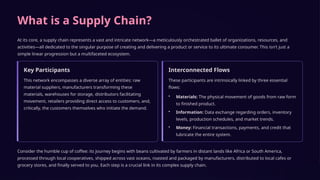
At its core, a supply chain represents a vast and intricate network—a meticulously orchestrated ballet of organizations, resources, and
activities—all dedicated to the singular purpose of creating and delivering a product or service to its ultimate consumer. This isn't just a
simple linear progression but a multifaceted ecosystem.
Key Participants
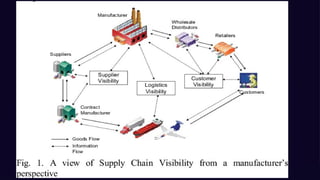
This network encompasses a diverse array of entities: raw
material suppliers, manufacturers transforming these
materials, warehouses for storage, distributors facilitating
movement, retailers providing direct access to customers, and,
critically, the customers themselves who initiate the demand.
Interconnected Flows
These participants are intrinsically linked by three essential
flows:
• Materials: The physical movement of goods from raw form
to finished product.
• Information: Data exchange regarding orders, inventory
levels, production schedules, and market trends.
• Money: Financial transactions, payments, and credit that
lubricate the entire system.
Consider the humble cup of coffee: its journey begins with beans cultivated by farmers in distant lands like Africa or South America,
processed through local cooperatives, shipped across vast oceans, roasted and packaged by manufacturers, distributed to local cafes or
grocery stores, and finally served to you. Each step is a crucial link in its complex supply chain.
Visualizing the
Interconnected Supply Chain
Suppliers
Source raw materials
Manufacturing
Transform materials
into products
Warehousing
Store and manage
inventory
Distribution
Deliver to retailers
and customers
The illustration above vividly portrays the dynamic flow within a typical supply
chain. It highlights how each stage—from the initial acquisition of raw materials
to the final delivery to the end-user—is a critical component of the overall
process. This seamless journey ensures products move efficiently and effectively
through the system, creating value at every point.
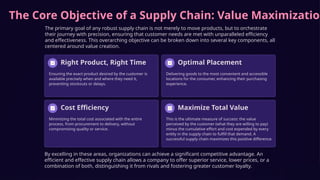
The Core Objective of a Supply Chain: Value Maximization
The primary goal of any robust supply chain is not merely to move products, but to orchestrate
their journey with precision, ensuring that customer needs are met with unparalleled efficiency
and effectiveness. This overarching objective can be broken down into several key components, all
centered around value creation.
Right Product, Right Time
Ensuring the exact product desired by the customer is
available precisely when and where they need it,
preventing stockouts or delays.
Optimal Placement
Delivering goods to the most convenient and accessible
locations for the consumer, enhancing their purchasing
experience.
Cost Efficiency
Minimizing the total cost associated with the entire
process, from procurement to delivery, without
compromising quality or service.
Maximize Total Value
This is the ultimate measure of success: the value
perceived by the customer (what they are willing to pay)
minus the cumulative effort and cost expended by every
entity in the supply chain to fulfill that demand. A
successful supply chain maximizes this positive difference.
By excelling in these areas, organizations can achieve a significant competitive advantage. An
efficient and effective supply chain allows a company to offer superior service, lower prices, or a
combination of both, distinguishing it from rivals and fostering greater customer loyalty.
Why Supply Chain Decisions Hold Immense Significance
Every choice made within the vast expanse of a supply chain reverberates throughout the entire
operation, directly influencing critical performance indicators and ultimately determining business
success or failure. These decisions are not merely operational; they are strategic imperatives.
Impact on Cost & Service
Decisions regarding everything from raw
material procurement to final delivery
directly dictate operational costs and the
quality of service experienced by the end
customer. Optimized decisions can lead to
significant savings and enhanced customer
satisfaction.
Speed and Flexibility
The agility of a supply chain, its ability to
respond quickly to market changes, and
the speed at which products reach
consumers are all products of strategic
choices. A nimble supply chain can adapt
to disruptions and capitalize on new
opportunities.
Consequences of Poor Choices
• Stockouts: Lost sales and frustrated
customers when products are
unavailable.
• Excess Inventory: Increased holding
costs, obsolescence risk, and reduced
cash flow.
• High Costs: Inefficient processes
leading to inflated operational
expenses.
• Lost Customers: A direct result of
consistent dissatisfaction due to
delays, poor quality, or high prices.
Ultimately, strategic sourcing, determining optimal production locations, establishing intelligent inventory
policies, and making astute distribution choices are not just tactical maneuvers; they are fundamental pillars
that shape a business's long-term viability and competitive standing in the marketplace.
Real-World Impact: The Global Sourcing Imperative
In today's interconnected world,
global sourcing has become a
cornerstone strategy for many
multinational corporations. The
decision to procure raw materials
and components from across the
globe is primarily driven by the
pursuit of cost efficiencies,
leveraging specialized labor, and
accessing unique resources
unavailable domestically.
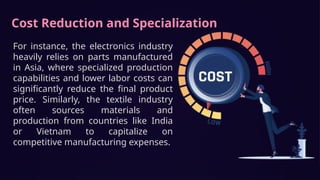
Cost Reduction and Specialization
For instance, the electronics industry
heavily relies on parts manufactured
in Asia, where specialized production
capabilities and lower labor costs can
significantly reduce the final product
price. Similarly, the textile industry
often sources materials and
production from countries like India
or Vietnam to capitalize on
competitive manufacturing expenses.
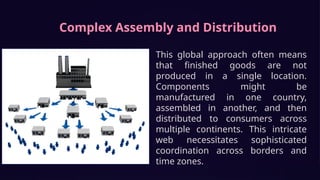
Complex Assembly and Distribution
This global approach often means
that finished goods are not
produced in a single location.
Components might be
manufactured in one country,
assembled in another, and then
distributed to consumers across
multiple continents. This intricate
web necessitates sophisticated
coordination across borders and
time zones.
Challenges of Global Coordination
Such a dispersed supply chain demands exceptional
management to:
• Ensure Quality Control: Maintaining consistent product standards
across diverse manufacturing sites.
• Manage Timing and Deliveries: Overcoming logistical hurdles,
customs regulations, and potential geopolitical disruptions to meet deadlines.
• Optimize Costs: Balancing the savings from global sourcing against
increased transportation costs, inventory holding, and potential risks.
The complexity and scale of global sourcing highlight why strategic
supply chain decisions are paramount to operational success and market
competitiveness.
Supply Chain Management: The Art of Strategic
Coordination
Supply Chain Management (SCM) is far more than just logistics; it's a holistic and strategic discipline focused on orchestrating the entire journey of a
product, from its rawest form to the end consumer. It is the comprehensive planning, meticulous implementation, and continuous control of all activities
involved in a product's lifecycle.
Meeting Customer Requirements
The ultimate goal of SCM is to meet customer
requirements with maximum efficiency. This
involves understanding demand, forecasting
needs, and ensuring products are available
and delivered as promised.
Integrated Functions
SCM effectively integrates critical business
functions that traditionally operated in silos:
• Logistics: Managing the efficient flow and
storage of goods.
• Procurement: Sourcing and acquiring raw
materials and services.
• Production: Transforming materials into
finished goods.
• Distribution: Delivering products to
retailers and end-users.
The "Art" of SCM
Often described as "the art of delivering the
right product, at the right time, place, and
cost," SCM balances competing objectives—
such as minimizing costs while maximizing
customer service—requiring a delicate balance
of strategy, technology, and human ingenuity.
By proactively managing these interconnected elements, SCM aims to optimize the entire process, reduce inefficiencies, mitigate risks, and enhance the
overall value proposition for both the company and its customers.
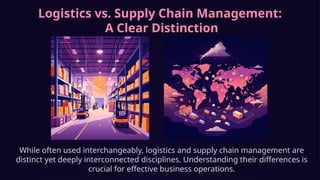
Logistics vs. Supply Chain Management:
A Clear Distinction
While often used interchangeably, logistics and supply chain management are
distinct yet deeply interconnected disciplines. Understanding their differences is
crucial for effective business operations.
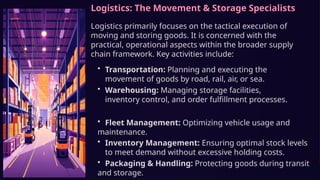
Logistics: The Movement & Storage Specialists
Logistics primarily focuses on the tactical execution of
moving and storing goods. It is concerned with the
practical, operational aspects within the broader supply
chain framework. Key activities include:
• Transportation: Planning and executing the
movement of goods by road, rail, air, or sea.
• Warehousing: Managing storage facilities,
inventory control, and order fulfillment processes.
• Fleet Management: Optimizing vehicle usage and
maintenance.
• Inventory Management: Ensuring optimal stock levels
to meet demand without excessive holding costs.
• Packaging & Handling: Protecting goods during transit
and storage.
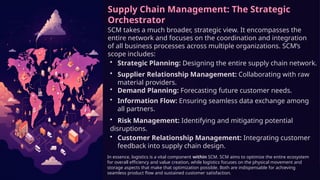
Supply Chain Management: The Strategic
Orchestrator
SCM takes a much broader, strategic view. It encompasses the
entire network and focuses on the coordination and integration
of all business processes across multiple organizations. SCM’s
scope includes:
• Strategic Planning: Designing the entire supply chain network.
• Supplier Relationship Management: Collaborating with raw
material providers.
• Demand Planning: Forecasting future customer needs.
• Information Flow: Ensuring seamless data exchange among
all partners.
• Risk Management: Identifying and mitigating potential
disruptions.
• Customer Relationship Management: Integrating customer
feedback into supply chain design.
In essence, logistics is a vital component within SCM. SCM aims to optimize the entire ecosystem
for overall efficiency and value creation, while logistics focuses on the physical movement and
storage aspects that make that optimization possible. Both are indispensable for achieving
seamless product flow and sustained customer satisfaction.
The Importance of Supply Chain Decisions: A Case Study
Snapshot
The strategic choices made within a supply chain can profoundly impact a company's bottom line and
competitive standing. Let's consider a practical example to illustrate this point.
Direct Shipping Strategy
A retailer decides to ship products directly from
overseas factories to customers, bypassing
traditional warehouses and distribution centers.
This decision, aimed at reducing handling costs
and potentially speeding up delivery, has
significant implications for both cost and
customer experience.
Impact on Delivery & Cost
While direct shipping might lower
warehousing expenses, it could introduce
challenges such as longer transit times,
increased customs complexities, and less
control over the "last mile" delivery,
potentially leading to higher per-item
shipping costs and varied delivery speeds for
the customer.
Inventory Policy Adjustments
Conversely, making a strategic decision on
inventory levels can dramatically alter
outcomes. By implementing a just-in-time (JIT)
inventory system, a company aims to reduce
holding costs and waste. This requires precise
forecasting and strong supplier relationships,
but can greatly improve responsiveness to
market demand.
Profitability & Loyalty
Ultimately, these effective supply chain decisions
—whether concerning shipping routes or
inventory strategies—directly contribute to
profitability by optimizing costs and enhancing
operational efficiency. Crucially, they also build
customer loyalty by ensuring reliable, timely,
and high-quality product delivery, fostering trust
and repeat business.
These scenarios underscore how every major supply chain decision is a strategic lever that can either propel
a business forward or create significant headwinds, emphasizing the need for meticulous planning and
foresight.
Summary: Why Understanding Supply Chains is Critical
The journey through the fundamentals of supply chains reveals their indispensable role in the modern global economy. Far from being a mere logistical
function, supply chains are the intricate arteries through which commerce flows, connecting diverse markets and fulfilling an ever-evolving spectrum of
customer demands.
1 Global Connectivity
Supply chains are the ultimate orchestrators of global markets,
seamlessly linking raw material sources with manufacturing hubs, and
ultimately, with customer demands across continents. They are the
backbone of international trade and economic interdependence.
2 Value Creation as Objective
The core objective of every supply chain is to create maximum value.
This is achieved through the efficient, timely, and cost-effective delivery
of products and services, ensuring that the customer's perceived value
outweighs the total cost of fulfillment.
3 Competitive Advantage Through Strategy
In today’s dynamic and fiercely competitive business environment,
smart supply chain decisions are not just beneficial—they are a critical
source of competitive advantage. Optimizing these decisions can lead
to lower costs, enhanced service, greater flexibility, and superior
market responsiveness.
4 Foundation for Future Mastery
Mastering these foundational concepts of supply chain mechanics,
objectives, and importance lays the essential groundwork. It empowers
individuals and organizations to delve deeper into advanced supply
chain strategies, risk management, and innovative technologies,
paving the way for sustained success in an increasingly complex global
landscape.
Decision Phases in a Supply
Chain: Understanding
Process Views & Real
Examples
The Supply Chain: A Complex Network in Motion
A supply chain is far more than just a linear flow of goods; it's an intricate
ecosystem comprising companies, individuals, resources, activities, and
information, all collaborating to move a product or service from its origin to the
end customer. From the extraction of raw materials to manufacturing,
transportation, warehousing, and final delivery, every step is interconnected.
Effective supply chain management is the art and science of ensuring this complex
network operates seamlessly. It aims to optimize the flow of goods, services, and
information, reducing costs, enhancing efficiency, and improving customer
satisfaction. This comprehensive approach involves strategic planning and
meticulous execution across all stages.
Coordination across various internal functions—such as procurement, production,
marketing, and sales—and external partners, including suppliers, distributors, and
retailers, is absolutely critical. Without strong collaboration and communication,
even minor disruptions can ripple through the entire chain, impacting delivery
times, costs, and ultimately, customer trust. Successful supply chains are built on
strong partnerships and a shared understanding of common goals.
The Three Decision Phases in Supply Chain
Management
Strategic Phase
These are long-term decisions with high
impact, setting the overall structure and
direction for the supply chain. They often
involve significant capital investment
and are difficult to reverse.
• Facility location and capacity
planning
• Network design and infrastructure
• Global sourcing and partnership
strategies
Planning Phase
These tactical decisions span several
months to a quarter. They translate the
strategic goals into actionable plans,
balancing supply and demand.
• Demand forecasting and sales
planning
• Inventory policies and management
• Production scheduling and capacity
allocation
Operational Phase
These are day-to-day decisions focused
on executing the plans efficiently. They
ensure products are delivered on time
and at minimal cost.
• Order fulfillment and processing
• Shipment allocation and routing
• Real-time inventory reporting and
tracking
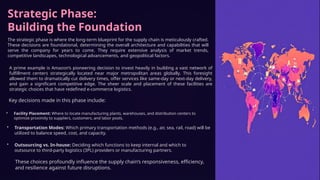
Strategic Phase:
Building the Foundation
The strategic phase is where the long-term blueprint for the supply chain is meticulously crafted.
These decisions are foundational, determining the overall architecture and capabilities that will
serve the company for years to come. They require extensive analysis of market trends,
competitive landscapes, technological advancements, and geopolitical factors.
A prime example is Amazon’s pioneering decision to invest heavily in building a vast network of
fulfillment centers strategically located near major metropolitan areas globally. This foresight
allowed them to dramatically cut delivery times, offer services like same-day or next-day delivery,
and gain a significant competitive edge. The sheer scale and placement of these facilities are
strategic choices that have redefined e-commerce logistics.
Key decisions made in this phase include:
• Facility Placement: Where to locate manufacturing plants, warehouses, and distribution centers to
optimize proximity to suppliers, customers, and labor pools.
• Transportation Modes: Which primary transportation methods (e.g., air, sea, rail, road) will be
utilized to balance speed, cost, and capacity.
• Outsourcing vs. In-house: Deciding which functions to keep internal and which to
outsource to third-party logistics (3PL) providers or manufacturing partners.
These choices profoundly influence the supply chain’s responsiveness, efficiency,
and resilience against future disruptions.
Planning Phase: Aligning Supply with Demand
Once the strategic framework is in place, the planning phase focuses on tactical
decisions that bridge the gap between long-term vision and daily execution. This
phase is dynamic, adapting to changing market conditions and striving to match
supply capabilities with anticipated customer demand over a medium-term horizon,
typically several months to a quarter.
Consider Apple's intricate planning for its iPhone releases. Months before a new model
launches, Apple meticulously forecasts global demand, taking into account historical
sales data, market trends, economic indicators, and competitor activities. Based on
these forecasts, they plan production volumes with their manufacturing partners,
secure necessary components from suppliers, and allocate inventory across different
regions and sales channels.
The planning phase involves critical activities such as:
• Demand Forecasting: Using statistical methods and market intelligence to predict future
customer orders accurately.
• Production Planning: Determining how much to produce, when, and where, to meet
forecasted demand while optimizing resource utilization.
• Inventory Management: Establishing policies for safety stock, reorder points, and inventory
levels to balance holding costs with customer service levels.
• Market Allocation: Deciding how to distribute products across different geographic markets
to capitalize on regional demand and profitability.
Effective planning helps companies balance cost control—by avoiding overproduction
or excessive inventory—with responsiveness to market changes, ensuring products
are available when and where customers want them.
Operational Phase: Executing Daily Activities
The operational phase is the heartbeat of the supply chain, where the plans formulated in the
previous stages are put into action on a day-to-day basis. These decisions are short-term,
often made in real-time, and focus on the efficient execution of all processes to fulfill
customer orders and maintain smooth operations.
Walmart provides an excellent illustration of operational excellence. Its vast network of distribution
centers (DCs) operates continuously, receiving products from suppliers and then precisely
allocating them to individual stores. Daily, systems determine optimal shipment routes, consolidate
orders, and dispatch trucks to ensure that store shelves are consistently stocked, minimizing out-
of-stock situations and maximizing sales. This real-time coordination is crucial for their high-
volume, low-margin business model.
Key aspects of the operational phase include:
• Order Fulfillment: Processing customer orders from receipt to packaging and preparation for
shipment, ensuring accuracy and speed.
• Shipment Allocation & Routing: Deciding which orders go on which trucks, optimizing routes
for efficiency, fuel consumption, and timely delivery.
• Inventory Reporting: Continuously tracking inventory levels at all points in the supply chain to
provide accurate, real-time data for decision-making.
• Returns Management (Reverse Logistics): Handling product returns efficiently, including
inspection, repair, recycling, or disposal, to recover value and maintain customer satisfaction.
The primary focus here is to minimize delays, reduce operational costs, and optimize the overall
performance of the supply chain, ensuring that the customer receives their product as expected.
Process View of a Supply Chain: Core Functions
Beyond decision phases, understanding the functional processes within a supply chain provides another critical
perspective. These processes are the operational pillars that carry out the decisions made at strategic, planning, and
operational levels.
Planning
This foundational process involves
forecasting demand, scheduling production,
and strategically organizing all necessary
resources. It's about orchestrating the entire
supply chain to align with projected needs
and market opportunities, ensuring a
coherent flow of information and materials.
Sourcing
The sourcing process is dedicated to
identifying, evaluating, and engaging with
suppliers. It focuses on procuring raw
materials, components, and services at the
right quality, cost, and time, ensuring a
robust and reliable supply base while
mitigating risks.
Production
This core process involves the transformation
of raw materials and components into
finished goods. It encompasses
manufacturing, assembly, and testing, aiming
for maximum efficiency, quality control, and
adherence to production schedules.
Distribution
The distribution process manages the movement of
finished products from manufacturing facilities to the
end customer. This includes warehousing, order
picking, packaging, transportation logistics, and final
delivery, all focused on speed and accuracy.
Returns
Often overlooked, the returns process,
also known as reverse logistics, handles
products flowing backward through the
supply chain. This includes managing
customer returns, recalls, repairs,
recycling, and disposal, aiming to recover
value and maintain customer
satisfaction.
Real-World Supply Chain Examples
Observing how leading companies manage their supply chains offers invaluable insights into the practical application of decision
phases and process views.
Tesla: Global Manufacturing Footprint
Tesla's strategic decision to build
"Gigafactories" in multiple continents
(e.g., Nevada, Texas, Berlin, Shanghai)
exemplifies strategic network design.
This approach reduces shipping costs,
mitigates geopolitical risks, and speeds
up delivery times to regional markets.
Their planning involves sophisticated
forecasting to ramp up production of
new models, while operations focus on
highly automated manufacturing and
direct-to-consumer delivery models.
Zara: Fast Fashion Agility
Zara's supply chain is a masterclass in
agility. Their planning phase is
exceptionally rapid, with designers
translating fashion trends into new
collections in mere weeks.
Operationally, they employ localized
manufacturing and efficient distribution
networks to deliver fresh designs to
stores twice a week. This "fast fashion"
model minimizes inventory risk and
maximizes responsiveness to consumer
tastes, setting them apart in a highly
competitive industry.
Procter & Gamble: Integrated Sourcing and
Production
P&G, a multinational consumer goods giant,
leverages an integrated sourcing and production
planning strategy on a global scale. They manage
a vast network of suppliers and manufacturing
sites to produce thousands of different products.
Their planning involves complex algorithms for
demand forecasting and inventory optimization
across diverse product categories. Operationally,
P&G focuses on efficient plant utilization and a
robust distribution system to ensure their
products are readily available in markets
worldwide, while continuously seeking to reduce
waste and improve sustainability.
Why Understanding Decision Phases Matters
A deep understanding of the strategic, planning, and operational decision phases is not merely academic; it's a
critical imperative for any organization aiming for sustainable growth and competitive advantage in today's dynamic
global marketplace.
Aligning for Resilience
By distinguishing between these
phases, organizations can ensure that
long-term strategic objectives are
consistently supported and translated
into medium-term plans and daily
operational activities. This alignment
fosters a resilient supply chain capable
of withstanding disruptions, from
natural disasters to geopolitical shifts,
by having coherent responses across all
levels.
Proactive Adaptability
Understanding the different time
horizons allows for proactive
rather than reactive management.
Strategic decisions anticipate
future market shifts and
technological advancements,
planning decisions adjust to
evolving demand and supply
conditions, and operational
decisions optimize daily execution.
This multi-layered approach
enables the supply chain to adapt
swiftly and effectively to
unforeseen challenges and
emerging opportunities.
Driving Core Advantages
Effective management across all three
phases directly contributes to several key
business advantages:
• Cost Savings: Optimizing facility
locations (strategic), inventory levels
(planning), and transportation routes
(operational) significantly reduces
expenses.
• Customer Satisfaction: Reliable
product availability, faster delivery
times, and efficient returns processing
enhance the customer experience.
• Competitive Edge: A well-managed
supply chain can be a powerful
differentiator, enabling companies to
offer superior service, lower prices, or
innovative products faster than
competitors.
Conclusion: Mastering Supply Chain Decisions for Success
The journey from raw material to a satisfied customer is a complex dance
choreographed by countless decisions. A robust supply chain doesn't happen
by chance; it's the result of meticulous planning and execution across distinct,
yet interconnected, decision phases.
• Supply chains truly thrive when strategic, planning, and operational
decisions are not made in isolation but work in perfect harmony. This
vertical alignment ensures that every daily action contributes to long-term
goals.
• Process views—from planning and sourcing to production, distribution,
and returns—serve as invaluable frameworks. They clarify roles,
streamline workflows, and improve coordination across diverse functions
and partners, enhancing overall efficiency.
• Real-world examples from industry leaders like Tesla, Zara, and P&G
demonstrate that mastering these decision phases transforms supply chain
management from a mere operational necessity into a powerful source of
competitive strength and innovation.
Your next step:
Take the initiative to analyze your own supply chain's decision phases. Identify
areas for better alignment, improved forecasting, or optimized daily operations.
By doing so, you can unlock significant efficiencies, enhance customer
satisfaction, and drive sustained growth for your organization. ACTIONABLE INSIGHT
THANK YOU!

Chapter-1-Understanding-the-Supply-Chain.pptx

  • 1.
  • 2.
    What are the productsneeded to produce/ materials a Doughnut?
  • 3.
    What is aSupply Chain? At its core, a supply chain represents a vast and intricate network—a meticulously orchestrated ballet of organizations, resources, and activities—all dedicated to the singular purpose of creating and delivering a product or service to its ultimate consumer. This isn't just a simple linear progression but a multifaceted ecosystem. Key Participants This network encompasses a diverse array of entities: raw material suppliers, manufacturers transforming these materials, warehouses for storage, distributors facilitating movement, retailers providing direct access to customers, and, critically, the customers themselves who initiate the demand. Interconnected Flows These participants are intrinsically linked by three essential flows: • Materials: The physical movement of goods from raw form to finished product. • Information: Data exchange regarding orders, inventory levels, production schedules, and market trends. • Money: Financial transactions, payments, and credit that lubricate the entire system. Consider the humble cup of coffee: its journey begins with beans cultivated by farmers in distant lands like Africa or South America, processed through local cooperatives, shipped across vast oceans, roasted and packaged by manufacturers, distributed to local cafes or grocery stores, and finally served to you. Each step is a crucial link in its complex supply chain.
  • 4.
    Visualizing the Interconnected SupplyChain Suppliers Source raw materials Manufacturing Transform materials into products Warehousing Store and manage inventory Distribution Deliver to retailers and customers The illustration above vividly portrays the dynamic flow within a typical supply chain. It highlights how each stage—from the initial acquisition of raw materials to the final delivery to the end-user—is a critical component of the overall process. This seamless journey ensures products move efficiently and effectively through the system, creating value at every point.
  • 7.
    The Core Objectiveof a Supply Chain: Value Maximization The primary goal of any robust supply chain is not merely to move products, but to orchestrate their journey with precision, ensuring that customer needs are met with unparalleled efficiency and effectiveness. This overarching objective can be broken down into several key components, all centered around value creation. Right Product, Right Time Ensuring the exact product desired by the customer is available precisely when and where they need it, preventing stockouts or delays. Optimal Placement Delivering goods to the most convenient and accessible locations for the consumer, enhancing their purchasing experience. Cost Efficiency Minimizing the total cost associated with the entire process, from procurement to delivery, without compromising quality or service. Maximize Total Value This is the ultimate measure of success: the value perceived by the customer (what they are willing to pay) minus the cumulative effort and cost expended by every entity in the supply chain to fulfill that demand. A successful supply chain maximizes this positive difference. By excelling in these areas, organizations can achieve a significant competitive advantage. An efficient and effective supply chain allows a company to offer superior service, lower prices, or a combination of both, distinguishing it from rivals and fostering greater customer loyalty.
  • 8.
    Why Supply ChainDecisions Hold Immense Significance Every choice made within the vast expanse of a supply chain reverberates throughout the entire operation, directly influencing critical performance indicators and ultimately determining business success or failure. These decisions are not merely operational; they are strategic imperatives. Impact on Cost & Service Decisions regarding everything from raw material procurement to final delivery directly dictate operational costs and the quality of service experienced by the end customer. Optimized decisions can lead to significant savings and enhanced customer satisfaction. Speed and Flexibility The agility of a supply chain, its ability to respond quickly to market changes, and the speed at which products reach consumers are all products of strategic choices. A nimble supply chain can adapt to disruptions and capitalize on new opportunities. Consequences of Poor Choices • Stockouts: Lost sales and frustrated customers when products are unavailable. • Excess Inventory: Increased holding costs, obsolescence risk, and reduced cash flow. • High Costs: Inefficient processes leading to inflated operational expenses. • Lost Customers: A direct result of consistent dissatisfaction due to delays, poor quality, or high prices. Ultimately, strategic sourcing, determining optimal production locations, establishing intelligent inventory policies, and making astute distribution choices are not just tactical maneuvers; they are fundamental pillars that shape a business's long-term viability and competitive standing in the marketplace.
  • 9.
    Real-World Impact: TheGlobal Sourcing Imperative In today's interconnected world, global sourcing has become a cornerstone strategy for many multinational corporations. The decision to procure raw materials and components from across the globe is primarily driven by the pursuit of cost efficiencies, leveraging specialized labor, and accessing unique resources unavailable domestically.
  • 10.
    Cost Reduction andSpecialization For instance, the electronics industry heavily relies on parts manufactured in Asia, where specialized production capabilities and lower labor costs can significantly reduce the final product price. Similarly, the textile industry often sources materials and production from countries like India or Vietnam to capitalize on competitive manufacturing expenses.
  • 11.
    Complex Assembly andDistribution This global approach often means that finished goods are not produced in a single location. Components might be manufactured in one country, assembled in another, and then distributed to consumers across multiple continents. This intricate web necessitates sophisticated coordination across borders and time zones.
  • 12.
    Challenges of GlobalCoordination Such a dispersed supply chain demands exceptional management to: • Ensure Quality Control: Maintaining consistent product standards across diverse manufacturing sites. • Manage Timing and Deliveries: Overcoming logistical hurdles, customs regulations, and potential geopolitical disruptions to meet deadlines. • Optimize Costs: Balancing the savings from global sourcing against increased transportation costs, inventory holding, and potential risks. The complexity and scale of global sourcing highlight why strategic supply chain decisions are paramount to operational success and market competitiveness.
  • 13.
    Supply Chain Management:The Art of Strategic Coordination Supply Chain Management (SCM) is far more than just logistics; it's a holistic and strategic discipline focused on orchestrating the entire journey of a product, from its rawest form to the end consumer. It is the comprehensive planning, meticulous implementation, and continuous control of all activities involved in a product's lifecycle. Meeting Customer Requirements The ultimate goal of SCM is to meet customer requirements with maximum efficiency. This involves understanding demand, forecasting needs, and ensuring products are available and delivered as promised. Integrated Functions SCM effectively integrates critical business functions that traditionally operated in silos: • Logistics: Managing the efficient flow and storage of goods. • Procurement: Sourcing and acquiring raw materials and services. • Production: Transforming materials into finished goods. • Distribution: Delivering products to retailers and end-users. The "Art" of SCM Often described as "the art of delivering the right product, at the right time, place, and cost," SCM balances competing objectives— such as minimizing costs while maximizing customer service—requiring a delicate balance of strategy, technology, and human ingenuity. By proactively managing these interconnected elements, SCM aims to optimize the entire process, reduce inefficiencies, mitigate risks, and enhance the overall value proposition for both the company and its customers.
  • 14.
    Logistics vs. SupplyChain Management: A Clear Distinction While often used interchangeably, logistics and supply chain management are distinct yet deeply interconnected disciplines. Understanding their differences is crucial for effective business operations.
  • 15.
    Logistics: The Movement& Storage Specialists Logistics primarily focuses on the tactical execution of moving and storing goods. It is concerned with the practical, operational aspects within the broader supply chain framework. Key activities include: • Transportation: Planning and executing the movement of goods by road, rail, air, or sea. • Warehousing: Managing storage facilities, inventory control, and order fulfillment processes. • Fleet Management: Optimizing vehicle usage and maintenance. • Inventory Management: Ensuring optimal stock levels to meet demand without excessive holding costs. • Packaging & Handling: Protecting goods during transit and storage.
  • 16.
    Supply Chain Management:The Strategic Orchestrator SCM takes a much broader, strategic view. It encompasses the entire network and focuses on the coordination and integration of all business processes across multiple organizations. SCM’s scope includes: • Strategic Planning: Designing the entire supply chain network. • Supplier Relationship Management: Collaborating with raw material providers. • Demand Planning: Forecasting future customer needs. • Information Flow: Ensuring seamless data exchange among all partners. • Risk Management: Identifying and mitigating potential disruptions. • Customer Relationship Management: Integrating customer feedback into supply chain design. In essence, logistics is a vital component within SCM. SCM aims to optimize the entire ecosystem for overall efficiency and value creation, while logistics focuses on the physical movement and storage aspects that make that optimization possible. Both are indispensable for achieving seamless product flow and sustained customer satisfaction.
  • 17.
    The Importance ofSupply Chain Decisions: A Case Study Snapshot The strategic choices made within a supply chain can profoundly impact a company's bottom line and competitive standing. Let's consider a practical example to illustrate this point. Direct Shipping Strategy A retailer decides to ship products directly from overseas factories to customers, bypassing traditional warehouses and distribution centers. This decision, aimed at reducing handling costs and potentially speeding up delivery, has significant implications for both cost and customer experience. Impact on Delivery & Cost While direct shipping might lower warehousing expenses, it could introduce challenges such as longer transit times, increased customs complexities, and less control over the "last mile" delivery, potentially leading to higher per-item shipping costs and varied delivery speeds for the customer. Inventory Policy Adjustments Conversely, making a strategic decision on inventory levels can dramatically alter outcomes. By implementing a just-in-time (JIT) inventory system, a company aims to reduce holding costs and waste. This requires precise forecasting and strong supplier relationships, but can greatly improve responsiveness to market demand. Profitability & Loyalty Ultimately, these effective supply chain decisions —whether concerning shipping routes or inventory strategies—directly contribute to profitability by optimizing costs and enhancing operational efficiency. Crucially, they also build customer loyalty by ensuring reliable, timely, and high-quality product delivery, fostering trust and repeat business. These scenarios underscore how every major supply chain decision is a strategic lever that can either propel a business forward or create significant headwinds, emphasizing the need for meticulous planning and foresight.
  • 18.
    Summary: Why UnderstandingSupply Chains is Critical The journey through the fundamentals of supply chains reveals their indispensable role in the modern global economy. Far from being a mere logistical function, supply chains are the intricate arteries through which commerce flows, connecting diverse markets and fulfilling an ever-evolving spectrum of customer demands. 1 Global Connectivity Supply chains are the ultimate orchestrators of global markets, seamlessly linking raw material sources with manufacturing hubs, and ultimately, with customer demands across continents. They are the backbone of international trade and economic interdependence. 2 Value Creation as Objective The core objective of every supply chain is to create maximum value. This is achieved through the efficient, timely, and cost-effective delivery of products and services, ensuring that the customer's perceived value outweighs the total cost of fulfillment. 3 Competitive Advantage Through Strategy In today’s dynamic and fiercely competitive business environment, smart supply chain decisions are not just beneficial—they are a critical source of competitive advantage. Optimizing these decisions can lead to lower costs, enhanced service, greater flexibility, and superior market responsiveness. 4 Foundation for Future Mastery Mastering these foundational concepts of supply chain mechanics, objectives, and importance lays the essential groundwork. It empowers individuals and organizations to delve deeper into advanced supply chain strategies, risk management, and innovative technologies, paving the way for sustained success in an increasingly complex global landscape.
  • 19.
    Decision Phases ina Supply Chain: Understanding Process Views & Real Examples
  • 20.
    The Supply Chain:A Complex Network in Motion A supply chain is far more than just a linear flow of goods; it's an intricate ecosystem comprising companies, individuals, resources, activities, and information, all collaborating to move a product or service from its origin to the end customer. From the extraction of raw materials to manufacturing, transportation, warehousing, and final delivery, every step is interconnected. Effective supply chain management is the art and science of ensuring this complex network operates seamlessly. It aims to optimize the flow of goods, services, and information, reducing costs, enhancing efficiency, and improving customer satisfaction. This comprehensive approach involves strategic planning and meticulous execution across all stages. Coordination across various internal functions—such as procurement, production, marketing, and sales—and external partners, including suppliers, distributors, and retailers, is absolutely critical. Without strong collaboration and communication, even minor disruptions can ripple through the entire chain, impacting delivery times, costs, and ultimately, customer trust. Successful supply chains are built on strong partnerships and a shared understanding of common goals.
  • 21.
    The Three DecisionPhases in Supply Chain Management Strategic Phase These are long-term decisions with high impact, setting the overall structure and direction for the supply chain. They often involve significant capital investment and are difficult to reverse. • Facility location and capacity planning • Network design and infrastructure • Global sourcing and partnership strategies Planning Phase These tactical decisions span several months to a quarter. They translate the strategic goals into actionable plans, balancing supply and demand. • Demand forecasting and sales planning • Inventory policies and management • Production scheduling and capacity allocation Operational Phase These are day-to-day decisions focused on executing the plans efficiently. They ensure products are delivered on time and at minimal cost. • Order fulfillment and processing • Shipment allocation and routing • Real-time inventory reporting and tracking
  • 22.
    Strategic Phase: Building theFoundation The strategic phase is where the long-term blueprint for the supply chain is meticulously crafted. These decisions are foundational, determining the overall architecture and capabilities that will serve the company for years to come. They require extensive analysis of market trends, competitive landscapes, technological advancements, and geopolitical factors. A prime example is Amazon’s pioneering decision to invest heavily in building a vast network of fulfillment centers strategically located near major metropolitan areas globally. This foresight allowed them to dramatically cut delivery times, offer services like same-day or next-day delivery, and gain a significant competitive edge. The sheer scale and placement of these facilities are strategic choices that have redefined e-commerce logistics. Key decisions made in this phase include: • Facility Placement: Where to locate manufacturing plants, warehouses, and distribution centers to optimize proximity to suppliers, customers, and labor pools. • Transportation Modes: Which primary transportation methods (e.g., air, sea, rail, road) will be utilized to balance speed, cost, and capacity. • Outsourcing vs. In-house: Deciding which functions to keep internal and which to outsource to third-party logistics (3PL) providers or manufacturing partners. These choices profoundly influence the supply chain’s responsiveness, efficiency, and resilience against future disruptions.
  • 23.
    Planning Phase: AligningSupply with Demand Once the strategic framework is in place, the planning phase focuses on tactical decisions that bridge the gap between long-term vision and daily execution. This phase is dynamic, adapting to changing market conditions and striving to match supply capabilities with anticipated customer demand over a medium-term horizon, typically several months to a quarter. Consider Apple's intricate planning for its iPhone releases. Months before a new model launches, Apple meticulously forecasts global demand, taking into account historical sales data, market trends, economic indicators, and competitor activities. Based on these forecasts, they plan production volumes with their manufacturing partners, secure necessary components from suppliers, and allocate inventory across different regions and sales channels. The planning phase involves critical activities such as: • Demand Forecasting: Using statistical methods and market intelligence to predict future customer orders accurately. • Production Planning: Determining how much to produce, when, and where, to meet forecasted demand while optimizing resource utilization. • Inventory Management: Establishing policies for safety stock, reorder points, and inventory levels to balance holding costs with customer service levels. • Market Allocation: Deciding how to distribute products across different geographic markets to capitalize on regional demand and profitability. Effective planning helps companies balance cost control—by avoiding overproduction or excessive inventory—with responsiveness to market changes, ensuring products are available when and where customers want them.
  • 24.
    Operational Phase: ExecutingDaily Activities The operational phase is the heartbeat of the supply chain, where the plans formulated in the previous stages are put into action on a day-to-day basis. These decisions are short-term, often made in real-time, and focus on the efficient execution of all processes to fulfill customer orders and maintain smooth operations. Walmart provides an excellent illustration of operational excellence. Its vast network of distribution centers (DCs) operates continuously, receiving products from suppliers and then precisely allocating them to individual stores. Daily, systems determine optimal shipment routes, consolidate orders, and dispatch trucks to ensure that store shelves are consistently stocked, minimizing out- of-stock situations and maximizing sales. This real-time coordination is crucial for their high- volume, low-margin business model. Key aspects of the operational phase include: • Order Fulfillment: Processing customer orders from receipt to packaging and preparation for shipment, ensuring accuracy and speed. • Shipment Allocation & Routing: Deciding which orders go on which trucks, optimizing routes for efficiency, fuel consumption, and timely delivery. • Inventory Reporting: Continuously tracking inventory levels at all points in the supply chain to provide accurate, real-time data for decision-making. • Returns Management (Reverse Logistics): Handling product returns efficiently, including inspection, repair, recycling, or disposal, to recover value and maintain customer satisfaction. The primary focus here is to minimize delays, reduce operational costs, and optimize the overall performance of the supply chain, ensuring that the customer receives their product as expected.
  • 25.
    Process View ofa Supply Chain: Core Functions Beyond decision phases, understanding the functional processes within a supply chain provides another critical perspective. These processes are the operational pillars that carry out the decisions made at strategic, planning, and operational levels. Planning This foundational process involves forecasting demand, scheduling production, and strategically organizing all necessary resources. It's about orchestrating the entire supply chain to align with projected needs and market opportunities, ensuring a coherent flow of information and materials. Sourcing The sourcing process is dedicated to identifying, evaluating, and engaging with suppliers. It focuses on procuring raw materials, components, and services at the right quality, cost, and time, ensuring a robust and reliable supply base while mitigating risks. Production This core process involves the transformation of raw materials and components into finished goods. It encompasses manufacturing, assembly, and testing, aiming for maximum efficiency, quality control, and adherence to production schedules. Distribution The distribution process manages the movement of finished products from manufacturing facilities to the end customer. This includes warehousing, order picking, packaging, transportation logistics, and final delivery, all focused on speed and accuracy. Returns Often overlooked, the returns process, also known as reverse logistics, handles products flowing backward through the supply chain. This includes managing customer returns, recalls, repairs, recycling, and disposal, aiming to recover value and maintain customer satisfaction.
  • 26.
    Real-World Supply ChainExamples Observing how leading companies manage their supply chains offers invaluable insights into the practical application of decision phases and process views. Tesla: Global Manufacturing Footprint Tesla's strategic decision to build "Gigafactories" in multiple continents (e.g., Nevada, Texas, Berlin, Shanghai) exemplifies strategic network design. This approach reduces shipping costs, mitigates geopolitical risks, and speeds up delivery times to regional markets. Their planning involves sophisticated forecasting to ramp up production of new models, while operations focus on highly automated manufacturing and direct-to-consumer delivery models. Zara: Fast Fashion Agility Zara's supply chain is a masterclass in agility. Their planning phase is exceptionally rapid, with designers translating fashion trends into new collections in mere weeks. Operationally, they employ localized manufacturing and efficient distribution networks to deliver fresh designs to stores twice a week. This "fast fashion" model minimizes inventory risk and maximizes responsiveness to consumer tastes, setting them apart in a highly competitive industry. Procter & Gamble: Integrated Sourcing and Production P&G, a multinational consumer goods giant, leverages an integrated sourcing and production planning strategy on a global scale. They manage a vast network of suppliers and manufacturing sites to produce thousands of different products. Their planning involves complex algorithms for demand forecasting and inventory optimization across diverse product categories. Operationally, P&G focuses on efficient plant utilization and a robust distribution system to ensure their products are readily available in markets worldwide, while continuously seeking to reduce waste and improve sustainability.
  • 27.
    Why Understanding DecisionPhases Matters A deep understanding of the strategic, planning, and operational decision phases is not merely academic; it's a critical imperative for any organization aiming for sustainable growth and competitive advantage in today's dynamic global marketplace. Aligning for Resilience By distinguishing between these phases, organizations can ensure that long-term strategic objectives are consistently supported and translated into medium-term plans and daily operational activities. This alignment fosters a resilient supply chain capable of withstanding disruptions, from natural disasters to geopolitical shifts, by having coherent responses across all levels. Proactive Adaptability Understanding the different time horizons allows for proactive rather than reactive management. Strategic decisions anticipate future market shifts and technological advancements, planning decisions adjust to evolving demand and supply conditions, and operational decisions optimize daily execution. This multi-layered approach enables the supply chain to adapt swiftly and effectively to unforeseen challenges and emerging opportunities. Driving Core Advantages Effective management across all three phases directly contributes to several key business advantages: • Cost Savings: Optimizing facility locations (strategic), inventory levels (planning), and transportation routes (operational) significantly reduces expenses. • Customer Satisfaction: Reliable product availability, faster delivery times, and efficient returns processing enhance the customer experience. • Competitive Edge: A well-managed supply chain can be a powerful differentiator, enabling companies to offer superior service, lower prices, or innovative products faster than competitors.
  • 28.
    Conclusion: Mastering SupplyChain Decisions for Success The journey from raw material to a satisfied customer is a complex dance choreographed by countless decisions. A robust supply chain doesn't happen by chance; it's the result of meticulous planning and execution across distinct, yet interconnected, decision phases. • Supply chains truly thrive when strategic, planning, and operational decisions are not made in isolation but work in perfect harmony. This vertical alignment ensures that every daily action contributes to long-term goals. • Process views—from planning and sourcing to production, distribution, and returns—serve as invaluable frameworks. They clarify roles, streamline workflows, and improve coordination across diverse functions and partners, enhancing overall efficiency. • Real-world examples from industry leaders like Tesla, Zara, and P&G demonstrate that mastering these decision phases transforms supply chain management from a mere operational necessity into a powerful source of competitive strength and innovation. Your next step: Take the initiative to analyze your own supply chain's decision phases. Identify areas for better alignment, improved forecasting, or optimized daily operations. By doing so, you can unlock significant efficiencies, enhance customer satisfaction, and drive sustained growth for your organization. ACTIONABLE INSIGHT

  • 29.