
Stefano Crea
Bangkok, May 23rd 2013
© DNV Business Assurance. All rights reserved.
Supply Chain Management: Tools for
improvement or barriers to trade?
World of Food Safety
© DNV Business Assurance. All rights reserved.
Supply Chain Management: Tools for improvement or barriers to trade?
Bangkok, May 23rd 2013
Content
 How can we ensure a sustainable supply
chain, where food production is responsibly
carried out while resulting in safe food?
 What are main supply chain operators and
food suppliers’ concerns, issues, attitudes
and perceptions on food safety?
 What is the level of trust along the supply
chain?
 Are the food safety certification practices
and systems currently used a tool for
improvement or as a barrier?
 How to find the balance between the highest
food safety standards and fulfilling growing
demand?
2
© DNV Business Assurance. All rights reserved.
Supply Chain Management: Tools for improvement or barriers to trade?
Bangkok, May 23rd 2013
About DNV
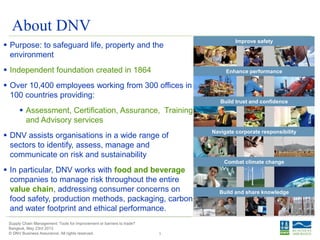
 Purpose: to safeguard life, property and the
environment
 Independent foundation created in 1864
 Over 10,400 employees working from 300 offices in
100 countries providing:
 Assessment, Certification, Assurance, Training
and Advisory services
 DNV assists organisations in a wide range of
sectors to identify, assess, manage and
communicate on risk and sustainability
 In particular, DNV works with food and beverage
companies to manage risk throughout the entire
value chain, addressing consumer concerns on
food safety, production methods, packaging, carbon
and water footprint and ethical performance.
Improve safety
Navigate corporate responsibility
Combat climate change
Enhance performance
Build trust and confidence
3
Build and share knowledge
© DNV Business Assurance. All rights reserved.
Supply Chain Management: Tools for improvement or barriers to trade?
Bangkok, May 23rd 2013
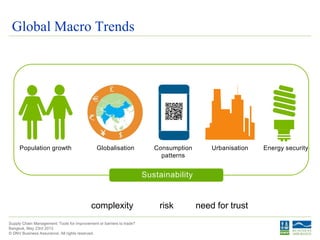
Population growth Urbanisation
GLOBAL MACRO TRENDS
Sustainability
complexity risk need for trust
Globalisation Energy securityConsumption
patterns
Global Macro Trends
© DNV Business Assurance. All rights reserved.
Supply Chain Management: Tools for improvement or barriers to trade?
Bangkok, May 23rd 2013Bangkok, May 23rd 2013
© DNV Business Assurance. All rights reserved.
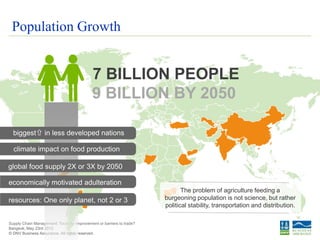
POPULATION GROWTH
biggest in less developed nations
climate impact on food production
global food supply 2X or 3X by 2050
The problem of agriculture feeding a
burgeoning population is not science, but rather
political stability, transportation and distribution.
7 BILLION PEOPLE
9 BILLION BY 2050
Population Growth
economically motivated adulteration
resources: One only planet, not 2 or 3
© DNV Business Assurance. All rights reserved.
Supply Chain Management: Tools for improvement or barriers to trade?
Bangkok, May 23rd 2013Bangkok, May 23rd 2013
© DNV Business Assurance. All rights reserved.
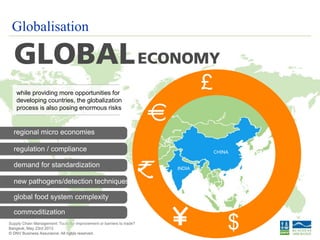
regional micro economies
regulation / compliance
demand for standardization
GLOBALISATION
while providing more opportunities for
developing countries, the globalization
process is also posing enormous risks
CHINA
INDIA
£
$
Globalisation
new pathogens/detection techniques
global food system complexity
commoditization
© DNV Business Assurance. All rights reserved.
Supply Chain Management: Tools for improvement or barriers to trade?
Bangkok, May 23rd 2013Bangkok, May 23rd 2013
© DNV Business Assurance. All rights reserved.
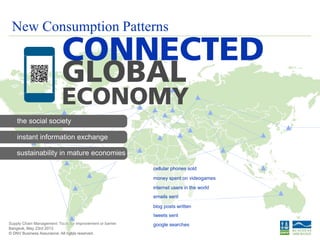
NEW CONSUMPTION PATTERNS
the social society
instant information exchange
sustainability in mature economies
cellular phones sold
money spent on videogames
internet users in the world
blog posts written
emails sent
tweets sent
google searches
New Consumption Patterns
© DNV Business Assurance. All rights reserved.
Supply Chain Management: Tools for improvement or barriers to trade?
Bangkok, May 23rd 2013Bangkok, May 23rd 2013
© DNV Business Assurance. All rights reserved.
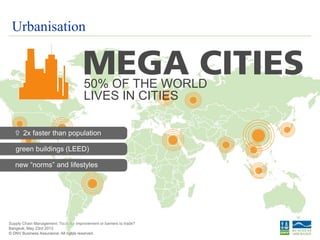
new “norms” and lifestyles
URBANISATION
 2x faster than population
green buildings (LEED)
50% OF THE WORLD
LIVES IN CITIES
Urbanisation
© DNV Business Assurance. All rights reserved.
Supply Chain Management: Tools for improvement or barriers to trade?
Bangkok, May 23rd 2013
9
Perception on Food Safety
Customers Survey – January 2013
© DNV Business Assurance. All rights reserved.
Supply Chain Management: Tools for improvement or barriers to trade?
Bangkok, May 23rd 2013
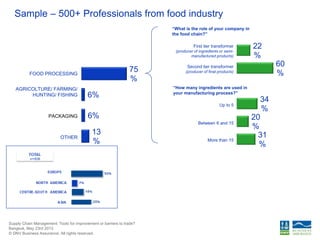
Sample – 500+ Professionals from food industry
75
%
6%
6%
13
%
FOOD PROCESSING
AGRICOLTURE/ FARMING/
HUNTING/ FISHING
PACKAGING
OTHER
22
%
60
%
34
%
20
%
31
%
First tier transformer
(producer of ingredients or semi-
manufactured products)
Second tier transformer
(producer of final products)
Up to 5
Between 6 and 15
More than 15
“How many ingredients are used in
your manufacturing process?”
“What is the role of your company in
the food chain?”
© DNV Business Assurance. All rights reserved.
Supply Chain Management: Tools for improvement or barriers to trade?
Bangkok, May 23rd 2013Bangkok, May 23rd 2013
© DNV Business Assurance. All rights reserved.
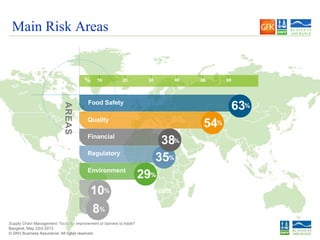
Regulatory
35%
Main Risk Areas
AREAS
10 20 30 40 50% 60
Financial
38%
54Quality %
63Food Safety %
Environment
29%
10 Community Impact%
Ethical8%
© DNV Business Assurance. All rights reserved.
Supply Chain Management: Tools for improvement or barriers to trade?
Bangkok, May 23rd 2013Bangkok, May 23rd 2013
© DNV Business Assurance. All rights reserved.
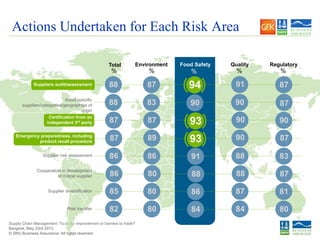
Actions Undertaken for Each Risk Area
Food SafetyEnvironmentTotal Quality Regulatory
Suppliers audit/assessment
Avoid specific
suppliers/categories/geographies of
origin
Certification from an
independent 3rd party
Emergency preparedness, including
product recall procedure
Supplier risk assessment
Cooperation in development
of critical supplier
Supplier diversification
Risk transfer
94
93
93
90 90 87
87
90
87
83
87
81
80
90
90
88
88
87
84
91
83
87
89
86
80
80
80
87
88
87
87
86
86
85
82
88
91
88
86
84
% % % % %
© DNV Business Assurance. All rights reserved.
Supply Chain Management: Tools for improvement or barriers to trade?
Bangkok, May 23rd 2013Bangkok, May 23rd 2013
© DNV Business Assurance. All rights reserved.
Internal policy
47%
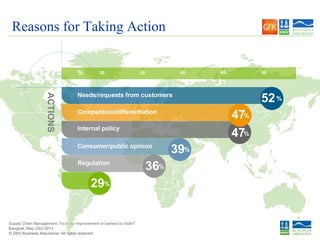
Reasons for Taking Action
ACTIONS
30 35 40 45 50%
52Needs/requests from customers
%
47Competition/differentiation
%
39Consumer/public opinion
%
36Regulation
%
29 Economic%
© DNV Business Assurance. All rights reserved.
Supply Chain Management: Tools for improvement or barriers to trade?
Bangkok, May 23rd 2013Bangkok, May 23rd 2013
© DNV Business Assurance. All rights reserved.
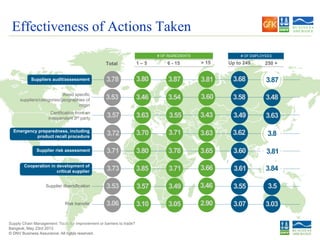
Effectiveness of Actions Taken
> 156 - 15Total
Avoid specific
suppliers/categories/geographies of
origin
Supplier risk assessment
Cooperation in development of
critical supplier
Supplier diversification
Risk transfer
3.81
3.43
3.603.54
3.55
3.71
3.78
3.71
3.49
3.05
3.87
3.53
3.57
3.72
3.71
3.73
3.53
3.06
3.78
3.65
3.46
2.90
3.66
3.63
Suppliers audit/assessment
Certification from an
independent 3rd party
Emergency preparedness, including
product recall procedure
250 +Up to 249
3.87
3.63
3.483.58
3.49
3.62
3.60
3.61
3.55
3.07
3.68
3.81
3.5
3.03
3.84
3.8
1 – 5
3.46
3.63
3.70
3.80
3.85
3.57
3.10
3.80
# OF INGREDIENTS # OF EMPLOYEES
© DNV Business Assurance. All rights reserved.
Supply Chain Management: Tools for improvement or barriers to trade?
Bangkok, May 23rd 2013Bangkok, May 23rd 2013
© DNV Business Assurance. All rights reserved.
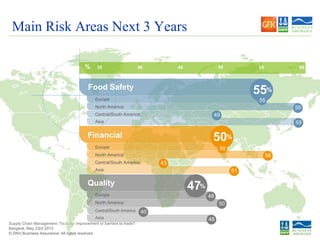
55Food Safety %
50Financial %
Main Risk Areas Next 3 Years
59North America
35 40 45 50 55 60
Europe 55
Central/South America 49
Asia 59
Europe 50
North America 56
Central/South America 43
Asia 51
Europe 48
North America 50
Central/South America 40
Asia 48
%
Quality
47%
© DNV Business Assurance. All rights reserved.
Supply Chain Management: Tools for improvement or barriers to trade?
Bangkok, May 23rd 2013
16
Food Supply Chain Management
© DNV Business Assurance. All rights reserved.
Supply Chain Management: Tools for improvement or barriers to trade?
Bangkok, May 23rd 2013
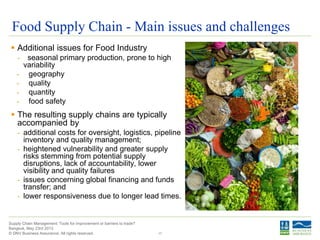
Food Supply Chain - Main issues and challenges
 Additional issues for Food Industry
- seasonal primary production, prone to high
variability
- geography
- quality
- quantity
- food safety
 The resulting supply chains are typically
accompanied by
- additional costs for oversight, logistics, pipeline
inventory and quality management;
- heightened vulnerability and greater supply
risks stemming from potential supply
disruptions, lack of accountability, lower
visibility and quality failures
- issues concerning global financing and funds
transfer; and
- lower responsiveness due to longer lead times.
17
© DNV Business Assurance. All rights reserved.
Supply Chain Management: Tools for improvement or barriers to trade?
Bangkok, May 23rd 2013
Effective Supply Chain Management
 Supply Chain Management is a complex process deeply affecting the
company’s capability to compete on the market
- Strategic issues, such as
- Strategic partnership with suppliers, distributors, and customers
- Information Technology infrastructure, to support supply chain operations
- Where-to-make and what-to-make-or-buy decisions
- Tactical issues, such as
- Sourcing contracts and other purchasing decisions.
- Inventory decisions, including quantity, location, and quality of inventory.
- Transportation strategy, including frequency, routes, and contracting.
- Operational issues, such as
- Demand planning and forecasting, coordinating the demand forecast of all customers and
sharing the forecast with all suppliers.
- Sourcing planning, including current inventory and forecast demand, in collaboration with all
suppliers.
- Inbound operations, including transportation from suppliers and receiving inventory.
- Order promising, accounting for all constraints in the supply chain, including all suppliers,
manufacturing facilities, distribution centres, and other customers.
18
© DNV Business Assurance. All rights reserved.
Supply Chain Management: Tools for improvement or barriers to trade?
Bangkok, May 23rd 2013
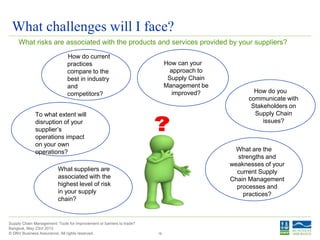
What challenges will I face?
1919
How do current
practices
compare to the
best in industry
and
competitors?
To what extent will
disruption of your
supplier’s
operations impact
on your own
operations?
What risks are associated with the products and services provided by your suppliers?
How can your
approach to
Supply Chain
Management be
improved? How do you
communicate with
Stakeholders on
Supply Chain
issues?
What are the
strengths and
weaknesses of your
current Supply
Chain Management
processes and
practices?
What suppliers are
associated with the
highest level of risk
in your supply
chain?
© DNV Business Assurance. All rights reserved.
Supply Chain Management: Tools for improvement or barriers to trade?
Bangkok, May 23rd 2013
Supply Chain Management
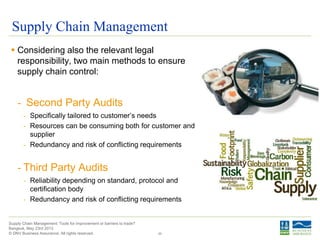
 Considering also the relevant legal
responsibility, two main methods to ensure
supply chain control:
- Second Party Audits
- Specifically tailored to customer’s needs
- Resources can be consuming both for customer and
supplier
- Redundancy and risk of conflicting requirements
- Third Party Audits
- Reliability depending on standard, protocol and
certification body
- Redundancy and risk of conflicting requirements
20
© DNV Business Assurance. All rights reserved.
Supply Chain Management: Tools for improvement or barriers to trade?
Bangkok, May 23rd 2013
(Tailored) 2nd party Supplier Audits
 Determine Supply Chain (boundaries)
 Define the scope (e.g. Food Safety, Quality,
Environment, Occupational Health and
Safety, Ethical, etc.)
 Define the standards (international
standards, customer requirements, etc. )
 Specific company/customer requirements
as possible add-ons
 Define auditor competence
 Set/train/calibrate dedicated team of
auditors
 Audit Approach/Audit Trails
21
© DNV Business Assurance. All rights reserved.
Supply Chain Management: Tools for improvement or barriers to trade?
Bangkok, May 23rd 2013
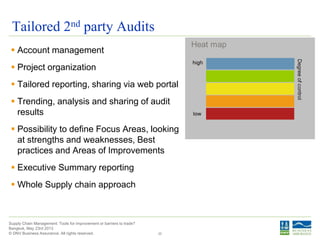
Tailored 2nd party Audits
 Account management
 Project organization
 Tailored reporting, sharing via web portal
 Trending, analysis and sharing of audit
results
 Possibility to define Focus Areas, looking
at strengths and weaknesses, Best
practices and Areas of Improvements
 Executive Summary reporting
 Whole Supply chain approach
22
© DNV Business Assurance. All rights reserved.
Supply Chain Management: Tools for improvement or barriers to trade?
Bangkok, May 23rd 2013
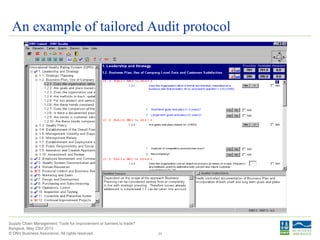
An example of tailored Audit protocol
23
© DNV Business Assurance. All rights reserved.
Supply Chain Management: Tools for improvement or barriers to trade?
Bangkok, May 23rd 2013
Reporting - Analysis Capabilities
24
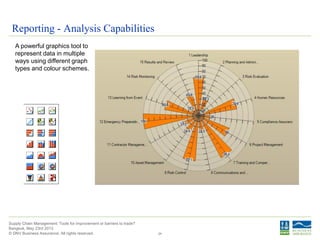
A powerful graphics tool to
represent data in multiple
ways using different graph
types and colour schemes.
© DNV Business Assurance. All rights reserved.
Supply Chain Management: Tools for improvement or barriers to trade?
Bangkok, May 23rd 2013
Reporting - Analysis Capabilities
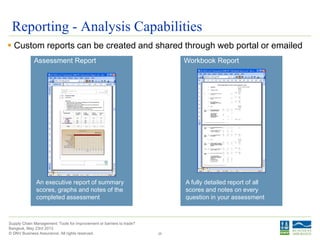
 Custom reports can be created and shared through web portal or emailed
25
Assessment Report Workbook Report
An executive report of summary
scores, graphs and notes of the
completed assessment
A fully detailed report of all
scores and notes on every
question in your assessment
© DNV Business Assurance. All rights reserved.
Supply Chain Management: Tools for improvement or barriers to trade?
Bangkok, May 23rd 2013
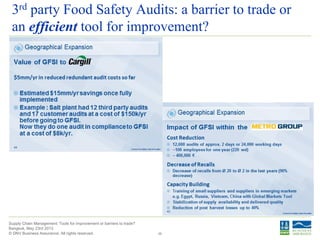
3rd party Food Safety Audits: a barrier to trade or
an efficient tool for improvement?
26
© DNV Business Assurance. All rights reserved.
Supply Chain Management: Tools for improvement or barriers to trade?
Bangkok, May 23rd 2013
Homogenous approach
 In the last 10 years the GFSI gained the global
leadership to drive the development of Food
Safety in the food industry
 The GFSI objectives are to:
- Reduce food safety risks by delivering equivalence
and convergence between effective food safety
management systems
- Manage cost in the global food system by
eliminating redundancy and improving
operational efficiency
- Develop competencies and capacity building in
food safety to create consistent and effective global
food systems
- Provide a unique international stakeholder
platform for collaboration, knowledge exchange and
networking
27
© DNV Business Assurance. All rights reserved.
Supply Chain Management: Tools for improvement or barriers to trade?
Bangkok, May 23rd 2013
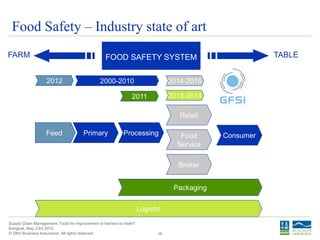
Food Safety – Industry state of art
2828
Feed ConsumerPrimary Processing
Retail
Food
Service
FOOD SAFETY
FOOD SAFETY SYSTEM
ISO 22000 Framework
FARM TABLE
Packaging
Logistic
2012
2011
2014-20152000-2010
2013-2014
Broker
© DNV Business Assurance. All rights reserved.
Supply Chain Management: Tools for improvement or barriers to trade?
Bangkok, May 23rd 2013
29
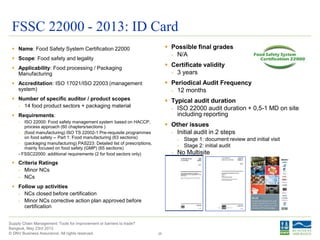
FSSC 22000 - 2013: ID Card
 Name: Food Safety System Certification 22000
 Scope: Food safety and legality
 Applicability: Food processing / Packaging
Manufacturing
 Accreditation: ISO 17021/ISO 22003 (management
system)
 Number of specific auditor / product scopes
- 14 food product sectors + packaging material
 Requirements:
- ISO 22000: Food safety management system based on HACCP,
process approach (60 chapters/sections )
- (food manufacturing) ISO TS 22002-1 Pre-requisite programmes
on food safety -- Part 1: Food manufacturing (63 sections)
- (packaging manufacturing) PAS223: Detailed list of prescriptions,
mainly focused on food safety (GMP) (65 sections)
- FSSC22000: additional requirements (2 for food sectors only)
 Criteria Ratings
- Minor NCs
- NCs
 Follow up activities
- NCs closed before certification
- Minor NCs corrective action plan approved before
certification
 Possible final grades
- N/A
 Certificate validity
- 3 years
 Periodical Audit Frequency
- 12 months
 Typical audit duration
- ISO 22000 audit duration + 0,5-1 MD on site
including reporting
 Other issues
- Initial audit in 2 steps
- Stage 1: document review and initial visit
- Stage 2: initial audit
- No Multisite
© DNV Business Assurance. All rights reserved.
Supply Chain Management: Tools for improvement or barriers to trade?
Bangkok, May 23rd 2013
30
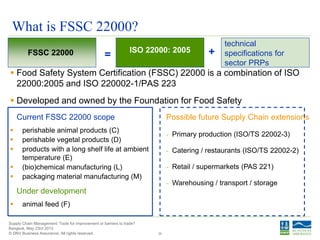
What is FSSC 22000?
 Food Safety System Certification (FSSC) 22000 is a combination of ISO
22000:2005 and ISO 220002-1/PAS 223
 Developed and owned by the Foundation for Food Safety
FSSC 22000 ISO 22000: 2005
technical
specifications for
sector PRPs
= +
Possible future Supply Chain extensions
- Primary production (ISO/TS 22002-3)
- Catering / restaurants (ISO/TS 22002-2)
- Retail / supermarkets (PAS 221)
- Warehousing / transport / storage
Current FSSC 22000 scope
 perishable animal products (C)
 perishable vegetal products (D)
 products with a long shelf life at ambient
temperature (E)
 (bio)chemical manufacturing (L)
 packaging material manufacturing (M)
Under development
 animal feed (F)
© DNV Business Assurance. All rights reserved.
Supply Chain Management: Tools for improvement or barriers to trade?
Bangkok, May 23rd 2013
31
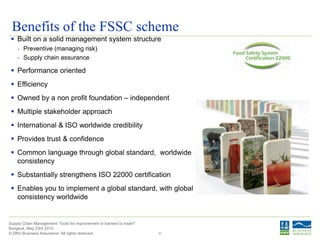
Benefits of the FSSC scheme
 Built on a solid management system structure
- Preventive (managing risk)
- Supply chain assurance
 Performance oriented
 Efficiency
 Owned by a non profit foundation – independent
 Multiple stakeholder approach
 International & ISO worldwide credibility
 Provides trust & confidence
 Common language through global standard, worldwide
consistency
 Substantially strengthens ISO 22000 certification
 Enables you to implement a global standard, with global
consistency worldwide
Stefano Crea
Bangkok, May 23rd 2013
© DNV Business Assurance. All rights reserved.
Kraft Foods EMEA
FSSC 22000 Implementation Project – A Case History
© DNV Business Assurance. All rights reserved.
Supply Chain Management: Tools for improvement or barriers to trade?
Bangkok, May 23rd 2013
Kraft Foods EMEA Case History
Some figures for the project
 Europe, Middle East, Africa
 58 plants involved
 25 countries
 25 auditors involved
 > 250 auditor days
Products involved:
 Biscuits
 Cheese
 Grocery products
 Convenience meals
 Beverages
 Chocolate
 Coffee
 Salty snacks
 Dairy products
 Desserts
 Canned meat
 Canned fish
33
© DNV Business Assurance. All rights reserved.
Supply Chain Management: Tools for improvement or barriers to trade?
Bangkok, May 23rd 2013
Implementation Project: Success factors
 Using existing Kraft Foods systems and
tools (no major changes needed)
 Focus on organizational boundaries
between local HACCP team and supporting
functions
 Close cooperation/good communication
with certification body
 Clear plan/clear targets for roll out and
certification
 Using existing central functions in
supporting local sites where necessary
34
© DNV Business Assurance. All rights reserved.
Supply Chain Management: Tools for improvement or barriers to trade?
Bangkok, May 23rd 2013
What Kraft Foods has done
 Only small adaptation of the existing
systems and tools was needed
 Pilot implementation of ISO 22000 in EU
coffee plants + certification
 … working to support the creation PAS 220
by BSI!
 After publication upgrade from ISO 22000
to FSSC 22000
 Step by step certification of all plants,
including newly acquired facilities with
rollout targets across 1-2 years after
integration
35
© DNV Business Assurance. All rights reserved.
Supply Chain Management: Tools for improvement or barriers to trade?
Bangkok, May 23rd 2013
Challenges in implementation
 Clear understanding of CCP, oPRP, PRP
concept at some local sites
 Many countries, many cultures, many
people
 On-going integration of new sites (not only
one project)
 Major organizational changes during the
project
 Different wording/interpretation of standard
requirements
36
© DNV Business Assurance. All rights reserved.
Supply Chain Management: Tools for improvement or barriers to trade?
Bangkok, May 23rd 2013
Benefits of the scheme for Kraft Foods
 Independent from standard owner (ISO)
 Multiple stakeholders driven
 Clear management system and
performance (requirements) approach
 Easy to link to existing management
system culture within the company
 Improved food safety awareness at site
level
 Reports can be used as an additional
source of info regarding specific site
performance
 Driver for further improvement of food
safety culture within Kraft Foods
37
© DNV Business Assurance. All rights reserved.
Supply Chain Management: Tools for improvement or barriers to trade?
Bangkok, May 23rd 2013
© DNV Business Assurance. All rights reserved.
Supply Chain Management: Tools for improvement or barriers to trade?
Bangkok, May 23rd 2013
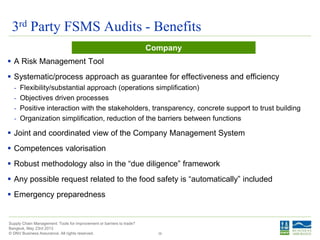
3rd Party FSMS Audits - Benefits
39
 A Risk Management Tool
 Systematic/process approach as guarantee for effectiveness and efficiency
- Flexibility/substantial approach (operations simplification)
- Objectives driven processes
- Positive interaction with the stakeholders, transparency, concrete support to trust building
- Organization simplification, reduction of the barriers between functions
 Joint and coordinated view of the Company Management System
 Competences valorisation
 Robust methodology also in the “due diligence” framework
 Any possible request related to the food safety is “automatically” included
 Emergency preparedness
Company
© DNV Business Assurance. All rights reserved.
Supply Chain Management: Tools for improvement or barriers to trade?
Bangkok, May 23rd 2013
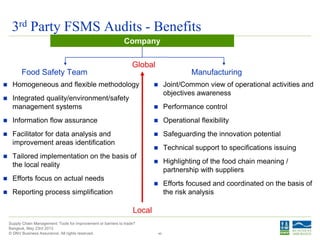
3rd Party FSMS Audits - Benefits
40
Company
 Homogeneous and flexible methodology
 Integrated quality/environment/safety
management systems
 Information flow assurance
 Facilitator for data analysis and
improvement areas identification
 Tailored implementation on the basis of
the local reality
 Efforts focus on actual needs
 Reporting process simplification
Food Safety Team
 Joint/Common view of operational activities and
objectives awareness
 Performance control
 Operational flexibility
 Safeguarding the innovation potential
 Technical support to specifications issuing
 Highlighting of the food chain meaning /
partnership with suppliers
 Efforts focused and coordinated on the basis of
the risk analysis
Manufacturing
Global
Local
© DNV Business Assurance. All rights reserved.
Supply Chain Management: Tools for improvement or barriers to trade?
Bangkok, May 23rd 2013
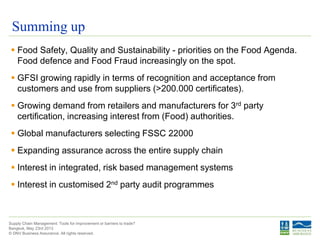
Summing up
 Food Safety, Quality and Sustainability - priorities on the Food Agenda.
Food defence and Food Fraud increasingly on the spot.
 GFSI growing rapidly in terms of recognition and acceptance from
customers and use from suppliers (>200.000 certificates).
 Growing demand from retailers and manufacturers for 3rd party
certification, increasing interest from (Food) authorities.
 Global manufacturers selecting FSSC 22000
 Expanding assurance across the entire supply chain
 Interest in integrated, risk based management systems
 Interest in customised 2nd party audit programmes
© DNV Business Assurance. All rights reserved.
Supply Chain Management: Tools for improvement or barriers to trade?
Bangkok, May 23rd 2013
Slide 4223 May 2013
Questions?
© DNV Business Assurance. All rights reserved.
Supply Chain Management: Tools for improvement or barriers to trade?
Bangkok, May 23rd 2013
www.dnvba.com
43
Stefano Crea
+39 348 7719903
 stefano.crea@dnv.com
food.dnvba.com
AFRIS. AsianFoodRegulationInformationService.
We have the largest database of Asian food regulations in the world and it’s
FREE to use.
We publish a range of communication services, list a very large number of
food events and online educational webinars and continue to grow our Digital
Library.
We look forward to hearing from you soon!
www.asianfoodreg.com
adrienna@asianfoodreg.com

Supply Chain Management

  • 1.
    Stefano Crea Bangkok, May23rd 2013 © DNV Business Assurance. All rights reserved. Supply Chain Management: Tools for improvement or barriers to trade? World of Food Safety
  • 2.
    © DNV BusinessAssurance. All rights reserved. Supply Chain Management: Tools for improvement or barriers to trade? Bangkok, May 23rd 2013 Content  How can we ensure a sustainable supply chain, where food production is responsibly carried out while resulting in safe food?  What are main supply chain operators and food suppliers’ concerns, issues, attitudes and perceptions on food safety?  What is the level of trust along the supply chain?  Are the food safety certification practices and systems currently used a tool for improvement or as a barrier?  How to find the balance between the highest food safety standards and fulfilling growing demand? 2
  • 3.
    © DNV BusinessAssurance. All rights reserved. Supply Chain Management: Tools for improvement or barriers to trade? Bangkok, May 23rd 2013 About DNV  Purpose: to safeguard life, property and the environment  Independent foundation created in 1864  Over 10,400 employees working from 300 offices in 100 countries providing:  Assessment, Certification, Assurance, Training and Advisory services  DNV assists organisations in a wide range of sectors to identify, assess, manage and communicate on risk and sustainability  In particular, DNV works with food and beverage companies to manage risk throughout the entire value chain, addressing consumer concerns on food safety, production methods, packaging, carbon and water footprint and ethical performance. Improve safety Navigate corporate responsibility Combat climate change Enhance performance Build trust and confidence 3 Build and share knowledge
  • 4.
    © DNV BusinessAssurance. All rights reserved. Supply Chain Management: Tools for improvement or barriers to trade? Bangkok, May 23rd 2013 Population growth Urbanisation GLOBAL MACRO TRENDS Sustainability complexity risk need for trust Globalisation Energy securityConsumption patterns Global Macro Trends
  • 5.
    © DNV BusinessAssurance. All rights reserved. Supply Chain Management: Tools for improvement or barriers to trade? Bangkok, May 23rd 2013Bangkok, May 23rd 2013 © DNV Business Assurance. All rights reserved. POPULATION GROWTH biggest in less developed nations climate impact on food production global food supply 2X or 3X by 2050 The problem of agriculture feeding a burgeoning population is not science, but rather political stability, transportation and distribution. 7 BILLION PEOPLE 9 BILLION BY 2050 Population Growth economically motivated adulteration resources: One only planet, not 2 or 3
  • 6.
    © DNV BusinessAssurance. All rights reserved. Supply Chain Management: Tools for improvement or barriers to trade? Bangkok, May 23rd 2013Bangkok, May 23rd 2013 © DNV Business Assurance. All rights reserved. regional micro economies regulation / compliance demand for standardization GLOBALISATION while providing more opportunities for developing countries, the globalization process is also posing enormous risks CHINA INDIA £ $ Globalisation new pathogens/detection techniques global food system complexity commoditization
  • 7.
    © DNV BusinessAssurance. All rights reserved. Supply Chain Management: Tools for improvement or barriers to trade? Bangkok, May 23rd 2013Bangkok, May 23rd 2013 © DNV Business Assurance. All rights reserved. NEW CONSUMPTION PATTERNS the social society instant information exchange sustainability in mature economies cellular phones sold money spent on videogames internet users in the world blog posts written emails sent tweets sent google searches New Consumption Patterns
  • 8.
    © DNV BusinessAssurance. All rights reserved. Supply Chain Management: Tools for improvement or barriers to trade? Bangkok, May 23rd 2013Bangkok, May 23rd 2013 © DNV Business Assurance. All rights reserved. new “norms” and lifestyles URBANISATION  2x faster than population green buildings (LEED) 50% OF THE WORLD LIVES IN CITIES Urbanisation
  • 9.
    © DNV BusinessAssurance. All rights reserved. Supply Chain Management: Tools for improvement or barriers to trade? Bangkok, May 23rd 2013 9 Perception on Food Safety Customers Survey – January 2013
  • 10.
    © DNV BusinessAssurance. All rights reserved. Supply Chain Management: Tools for improvement or barriers to trade? Bangkok, May 23rd 2013 Sample – 500+ Professionals from food industry 75 % 6% 6% 13 % FOOD PROCESSING AGRICOLTURE/ FARMING/ HUNTING/ FISHING PACKAGING OTHER 22 % 60 % 34 % 20 % 31 % First tier transformer (producer of ingredients or semi- manufactured products) Second tier transformer (producer of final products) Up to 5 Between 6 and 15 More than 15 “How many ingredients are used in your manufacturing process?” “What is the role of your company in the food chain?”
  • 11.
    © DNV BusinessAssurance. All rights reserved. Supply Chain Management: Tools for improvement or barriers to trade? Bangkok, May 23rd 2013Bangkok, May 23rd 2013 © DNV Business Assurance. All rights reserved. Regulatory 35% Main Risk Areas AREAS 10 20 30 40 50% 60 Financial 38% 54Quality % 63Food Safety % Environment 29% 10 Community Impact% Ethical8%
  • 12.
    © DNV BusinessAssurance. All rights reserved. Supply Chain Management: Tools for improvement or barriers to trade? Bangkok, May 23rd 2013Bangkok, May 23rd 2013 © DNV Business Assurance. All rights reserved. Actions Undertaken for Each Risk Area Food SafetyEnvironmentTotal Quality Regulatory Suppliers audit/assessment Avoid specific suppliers/categories/geographies of origin Certification from an independent 3rd party Emergency preparedness, including product recall procedure Supplier risk assessment Cooperation in development of critical supplier Supplier diversification Risk transfer 94 93 93 90 90 87 87 90 87 83 87 81 80 90 90 88 88 87 84 91 83 87 89 86 80 80 80 87 88 87 87 86 86 85 82 88 91 88 86 84 % % % % %
  • 13.
    © DNV BusinessAssurance. All rights reserved. Supply Chain Management: Tools for improvement or barriers to trade? Bangkok, May 23rd 2013Bangkok, May 23rd 2013 © DNV Business Assurance. All rights reserved. Internal policy 47% Reasons for Taking Action ACTIONS 30 35 40 45 50% 52Needs/requests from customers % 47Competition/differentiation % 39Consumer/public opinion % 36Regulation % 29 Economic%
  • 14.
    © DNV BusinessAssurance. All rights reserved. Supply Chain Management: Tools for improvement or barriers to trade? Bangkok, May 23rd 2013Bangkok, May 23rd 2013 © DNV Business Assurance. All rights reserved. Effectiveness of Actions Taken > 156 - 15Total Avoid specific suppliers/categories/geographies of origin Supplier risk assessment Cooperation in development of critical supplier Supplier diversification Risk transfer 3.81 3.43 3.603.54 3.55 3.71 3.78 3.71 3.49 3.05 3.87 3.53 3.57 3.72 3.71 3.73 3.53 3.06 3.78 3.65 3.46 2.90 3.66 3.63 Suppliers audit/assessment Certification from an independent 3rd party Emergency preparedness, including product recall procedure 250 +Up to 249 3.87 3.63 3.483.58 3.49 3.62 3.60 3.61 3.55 3.07 3.68 3.81 3.5 3.03 3.84 3.8 1 – 5 3.46 3.63 3.70 3.80 3.85 3.57 3.10 3.80 # OF INGREDIENTS # OF EMPLOYEES
  • 15.
    © DNV BusinessAssurance. All rights reserved. Supply Chain Management: Tools for improvement or barriers to trade? Bangkok, May 23rd 2013Bangkok, May 23rd 2013 © DNV Business Assurance. All rights reserved. 55Food Safety % 50Financial % Main Risk Areas Next 3 Years 59North America 35 40 45 50 55 60 Europe 55 Central/South America 49 Asia 59 Europe 50 North America 56 Central/South America 43 Asia 51 Europe 48 North America 50 Central/South America 40 Asia 48 % Quality 47%
  • 16.
    © DNV BusinessAssurance. All rights reserved. Supply Chain Management: Tools for improvement or barriers to trade? Bangkok, May 23rd 2013 16 Food Supply Chain Management
  • 17.
    © DNV BusinessAssurance. All rights reserved. Supply Chain Management: Tools for improvement or barriers to trade? Bangkok, May 23rd 2013 Food Supply Chain - Main issues and challenges  Additional issues for Food Industry - seasonal primary production, prone to high variability - geography - quality - quantity - food safety  The resulting supply chains are typically accompanied by - additional costs for oversight, logistics, pipeline inventory and quality management; - heightened vulnerability and greater supply risks stemming from potential supply disruptions, lack of accountability, lower visibility and quality failures - issues concerning global financing and funds transfer; and - lower responsiveness due to longer lead times. 17
  • 18.
    © DNV BusinessAssurance. All rights reserved. Supply Chain Management: Tools for improvement or barriers to trade? Bangkok, May 23rd 2013 Effective Supply Chain Management  Supply Chain Management is a complex process deeply affecting the company’s capability to compete on the market - Strategic issues, such as - Strategic partnership with suppliers, distributors, and customers - Information Technology infrastructure, to support supply chain operations - Where-to-make and what-to-make-or-buy decisions - Tactical issues, such as - Sourcing contracts and other purchasing decisions. - Inventory decisions, including quantity, location, and quality of inventory. - Transportation strategy, including frequency, routes, and contracting. - Operational issues, such as - Demand planning and forecasting, coordinating the demand forecast of all customers and sharing the forecast with all suppliers. - Sourcing planning, including current inventory and forecast demand, in collaboration with all suppliers. - Inbound operations, including transportation from suppliers and receiving inventory. - Order promising, accounting for all constraints in the supply chain, including all suppliers, manufacturing facilities, distribution centres, and other customers. 18
  • 19.
    © DNV BusinessAssurance. All rights reserved. Supply Chain Management: Tools for improvement or barriers to trade? Bangkok, May 23rd 2013 What challenges will I face? 1919 How do current practices compare to the best in industry and competitors? To what extent will disruption of your supplier’s operations impact on your own operations? What risks are associated with the products and services provided by your suppliers? How can your approach to Supply Chain Management be improved? How do you communicate with Stakeholders on Supply Chain issues? What are the strengths and weaknesses of your current Supply Chain Management processes and practices? What suppliers are associated with the highest level of risk in your supply chain?
  • 20.
    © DNV BusinessAssurance. All rights reserved. Supply Chain Management: Tools for improvement or barriers to trade? Bangkok, May 23rd 2013 Supply Chain Management  Considering also the relevant legal responsibility, two main methods to ensure supply chain control: - Second Party Audits - Specifically tailored to customer’s needs - Resources can be consuming both for customer and supplier - Redundancy and risk of conflicting requirements - Third Party Audits - Reliability depending on standard, protocol and certification body - Redundancy and risk of conflicting requirements 20
  • 21.
    © DNV BusinessAssurance. All rights reserved. Supply Chain Management: Tools for improvement or barriers to trade? Bangkok, May 23rd 2013 (Tailored) 2nd party Supplier Audits  Determine Supply Chain (boundaries)  Define the scope (e.g. Food Safety, Quality, Environment, Occupational Health and Safety, Ethical, etc.)  Define the standards (international standards, customer requirements, etc. )  Specific company/customer requirements as possible add-ons  Define auditor competence  Set/train/calibrate dedicated team of auditors  Audit Approach/Audit Trails 21
  • 22.
    © DNV BusinessAssurance. All rights reserved. Supply Chain Management: Tools for improvement or barriers to trade? Bangkok, May 23rd 2013 Tailored 2nd party Audits  Account management  Project organization  Tailored reporting, sharing via web portal  Trending, analysis and sharing of audit results  Possibility to define Focus Areas, looking at strengths and weaknesses, Best practices and Areas of Improvements  Executive Summary reporting  Whole Supply chain approach 22
  • 23.
    © DNV BusinessAssurance. All rights reserved. Supply Chain Management: Tools for improvement or barriers to trade? Bangkok, May 23rd 2013 An example of tailored Audit protocol 23
  • 24.
    © DNV BusinessAssurance. All rights reserved. Supply Chain Management: Tools for improvement or barriers to trade? Bangkok, May 23rd 2013 Reporting - Analysis Capabilities 24 A powerful graphics tool to represent data in multiple ways using different graph types and colour schemes.
  • 25.
    © DNV BusinessAssurance. All rights reserved. Supply Chain Management: Tools for improvement or barriers to trade? Bangkok, May 23rd 2013 Reporting - Analysis Capabilities  Custom reports can be created and shared through web portal or emailed 25 Assessment Report Workbook Report An executive report of summary scores, graphs and notes of the completed assessment A fully detailed report of all scores and notes on every question in your assessment
  • 26.
    © DNV BusinessAssurance. All rights reserved. Supply Chain Management: Tools for improvement or barriers to trade? Bangkok, May 23rd 2013 3rd party Food Safety Audits: a barrier to trade or an efficient tool for improvement? 26
  • 27.
    © DNV BusinessAssurance. All rights reserved. Supply Chain Management: Tools for improvement or barriers to trade? Bangkok, May 23rd 2013 Homogenous approach  In the last 10 years the GFSI gained the global leadership to drive the development of Food Safety in the food industry  The GFSI objectives are to: - Reduce food safety risks by delivering equivalence and convergence between effective food safety management systems - Manage cost in the global food system by eliminating redundancy and improving operational efficiency - Develop competencies and capacity building in food safety to create consistent and effective global food systems - Provide a unique international stakeholder platform for collaboration, knowledge exchange and networking 27
  • 28.
    © DNV BusinessAssurance. All rights reserved. Supply Chain Management: Tools for improvement or barriers to trade? Bangkok, May 23rd 2013 Food Safety – Industry state of art 2828 Feed ConsumerPrimary Processing Retail Food Service FOOD SAFETY FOOD SAFETY SYSTEM ISO 22000 Framework FARM TABLE Packaging Logistic 2012 2011 2014-20152000-2010 2013-2014 Broker
  • 29.
    © DNV BusinessAssurance. All rights reserved. Supply Chain Management: Tools for improvement or barriers to trade? Bangkok, May 23rd 2013 29 FSSC 22000 - 2013: ID Card  Name: Food Safety System Certification 22000  Scope: Food safety and legality  Applicability: Food processing / Packaging Manufacturing  Accreditation: ISO 17021/ISO 22003 (management system)  Number of specific auditor / product scopes - 14 food product sectors + packaging material  Requirements: - ISO 22000: Food safety management system based on HACCP, process approach (60 chapters/sections ) - (food manufacturing) ISO TS 22002-1 Pre-requisite programmes on food safety -- Part 1: Food manufacturing (63 sections) - (packaging manufacturing) PAS223: Detailed list of prescriptions, mainly focused on food safety (GMP) (65 sections) - FSSC22000: additional requirements (2 for food sectors only)  Criteria Ratings - Minor NCs - NCs  Follow up activities - NCs closed before certification - Minor NCs corrective action plan approved before certification  Possible final grades - N/A  Certificate validity - 3 years  Periodical Audit Frequency - 12 months  Typical audit duration - ISO 22000 audit duration + 0,5-1 MD on site including reporting  Other issues - Initial audit in 2 steps - Stage 1: document review and initial visit - Stage 2: initial audit - No Multisite
  • 30.
    © DNV BusinessAssurance. All rights reserved. Supply Chain Management: Tools for improvement or barriers to trade? Bangkok, May 23rd 2013 30 What is FSSC 22000?  Food Safety System Certification (FSSC) 22000 is a combination of ISO 22000:2005 and ISO 220002-1/PAS 223  Developed and owned by the Foundation for Food Safety FSSC 22000 ISO 22000: 2005 technical specifications for sector PRPs = + Possible future Supply Chain extensions - Primary production (ISO/TS 22002-3) - Catering / restaurants (ISO/TS 22002-2) - Retail / supermarkets (PAS 221) - Warehousing / transport / storage Current FSSC 22000 scope  perishable animal products (C)  perishable vegetal products (D)  products with a long shelf life at ambient temperature (E)  (bio)chemical manufacturing (L)  packaging material manufacturing (M) Under development  animal feed (F)
  • 31.
    © DNV BusinessAssurance. All rights reserved. Supply Chain Management: Tools for improvement or barriers to trade? Bangkok, May 23rd 2013 31 Benefits of the FSSC scheme  Built on a solid management system structure - Preventive (managing risk) - Supply chain assurance  Performance oriented  Efficiency  Owned by a non profit foundation – independent  Multiple stakeholder approach  International & ISO worldwide credibility  Provides trust & confidence  Common language through global standard, worldwide consistency  Substantially strengthens ISO 22000 certification  Enables you to implement a global standard, with global consistency worldwide
  • 32.
    Stefano Crea Bangkok, May23rd 2013 © DNV Business Assurance. All rights reserved. Kraft Foods EMEA FSSC 22000 Implementation Project – A Case History
  • 33.
    © DNV BusinessAssurance. All rights reserved. Supply Chain Management: Tools for improvement or barriers to trade? Bangkok, May 23rd 2013 Kraft Foods EMEA Case History Some figures for the project  Europe, Middle East, Africa  58 plants involved  25 countries  25 auditors involved  > 250 auditor days Products involved:  Biscuits  Cheese  Grocery products  Convenience meals  Beverages  Chocolate  Coffee  Salty snacks  Dairy products  Desserts  Canned meat  Canned fish 33
  • 34.
    © DNV BusinessAssurance. All rights reserved. Supply Chain Management: Tools for improvement or barriers to trade? Bangkok, May 23rd 2013 Implementation Project: Success factors  Using existing Kraft Foods systems and tools (no major changes needed)  Focus on organizational boundaries between local HACCP team and supporting functions  Close cooperation/good communication with certification body  Clear plan/clear targets for roll out and certification  Using existing central functions in supporting local sites where necessary 34
  • 35.
    © DNV BusinessAssurance. All rights reserved. Supply Chain Management: Tools for improvement or barriers to trade? Bangkok, May 23rd 2013 What Kraft Foods has done  Only small adaptation of the existing systems and tools was needed  Pilot implementation of ISO 22000 in EU coffee plants + certification  … working to support the creation PAS 220 by BSI!  After publication upgrade from ISO 22000 to FSSC 22000  Step by step certification of all plants, including newly acquired facilities with rollout targets across 1-2 years after integration 35
  • 36.
    © DNV BusinessAssurance. All rights reserved. Supply Chain Management: Tools for improvement or barriers to trade? Bangkok, May 23rd 2013 Challenges in implementation  Clear understanding of CCP, oPRP, PRP concept at some local sites  Many countries, many cultures, many people  On-going integration of new sites (not only one project)  Major organizational changes during the project  Different wording/interpretation of standard requirements 36
  • 37.
    © DNV BusinessAssurance. All rights reserved. Supply Chain Management: Tools for improvement or barriers to trade? Bangkok, May 23rd 2013 Benefits of the scheme for Kraft Foods  Independent from standard owner (ISO)  Multiple stakeholders driven  Clear management system and performance (requirements) approach  Easy to link to existing management system culture within the company  Improved food safety awareness at site level  Reports can be used as an additional source of info regarding specific site performance  Driver for further improvement of food safety culture within Kraft Foods 37
  • 38.
    © DNV BusinessAssurance. All rights reserved. Supply Chain Management: Tools for improvement or barriers to trade? Bangkok, May 23rd 2013
  • 39.
    © DNV BusinessAssurance. All rights reserved. Supply Chain Management: Tools for improvement or barriers to trade? Bangkok, May 23rd 2013 3rd Party FSMS Audits - Benefits 39  A Risk Management Tool  Systematic/process approach as guarantee for effectiveness and efficiency - Flexibility/substantial approach (operations simplification) - Objectives driven processes - Positive interaction with the stakeholders, transparency, concrete support to trust building - Organization simplification, reduction of the barriers between functions  Joint and coordinated view of the Company Management System  Competences valorisation  Robust methodology also in the “due diligence” framework  Any possible request related to the food safety is “automatically” included  Emergency preparedness Company
  • 40.
    © DNV BusinessAssurance. All rights reserved. Supply Chain Management: Tools for improvement or barriers to trade? Bangkok, May 23rd 2013 3rd Party FSMS Audits - Benefits 40 Company  Homogeneous and flexible methodology  Integrated quality/environment/safety management systems  Information flow assurance  Facilitator for data analysis and improvement areas identification  Tailored implementation on the basis of the local reality  Efforts focus on actual needs  Reporting process simplification Food Safety Team  Joint/Common view of operational activities and objectives awareness  Performance control  Operational flexibility  Safeguarding the innovation potential  Technical support to specifications issuing  Highlighting of the food chain meaning / partnership with suppliers  Efforts focused and coordinated on the basis of the risk analysis Manufacturing Global Local
  • 41.
    © DNV BusinessAssurance. All rights reserved. Supply Chain Management: Tools for improvement or barriers to trade? Bangkok, May 23rd 2013 Summing up  Food Safety, Quality and Sustainability - priorities on the Food Agenda. Food defence and Food Fraud increasingly on the spot.  GFSI growing rapidly in terms of recognition and acceptance from customers and use from suppliers (>200.000 certificates).  Growing demand from retailers and manufacturers for 3rd party certification, increasing interest from (Food) authorities.  Global manufacturers selecting FSSC 22000  Expanding assurance across the entire supply chain  Interest in integrated, risk based management systems  Interest in customised 2nd party audit programmes
  • 42.
    © DNV BusinessAssurance. All rights reserved. Supply Chain Management: Tools for improvement or barriers to trade? Bangkok, May 23rd 2013 Slide 4223 May 2013 Questions?
  • 43.
    © DNV BusinessAssurance. All rights reserved. Supply Chain Management: Tools for improvement or barriers to trade? Bangkok, May 23rd 2013 www.dnvba.com 43 Stefano Crea +39 348 7719903  stefano.crea@dnv.com food.dnvba.com
  • 44.
    AFRIS. AsianFoodRegulationInformationService. We havethe largest database of Asian food regulations in the world and it’s FREE to use. We publish a range of communication services, list a very large number of food events and online educational webinars and continue to grow our Digital Library. We look forward to hearing from you soon! www.asianfoodreg.com adrienna@asianfoodreg.com