REDUCING SUPPLY CHAIN EXPENSES BY 18 PERCENT WHILE
MAINTAINING CARE QUALITY | September 2017
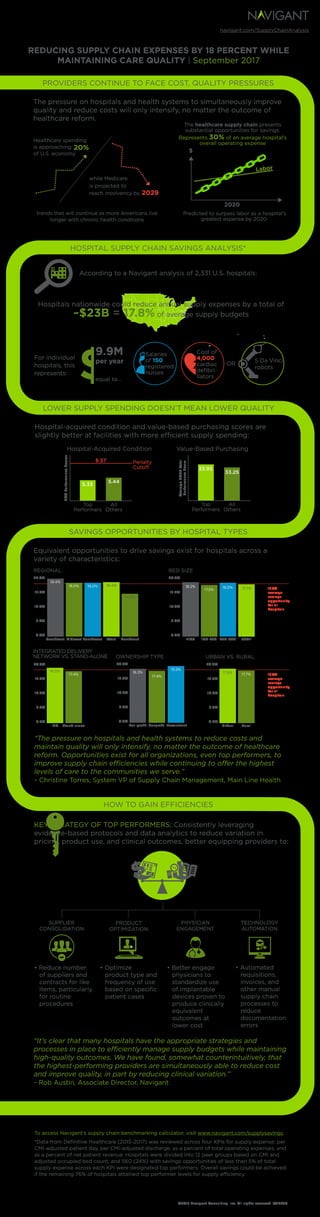
SAVINGS OPPORTUNITIES BY HOSPITAL TYPES
17.8%
average
savings
opportunity
for all
hospitals
Equivalent opportunities to drive savings exist for hospitals across a
variety of characteristics:
“The pressure on hospitals and health systems to reduce costs and
maintain quality will only intensify, no matter the outcome of healthcare
reform. Opportunities exist for all organizations, even top performers, to
improve supply chain efficiencies while continuing to offer the highest
levels of care to the communities we serve.”
- Christine Torres, System VP of Supply Chain Management, Main Line Health
17.8%
average
savings
opportunity
for all
hospitals
REGIONAL
0.0%
5.0%
10.0%
15.0%
20.0%
19.4%
18.0% 18.0% 18.4%
14.5%
Southeast Midwest Southwest West Northeast
URBAN VS. RURAL
0.0%
5.0%
10.0%
15.0%
20.0%
17.9% 17.7%
Urban Rural
OWNERSHIP TYPE
0.0%
5.0%
10.0%
15.0%
20.0%
18.3%
17.4%
19.2%
For-profit Nonprofit Government
INTEGRATED DELIVERY
NETWORK VS. STAND-ALONE
0.0%
5.0%
10.0%
15.0%
20.0%
18.3%
17.4%
IDN Stand-alone
BED SIZE
0.0%
5.0%
10.0%
15.0%
20.0%
18.2%
17.5%
18.0% 17.7%
<100 100-250 250-500 500+
PROVIDERS CONTINUE TO FACE COST, QUALITY PRESSURES
The pressure on hospitals and health systems to simultaneously improve
quality and reduce costs will only intensify, no matter the outcome of
healthcare reform.
Healthcare spending
is approaching
of U.S. economy
20%
while Medicare
is projected to
reach insolvency by 2029
trends that will continue as more Americans live
longer with chronic health conditions
The healthcare supply chain presents
substantial opportunities for savings:
Represents 30% of an average hospital’s
overall operating expense
Labor
$
2020
To access Navigant’s supply chain benchmarking calculator, visit www.navigant.com/supplysavings.
*Data from Definitive Healthcare (2015-2017) was reviewed across four KPIs for supply expense: per
CMI-adjusted patient day, per CMI-adjusted discharge, as a percent of total operating expenses, and
as a percent of net patient revenue. Hospitals were divided into 12 peer groups based on CMI and
adjusted occupied bed count, and 560 (24%) with savings opportunities of less than 5% of total
supply expense across each KPI were designated top performers. Overall savings could be achieved
if the remaining 76% of hospitals attained top performer levels for supply efficiency.
HOW TO GAIN EFFICIENCIES
KEY STRATEGY OF TOP PERFORMERS: Consistently leveraging
evidence-based protocols and data analytics to reduce variation in
pricing, product use, and clinical outcomes, better equipping providers to:
“It’s clear that many hospitals have the appropriate strategies and
processes in place to efficiently manage supply budgets while maintaining
high-quality outcomes. We have found, somewhat counterintuitively, that
the highest-performing providers are simultaneously able to reduce cost
and improve quality, in part by reducing clinical variation.”
- Rob Austin, Associate Director, Navigant
$
• Reduce number
of suppliers and
contracts for like
items, particularly
for routine
procedures
• Optimize
product type and
frequency of use
based on specific
patient cases
• Better engage
physicians to
standardize use
of implantable
devices proven to
produce clinically
equivalent
outcomes at
lower cost
• Automated
requisitions,
invoices, and
other manual
supply chain
processes to
reduce
documentation
errors
HOSPITAL SUPPLY CHAIN SAVINGS ANALYSIS*
According to a Navigant analysis of 2,331 U.S. hospitals:
Hospitals nationwide could reduce annual supply expenses by a total of
~$23B = 17.8% of average supply budgets
For individual
hospitals, this
represents:
9.9M
per year
equal to...
Predicted to surpass labor as a hospital’s
greatest expense by 2020
LOWER SUPPLY SPENDING DOESN’T MEAN LOWER QUALITY
Hospital-acquired condition and value-based purchasing scores are
slightly better at facilities with more efficient supply spending:
Hospital-Acquired Condition
Top
Performers
All
Others
5.33
5.44
Penalty
Cutoff
6.57
Value-Based Purchasing
Top
Performers
All
Others
33.95
33.25
AverageHVBPTotal
PerformanceScore
HACPerformanceScores
Salaries
of 150
registered
nurses
Cost of
4,000
cardiac
defibri-
llators
5 Da Vinci
robots
OR
SUPPLIER
CONSOLIDATION
PRODUCT
OPTIMIZATION
PHYSICIAN
ENGAGEMENT
TECHNOLOGY
AUTOMATION
navigant.com/SupplyChainAnalysis
©2017 Navigant Consulting, Inc. All rights reserved. W12920

Reduce Supply Chain Expenses While Maintaining Care Quality

  • 1.
    REDUCING SUPPLY CHAINEXPENSES BY 18 PERCENT WHILE MAINTAINING CARE QUALITY | September 2017 SAVINGS OPPORTUNITIES BY HOSPITAL TYPES 17.8% average savings opportunity for all hospitals Equivalent opportunities to drive savings exist for hospitals across a variety of characteristics: “The pressure on hospitals and health systems to reduce costs and maintain quality will only intensify, no matter the outcome of healthcare reform. Opportunities exist for all organizations, even top performers, to improve supply chain efficiencies while continuing to offer the highest levels of care to the communities we serve.” - Christine Torres, System VP of Supply Chain Management, Main Line Health 17.8% average savings opportunity for all hospitals REGIONAL 0.0% 5.0% 10.0% 15.0% 20.0% 19.4% 18.0% 18.0% 18.4% 14.5% Southeast Midwest Southwest West Northeast URBAN VS. RURAL 0.0% 5.0% 10.0% 15.0% 20.0% 17.9% 17.7% Urban Rural OWNERSHIP TYPE 0.0% 5.0% 10.0% 15.0% 20.0% 18.3% 17.4% 19.2% For-profit Nonprofit Government INTEGRATED DELIVERY NETWORK VS. STAND-ALONE 0.0% 5.0% 10.0% 15.0% 20.0% 18.3% 17.4% IDN Stand-alone BED SIZE 0.0% 5.0% 10.0% 15.0% 20.0% 18.2% 17.5% 18.0% 17.7% <100 100-250 250-500 500+ PROVIDERS CONTINUE TO FACE COST, QUALITY PRESSURES The pressure on hospitals and health systems to simultaneously improve quality and reduce costs will only intensify, no matter the outcome of healthcare reform. Healthcare spending is approaching of U.S. economy 20% while Medicare is projected to reach insolvency by 2029 trends that will continue as more Americans live longer with chronic health conditions The healthcare supply chain presents substantial opportunities for savings: Represents 30% of an average hospital’s overall operating expense Labor $ 2020 To access Navigant’s supply chain benchmarking calculator, visit www.navigant.com/supplysavings. *Data from Definitive Healthcare (2015-2017) was reviewed across four KPIs for supply expense: per CMI-adjusted patient day, per CMI-adjusted discharge, as a percent of total operating expenses, and as a percent of net patient revenue. Hospitals were divided into 12 peer groups based on CMI and adjusted occupied bed count, and 560 (24%) with savings opportunities of less than 5% of total supply expense across each KPI were designated top performers. Overall savings could be achieved if the remaining 76% of hospitals attained top performer levels for supply efficiency. HOW TO GAIN EFFICIENCIES KEY STRATEGY OF TOP PERFORMERS: Consistently leveraging evidence-based protocols and data analytics to reduce variation in pricing, product use, and clinical outcomes, better equipping providers to: “It’s clear that many hospitals have the appropriate strategies and processes in place to efficiently manage supply budgets while maintaining high-quality outcomes. We have found, somewhat counterintuitively, that the highest-performing providers are simultaneously able to reduce cost and improve quality, in part by reducing clinical variation.” - Rob Austin, Associate Director, Navigant $ • Reduce number of suppliers and contracts for like items, particularly for routine procedures • Optimize product type and frequency of use based on specific patient cases • Better engage physicians to standardize use of implantable devices proven to produce clinically equivalent outcomes at lower cost • Automated requisitions, invoices, and other manual supply chain processes to reduce documentation errors HOSPITAL SUPPLY CHAIN SAVINGS ANALYSIS* According to a Navigant analysis of 2,331 U.S. hospitals: Hospitals nationwide could reduce annual supply expenses by a total of ~$23B = 17.8% of average supply budgets For individual hospitals, this represents: 9.9M per year equal to... Predicted to surpass labor as a hospital’s greatest expense by 2020 LOWER SUPPLY SPENDING DOESN’T MEAN LOWER QUALITY Hospital-acquired condition and value-based purchasing scores are slightly better at facilities with more efficient supply spending: Hospital-Acquired Condition Top Performers All Others 5.33 5.44 Penalty Cutoff 6.57 Value-Based Purchasing Top Performers All Others 33.95 33.25 AverageHVBPTotal PerformanceScore HACPerformanceScores Salaries of 150 registered nurses Cost of 4,000 cardiac defibri- llators 5 Da Vinci robots OR SUPPLIER CONSOLIDATION PRODUCT OPTIMIZATION PHYSICIAN ENGAGEMENT TECHNOLOGY AUTOMATION navigant.com/SupplyChainAnalysis ©2017 Navigant Consulting, Inc. All rights reserved. W12920